A perfume for Oakland
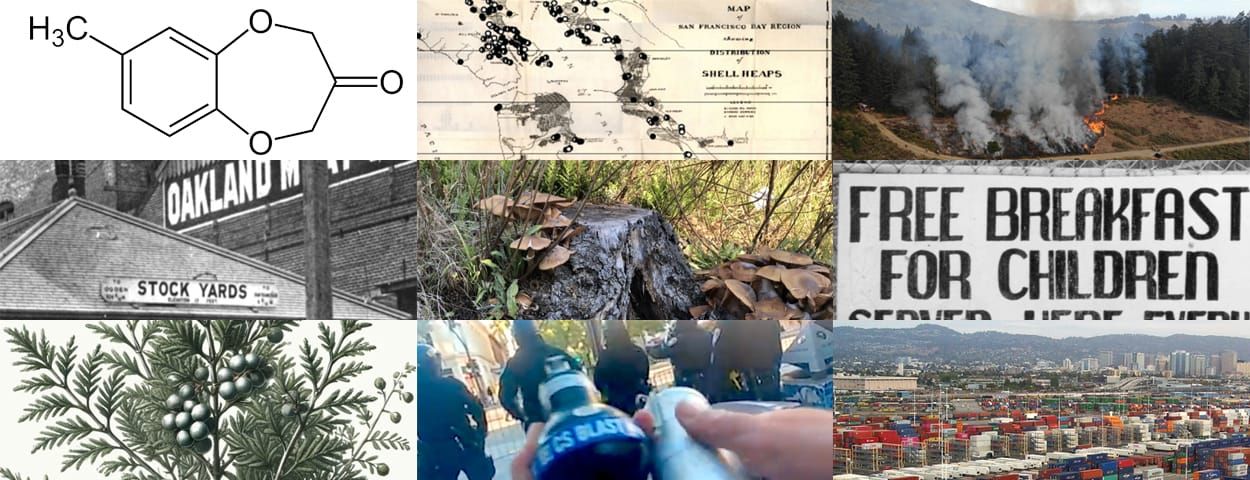
We’re closing out the olfactory portion of our Six Senses of Oakland membership drive. Read more about the drive here. Check out other Six Senses stories here. Get a great big whiff of ORB by subscribing here.
◎
Oak and coal, brine and diesel. Burrito and tear gas, wildfire, coffee bloom, Eucalyptus. Your cats’ piss, narcissus, detergent exhaust, palo santo. The smells of Oakland are ripe with the dynamic gyre and sediment of its history and people.
I am a perfumer. I make scents that generate original composite experiences of earthly time and circulation—specific moments of rain and sun, labor and land, and even power as it moves through the cultivation, extraction and naming of essentialized things—all embodied and visceral. Perfumers curate a vibey form of consciousness out of the affective natures of worldly matter and language; we thrive in receiving such resonance and recycling it back from the world.
When I walk Oakland, I breathe in and think about all the dynamic echoes of Oaklandness. The messages are intoxicating when they appear as jasmine evening bloom, blessings of a fertile zone; nauseating to the body and psyche as the aerated corporate technohubris cesspool runoff of this human season. Given the choice, most people in Oakland might prefer to simmer in dulcet aromas. Sustained and curated exposure to jasmine, however, requires certain conditions, specific histories of power, land ownership, accumulation. Aromas can be a scourge, the presence of miasma. They are also forms of privilege, active techniques of class. My practice emerges from an attention to scent as a milieu with deep history: It is a condition of relating—and each scent, rapturous and/or repulsive, links directly to a set of human practices that become mobilized in the air.
Every perfume begins with a concept. Attunement to historical material information is often essential to the forging of a good idea. So how might a perfumer, someone who walks through the world and receives it through visceral index, compose a fragrance for Oakland?
That is the prompt I assigned myself.
Below, I create the olfactory scaffolding for an eau de toilette in honor of this city and place, treating smell as an affective, material atmosphere and product of history. The design is based on the perfumer’s basic principles of composition: “top,” “heart,” and “base” notes distributed for characteristic immediacy of expression and/or tenacity, or, in other words volatility, molecular weight, and endurance. Notions of weight and charge are analytical and poetic at once here in relation to the actual technical consideration of perfume materials and the specific material histories named according to my interpretation of how they linger, dissipate, and gurgle up across different time scales in the contemporary political spatial current.
A note on formulation: Most of the sites and events this proposal recalls cannot be embodied by the original botanical distillates or extractions otherwise of bio-things alone. In order to effectively render an olfactory portrait of Oakland past, present, and future, we will bring in the masters of somatic analog: proprietary designer synthetic chemicals. While jasmine, in all its sensual glory, can also certainly carry charges of stolen land and indentured labor, it speaks less directly to, let’s say, the building of a rail or port or an überextractive wage theft economy.
In the suggested blend below, then, I have included a range of what are called natural and synthetic materials, with additional notes on such inclusions for the discerning pleasure of our fraghead readers. Though the proprietary information included is less directly sutured to Oakland history, this recipe invites you to think about Oakland’s relations to the global economy as they waft through the city. I balance the technical consideration with some speculative dwelling on the scent of a few specific historical moments.
Perfume 37° N
Overall profile: tender ozoic, moody wood, hot metal
TOP:
┌─────────────────┐
│ ▓▓▓▓▓▓▓▓▓▓▓▓▓▓ │ green–tannic
│ ▓▓▓▓▓▓▓▓▓▓▓▓▓ │ tidal brine
│ ▓▓▓▓▓▓▓▓▓ │ soft metallic
│ ▓▓▓▓▓▓▓ │ smoke plume
└─────────────────┘
HEART:
┌─────────────────────┐
│ ▓▓▓▓▓▓▓▓▓▓▓▓▓▓▓▓ │ animalic–industrial
│ ▓▓▓▓▓▓▓▓▓▓▓▓▓▓▓ │ fermented ozone
│ ▓▓▓▓▓▓▓▓▓▓▓ │ communal meal grain sugar
└─────────────────────┘
BASE:
┌──────────────────────────┐
│ ▓▓▓▓▓▓▓▓▓▓▓▓▓▓▓▓▓▓▓▓ │ smoke tar
│ ▓▓▓▓▓▓▓▓▓▓▓▓▓▓▓▓ │ hot metallic/ aggregate chemic vibrancy
│ ▓▓▓▓▓▓▓▓▓▓▓▓ │ domestic residue
└──────────────────────────┘
Intensity logic
longer bar = greater persistence in air and on skin
top = fleeting diurnal reference
heart = metabolized matter echoing
base = infrastructural memory and sediments
Constituents
Top
Profile: The top notes weave a delicate invitation into the cross ecotones and temporalities of Oakland. We blend images of transitional woodlands and their echoes of seasonal fire and harvest; indigenous foodsheds of edible acorn, maturing elderberry, browning tule root; bay tides and their cloaking inland drifts; diurnal toggles heat mass and cooling, the fog between green shades, citrus, and moss; wharves and docks and maritime diesel; the sweet and acerbic settler-dismantled Lisjan Ohlone shellmounds; Sausal Creek and Joaquin Miller Park, Oscar Grant Plaza grassy public space, green, tannic, tense, and fresh.
green-tannic: quercus agrifolia maceration: timeless mosaic forest cathedralic life path imprint calling you back in; bitter acorn husk for the mother’s milk of heritage food and nutrition stock in Californian history; bay laurel; foot tread yerba buena for the creeping native groundcover in a city that won’t forget its land relation.
tidal brine: eelgrass underwater meadow vital nursery; estuarine silt distillate; Calone 195, a cornerstone of the marine or aquatic scent family proprietarily engendered in 1966 by Pfizer, thereby opening the possibility, and trend, of a seashore, ozonic, and slightly fruity melonlike smell into a global industrial palette that hit it in ’90s. Think Escape by Calvin Klein (1991), L’Eau d’Issey (1992), and Acqua di Giò (1996).
soft metallic: Helional contributes a fresh, watery, and ozonic or ozoic yet slightly married cyclamen (primrose) note, a misty effect; Ambroxan, technically in amber/wood classification though it also hits warm, hot even, and slightly metallic, the husk dried sea salt and honey-booty of ambergris (see Zoninsein 2023, 2026; Aldehyde C-12/ Lauric-Dodecanal—a waxy, herby, clean laundry machine reticent of the possibility of flowers, invented in 1903.
smoke plume: New age old world ceremonial sage; crushed onycha shells maceration from Mandy Aftel; 3-Ethylphenol & 4-Ethylphenol-ash dust and dry mineral derived from wood smoke chemistry, reminiscent of seasonal burns at a distance and first extracted from coal tar in 1834 by Friedlieb Ferdinand Runge, who, in his experimentations, also synthesized aniline blue (first coal tar dye) and isolated caffeine.
Heart
Profile: The middle notes embody the metabolic shifts of frontier urbanization in Oakland in the late nineteenth and early twentieth centuries. The blend proffers a warm metallic-animalic weft squinting toward the slaughterhouses and tanneries of the laborscape beneath Mandela Parkway and Fruitvale, with some epochal peach cannery uplift as it mingles on bent skin. The profile swerves, too, with the durational air of community organizing, around West Oakland and East Lake/Lake Merritt, suspending in soft/savory olfactory counterpoint with a tense coffee house incursion note toward the present.
animalic–industrial: creosote extract; -1octen-3-one, a potent odorant, metallic and mushroomy, added in prayer for the dissolution of class pain as the formula identifies with the main metallic smell of iron/blood produced by the oxidation of skin fats in contact with Fe2+. This note has an ultra vibey, warm, coppery, animal heat feel, and I mix it with a low-resolution Cashmeran, a non polycyclic (carcinogenic) musk, a velvety soft-wood, skin-but-better amber spice.
fermented–ozoic: overturned loam EO from speculative tree stumps across the arboreal mosaic hills; Cepes sourced, too, from Mandy’s gorgeous collection; dawn jasmine dusk jasmine concrete; and Paracresol dancing between the narcotic white floral space (think: your face in early Spring Narcissus) and intensely phenolic/medicinal animalic at high concentrations, here high pitch for one note of decaying protein or salt vat, cascading into a green-hay natural floral in dissolution.
communal, food: breakfast program accord: 2-methyl-3-furanthiol for bacon but only in some 0.01 drop, 2-acetyl-1-pyrroline for grit/cereal note, almost hot-toast buttered-popcorn blending creamier, and splash of Decanal for a glass of juice reminiscent of the sunrise. A lingering side story, there’s an aspect of 2-Isopropyl-3-Methoxypyrazine for a Huey Newton and Bobby Seale newsprint note, and 2,3-butanedione to soften toward caramel the borderline pomps of the coffee roastery.
Base
Profile: The base translates a gritty, extractive infrastructural shriek into a kindred high-pitch ecstatic movement on the dance floor. Expansion of the port, railroads, the steel-braiding, iron-smelting, blasting, piling, forging, and logistical circulation and hinge-making of the modern Pacific economy; the base grounds us in the present conditioning of it all. Kindred smoke from the Oakland Hills firestorm, the Camp fire, and the many sylvan griefs unfolding Oakland into a planetary regime of climate scent and memory, the sweet–acrid scent of exhaust and port commodity sound the siren for Oakland’s place in global circulation. The notes are memory-bearing and invisible, persistent as the long life of combustion—social and otherwise.
smoke tar and petro vibrancy: Cade EO for the sexy side of bitter, sulfurous, tarry particulates; Isobutly Quinoline for intensely woody, dry and leathery, sometime vetiver notes and dark mineral slickness.
hot metallic/aggregate chemical vibrancy: Alpha-Ionone for a powdery dry chalk texture departing from the violet; Aldehyde C-12 MNA in tiny concentration lends a metallic, sharp, champagnelike hot iron alkalinity; silence for the tear gas; Isobutyl Quinoline for a very dry, tobacco-petrol background hum.
domestic residue: Labdanum for leather, booze, burnt tire, and wool; musk ketone for a molasses affect of compressed labor with costis like halitosis but here curious body intently adhered by sweat.
All levels of the aroma will be carefully titrated for delicate balance first in their note group, with conversation, echo, and exchange across the vertical column of the blend. An equal total budget of drops per T, M, and B will constrain exaggeration in any one temporality, and the blend will linger gently on the skin, an imposing circumference large enough only to fashion the first sensations of critical thought by passersby.
References
Bloom, Joshua, and Waldo E. Martin Jr. 2013. Black against Empire: The History and Politics of the Black Panther Party. Berkeley: University of California Press.
Bullard, Robert D. 2000. Dumping in Dixie: Race, Class, and Environmental Quality. 3rd ed. Boulder: Westview Press.
Classen, Constance, David Howes, and Anthony Synnott. 1994. Aroma: The Cultural History of Smell. London: Routledge.
Corbin, Alain. 1986. The Foul and the Fragrant: Odor and the French Social Imagination. Cambridge, MA: Harvard University Press.
Davis, Mike. 1998. Ecology of Fear: Los Angeles and the Imagination of Disaster. New York: Metropolitan Books.
Henshaw, Victoria. 2013. Urban Smellscapes: Understanding and Designing City Smell Environments. London: Routledge.
Lightfoot, Kent G., and Otis Parrish. 2009. California Indians and Their Environment. Berkeley: University of California Press.
Porteous, J. Douglas. 1985. “Smellscape.” Progress in Human Geography 9 (3): 356–378.
Pulido, Laura. 2000. “Rethinking Environmental Racism.” Annals of the Association of American Geographers 90 (1): 12–40.
Self, Robert O. 2003. American Babylon: Race and the Struggle for Postwar Oakland. Princeton, NJ: Princeton University Press.
Vannini, Phillip, Dennis Waskul, and Simon Gottschalk. 2012. The Senses in Self, Society, and Culture. New York: Routledge.
Leonora (she/her) is a Brasilian-American artist and researcher with a PhD in Human Geography from UC Berkeley. Her book manuscript, How a Whale Becomes a Molecule: A Geography of Modern Olfaction, explores how the production of notions of biological and chemical essence shape political atmospheres today. She makes signature and conceptual scents through her perfume studio, NIGHT AIR (Night-Air.com; website under construction).