A review of Oakland’s ongoing artistic craze: anti-Flock signs
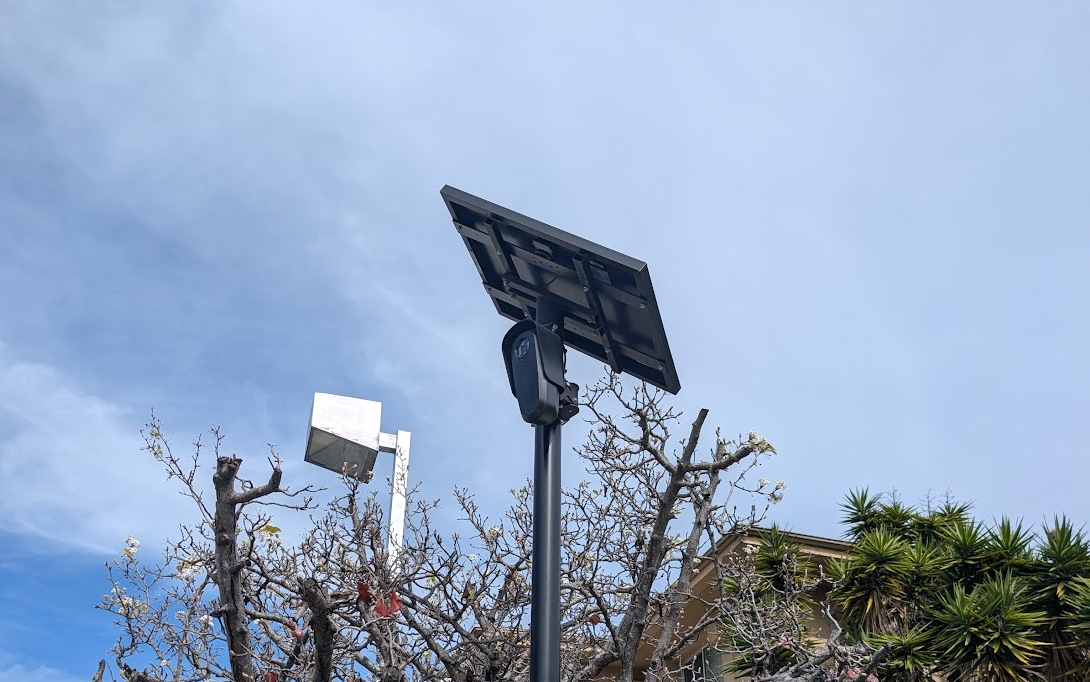
Oakland isn’t the “center” of the Proximitivist movement, of course. We are far from the only American city to feel our definitions of “neighbor” warp and weave under emergent gentrifying tech fascisms like Flock Group Inc.’s “Condor” cameras. And yet Oakland is singular in its exemplarity, defined by its proximity to not-itselves, metamorphically formed by the pressures of those who come, and its remnants shaped by that which has departed. Nowhere else are the theres as here as they are here, one might say (and we have).
Not everyone is convinced that Proximitivism is the major artistic innovation of our period, of course, and some have argued it simply to be an emergent (and general) property of our broadly shared technofascist horizon. You will find no Proximitivism in SFMOMA, alas. But while important Proximitivist exhibitions have sprung up in towns like Huntsville, Seattle, Suffolk, and Olympia, Oakland Review of Books will mount the claim that our installations—our here, here—now represent the fullest expression of the modality, the site where its entangled mycelial strands are most anastomosing and hyaline, its loquats hanging heaviest in their clusters, and our neighbors’ forbidden lemon tree beckoning, most persuasively, with forbidden and alluring promise.
With that in mind, we collect the following thirteen pieces—“reibungspunkte,” or friction points, as the German Proximitivists have it—as both inspired by and intervening into the Proximitivist milieu, asking: What does it mean to collect that which is defined by how it collects its own environment in dispersal?
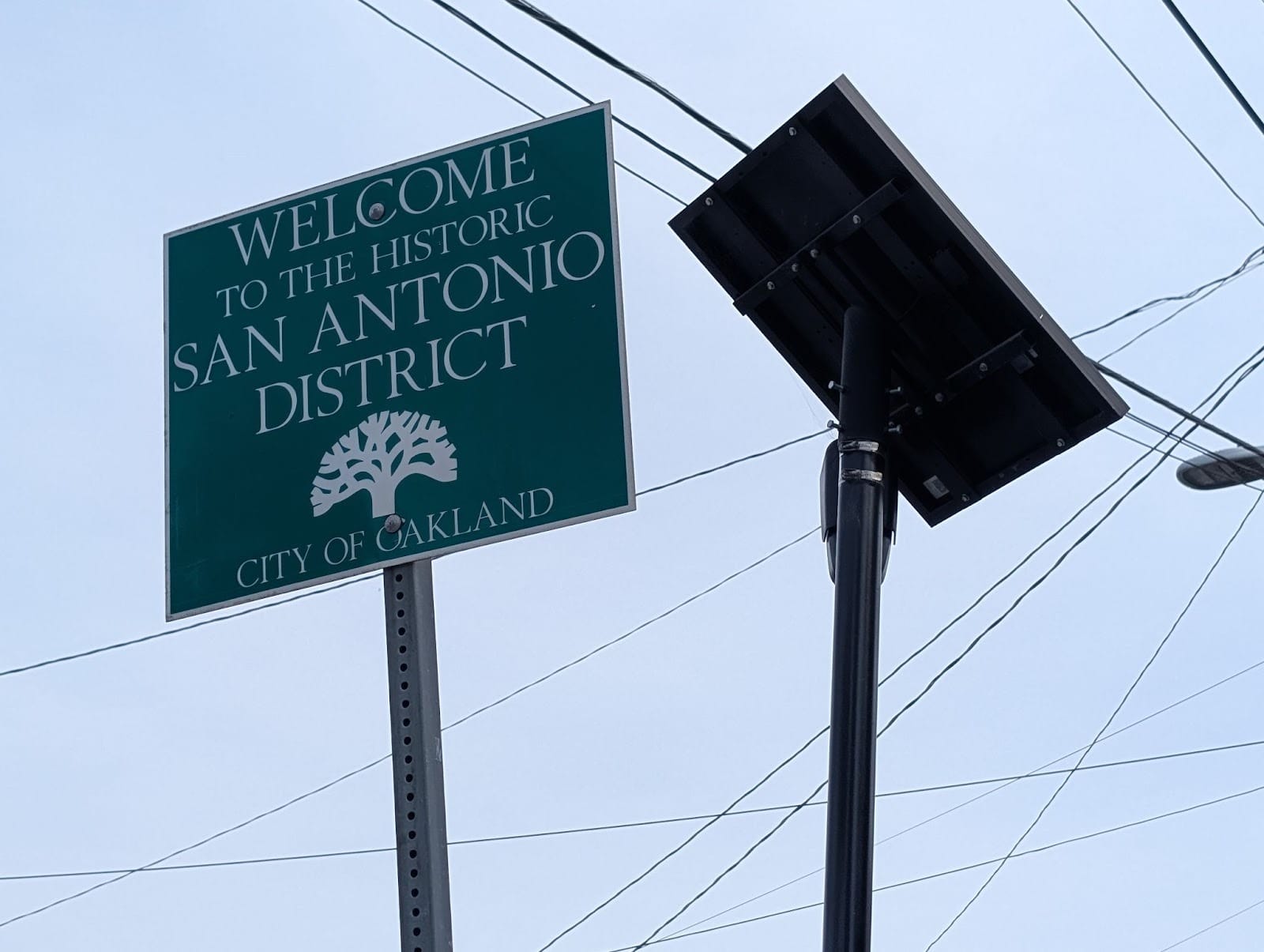
Flock Group Inc. (2025) & City of Oakland (2011), Welcome, History. Installation view at E. 21st St, near 14th Ave.
That this heritage sign pre-dated the Flock camera which mirrors it is exactly the point, a commentary on time and the way borders move: They cross us, as the slogan continues to go, and there are no beginnings. Rancho San Antonio once contained everything from Albany to San Leandro; today, it is reduced to a mere “district,” a part of what became “Brooklyn” and then stopped being Brooklyn when it was annexed by Oakland. Neither is this piece the “beginning” of Proximitivism; it only became so afterwards, when, by placing the Flock panel so close to its historical analogue, the unnamed technician-artist invited us to contemplate how the past still speaks, simply by remaining, and how that remnant, in its still continuity, also grows and changes, its “welcome” made ironic, even bitter, for a district filled with descendants of those whom the Peralta land grant was designed to displace, yet which it now harbors, surveils, and expels, again, as always.
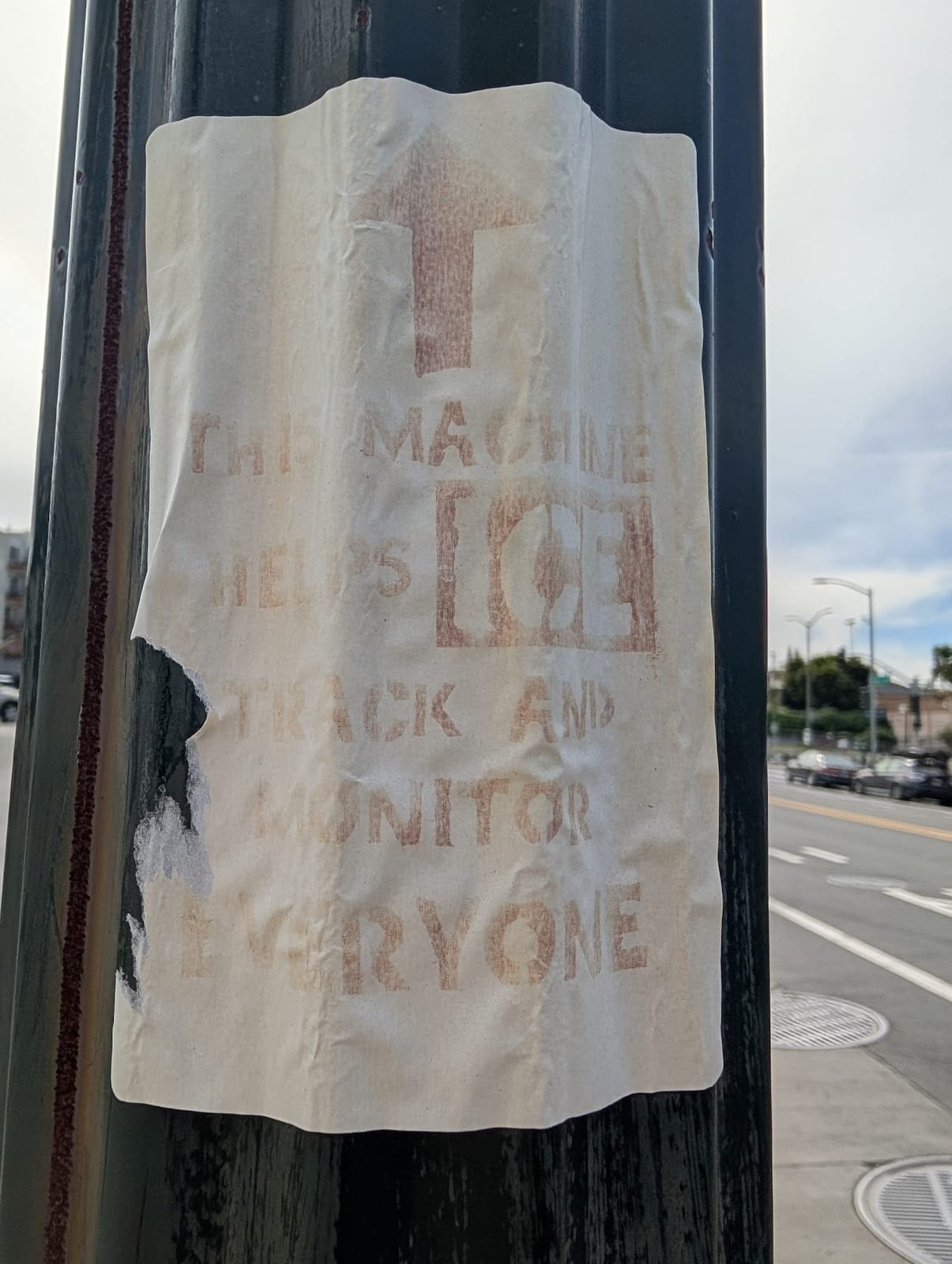
Artist unknown, Time’s Fools, 2025.
Multiple variations on this theme around the Town, dating to before that last wave of rain, and rain again, and then rain, again, weathered by the weather, subordinating the message to the message of the medium itself: time. That they are legible speaks to the quality of the postering methodology (no simple grocery-store tape for these folks), and you can see attempts to tear them down (as if decay were not an extant form of life). But if these fliers are survivors, there is irony in their victory: For the message to survive, it must become survival itself. One recalls protests that begin with specific political demands; when cops attack, what had been directed and articulated is transformed into the protest for the right, simply, to have demands, to protest at all. Who remembers, after all, that the Free Speech Movement began as organizing against Jim Crow? Well I do, I guess, and now so do you. Time makes fools of us all, unless we work at it, but memory endures when we labor at remembering.
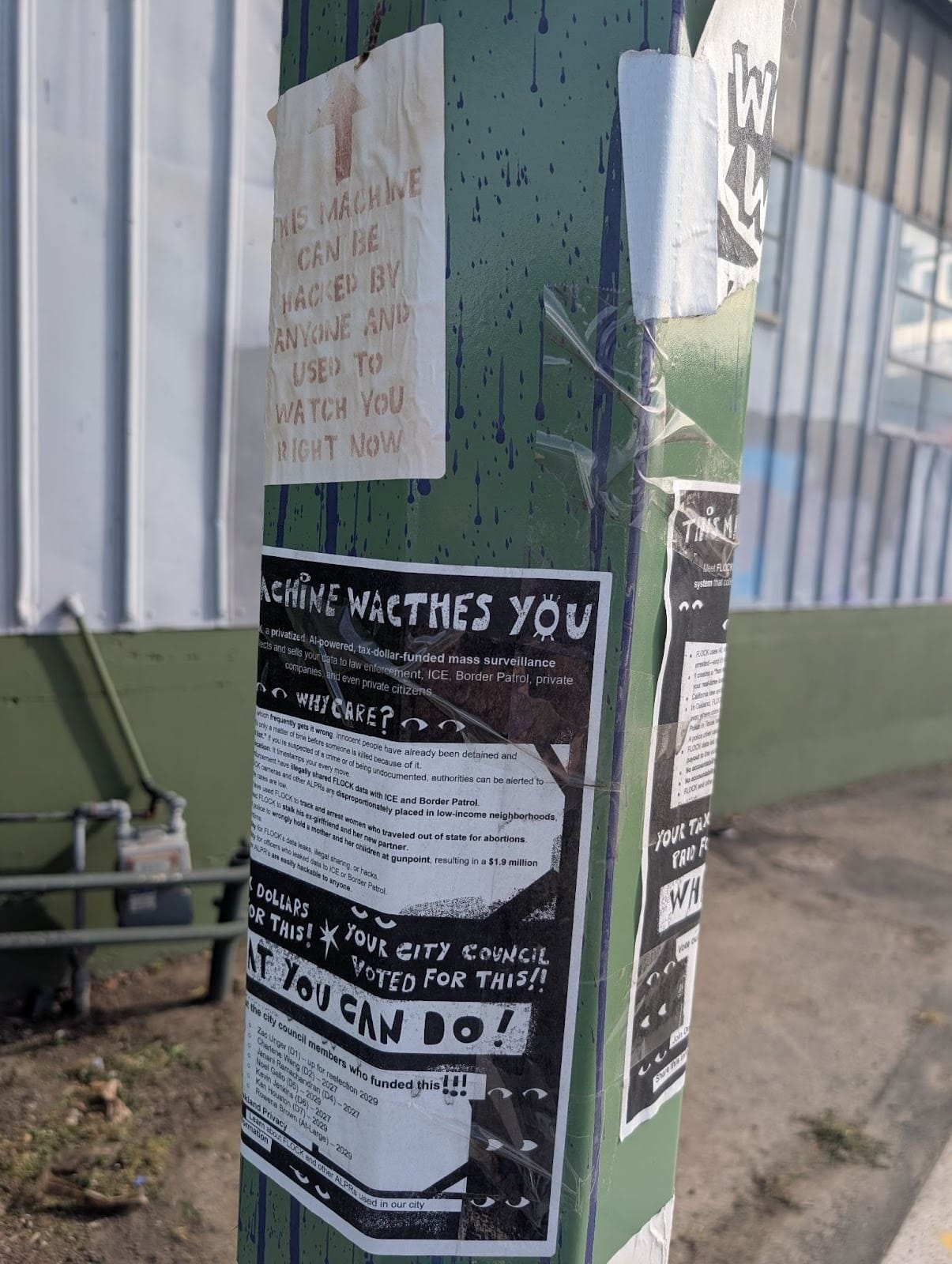
Artist(s) unknown, Time’s Fools (Redux), 2025/6. Installation view on Alcatraz Avenue.
Whether a collaboration or merely the coexistence of two distinct artistic visions, and whether, in fact, that question is the actual point being posed…that was/has become Proximitivism. If this original Time’s Fools piece obviously predates the more recently installed Wacthes, the former invites the viewers to contemplate history, from a remove, while the latter places us into the welter of contemporaneous struggle and agency: What your city council just did, and what you, now, can do. And yet, for all the clash of style and presentation and ethos, the underlying message is unified. Perhaps in coexistence, in mere proximity—as the now familiar slogan goes—comes neighborly transformation, from isolated “I”s to the singular “you” of us all? Yet even this now well-known formula is unstable: Unity is produced by the very device of division, the Flock camera itself. Are we its object? Or are we, perhaps, the Subject of History, who gazes back? Yes, and yes.
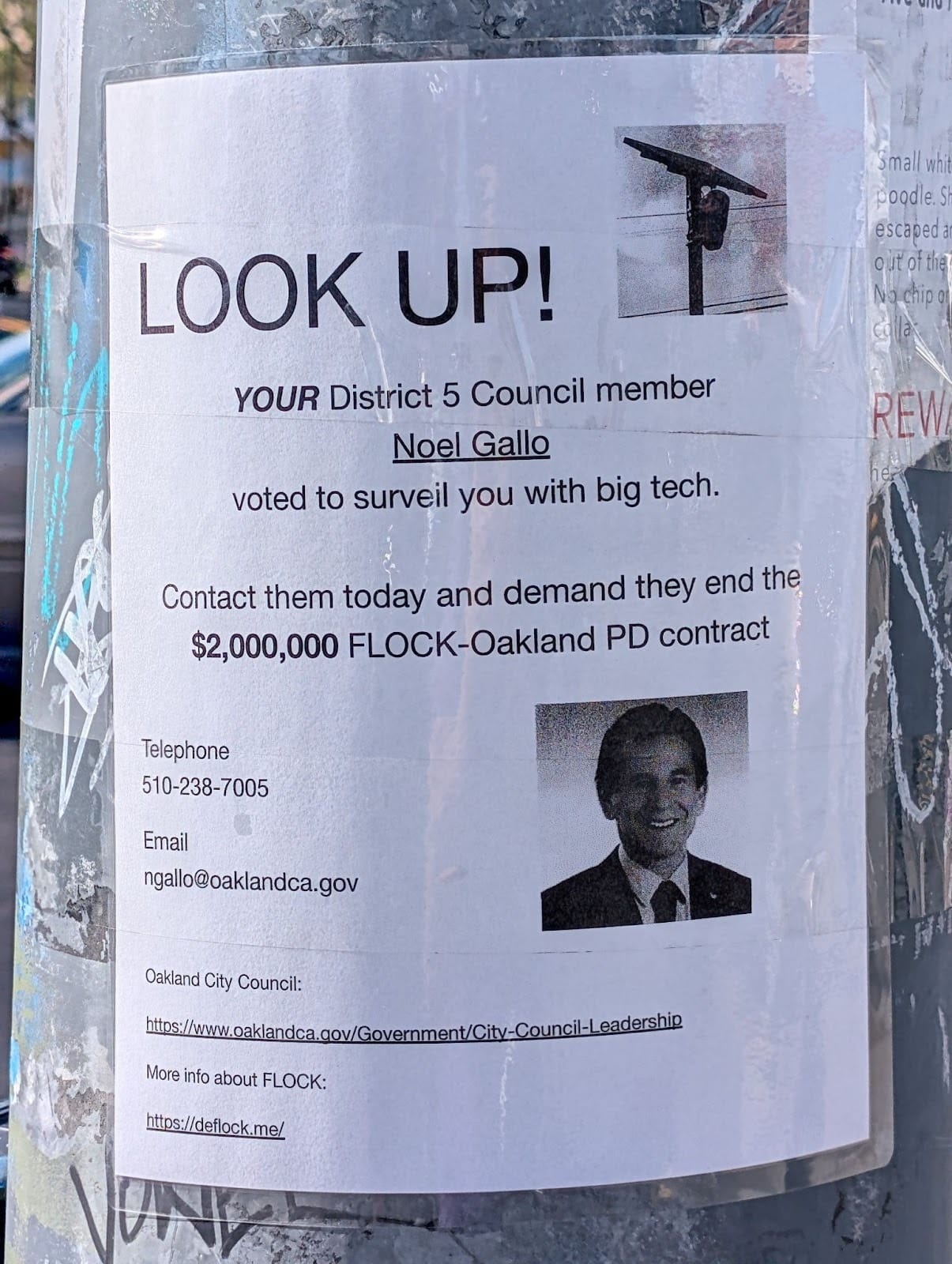
Artist unknown, On the Disauthorization of Power #1, 2025.
Arguably the least Proximitivist pieces in the exhibit, and yet (paradoxically, appropriately) inextricable from the whole, this series anchors the exhibit by the many Proximitivist retorts to it.
First, however, experience it as it was originally installed, inviting us to contemplate (and desire?) the way power contains the seeds of its own exhaustion, the way, in the arbitrary authority they hold, and exercise, elected leaders create the conditions for their own dis-election. It is, in its way, a simple idea, and the artist invites us to contemplate that simplicity by adopting a faux naive printed-out-Word-document style, complete with hyperlinks rendered cold and lifeless as printer ink on papyrus. Does the expressive act, too, exhaust itself as well?
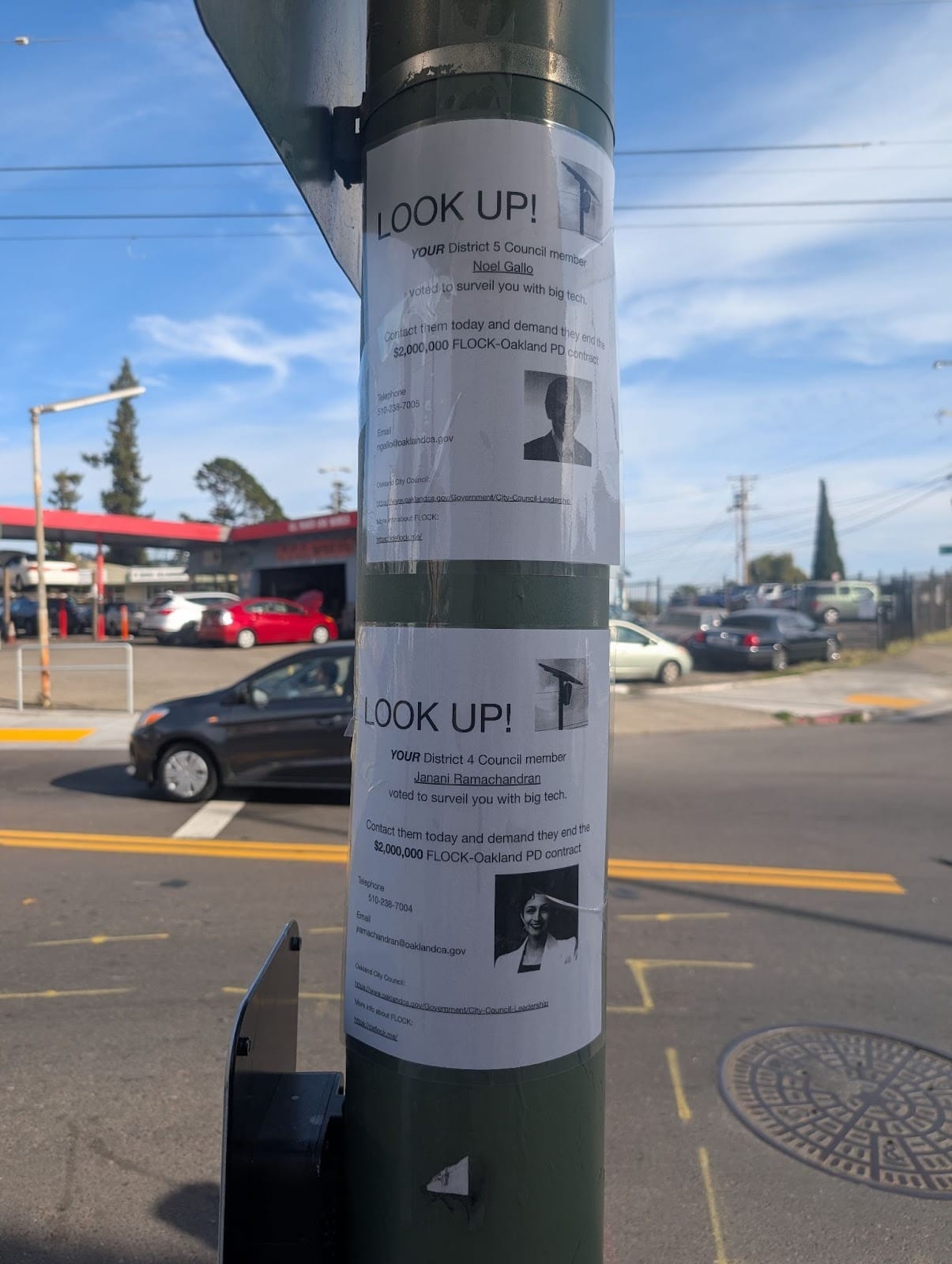
Artist unknown, On the Disauthorization of Power #6, 2025. Installation view in the Dimond District.
A rare example in the series of Proximitivist Proximitivism.
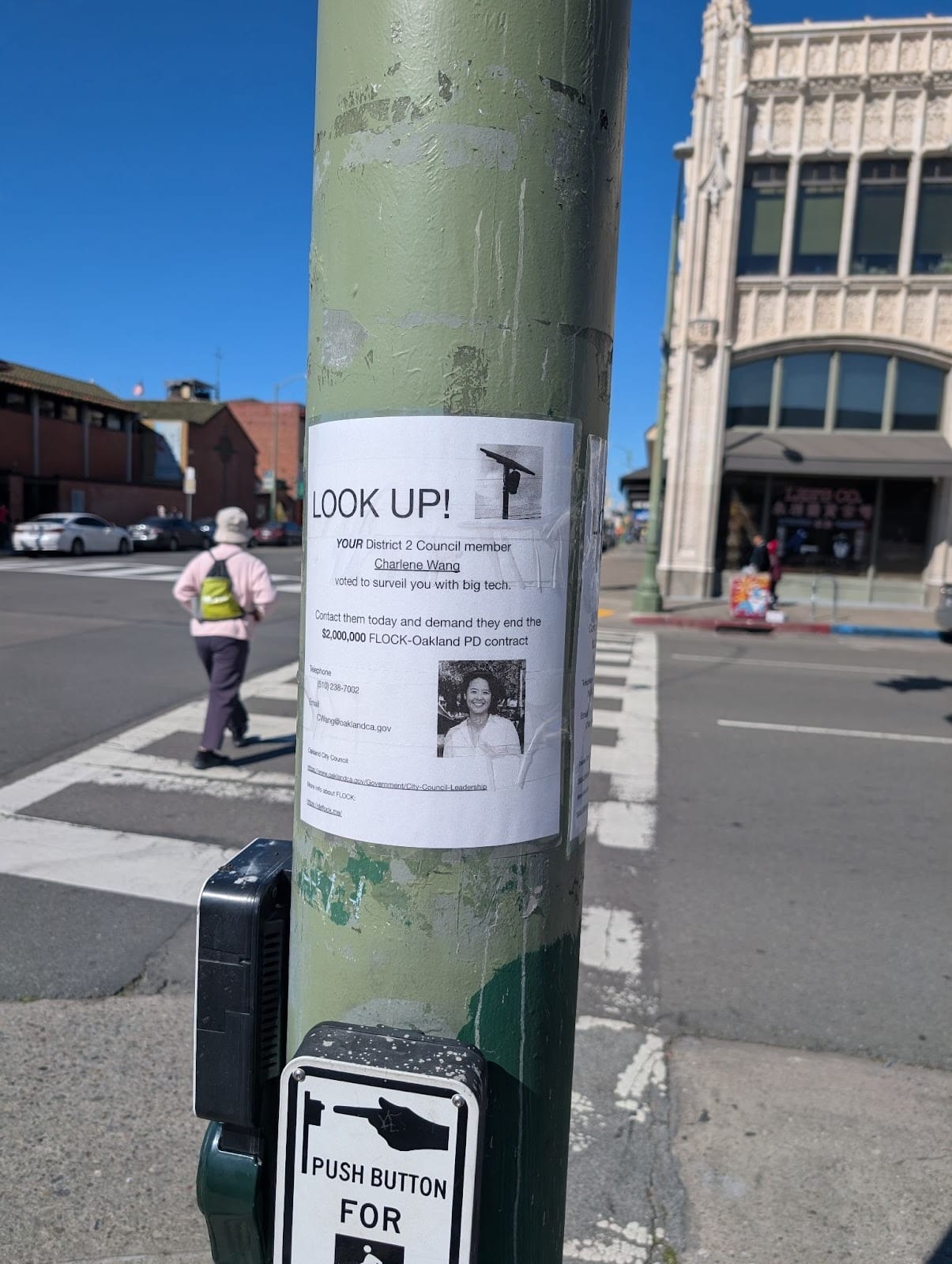
Artists unknown, On the Disauthorization of Power #3, 2025. Chinatown.
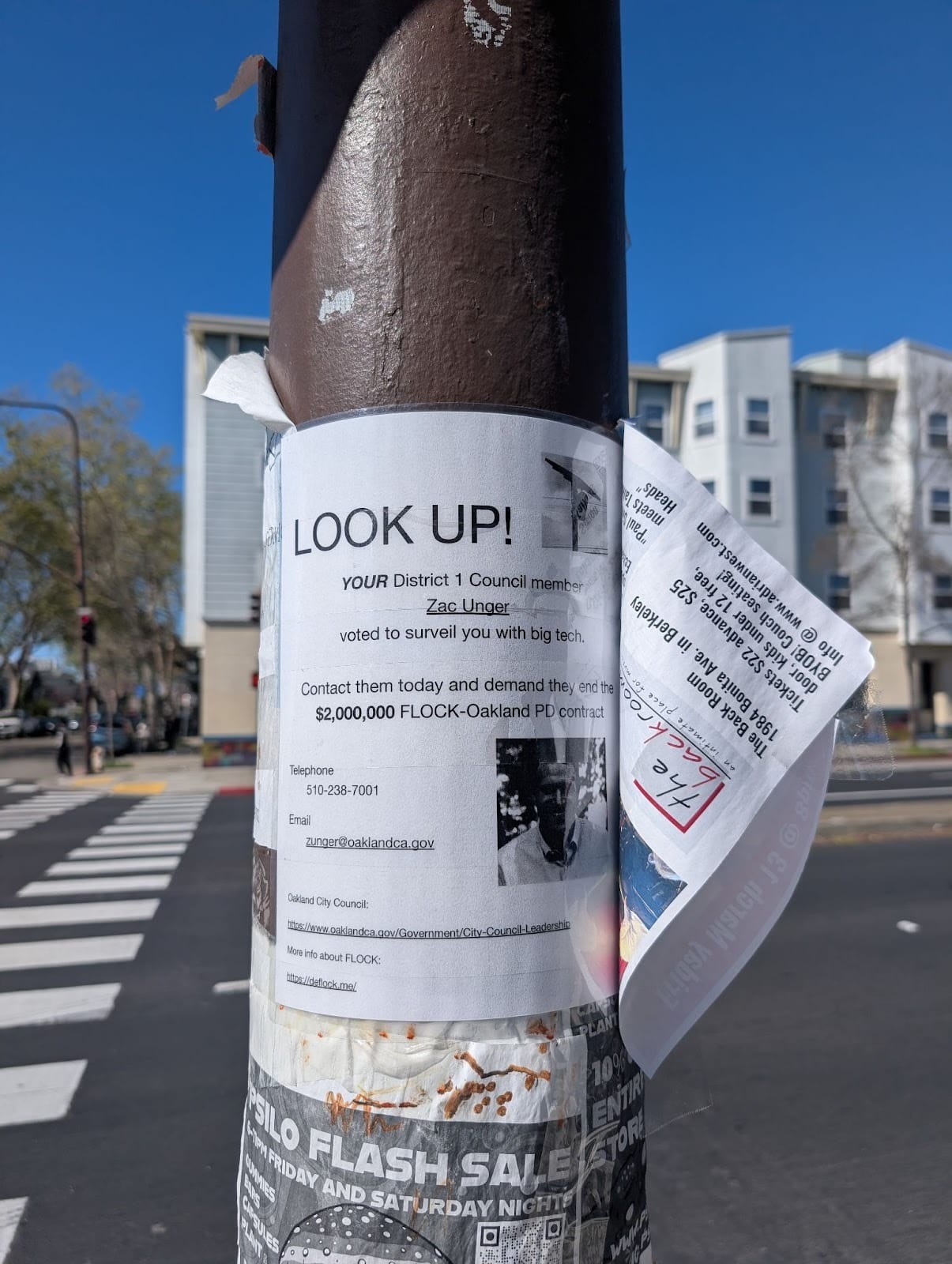
Artist unknown, On the Disauthorization of Power #12, 2025.
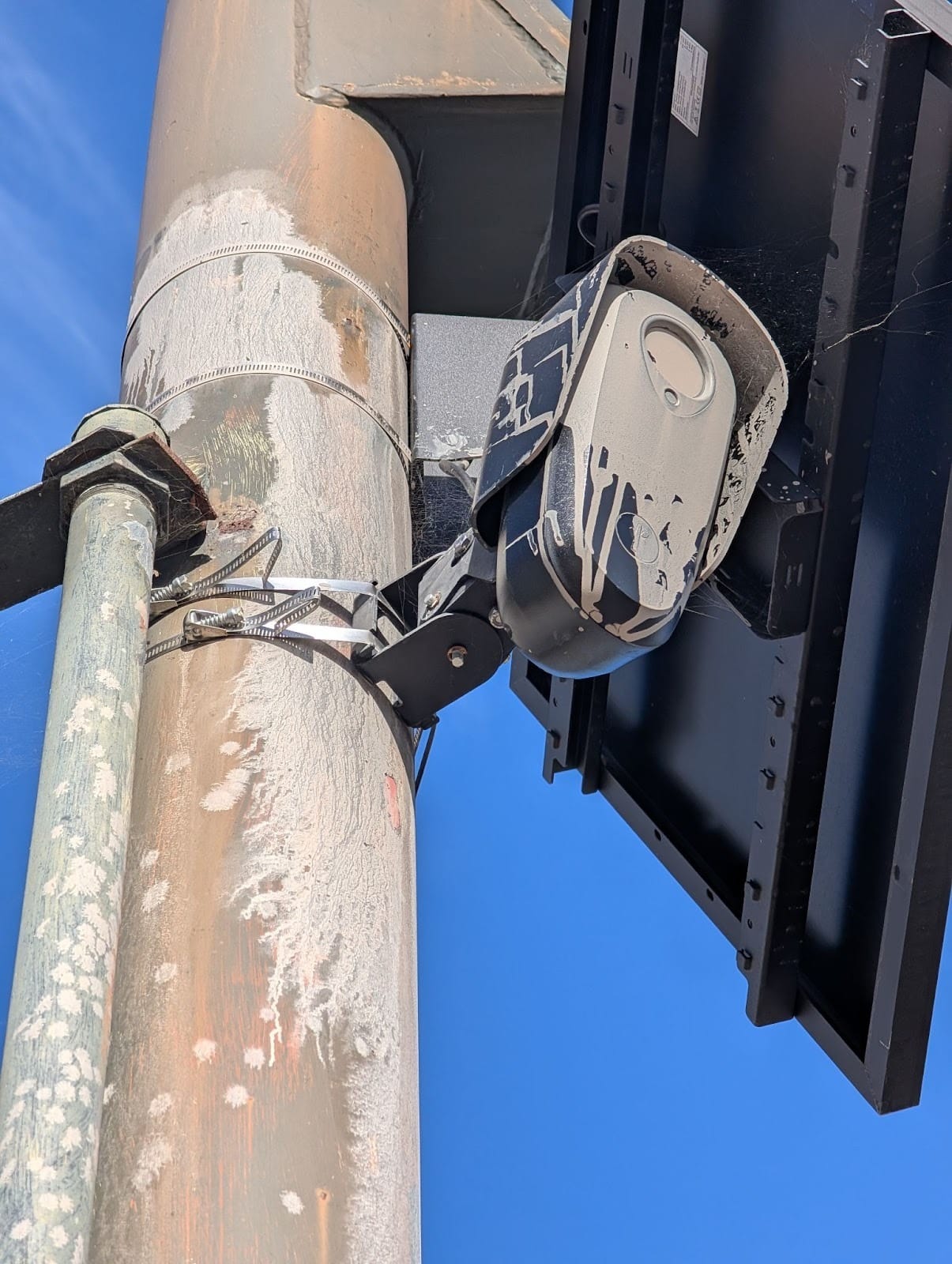
Artist(s) unknown, Propaganda of the Deed, 2025 (updated 2026).
In one of the sharpest retorts to the faux naivete of the On the Disauthorization… series, this conceptual installation interrogates conceptualism while demanding a mode of engagement that surpasses the merely expressive. Can a “splatter” painting repoliticize abstraction? Did the CIA invent modern art? Jackson Pollock a psyop, etc.? Nonsense, and yet expression is nonsense; in material art, art becomes materialist again. Twenty-first century infrarealism and not a moment too late.
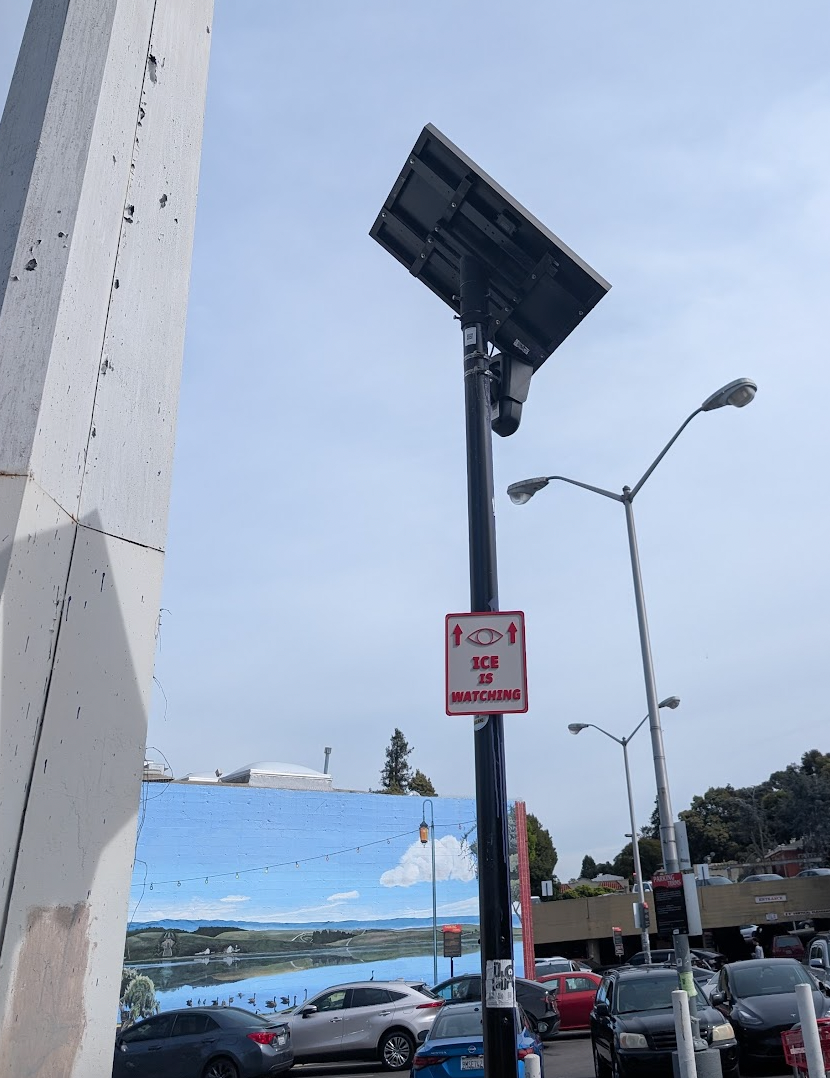
Artist unknown, What is, is what, is ICE, 2026. Installation view in Lakeshore Trader Joe’s parking lot.
In its dematerialized presence, ICE represents more than simply an acronymed “agency” shat out of the anus of the war on terror; as it settles into the totality of the information environment, it is revealed as foundational to our modernity. In watching, we, too, become ICE, because what is ICE if not watching? Direct your gaze, we are told, and we obey, and watch.
Or at least this is the provocation to settler citizens for whom the indignity of being seen is all that they (or we) can conceive of the threat being: ICE, after all, is so much more than being seen for the global citizens whose lives are upended, whose bodies are incarcerated and abused. And what do “we” do, as our silent complicity with what we see defies our right to the solidarity of the first-person plural: We watch, only.
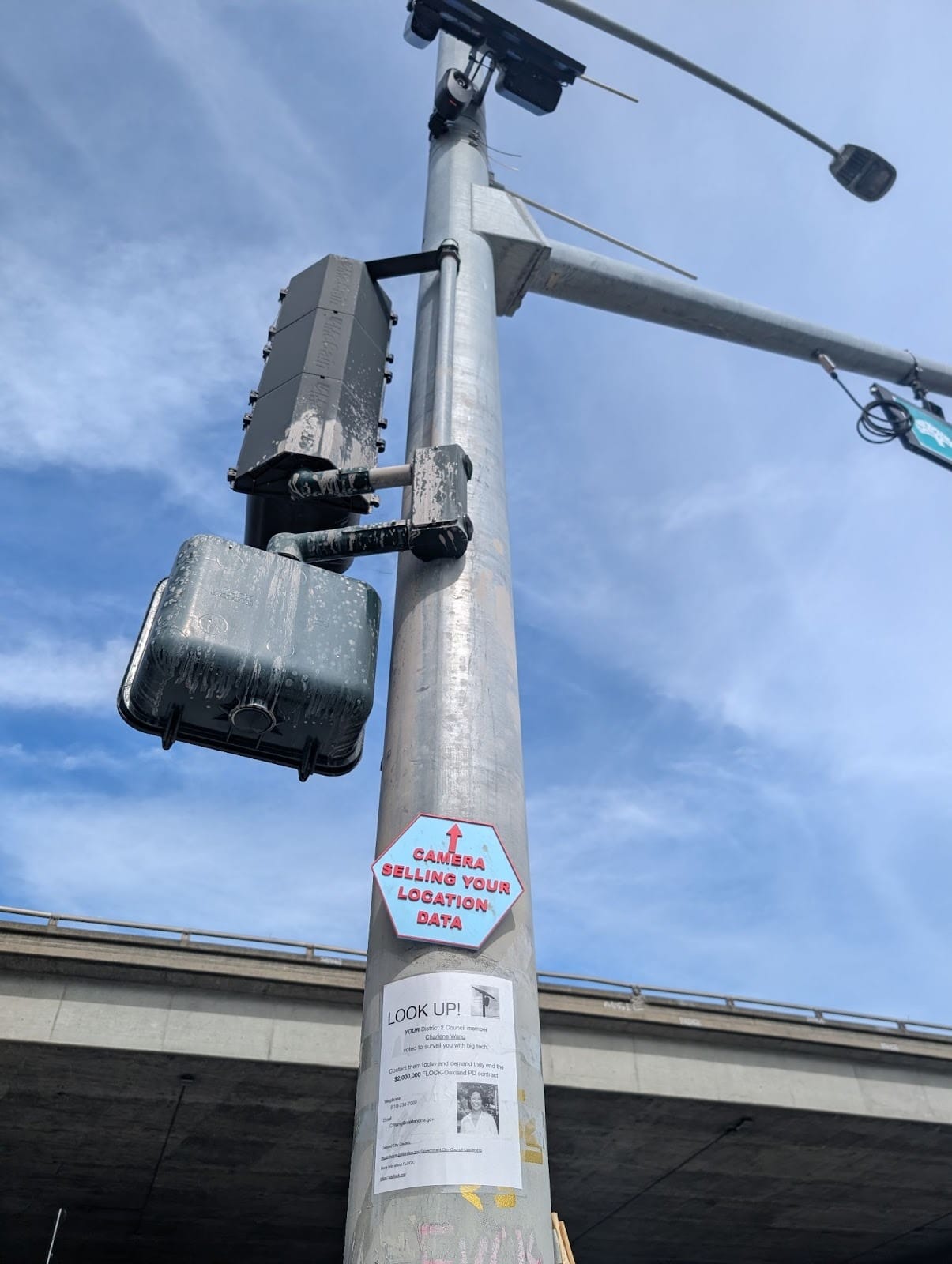
Artist(s) unknown, Stop. Flock., 2026. Installation view on Grand Avenue.
This hexagonal installation reminds us that there is nothing more uncanny that the injunction to stop: To obey is to act, after all, and a stop sign never ceases to issue its impetuous call, even from a place of stillness. But of course a proper stop sign would have eight sides—one for each district of Oakland—and this one has six; the absence of the word “stop” is notable as the word, unspoken, but all the more audible for it. This sign tells Flock when to “go.”
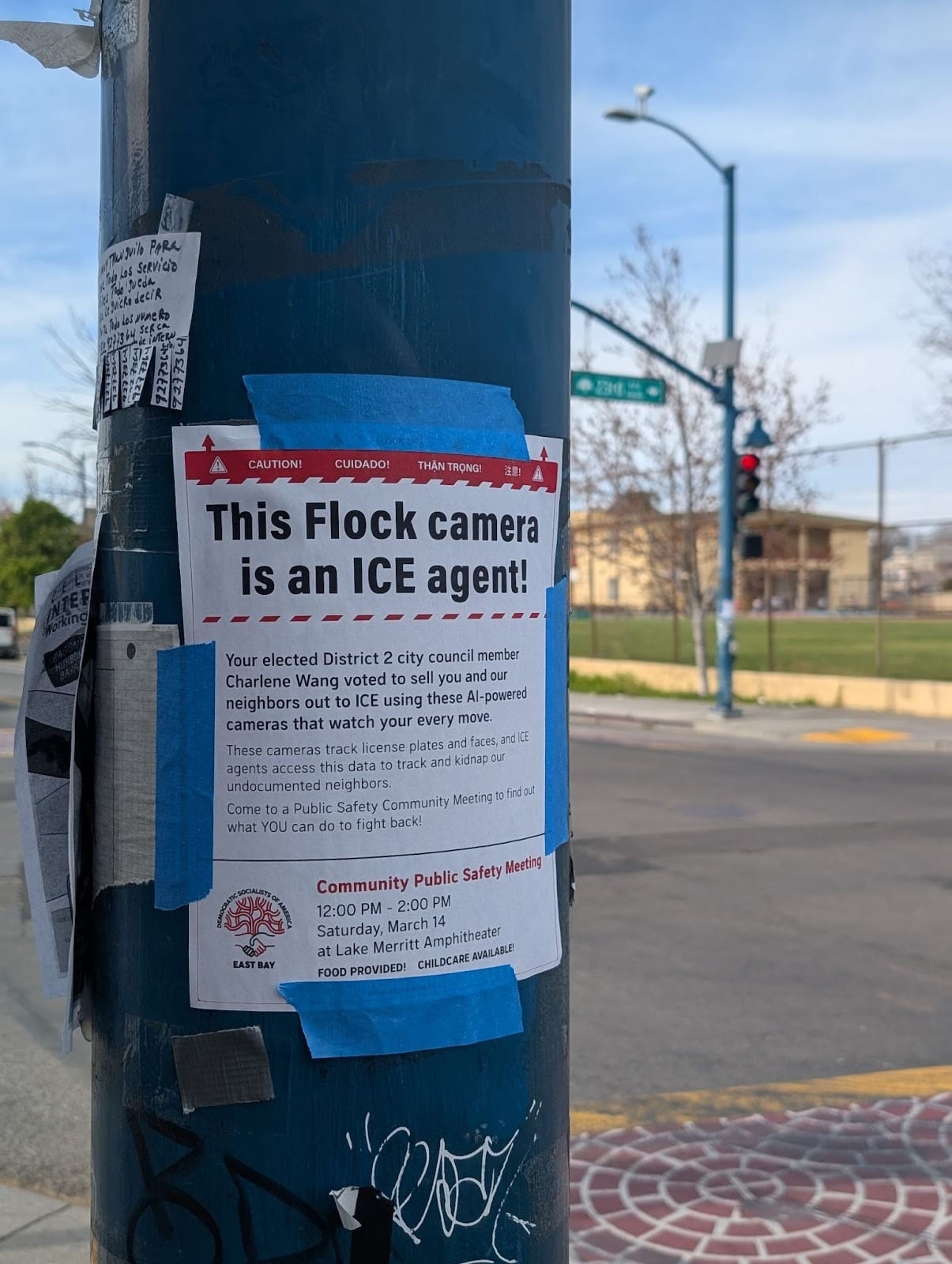
East Bay DSA, Agency, 2026. Installation view on Park Avenue.
From its red, white, and blue, in assemblage, to its faith in organic social reproduction, this piece—also known as “Community Public Safety Meeting"—still believes that the beloved social apparatus can find its way back to peace and prosperity. In this way representing a strain of optimistic Proximitivism that has most tended to flourish online, this physically mediated example of that genre also exemplifies its tensions, which have been particularly latent in the Disauthorization sequence: If power exhausts itself, do we not, too, in seizing our agency as a collective, run the risk of becoming “agents”?
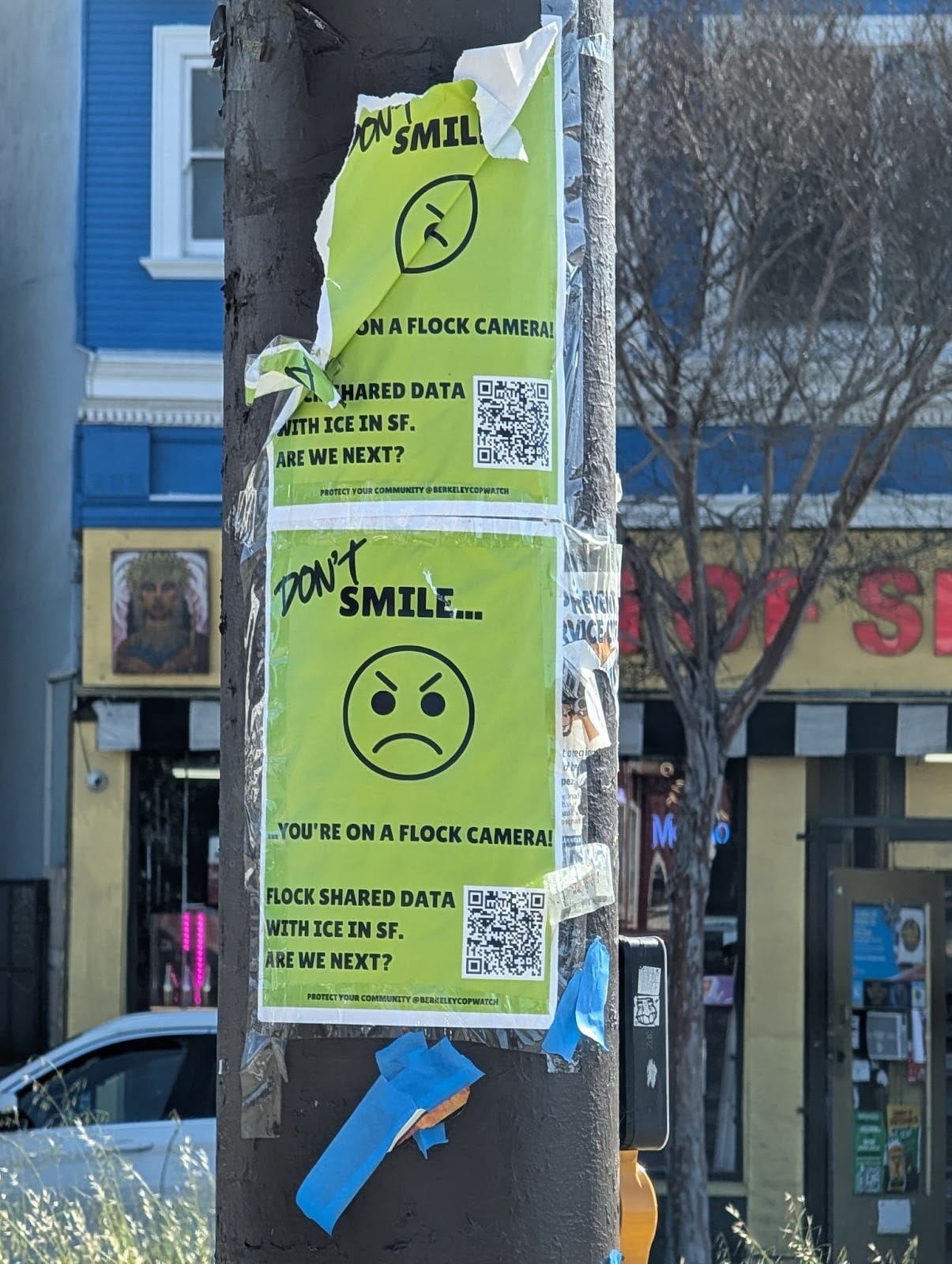
Berkeley Copwatch, Affect’s Regulation, 2026.
We strive, when seen by the state, to control ourselves, the better to evade being seen and controlled from without. When the outward gaze sees us, we look inward. Is this a dialectic? Or is it the structural nature of power, which circulates and pervades? Depends on whether Marx or Foucault rules the day. But Berkeley Copwatch incepts in us the notion that in seeking to defy the state’s gaze—in watching the cop who watches you—we have, perhaps, constructed the state on top of itself, in the very act of tearing it down.
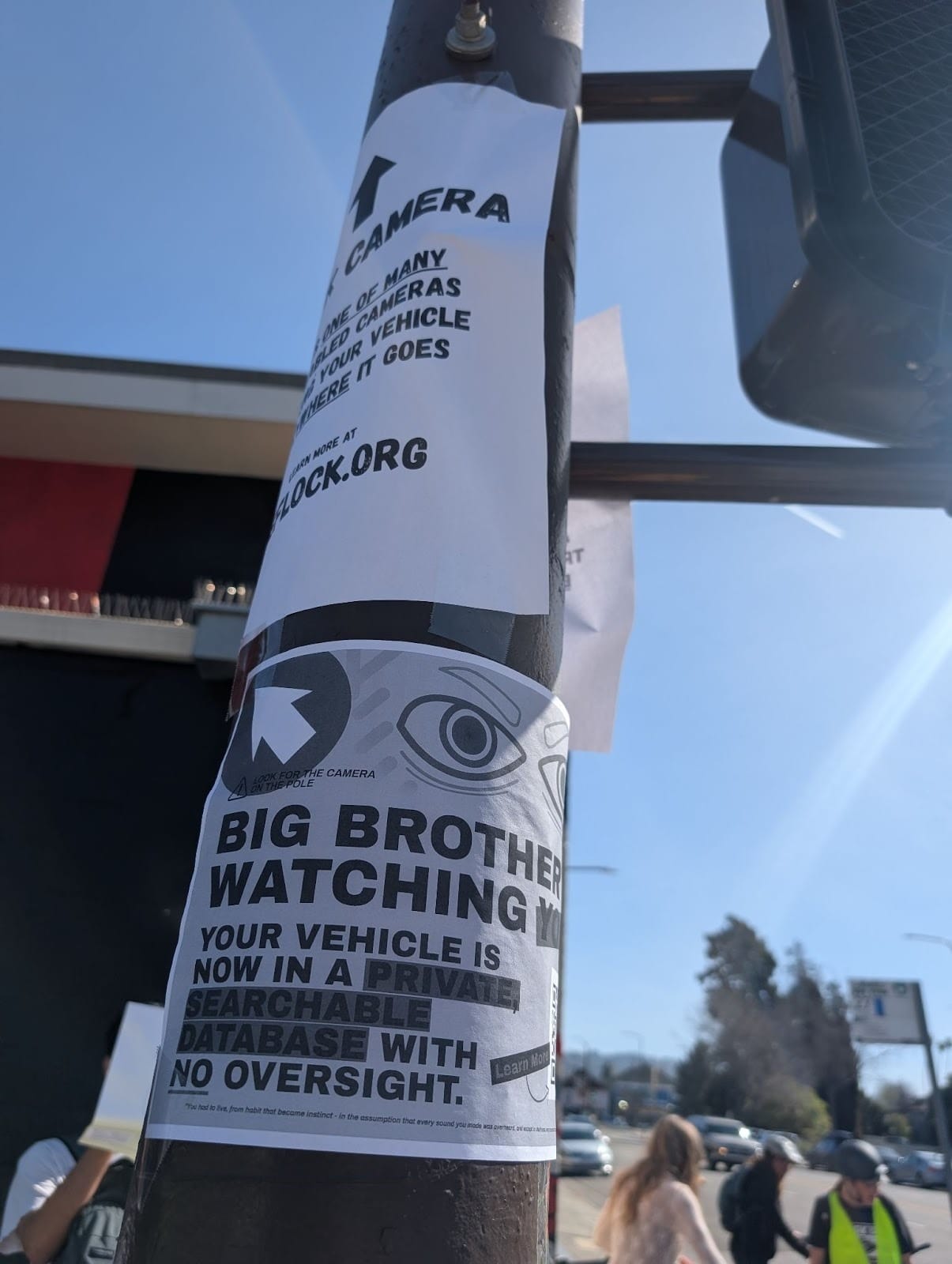
Artist unknown, Untitled, 2026. Installation view on Alcatraz Avenue.
At some point in early 2026, the sign that Proximitivism had run its course was to be seen in signs that ran together, with the multiple clustering aesthetics on the same poles no longer giving off the frisson of fissionary history, but just a sense of who got there first, and who got there next. Not a bad thing, not a bad thing at all. But art reaches its limits, and somewhere around the cursed intersections of Alcatraz and MLK, so did Proximitivism.