We had a time, don’t let ’em say different
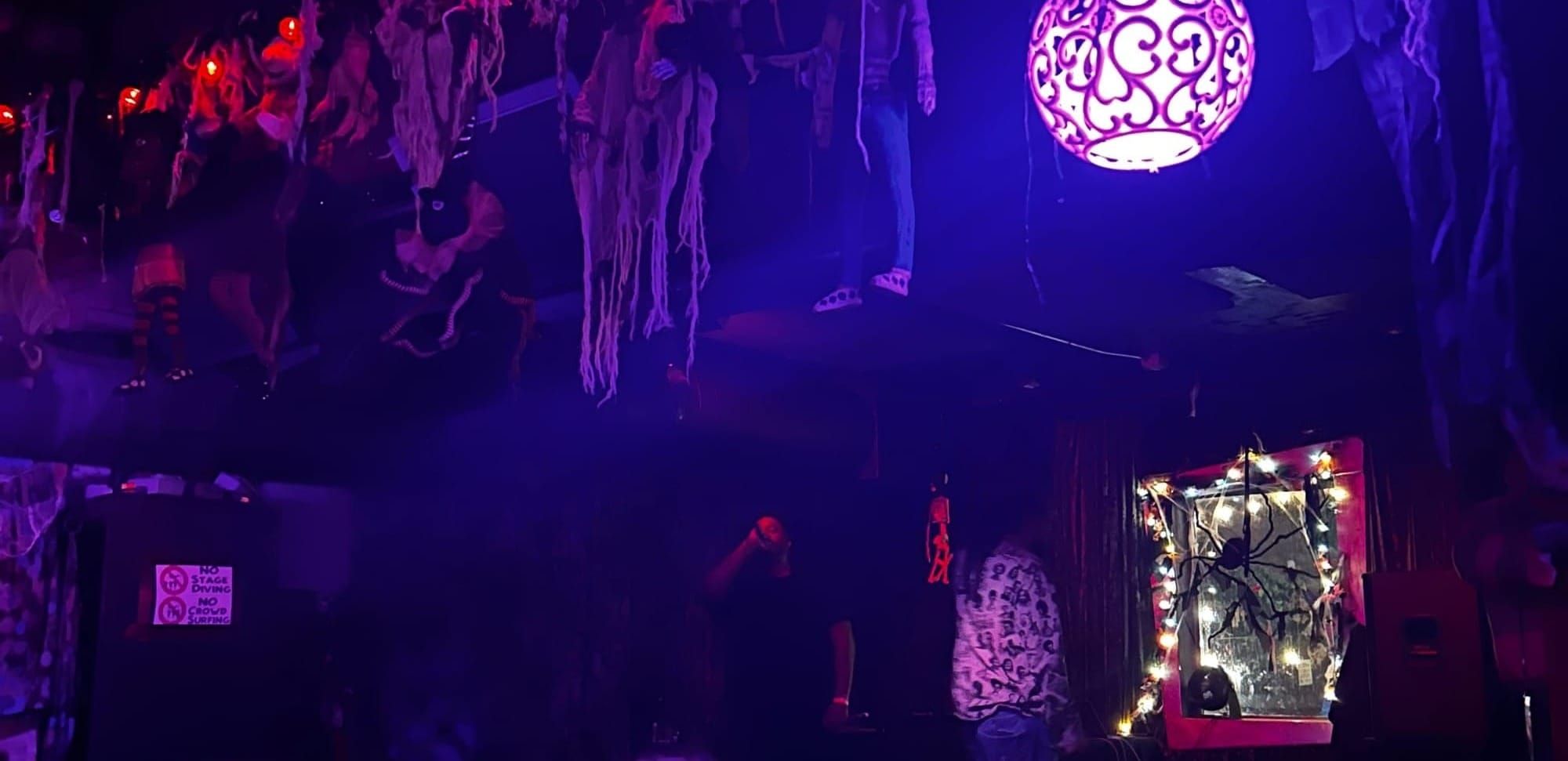
The leftover Halloween skeleton ornaments dangling from the chandeliers above the crowd at the Armand Hammer show on Sunday night were a funny reminder that, for most of 2026, every show at Bottom of the Hill has doubled as a funeral. At the beginning of the year, it was announced that the storied Potrero Hill venue would host its last show on New Year’s Eve. A 247-person capacity room housed in a 115-year-old building, Bottom of the Hill is among the last of a dying breed in San Francisco, and in cities around the country—the small independent rock club- slash-cultural institution.
Bottom of the Hill opened its doors in 1991, the year I was born, and there is a good chance that your favorite band, or the band that inspired your favorite band, played there. You can look at its delightfully retro website, which hosts a database of the some 14,000 different bands that have taken the stage. It is the place you saw your favorite band before they blew up, or your favorite band that never did but should’ve. I looked up my cousins’ late-1990s indie rock band The Push Kings. Sure enough, they played there. The venue was mentioned in the Pulitzer Prize–winning memoir Stay True, by New Yorker writer Hua Hsu, about coming of age as a music obsessive in the Bay Area in the 1990s. (He saw The Push Kings there, I’m told).
When Coyote broke the news of the closure, the owners cited several reasons. Insurance and licenses and day-to-day operating costs were piling up. At the same time, there was less of a built-in clientele, employee base, and local talent pool, what with all the punks and rappers and other bohemian ne’er-do-wells getting priced out of San Francisco. Hanging over all of it is the near total monopoly of vertically integrated corporations like Live Nation, which promote shows, sell tickets, and increasingly own brick-and-mortar venues outright. While it is said that we are in a Golden Age of live music, it is really more like a Gilded Age. Live Nation brought in $25.2 billion in revenue last year, having grown nearly ninefold since 2005; meanwhile, a report from the National Independent Venue Association found that 64 percent of stages were not profitable in 2024. The big artists, venues, and promoters make off like bandits, and the smaller venues around the country, and the artists who tour them, are squeezed from all sides and forced to scrounge for scraps. Eventually the venues become condos the artists can’t afford.
On Sunday night I went to Bottom of the Hill to see Armand Hammer, a duo made up of the New York–based rappers Elucid and billy woods, both solo artists in their own right. It was a tour stop in promotion of their 2025 album Mercy. To my surprise, it had been sold out since the summertime. Perhaps it was a mad rush by Bottom of the Hill loyalists hoping to see every last show, or perhaps it was a testament to the duo’s growing renown. Woods was profiled in the New York Times after he released his last solo album, and he was recently tapped as an opening act for Geese, the Gen Z it-band of the moment. In July, the pair played the vaunted NPR Tiny Desk.
It was an all-ages crowd that tended toward the bearded, flanneled, hoodied male in his mid-thirties. I know him well. I am him. There were ladies onstage, however. The opening act was Bay Area–based rapper Sha Ray and New York–based producer DJ Haram, who recently released an album called Critical Thot on billy woods’s label Backwoodz Studios. They make self-described “scaring the bros,” stab-you-with-a stiletto noise rap. Dressed like a cabaret dancer, Sha Ray barked out her verses with ferocity and tight breath control, which she noted was all the more impressive in a corset. The fellas couldn’t quite match her freak, and DJ Haram scolded us for it. Maybe the bros were scared. “Lotta dudes,” remarked my date.
After a trip to the patio for intermission, we were back inside, stage right about ten paces back. As Elucid began to set up on stage, sliding a MacBook and microphone pedal out of a white tote bag with a cartoon dog on it, two young lads behind me tried to figure out what was going on. “I’m not sure what he looks like—is billy woods in Armand Hammer? Does one make beats and the other rap?” One could partly excuse their confusion about woods’s appearance, as the only time you’ll see his face is if you see him live. In press photos, music videos, and interviews, it is blurred or otherwise obscured. At shows, he asks to cut the lights on stage, and there’s an unspoken though not always observed agreement that if attendees post photos or videos, they’ll do the same. His government name, as far as I know, has never been revealed. On one song, he tells a story about his butcher figuring out who he was. He had to find a new butcher.
The last time I saw billy woods in San Francisco, he thanked us for attending by way of lamenting the cost of child care in New York City.
The first time I saw Armand Hammer was in 2021, when they toured their breakout album Haram. It was the first concert I attended after the pandemic. Ever since, I felt compelled to see them at least once a year for nourishment, the same way you might need to go to your favorite restaurant. Their music exists in a very specific slice of the cultural economy, which required their talents to be honed and refined through years and years of having to tour the likes of Bottom of the Hill just to make a living. As independent artists with kids to feed, they cannot afford not to. The last time I saw billy woods in San Francisco, he thanked us for attending by way of lamenting the cost of child care in New York City.
Whether because of their at times unorthodox, stripped-down production or their spoken word–adjacent rap style, or the esoteric intimations littered through their lyrics, Armand Hammer is best enjoyed in small, intimate rooms. The crowd on Sunday was rapt as the pair traded verses, taking turns playing favorites from their solo catalogs. Like the best rap duos, they’re a case study in contrast and reciprocity. Both rap in a way where the instrumental can sometimes seem secondary. Elucid’s voice is warmer, raspier, and more prone to hypnotic melodies and guttural chants. At one point Sunday, he clutched two microphones, one with the reverb turned all the way up, and rapped back and forth into them. By the end he was barking. I’d never seen anything like it. Woods, on the other hand, does not so much float over a beat as he grabs it by the throat. He began the set a bit staid, almost like he was going through soundcheck, but by the third or fourth song, every verse was a lighting bolt delivered like it might be his last.
Their idiosyncratic style can make Armand Hammer an acquired taste for some. But once you acquire it, you turn into a zealot. I’ve sent more screenshots of billy woods lyrics to certain friends than I’d care to admit. (A recent one: “All that ‘kill the rich,’ that’s the easy shit. I’m not impressed, but I can admit, once you put him in the ground, everybody’s spirits lift.” Another: “My ex-wife is my mistress, your woman on a pedestal but this Ruby Ridge shit.”) I screen-recorded the best one-minute clips from their July Tiny Desk performance and played them for myself all summer when I needed a boost. They are your favorite rapper’s favorite rappers, whether that’s Earl Sweatshirt, Danny Brown, or Noname. Both excel at turning life’s commonplaces into high art. Like errands: Elucid can make a trip for gardening tools into a psychedelic meditation, while woods can turn a bodega run into a haunting diaspora family drama.
One would be remiss not to remark on their politics. It should be no surprise that a group named for a Soviet-collaborating oil magnate makes frequent allusions to the Cold War, the Global War on Terror, and the Black radical tradition. One of Elucid’s best songs, Spelling, begins with an excerpted speech from the abolitionist political philosopher Joy James. On Sunday, woods wore a brown button-up covered in illustrations of Black historical figures, but it was so dark on stage that the only one I could make out was Frederick Douglass. He spent his childhood in Zimbabwe because his father, a Marxist academic, worked in Robert Mugabe’s government after the country was born from the ashes of the white-supremacist rogue regime of Rhodesia. Maybe that accounts for his unsparing world-weariness and sardonic gallows humor. (“When the revolution was over they gave them half what they promised, let’s be honest.”) On Mercy, Elucid raps of having nightmares about exploding beepers, woods of Pinochet’s best pilots cruising over the south Atlantic.
A few weeks before the show, Coyote broke more news. Bottom of the Hill will live on. The venue was purchased by a biotech entrepreneur who’d been a regular since the 1990s. A benevolent wealthy patron preserving an iconic cultural institution: fitting for our new Gilded Age. At the end of the set, woods thanked the venue and remarked on the love the Bay Area has always given him. He said that even before he could book a show in New York City, he was drawing a crowd to the Brick and Mortar Music Hall, another one on the dwindling list of independent venues in San Francisco. There was no encore Sunday night. They had vinyl, cassettes, and T-shirts to sell, and the line for the merch table stretched the length of the entire venue. There would be a couple more tour stops during the week, and then a return to New York City. They didn’t mention it at the show, but two days later they dropped a surprise album called Snakes and Ladders. Not entirely by chance, I’ll be in NYC this weekend, and I have tickets to see Armand Hammer on Sunday night. They’re playing the storied Williamsburg Hall of Music. It’s closing at the end of the year.
\O/
Eamon Whalen is a writer and reporter in the West Bay.