Black sonic politics in Oakland, in nine sounds
Welcome to Sound Week, part of our “Six Senses of Oakland” membership drive. Read more about it here. Check out other Six Senses stories here, Subscribe here.
We asked Alex Werth, author of last year’s indispensable On Loop: Black Sonic Politics in Oakland, to put together of playlist of songs and sounds that are characteristic in some way of Oakland. His list is below, accompanied by his commentary (as told to Tommy Craggs). Be sure as well to check out his piece about where sideshows come from and what they mean.
“3 O’Clock Blues,” Lowell Fulson (1948)
This song exemplifies the blues sound that was created in Oakland by a record producer named Bob Geddins, who is often called the “Godfather of the Oakland blues.” Geddins was born on a plantation in Texas and came to Oakland, like the vast majority of Black migrants, during the middle of the 20th century, in order to work in the wartime economy. He worked at Kaiser Shipyards in Richmond and a record shop on 7th Street, which was then the commercial heart of West Oakland. He became a musical entrepreneur and created the initial infrastructure for recording and marketing the kind of folk sounds that many Black migrants brought to the Bay Area in the Second Great Migration. That included creating a lot of different local record labels and actually opening a record-pressing plant, to imprint these sounds on wax or shellac, and then trying to distribute the records to the local community and beyond. In some ways, Geddins was the center of the Black musical universe in the East Bay in the 1940s and ’50s.
He both uplifted and accentuated this very particular blues sound that Black migrants brought with them to the East Bay from states like Texas, Louisiana, Arkansas, and Oklahoma. There was more of a country sound to it than a lot of the blues that moved up from the Mississippi Delta to Chicago and became associated with artists like B.B. King. So, when people talk about the Oakland blues, they’re talking about this more stripped-down, raw, unvarnished—perhaps even more acoustic—version of the blues.

Geddins was known for taking that kind of country twang and enhancing it. He later reflected that he would try to coach the musicians in his stable to extend their drawl and make their phrasing sound, in his words, as sad as possible. Even if it was a performance, that intense melancholia reflected the kind of abject conditions of segregation and subordination that migrants found when they finally made their way to the supposed promised land of the West Coast.
The story of “3 O’Clock Blues” establishes a theme that becomes pretty important for tracking the dynamics within Black music and the recording industry in Oakland. Geddins didn’t have the kind of corporate power or access to the distributional reach that competing record labels did in places like L.A. and Chicago. He was never really able to elevate Oakland to be on par with these other hotbeds of Black musical production. As a result, if an artist wanted to make it big, they would tend to leave Oakland, because Oakland put a ceiling on their career possibilities. And it actually left a lot of local artists pretty vulnerable to exploitation. People had their songs covered, oftentimes without credit. They would launch hits for other people who ended up enjoying much more career success.
This particular song was Geddins’s first hit. It got national airplay on Black radio stations. It became popular with B.B. King before he was big. In 1951, King recorded a cover of it, without paying for the rights, in a Memphis YMCA. It became the breakout moment of his career—a No. 1 R&B single for five weeks in 1951. It really marked his transition into superstardom. Today, everyone knows B.B. King. But barely anybody who’s not a blues head knows Lowell Fulson.
“Power to the People,” live at Merritt College, The Lumpen (1970)
Audio courtesy the Huey P. Newton Foundation Inc. Collection at Stanford University
The Lumpen were basically the Black Panther Party’s house band in the Bay Area. Credit to the funk historian Rickey Vincent for sharing their story. The group consisted of four rank-and-file party members, all young guys who happened to have a knack for R&B and soul music. They were packaging up copies of the Black Panther Party’s newspaper one day, and folks overheard them humming and singing along with the music on the radio. The minister of culture for the BPP, Emory Douglas, realized that their musical talent could be used as a tool to help recruit more young people into the movement, by speaking to them through the kind of soul music they were listening to in everyday life.
Emory Douglas is remembered for his iconic visual art, especially those woodcut-inspired graphic illustrations that adorned the covers of The Black Panther newspaper and posters. But he was also attuned to the ways that popular music could be an exciting, attractive, and compelling force among the working-class youth who were the base of the Panthers as a political movement.
The Lumpen recorded a two-track 45 RPM single that the Panthers would sell in order to raise money for their survival programs. And the group would warm up the crowds at rallies. This recording was from a full-on concert that they did in 1970 at Merritt College, where Bobby Seale and Huey Newton were politicized as students a few years earlier.
In this particular recording, they’re doing a cover of Sly and the Family Stone’s “Dance to the Music,” from 1967. It was a breakout for Sly and the Family Stone, a pivotal funk band from the East Bay. Sly—born Sylvester Stewart—and his siblings grew up in Vallejo, and Larry Graham, the bassist, grew up in West Oakland. They become really pivotal in defining the cultural politics of funk and creating these kinds of playful, pleasurable articulations of Black Power that centered on experiencing liberation through dance and self expression.
The Lumpen had a different kind of politics. They were really trying to mobilize Black youth to participate in this militant insurgency and put their lives on the line in a very literal sense. And so they tweaked the lyrics—instead of “dance to the music,” it’s “power to the people.”
Their lyrics were politically didactic, trying to communicate a very explicit message. But what I think is particularly interesting is that they did retain the actual sonic quality of the song itself because they knew that this kind of beat, these kind of funky guitar riffs, this sort of prominent bass, were going to work the people in the audience up into a kind of emotional and somatic state that was exciting—that would get them ready for something like revolution. So this idea that preparation for revolution happens through working upon people’s bodies, through sound—that’s what really interests me about it. And I think they understood this, too. The original song was 128 beats per minute. But The Lumpen cover is 148 beats per minute. Either these were superexcited young people losing control of their tempo or they were intentionally speeding it up to make people dance to the music even more fervently. I really do think they were thinking about the ways that their form of playing was a device to help get people ready to participate in revolution.
“Swing Down, Sweet Chariot,” live at the Oakland Coliseum, Parliament (1977)
This is from Parliament’s Live: P-Funk Earth Tour album from 1977. “Swing Down, Sweet Chariot” was recorded at the Oakland Coliseum, and what we’re hearing is this really slow, steady build in terms of the music and the instrumentation. The band uses what sounds to me like a gospel technique called the vamp—repeating the same phrase over and over again, slowly adding more and more layers to the sound so that the energy builds and builds. The vocals are the P-Funk guitarist Glenn Goins, who would come in at this particular point during the show and start to emcee with the audience and get people excited enough—to raise their vibrations enough—to basically call in the mothership. And the stagecraft of this tour—which as I understand it was the most expensive production of any Black musical tour at this point in history—materialized Parliament’s cosmology: a funky tribe that was going to leave the bad vibes of racialized oppression on planet Earth for the cosmos. The mothership was this sonically powered vehicle that was going to take all the funky people into outer space together as a way of getting free. And so this is a freedom imaginary, a liberatory politics. Which is why I think it’s really important that it’s actually a riff on “Swing Low, Sweet Chariot,” an African American spiritual and freedom song, just rearticulated for a very different moment in terms of Black history and cultural expression.
As Goins is leading the chant, this massive prop of the mothership is actually coming down, surrounded by sparks and flames and things like that, and landing on stage for George Clinton to emerge. I love this song and this moment, because it gets at the ways that funk culture in the late ’60s and ’70s harnessed all these older imaginaries of Black freedom and merged them with a new and increasingly out-of-this-world sound in order to create freedom practices for this precipice to the twenty-first century.
Parliament were theorists of sound. They theorized sound as a vehicle of emancipation. And I think it is no surprise that they chose to do this in Oakland, because of the association of Oakland with the militant side of the Black freedom struggle. And also as a citation of Sun Ra and Space Is the Place, which has a very similar cosmology and freedom imaginary and had been filmed in Oakland a few years earlier.
Years later, in 1998, Boots Riley and the Coup sampled Glenn Goins saying, “Oakland, do you want to ride tonight?” in the chorus of “Me and Jesus the Pimp in a ’79 Granada Last Night.” So twenty years later, you have the next generation of politicized Black musical artists—Oakland based, in the Coup’s case—drawing from this archive of freedom imaginaries in order to do a sort of updated hip hop version. For the first 15 years of Oakland hip hop, and Bay Area hip hop in general, funk culture was the primary reference point and sonic archive from which artists were able to create music for their own generation to get free to.
“Ring ’Em,” MC Hammer (1987)
MC Hammer’s from East Oakland, an absolute superstar of late 1980s and early 1990s hip hop. Oakland always claims Hammer because Oakland loves to claim all of its cultural luminaries. But in hip hop culture at large, Hammer’s the butt of jokes. Still, in thinking about this playlist, it was interesting for me to think about what we can actually learn about Black sonic politics in Oakland by taking Hammer seriously.
This song was his first single from 1986. It had been his demo. Hammer’s sound was really shaped by the fact that he linked up with this musician named Felton Pilate. Pilate was a member of the band Con Funk Shun, which was a pretty popular funk band from Vallejo from the 1970s. I’m interested in the relationship between Pilate and Hammer because of the ways that Pilate’s beat-making really imprinted East Bay funk into Hammer’s production style. “Ring ’Em” has a pretty sparse, drum-machine–like beat for most of the verses and choruses. But I love the fact that there’s always this kind of syncopated moment in the third bar of each four-bar loop where you hear the pop of a slap bass.
The slap bass is, for me, such an important marker of Oakland’s contribution to funk culture and to dance music beyond funk itself. Because the story goes that the technique was basically invented by Larry Graham as a young person gigging around Oakland with his mother, who was a singer and pianist named Dell Graham. As I mentioned, he would later become the bassist for Sly and the Family Stone and eventually front his own group, Graham Central Station.
The slap sound really marries the low end, the bass frequencies, with percussiveness. These two elements, drums and bass, have become so important not only to funk music, and how compelling it is as dance music, but also to hip hop and various forms of electronic dance music. These two things come together in Larry Graham inventing this technique in Oakland in the 1960s. You hear the slap bass again in “Ring ’Em”—that’s like an homage.
I just think it’s really interesting that the kind of party politics of Bay Area funk culture get incorporated into Hammer’s sound, both because that’s what he grew up with and also because he’s working with Pilate. Then that becomes the sort of alchemical recipe that allows for rap music’s first crossover commercial dynamo to blow up—and that’s an Oakland story.
“Sideshow,” Traxamillion, feat. Too Short and Mistah F.A.B. (2006)
This song exemplifies the production style of what by this point had come to be called the hyphy movement. You still have the use of cheap and relatively available drum machines and synthesizers, so that any kid could produce beats. But it’s not sample-based anymore, so it’s not harking back to that golden age of East Bay funk. This song, I think, is only about 97 beats per minute. Other hyphy anthems, like E-40’s “Tell Me When to Go,” are more up in the mid-hundreds, which is pretty fast for a rap record. This isn’t super fast, but it is faster than what was typical for the mobb music of the 1990s. So we’re moving toward a more excited energy where the emphasis is really on the pound of the drums from an 808 drum machine and pretty simple synthesized instrumentation.
This song really has that sound. It’s a beat to drive to, and it’s a beat to dance to—and potentially to spin your car to. The lyrics are all about the Oakland sideshow—these renegade car parties that by this time were totally decentralized and could pop up at any parking lot or street corner, whether it was in East Oakland, West Oakland, or North Oakland, oftentimes late at night. They were basically ungovernable late-night street parties. These were attractive to local youth because they were exciting. But also because there was so little else for teenagers to do—whether because they were young and couldn’t get into a club, or because they couldn’t afford the cover charges, which were used as a means of exclusion, or because disinvestment from their neighborhoods had left so few places to hang out and recreate that sideshows became a grassroots alternative. The sideshow became so important to the musical style of hyphy.
Alex Werth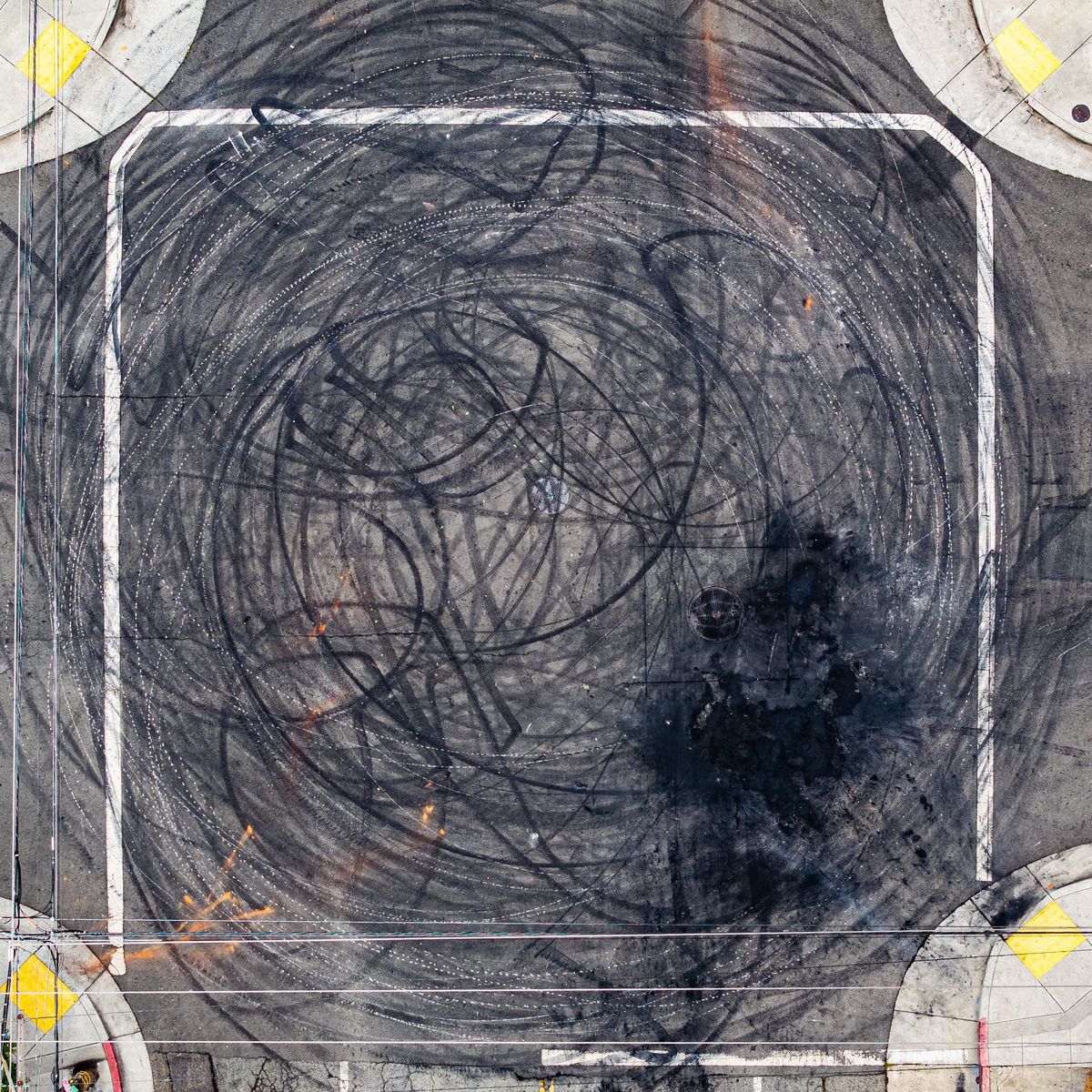
I think we hear it in this song. Producers really made beats imagining what they would sound like rumbling out of the trunk of someone’s car at a street party. And the lyrics themselves are also celebrating this renegade street culture. So it really appealed to sideshow participants, which meant that they would play the songs from their cars at the events or cruising around Oakland. This became a means of actually distributing the music, of broadcasting it, and generally increasing not so much the visibility but the audibility of a track like this. This was really important in a moment when there was still a fair amount of radio monopoly and censorship. The sideshow became what the critical race scholar Gaye Theresa Johnson calls a “guerrilla radio station.”
The fact that hyphy artists and fans identify with this label of hyphy as a “movement" has always been really interesting to me. It’s like they are self-consciously situating it in the lineage of Black Power as a social movement. But there is very little in the way of organized political platform or struggle by the time we get to the 2000s. It’s a much more disordered set of movement politics. The hyphy kids weren’t trying to take over the apparatus of city government in order to restructure or abolish policing, as was the case in the Black Power era. It doesn’t mean that they weren’t in an antagonistic relationship with the police. It was just more playful. It had a lot more to do with blasting music late at night and throwing these unsanctioned car parties, which really pissed the hell out of a lot of people and forced the police to chase them around all night.
“Whistle Tip Remix,” Doobie, feat. Bubb Rubb and Lil’ Sis (2007)
Doobie produced this song by sampling an iconic television news piece in which a KRON4 reporter interviewed Bubb Rubb and Lil’ Sis, an associate, about the phenomenon of something called the whistle tip. Whistle tips were these little pieces of metal that mechanics could insert into your tailpipe so that when you accelerated, the exhaust would let out a screaming sound, kind of like a steam train.
The whistle tip became a part of the rebelliousness of Oakland car culture in the mid-2000s, like the sideshow. Disruption was a primary modus operandi. And sound was a key medium that was used in order to puncture the stable order of the city in which so many of these young people were bored, repressed, and oppressed. There were a lot of different techniques and technologies used in order to force one’s presence upon the soundscape of the city. Loud bass coming from cars was one of them. Screeching tires, like from spinning donuts, was another one. And the whistle tip was the culmination of this kind of sonic and spatial politics. Like, “What is the loudest thing we can make our car do in a way that announces our presence and reorganizes life in the flatlands around us?”
I’ve come to think about the politics of the hyphy movement as a form of anti–respectability politics. It’s carnivalesque. It’s playing with dominant society’s expectations around how young Black people are supposed to act and then going all the way in the other direction, on purpose. That can be seen in the concept of “going stupid” or “going dumb.” It can also be seen in leaning into the label of nuisance, through something like the whistle tip.
The sound of a Harley-Davidson
There’s a Weberian line here that we can adapt: The state has a monopoly on the legitimate production of noise in the enforcement of its order. Think about a flatland youth driving a car with a souped-up engine. Now think about an Oakland police officer riding a Harley-Davidson. These things are equally noisy, but one is categorized as a nuisance and subject to regulation and policing, and the other is deemed a normal and necessary part of the working of the state apparatus. When it has to do with Black car culture, loud sounds are ascribed to the supposed inferiority or immorality of Black people. But the state is producing all these noises, too.
The traffic section of the OPD has a bunch of Harley-Davidsons. In my book, I write about a scene in one of Yakpasua Zazaboi’s Sydewayz documentaries in which cops show up at a daytime sideshow riding their Harley-Davidsons. They drive up onto the curb and start to nudge two Black men along with the noses of their motorcycles, just pushing them along with these vehicles. And you can see one of the men covering his ears, which is an indication that policing also produces a tremendous amount of noise, not unlike the whistle tip, but in a way that cannot be rendered or understood as violence.
I’m a Virgo, episode 1
This is a clip from the first episode of Boots Riley’s I’m a Virgo, from 2023. The series is about Cootie, a 13-foot-tall teenage giant. Throughout his childhood, Cootie’s parents keep him cooped up in their compound in East Oakland to hide him from a world that will see him as a threat. In this scene, Cootie is experiencing his first night out in the world, beyond the confines of his yard.
For Cootie, this freedom is signified through driving around in a convertible with his friends through downtown Oakland, listening to music, and then ultimately immersing himself in sound—merging his body with the bass coming from six subwoofers in the trunk of the car. The song that’s playing is called “Big Subwoofer,” from 2021, and it’s by this group Mount Westmore, which includes E-40 and Too Short from Vallejo and Oakland, and then Snoop Dogg and Ice Cube from Southern California—these founding fathers of West Coast rap getting together and doing a supergroup thing.
The song is a kind of revival, bringing back that automotive bass-heavy sound in this moment, 20 to 30 years after the heyday of these rappers’ careers. In this scene, Boots Riley, who grew up in Oakland, exemplifies what freedom means for Cootie by having him cruise around the town and spin donuts at the sideshow and listen to hyphy music, or music that shares a sonic similarity to hyphy music.
Then, later on, Cootie is listening to “Feelin’ Myself” by Mac Dre, which is one of the key hyphy anthems. He’s in a club, sitting up against a stack of subwoofers, and he kind of waxes poetic about bass: “It can help you feel the inside of yourself and the rest of the world at the same time.”
What I love about this is that this sentiment fits very much within the philosophical canon of sound studies. Like, he’s thinking about how the materiality of bass frequency sound waves move through air and our bodies in a way that unifies them into one experience of physical porosity.
There’s so much there—bass gets stigmatized and written off as something almost nonmusical about rap music and earlier genres of Black dance music. But this is pointing to the fact that bass shows us a way of relating non-dualistically, between inside and outside, between self and other, between individual and community. I just love that. But then, it’s also the fact that it’s situated next to the song “Feelin’ Myself.” What was Dre talking about? Yeah, I’m feeling myself. It’s like Cootie is expounding upon that and taking it further—like, actually, Dre was on some deep shit about how bass makes you feel.
“Squabble Up,” Kendrick Lamar (2024)
This is kind of a funny place to end, because Kendrick is associated so closely with Compton, where he’s from. But there is a consistent thread in his music of drawing from and paying deference to the East Bay.
That comes across very clearly in terms of the sound of this beat. No Bay Area producers were involved. But to me, and I think to a lot of people, this reads like a hyphy beat. It’s 104 beats per minute—so again, faster. There is that sample from Debbie Deb’s “When I Hear Music” (1983), but generally speaking, it’s just a hard-hitting drum machine and a fat, synthesized bass—slaps, basically. It’s hard to place slaps into a genre, but it’s this affective style of music that comes from Oakland and the East Bay. You just know it when you feel it. This, I think, is an Oakland slap.
And the connections to Oakland are also drawn very explicitly in the video because Kendrick’s got a bunch of iconography from the hyphy movement—scraper bikes; four turf dancers, including three from the TurfFeinz, which is the best-known turf-dancing group. He’s definitely drawing connections and kind of synthesizing affinities between the Black sonic politics and dance cultures of Southern California and Northern California.
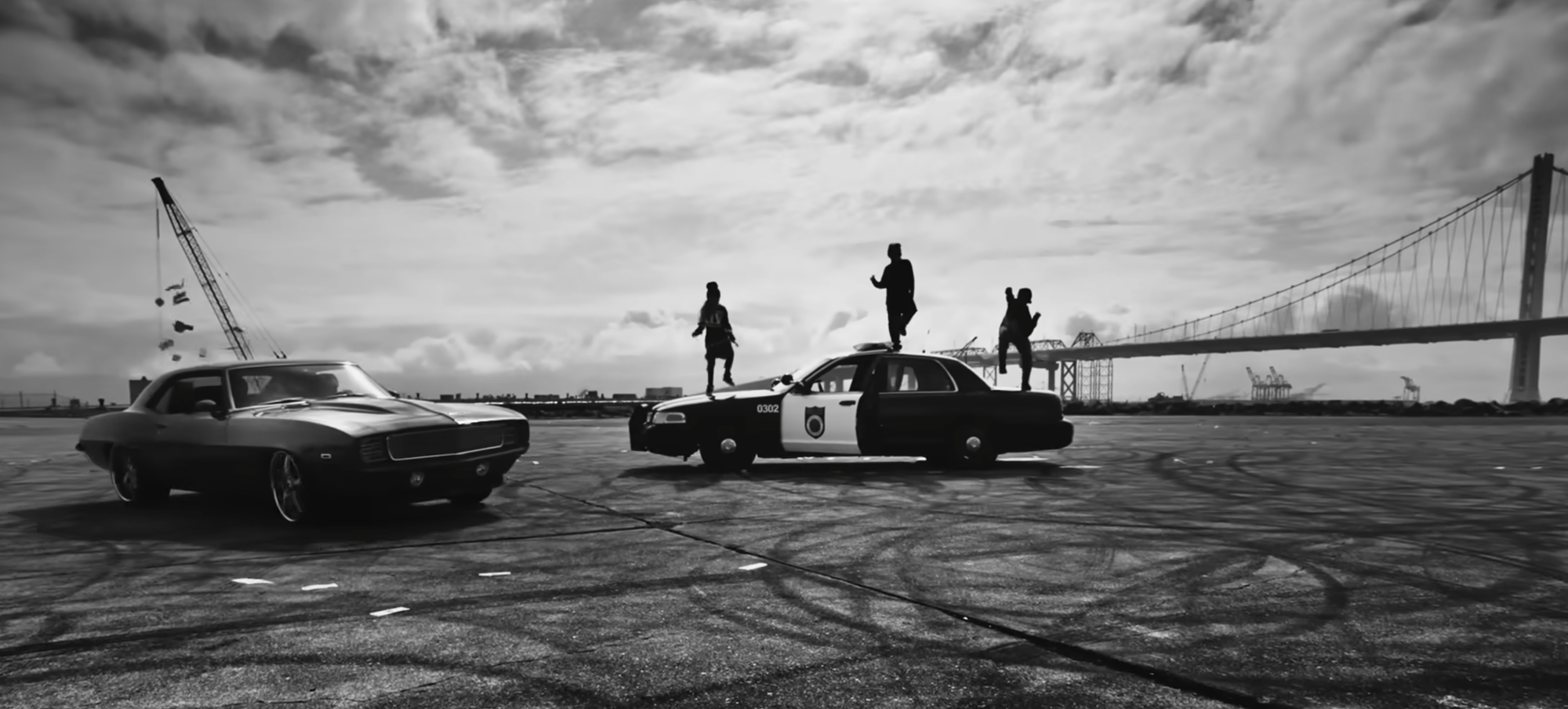
I also think we get an insight into Kendrick’s interest in Oakland, not just as a producer of sound but also as a signifier, in the video for “Alright,” from 2015. The video begins with the staging of a sideshow on Treasure Island. You see the cranes from the Port of Oakland in West Oakland rising in the background. Kendrick is in a Camaro spinning donuts around a cop car with some young kids dancing on top. And then later, there are turf dancers on the steps of the Alameda County Courthouse. He was putting so many signifiers together. You have hyphy culture, sideshows, turf dancers. You have sites like the Alameda County Courthouse, where Huey Newton was incarcerated and where the Black Panthers regularly staged “Free Huey” rallies. And then you’ve got the song, which basically became the anthem of Black Lives Matter in 2015—a song of political endurance. “We gon’ be alright.”
I think it’s intentional that Oakland sits at the center of that constellation of meaning. The city is framed as an exceptional site of Black struggle in ways that hark back to the Panthers and militancy and organized political movements, but also that continue to reverberate through these particular sound cultures and movement practices.
Alex Werth is a geographer, DJ, and housing justice advocate. He’s the author of On Loop: Black Sonic Politics in Oakland from University of California Press.