Body language
Welcome to Week 2 of Touch Week. That’s right—we’re extending last week’s theme in our “Six Senses of Oakland” membership drive. Read more about the drive here. Check out other Six Senses stories here. Caress that subscribe button here.
◎
Writing is such a solitary act. Reading too. Just one set of hands typing or gripping that pen (and later another set of hands scrolling or page flipping). Words crossing space and time allow two people not to touch, to stay mediated always by a paper chaperone. But the right words will fire up the receptive mind and create riotous bodily responses. And then, when the lights are low, and we’re all in the same room, listening to the same words, what channels, what portals might open, connecting one body to another (even without any touching at all)?
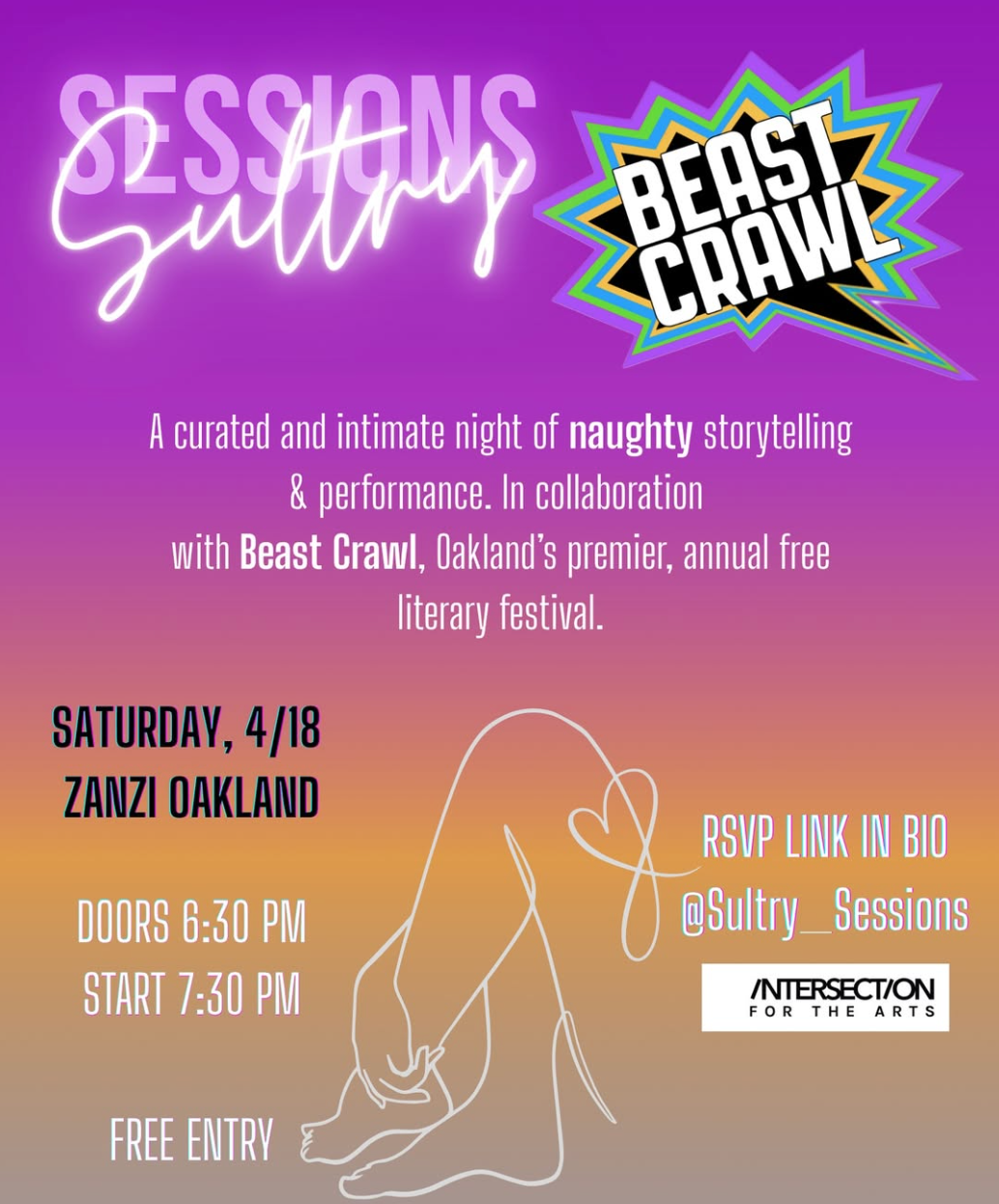
More to the point: here in downtown Oakland an erotic open mic series called Sultry Sessions is held on the last Wednesday of the month in downtown Oakland, exploring all the romantic and titillating pleasures we keep in our memories and imaginations and offering them from mouths at the mic to our eyes and ears in the moment. Verbal expressions of a horizontal desire is what we’re talking about, to butcher Shaw, which dials awareness of the audience’s own sensorial experience to eleven.
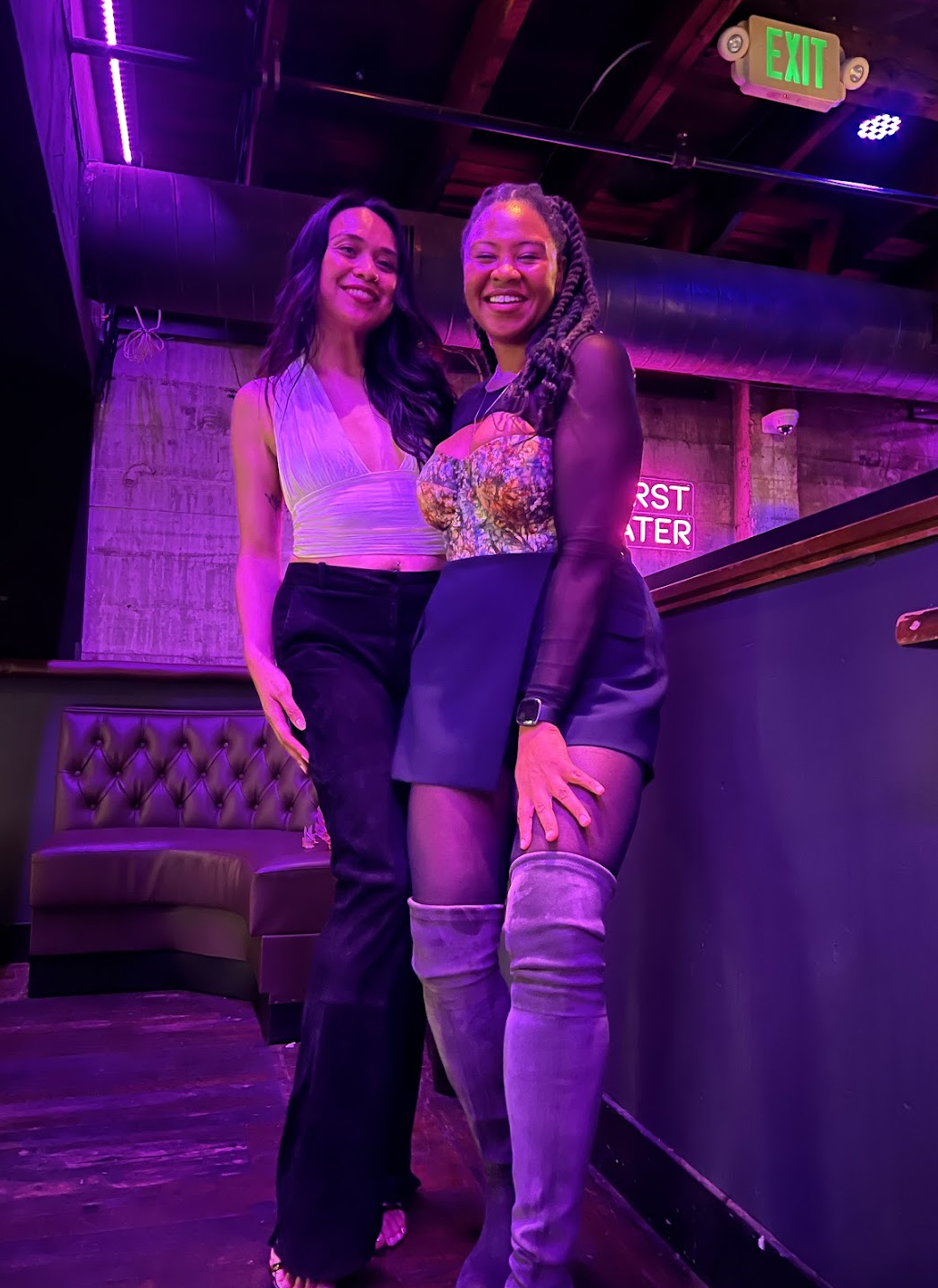
Melanie and Ada host Sultry Sessions to celebrate BIPOC community members’ most sensual sides, building community, connection, and sexual positivity one Wednesday night at a time. They’re celebrating their first anniversary this spring and ORB wanted to know: how do you like to touch and be touched? Consent should be verbal and enthusiastic, after all. So in the low light of Clio’s Books, we met up for an intimate interview, stealing Melanie and Ada’s own invention, and talked about what it’s like to say out loud and in public the most private and intimate words we have.-MS
What led you to want to start Sultry Sessions?
Ada: It was a process. Melanie and I met a few years ago, and instantly, we connected. I'm a writer, and I mostly do non-fiction, flash fiction, poetry, and I was on the open mic and literary performance scene, and I was dragging Melanie to all of them with me. I introduced her to a scene that I had grown to love since I moved to the Bay Area, and it's just fostered my creativity, passion, and what I want to do for the rest of my life, and I loved getting to share it with one of my best friends.
Melanie: I love going to these readings and supporting my boo here. But for me, I wasn't really relating to a lot of what was being shared in the spaces and places that we were in. And I had traveled to DC, and usually when I travel, I like to just find some random ass shit to do, and so I came across a sexy storytelling event, a bit similar to The Moth. But, you know, sexy. So I was talking to Ada, and said, What if we could do something like that here in the Bay Area? The additional lens for me, though, was also that I wanted it to be BIPOC centered.
I'm not a writer. I just write for Sultry Sessions. But I like to process and digest my erotic exploration. So everything I write has either happened, or I want to happen. Like everything, except one piece, is from my life's experience. I take a scene that I enjoyed, and I'll start there and then add the emotional context and all of the things that either led up to, or what I felt afterwards, like the surrounding package of it. And I wanted to be able to share those things with an audience whose life and background aligned with me, you know? Like, if I mention a certain song, I want to know they will get it, if I mentioned a certain culturally popular time in the nineties or particular artists. I think those elements came together to be, like, Okay, let's talk dirty and I want it to be BIPOC focused.
I had been curious about the decision to organize it as an open mic instead of a curated series. It sounds like that came out of the open mic world being where you feel welcome? And that’s the vibe that you want to help create for others?
Ada: Open mic fosters community, rather than exclusivity, and I think that's why Melanie and I resonated with that from the beginning. We want everyone to have a chance to showcase and platform their art.
Melanie: I hadn't gone to a lot of curated readings. But since I moved out here in 2011, I would go to a lot of open mics. It’s a strong tradition in the Black community, with music and poetry, and all of that.
Ada: We’d been sitting on the idea of Sultry Sessions for like a year. Then in January 2025, I got back from a trip and texted Melanie, “Okay, so I'm gonna start emailing venues.”
Melanie: Oh, she didn't text me before. She texted me after she had done it. Let's be clear!
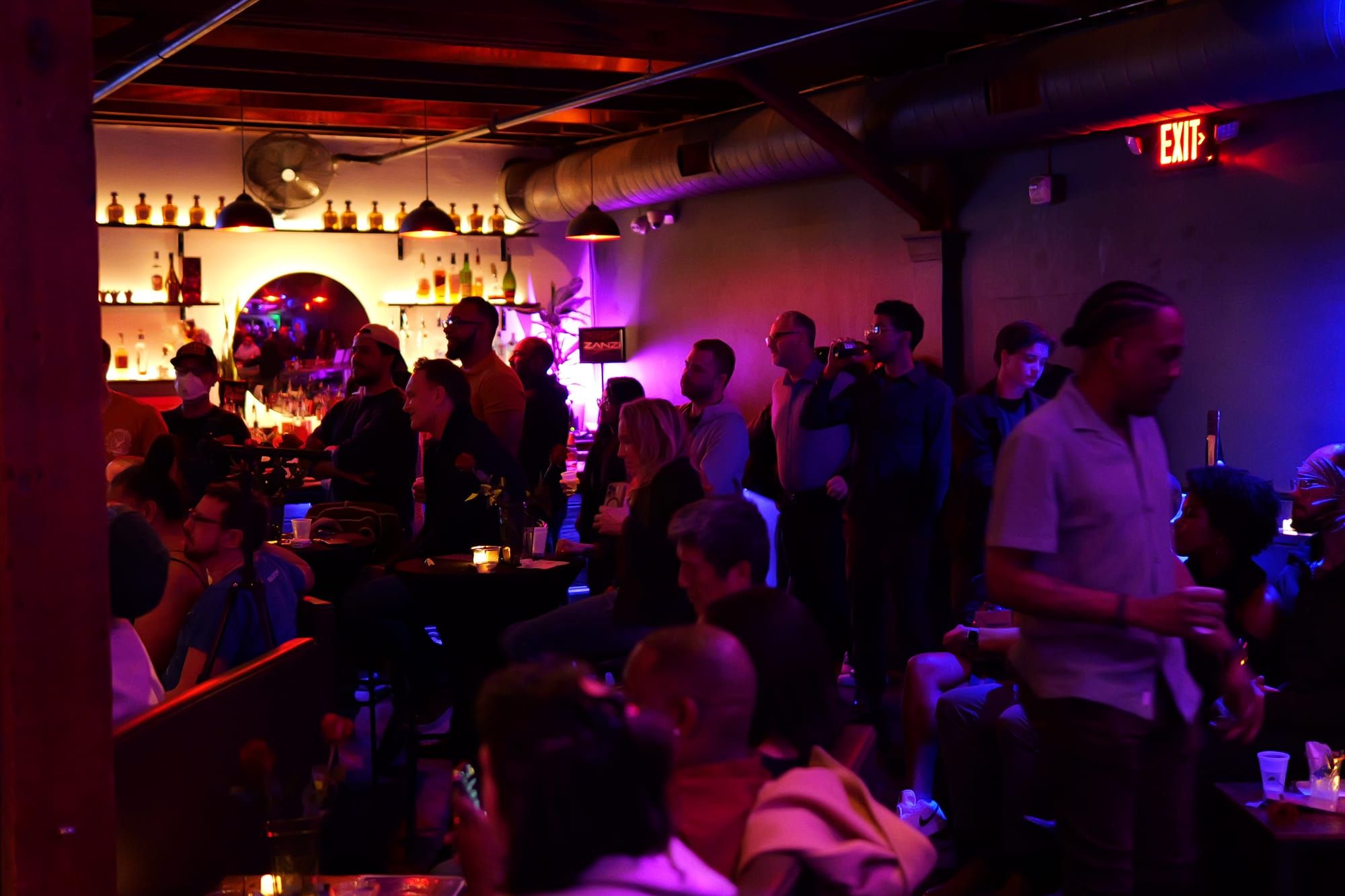
Ada: I honestly don’t know why. I just decided, It’s gonna be this year, and from the beginning we wanted it in Oakland. A lot of the open mics and literary events I was going to and taking Melanie to were in San Francisco. So I started emailing, and Zanzi was the one who got back to us first. The owner, Mek, was really agreeable. He was like Okay! Art, sex: great. I like the vibe.
Melanie: It's always kind of a mindfuck going in that space because it used to be Era Art Bar & Lounge. When I was in my late 20s, I would be all through there, drunk, partying. So, walking in there and being like, Oh, this is bringing back memories of those fun wild party times! We pitched it as a one-time thing, and he was like, Oh no, you're gonna do it multiple times. We were like, we're gonna think about it, but if we do, maybe quarterly. He matter-of-factly said, Then you're gonna lose your audience. And that’s how once-a-month was born.
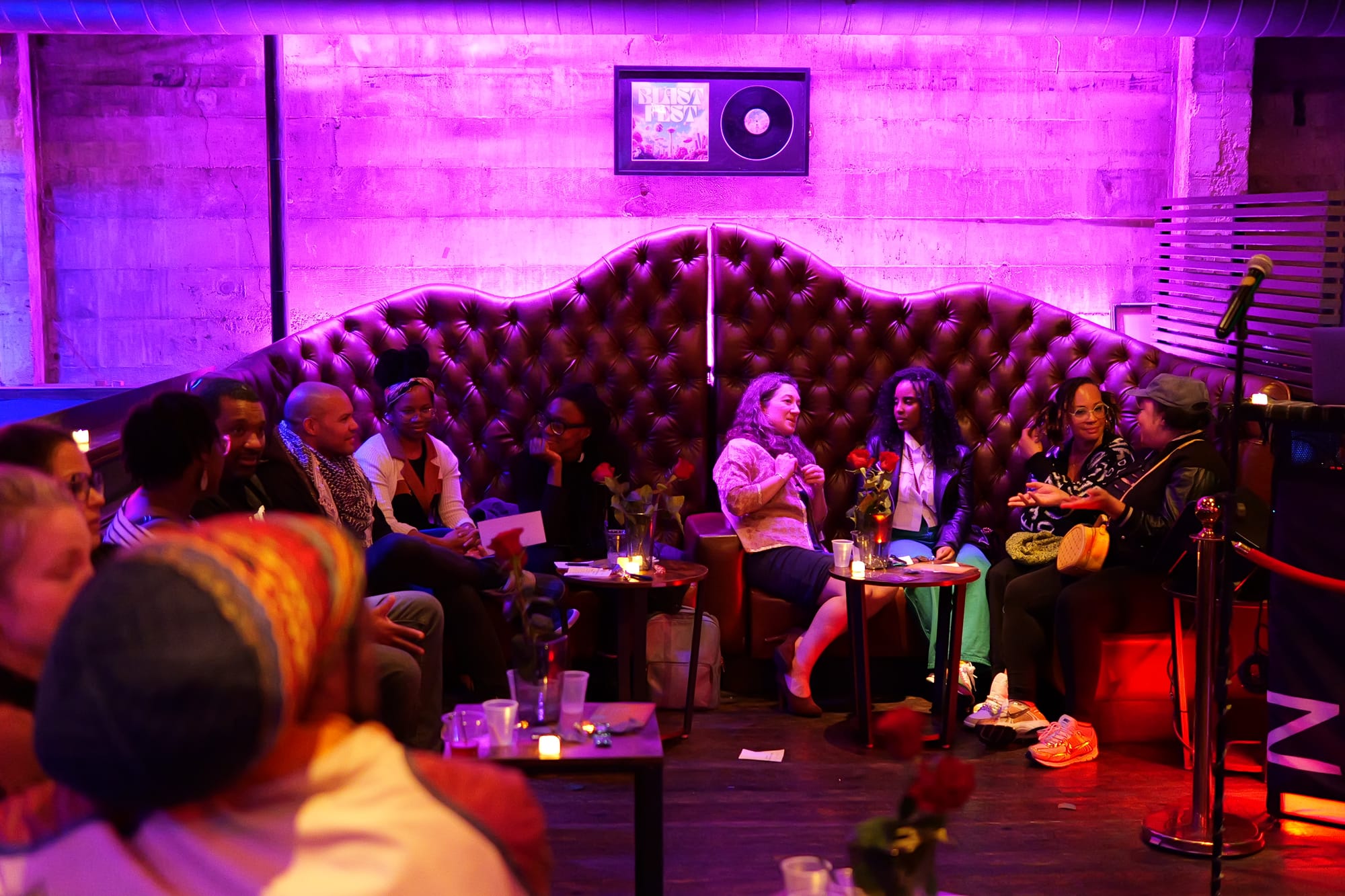
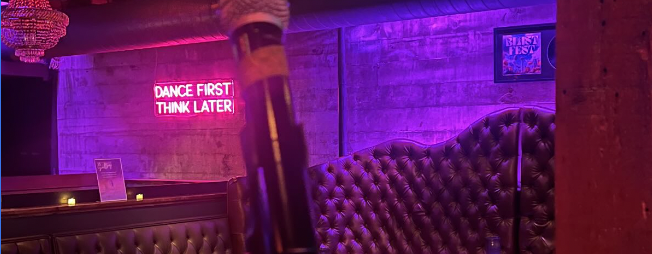
I would describe the space as loungy, but cozy, like a very sexy living room, with all the couches. You go in through the tunnel, and then it's a very speakeasy feeling. When you come up into the space, your host checks: Are you on the list? Do you consent to the environment you’re entering and its rules? I was, like, oh, I really like how that feels.
Melanie: That part of it is definitely from my time in play spaces. Sexuality and erotica, outside of this, are a large part of my life. In play spaces, you’re always making sure that people are comfortable with the things that will unfold and have some framework for what's coming next. Even though it's an open mic, we do have guard rails on this situation; that's very intentional to make sure that people are, from the jump, consenting to what they're gonna hear about.
I also really love that there's like this dual sexiness to the parts of the night, in that people can sign up to read for the slots where recording is allowed (and encouraged!) or, also, for the slots that forbid all cameras. It’s not that one is better than the other, they're just both sexy in their own ways, the public and the private.
Ada: I want memories of my performances, and I also want to market myself as an artist, on the scene. That's my viewpoint. But Melanie made the point that that's not gonna be everybody's jam.
Melanie: I am about six years older than Ada, and I'm not on Instagram outside of Sultry Sessions. My last Facebook post is from, like, 2013. And coming from play spaces, where cameras aren't allowed, and wanting space for people to be vulnerable and really be willing to be explicit in their descriptions. Then, also, thinking about myself: I don't necessarily want that reading to be on the interwebs forever! But I am more than willing to share and cultivate that energy and vulnerability with people who are reciprocating it at that moment in time. And so, in talking about the idea with a friend, she was, like, Well, why don't you just do both?
Is a play space always a sexual space?
Melanie: It doesn't have to be. At a play party, there are lots of things that are happening that aren't genital-focused sex, or penetrative sex. There's other forms of play, like body paint, and people are able to paint one another, nude or in lingerie. Or with sexy coloring books, sexy games. Sexy play is a level of freeness, and engaging one another's bodies in a different way than you might imagine sex to be.
I'm wondering about your writing practice: tell me about description. How does that connect the body and mind for you?
Melanie: I journal regularly, but also, because I'm in the play and kink community, I think a lot about specific experiences. And right now, I'm in the early stages of transitioning my career into somatic sexology, which is really connecting, exploring, and potentially healing aspects of mind and body through erotic engagement and pleasure.
I start with my encounters with partners, and the things that made me go, Oooh, I really like that. I am also into kink, and so the other part is wanting to learn more, or get better with a skill, and thinking about particular moments where I felt that way. Or I start with a particular scene or a particular type of sex that that occurred in my life. Then, build out from there. For instance, the first time I met my ex-fiance and all the things that happened around that on that first night and then the entirety of that relationship sexually, beginning to end. I lost a lot of weight in early 2022 and, so, engaging with my new body, connecting to and feeling sensations and the descriptiveness of that. That’s the foundation, and I go out from there. I like to get really descriptive around the actual sex.
How do you find the words to help us feel what you feel? What are you inspired by? Do you read erotica? Melanie, having heard your work, you're not cliche at all in how you're describing sex and kink. I'm thinking of the bathtub scene you shared.
Melanie: I write exactly how I would talk. I'll write it graphic and dirty, immediately, and less artistically. I knew in writing the watersport piece that I was not going to use the word “watersport.” I wasn't going to use any of those words. I would use pieces and parts so if you're paying attention and even if you have just a small experience with kink, you can put the pieces together to know what I'm talking about.
It was subtle and beautiful, and very focused on the sensation. What about for you, Ada? Are you bringing the same kind of open mic practice to sultry sessions, just, like, dialed up to ten?
Ada: I like to read poetry before I write. I love lyrical language and the musicality is delicious and natural to me, so I like to bring that to the pieces that I write. I start with a scene, and from there, I draw it out. When I am writing for Sultry Sessions, it starts as a scene in my mind. It's easy to get fantastical because the topic of sex and and sexuality is so rich, but I come back to the reality and realness of it all for me. The most recent piece that I read was definitely more of a memoir. Melanie said, “Well, that was the most personal thing you've ever read!”
When you’re thinking about writing a scene, is it describing actions, having rich character interaction, or getting into the dirty details of the scene that is really like the thrust of it for you? [M&A appreciate the pun]
Ada: When I'm writing, I get too much in my head until I'm actually reading it in front of people, and I realize it resonates with the audience. So, thinking about how it’s going to land and be received is a big part of it. But because I am a writer, everything is the thrust for me! Actions, characters, details. I love the editing process, but I also foster the artist in me.
Melanie: Another difference is you are a writer, and you write for your things to be read. Even before we began, I remember thinking, the way I write for a reader is very different from my expressiveness in person. So when I write, I'm coaching my own behavior in the piece, like wink here and I don't use full sentences. I'm not writing for it to be read by someone else. So in the beginning, I had to pivot, very intentionally, out of that. I was like, oh, I wrote this, but I wouldn't read it like this. Like, this sentence is too clunky like there. It's too many pieces. That’s not how I would talk about it if I were describing connections.
I'm white, and I am in white spaces a lot, and I really liked going to Sultry Sessions being like, Oh, there's a whole scene out there that I'm not a part of, and I'm really curious about that, especially the open mic scene and the invitation of that openness and the history and the culture of that in the Bay Area. I'm also intrigued by thinking about writing that's meant to be performed and experienced aurally. And with an open mic, you have that audience becoming the readers and switching, like you are just all in it together.
Melanie: Well, from the Black tradition—and I don't know as much of the historical context as I’d like—but for me, growing up in the A.M.E church, I would have to read poems on Easter Sunday and Christmas. So I was a kid giving a piece, a poem that I'd have to memorize and then get up and perform in front of the congregation. When I would go to open mics, I felt the connection to that of, like, oh yeah, that’s familiar! Projecting the energy of these words and an experience.
Now, as an adult, seeing people who have embodied the piece, memorized it, paced it out, and are performing the piece in the same way that you would have done if you were at church, the irony is, like, back then, I'm talking about Easter, or like Christ is Risen; now, I'm, like, Oh, no, it was Jaquan! He definitely rises!
It just makes me laugh, when I think about that skill that my parents probably had a very different vision for. And now I am relying on it — in a different way!
Let’s talk about logistics. In an open mic, how do you make sure it centers BIPOC experience, and queer experience, since an open mic is, by definition, open. How do you find that balance between having a focus and a priority and wanting to see how people volunteer and what comes through?
Melanie: I’m intentional about where I'm reaching out. Like, yes, I love papering the poles. But while doing that, I'm talking to people, and I'm very intentional about where I'm sharing the information. I'm handing out flyers, inviting people. And we put it on Plura, a sex-positive event-based app.
I identify as a Black woman, cisgendered, queer, very sex-positive, non-monogamous, polyamorous. Existing in all those different communities and finding people in those communities has always been part of my life, and as I find people like me, or who align to those pieces, I'm like, yes, please come to Sultry Sessions, because I want to hear pieces and parts of your journey. And if I'm able to, reflect back parts of your journey to you, that have happened to me as well, that's been very important for me.
If it gets too far off from connections to my interpersonal, I'm like, naw. There were three performances, in either June or July, that were not erotic, or on topic. Two of the performers were white. One guy got up to talk about being vegan, and in the beginning, I was, like, Okay, I know he's gonna get to talking about eating pussy raw. But he never did! There are a hundred other open mic spaces where he could have gotten to do that besides this erotic, BIPOC centered space. There was another guy, who did a sound bath, and didn't even try to make it sexy. So, we try to emphasize that we have one lane, and we're very clear about that now, in the messaging we put out. And then we came up with a shutdown procedure for anyone getting out of that lane.
What does it feel like to define and run this space now? Has it changed your relationship to sex to be the ones like defining this and running it and choosing the vibe for everybody.
Ada: I'm so grateful that Melanie exists in these places, to help define these terms of what human sexuality is. Because I am not in those same spaces. I'm monogamous. I've been with my husband for ten years and my sexual adventures have mainly been with him. For a good chunk of it I felt like, I am not living up to what this presents! Who am I to be speaking on this?
But now, there are so many couples that go on date night, and will come up to me and say, “Oh my, gosh, I feel like I just want to go home and have sex with my husband or wife.” And they don't necessarily have to have crazy sex all the time. Which is like, amazing, if you do! Intimacy is such a spectrum and it’s sexy. It's such a dream!
It sounds like you feel like you're giving a gift to a lot of people in the audience, which is such a good feeling.
Ada: I didn’t have any expectations. I was, like, Okay, sure, let's do this, not knowing what it would do to me personally. But I knew it was gonna do something. I think that for me, mainly, it's been: How am I going to explore my relationship with sex and realize the different avenues I could take for myself and for my partner? I also think that the biggest gift is the community, just the people that we're meeting, and the artists that we get to hear. That's just been the biggest, greatest joy. Every time we end, it's just always such a good high.
The time that I was there, at the end, someone was like “There's twenty shots of Patron at the bar!”
Melanie: That was a really fun thing that was very sweet. That's a sweet patron of ours.
Yeah. I was like, “Patronize me anytime.” Melanie, as someone who doesn't identify as a writer—although, now, you write, so now you are a writer—has writing for the open mic session changed your relationship to sex? Has it changed your relationship to writing?
Melanie: It has changed my relationship to writing. For me, it was always intended to really be a gift to my community. From the first session, it’s been intentional to set up, “This is an exchange of vulnerability.” Since this is an exchange of vulnerability, it’s not a space in which I can ask for something which I'm unwilling to give. And not that everything has to be transactional, but reciprocal feels good.
In terms of my relationship to sex, when we started, I was in the play community, but I hadn't found a very specific Black play community. Sultry Sessions brought me to those individuals who were in this group. I had heard about them in other places and spaces and I actually had met some of them before, but the universe was moving in a different way then. Now, two years later, they’re here. That has been really important and transformative for me to be in a community where I'm reflected, where I'm held, and where the experiences that we've had in life and with one another are similar and sexy. The other thing that I'm loving is the number of cisgender Black men who get on the mic and talk about sex in a way that's not degrading, but more emotive. It's created a space for that to occur. That’s happening in an artistic way during the open mic section, but also during the “Intimate Interview.” The interview piece of the night is very intentional in inviting the community, because there are people like myself, who would think, I don't have the time to write a piece every month, or I don't consider myself to be a writer. But their life experiences matter… just being able to hear: You know, I did this thing. It went all bad. I almost burned the house down. The wax play was great, but the candle got knocked over. The experience of, I tried something new with someone that I was being intimate with. It didn't quite go the way that I thought that it would, but it created such meaningful connection. Or like, I tried this thing that a lot of people fantasize about, and it wasn't as great as I thought. Or it was!
So this last show, in February, we had Valentine's Day and Black History Month all coming together, so the couple that performed—both a real life and performance couple, Medusa Sting and James, she did a chair dance, that led to a floor dance, that led to a backflipping lap dance into her partner's lap, and he picked her up, and like they had a really beautiful moment where she was straddling his shoulders and he was holding her, and they were looking into each other's eyes. It was such a wonderful and beautiful expression of love and Black love and just like the passion, and they're six or seven years together, so that’s not new relationship energy. Then after that, they agreed to do the intimate interview. I wrote three questions specifically for them because I knew they were a long-term couple and hearing their reflections after seeing their connection felt so warm, affirming, and deserving of celebration
Can you talk about how you try to get people to engage with their senses while they're at Sultry Sessions?
Melanie: The vibe is important! It’s cultivated and intentional. If we’re going to do the flowers, let’s do the chocolates, let’s create opportunities for conversation and connection. Let’s help people get comfortable with one another and themselves.
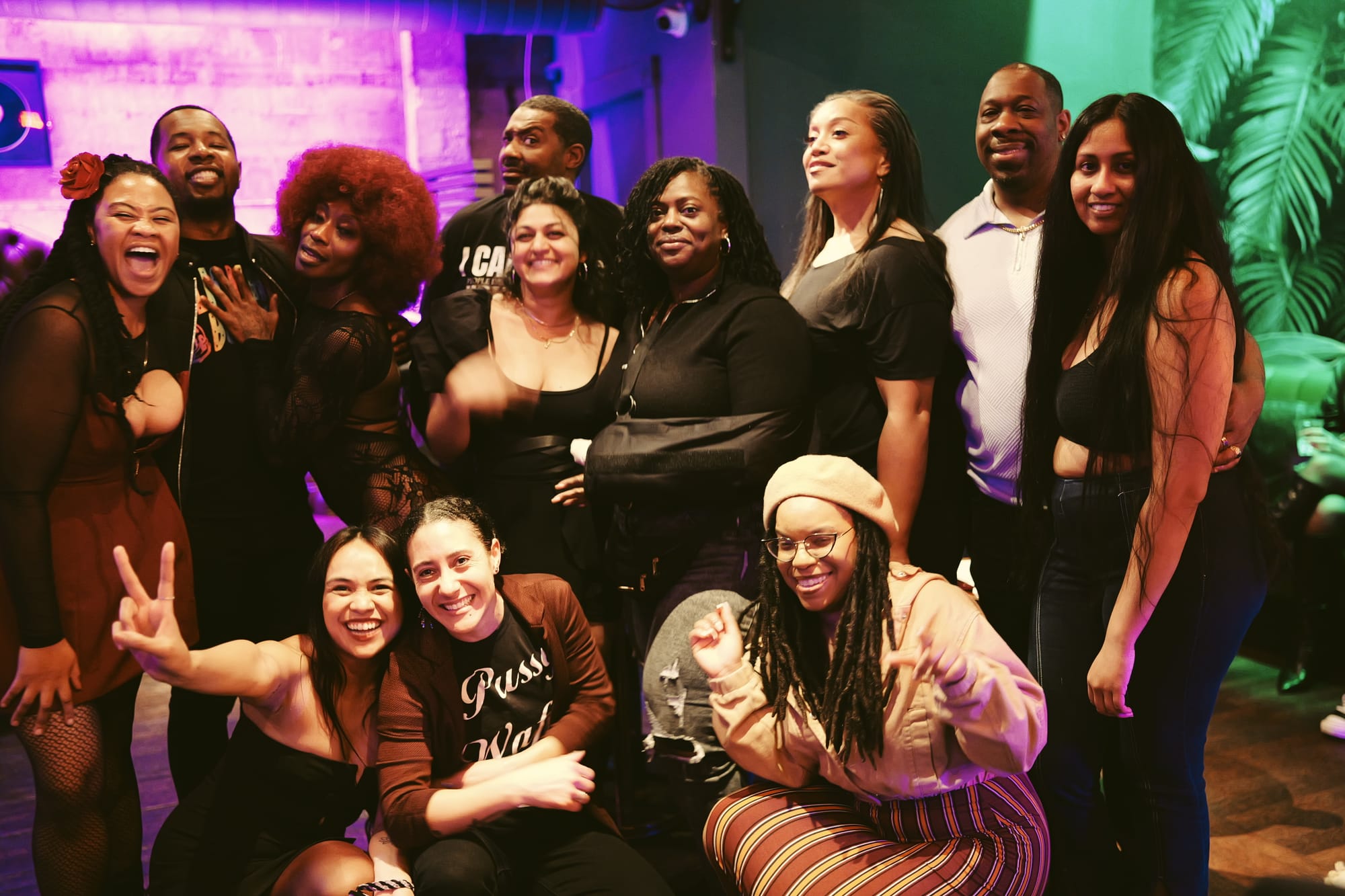
Ada: The lighting was actually red in the beginning, and then they were changing the colors and we were like, “Oh you can do that? Let’s do purple!” Zanzi had small votive candles, and we decided we needed more, we needed them everywhere. Let's set a sexy vibe in the space. And around June or July we decided to do our Sultry Starters to get people to talk to each other, because it did become apparent that it's a great date night and meet-cute event. It's not super expensive, it’s free-ninety-nine! You can get whatever drinks that you want to get, you can bring food into the space. And then the other thing is, if you're with a newer person or in a newer relationship, you kind of get to see what they are interested in or what draws their body language, or what they're extra leaning into.
How do you notice people's bodies in this space? When I’ve been, it’s been full, everyone's filling up the couches. Do you feel like people are more and more aware of their bodies as the evening goes on?
Melanie: I'm watching body language all night long. Watching the couples that are like, cozying up to each other. I'm watching the hands meander, or I'm watching, in between and in the breaks when there are couples who will start making out a little bit. I'm watching body language constantly! The last one, on February 14th, just filled my little black queer heart with joy because there were so many queer couples right up front who were just cozied up to each other, hands wandering. I was briefly distracted by a group of three women midshow—and they know who they are! For me, the energy in the space is paramount. As long as it feels welcoming and relaxing and beautiful.Ada: That's the difference between this and other open mics in a bar: a lot are not really, intentionally creating a space. For myself in this space, I’ve been making more of an effort to notice my own body language. I realized I need to connect with people more, so I make an effort to move my body, go talk, get to know my community.
Melanie: Yes, you have gotten way more extroverted! In the beginning, she was like, I don't want to talk to the strangers.
Ada: Yeah, get me up at a mic, and then I'll do my stuff!
So for Melanie, the community and the energy is paramount, and for you Ada, it’s the art and performances. What a combination! Can you share with me your favorite memories? Stories, performances that have resonated with you or that you've seen the audience really respond to. Moments when you’re like, That's what we're here for!
Melanie: Oh man, there have been several of those moments for me. One of my first favorite pieces, I think her name was Janine, she did a piece about sucking dick, and she opened like, making the noises. And then she talked about there being flies, and about being slightly distracted. And for me, I was like, yes, she is hitting all the things: the artistry, the description, sharing what she's thinking and being. That was one of those moments where I was, like, okay, like people have picked up the lane and they're running in it, and I love that.
There's another artist, Poetically Divine Tay, and she did a really, really beautiful piece about love, and it was much more emotional, not as sexual, but all about the ways that she is loving and engaging with her partner that I really, really liked. That felt really good. Um, and then in general, I love first timers. Like, we literally, when I say we love first timers, I love first timers. I love people who get up there, and they're like, I don't really write, but then go off. I love it. And the fact that they would pick this topic to be the first topic to write and perform in makes me so happy. We had a recent performer who is on the open mic circuit pretty regularly, I would say, and he's more focused on social justice issues, and for him to pivot and come into the space in this way—I love it!
Ada: There have been so many people, especially the people who have been coming and have never performed. Like Hassan, he’s been at Sultry Sessions since Day One, coming to watch and support from the audience, and after a few months, he finally performed his own piece! He’d never written or performed before, and now we expect him to be up on that mic every month. And then, Jahan, our awesome resident bartender at Zanzi, she had never written or performed at all either and all of a sudden she just came out from behind the bar, and was like, “I don't write or anything, but this is something from my phone.” So amazing!
It's in the notes app!
Melanie: I am definitely writing in the notes app.
Ada: And I didn't realize that was kind of the purpose of this. As an artist I thought, Okay, an open mic for writers, poets, musicians, but no, this changed into a chance to break down strong barriers to let your heart show. Let it all out there to share it with us. Then, we're gonna hold it with you. And if you're not ready for it, that’s okay! But if you feel compelled, then do it!
The tradition with an open mic is sort of, anything goes. When I've been at Sultry Sessions, it's been mostly like verbal storytelling. Have there been other notable non-literary performances that really brought something to the space that that you want to see more of or that you celebrate?
Melanie: Yeah, we've had a couple of songwriters! We had a very sexy songstress named The Alchemist. And another songwriter, who plays a guitar, and she did a piece about falling in love with someone in hospice and them dying, and then fucking somebody else on the grave. It was a whole experience. And she got people to sing along! That was really fun. And we also had a professional hypnotist for a little bit while who works with clients and their desires, using hypnotism as a tool, and he did a couple of demos.
And now in 2026, you have been bringing in movement artists.
Melanie: Yes. And I think what kind of makes us a little bit different. We’re all about creating that space and place to have any form of expression around erotic energy. Of course, you know, the writing is crucial, and the performance and all of that. But for me, that's the North Star: how can we make the space erotic, vulnerable, enjoyable, and community-focused? I want people to feel like their three hours are well spent, and fulfilling, and enjoyable, and then that they want to come back.
Let's define erotic: what does erotic mean to you? What is that energy that people are bringing? In romance novels, there’s levels of spiciness or steaminess, for instance, versus full out erotica. Audre Lorde has an essay about erotic energy that discusses the erotic as this embodiment of reciprocal, creative energy, not just a sexual fulfillment energy.
Melanie: I'll draw on recent experience and information. I am reading Radical Relating: A Queer and Polyamory-Informed Guide to Love Beyond the Myth of Monogamy by Mel Cassidy as part of a QTBIPOC poly book club, and Cassidy talks about the four quadrants in your relational landscape: social, practical, emotional, and erotic. What resonated with me when she was talking about “the erotic” is that raw, creative, playful space from which you move and engage with others, or even yourself or even your own body. That immediate creativity, spiritual energy that if you release it, then it's allowed to just roam and play. I think that's a big part of it, and also because I have a dirty mind, I’m like, AND SEX. Yeah, even with the body painting, or pussy portraits. All the different ways that you're engaging with that creative energy and sexuality at the same time.
Ada: I'm going to get very nuanced. What’s erotic for me: so I'm getting ready for Sultry Sessions, and I’m always rushing because I’m always late. But then, getting ready, getting on my outfit, and my husband and I look at each other, and he slaps my ass, and I look at him, thinking we are so into each other. That’s my mindfuck. That’s erotic. And that inspires me throughout the night. When I'm reading something, I just get the audience going “Mmmm,” and I know I've hit it. I’m reminded that WAS hot, I’m hot, and I feel something, right here in my core. That's erotic for me. And I look at someone in the audience, make that eye-contact and something's just hit that quadrant for me. Leaning into the feeling, the raw, the sexy. That's erotic.
Melanie: Music for me is so important. When we first started, we had a DJ. Bless this man’s heart. We wanted, you know, sexy music, and I think I realized he was not gonna hit the nail on the head when he started playing James Brown. Which, don't get me wrong. Love me some James Brown! But we wanted to drive in a very particular direction and not just during the breaks. It became clear that the music charges that moment after the performance. DJ Blackwoman has been an absolute blessing and is so very integral. At the readings I’ve been to, music was always missing for me. And music is so important. Sexually, I'm one of those people where even if the playlist is right, and then the lyrics start talking about some random thing, I get completely distracted. DJ Blackwoman has really been a gift, because from the first time she came, she's, like, yeah, I got you. And it's been a gift ever since.
Coming from the writer's perspective, does it feel like now you're seeing writing in conversation with other kinds of art and music?
Ada: I think so. I mean, I'm not gonna go and start playing guitar, but I think for me, it's created a sense of appreciation. Poetry open mics dominate the performance art scene. It’s hard to find prose-specific spaces, which is what I mainly write. And I think for me, it's just kind of opened doors: What kind of artists are coming here and what can I be exposed to? I don't want to just stay in my corner, and just do the same things. I want to learn other avenues for art and bring it into my own creativity. Maybe I will play guitar, I don't know! That's how you cultivate more art, being around other artists.
I have a real body question that's gonna take us outside of Zanzi, outside of just the one night. How do you touch Oakland or get bodily with Oakland? What are the ways that you, your body experiences this place? The first night that I was at Sultry Sessions, I became so aware of my body, that as I left Zanzi, I was like, super sticky, because it was a hot night and you had packed the place, but then I was walking and it was cool, and the moon was out, and I was just walking in the city and feeling my body differently in the city as I was walking through it.
So, for you, what is it like to be embodied in Oakland now?
M: I live in Oakland; I own a condo in Oakland. I have Oakland tatted on my body! Oakland is a part of my life, like a part of myself, part of my energy. It has meant so much to me. When I met my ex, I moved to Alabama and quickly realized that was not a space or place in which I could thrive, and then to DC, which was great, but it was not Oakland. And so I would say, now, it's just walking, in the air. Like yesterday I went on a date with a friend, and we laid out at the lake and fondled each other and made out a little bit in the sunshine. For me, that's the tactile part, of literally touching community, but also, like, being out in community, making eye contact and smiling, just feeling that connection with people. Moving through the world! The trail runs. Being in among the trees up in the hills. I don't even like to run, but I do like to just be out there to look at the land, look at the place, look at the space. And then, of course, pulling random tabs off of pole flyers!
Actually the flyer part was such a big part of the beginning of Sultry Sessions! So literally touching Oakland, touching people, and like putting the flyers all around the lake, downtown, in the restaurants along Grand and Lakeshore. There was a lot of touching in the beginning: we have this thing, and we want to share it with you. Can you take this piece of paper? Will you come into this space and share emotional touch?
Ada: I live in Alameda, and I grew up in LA. When I first moved here, I lived in Oakland for a year, and then moved to Alameda six, seven years ago.
For me, it was kind of a slow discovery of Oakland because I was so unsure of what the Bay was to me. I moved here with my husband—then my boyfriend—and I didn't really know the Bay. I didn't have any family here. I didn't have a community. And then I slowly started to build that in San Francisco, because my grad school was there. I was always heading to San Francisco for two years, and then I worked in San Francisco, so I was still always going to San Francisco! But then I started looking around me here in Oakland and was like, wow, look at all this art just on the buildings. And I don’t know where else this exists, in such proximity, where you can see one mural after another. So that’s when I started appreciating it. And I think also just late nights, when I’m out downtown and my feet hurt, and I'm having good cocktails and I’m just so alive! I’ve talked to strangers who've become friends when I go out to dinner. It’s been a slow-growing relationship, because I still miss home, but home is starting to rub off on me here.
Is there anything important to you that I haven't asked you about yet?
Melanie: As much as the culture in general has become a little bit more liberal around sexuality, there’s been a real movement lately, a ripple and a drive to pull us back away from that. It's interesting being out in the world and dating and encountering judgemental undertones. Like, people have the context and the knowledge of sexual liberation, but somewhere they've started to also gravitate towards the message of, if you sleep with one too many people, uh oh! Four or five is good, but like seven is too many. This whole question of “body count.” Little pieces of that are starting to come back in a way that feels intriguing to me, but also very disheartening. And it's creating in me a very strong desire to move against it, since it still holds a lot of judgment particularly against women exploring their sexuality. But your sexuality is yours to shape and mold and engage in, and the pleasure that you get to have from your body is your right, and, do not let any of these people tell you that you shouldn't go to a play party or you shouldn't masturbate in XYZ way, or you're only supposed to play in ABC way or the ways that you do want to play are not sexual enough. That's your journey to have with your own body and your own erotic energy.
That's really important to me to say, in this time. I'm not online a lot, but when I drop in, and I'm like, what are the kids talking about? What are the kids saying these days?
Is that a generational shift, or like a bigger cultural shift?
Melanie: I think there's definitely a generational shift, but being in my forties and also dating older, it's been positive to see older cisgender men and women and non-binary people embrace or try to learn the terms in different ways around sexuality and be a little bit more open. The whole idea of a play party, for instance. There's a specific joy in engaging with a demographic that has historically been taught more repressive tendencies toward sexuality and seeing them dismantle those beliefs has been reassuring.
What about for you, Ada? Is there anything that's important to you that we haven't talked about yet?
Ada: Just going into the whole thing, I had no idea what we were getting into. It just sounded fun! I’ve gotten so much out of it, not just for my artistic and creative side, but having conversations about sex in general that probably wouldn't have started for me, both for myself and within my relationship. Like Melanie said, there is a subconscious, repressive thing that still exists today, whether we’re aware of it or not. Sultry Sessions has had a huge impact on my life in that way. I never imagined hosting something like this, but we’re doing it. And it’s so fucking cool!