Can the eucalyptus find home in California?
We’ve reached the olfactory portion of our Six Senses of Oakland membership drive. Read more about the drive here. Check out other Six Senses stories here. Get a great big whiff of ORB by subscribing here.
First published in Arnoldia, Winter 2025, as “Lonely Emissaries: Eucalyptus in California.” Illustrations by the author.
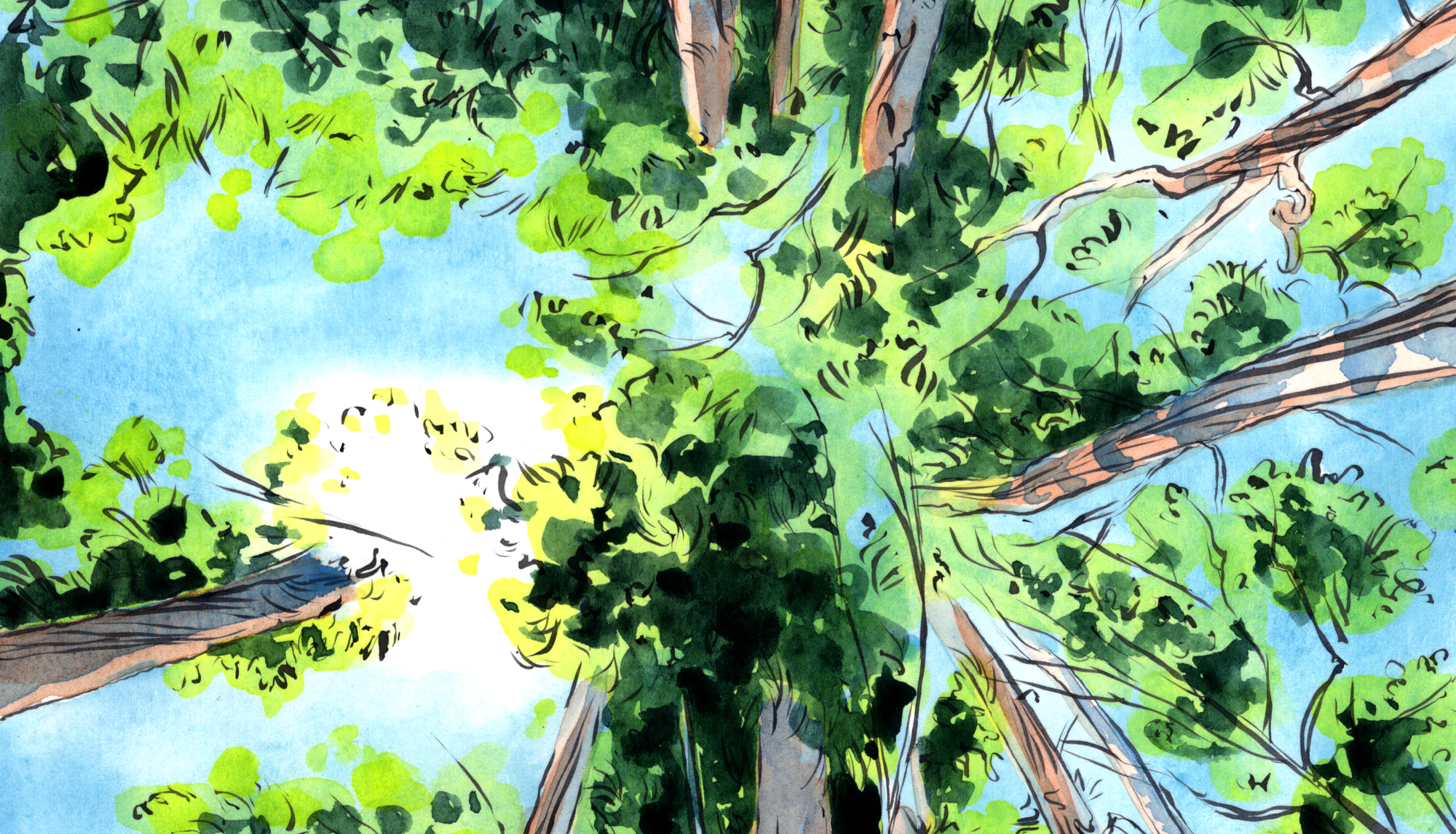
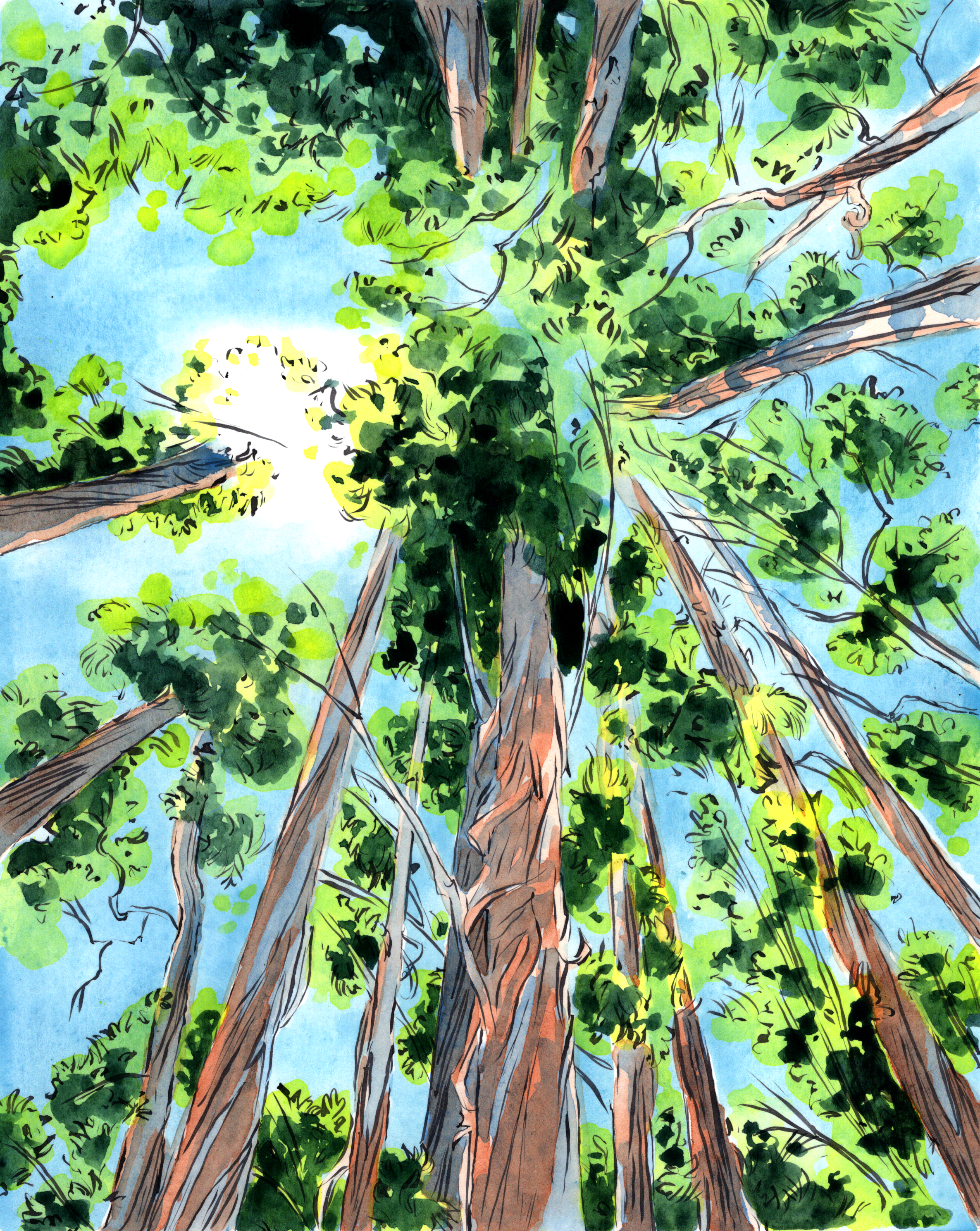
It feels like walking into a room. Passing between the trunks of the great shaggy giants, I come into a grove of blue gums on the University of California, Berkeley campus. There are about fifty trees in the grove, and it is bare of any other plants. The grove is gently removed from the thrum of campus activity. The air and light shift as I enter. Near the stump of a cut tree, I sit at the giants’ feet, on a tough, silver-green and pink carpet of fallen leaves. I pick up a leaf and snap it in two to sniff its crisp zest, although I mostly smell the dust of a dry day. Warm turquoise light falls on my arms, constantly moving, broken into moving prisms by fluttering leaves far above.
It feels like home. And there lies the complexity of California.
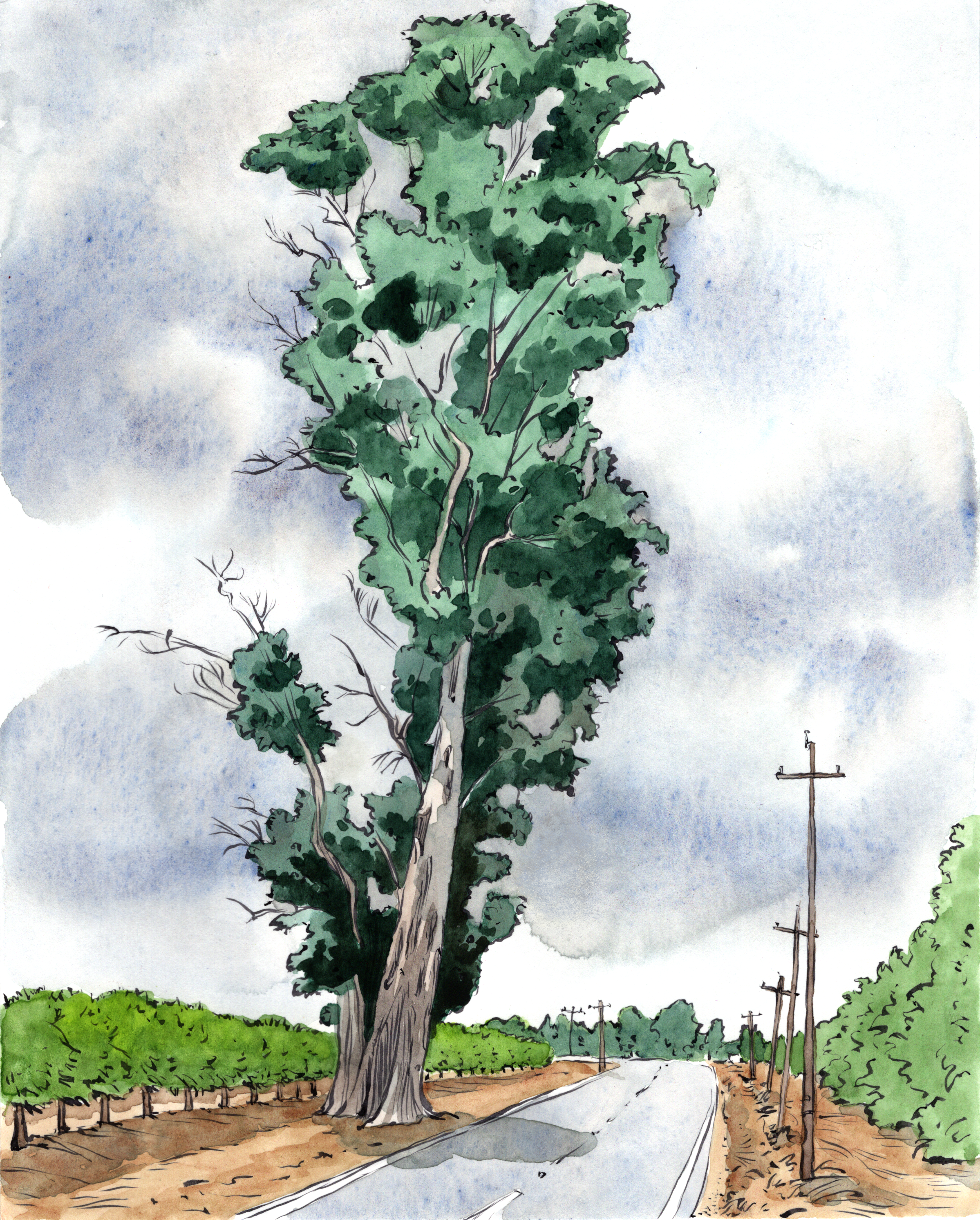
I grew up in California and have lived here for most of my adult life. Home has always been defined by habitats filled with species native to California and anchored by native trees: oak woodlands, coastal redwood forests, willow riparian forests, high elevation pine forests, coastal sage scrub, and chaparral dotted with bay laurel and buckeye. But threaded between these native habitats are the eucalyptus. So many eucalyptus. There are river red gums and red ironbarks lining bike paths in the town near Sacramento where I grew up. Stands of blue gums growing everywhere in the nearby Bay Area, both urban and wild. Groves of blue gums sheltering monarch butterflies in beach towns along the coast. Orderly, aging plantations of closely spaced trees here and there along the length of the Central Valley. And towering blue and red gums standing lonely along country roads, remnants of past windbreaks between farm fields.
Now the most common non-native trees in California, eucalyptus have become so familiar that they are sometimes mistaken for natives. A stand of eucalyptus is not just a visual experience. It envelops us in an entire sensescape, one that is achingly familiar to Californians, and integral to our sense of home. The gentle clattering of pendulous, leathery leaves in even slight breezes. The pale, dry bark in long peels piled around the feet of the trees. The shifting light as the leaves rotate on their flexible stems. The sharp, clean smell of eucalyptus oil. And the feel of eucalyptus bark—soft and smooth like blue gum, or deeply fissured and rough like red ironbark.
Though there are countless introduced plant species in California, remnants of European colonization, migration, and trade, eucalyptus stand out for their size, their charisma, and their relationship with fire. And they have aroused great passions. Loved, hated, and sometimes feared, eucalyptus are integral to the psyche of the state.
Though all of the blue gums around me in the Berkeley grove are rooted in place, they are travelers. From their home in Australia, species in the Eucalyptus genus have made extraordinary journeys around the globe, beginning in the nineteenth century and continuing today. If we consider them in all of their complexity—remaining aware of their effects on their adoptive ecosystems—eucalyptus can help us understand what is shared between all of the countries and habitats in which they now grow. In particular, their relationship with fire offers fresh perspectives on native California habitats and where we are headed in a time of intensifying climate breakdown.
Arrival
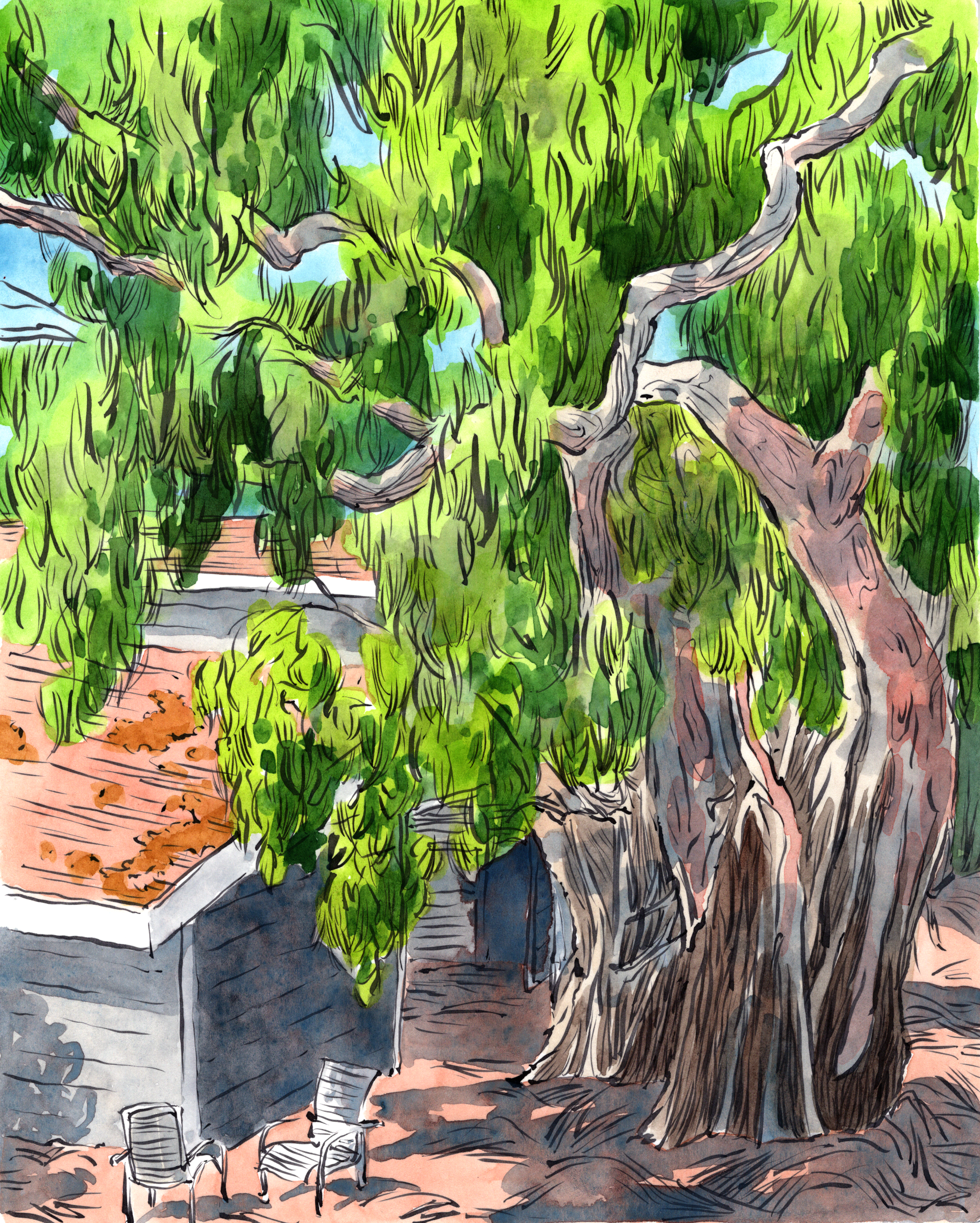
On an early fall day, with temperatures just starting to ease from their summer brutality, I walk down the sidewalk of an ordinary cul-de-sac. A half-hour drive from my home, at the base of the southern foothills of the Vaca Mountains, the street is lined with the usual 1980s and 90s suburban homes. Tucked next to the modern houses, though, lies a very old house with barn and stables. And in the yard is an enormous blue gum, copious strips of bark peeling off and piled at its base. The gum’s size and its proximity to the house are clues that it may be one of the very first eucalyptus planted in California.
The house was built in 1852 by Robert Waterman, a ship captain who founded the city of Fairfield and lived in the area for a while. He is thought to be the first person to plant eucalyptus in the state, his long travels at sea having left him longing for a life on land surrounded by trees. In asking his former first mate to bring him blue gum seeds from Australia in 1853, Waterman joined a growing number of Europeans and their descendants who used eucalyptus to create the wooded parks that reminded them of home. California, as it was, felt too barren, and they leapt to replace grasslands, shrublands, and wetlands with woodlands and forests. Waterman planted eucalyptus all around the Suisun Valley and gave out gifts of seeds so that others could do the same.[1]
Having discovered that Waterman’s house still stood 150 years later, and seeing maps indicating eucalyptus on the property, I wondered if the trees might be some of his original plantings. As soon as I see the behemoth standing next to Waterman’s old barn, I am convinced. Aging trees by their size is no exact science, but even given blue gums’ rapid growth rates in California, the more than six-foot diameter of the trunk indicates it could be the age of Waterman’s plantings.
Standing on the sidewalk looking at the venerable eucalyptus grove, I feel only a whisper of a breeze at ground level, but the rising and falling murmur of leaves high above tells of stronger wind at crown height. I watch as the tops of the trees on their long, flexible trunks sway, each describing their own idiosyncratic orbit, interweaving with their neighbors, bowing and retreating. I think about the old tree and where its seed came from.
Eucalyptus traveled the world not under their own steam, but as tools of the colonial reshaping of landscapes. Their beauty and novelty were the first draw. Soon after Waterman planted his first gums, nurseries began selling eucalyptus seeds, and cultivation took off. They were highly regarded as ornamentals for gardens and parks, as windbreaks, and as erosion and drainage control, all aided by eucalyptus’ rapid growth and great sizes.
Eucalyptus’ swift growth is not just upward into their trunk, branches, and leaves, but also downward, into their roots. In arid climates, eucalyptus must extract as much water as possible from the ground. Eucalyptus’ prodigious water uptake became a valuable tool in many parts of the world where it was planted. Remaking the California landscape to be congenial to European settlement required taming and drying its extensive wetlands. Eucalyptus were an inexpensive and effective solution, helping pave the way for agriculture, urban development, and, later, quite literally, pavement. Drying out wetlands also checked mosquito populations, helping control mosquito-borne diseases like malaria. Malaria had arrived along with settlers and plagued much of California in the late nineteenth century, especially the Central Valley.
Just after the turn of the twentieth century, eucalyptus looked like a solution to a new problem. Intensive logging to meet insatiable building demand across the country had led to widespread deforestation. People were scrambling for quick-growing hardwood alternatives, to quell the fear that the country would soon run out of timber. When the U.S. Forest Service announced in 1907 that Appalachian hardwoods would be gone in 25 years, a frenzy of eucalyptus planting commenced.
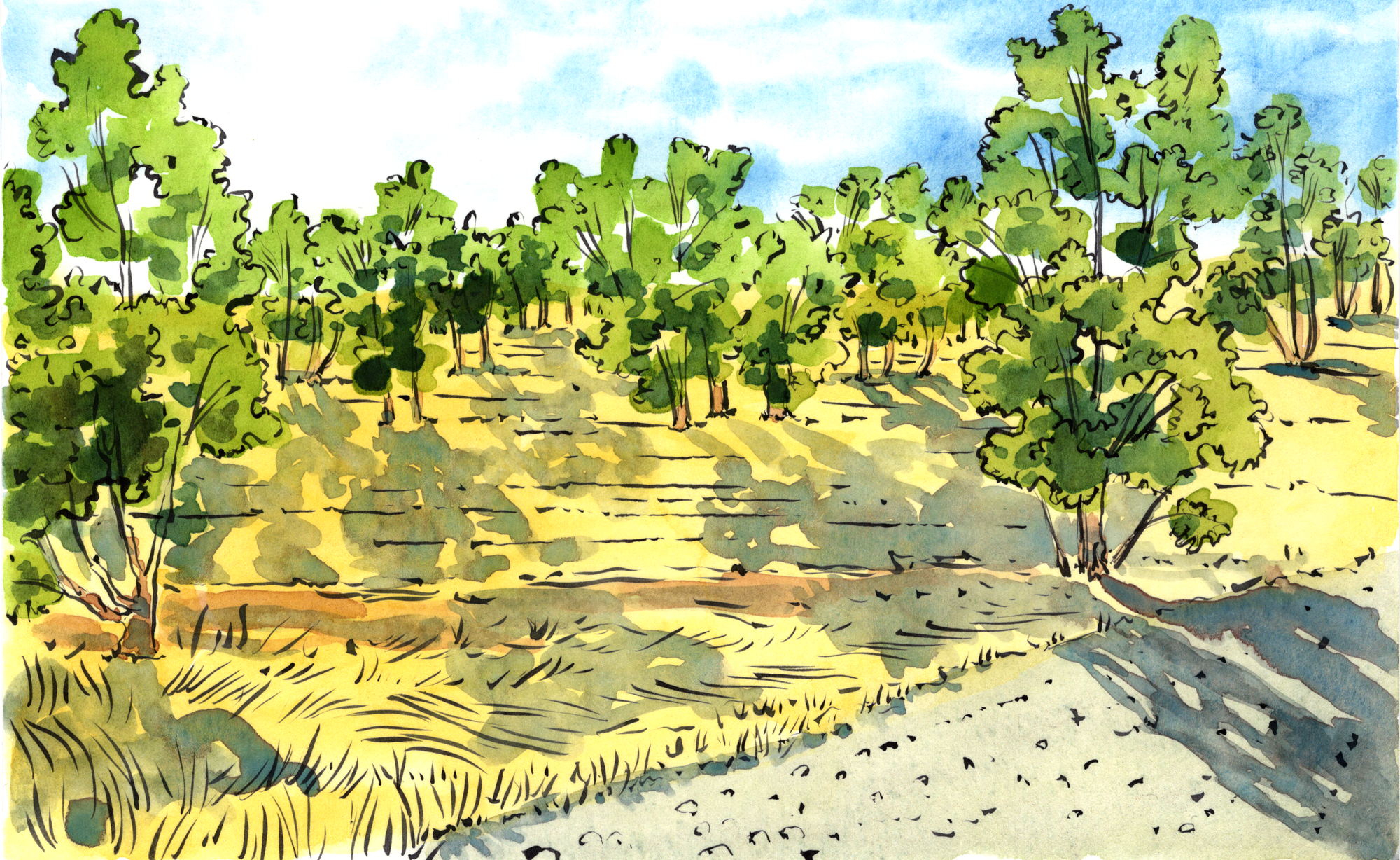
Everyone wanted in on the scheme, and a bubble began to swell. Speculators bought and sold dense stands of eucalyptus across California, hoping to make fortunes once the trees were harvested. But the promise of fast and easy lumber was thwarted when it came time to process it. Eucalyptus have tall trunks that are top-heavy, especially when planted close together, as they are in California plantations. Their branches all end up at the top of the tree, in an attempt to reach sunlight. To hold this unbalanced weight, eucalyptus trunks must be strong. Their wood is dense, with an unusually high water content, and as a result, the trunks are under high tension. The consequences of this tension become apparent when a tree is felled. Cutting the trunk releases the tension and causes the wood to crack and break internally. Over time, as the water dries from the trunk, it warps and becomes unusable for lumber.
It didn’t take long to learn these lessons, and the eucalyptus bubble burst quickly. By 1913, the eucalyptus timber market had fallen apart, leaving behind countless unharvested plantations, many of which remain today. And so it was that eucalyptus remade California habitats, turning places that were once open grasslands, chaparral hillsides, or coastal sage scrub into orderly woods. These close, regular plantations have had inevitable consequences for the habitats into which they were wedged.
Eucalyptus brought with them their particularly elbows-up approach to defending the space around them. Their distinctive scent comes from the oils they produce in their leaves, which contain compounds that deter or kill fungi and insects that would eat them. When leaves fall to the ground, the chemicals leach into the soil, where they make it more difficult for other plants to grow. Competing plants are further inhibited by lack of water in eucalyptus groves, given the efficiency and volume with which eucalyptus roots extract water from underground sources. In their native Australia, their neighbors have evolved to tolerate eucalyptus’ defenses, so there are some plants that can grow in their understory, and some fungi and animals that can eat them.
What did not arrive in California with eucalyptus originally were their herbivores. It takes a special animal to be able to tolerate their oils, and it took 130 years for any of those animals to make it to California. The first to arrive, in 1984, was the eucalyptus longhorned borer, a beetle that was followed shortly by several more beetle species. We’re still waiting for the koalas. But the eucalyptus are glad to be rid of them and their voracious reliance on eucalyptus leaves. In many ways, California is a welcoming place for eucalyptus, without their natural pests or competitors and with little keeping them in check. They grow taller and create more leaf litter because nothing is eating their leaves. More seedlings are able to survive, too, because nothing is browsing them. And in California, when eucalyptus die, they are highly resistant to decay, having left the insects and fungi that break down their dead tissue behind in Australia. These strategies all help eucalyptus monopolize space, light, and water—an effect even more pronounced in closely planted stands.
One might think, then, that those conditions would allow eucalyptus to spread unchecked in California as an invasive species, freed from these constraints. But that isn’t what happened in California. Most places in the state, eucalyptus only grow where they are planted. Though much of California has a Mediterranean climate similar to that of eucalyptus’ range in Australia, eucalyptus have not developed self-sustaining populations here. One reason may be that California soil lacks all of the organisms that eucalyptus require for full and healthy functioning: the mycorrhizal fungi, bacteria, and invertebrates they evolved with. It is only along the coast, where fog provides the year-round moisture that is lacking in the rest of the state, that two species of eucalyptus, blue gum and red gum, have been able to spread outside of the areas where they were originally planted. It appears that in these areas, the extra moisture is enough to at least partially overcome other barriers to invasiveness.
Despite their general inability to spread, eucalyptus continue to have an outsize impact on California habitats. By inhibiting other plants from growing in their understory and taking over areas that once did not have trees or had native species of trees, eucalyptus wreak havoc with the rest of the community. For example, some migratory birds can nest in eucalyptus, but never as successfully as in the native trees the eucalyptus displaced. Eucalyptus limbs are smooth enough that nests can be easily blown down in the wind, and eucalyptus wood is so dense that cavity-nesting birds are usually unable to find holes or excavate them. Species diversity in general, including plants, arthropods, small mammals, and birds, has been found to be three times greater in native grasslands and oak and bay woodlands than in eucalyptus forests, though there is a great deal of variability within these different groups.[2]
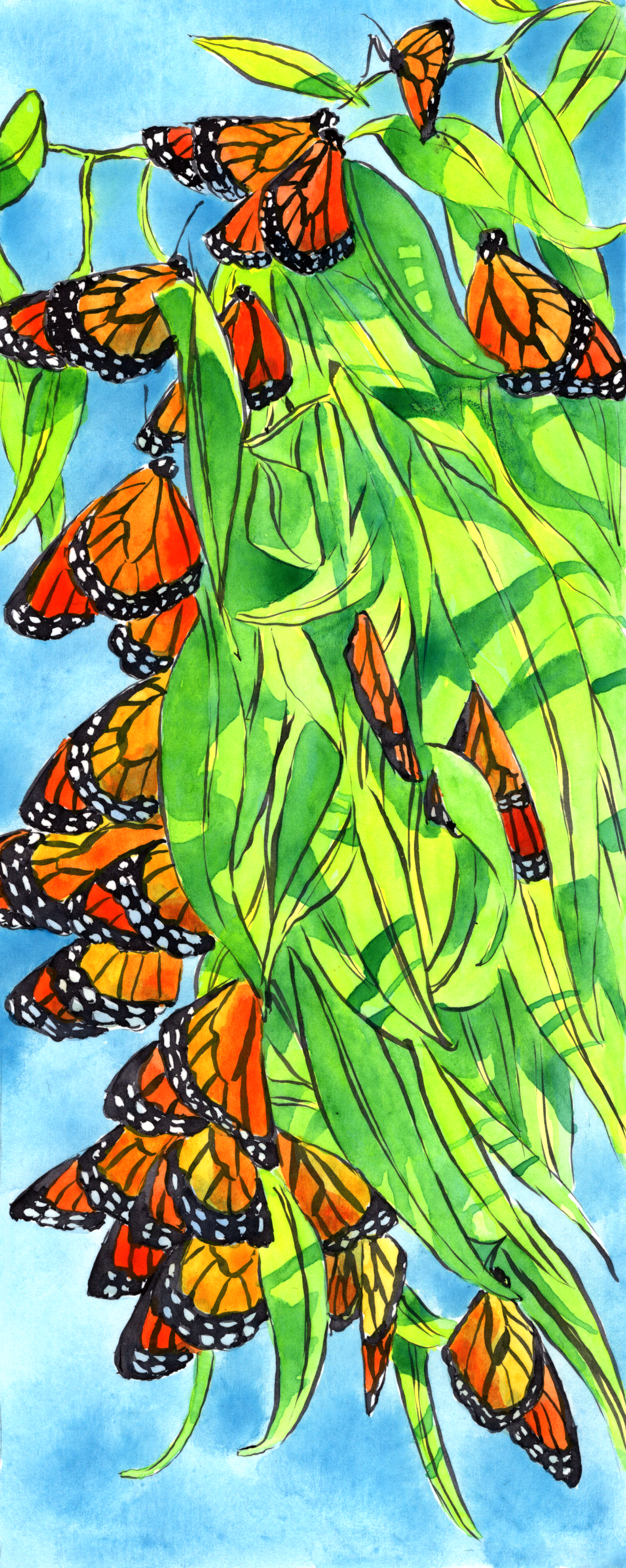
In at least one case, eucalyptus have become integrally bound up in the fate of a species that might not otherwise still be here. Most of the western populations of monarch butterflies do not make the southbound annual journey to winter in Mexico like the central and eastern populations do. Instead, most monarchs west of the Rocky Mountains migrate to the California coast, where they originally overwintered in native pines and cypresses. But those trees’ populations were greatly diminished by logging. Starting in the early 1900s, monarchs adapted by sheltering from coastal wind in eucalyptus, taking almost immediate advantage of the newly planted stands. Though the western monarch population is in dramatic decline due to habitat loss, pesticides, and climate change, eucalyptus remain important surrogates for native trees, and now support a majority of roosting monarchs in the state.[3]
Monarchs appear to be an exception, though. The more common pattern is that species that coexist with eucalyptus are generalists. They are species that are widespread and numerous—those that are able to survive and sometimes thrive in disturbed habitats and alongside human activities. Poison oak, for one, is happy to use eucalyptus as a climbing support, able to grow under the eucalyptus canopy despite the chemical deterrence. Red-tailed hawks and great horned owls nest in eucalyptus, which provide the height they need for hunting and avoiding predators. Eucalyptus have been altering their adopted ecosystems in California since their arrival, changing the soil, water, air, temperature, and organisms all around them. And one of their biggest impacts is on fire.
Burning
Growing up, I spent a lot of time in the Oakland hills where my grandparents lived. Some of the most familiar smells from my childhood are eucalyptus and native California bay laurel, both with heady scents, beautiful and evocative.
When I was 16, my family spent the day of October 20, 1991, glued to the television. The Oakland Hills Fire had started the afternoon before, and while it was nearly extinguished by that evening, it came back to life the next morning, spreading hungrily across the landscape. Running over the hills, crossing freeways, the fire advanced into residential neighborhoods. We watched it spread into places we knew well. We worried about my grandparents, and what to do if they needed to evacuate.
By the next day, my grandparents had gone to stay at a friend’s house. Five days later, when the fire was completely extinguished, my mother and I made the trip to check on my grandparents’ house and pick up supplies for them. My grandparents’ block had not burned, but other blocks of their street had. As we skirted the fire perimeter, I saw familiar neighborhoods entirely transformed. Houses were alternately incinerated, partly burned, or standing seemingly unharmed on a block where everything else was gone. Everything was suffused with a strange, quiet intensity.
Eucalyptus took the heat—quite literally—because eucalyptus love fire. For as long as Australia has been a continent, eucalyptus and fire have coexisted, and eucalyptus evolved many strategies to thrive in a landscape that burns regularly. In fire’s wake, eucalyptus spring immediately to action. They re-sprout vigorously from lignotubers and roots. Their seeds avidly use the nutrients in ash to grow. And they take advantage of fire’s removal of the herbivores and fungi that keep their growth in check.
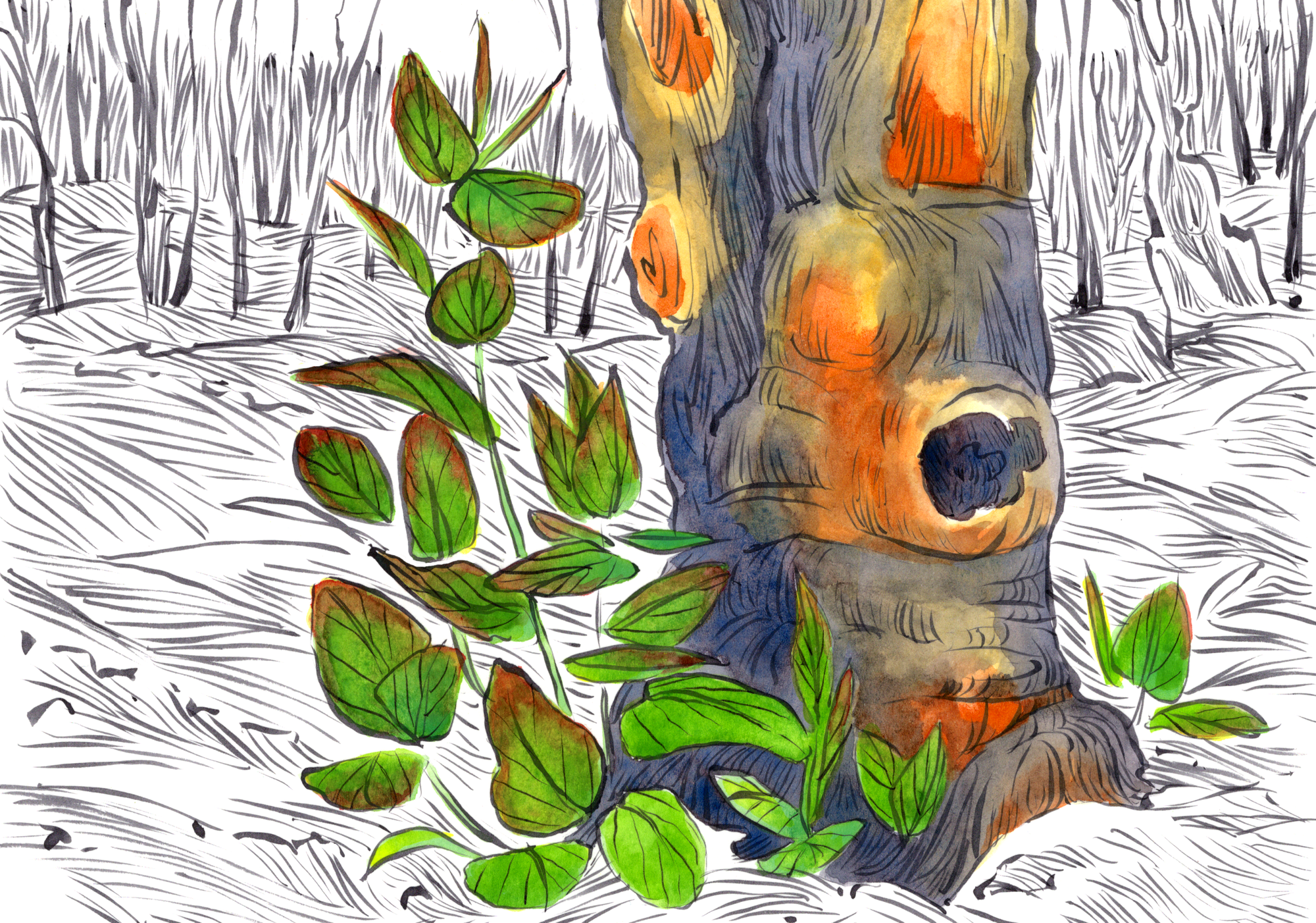
Eucalyptus didn’t start the Oakland Hills Fire (it began as a grass fire), but eucalyptus were rightly blamed for its rapid spread. Because they need their home to burn to fuel their growth, eucalyptus have a host of traits that promote fire. They grow a new layer of bark each year, shedding the previous year’s to create a lush pile of debris at their bases. The debris intensifies and spreads fire. The oils in their leaves have a similar effect, causing flames to burn hotter. Burning bark and leaves are light enough that winds can lift them easily into the air, where they ignite new ground. Many species of eucalyptus require fire to open their seed pods, and this heat-triggered explosion can also send embers flying to start new fires.
Eucalyptus brought all of these adaptations with them to California, with the added intensity that comes from growing them so close together in plantations. The Oakland Hills Fire was a turning point in how people viewed eucalyptus in the state. For a long time, they were seen as harmless beauties, integral to the scenery. Sometimes they were even mistaken as native plant, because they seemed to fit in so well aesthetically. Their role in the 1991 fire raised a new specter of eucalyptus as a malign presence in the state, spreaders of fiery destruction.
It is a dance, where each plant in a habitat helps shape how fire behaves in their ecosystem. Fire doesn’t just happen to an ecosystem. Species do not just experience fire passively. The movement of fire through a habitat is actively choreographed by the participants.
In Australia, many species of eucalyptus actively encourage fire. But in these communities where eucalyptus evolved, there are many checks on their firebug inclinations. Some of those are climatic: eucalyptus’ relatively high moisture content means that they usually burn toward the end of the dry season, so that coming rains help douse fires. And there are other species in their habitats that act as dampers to the fires eucalyptus stoke. When wildfires start in natural eucalyptus forests, the fires don’t burn forever. They don’t burn as far because there are other species that burn less readily, or that contain more moisture at that time of the year, slowing the flames down and helping to end the fire naturally. The result is mosaic patterns of burning, rather than broad, evenly scorched areas.
In California, eucalyptus have been taken out of context. They don’t have any of their companion species that act as natural dampers in Australia. When areas burn, especially ones that have been planted heavily in eucalyptus, there’s nothing to stop the spread of flames. And that’s what we saw in the Oakland hills. On top of eucalyptus’ natural inclination to burn, the fire came after five years of drought. This made the trees even more flammable, being much drier in autumn than they should have been. The potent combination of eucalyptus’ missing ecological community plus frequent drought conditions is what makes eucalyptus so often dangerous in California.
Bridges
When a natural reserve near my home burned in 2015, I wanted to experience the fire’s aftermath up close. So, I started visiting regularly. I watched as the chaparral and oak woodland habitats in the reserve re-sprouted, grew, and flourished in the years after the fire. I saw firsthand the variety of ways that native California species interact with fire. There are some species, such as the shrub chamise (Adenostoma fasciculatum), that burn like eucalyptus. They have waxes, resins, and oils that burn hot, and their long branches with tiny leaves distribute the fire evenly throughout the canopy, spreading it faster. There are other species that help calm those flames, such as toyon (Heteromeles arbutifolia) and coyotebrush (Baccharis pilularis). They have natural fire-retardant chemicals and hold more moisture in their larger leaves. When fire reaches them, they calm it down. They ensure that fire moves through an ecosystem unevenly, burning hotter and more severely in some places, and less severely or not at all in other places.
It is a dance, where each plant in a habitat helps shape how fire behaves in their ecosystem. Fire doesn’t just happen to an ecosystem. Species do not just experience fire passively. The movement of fire through a habitat is actively choreographed by the participants.
Now, when I think now about the fire in the Oakland hills, and about the image of blue gums as torches, as terrible, potent destroyers of the landscape, I do so with a new perspective. I recognize eucalyptus as kindred fire architects, mirrors of the native species with which I have spent so much time. Eucalyptus evolved with the same checks and balances as chamise did, each in their own communities. Like the species in my local ecosystems, eucalyptus evolved with the same choreography in their native environment. But in California, they’re missing the rest of their dance partners. They’re missing the species that slowed the flames and calmed the fire.
This is the context that eucalyptus are missing here. Without the rest of their communities—their partners in fire management and the competitors and pests that constrain their growth—they burn hot and free. There is another context eucalyptus miss today, too, both in Australia and in the other countries where they’ve been planted. Humans were longtime partners in eucalyptus forest ecology, tending fire and burning patterns based on close and careful observation of ecosystems. Colonial erasure of indigenous stewardship in Australia is closely paralleled in California, where native habitats were similarly tended for thousands of years.[4]
Eucalyptus in California are ambassadors. Seeing the importance of the entire community of species in maintaining California’s fire-adapted habitats, I much better understand the consequences of placing eucalyptus far outside their native ecological context. The parallels deepen my empathy for eucalyptus, rooted in my love for native trees and shrubs on California hillsides and the ways that they support each other in their larger community. Knowing intimately how the ecological pieces fit together here, I can envision eucalyptus woven into their own tapestries in Australia.
But eucalyptus are also lonely emissaries of something darker. We took them from their home and brought them here to grow without the rest of their evolutionary partners. They are harbingers of what we are doing to our own home habitats. Habitat destruction and climate breakdown are wreaking havoc on species, causing some to dwindle or disappear as the conditions in which they evolved change beyond their ability to adapt. As we lose these species, we lose their contributions to the dance of the community as a whole.
Eucalyptus plantations in a fire may be at the extreme end of this trajectory, but blue gums are telling us where we’re headed, even in native habitats. It is a vicious cycle. As the climate changes, fire cycles are shortened and intensified in some places, but continue to be suppressed in others. Communities are thrown out of balance as more and more species are affected and partnerships lost.
Partners
Eucalyptus have long evoked strong feelings in California. Their cultural perception has swung between extremes, from loved and championed to hated and feared. Eucalyptus are often made to personify our competing impulses to subdue and preserve wild places.
The temptation to imbue eucalyptus with human intentions has been irresistible. On one side, they have been vilified as colonial invaders, active agents of the restructuring of California landscapes to meet European ideals. As such, they must all be summarily removed. On the other, they are characterized as misrepresented immigrants, subjected to nativist chauvinism. In this view, they must all be protected, without regard to ecological impact.
But this is ascribing human agency and values to the trees. There is much we can learn from eucalyptus in California, but to do so requires seeing eucalyptus on their own terms. This means asking what they need to both sustain and constrain them in Australia, and how those same needs are and are not met in California. Eucalyptus play critical roles in California ecology, impacting soil, water, biodiversity, and the spread of wildfire. How do we learn from eucalyptus’ experience as travelers out of their own home context? Can we recognize them as bridges between their home fire-sculpted ecosystems and ours, while allowing them to stand on their own rather than as symbols or projections of human goals, intentions, and actions?
The answer lies in partnership, in understanding that humans cannot act alone, no matter how much we’ve tried to convince ourselves that we can. We cannot cut our way out of the web of ecosystems. All we manage to do when we try is get tangled up in the silk as we trip and fall and tear the strands. Realizing that we are always acting in partnership with the other species on the planet, and that we have a choice about the nature of the partnership, is our only hope for a future that is survivable for us and the rest of the species on the planet.
Eucalyptus were cultivated as agents of displacement and disconnection, but open-minded stewardship can—in places—integrate them into their adopted home.
The first step is to pay attention. To understand our other partners, native and introduced: where they came from, what their home habitats were, and what role they played there. To learn how they shaped their habitats together. To learn how introduced species fit in, and how our own native habitats have changed. To learn how species have waxed and waned and disappeared or grown too vigorously out of balance.
With this knowledge, we no longer face a simple dichotomy between eradicating all eucalyptus or leaving them all untouched. Instead, open-minded stewardship can be based on how eucalyptus fit into each different habitat. Along streams, for example, where they displace native riparian species, but may provide important cover until native trees are reintroduced. Or on Bay Area hillsides, where they grow densely, spreading slowly and crowding other species out, but perhaps also helping concentrate the moisture in fog, dripping it down into a more limited yet still existing understory. Or along Central and Southern California coasts, where they lack the resources needed by migrating birds, but shelter monarch butterflies.
Likewise, we can identify and work toward measurable and tangible goals like biodiversity. We do not need to choose between returning to a past that is irretrievable or fully embracing the loss of biodiversity forced by introduced monoculture. There are many intermediate options, such as removing eucalyptus where there is the potential to steward the regrowth of more diverse species. Or in other cases, leaving eucalyptus stands where they are doing less harm or where removal would be too destructive. Balanced stewardship like this is becoming increasingly common in places like the San Francisco Bay Area, Elkhorn Slough near Monterey Bay, Morro Bay on the Central Coast, and Batiquitos Lagoon in San Diego County.
The decisions—made by municipalities, state and federal land management agencies, and land stewardship non-profits—must acknowledge that we will not be able to perfectly restore ecosystems from the past, nor can we preserve in amber the ecosystems existing right now. Time moves forward, habitats and species are always in motion, and climate change is accelerating. Our only option is to engage in stewardship, working with the species around us in partnership as we try to bring as many communities as possible—as much diversity—forward into the future.
Eucalyptus are striking reminders of these choices. As a large and charismatic species, they are impossible to ignore. They are an introduced species that disrupts California habitats and is bereft here of its own native communities. At the same time, they have come to feel deeply a part of the California landscape, sentinels that many Californians cannot imagine losing. Eucalyptus were cultivated as agents of displacement and disconnection, but open-minded stewardship can—in places—integrate them into their adopted home. The ways in which eucalyptus both do and do not fit in speak volumes about the choices we have before us. They beg us to decide whether we are ready to treat all of the members of the ecological communities around us as partners.
Home
I am in awe of tall and serene blue gums, but the eucalyptus I love best are red ironbarks. They line a bike path that runs along a stormwater drainage ditch in my town. I revel in their craggy bark, tough, sea-foam-colored leaves, shocking pink eyelash flowers, and jewel-like globs of deep red sap.
The riparian zone along the stormwater canal underwent a four-year habitat enhancement project a decade ago and continues to be tended. A variety of introduced plant species were removed and replaced with plantings of diverse native wildflowers, grasses, shrubs, and trees. Part of the original proposal included cutting down the red ironbarks, which set off fierce debate among neighbors and community members. Eucalyptus are extremely difficult to remove effectively: they regrow so robustly that extensive and repeated cutting is required. Moreover, chemicals are often required to prevent their return, and run contrary to the goals of habitat enhancement projects. In the end, removing the trees was deemed too expensive, and so the ironbarks remain, reminders of the complexity of stewardship.
I put a hand on the deep creviced trunk of one of these ironbarks. The question is not whether the red ironbark next to me belongs here. The question is now that it is here, how will I walk with it, hand in hand, into the future.
[1] Groenendaal, Gayle M. 1983. Eucalyptus helped solve a timber problem: 1853-1880. In: Standiford, Richard B.; Ledig, F. Thomas, technical coordinators. Proceedings of a workshop on Eucalyptus in California, June 14-16, 1983, Sacramento, California. Gen. Tech. Rep. PSW 69. Berkeley, CA: Pacific Southwest Forest and Range Experiment Station, Forest Service, U.S. Department of Agriculture; p. 1-8.
[2] Fork, S., Woolfolk, A., Akhavan, A., Van Dyke, E., Murphy, S., Candiloro, B., Newberry, T., Schreibman, S., Salisbury, J. & Wasson, K. (2015). Biodiversity effects and rates of spread of nonnative eucalypt woodlands in central California. Ecological Applications 25, 2306–2319; Wolf, Kristina & DiTomaso, Joseph. 2015. Management of blue gum eucalyptus in California requires region-specific consideration. California Agriculture 70, 39-47.
[3] Griffiths, J., and F. Villablanca. 2015. Managing monarch butterfly overwintering groves: making room among the eucalyptus. California Fish and Game 101:40–50.
[4] For a firsthand account of eucalyptus burning regimes and indigenous stewardship in Australia, I cannot recommend highly enough Victor Steffensen’s Fire Country: How Indigenous Fire Management Could Help Save Australia (Hardie Grant Publishing, 2020).
Robin Lee Carlson is a natural science illustrator and the author of The Cold Canyon Fire Journals. This story was republished with permission of Arnoldia, the quarterly magazine of Harvard University's Arnold Arboretum.