Crip-sourcing park access
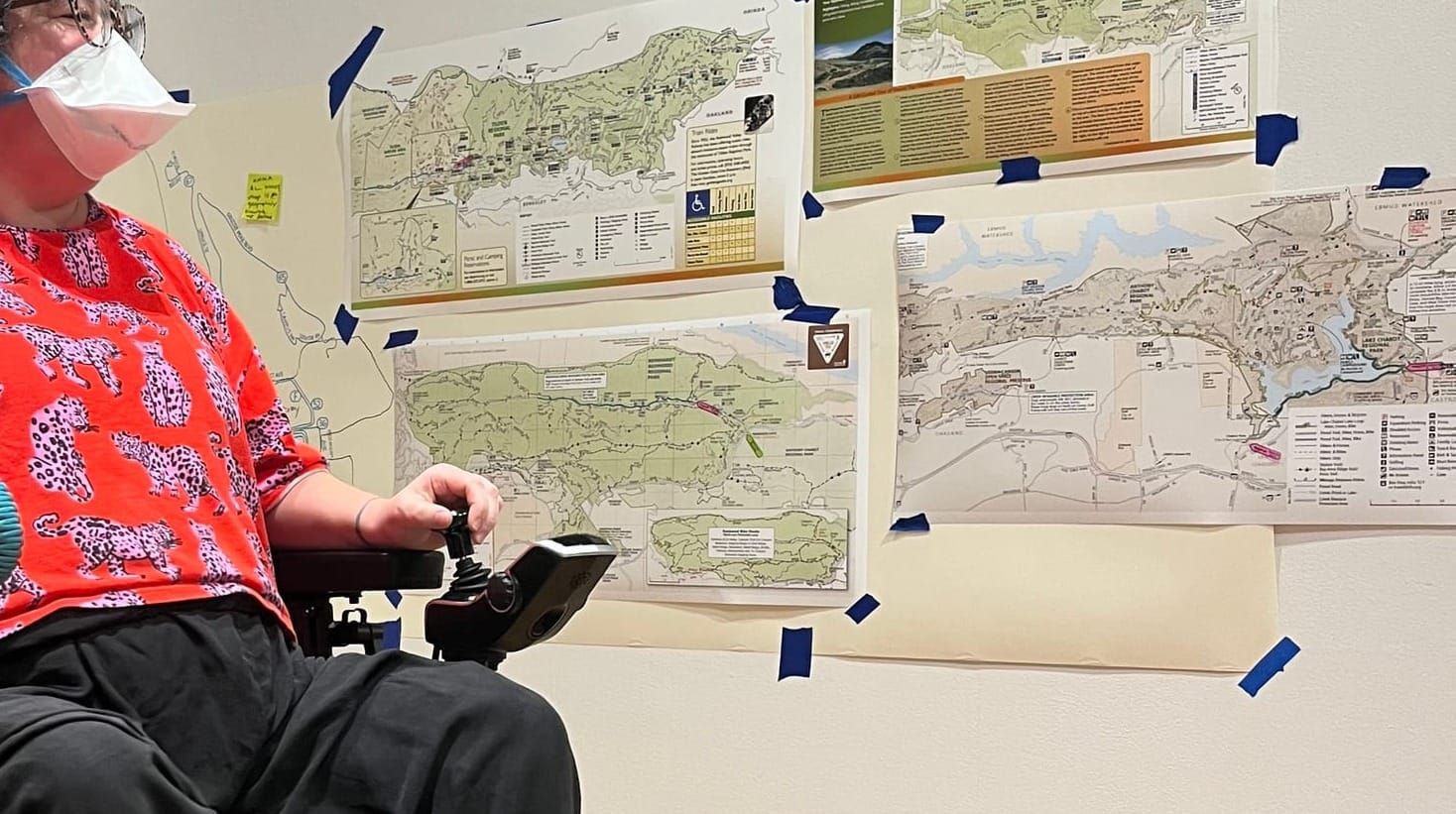
I’m perched on the amphitheater-style outdoor seating outside the Berkeley Art Center when Jillian Crochet, the disabled multimedia artist and my dear friend, flies down the wooden ramp from the gallery in a motorized whirr.
During her monthlong residency, Jillian has been constructing a rock costume—a huge foam-covered wire frame that will sit over her body and power chair, camouflaging her in nature. On this particular Wednesday evening, she’s delightfully noticeable in a red Nooworks tee printed with pink tigers, the soft blue straps of her white duckbill-style N95 mask tucked into her short salt and pepper curls.
She ushers several of us toward the gallery door, where a folding table holds COVID-19 rapid tests and more masks. Most of us arrived wearing our own: a black ZiMi Air KN95, a red KF94 adorned with tiny gold rhinestones. Those who didn’t test at home swab their noses and set timers so that during our outdoor dinner, everyone feels safe unmasking to eat. Among the dozen individuals gathered were folks who know each other from disability organizing and from BORP, the adaptive recreation nonprofit that organizes group sports and outdoor adventures like hiking, kayaking, and camping for disabled people.
Several of us straddle wobbly lines between friend, activity pal, and accomplice, like Bonnie Lewkowicz, who manages BORP’s detailed trail and amenity listings on AccessCA.org. Jillian and I met a few years ago advocating for basic infection control in health care settings—meaning respirator masks, like the ones we’re all casually wearing tonight to keep each other safe. When we’re not in organizing meetings together, we go birding, drop in on her artist friends’ exhibitions, and talk on the phone about our over-40 bodies.
The rock sculpting has been slow. Her hands have also been hurting this year, making it harder to experiment. Frustratingly, her latest attempts collapsed the frame. “The foam was too thick and heavy…” she groaned, trailing off.
Tonight’s gathering is a different type of nature planning, what she calls a crip-sourced collaborative community mapping project. Basically, we’re all trying to figure out how to make it more seamless to get to more parks, more often, despite an array of physical disabilities and a lack of easily navigable low-cost transit options. (It was just last year that the city added a wheelchair-accessible walkway next to the stairs at the main entrance of Dimond Park, ten years after a group of neighbors formed a group, Friends of Dimond Park, specifically to lobby for just such an improvement.)
Before we all arrived, Jillian and her assistant taped large print maps of East Bay parks—Sibley, Coyote Hills, the MLK Jr. Shoreline—to the gallery walls. For years, Jillian, friend and advocate Christina Leffmann, and a wider network of disabled nature enthusiasts have been working to expand outdoor access for wheelchair users. These particular maps, kindly printed by Berkeley public librarians, were meant to focus our brainstorming on several desirable spots.
Can paratransit riders even reach the parks shown on the huge wall maps? In most cases, not really. Paratransit will drop off passengers 0.7 miles from public transit stops, but only at established addresses. Paratransit riders also have to book by 5pm the day prior. Some participants scheduled rides to and from today’s event on Tuesday afternoon with no way to change the reservation if their own schedule shifted. More than once, Jillian and I have been out exploring and her bus has been weirdly early or disconcertingly late.
Few (none?) of us actually marked up the maps today. Mostly, we sat and excitedly talked—and maybe lightly argued?—about what access different folks need. A transportation representative from East Bay Regional Park District, who has a background in public health, mused about how to create addresses where none exist, perhaps by installing a physical mailbox. One low-vision attendee asked about parks navigable for blind people. Potential AC Transit cuts are another issue, and “will cause undue hardship on disabled and poor folks to get anywhere, including finding joy and respite,” Jillian added. “We should all be able to access nature!” I stepped out a back door to take a mask break, drinking water while an oak titmouse zipped past the closest redwood.
Back inside, rumors about free day-of hired rides floated: Someone knew someone who’d called a phone number and gotten a ride to a park—in the back of an ambulance, an awkward fit with their chair squeezed next to a gurney. “And then how did they get home?” someone asked. No one knew.
Potato pizzas from Sliver arrived. Jillian’s assistants tended a smoky fire on a BBQ grill. We moseyed out to picnic tables piled with pitchers of homemade watermelon agua fresca, ingredients for s’mores, and delicious veggie wraps, both gluten-free and gluten-full, made by one attendee’s In-Home Supportive Services (IHSS) worker.
As we roasted marshmallows on ergonomically pleasing extendable sticks, passersby walking their dogs glanced over with interest. Two ravens landed on low oak branches overhead. Higher up, a Steller’s Jay was also attentive to our activities.
“We could walk around parks with a bag of marshmallows and offer to trade for fire,” I mused, pulling lightly charred goo off the stick.
“A performance piece!” someone added gleefully.
“But what would it mean?” I asked too seriously, causing us all to laugh. “We could go back to the beach for fires,” referring to the last time Jillian and I had a beach day.
“Where were we? So many lupines! The paratransit driver complained that he couldn’t turn around in the parking lot and almost wouldn’t drop me off,” Jillian said.
“Skill issue,” someone cooed, and we all giggled.
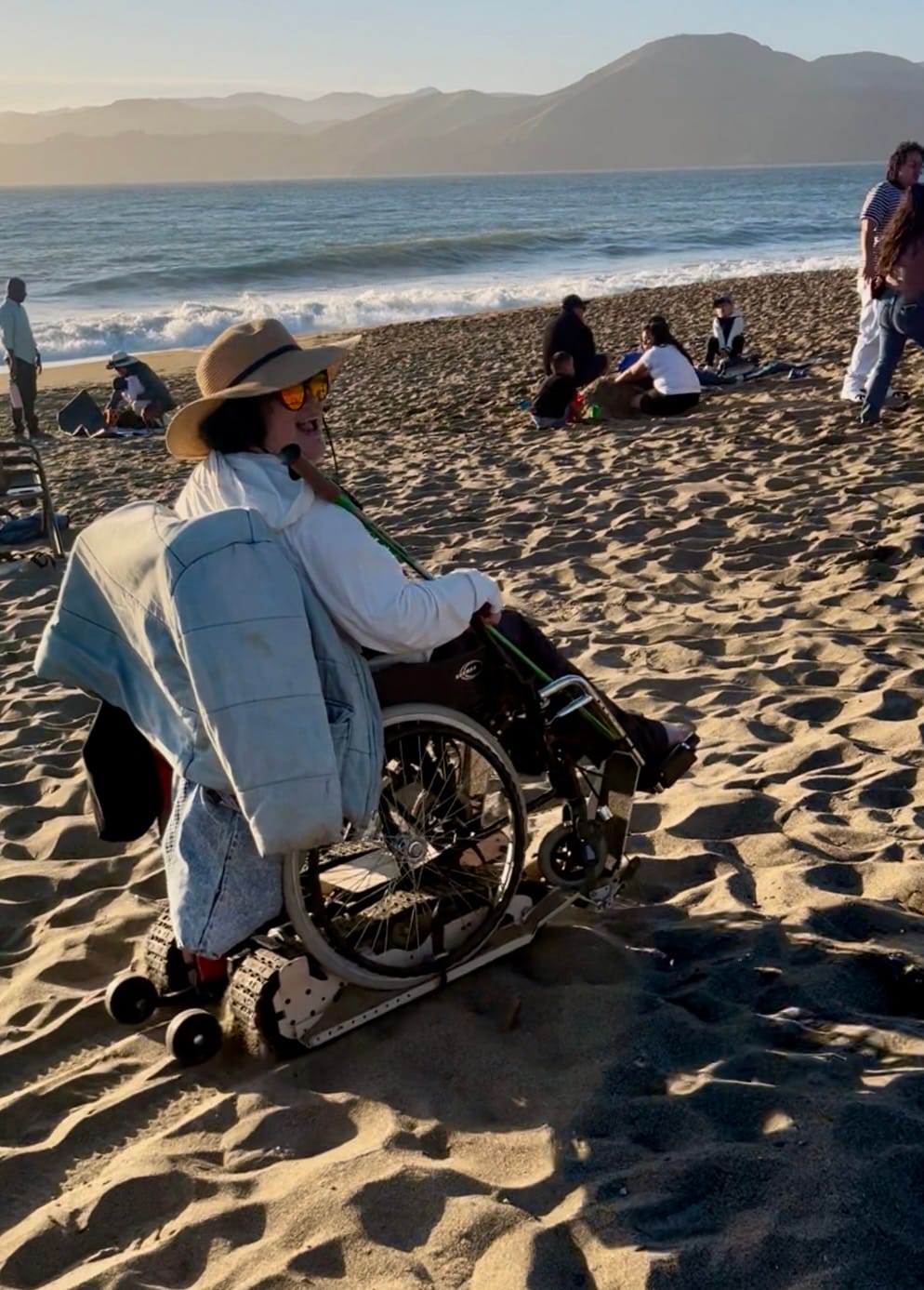
“Baker Beach,” I added. “We should go again with the Freedom Trax. People loved that. They’d totally share flames.” To cross the sand at her standard rapid pace, Jillian had borrowed an all-terrain set of tanklike wheels that can fit around the bottom of most wheelchairs. As usual, I’d been unable to keep up with her marvelous speed. Random beachgoers cheered when we passed. “They’re so curious!” she agreed.
As our meeting wound down, a few people left for other meetings. I had to drive home to SF. We agreed to go searching for baby owls soon and put our masks back on for a tight, safe hug.