Dead at McDonald’s
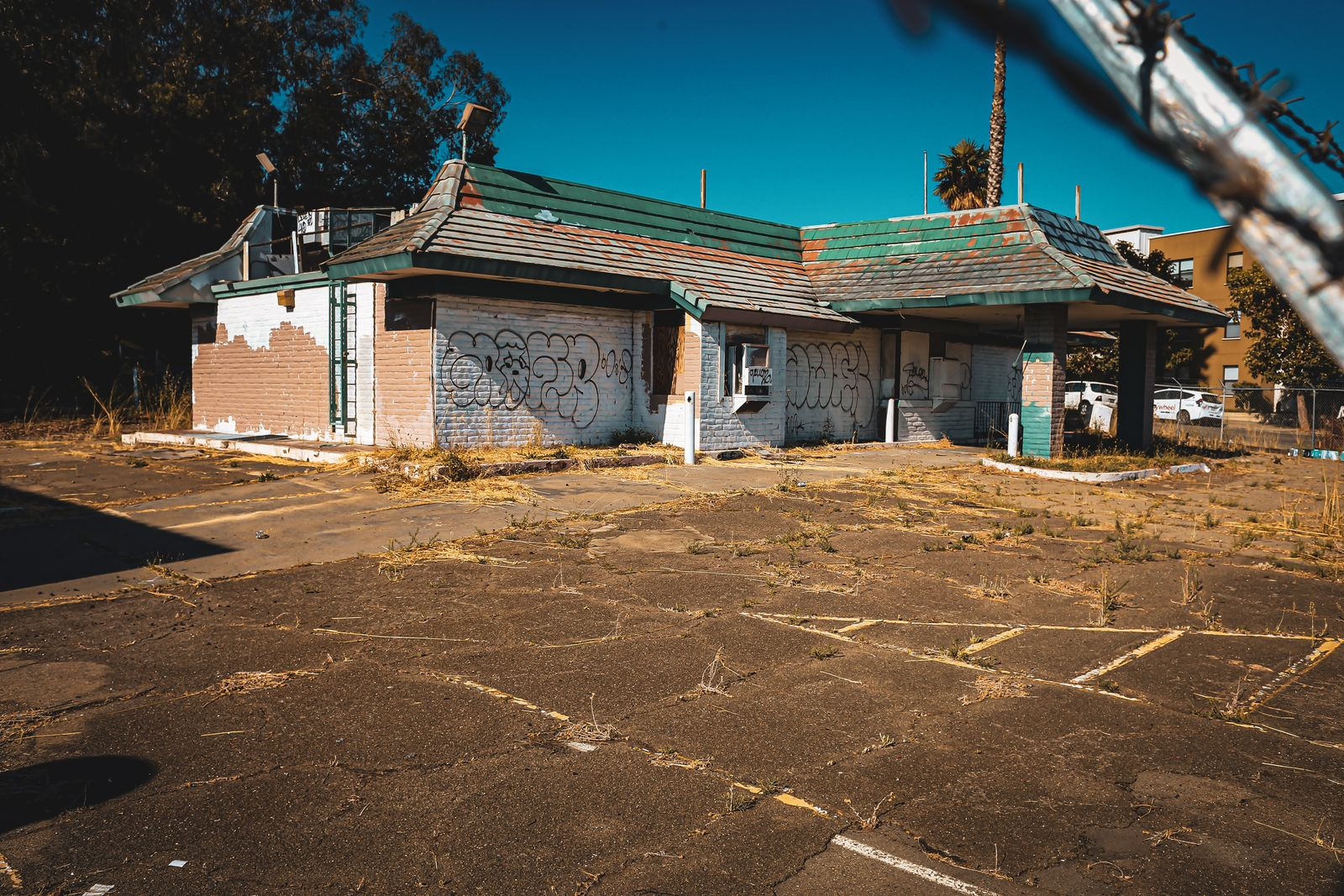
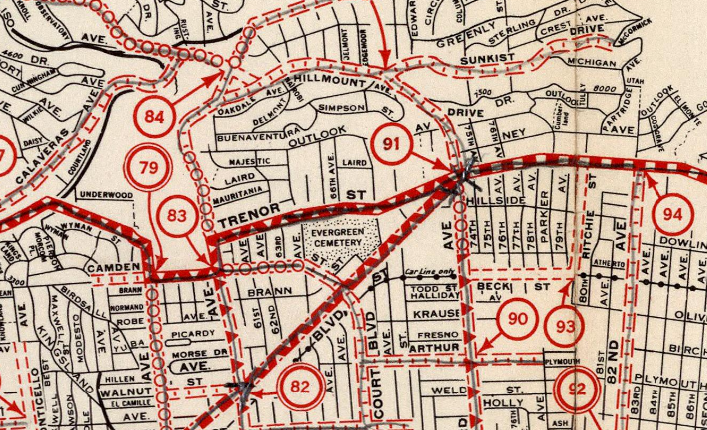
The entire block was quiet when I visited the site on a recent afternoon, after driving down MacArthur, past “Mills College at Northeastern University,” around a grove of eucalyptus, and then a few blocks down Foothill Boulevard to the corner of 68th Ave. Foothill is three lanes wide, and the block is long, which fits the industrial area the neighborhood once was: Even before two freeways tore through it, the whole area was designed above all to funnel raw materials in and finished goods out rather than as a place for people to stay and be with one another. On that day, there was far less traffic than the road could handle, and the cars that passed were usually the only ones to be seen in either direction. I had had the idea to ask someone on the street about what had been there, once, but over the ten minutes or so it took for my friend to get a few photos, and as I took in the scene, there wasn’t a pedestrian in sight.
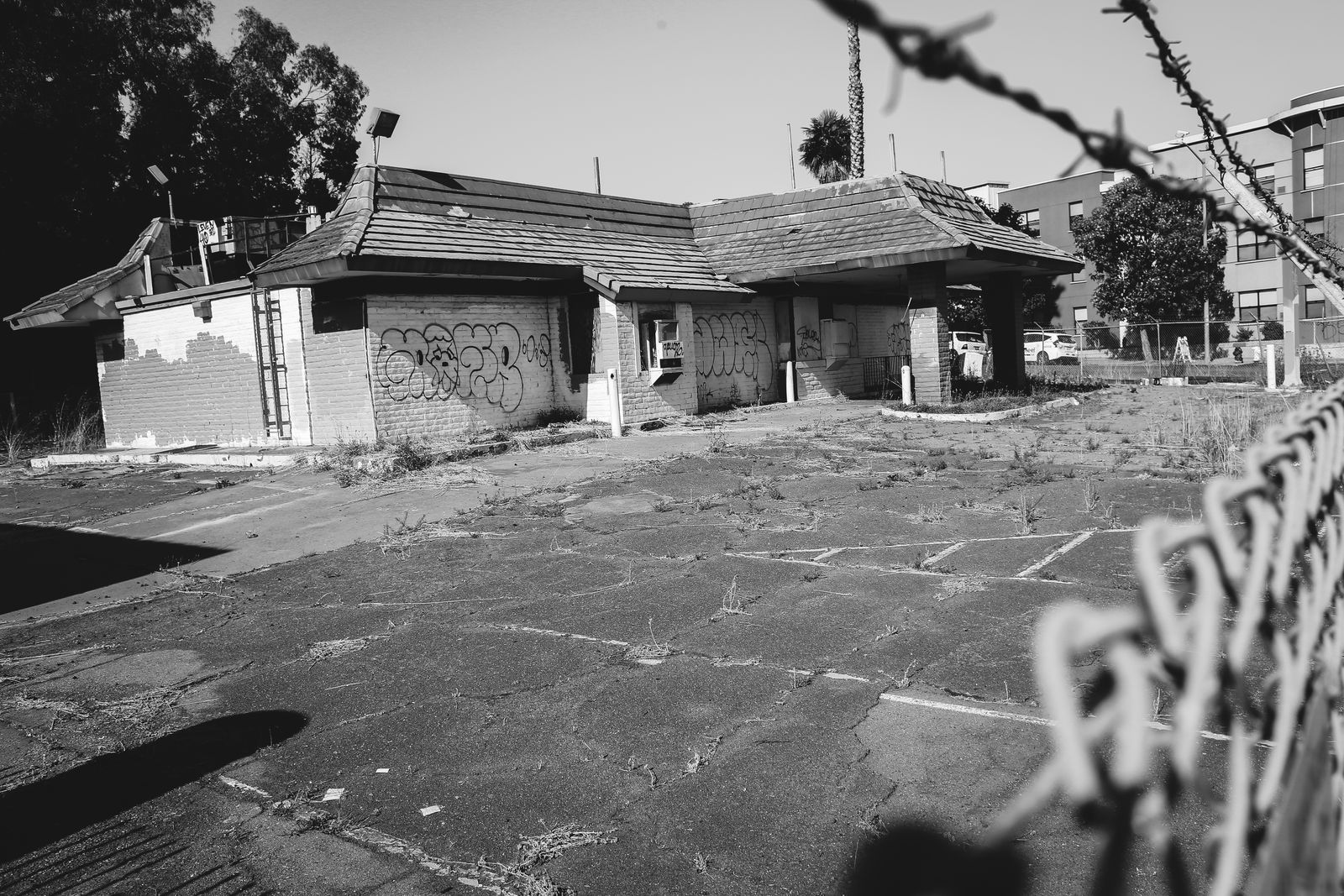
The building I had come to see was once a McDonald’s—the very first McDonald’s in Oakland, in fact—though it closed years ago. When, exactly, I’m not sure. The last day wasn’t the kind of historical event that registered in local papers. The reason for its shuttering seems to have been its replacement with a bigger and surely more modern facility. Down Foothill, next to the OPD substation, the McDonald’s that now presides in the area is notable for a sloped roof and arches, spanning the short dimension of the building, that make it resemble some of the chain’s early outfits in the 1950s, and that leads people to think it’s older than it actually is. It’s open 24 hours, and seems to be busy.
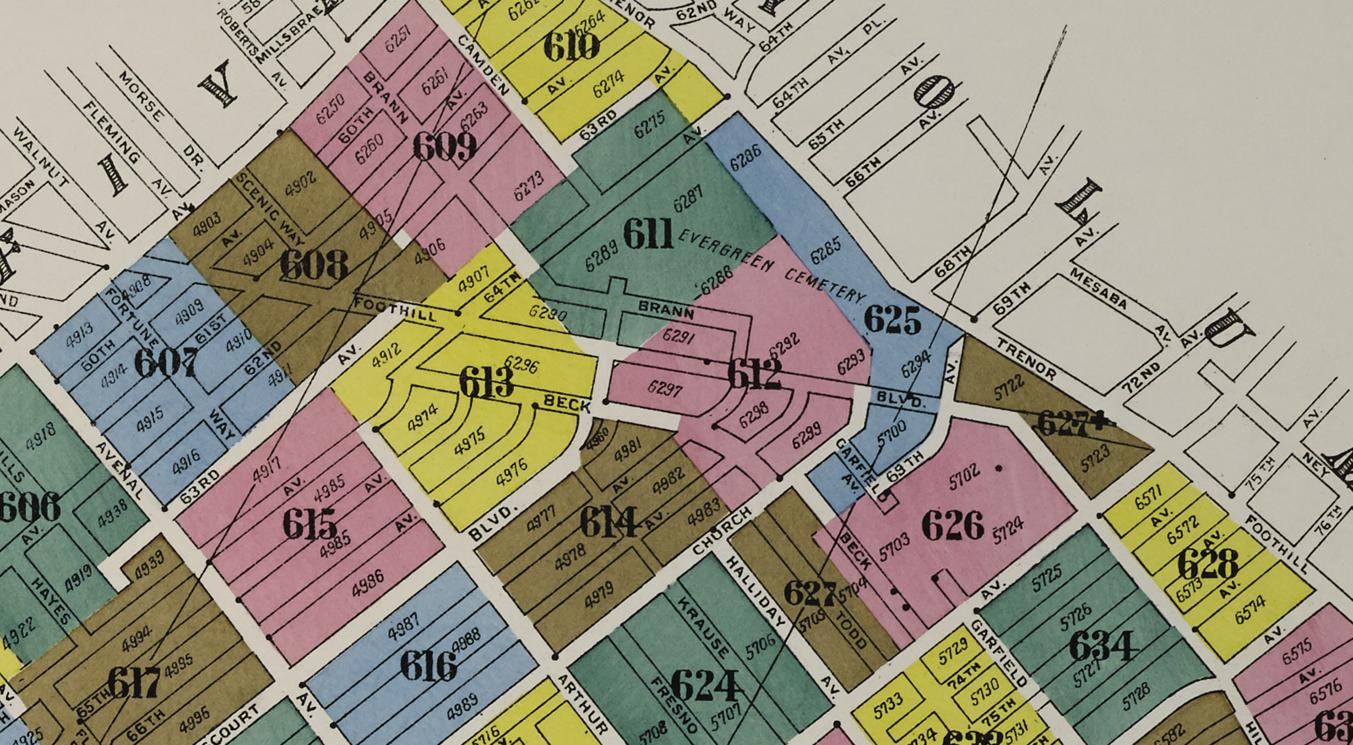
I didn’t come for a burger. I’ve been fascinated with this old place, decrepit as it is, mostly because of its location, right where two landmarks of its era nearly touch: Across Foothill Boulevard and down a bit is the Eastmont Town Center, long a struggling commercial hub, and still the place that many organizations intent on doing right by the community have planted themselves over the years. Behind it, visible just above what’s left of the roof of the building, is the Evergreen Cemetery, where the Black Panther Party founder Huey P. Newton was cremated in 1989 and where more than 400 victims of the Jonestown massacre in Guyana are buried in the hillside.
A lot of Oaklanders were surely reminded of this old building when it made an appearance in the Town’s big movie of the year: In I Love Boosters, Boots Riley’s surreal fable of a heroic band of fashion-conscious hustlers looking to bring down a grimy clothing executive by shoplifting her stores at industrial scale, the main characters’ hideout is this old McDonald’s, refashioned as the derelict remnants of a fake fast food chain called “Jackie’s Chicken.”
With cracked asphalt and a barbed-wire fence surrounding the actual location, there were surely easier abandoned places to have dressed with a prop sign for a moment-long shot. (I Love Boosters was partly filmed in Atlanta, anyway.) But it felt like an inside joke, or a comment, to add this particular bit of scenery to the story, and to imagine it being the headquarters of a group of people fighting the system while living at its margins. If it was, the audience for it would have to have been quite specific, its significance legible only to people who had lived in the Deep East or had at least had spent some time in the area in the 1970s and 1980s.
Some did. When a woman posted a shot of the relic on 67th and Foothill in the Deep East as it appeared in the movie on the Facebook group “Old School Oakland (When Oakland was Really Fun),” a water cooler for people who grew up in Oakland to trade memories, more than twenty people chimed in to either identify the building or share some association with it.
“One of the most popping hangout McDonald’s spots back in the days,” one said. “I used to be a manager there in the good old days,” wrote another person, by the name of Anthony Williams. (Expressions of nostalgia are a common theme at Old School Oakland.) “[I]f you came into this McDonald’s talking shit, you would get your ass whooped … We had guns too never had a problem. ”
In the comments to another post, captioned “You ain’t from #Oakland if you don’t know what this is lol,” that got republished to the Oakland History Facebook group a few years ago, people in the know variously noted that they had taken their children there, worked there, or watched sideshows in the parking lot.
Whatever else the site’s former customers could remember of it, it was theirs.
\O/
The story of McDonald’s arrival in Oakland is interesting less for how it fit into the company’s story at the time than for how it fit into Oakland’s.
In 1966, the Oakland City Council met to discuss, among other things, a proposal by a Chicago corporation to bring a new business to East Oakland, a scene that played out in dozens of localities across the country since the mid-1950s. Ten years after the Golden Arches had first started to spread over the nation, the new “McDonald’s hamburger ‘restaurant’” as a Tribune reporter would call it, quotes and all, would be the first in town. Like the fast food phenomenon that had largely grown from its success, McDonald’s was rooted in the suburbs, and, as a suburb, albeit one inside a city, the Deep East suited it just fine.
Not everyone was enthusiastic. At the meeting, a lawyer registered the objections of eight of the proposed site’s neighboring residents. The new outlet would “upset the residential area with increased traffic and noise,” it said. But McDonald’s could count on most people to be at least indifferent to its arrival. At the same meeting, a representative from the corporation, which planned to own and operate the drive-in itself, introduced another letter—this one signed by eighty residents who “did not object to having a hamburger operation near their homes,” as the Tribune reported. Before the night was out, the council not only approved McDonald’s proposal, it granted the company permission to add a parking lot to the area that was larger than city regulations would otherwise allow.
Support for the new outlet was likely more robust than McDonald’s’ survey indicated. Three years before, on the other side of Foothill, General Motors had closed its Oakland factory, resulting in massive job losses, and the new drive-in’s arrival coincided with the opening of the commercial center, complete with separate stores to buy drugs, groceries, and auto parts, that was to replace it at the old site. Two years later, McDonald’s was open and Eastmont Mall had expanded to become a full-fledged shopping center.
In the late 1960s, it may not yet have been obvious that East Oakland’s evolution was a preview of what would happen across the country. Losing GM was a hit to the Town, but not to the region, since GM was merely relocating the plant to Fremont. (It later became the NUMMI plant, a joint-venture between GM and Toyota, until Tesla acquired it in 2010. It’s currently being refitted to manufacture humanoid robots.) But whether anyone realized it, what was happening on and around the block wedged between Foothill, Bancroft, and 73rd Ave, already embodied generations of national disruption to come. The fundamental work of the United States economy was shifting from making things to merely selling them; suburbs were ballooning on the cities’ peripheries with wealth and white people, and American cities were simultaneously becoming poorer and more Black.
Indeed, McDonald’s emergence on the national stage was already evidence of the change underway. Before McDonald’s rise, national restaurant companies were few and their outlets inconsistent. Yet the year before it came to Oakland, McDonald’s topped off a decade-long winning streak with a remarkable achievement: it went public by describing itself to investors as a sort of high-tech system, not just for manufacturing food, but for manufacturing restaurants. It quickly became one of the hottest stocks on Wall Street. What McDonald’s was doing on the street in East Oakland, it was also doing in the more abstract realm of Americans’ finances, setting up shop near an old auto plant at the very same time that it was vying for space inside the pensions, endowments, and insurance pools that still mostly rode on heavy industrial concerns like GM.
Yet even before the GM plant closed, people were already leaving, and nowhere faster than below Seminary. In 1963, 44 percent of the students at Castlemont, the high school of the Deep East, were Black. By 1966, Black students made up 72 percent of the student body—the biggest shift of any of Oakland’s six high schools. White East Oaklanders were packing their things and heading for the suburbs in droves, taking their money and their kids with them. Whether or not they wanted to, their Black neighbors didn’t have the option to join them: cities like San Leandro, Berkeley, and San Jose were among the 113 cities in California where Black people have been historically unwelcome as visitors (or even banned as permanent residents). East Oakland became theirs and theirs alone, not by choice, but because it was one of the few places they were allowed.
Conditions in East Oakland were especially shameful given how much things had changed in recent years. The Civil Rights Act passed in 1964, to make segregation and workplace discrimination illegal nationwide. Yet in California, poverty and state violence, and housing discrimination were endemic in Black neighborhoods and followed Black people wherever they went, even without the legal structures that had persisted in the South, urban Black communities were subject to a bereft material reality. In 1966, a year after riots broke out in the Watts neighborhood of Los Angeles—the first of what would be a series of major uprisings around the country—Huey Newton and Bobby Seale formed the Black Panther Party in Oakland. When Martin Luther King was assassinated two years later, and the urban masses across the country set off another wave of violence that touched over a hundred cities, the Panthers’ message that Black people needed not just rights but an improvement to their material conditions looked prescient.
As the Panthers gained followers and chapters across the country, federal authorities would deem them a threat to national stability. Yet, at the moment of King’s assassination, Oakland was tame in a way that corporate America could appreciate, not in spite of the radical groups that were then such a visible part of the Black community, but largely because of them. Newton was in prison in Vacaville then, awaiting trial for the murder of an OPD officer, but when a reporter asked Bobby Seale why Oakland and San Francisco had stayed quiet as so many others burned, Newton’s most trusted ally credited the movement they had founded together. “Because the Black Panther Party told them to be quiet,” he said.
The national upsurge of violence still sent a chill through white America, which would translate into policy that would touch every city, Oakland included. Federal authorities, eager to tamp down the fears and resentments of white voters, started to think seriously about how the government might change the material circumstances of Black people in cities like Oakland.
In the early 1960s, East Oakland had been the site of substantial experimentation on part of government and civil society to develop the region and reduce crime. In 1961, the Ford Foundation delivered a $2 million grant to the city to kick off its national “Gray Areas Program” with a number of targeted programs social, recreational, and policing programs around Castlemont. Ford chose the area, its people said, because it was at an inflection point: poor Black people living there were mostly “low-income migrants,” having come from somewhere else in search of a job and had yet to resign themselves to their impoverished state.
Though Gray Areas was privately funded, it was the forerunner of Lyndon Johnson’s War on Poverty and the multitude of programs that fell under its umbrella. But by the time of King’s assassination, the federal government was less inclined to stake so much money on similar efforts.
“The old vocabulary of the civil rights movement has become the rhetoric of the rearview mirror,” then-candidate Richard Nixon said during a fireside chat on CBS Radio just weeks after the assassination, echoing a conclusion that many Black people had already drawn. The United States had reached the limits, he argued, of what could be done with the kind of direct social spending that had characterized the efforts of the outgoing Johnson administration: “For too long, white America has sought to buy off the Negro—and to buy off its own sense of guilt—with ever more programs of welfare, of public housing, of payments to the poor,” he said.
Nixon’s argument was practical as well as philosophical. The nation was approaching a fiscal crisis, he said; any incoming president who offered voters billions more dollars to alleviate poverty in the cities would be making a promise he would never keep. Instead, he said, the government should channel private capital into cities, to “make acceptable the added risks of ghetto development” and foment a new generation of Black capitalists. “Helping provide these incentives is the proper role of government,” Nixon said. “Actually doing the job is not—because industry can do it better.”
A little more than halfway through his speech, Nixon appeared to address the Panthers and their admirers, albeit indirectly:
Black extremists are guaranteed headlines when they shout ‘bum’ or ‘get a gun’…But much of the Black militant talk these days is actually in terms far closer to the doctrines of free enterprise than to those of the welfarist 30’s…What most of the militants are asking is not separation, but to be included in—not as supplicants, but as owners, as entrepreneurs—to have a share of the wealth and a piece of the action. And this is precisely what the central target of the new approach ought to be. It ought to be oriented toward more Black ownership, for from this can flow the rest—Black pride, Black jobs, Black opportunity and yes, Black power, in the best, the constructive sense of that often misapplied term.
Nixon’s approach to urban poverty would ultimately involve cops just as much as capital. But by the early 1970s, even the Panthers (who had made “an end to the robbery by capitalists of our Black Community” the third point of their original ten-point program) had come around to accepting the rise of “Black capitalism” as a positive, and perhaps even necessary development. “Our strategy should have been to analyze the positive and negative qualities of this phenomenon before making any condemnation,” Newton wrote in a 1971 essay.
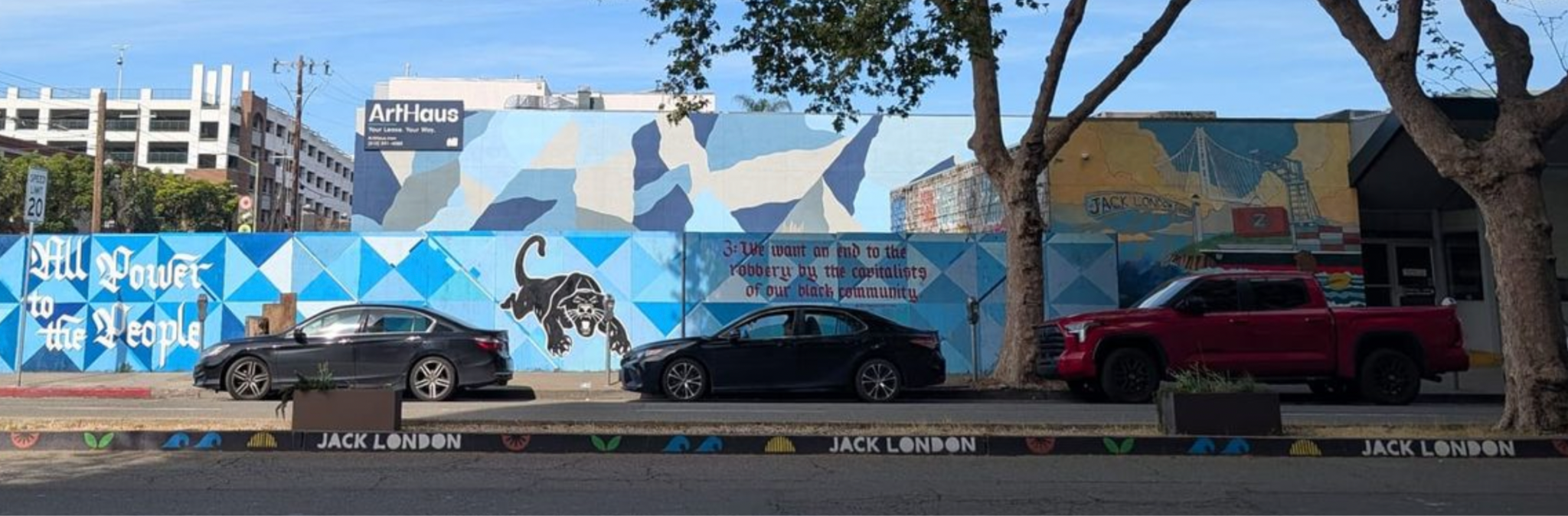
As Newton wrote, the Panthers’ numerous programs to distribute food and clothing, and to provide health services to Black people across Oakland were so successful because the group offered them without charge. It was an agenda that was as revolutionary as it was practical: the community was helping itself without any desire for profit, in a demonstration of what a world without capitalism might be like.
But keeping those programs free to Oakland’s poorest required substantial contributions from “wealthy White philanthropists, humanitarians, and heirs to corporate monopolies,” as Newton put it. Black capitalists weren’t deserving of criticism for their reliance on white business any more than the Black Panthers were deserving of criticism for their reliance on white money: faced with the same reality, both groups had found their way to the system that sought to destroy them.
And if the Panthers could use their programs to educate Black people, by feeding people breakfast while also teaching them about the system that had made them hungry in the first place, for instance, Black capitalists could do the same with their businesses. The typical neighborhood Black capitalist “will not be able to deliver the people from their problems,” Newton wrote, “but he will be able to help them build the strong political machine which will serve as a revolutionary vanguard and guide the people in their move towards freedom.”
Not every Bay Area radical shared Newton’s patience, or his pragmatism. In 1969, the Weather Underground split off from the Students for a Democratic Society in opposition to the larger group’s commitment to protesting the Vietnam War without violence of their own. The following year, a fiery white minister named Jim Jones led his mostly-Black congregation south along the 101 from the redwood forests of Ukiah to San Francisco. Before long, followers came to the People’s Temple church from across the Bay Area to hear Jones preach about capitalism and socialist revolution with the same energy that other ministers typically reserved for more overtly Biblical subjects.
Even Newton was caught between a realistic optimism and a dire sense of futility. The Panthers’ programs of material support could only do so much for people in a system that was built to exploit them. For the masses, “life will not change for the better without an assault on the Establishment,” he wrote in Revolutionary Suicide, the 1973 autobiography that he penned behind bars with help from Herman Blake, a UC Santa Cruz sociologist. The marginal status that Black people had been confined to in America was fundamentally unsurvivable, he had decided: if the State didn’t kill them outright, it drove them to kill themselves.
Faced with the inevitable, Newton wrote, people on the edge could at least choose how they died. One way, so often the only one anyone was aware of, was to let oneself go, slowly and over time, as the world’s cruelties enveloped and destroyed the body and mind. “Reactionary suicide,” as he called such an end, was the plight of so many Black people who had given up.
The other way to kill oneself was to commit to the system’s destruction with the awareness that such a course of action would result in one’s own demise. That was revolutionary suicide.
The options were stark, but death awaited a person either way. “Thus, it is better to oppose the forces that would drive me to self-murder than to endure them,” Newton wrote in his book’s first pages, in a passage that reads like a prayer to be recited by future disciples. “Although I risk the likelihood of death, there is at least the possibility, if not probability, of changing intolerable conditions…Indeed, we are all—Black and White alike—ill in the same way, mortally ill. But before we die, how shall we live? I say with hope and dignity; and if premature death is the result, that death has a meaning reactionary suicide can never have. It is the price of self-respect.”
\O/
Oakland was at the forefront of whatever was happening to America’s cities, and by the 1970s, McDonald’s executives seemed to think the city was managing that change well. After the 1966 opening of its store near Eastmont Mall, the company started to show a deepening appreciation for Oakland as a place that could bridge the suburbs it knew and the cities it wanted to get to know better. The in-between nature of the city made it ideal for testing some more urban concepts: Ahead of BART’s first ride through Oakland in 1972, McDonald’s introduced a new type of store, the “town-house,” at the 19th and Broadway station entrance downtown. Without a drive-thru window or even dedicated parking, the outlet was the first McDonald’s built with transit passengers in mind. That year, according to a Tribune article from the time, the store also became an early testing ground for McDonald’s breakfast menu.
(It was a fortuitous choice. The following year, Egypt and Syria attacked Israel, attempting to reclaim territory lost in an earlier war, and when Middle Eastern nations sharply curtailed the outflow of oil to the United States, the game of geopolitical gamesmanship led to a surge in interest in public transit. McDonald’s ended up building a lot more transit-oriented stores around the country.)
Below Seminary, Eastmont Mall was navigating the era with some bold moves of its own. By 1970, the property included a two-story shopping center, complete with a JC Penney, to make it the only enclosed mall in a majority-Black area anywhere in the United States, as well as a four-story office building. By June 1974, the mall had 85 “shops and services” and dozens more were incoming, the Tribune noted.
Shops and services: East Oakland being in the state that it was, the mall couldn’t rely on operations intent on making a profit to fill the halls alone, so government agencies joined them as tenants. Though they hardly added to the mall’s luster, they were an added convenience for a people who relied on them more than their peers in San Leandro and Pleasant Hill. In a single visit, a person could shop for clothes, visit the office of their elected representatives, and pass through the social security office.
Eastmont’s proprietor, an ambitious Black Chicagoan by the name of Norm Spaulding, was effusive about the mall’s potential, both as a social and a commercial endeavor, even as he was clear-eyed about the multitude of challenges it faced daily. “If the city of Oakland is successful in making Eastmont work, we’ll have a first in this country,” he told the Tribune in 1976. “I want to see that first happen.”
Yet even if the mix of government agencies and commercial businesses was innovative, some of the tenants betrayed a deeper pessimism about life in the neighborhood that Eastmont anchored. In one program that would make people bristle now, the Oakland public school system hosted classes for adults at the mall “in all aspects of retailing” that included assignments at mall stores. It was a rather bleak assessment of the options available in the Deep East: young people who might have launched a career at shop class were now taking classes in servicing retail shoppers. A reality that would dawn on the rest of the nation before long was already becoming rather apparent in Oakland: a mall could not and would not fill the factory-sized hole, just like McDonald’s couldn’t bring the widespread prosperity that GM had once plausibly claimed to.
By 1977, America’s revolutionaries were losing, and the optimism they had once brought to East Oakland and the nation was evaporating. The region had slipped into becoming “a surplus place, for surplus people and surplus violence” in the words of the late PhD candidate and teacher Kirin Agustin Rajagopalan. With crime rising, Eastmont added a security force—an uncommon move for a mall at the time. Spaulding said it was the reason his property was “the safest mall anywhere,” but the fact that he needed guards at all was indicative of a raft of problems.
On the other side of the Bay, people began using the word “cult” as rumors circulated about a megalomaniac pastor at the head of the Fillmore’s People’s Temple. Inside the church, Jones started arranging his congregants’ marriages and putting their children under the care of unrelated followers, all with the aim of breaking down familial bonds and turning People’s Temple into one family united in revolution with himself as the father-like ultimate leader. The fact that Jones was politically well-connected and known around San Francisco had served him well in good times. But as revelations emerged about his strange behavior, notoriety turned to scrutiny, and he grew paranoid, especially as a pair of San Francisco Chronicle reporters started to interview ex-congregants to shed some light on the group. (Though after the Chronicle passed, the pair took their story to another publication, New West, in one of a number of cases of that newspaper passing on a story that would bring some unwanted attention to a local celebrity.)
Paranoid and under increasing scrutiny, Jones started to echo Newton’s own comments about suicide. At a Memorial Day anti-suicide rally on the Golden Gate Bridge, at which he was a speaker, Jones called suicide “a symptom of an uncaring society,” adding that “the suicide is a victim of conditions which he cannot tolerate.”
In his 2018 book The Road to Jonestown, Jeff Gunn suggested that Jones’s comments might be read as externalizing his own plight, as he was by this time already contemplating ending his own life. But Jones’s own suicide would have to wait. That year, he began to press congregants to move en masse to Guyana, where the church had established a settlement in his name. Hundreds followed his directive, guided by the sincere belief that, in the South American jungle, they could build the truly egalitarian society that America had never been. After having suffered so many years under Jim Crow, only to struggle under the plight of urban poverty and violence that saturated life in places like Deep East Oakland, and with few signs of improvement on the horizon, the most radical option had a way of seeming utterly rational.
\O/
Back in Oakland, McDonald’s at last relinquished its Foothill store to a Black owner. Crime had been picking up in East Oakland for years. If only for that reason, it was fitting that McDonald’s would give its Foothill store to a cop.
James L. Jackson was 38 years old and an officer in the San Francisco Police Department when McDonald’s let him take over in 1977. Jackson had wanted an outlet for six years. As he said in his application, he was willing to move, but he preferred to stay in the Bay Area.
McDonald’s ultimately gave him what he wanted, though in keeping with their typical way of involving Black franchisees at the time, they sent him to a high-crime area where franchisees were afraid to go. Black people were better positioned to manage stores that served primarily Black people, the reasoning went. But managing stores in those areas was the only reason McDonald’s allowed Black franchisees into its system at all.
Upon arriving at 68th and Foothill, Jackson was eager to get started. His wife joined as a manager, as did a brother-in-law, all of whom worked sixteen-hour days. He dumped the staff and hired locals, many of whom were customers.
Nine days after they took over, two young men tried, unsuccessfully, to rob the store just before closing. When a 28-year-old assistant manager couldn’t open the backroom safe, the men shot her, along with an 18-year-old security guard, in apparent frustration. Despite the setback, Jackson persisted. After a month, business was 35 percent higher than when McDonald’s owned the store itself.
“An owner-operator runs the store different than a company manager even though the structure is the same,” the franchisee said when a (white) Tribune reporter inquired about his initial success. “We’ve had a lot of help from the area operations supervisor. But it’s our life and we are going to be successful.”
The Tribune’s optimistic profile didn’t mention the robbery, or the assault on Jackson’s employees.
\O/
The debate over fast food, capitalism, and the best ways to uplift Black people in Oakland and elsewhere would continue through the 1970s. More businesses left, crime rose, a hardline police presence grew, a local gangster named Felix Mitchell would take a commanding role, and a tax revolt gathered force. Businesspeople like Jackson drew the admiration of locals and earned praise from area media for their hard work in the face of adversity, but Black radicals were bothered to see fast food franchisees as the new faces of Black salvation.
“Many of the very people who wanted to struggle against racism in the ’60s are found not to have wanted to destroy the system but merely to get in it,” as playwright, poet, and founder of the Maoist group Congress of Afrikan People Amira Baraka put it, in 1974: Such people may have voiced objections to systemic racism, but they were really directing their outrage at a system that did not allow them “to help oppress the rest of the world’s people along with the white bourgeoisie and petit bourgeoisie. ‘I can oppress just as good as any whitey’ is their real cry!”
By opening Burger Kings and McDonald’s in the neighborhood—often with help from low-interest government loans—such Black capitalists only deluded their fellow members of Black society into believing “that somehow they could make it without totally destroying capitalism.” The trend might have been called “Black capitalism” but its ends were hardly distinct from any other capitalism: “profit for a few, only this few is Black,” and “for the masses of Blacks, no change at all.”
Baraka was largely right. Fast food outlets were, in and of themselves, pits of inequality, with franchisees (sometimes) achieving millionaire status while their workers scarcely made anything above minimum wage. But like countless fast food critics before and since, he missed the reason why Black people in a place like East Oakland might want to go to McDonald’s in the first place: It was a place to be treated as an equal and respected as a customer in a society that valued consumption more than citizenry. If you had enough money to buy something, you could make the hands of a capitalist system that was more often cruel and debilitating work for you, if only for a moment. It was a place to be treated fairly and experience fairness, in that way, at a time and in a place where such qualities, as basic as they were, still proved elusive.
\O/
In 1978, Prop 13 passed by a two-to-one margin, starving the city of already diminished revenues for services, making the inequality that divided the Deep East from the rest of Oakland worse, and ensuring that division would persist for generations.
A year later, the Panthers’ Oakland mother chapter, by then devolving into the infighting and paranoia that would foreshadow the entire movement’s dissolution, reprinted an editorial in its namesake paper about the ways in which schools had outsourced the role of cafeteria workers to private companies as the notion of a “service economy” expanded to include making basic government functions means for generating profit.
“[T]he public schools are feeling the pressure of a McDonalds [sic] on every corner and corporate advertising which is turning America’s youth into junk food junkies,” the anonymous editorial went.
A few pages down, the same paper noted that the remains of more than 251 people had arrived at the Oakland Army Base on their way to a final burial, having come from Guyana by way of Dover Air Force Base in Delaware, where they had spent the last six months. It was the closing chapter in a saga that began with an attempt to remake society and ended with the most terrifying act of “revolutionary suicide” yet seen: As his lieutenants brought the cyanide out, Jones had uttered Huey Newton’s immortal phrase to his followers and told them to act accordingly.
In all, the unclaimed and mostly unidentified bodies of more than 400 of the nearly 1,000 People’s Temple members who died in Guyana would be buried together in a mass grave on the side of a hill at Evergreen Cemetery across the street from Eastmont Mall, now the Eastmont Town Center.
On the day I visited, the gate to that part of the cemetery was closed. A cul-de-sac of houses with some grassed over sidewalks leading up to the entrance was as close as we could get. Back around the corner, on Foothill, the burial hill and the crematorium were visible from the sidewalk, rising just above what was left of the roof of the old McDonald’s.
That so many of the Jonestown dead had come from the area, or passed through it on their way to Guyana, at least, made it a natural place for them to be buried. Even for the ones who had never considered East Oakland their home, it was perhaps fitting that the last stop on a long journey would be a placid expanse inside a place broken down over generations of adversity.
And yet as always, practical considerations had factored into the choice to take the bodies there. After a nationwide search, Evergreen was the only cemetery in America willing to take them.