Debugging a private free-for-all
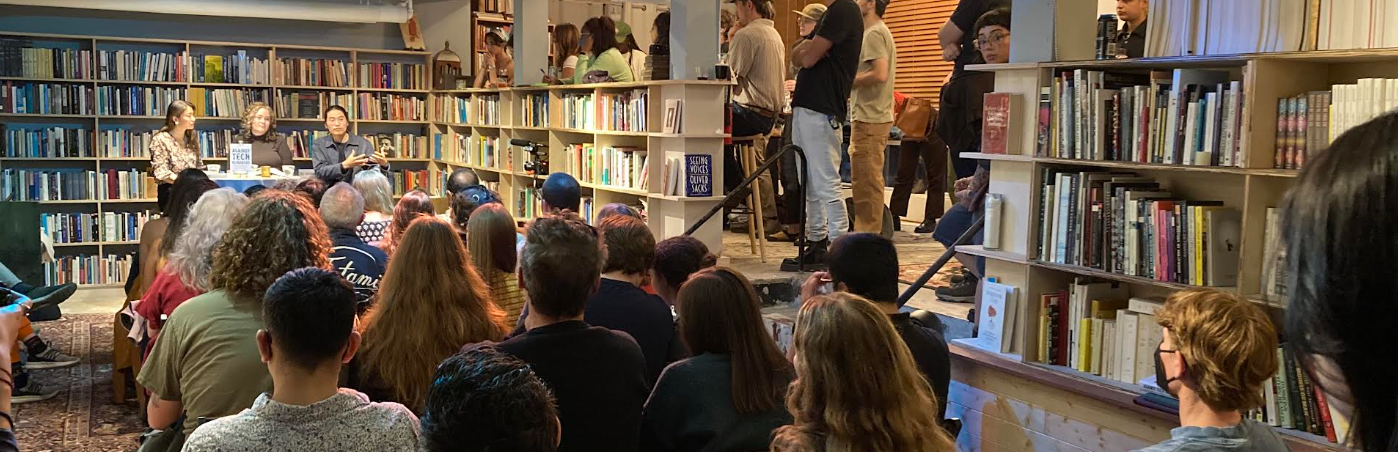
Author talks aren’t usually “private” events at Clio’s. This one is, ironically, because the co-organizers wanted to make entry free for all. Clio’s typically charges something like $10 for a seat—more if you want that and the book—but Bay Area Current and the Tech Workers Coalition wanted anyone and everyone to be able to come and sit down. I’m here for free, too, because I'm helping set up, and also selling copies of JS Tan and Clarissa Redwine’s Against Tech Oligarchy, the book in question (“The Book Your Tech Boss Doesn't Want You to Read.”)
I work part time at Clio’s as a bartender, and have organized a few prior book talks; also, because my full-time job is in tech, I have some thoughts about, well, all of this.
But first, Current is the primary emcee tonight: Wendy Liu takes the mic with the authors, up front, which leaves me standing just outside Clio’s back room, close enough to hear while staying out of the way, and chatting with organizers. One had just given a quick recruiting pitch for Tech Workers Coalition, before the conversation got started; the other explains that they were fired from Google for protesting its role in Palestinian apartheid. They’re upbeat, chatting with Clio’s patrons who are looking for the restrooms and get curious about the event. At one point we order a cheese and charcuterie plate because the recruiter didn’t manage to get dinner beforehand. It’s chill.


The reason we’re here is decidedly not chill, however. The tech industry’s role in the Israeli war machine’s mass bombings in the Levant is decidedly not chill, for example (and No Tech for Apartheid continues to protest it). But that collaboration is just one expression of the political stance that tech execs have taken up over the last decade. Tan and Redwine are veterans of the protests against that shift to the right, playing important roles in union drives at Microsoft and Kickstarter, respectively. They’re both TWC members and were employed as union organizers to work with Twitter employees on a drive of their own (before Musk X-ed it all out). They know what they’re talking about: How the tech workers movement won big, got knocked down, and how it might get out of its present doldrums.
This is the recent past that Against Tech Oligarchy recounts, roughly the 2010s through 2025, that saw a burgeoning resistance to Tech’s absolute dominance of the American economy. Tan’s growing realization of that power came from his experience at Microsoft, where he recoiled from developing software to help clients drill more efficiently for oil. Redwine cut her teeth at Kickstarter, as she and coworkers built their union in order to protect the platform’s mission from its founder. But each was moved to act out of horror at the ends of their work, the way the instruments and tools they were creating were being used to do things they thought harmful.
There were many protests in the era, against heavy-hitters like Google, Salesforce, and Amazon, but Tan and Redwine were early to embrace the idea of organizing legally recognized unions, and Redwine’s success at Kickstarter was itself a catalyst of a shift in tactics over time. As they describe, it started with public pressure campaigns, based on informal employee networks, that led to eruptions into the spotlight and even some concessions from their bosses. But to make that durable, employees tried to unionize. The thinking was that getting the National Labor Relations Board’s (NLRB) legal protection was essential to hold onto their wins and create momentum towards even more]. Sometimes employees did this on their own, as the Amazon Labor Union did. Often, they affiliated with an international like the Communication Workers of America (CWA).
But here is where, as Tan and Redwine note, things took an unfortunate turn for their movement. As the heads of these tech companies—and their venture capitalist ilk—started getting the message that maybe they were the baddies, they reacted poorly. Prominent examples include flipping out at Lina Khan’s attempts at regulation, inflaming the Republican party’s continued descent into what Richard Seymour calls “disaster nationalism,” and ramping up the disciplining of their workers through layoffs and LLMs. Elon Musk’s stripmining of Twitter shows what this looks like in extremis.
The internationals weren’t all that helpful. Most of these companies’ employees had little to no experience with workplace organizing, and they struggled to do it, often not succeeding before people lost their patience with the process. And the bread-and-butter issues of pay and benefits—that internationals know well how to fight for—just aren’t as salient for this group of workers. Their own personal benefits are still largely taken care of, so long as they can keep their jobs. (Though as layoffs continue and the “cost of living” problem deepens, that becomes less easy to take for granted.)
For tech workers, the issue has been how their employers’ time, money, and resources—in short, their capital—are utilized, and to what end. Because they really do believe that their work at these companies has the power to change the world, they’re worried about their complicity in doing harm. International unions aren’t set up to issue that sort of challenge to the powers that be. Even when unions have won recognition they can’t necessarily get the goods; the NY Times Tech Guild’s strike right before the 2024 election failed, for example.
What Tan and Redwine really wanted to really drive home, with this audience—and which Liu dwells on as well—was this question: what if tech really is different? Recognized unions are about negotiating a truce between employers and employees, in which, while unions fight for better pay and benefits, they leave the real mechanism of power, and the question of how money will be invested, to management, who can act according to their fiduciary duty to their investors. That’s what leads to Google contracting with Israel, after all. They probably made a ton of money. And if they didn’t do their fiduciary duty, it would spook would-be investors, the company would probably have to fold, and the unionized employees would be out of a job—to say nothing of the legal liabilities. Not challenging that power might be essential to the union’s survival, in ways that don’t jibe with the power that tech workers feel that they should have.
Moreover, as the NYT Tech Guild showed, challenging the company with the standard union playbook is perhaps foolhardy. Software isn’t just “developed,” it’s engineered with all kinds of automation, fault tolerances, and documentation. The Tech Guild found that the systems they’d built, worked by contracted scabs, could outlast them. The Times’ website and mobile apps maintained a sufficient service quality to keep enough readers clicking and enough revenue flowing to let management win the day.
\O/
What, then, is to be done?
Tan and Redwine give a few examples of past creative disruptions to business-as-usual. One that got a raucous reaction from the audience was a flight attendants’ CHAOS maneuver from the 1990s: the attendants throughout the network would call out of flights last minute and disrupt service, causing nasty ripple effects. But their big point, their major takeaway, was that, for tech worker organizing, waiting for NLRB recognition to fight for demands is ruinous; the demands had to be about how capital is deployed and not just employee’s immediate pay and benefits. Everyone seemed to get the message. In the question and answer session that followed, led by Liu, one woman, a mother, wanted to talk about tactics for voicing dissent at work while also avoiding the gendered problems that come with that: A disproportionate responsibility for creating a positive affective environment, and hazards women face for speaking out that men don’t. Redwine replied that they should talk afterwards, as she had some experience with handling it she said she’d be happy to share.
When it wrapped, people were having a good time at the afterparty between the cocktails from the front room’s bar and the free wine someone had hauled in. In the midst of all that, one of the attendees approached me to buy a book. They work at OpenAI as a software engineer.
We chat, a little, and then they move on to talk with folks from Current. Discontent is everywhere.
Against Tech Oligarchy: Worker Resistance in the World's Most Powerful Industry
JS Tan and Clarissa Redwine
Haymarket Books; 315 pp; September 2006