Drama at the roller derby
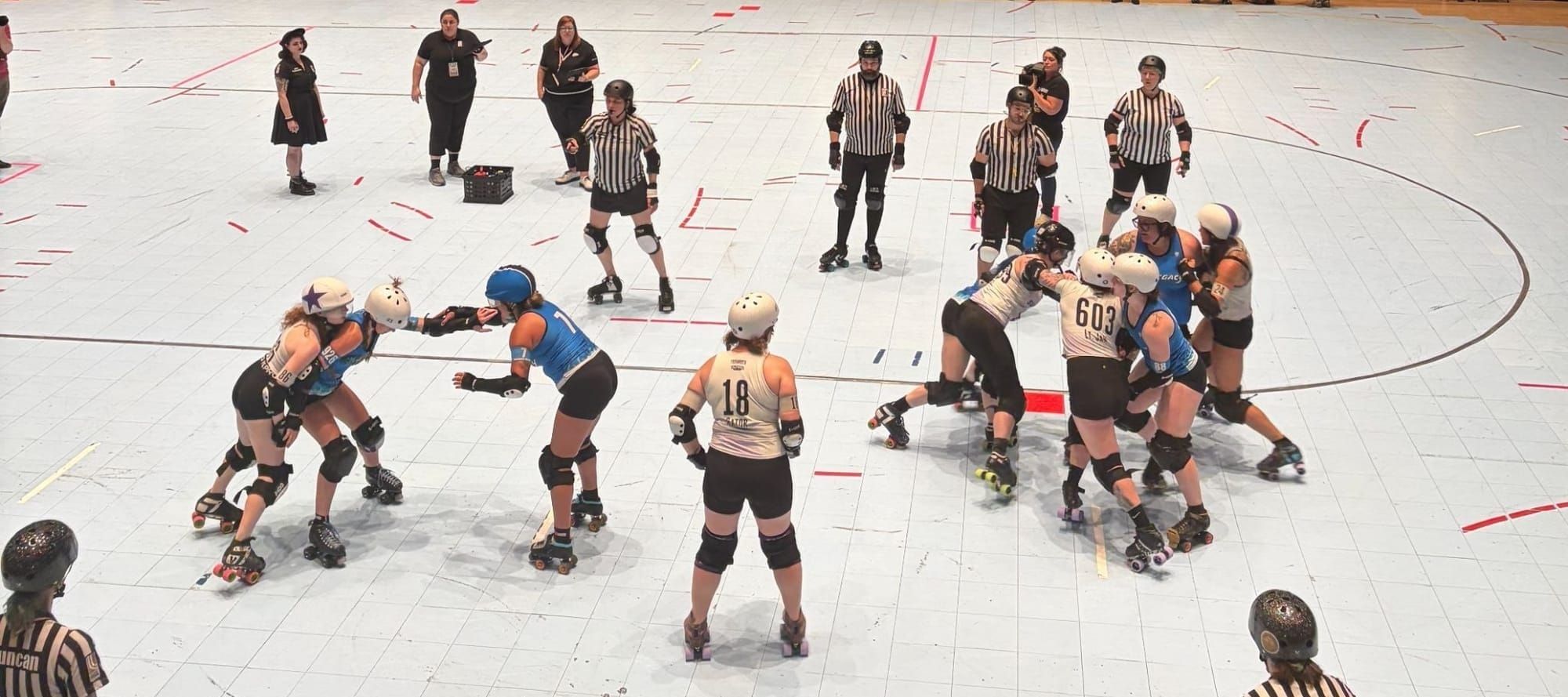
On a recent Friday night, we mainlined women’s roller derby vibes. We’d been invited to the WFTDA North American Playoffs in Richmond—at the Richmond Memorial Auditorium, specifically—and the potential mix of queer people, high-stakes competition, and walkability (for one of us, anyway) proved irresistible. There was one problem, though: Neither of us knew much of anything about the sport. Turns out this is a classic trope in roller derby, where athletes have to withstand the drop-ins of curious writer-types just like us, showing up clueless but eager for spectacle.
We did our best to learn the ropes while driving across Bay Area traffic, mostly via calling a few of Maya’s friends in the Chicago derby scene (“Okay, no balls in roller derby—just bodies? That’s kind of horny,” and “Wait, both teams are trying to score—at the same time?”) But it wasn’t until we’d arrived and gotten our bearings that we realized we were watching not only some of the stiffest Women’s Flat Track Derby Association competition in all of North America but also the focal point of considerable controversy in the sport, with storylines so complex they’d become the subject of “toxic” chatter on a “cesspit” of a Facebook group called Derby Hell. We may not know roller derby, but we are learned experts in the bruising sport known as queer drama.
Maya: I want to tell you about who invited us here. He is my friend from Chicago, named Chris (or “Spider” in roller derby nomenclature). Chris loves roller derby. As in, “I love baseball, I love basketball, but this is probably the greatest thing I’ve ever seen”-type of loves roller derby. As in, flew-out-from-Chicago-on-his-own-dime-for-this-roller-derby-tournament loves roller derby. Actually, that’s not unique—every team and individual at the tournament is self-funded. (In fact, it’s likely that no one in modern roller derby makes a full-time salary from the sport; many would jump at the chance, I’m sure.) Chris is also a cis guy who has never played the sport competitively. For over ten years, he’s been a dedicated volunteer: as a coach, administrator, and broadcaster. Roller derby, according to him, is an art form of infinite finesse. He was invited to watch one day while folding socks in his apartment in Peoria, Illinois, where he lived after college. He had nothing else to do that evening, so he jumped in his friend’s car; upon seeing skaters simultaneously playing defense and offense by juking and weaving and slamming on the track, Chris knew: “I wanted to be part of it.” He was enthralled by a game where winning or losing is determined by mere centimeters separating wheel and boundary line, where even the twelve officials on the court can “still get calls wrong.” With that, I’ll leave you to read the actual rules of roller derby, if you so choose. But we are more about the vibe.

Annie: It was clear the night would be energetically dense when we walked up to the Memorial Auditorium and saw a team of very young-seeming derby players warming up to “Empire State of Mind” before arriving at the entrance and getting our tickets scanned by someone with a huge smile and a black eye. We realized this evening would also be very Bay Area when, before we even walked into the auditorium itself, we had a fifteen-minute-long conversation with the people stationed at the merch booth about local conversational lightning rods (AI, women’s basketball). Of course, they turned out to be fellow writers, too.
Maya: What I liked most about finally finding our seats—old school, wooden, and stylistically untouched since their construction in 1949—was that it meant we could finally relax into just hanging out. By that I mean we spent the first ten minutes in silence gathering intel and typing separately on our devices, which is exactly why I wanted to make friends with people from ORB.
We noticed that here in the roller derby world, your competitive prowess isn’t necessarily conveyed through feats of athletic brawn. The real dynamos (who apparently juggle their roller derby careers with full-time jobs) come off as nerdier, more akin to makers at a zine festival than people playing sports ball (oh right, we reminded ourselves: no balls). But these are also playoffs, i.e., players at the top of their game, all the while sporting blue- and purple-dyed hair, sidecuts, chipped black nail polish, and prescription rimmed glasses. Every skater is introduced by their derby name, some crass and others kind of whimsical: F-bomb; Wrecks; Monster Mash; Alice in Thunderland; Yeti or Not, Here I Come. One player had braided pigtails flipped up the back of her helmet, running up the dome and then affixed, by their ends, to the top like some kind of druidic crown.
Annie: After taking our seats, the first thing I noticed was the points differential on the scoreboard. We had arrived mid-game for Rose City WoJ (Seed 1) vs. Denver Bruising (Seed 9), and it was a wipeout (is that a thing they say in derby? Is it a thing they say in any sport?): 306 to 24. I didn’t even know there were sports that included point totals as high as 306.
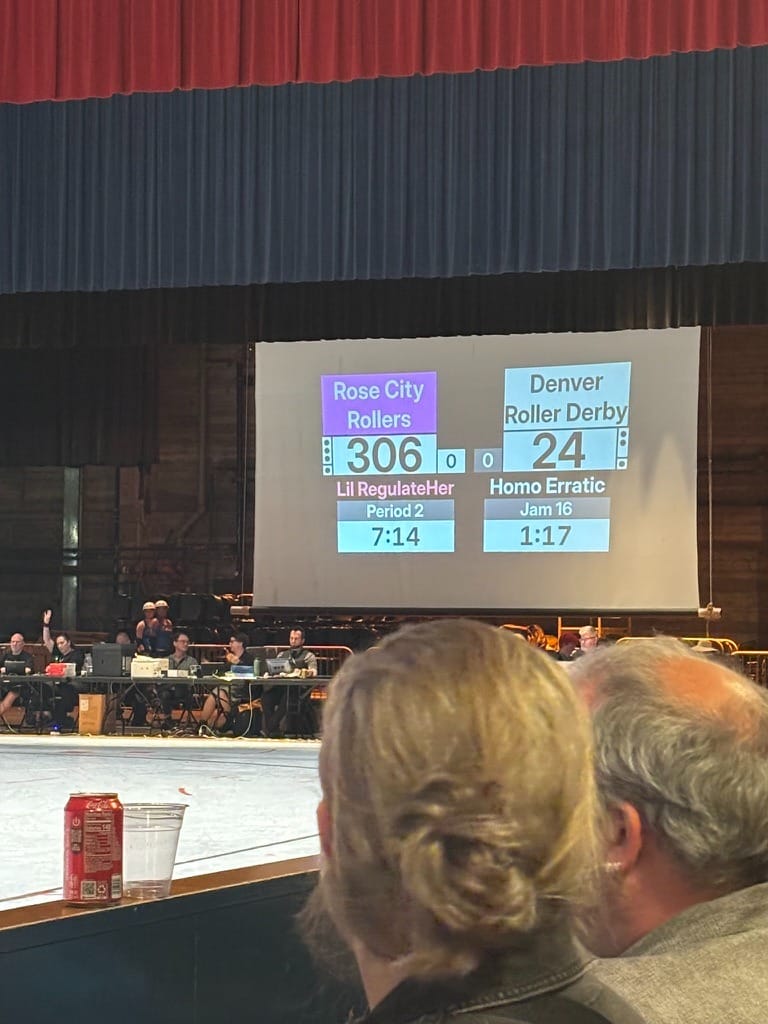
The action on the floor was incoherent to my layperson’s eyes, despite our pre-tournament crash course, so I started scanning for anything I could easily interpret. There was the femme rockabilly-ish official holding a notepad; someone roaming the stands in an inflatable alien costume; the live-streaming setup that we learned from Chris only became fancy and elaborate in the post-Covid world. Occasionally, though, a derby player—the jammer—would break away from the pack and glide around the track with such speed and finesse that even I could get locked in. You don’t need to know the rules of basketball to watch slack-jawed when Victor Wembanyama hits a three, for example, and you don’t need to know the rules of derby to know when someone is being cool and powerful and going fast.
Eventually, a group arrived and settled in the seats in front of us. I listened to their chatter and gleaned that these people really knew derby, so I immediately took advantage of their generosity and started interrogating them about the event. Or, rather, about the one thing I had noticed: an entire team of players, now warming up on the track—the ones we’d seen stretching outside to “Empire State of Mind,” who seemed noticeably younger than the rest. Who were they?
Little did I know this question would unlock the narrative of the whole night.
Maya: From what we could gather, roller derby historically consists of two major subdivisions, if you will: junior and adult leagues. Modern flat-track roller derby was invented in 2001 by adult amateurs in Austin, Texas, who were likely looking for community and exercise and spaces for self-expression. Over the years, roller derby leagues have offered plenty of avenues to train and involve curious adults, who of course had never played the sport. They also started junior leagues for young people—infrastructure that, as far as we could tell, is now spiritually intertwined but functionally separate. This also created a more recent phenomenon: the rise of “aged-out juniors,” or skaters who began playing in the junior leagues, as kids, aging into the adult leagues after turning eighteen.
What that also means is that, suddenly, this generation of young derby adults, trained since childhood and already playing at elite levels through the junior leagues, have started making their own decisions. And with growing autonomy has come the potential for new disruption.
Annie: Which brings us to the team on the track: an eighteen-plus adult roller derby offshoot of Santa Cruz’s junior league, the Santa Cruz Derby Groms. In 2024, instead of joining the adult league—Santa Cruz Roller Derby—the Santa Cruz Derby Groms chartered an adult team (The Legacy) that only their alumni could join. Skating before us was not a loose collection of recently trained adult amateurs but a team of veteran athletes who have played together for their entire adolescence and are looking to mop up at the adult level. In other words, according to one queer we later sat in front of, the Santa Cruz Derby Groms are “trying to build a superteam” (derogatory). And they don’t even host free skating sessions for new adult skaters (also derogatory). For another layer of controversy: Apparently there are even a couple adults who are on the team because they have championships under their belt and are good for the roster, and they don’t even live in Santa Cruz anymore! One of them, a former coach of their junior team, now flies in from New York just to compete. They qualify as “coaching alumni.” And apparently The Legacy practice in Scotts Valley, a suburb six miles north of Santa Cruz, rather than Santa Cruz proper, which, based on the tone of the person who shared this with us, is also controversial. Here at ORB we scoop amateur sports drama. Take that, Defector.
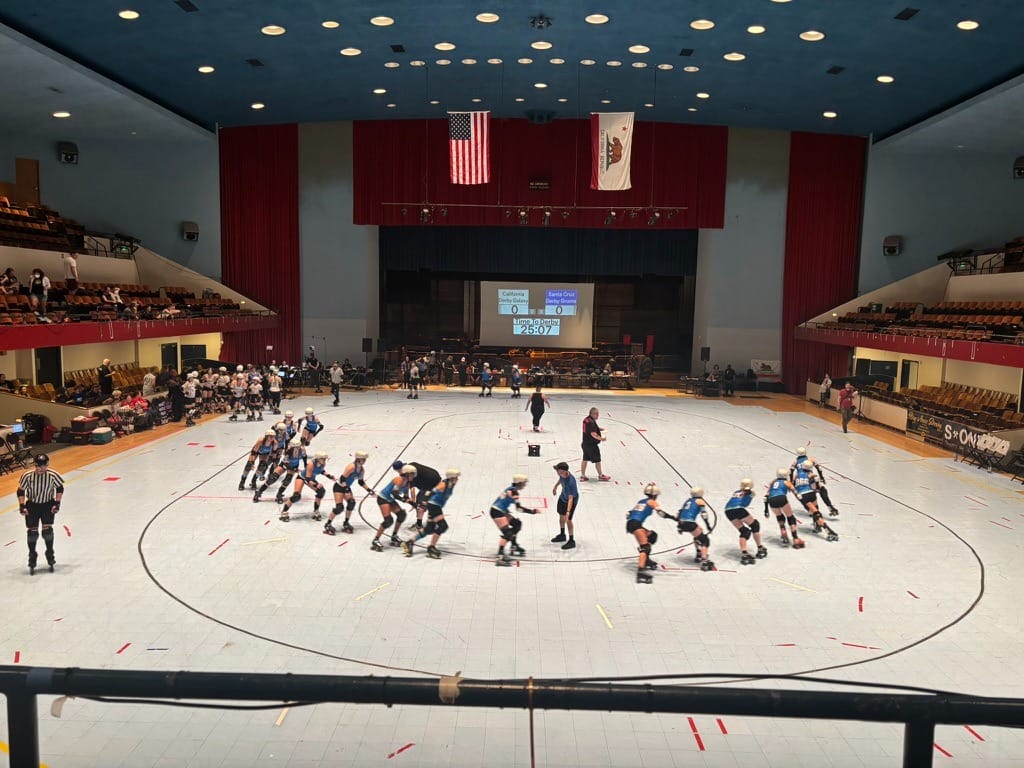
Maya: It was time for the game. “Who do you think will win?” we asked the far more learned roller derby observers around us. “I know who I think should win,” one of them responded, which meant the California Derby Galaxy, The Legacy’s opponents, apparently ranked a seed above. But we could already feel the tides turning. As we watched the “aged-out juniors” (and at least one former coach) playing against the adults, we asked one of our fellow spectators if the youth leagues were as queer as the adult leagues seemed to be. “Super queer,” they said. Then they looked at us with playful, mock dismay. “I mean they trans’d me!” We giggled.
Annie: The competition was way fiercer than the previous game. The Galaxy took an early lead, buoyed by emphatic cheers from across most of the auditorium, but then the Derby Groms pulled ahead. I retained absolutely no gameplay except the time the jammer actually jumped several feet to get past someone before continuing around the track. On skates! That was sick.
Maya: The one thing I’m sure of is that Alice in Thunderland was dominant as a jammer, but in a sneaky roller derby way, where she seemed to have that magic ability to tip toe (on wheels!) past the bulky presence of the defense. This technique is distinct from a strategy known as “bulldozing,” in which a jammer uses their strength and power to break through defenders. I think it has something to do with angles.
Annie: Even though the game continued to heat up, Maya and I could feel our attention drifting away from the sport itself. As outsiders to the derby universe, gossip and knowledge of how competition works could go only so far in our pursuit of the evening’s vibes. Satisfied with the conversations, the lore, and the amount of full-contact shoving from the evening, we gathered our stuff and pivoted to Little Hill Lounge, a dive bar in El Cerrito that feels like being in Chicago.
Maya: By the end of the weekend, we learned from Chris, the Santa Cruz Derby Groms placed third: ahead of where they were predicted to finish, qualifying the team for the WFTDA World Championships this October in Malmö, Sweden. But that wasn’t the shocker of the weekend after all. “I think Rose City’s B team beating Angel City’s top travel team was the biggest surprise,” Chris told me. That’s a whole different story, for another time—all you need to know is that this upset evoked a bit of “bellyaching,” according to Chris. “Do you think more bellyaching than about the team of children?” I asked him, in perhaps a not-PC way. “That’s a good question, actually,” Chris responded “I didn’t have time to go up in the crowd and get a feel for it, but there could be.” Thank goodness Annie and I had swooped in to check the vibes early in the weekend. Perhaps we still have miles to go in terms of properly learning and analyzing the sport the way it deserves, but we left well-exposed to its stakes: a game so beloved that it’s also ardently debated over, at least by the people for whom derby is the greatest thing they’ve ever seen.
By the way, if you want to learn to skate as an amateur adult, you still can! Bay Area Derby (or BAD) hosts a Learn to Skate program with sliding scale fees, and no one turned away for lack of funds (or skill).