Left in the dungeon
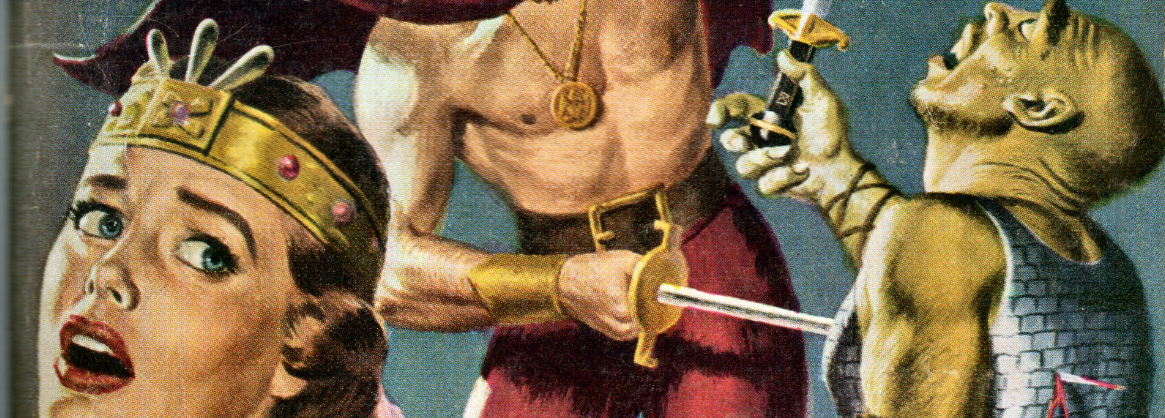

Carl must slay the naga princess! If he doesn’t, his best friend—the talking cat-wizard Princess Donut—will die instead. But Carl and his team have a plan. They track the princess to the god Khepri’s sanctum in the Vanquisher Club and slay the club’s guards with a MacGyver-demonology contraption. Inside the sanctum, though, Carl is surprised: The beetle-headed attendant supervising the insect banquet within is Khepri himself, god of Rebirth and the Sunrise, summoned as a trap by the devious princess. As a level-250 god, Khepri will slay Carl easily—disaster looms!
But Carl thinks quickly. Khepri’s divine presence renders him immortal for 90 seconds, and Carl has a thermobaric warhead in his inventory. He detonates it at his own feet—Carl is turned into goo, only kept alive by the immortality condition. But Khepri’s avatar is knocked far away by the blast, and Carl and the princess are blown out of the temple. There, before Carl’s immortality expires, the princess is driven insane by a spider demideity trapped in Carl’s chest tattoo and then slain by a juggalo slug (“sluggalo”) that emerges from Carl’s neck. She is dead! Princess Donut is safe! Carl escapes through the Calligraphy Guild and receives a Celestial lootbox.
\O/
If you found this sequence intelligible, you may be pleased to hear that this carnival of an action sequence is only the second or third climax of This Inevitable Ruin, the seventh book of the Dungeon Crawler Carl series. Elsewhere in Ruin, you will find another god wielding his own severed penis as a flail, an emergency lung-and-heart transplant carried out by a changeling prostitute named Juice Box, a WWI-style trench battle, and a one-winged bird draining the dungeon’s chaos abyss into the galaxy’s fanciest watch party.
Whatever is going on here, people love it.
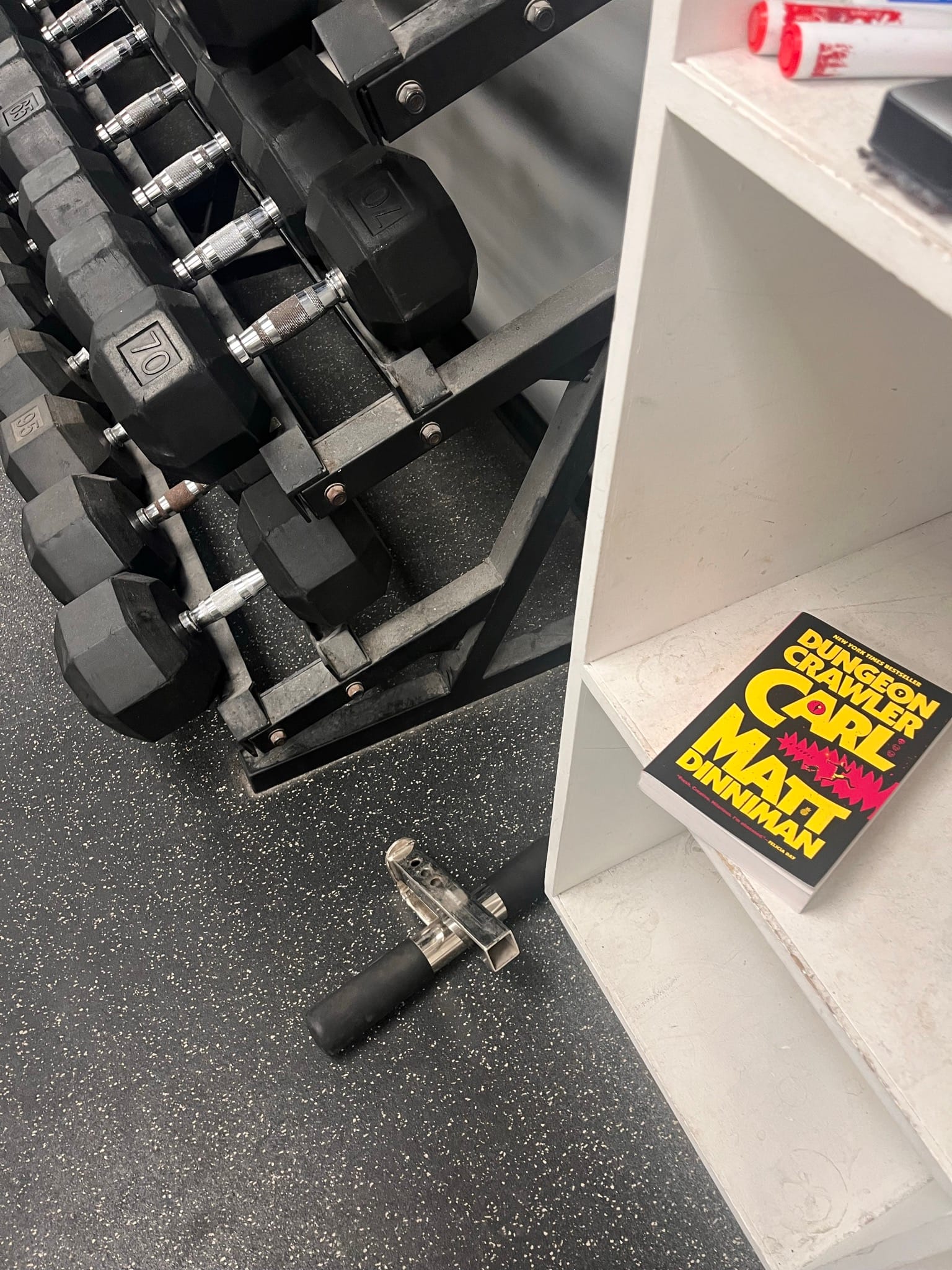
Carl author Matt Dinniman started writing chapters for free on serial website Royal Road in 2020, then began self-publishing whole novels on Amazon later that year. In 2024, partial rights to Carl and friends were acquired by Penguin imprint Ace Books, which has since reissued the first few volumes. Today it is everywhere: People are reading it at the gym; multiple volumes have landed on multiple New York Times bestseller lists; Seth MacFarlane’s company is working on the TV show. Even your ex has a copy. Despite the franchise already topping four thousand pages, at least three more books are still coming. Carl is likely the first English-language digitally native genre megaseries.
The period of the series’s ascendancy has been marked by growing recognition that many cultural forms are authoritarian—the suburbs! social media! charismatic health! And…perhaps the role-playing game? Lawful Evil all along?
But it’s not just all fun. Many say Carl has a real political message. Laura Miller, writing in Slate, notes how themes of “exploitation…[and] corporate skullduggery…become an increasingly rich and pointed analogy to the power imbalances of our own world.” Kat Abughazaleh, the journalist and former U.S. House candidate in Illinois, has skeeted praise for “a fun, antifascist sci-fi multispecies buddy comedy book series.”
These are bold claims for a series whose early installments revolve around the threat posed by “Krakarens” and their “Crotch Dumplings.” Bolder still, in a world whose empowered fascist imaginary shares many of Carl’s RPG-genre antecedents. The period of Carl’s ascendancy has been marked by growing recognition that many cultural forms are authoritarian, or at least so imbricated with authoritarianism that they seem beyond reclamation—the suburbs! social media! charismatic health! And…perhaps the role-playing game? Lawful Evil all along?
Is there anything antifascist in Carl’s inventory, alongside the assassinations and lootboxes and dick jokes? Is it anything that’s going to be useful for those of us without spider gods trapped in our chests?
\O/
Carl is the breakout project from the LitRPG microgenre—novels of character adventure inspired by the systems and situations of Massively Multiplayer Online Role-Playing Games (MMORPG) like World of Warcraft. The series begins with Donut—a tortoiseshell Persian pageant cat belonging to Carl’s checked-out girlfriend Beatrice—escaping from Carl’s Seattle apartment. He goes down in his boxers to retrieve her, and that’s when aliens invade earth, instantly killing everyone indoors but sparing nearly naked Carl. He then receives a notification delivered by a “male, robotic voice” and “text…floating in front of” him: the planet has been seized for mineral extraction; surviving humans will be given a chance to participate in an “18-Level World Dungeon” administered by “a Syndicate neutral observer AI.” A moment later, Carl carries the cat down a suddenly appearing staircase—he has entered the dungeon.
Once in the dungeon, Carl is systematized. More notifications inform him he is a level one human, with stat points “assigned based on your current physical and mental profile.” He has become a video game character in addition to a fictional character—and earned many achievements and lootboxes:
New achievement! Trailblazing Crazy Cat Lady.
You are the first crawler to have entered the World Dungeon accompanied by a cat. You must really love that thing. Too bad you’re both probably going to die a horrible death at any moment. Or maybe not. Look at the prize you just received!
Reward: You’ve received a Legendary Pet Box!
Carl punches to death a couple of goblins and meets a tutorial rat named Mordecai, who explains that the dungeon is run as livestreaming entertainment for galactic audiences and helps him access numerous menus and inventories. Inside the boxes, Carl finds various potions and apparel, plus—from the aforementioned Legendary Pet Box—a biscuit that turns Donut sassily lingual. “I heard everything you said to my manservant,” Donut tells Mordecai. “Now wave your hand and grant me access to my prize boxes so we can get this farce rolling.”
Lootboxes! Level-ups! Dungeon Levels! Stat Points! A reader searching for antifascism might find themselves discouraged already—MMO terminology like this has, after all, made itself gruesomely available to the contemporary right. The fascist on your team at work probably talks about leveling up; the one in the national-security supply chain keeps talking about being hardcore. Beneath the language is a worldview—violent and accumulative, full of fake people we can and even must slaughter for our own advantage.

The genre as a whole sometimes does feel haunted by these possibilities: Formally and narratively obsessed with the main characters’ progression through ranks and levels, LitRPGs at their worst feel arid and narcissistic. He Who Fights With Monsters, a twelve-books-and-still-going series by (the pseudonymous) “Shirtaloon,” teleports an Australian named Jason into a world of fantasy adventure. There, after some humbling knockouts at the hands of a guy with a shovel, he is gifted a set of evil-coded affliction magics and becomes this new world’s smartest and most generous person in addition to its best chef. His character is something like a reply guy’s¹ power fantasy: Though he does do real good, many chapters are arranged around the supercilious lectures he delivers about the world’s foolish religions, backward political economy, etc. And his choice to become a heroic “adventurer” is grounded in a vision of society consisting of ignorant and helpless citizens, kept “safe and happy” only by others’ heroic choice to “stain [their] hands.” A fash-adjacent model, but somewhat accurate in a fictional world of helpless peasants and villainous deities.
Carl, to its credit, escapes this warrior cop–ass vision. Carl himself can at times feel like a cipher, a goodhearted everybro who is also proficient with bombs. But the novels place him in constant trialogue with Donut’s excitable spunk and the AI’s Reddit-brained sarcasm, all supplemented by infrequent encounters with media figures from outside the dungeon, who fill in Carl’s understanding of the “real” world of galactic government and intrigue. It is one of the genre’s least lonely entries, the one whose hero constantly and joyously relates not just to himself and his enemies but to a rich cast of friends.
Not that there aren’t imperfections. Especially early on, Carl is uneven in the ways you might expect of a project drafted first as a free pandemic serial. The humor can be sophomoric, and with suspicious frequency the real villains turn out to be women, often with exotic or grotesquely large sexual organs. The plotting can seem ad hoc, with huge action scenes often playing out to their climax before flashbacks introduce the corner-case macguffins that have underwritten Carl’s triumph, and with other threads energetically developed and then completely dropped.
But the core buddy-comedy action is good, with Carl’s relationship to Donut being the series’ masterstroke—she’s an endearing costar in her own right and a bulwark against generic loneliness. Donut does for Carl what Sancho does for Don Quixote: grounds the protagonist and story in a relationship of tetchy comedy and genuine mutual care. There are other parallels to Quixote, too. Carl, like the Don, is a wayward genrenaut, one whose attempts to play out the conventions of one genre in a world defined by another yield punchline and pathos at once. And like Don Quixote, the Carl series is a project of novelistic assimilation—its treatment of a “low” entertainment genre, here the MMORPG, mixes its critique with a real affection. The restorative reading of Carl is a recursive one: He is himself a restorative reader, one who searches the dungeon’s violent systems of becoming for a way to remain human.
\O/
When we are talking about Carl, we are talking not only about the LitRPG or MMORPG but the RPG itself. Let’s call it “Long Dungeons & Dragons”: the half-century process by which Gary Gygax’s 1974 game system has leveled up into our everyday world. Stranger Things is perhaps the mainstream apex of Long D&D. It is supported by nearly every video game with a skill-progression system. Anything in your life that has been “gamified” is long D&D. So are board game nights and any narrative project with a “magic system.”² Big elements of the contemporary right are Long D&D, but so too are certain ways people talk about black bloc actions (a countable party! with special gear! doing “feats”!) and even elements of Democratic Party “popularism,” which proposes a politics of infinite and cynical respectability, always manipulating its character sheet to wield the Blessed Blade of the Median Voter.
D&D itself has, in its half-century history, seemed both ally and nemesis to left and right politics alike. Reactionary campaigns to have the game banned for encouraging Satanism have given way to a wistful appreciation for its longtime modeling of racial essentialism; left critiques of that same essentialism have been tempered by an awareness of D&D as a space of liberatory imaginative play, often for social misfits.
The game’s genius is the antinomy between its imaginative and systematic elements: The focus on small-group fantasy heroics gives faces, names, and narrative to tactical calculations about which dice to roll and when; the dice’s formalization of success and failure permit sorcerous fantasies to be played out as activity rather than daydream
That all of these sympathies and accusations are at least partly correct—barring the Satanism—is a testament to the syncretic breadth of D&D’s vast systems and communities. But these diverging intuitions about the game’s political compass are grounded, too, in the dialectics of its design. Historically speaking, D&D is a synthesis: Inventor Gary Gygax, a Wisconsin libertarian, was a devotee of both fantasy literature and the kind of daddish tactical wargames in which battles between large armies are resolved by rolling dice. D&D, first and confusingly codified³ in 1974, integrates the two. Instead of commanding squadrons or armies, players each control a single hero from a set of sword-and-sorcery archetypes, and adventure in a world of medieval-inspired combat and intrigue. The monsters and villains who oppose them, like the villagers and allies with whom they interact, are controlled by another player, the dungeonmaster, who determines and relates the effects of the party’s actions upon the world around them. The success of these actions, whether narrative or martial, is generally determined by the outcome of dice rolls, modified by each character’s abilities and characteristics. The game’s genius is the antinomy between its imaginative and systematic elements: The focus on small-group fantasy heroics gives faces, names, and narrative to tactical calculations about which dice to roll and when; the dice’s formalization of success and failure permit sorcerous fantasies to be played out as activity rather than daydream.
Most players begin by creating their characters—supplementing names and brief biographies with choices about race, class, attributes, and abilities. For most of D&D’s history, the choice of “race”—between Elf, Dwarf, Half-Orc, etc.—has come with defined characteristics. Elves, here, are dexterous, Half-Orcs strong, Dwarves hardy, Tieflings hot. Race, broadly, is real. Types of people have consistent traits and affinities, are well or poorly suited for certain roles—and you can tell just by looking at them, or knowing their descent! This organizing essentialism, especially prominent in the early material, is partly inherited from the racial determinism of Tolkien’s Lord of the Rings, still a superantecedent to any genre where spells are cast or swords are given names. There, too, race is real—the hobbits are stolidly decent, the men corruptibly fierce, the elves nobly disengaged, and the dark-skinned Haradrim natural servants of evil. Tolkien himself seems not to have been a personal-animus racist, but the books are undoubtedly racialist, shot through with the scientific racism of the prewar era. No surprise, maybe, that it’s the racial and moral essences of the whole fantasy genre—D&D included—that are most appealing to contemporary fascists, who have brought with them an interest in the old sort of race science. Part of the fantasy, for some, is of a neatly ordered world, whose villains were born to be villains and whose rulers were born to rule. Many contemporary fascists were furious when, catering to a more diverse playerbase in 2024, D&D removed “race” as a category, replacing it with “species” and moving these character bonuses to a set of personal-history “backgrounds.”
But if D&D’s systematization carries a germ of essentialism, it’s crucial to recall that D&D isn’t just a system—it is an imaginative system. The characters, once created, venture forth into a world bounded only by their collective imagination. Since the success of almost any venture can be determined by the roll of a twenty-sided die, a player might and often does try anything, especially if their friends and dungeonmaster find it fun. Anything, really—slay the evil fairy, befriend it, trap it in a whiskey bottle and try later to brew fairy-infused liqueur. Such possibility is invited by the game’s setting, always already a pastiche of the medieval, fey, demonic, biblical, and otherwise goofy sensorium of a nerd living in Wisconsin in 1973. As in the sonnet or villanelle, a fussy mathematical structure can platform acts of emergent creativity.
Most appealing, for many, is the system of character progression, still the world’s favorite formalization of individual becoming. A D&D character’s success in various enterprises is determined by their capacities; their capacities in turn by their level; their level by the experience they gain in various adventures. And, on gaining each level, the character becomes more fully themselves in both empowerment and choice. They may specialize further in a favorite weapon, learn to cast spells from the midst of a melee, or dabble in another class altogether. In life, self-actualization of this kind is a halting, messy business—in Long D&D it is progression, regular and certain but still holding the sense of breakthrough, our capacity expanded after a long plateau of effort.
It is no coincidence that D&D is an almost exact contemporary of Reagan–Thatcher human-capital liberalism—no societies here, only individuals and adventuring parties, hauling themselves up from level one with hard work and fifty feet of rope. But there is also the fantasy of change.
It is no coincidence that D&D is an almost exact contemporary of Reagan–Thatcher human-capital liberalism—no societies here, only individuals and adventuring parties, hauling themselves up from level one with hard work and fifty feet of rope. But there is also the fantasy of change—the creative liberation, the tabletop invitation to take a different name, try anything, become ourselves by taking up arms against the hoarding dragons. Especially since the late-2010s blowup of live-play podcasts, the game is a favorite of queer communities: within the armature of rules is an almost infinite imaginative horizon, bounded only by collaboration.
Later in the century, the D&D-like roleplaying game was enthusiastically digitized. Some classics partially preserved the branching contingencies of the tabletop game, but overall the replacement of the dungeonmaster with the CPU meant a drift away from human storytellers’ yes-and improvisation and toward the computers’ edge in doing really fast math. Computer RPGs became single-player stories, novels with combat—largely predetermined narratives, with some meaningful choices made by the player but far greater depth and complexity in the game’s two core mathematics, violence and character progression.
With the addition of the Internet, the CRPG evolved into Carl’s antecedent: the Massively Multiplayer Online Roleplaying Game. Alongside a renewed social experience, games like World of Warcraft offered their players a dopamine jubilee of constant progression: here was your paladin, level one and killing Kobolds, level twenty and slaying the pirate VanCleef, level sixty and wielding fantastic powers to raid the lair of Onyxia—monsters who’d respawn to be slain as many times as you’d like. Violence, in the MMORPG⁴, is both total and totally weightless: robbed of consequence, killing becomes both self-expression.
What does last, here, is the personal progress: Though Van Cleef never stays dead, you keep the loot and the experience points. When you arrive at the level cap, progression becomes possession: the search for “best-in-slot” items that will empower you to confront the tyrants of this year’s expansion. These tyrants, certainly, are narrative: Wielding a long lost arcanum, this demon/dragon/horror will soon cement an apocalyptic rule. They must be slain! But like Keats’s lovers they canst not reach their goal—subscription fees would end in the apocalypse. Tyranny, here, is always imminent but never actual; you can kill tyrants every week and change nothing; all that matters is what you can loot from their corpse.
In these Long D&D spaces many of today’s adults—millennials especially, the generation that believed most in hard work and triumphant becoming—spent formative hours and years grinding. What were we learning?
\O/
Because many of our political convictions begin as hypotheticals, our imaginative models are critical antecedents to our politics. If we imagine a world patterned on tabletop D&D, it is a place of joyous improvisation—we are on an adventure with our friends; we can be anyone; we can try anything. A CRPG world would be partly instrumental and a little neurotic—we will scour every room in hopes of finding rare material. And we will do favors for our friends, both because we love them and because the fancy swords they get at the end of the favor will help us save the world.
The MMORPG presents a more concerning model. There, the consequences of violence evaporate immediately but its profits endure. Personal accumulation is the only real story, and tyranny or collapse are threats so ambient they can never really come to pass. In this light it is easy to see why MMO discourse has been so convenient for the alt-right. A world populated by “NPCs” is one where we need no theory of other minds, and no consideration other than our own advantage—our urges, after all, are more real than anyone that they might harm.
Then there’s “grinding” and “maxxing,” terms that have been offered to a generation as a virtue ethics. Both have at least partial digital-RPG etymologies—grinding from the repeated slaying of weak monsters to gain power, and maxxing via “min-maxing,” a model of character design that pursues certain extraordinary powers by neglecting other aspects or abilities altogether. As a system for living well, they do contain some virtue—prioritization, laborious commitment, a sense of the refinable self. But the virtue in each is narrow to a point of fetishism—by perfecting one skill or attribute they hope to solve the whole uncertainty of life. At its most absurd expression adherents end up hitting themselves in the face with hammers, because a perfect jawline will solve all other problems. What is grinded or maxxed is asserted as total—with risks visible to anyone who’s witnessed the recent political trajectory of the manosphere or charismatic-health movements. We don’t need Adorno or Arendt to remind us that, having made something total, we are much of the way to endorsing a totalitarian politics. But at the same time the MMO is often a space of collaboration or even solidarity; the randos who help you slay Van Cleef are your class allies, online and likely offline too. Some might even become friends. And since the impact of each shadow bolt or healing wave was formulated by the game’s designers, the MMO likely offered many players first encounters with the caprice of power. To complain about a patch note, or grumble about overpowered characters, was to lift one’s eyes from the ecstasy of individual becoming and see that the horizons of that becoming were circumscribed by an arbitrary hand—a systematizing thought that might, might, lead leftward.
This, roughly, is Carl’s journey: Early in the series, he is a successful striver, slaying and growing and surviving. “You will not break me,” he vows throughout the first novel, addressing the dungeon administrators. But he always recognizes himself as a member of the class “humanity” and before long recognizes that the dungeon NPCs are often “people” too—successful crawlers from previous seasons, or dungeon-born life forms recycled many times. If they try to kill Carl it is their job, not their essence—his real enemy is the colonial-extractive galactic system, and the family monopolies that rule it. To be in the dungeon at all is a class position, one that obliges a revolt: By book four he has amended his motto, adding “I will break you.” In this way, as Carl’s concern for personal advancement is overtaken by his interest in systemic change, Dungeon Crawler Carl lies downstream of Germinal or Les Misérables as much as Tolkien. It is an action series becoming a revolutionary series, an attempt to dig a positive politics out of the conflicted imaginarium of the MMORPG.
\O/
However we read the political potential of the MMORPG, actually existing gamer collectivity has sorely tested Jameson’s suggestion that we admire solidarity wherever it occurs. This solidarity is often expressed as a demand not for justice outside the dungeon but degeneracy within it: The tits are too small, the recruitable allies too “woke.” Its class enemies are, at times, the MBA extractors adding endless microtransactional layers—but are at other times women in general, who cannot be trusted to make a single narrative decision. The frequent demand is not for a better world but a more consoling spectacle; perhaps it is no surprise that people who have spent days of their lives pretending to be blood elf warlocks exhibit a certain amount of false consciousness.
Carl does better. Though the master’s legendary lootboxes do very little to the master’s house, Carl sets out to resist the system from within the system. He has a few advantages here—as a high-viewcount crawler, he is often invited to media hits outside the dungeon. And the game’s governing AI, a near-omnipotent foot fetishist, has an evolving crush on Carl. Finally, many galactic hierarchs also want to participate in the dungeon, teleporting themselves into specific floors—he doesn’t need to leave the game to kill them.
Carl’s major tool, though, is the loophole—he is an artist of the corner case, the unintended overlap between the dungeon’s many systems. “Using a loophole isn’t cheating, Carl. Not when we do it,” Donut says toward the end of book six, speaking some of the series’ subtext. The loopholes are too many to list: In book four Carl uses an exploding Donut toy, a disco-ball smoke curtain, a bit of social engineering, and a situational notification block to assassinate a particularly annoying dungeon administrator. In book two he uses a beanie baby case to contain a nuclear explosion.
Overall, it’s not too much to say that the loophole is Carl’s chief resource in both surviving the dungeon and undermining the galactic power structure. As an imaginative tool the loophole holds at least some potential: A loophole is a heightened contradiction, a literal intersection where the impossible commitments of an authoritarian system reveal themselves as absurd, and at once a site where a single actor can have a systemic impact. In this reading, Carl is a critic, a post-structuralist tossing hob-lobber bombs at any power he encounters.
If loopholes are the prevailing revolutionary form, revolution itself becomes novelistic—heroic, clever, individual. One person, perhaps in patterned boxer shorts, will read the rules closely enough to identify their secret vulnerabilities—then the whole system will founder. An appealing model, especially for an author, but one whose appeal again recedes in contact with actually existing practitioners of loophole politics: sovereign citizens incanting admiralty law to excuse their tedious crimes, QAnoners whose faith in a righteous cabal makes spending all day decoding YouTube videos look like vital praxis. And our Supreme Court, too, philologians who each year discover new reasons the constitution always envisioned a king.
The best recent developments in left politics, meanwhile, have eschewed the loophole: Rather than clever concatenations of rules, they have been grounded in collective virtues obvious enough to seem a little stupid.
The best recent developments in left politics, meanwhile, have eschewed the loophole: Rather than clever concatenations of rules, they have been grounded in collective virtues obvious enough to seem a little stupid. New York Mayor Zohran Mamdani has found success with a program of “wanting openly to help people.” And the people of Minneapolis, who this past winter broke the vanguard of American authoritarianism, did it with nothing more secret or clever than whistles, text messages, and an absolute commitment to loving their neighbors. It is in these elementary-school virtues—care, honesty, presence, and effort—that American antifascism has found its most promising forms.
Not that Carl would object to these virtues—through the dungeon he proves himself a committed friend, a compassionate leader, and a loving kinda-parent to Donut. And so in the end it is not the spectacular battles or stratagems for which we should admire him—not the way he is brilliant but the ways he is bland, boring, even a little dull. His flat earnest decency, the stubbornness of his effort, and his absolute refusal to be broken offer far better models than the bank-shot legalisms of his triumphs. We, after all, are still not sorcerers—we can leave loopholes and magics for the Epsteins and Alitos and RFKs to whom they belong. If we are to save ourselves, games can help—they can teach us to imagine together, and to dare. But we must choose to play the roles not of heroes but of citizens, less clever than stubborn in our love for one another.
1. HWFWM, which is often compared-contrasted with Carl on the very lively genre discussion boards, also started life as a web serial. Sometimes the monologues seem to result from an authorial discovery that, having done an action sequence last week and character development the week before that, the feudalism lecture could probably be a credible way of chewing up a thousand words of this week’s entry.2. Gandalf’s magic system, e.g., was “caring a whole lot.” The idea that magic in stories ought to operate as a set of rules rather than a set of miracles is not at all baked into the original Tolkien-or-fairytale antecedent; it has at least something to do with the fact that many of our contemporary fantasy writers grew up playing D&D, and learned from it that even the miraculous ought to be systematized.
3. Choosing an elf in the very first 1974 ruleset permitted players to “begin as either fighting-men or magic-users and freely switch class whenever they choose,” but prohibited “progress beyond 4th level fighting-man (hero) nor 8th level Magic-User (warlock)” and offered an unenumerated ability to “note secret and hidden doors”; by 1978 the door thing has been elaborated to a 16 and two-thirds percent chance to note such doors, doubled if actively searching, and a nearby discussion of the Assassin class notes they must have “a minimum strength of 12, an intelligence of 11 or more, and a dexterity score of not less than 12,” and are “evil in alignment (perforce, as the killing of humans and other intelligent life forms for the purpose of profit is basically held to be the antithesis of weal).”
4. Hardcore, PVP, and other MMORPG scenarios trouble this model a bit, but are outside this article’s concern and word count.