Forty years of not getting closer
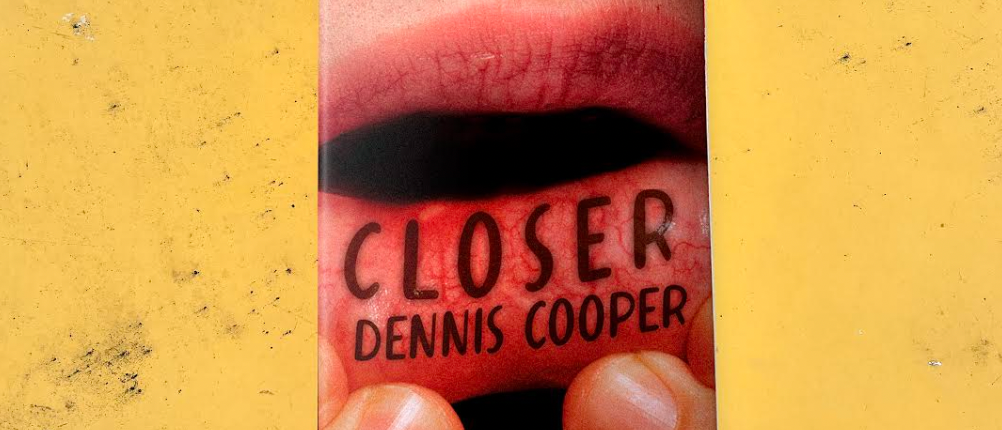
When two leather-clad, brooding beauties meet-cute, in Gregg Araki’s 1993 Totally F••••• Up—the first film in his Teenage Apocalypse trilogy—they flirt by discussing Dennis Cooper. The blonde has read him, the brunette has not. “He writes about, like, S&M and torture and serial killers,” as the blonde explains; “guys eating each other’s shit.” It’s a way to work his edgelordism into a sexually-tense contrast to the brunette’s puppy-eyed naivety. And as a seduction tactic, it works. The brunette is seduced. Then, when the blonde breaks the brunette’s heart, as of course he must, he blames it on his complicated emotional landscape, the same complication that made him a Cooper fan.
I’ll admit that it was the sexual capital associated with being a Cooper reader that brought me to his work. In our culture of images, books have become totemic accessories, glimpsed on Instagram or used as props in public to build out a personal brand (that tricky, fragile thing that the internet age demands of us all). You instantly understand the difference between a Clarice Lispector reader and the reader of James Patterson’s latest coauthored book with Bill Clinton (of which there are three!). One wants experimentation; one wants spectacle. I first picked up Closer because it built out the image of the reader I wanted to be perceived as being. Because his books feature sexualized torture and violence, “guys eating each others’ shit” as the blonde succinctly puts it, being seen to appreciate the filth of Cooper’s writing signals that you have stepped over the bodies of the prudish and square. You’ve survived the cull.
And then I actually read the book. It was difficult and disarming, not at all the sexy romp I’d assumed it to be all the muscled, mature men on the internet I’d seen reading it at the beach. It was cold, aloof, and gruesomely violent—entirely uninterested in arousing the reader or polemicizing about identity politics—and instead set on excavating the interior of the human body, exploring exactly where our humanity is located and what damage it can endure.
Closer is the first installment in Cooper’s “George Miles cycle,” a series of novels written as an ode to a boy Cooper knew in high school. Beginning in 1989, these novels were published into and captured a moment of Reagan-era queer, punk pessimism. Beautiful, zonked-out twinks with absent parents drop acid, lust after one another, make middling art, and resign themselves to increasingly violent and compromising sexual scenarios at the hands of older, sadistic men. They have lots of sex. They enjoy none of it. Nowhere were the cum shots, the turgid I-don’t-know-if-I-can-take-it cocks, nor the lustful moans that a reader might expect. Instead, the sexual escapades of these burnouts were like reading an account of a fetal pig dissection. These gay boys (far too many to realistically exist in one California suburb) take turns narrating their neuroses, their frustrated visions of desire, and their disillusionment about the ugliness of the world they’d inherited. They gorged on porn, comics, and video games regularly and with enthusiasm, but the sex they were having paled in comparison. They observed sex through a clinical remove. I imagined the experience smelled like formaldehyde and appeared to them as a series of truncated bullet points: I got it hard, we fucked for ten minutes, we stopped. Balls are likened to a pile of rubble, an open ass to a cobwebbed cavern, and the smell of sex to a hint of perfume misted somewhere in an old king’s tomb. No one is satisfied. No one gets closer.
Then, seemingly out of nowhere, acts of extraordinary violence punctuate the boys’ lives. John, the portraitist, bites wounds into the back of a random man that he and George bring home for a threesome; George’s previously perfect ass is mutilated beyond recognition; and David, the teen idol, is splattered dead in the middle of a garage party.
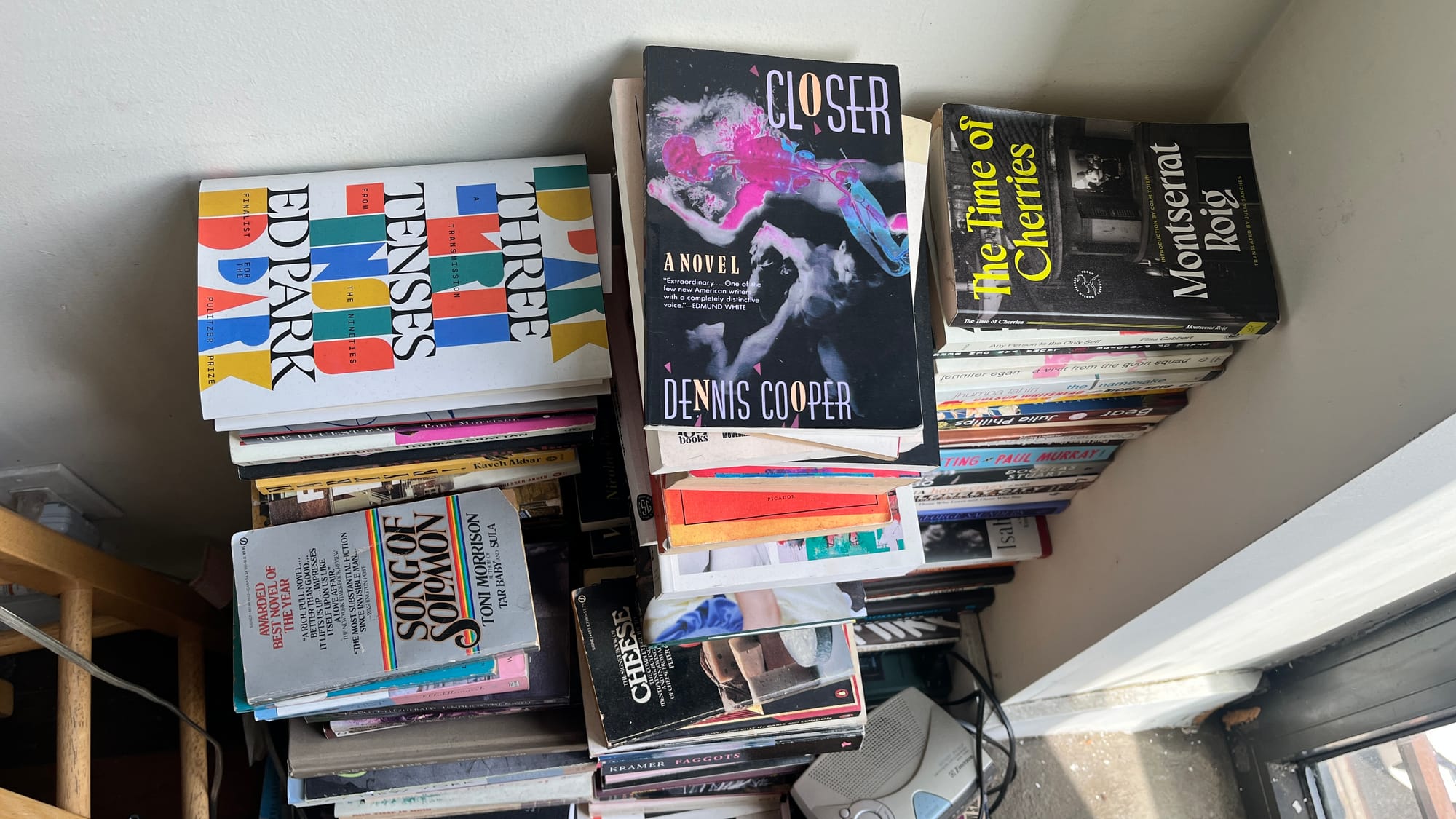
In May of this year, Grove reissued Closer with a new introduction by Lynne Tillman, the first since Cooper’s semi-autobiographical 2021 followup to the George Miles Cycle, I Wished, and the ballooning, BookTok-driven popularity of his standalone 2004 novel The Sluts. Cooper’s later novels sharpened and escalated his depictions of alienation and violence. I’ve read them all, wincing at the Amsterdam dismemberment in Frisk and the scrotal amputation in The Sluts. And yet there is something sticky about Closer. In the new introduction, Tillman writes about rereading Closer thirty-five years later: “The same words, sentences, structure, the same chapters in the same order. But the whole thing has been thrown up into the air and come down as something else.” Only a few years separated my first and second readings, having come to the books much later in their lifespan, but I understood what Tillman means by “the second reading—call it my first reading.”
Closer is a quieter novel than the others. The characters are still in their childhood homes, George is still named George (in later books he mostly exists under pseudonyms), and Cooper’s writing feels investigative and raw. The boys are on the precipice of adult life, briefly in the youthful, earnest period that precedes resignation. It’s Cooper’s unbecoming of age novel.
The thrill of my second reading was understanding, for the first time, how Cooper captures the incongruencies one discovers in early relationships. John, hearing George pour his heart out and name his deepest sadnesses, realizes in real time that though George feels deeply, his problems are not profound. Cliff, followed around by Alex, whom he does not love in equal proportion, likens Alex to a whining collie following at his heels, who if he could speak would only be able to muster a pathetic, squeaky “I… love… you.” Cooper provides a vocabulary for discovering an embarrassing deficiency in someone you’d hoped you’d love.
As the boys have mediocre sex—one of them can’t stay hard, one of them just lays there like a dead body—the boys abandon each other at the first sight of imperfections, collectively oblivious to their shared goal of a real, unmediated experience of intimacy (which might make their sex better). This understanding would require a perspective these boys don’t have yet. They’re starved for real experience, yet in pursuit of it they only find more dissatisfaction. And their boredom leads them to violence, the last threshold experience they haven’t tried—and, which, Cooper might argue—is the only effect snap out of their stupor.
Cooper makes no attempt to hide why they’re like this. The boys in Closer are completely alienated from one another: they are bedroom dwellers, raised on televised war, extreme conservatism, and threats of ecological collapse (while AIDS hovers over the narrative but is never named). They experience the Reagan years through approximations; they are able to access mass-broadcast, readily available images of beautiful people having fulfilling sex, but as they discuss and fantasize about pornography, they hold it up in comparison to real life in nearly every sexual encounter in the novel. Because real sex, demanding their participation, can never match their fantasies, they experience it like dissectionists: the meat in front of them gross and alienating. But watching porn, on the other hand, is disembodied, easy, and uninterrupted by disappointments. Weaned on fantasies, they’re obsessed with simulations of real experience.
George’s bedroom is uncannily filled with Disneyland paraphernalia, and his innocence materialized mocks him as increasingly disturbing events befall him: abandonment, the death of his mother, mutilation. I might gravitate towards Closer because it is, at its heart, a suburban narrative, a world that exists peripheral to everything they covet. The boys idolize Disneyland, the pornographic wonderworld of the San Fernando valley, and the alternative, queer bars of the Bay Area—all of which they are close to but cannot reach. The only salve for their boredom is images: watching television, porn, video games. There are obvious parallels to today’s bedroom-dwelling, nihilistic young. If Closer were written today, it might be called diagnostic.
George himself is the most powerful image: physically beautiful, captivatingly passive, and seems—to each boy—to have the cure for whatever ailment they’re suffering from. John is a portraitist who wants to deface beautiful people, and believes his true artistic achievement will come from capturing George’s face; Cliff and Alex believe George holds the key to making their amateur porno a success; David, the teen idol, believes George’s beauty makes him his only worthy mate; and Philippe, in what leads him to finger, fist, and eat the shit of George, wants to be as far inside him as possible. Like Elizabeth in Mrs. Dalloway, George’s youth and beauty drives people to want to possess him. George is, of course, based upon a real person Cooper knew—so the same can be said of him. Yet, the image is never the boy. The apprehensive disgust they feel when they’re finally inside of George, when they reach the perceived center, is the horror of understanding their own gullibility.
Cooper’s use of George as a test dummy might read as exploitative, were he not genuinely fascinated with his interiority. And as he is serially used and discarded, George’s innocence and sensitivity becomes harder to reach. Throughout the novel, George’s mother is dying. When he cries about it to John, he is abandoned—unable to make himself real to the people around him. Upon his mother’s death, George submits to mutilation to externalize his inner disfigurement. David, too, suffers from this alienation. He is a self-described teen idol, whose mild fame makes those around him treat him like an object. He says “my beauty was nothing but gift wrapping… I was crazy and empty,” and frustrated, he questions: “The critics who hate me are fairly articulate. The ones who adore me are shallow and indirect. What is a ‘dreamboat’ exactly? Why won’t my champions say what they mean? All they do is describe me again and again in forgettable gushes.” David wishes those who admire his beauty could see his insides, and he gets what he wants. At the conclusion of the novel, he’s flattened spectacularly by a car crashing through the wall of a party.
Freedom, I take Cooper to be saying, is in the destruction of the image entirely. And the grotesquerie of Cooper’s novels has always risked readers mistaking its surfaces for the point, like the version of myself who bought Closer to resemble Araki’s blonde dreamboat. For the chorus of boys who narrate Closer—each one of them unable to exist freely in the world that floods them with endless streams of images and keeps them isolated from one another—the image is exactly what obstructs their attempts to get closer to each other, a core of sentimentality and love thrums inside each of them. The violence of the book is Cooper’s answer, I think; the image stops at the human body’s vulnerability. His novels are a waiting room, where clueless, desensitized boys mingle, want, and reject each other in a frustrating loop until they are summoned to the threshold, the operating theatre, until they are flayed open for all to see. At the other end of their neuroses lies annihilation, the same experience they seek with drugs.
What of the real George? There’s a scene in I Wished, Cooper’s 2021 appendix to the George Miles cycle, which tells the story of the evening Cooper met George. At a school dance, a twelve-year-old George was suffering from a bad acid trip. His older brother found Dennis, who had experience with LSD, and asked him to sit with George while he rode the trip out, and he did. For four hours they sat, studying each other’s faces. George would protest every time Cooper looked away, but the sight of George—his eyes black and void of discernible human character—allowed Cooper to glimpse something beyond consciousness, beyond flesh, and beyond the power of language to capture. The image inspired him to write the five novels in the cycle, as an attempt to locate or save George, one of literature’s greatest love stories. Upon completion of the final novel, Period, Cooper learned that George had died years ago before Closer had even hit shelves.
For forty years, Cooper has been staring into those vacant, beautiful eyes, allowing us to wonder with him: What fascinates us about the image, about beauty? What in it is true? When will it stop, what will it take?