The most words ever written about “Freaky Tales”
Welcome to Sight Week, part of our “Six Senses of Oakland” subscription drive, dedicated to how the Town looks, sounds, feels to the touch, tastes, smells, and just, like, ~vibes~, man. It is also dedicated to getting us enough members to make this whole ORB thing sustainable. Read more about the drive here. Subscribe here.
I decided to write the longest and most excessive thing anyone has or will ever write about the 2025 movie Freaky Tales, a movie whose stickiest description is that it’s a “love letter to 1980s Oakland.”
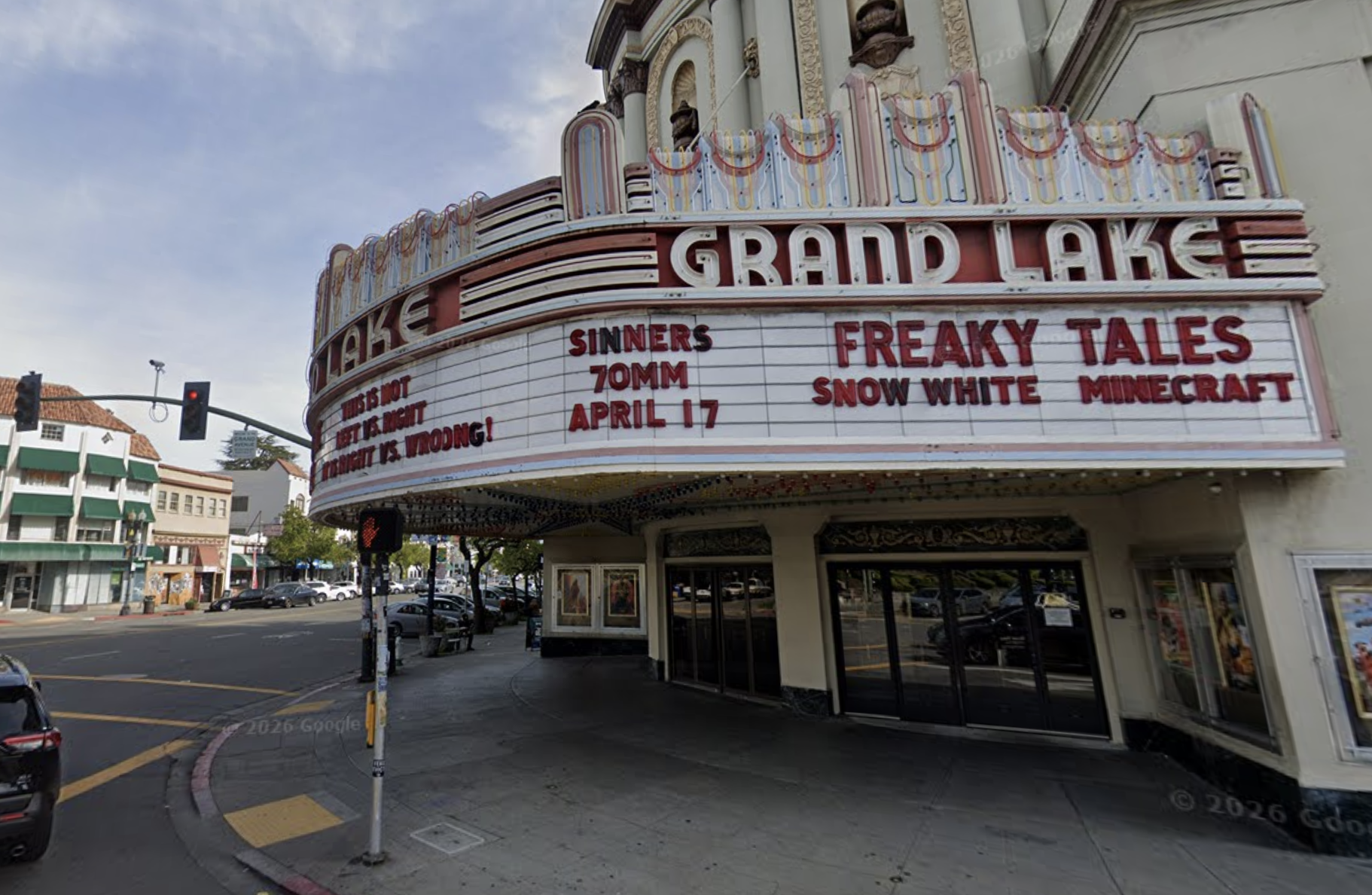
Those five words will do if you want only five words. If you want more words than that, then I have written nearly twelve thousand for you, for a few reasons. One is that when the movie was barely advertised, when it was dumped in a handful of theaters for an extremely brief period of time, it subsequently failed at the box office. Now you can see it on HBO, whenever you want, but you probably haven’t, and it’s a movie that was made to be seen in a theater. Even the ORB collective, I regret to say, had a pretty dismal viewing record: Only one of us saw it at Grand Lake Theater when it was there, the way we obviously should have all done (and mostly didn’t).
As a result, this is a movie which is in danger of not existing, by which I mean something very specific about what time and silence can do to a cultural object. There is a genre of movies “so lacking any cultural impact that they cease to exist” (as the scholars explain), a class of films which make you say “if something like that happened, surely I'd remember something about it.” But because you don’t, it couldn’t have. Such a film is very specifically not a bad movie; it might even be a great movie. It's a movie that should have had an impact, and because it feels like it would have, it makes you wonder if you simply imagined it when it seems like it didn't. Freaky Tales, we feel, should have left traces, should have mingled its footprints with other texts and contexts. People should have talked about it more than they did.
So let us see if we can un-disappear this movie, a little, by virtue of going really, really long. No one will write a longer essay about it, just like no one else made this movie before Ryan Fleck and Anna Boden did (or, for that matter, founded an Oakland Review of Books before we did). But sometimes the reasons for doing a thing become evident in the doing of them. Sometimes it’s just to learn that you can, and you only find out why after. And sometimes the reason to do something is to learn that you didn’t have to, and that you did anyway, and that not only was it fine that you did, but wouldn’t it have been a shame if you hadn’t, out of fear of looking silly? Why be afraid of failing, of losing? (I mean. Have you seen the state of the world?)
Looking silly
The first thing people say when they see Freaky Tales is that it evokes the look of Oakland in 1987, and if you know only one thing about the movie, you’ll probably know that. On that basis, you could call it a period piece. But if you don’t call it that, which most critics actually haven’t, that’s probably because that phrase usually indicates a different kind of historical past, British shit with horses and dowries and muskets, or maybe a swords-and-sandals situation. If it’s an American period, then it will be something tenement-y, a white ethnic New York neighborhood type of thing, or an Old West, or a Civil War, or a Roaring Twenty.
What it doesn’t usually mean is “Oakland in 1987.” In part, that’s because the phrase itself dates to the forties and fifties, when Hollywood started getting fascinated with its own specific sense of history, and its own specific perspective, embedding its favorite historical episodes in its roster of genres. In that moment of modernist optimism, when historical progress was a given, historical drama’s job was to demonstrate how far we had come, we moderns, with our bridges and skyscrapers and all the other vast monuments to the future that we erected in our fresh and clean new cities. Look at these guys in togas! Hollywood said. Check out what it was like before we had plumbing.
Oakland has bridges and buildings, of course, but this is not usually the story that “Oakland” is used to tell, whether in 1987 or at any other time. Partly, it’s because things don’t get “historical” just because they’re old. The eighties are twice as long ago, now, as the mid-fifties had been when Happy Days first glazed them with nostalgia (aka two Happy Days units ago), but Happy Days wasn’t exactly a “period piece,” either, and wasn’t about the benighted past before we had learned the wonders of electrification.
Happy Days is about the past because it’s afraid of what the past’s future held. For example, the episode in which a young Tom Hanks got his first big break by doing “karate” on the Fonz makes it clear that “karate” was still a new and foreign and “scarequoted” thing in the fifties, a decade in which, even in its tenth season, Happy Days strove to remain, in spirit. In that scene, the shocking novelty of karate gives the young Tom Hanks the unprecedented ability to kick the Fonz through a stained-glass window. (The internet tells me that no one had ever successfully done it before; the fact that it tells me this, tells us that it thinks that’s a significant fact). If you watch that scene on YouTube, now, disconnected from its context, you might see Pat Morita in that scene and assume that the show is guest-star-capitalizing on his fame from The Karate Kid, but he had been a semi-regular cast member for years; in 1984, when that episode aired, The Karate Kid—like 1987—hadn’t yet happened. When we watch Tom Hanks kick the Fonz through a window, the camera shudders and judders into a stunned, stammering slow motion, because we are seeing The Foreign and The Future kick the Fonz—that icon of a time when America was still great—right out of the building. The future was coming and it was freaking people out.
The scene looks pretty silly, now, as Happy Days increasingly did. It began by refusing to let go of the fifties—and what “the fifties” had been made to represent—but by 1984, it had invented “jumping the shark” and become a permanent rerun. Time couldn’t be allowed to pass in a show whose entire premise was to pretend the sixties—and what they represent—hadn’t yet happened, so the fact that it passed, anyway, was as embarrassing and awkward as Henry Winkler turning forty in the show’s final season. And yet, ironically, it’s the opposite of a show that “doesn’t exist,” in the sense that it bears tremendous cultural weight and meaning, while being all but impossible to actually view. When I say Happy Days, after all, you nod your head, and you know what I’m talking about, or think you do. But getting your hands on that episode is essentially impossible. You can watch that scene—or other disconnected scenes—on YouTube, if you want, but only the first six seasons were ever even issued on DVD, and only the first two are streaming. It’s a show whose cultural power, and meaning, are somehow undiminished by being the audiovisual equivalent of “out of print.”
Why? I think the nostalgia powering a show like Happy Days flows out a very specific investment in something that hadn’t then yet happened, a thing or things whose absence makes it a relief to go back to before they existed. Not a single cell phone in sight, just people living in the moment, as the ancient millennial saying goes (with “cell phone” standing in for whatever aspect of modernity we crave to predate). And when it came to what someone called Happy Days’s “wistful look back at adolescence,” what was wanted to be forgotten was this: the way the sixties forced Americans to grow up and face the world.
That means whiteness, of course; everyone in that show is white, everyone but literally Pat Morita and a one- or two-episode drummer in Fonzie’s band, who was only ever necessary so that Fonzie could stand against and fight racism. But it was everything else, too: the broad not-having-happened-yet-ness of the sixties, and all that’s implied, made it unnecessary to even be specific about what hadn’t happened yet: Whether it was Vietnam, Women’s Lib, the Civil Rights Act, or just the general revolt of the youth against their elders, it desires a past completely innocent of its future. It is, in that sense, a show you don’t even need to watch to know what it is, because what it is, actually, is the experience of what it isn’t.
“So damned fresh”
You might think this essay is well underway, since we’re well over a thousand words in. You might also wonder why I’ve talked so much about Happy Days and so little about Freaky Tales. You might expect me to have gotten to the point by now. However, we’ve barely gotten started. I’m still warming up. I could have cut all of what you’ve already read, and if anyone was being paid by the word for this—or if I wasn’t my own editor (albeit with a little help from my friends)—I probably would have. I did not. Sometimes the point of doing something is because you can, and no one can tell you not to.
But OK, let’s talk about the movie, and about Oakland.
What was it about Oakland in 1987 that made it “so damn fresh,” as Too Short puts it in the narration that opens Fleck and Boden’s film? What innocence is being re-created, alongside the clothes, music, cars, and backdrops that still exist—like the Grand Lake Theater, 1/4 lb. Giant Burger, or the Coliseum—not to mention the ones they had to remake, places like Dick’s Restaurant or that particlar Loard’s Ice Cream parlor (the one across MacArthur from Bret Harte middle school, which Tom Hanks attended in the seventies, that was once a primarily “white” school but which is now “one of the most ethnically and economically diverse middle schools in Oakland”)? Why spend all that time and money turning a block of Telegraph in 2025 into a block of Telegraph in 1987, interrupting business and annoying local merchants?
Why, to be blunt, did all that capital get invested in making a movie that anyone could probably have predicted, and must have anticipated, was destined to absolutely bomb at the box office, and which subsequently did? (Surely capital does not do things just to do them?)
It took a lot of work, another thing capital does not do. And most of the local press around the movie emphasized the labor required to look this fresh, to make it possible to believe that what you were seeing, projected on the Grand Lake Theater screen, is what you would have seen had you been there (and, perhaps also, that there was a there, there). We know we’re watching a movie, of course, not a documentary, not found footage of a real thing that happened. Obviously. But to enjoy the experience, we also train ourselves to forget that obvious fact. As long as it’s all just plausible enough, just sufficiently based on available facts and memories and documents to look and sound “right,” we can overlook that these are actors and sets, that we’re watching a new thing, a fiction. The pleasure lives in that desire to be fooled.
Do we take for granted the work needed to produce this feeling? Certainly, we’re accustomed to movies just existing, and to the huge amounts of money that are spent to make them. A season of Amazon’s Rings of Power, a show that might as well not exist, cost roughly what it costs to run Oakland’s entire school system for a year—a billion dollars—which is an insane fact that we allow to happen, largely, because we don’t think about it. And that not-thinking-about-it also doesn’t just happen. It takes a lot of work. Not thinking about it—I might venture to suggest—is a major industry in this country.
But let me get specific about “the work required,” as our media comrades did: When Fleck and Boden set out to make something that looks like Berkeley’s 924 Gilman did, in 1987, they did it by dressing up “a former plastic warehouse at 800 E. 10th Street,” in Oakland. They did that because northwest Berkeley is no longer the blasted post-industrial wasteland it was when 924 Gilman was first founded, in a supermarket that turned into a furniture factory that then turned into a music venue (and is still more prominently advertised as The Caning Shop, with which it shares the building). Since the eighties, all the emptied-out buildings around it have been filled, among other things, by a tight concentration of brew pubs, Fieldwork, Trumer, Headlands, Gilman, Dog Haus (not to mention the cluster of six wineries two blocks to the west).
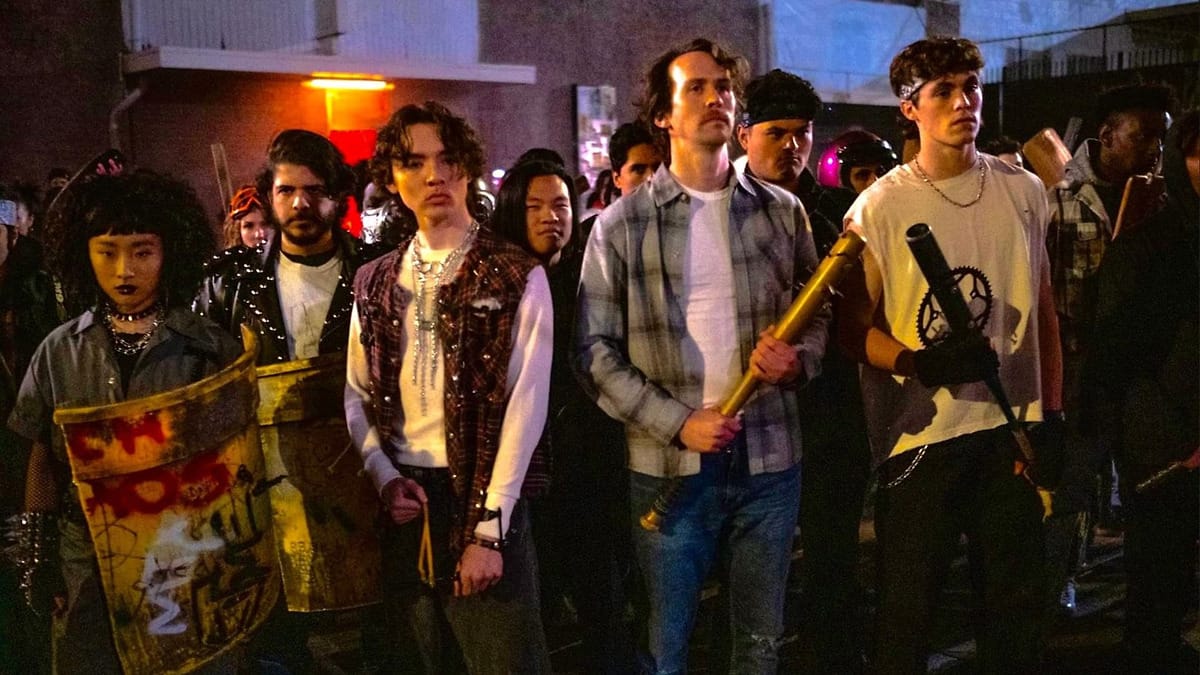
As a result, when you’re watching a group of punks fight Nazis—who are dressed, I can’t help but note, in leather jackets over white undershirts, as the Fonzie so often was, and who react to being hit in the same stuttering and slow-motion surprise as he did (and for that matter, doesn’t the white boy who is assisted by his Asian girlfriend in defeating the main bad guy have a real Daniel-san style headband on? Surely he has seen The Karate Kid?)—anyway, when you see all that, you don’t see the Tesla charging stations behind them, nor do you see the Starter Bakery where there used to be a Pyramid Alehouse. Instead, to give their movie a no-one-has-seen-a-smartphone vibe, the filmmakers went to a part of the Eastlake area of Oakland that you can call “East Peralta,” or “south of Clinton,” if you don’t want to call it “Little Saigon”; they went, in short, to a place where a gritty warehouse exterior was still available to be used precisely because no business improvement association has called it anything at all. Berkeley has too much there, now, we might venture to say; to get the vibe they wanted, they had to go to a part of Oakland where there still isn’t any.
Would it be impertinent to ask if that’s what 924 Gilman actually looked like, back in the day? Or is that just what it feels like it probably looked like? Obviously, it’s the latter, which we already knew, because we already knew that creating “authenticity” requires this kind of artifice. “Recreating the past” will always mean making choices, privileging some aspects of the vibe over true details that we can judge to be unimportant enough to be smoothed over by the audience’s desire to believe. If we know, on some level, that it isn’t true-true—because we do know we’re watching a movie, not documentary footage—then that just-enough verisimilitude warrants us to forget that we know better.
But what’s so great about knowing better? Do we go to the movies to “know better”?
Singularly multiple
Obviously not. But I’m interested in that desire to be fooled, in what we might otherwise just call a “willing suspension of disbelief,” because I think it’s interesting how no one made much fuss about how this “love letter to 1980s Oakland” opens with a story set in just about as northwest a part of Berkeley as you can be and not be in Albany, or that the Berkeley-born Fleck—who went to Castro Valley High School and Diablo Valley College—is described as an “Oakland native” in all the press around the movie.
In one sense, you’d think they would have made a fuss about it. It seems like the sort of thing people get het up about. But then, why does it matter that Fleck was usually described as a “Berkeley native” in film press before that? He did grow up in Oakland, too, the same way Concord-born Tom Hanks also attended Bret Harte (and lived in a houseboat in the estuary, and worked at the Coliseum, and so on). Sure, Hanks went to Chabot College in Hayward and may have mainly lived in the white hills around Oakland, the way East Bay white people generally tended to in that era of white flight. But is there something pretty definitely “Oakland in the 80s” about folks from Berkeley or the hills coming down into Oakland to watch movies or go to shows, and an important part of a place is what’s outside it. Even Too Short moved to his “native Oakland” only when he was 14, from Los Angeles, and no one holds it against Bobby Seale that he was born in Louisiana, or that Huey Newton was born in Texas.
These things are not quite the same, obviously; a white boy from Berkeley is going to seem less obviously Oakland than a Black fourteen-year-old from Los Angeles, or even from the parts of the South where so much of Oakland’s Black community traced their great migration. When Ryan Coogler set Sinners in the cradle of the blues in the Mississippi Delta, it was because that was the music he heard while growing up, in Oakland, among elders who had brought it with them when they came, at roughly the moment when Smoke and Stack were returning to Clarksdale, instead of taking a perhaps more advisable westward course. There’s no Oakland in Sinners, in the most literal sense, but Coogler was still making a movie about the world his Oakland comes from, in an Oakland accent that is what it is, at least in part, because of where it came from.
That is a thing you can say about the Town, though, throughout its entire history: It comes from the world, even uniquely so. So many people here haven’t been from here all that long—even while so many who are, often don’t, or can’t, stay—but everybody has and keeps ties to somewhere else, whether in the wider Bay Area or much farther afield. (Even an Oakland Review of Books cofounder might use a phrase like “het up” because it reminds him of the sort of thing people in his West Virginia childhood would say.) But I suspect that’s why the “who’s really from The Town” game is so zealously played, here, as well as why, despite the zeal, it’s essentially still a game. Oakland is not and has never been the kind of town that was self-sufficient unto itself; it’s a place that has never stayed still, and its borders are as porous as its locals are diasporan, keeping their connections. To some extent, every town is like that, or even every person; I think, sometimes, about how strange it is that my kids can so resemble both of their parents at once, how you can see the faces of all of their grandparents in their eyes and cut of their smiles, when those people don’t look like each other at all. How can one person look so much like so many different people at once?
How can one town look like itself by looking like a world of different people?
It does, though, more so than most towns. And it's seductively easy to romanticize this aspect of Oakland, to wax rhapsodic about things like the Lake Merritt loop at the heart of the Town, the way it links and binds and connects parts and communities of Oakland that might otherwise seem so different and disconnected from each other. I think about how many times I’ve heard the performers at OMCA off-the-grid events call out the beautiful diversity of their audience, and how good it feels when they do. Ishmael Reed called Oakland “Gumbo City” in his poem “Let Oakland be a City of Civility," which he read at Jerry Brown’s inauguration celebration. This idea, that the diversity and multiculturalism of the place melts together in a beautiful stew, that this diversity is the uniqueness of the place, is something one can hear at all manner of municipal ceremonies. And it’s certainly not wrong, however paradoxical, to observe that the most singular thing about this city is how multiple it is, and to take an extremely local pride in that fact.
What there is there now
Then again, when I came across a USA Today article which told me that “Boden and Fleck were inspired to include Hanks because of a 2020 mural painted by Oakland artists featuring the Oscar winner and Too Short,” I was startled.
That seems extremely unlikely, for one thing, and not only because the mural in question was erased almost before the paint dried. Even Google Street View will only show you what was there before the mural, and what was there after it, after Refa One and his crew painted over it.

To see the mural that the USA Today article is referencing, you have to click through to Pendarvis Harshaw describing it as “a work in progress,” barely a handful of days before it was already gone. The story the mural was telling about the Town, then, about who represented it and how, was not only sharply and immediately contested, but the change seems generally to have been accepted, at least officially. (“It’s a good thing,” as Harshaw quotes one of the artists. “Excited for what’s going up next.”) Five years later, the mural that Refa One painted over it is still there—albeit somewhat vexed with ivy—and still declaring, “We want decent housing fit for shelter of human beings.” A Panther protest originally against white landlords maintaining substandard housing for their Black tenants (who were redlined out of living almost literally anywhere else) has remained strikingly relevant, it seems, in an era where the struggle is now for Black Oaklanders not to be gentrified elsewhere.
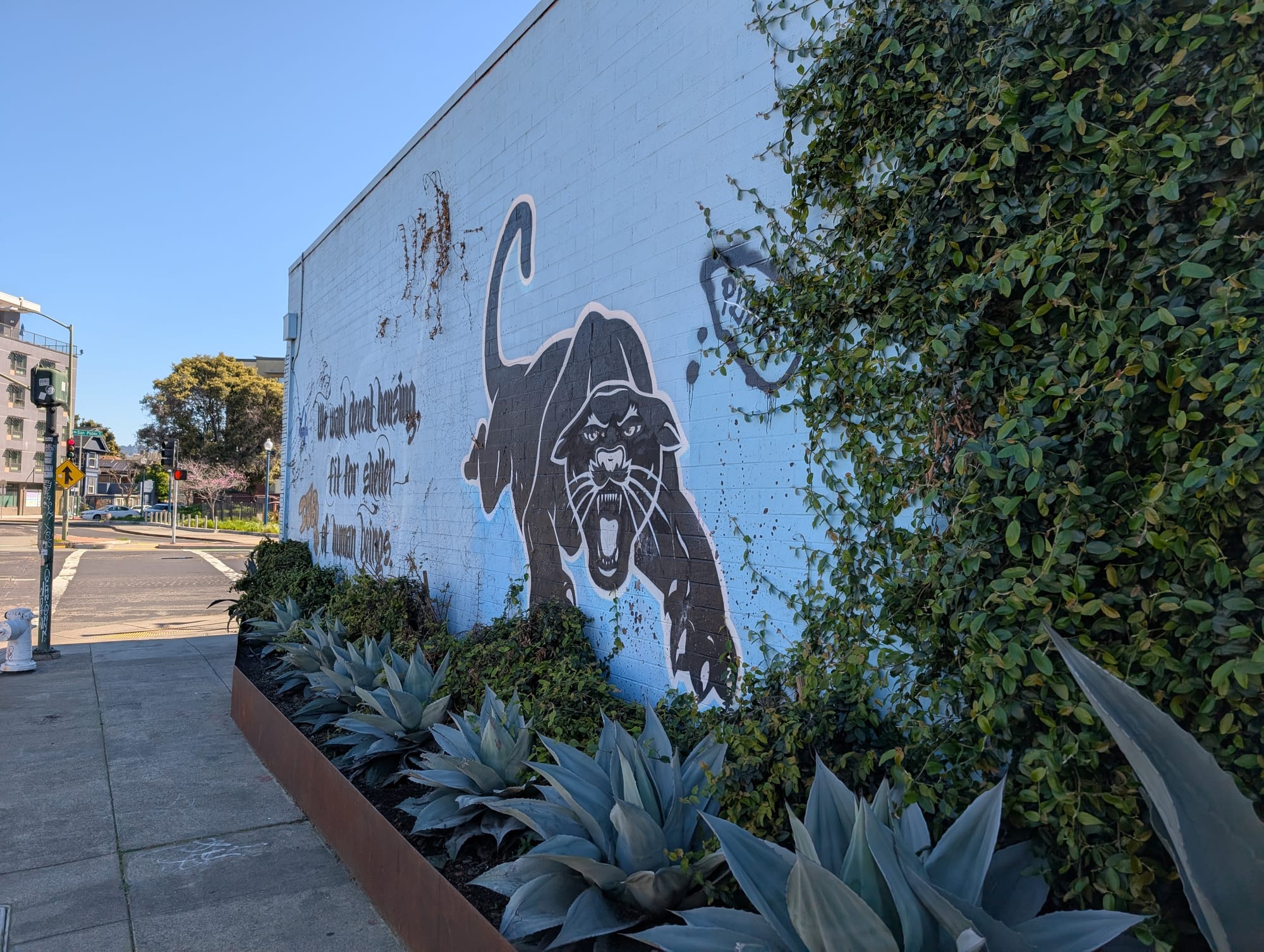
So that’s a weird claim from the USA Today, basically, whose author has not responded to my queries. To propose that Boden and Fleck were able to see that mural, in that brief window of time when it existed—rather than reading about it after it had been replaced by a Black Panther mural, and become a story about erasure—well, I guess it’s not impossible that that is what happened? But it feels unlikely. It feels very unlikely. It almost feels like a wink to what’s not being said, like positioning the movie itself as a retort to Refa One’s revision. And I wonder if the artists whose work was painted over were a little less happy about it than they indicated, in 2020; I wonder if referencing a mural that really only exists, and only ever existed, as a thing which was erased is a way of being secretly a little mad about that act of erasure and displacement (even when it was a protest against erasure and displacement). It also makes me wonder what Refa One—a “Black Panther cub” who carries the legacy fiercely—thinks about Freaky Tales, about “a love letter to 1980s Oakland” that features Tom Hanks and Too Short in the way it does. (But he didn’t answer my email either.)
Anyway, I say all that just to make a very obvious point: Behind paeans to Oakland’s diversity, the “who’s really from here” game sometimes has panther teeth. I’m certainly not going to adjudicate who gets to claim the Town—and not only because I’m a white person who moved here when Jerry Brown was mayor—but Refa One’s complaint wasn’t some simplistic born-and-raised (or even racial) standard for what counts as “native Oaklander.” Hanks has “never been known to make statements about the social conditions of Oakland,” he said, and also he accused the mural, as a whole, of being noxiously composed: Hanks’s “white image in a suit directly next to Too Short accompanied by sexist images of women seems like an effort to reduce the image of Black men to being oversexed.”
In a broader sense, then, the mural represented what he called the “the colonization of Oakland’s visual field” by an essentially “fake multiculturalism,” all the more objectionable because it was “painted right next to the violent displacement of Oakland’s Black populace [where] San Pablo Ave and Castro Street are notable for having a large homeless encampment adjacent to it.” Presumably, a somewhat different mural in a slightly different place might be a completely different thing. And certainly there are other murals of Too Short around town that Refa One’s paint can has not eliminated (there’s even a Tom Hanks or two).
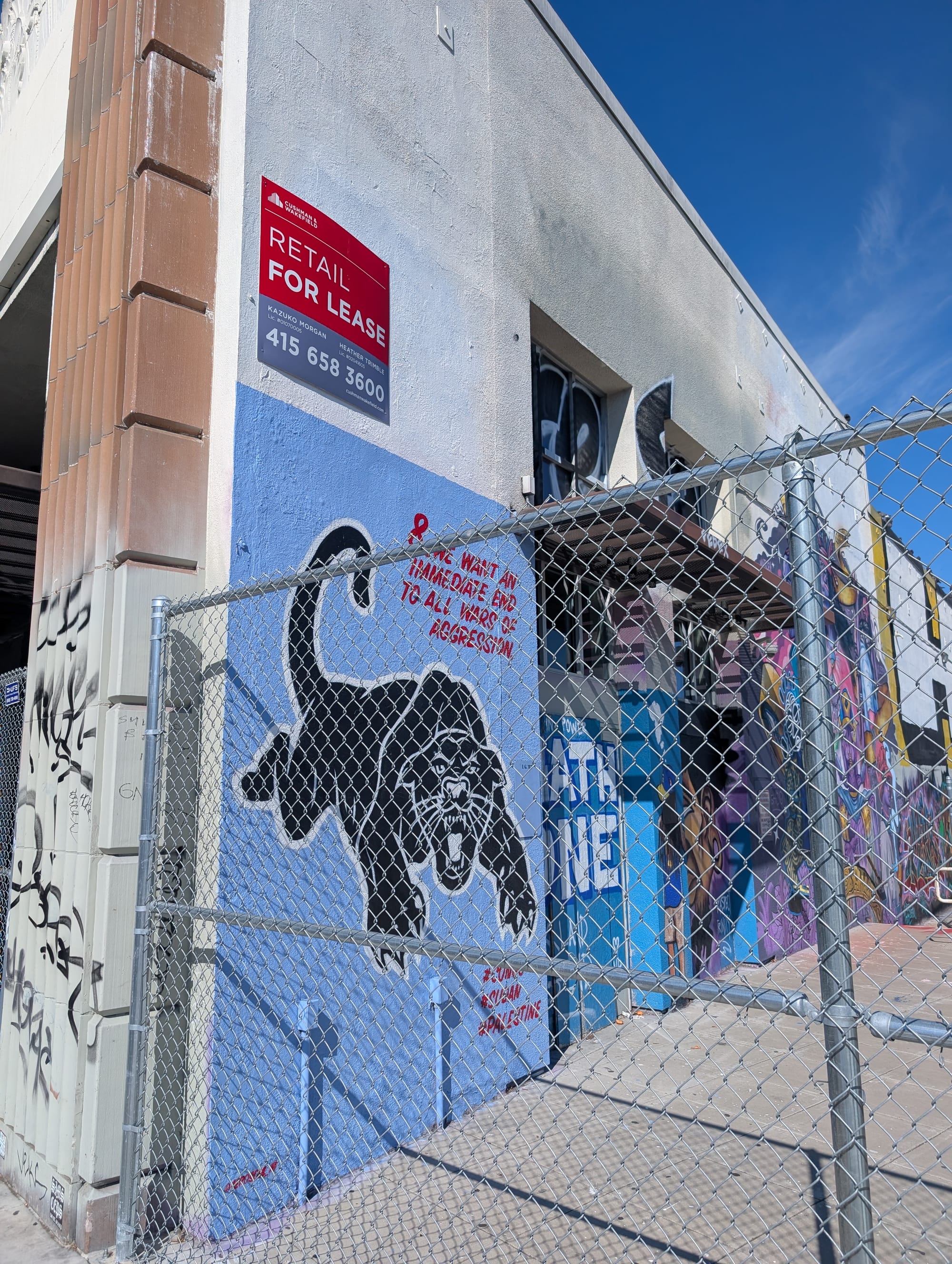
But it’s interesting that, I think, that mural was the first of Refa One’s ten-point murals, a trail that you can follow through Oakland if you want, each one a different statement of the Panthers 1966 program and all rendered (more or less) in the same style. “We want an immediate end to all wars of aggression” went up sometime in 2024 or so, for example, on the side of a shuttered CVS facing the Grocery Outlet parking lot on Telegraph Avenue:
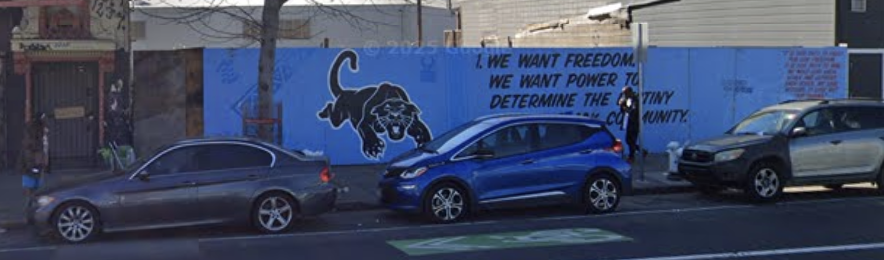
“We want freedom” along with an Assata Shakur quote was painted on San Pablo and 23rd a little over a year ago. When the garage door is down at Oakland Print & Copy Center, a few blocks north of that, you can see “We want full employment for our people” and “We want an immediate end to Police Brutality and Murder of Black People” is just over on 30th and San Pablo, a block away on Market, with a “We Want Freedom For All Black Men Held in Federal, State, County and City Prisons and Jails” just around the corner from it. Down San Pablo, a little more, another “We want decent housing.”
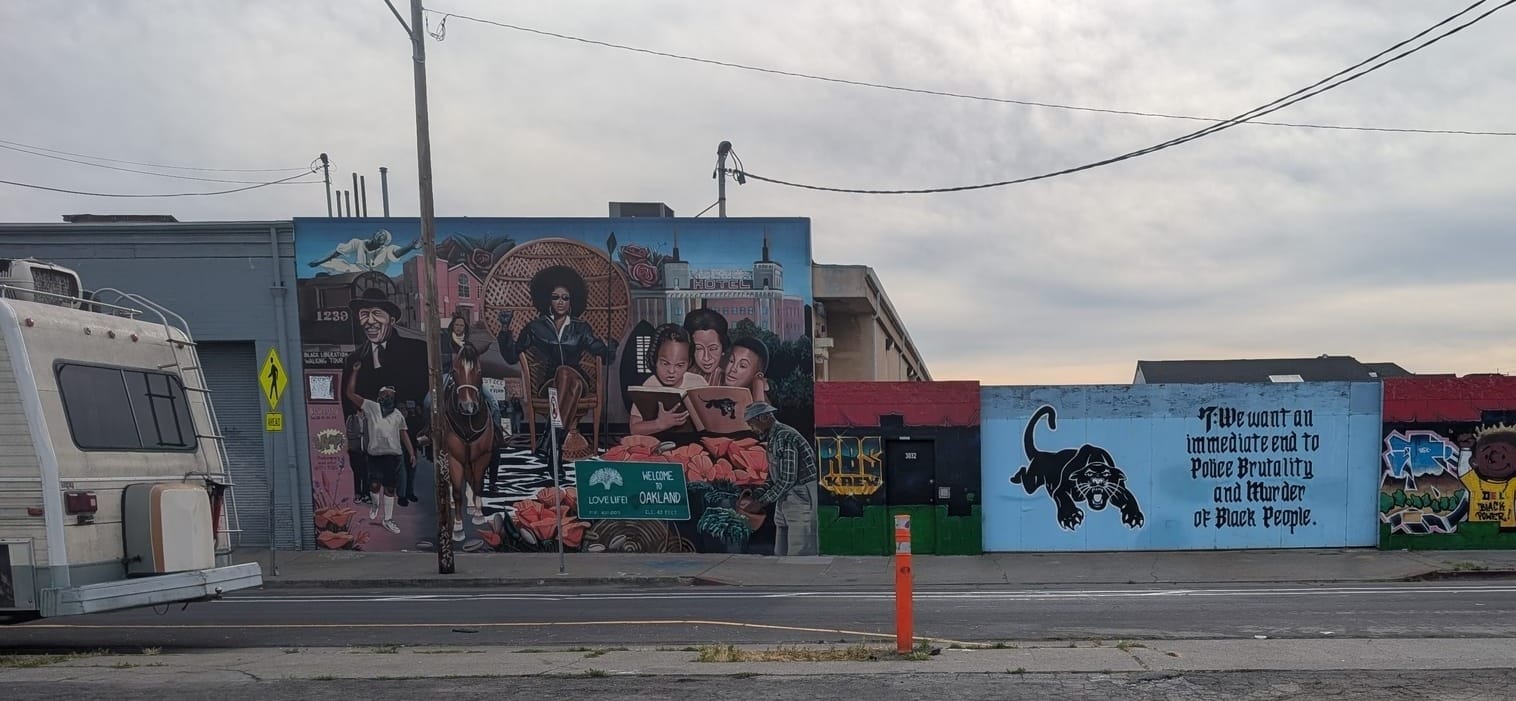
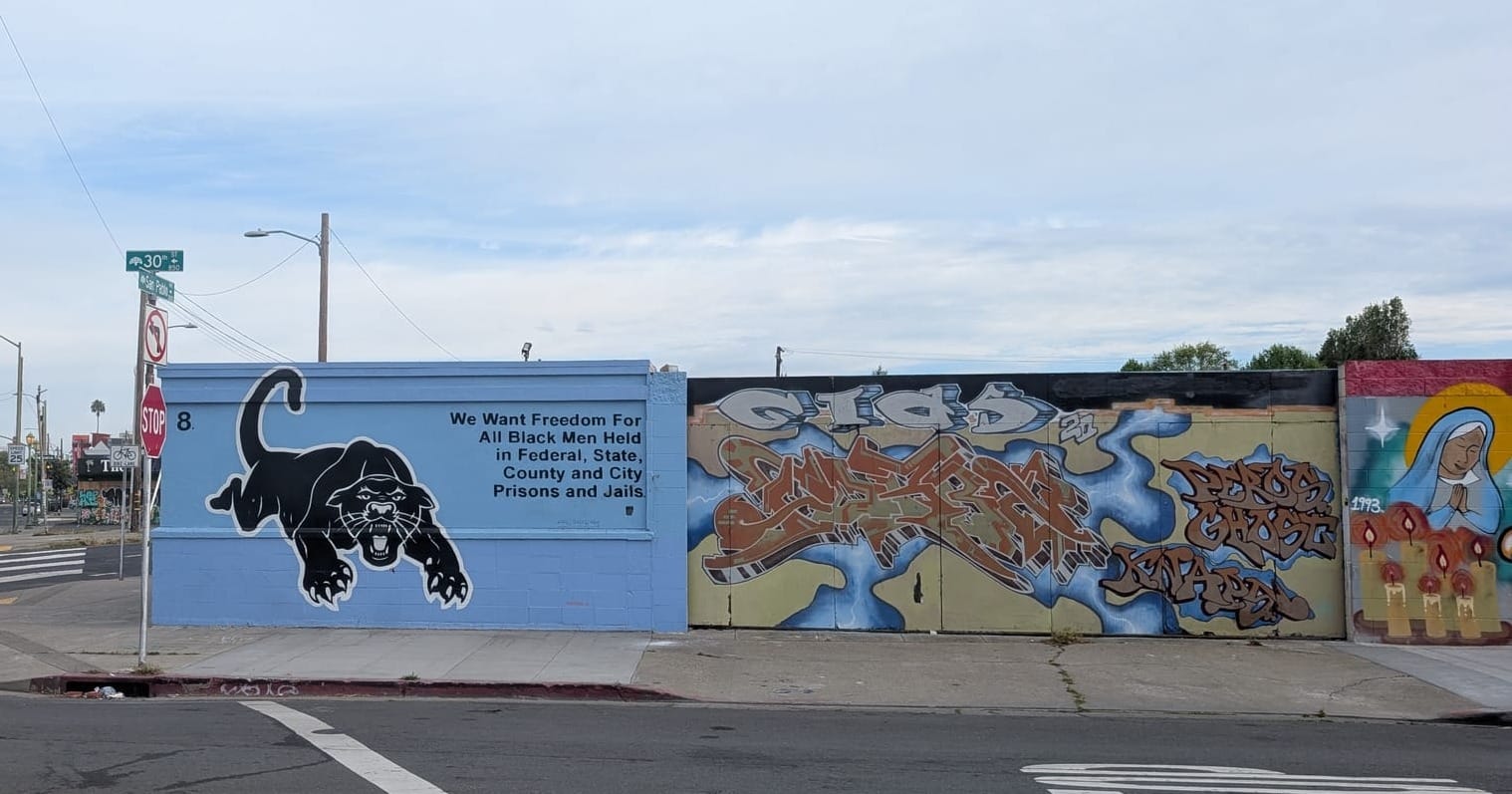
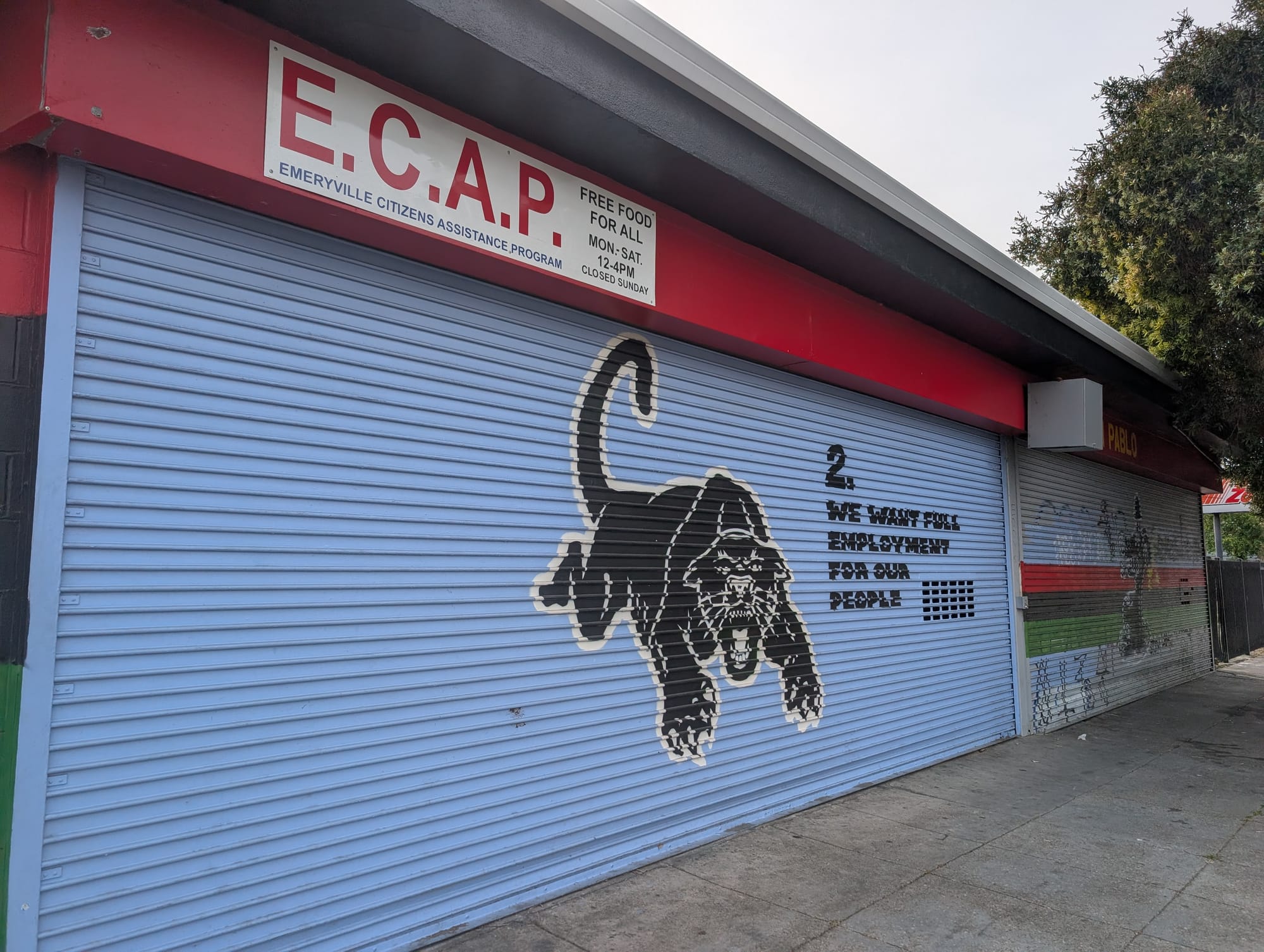
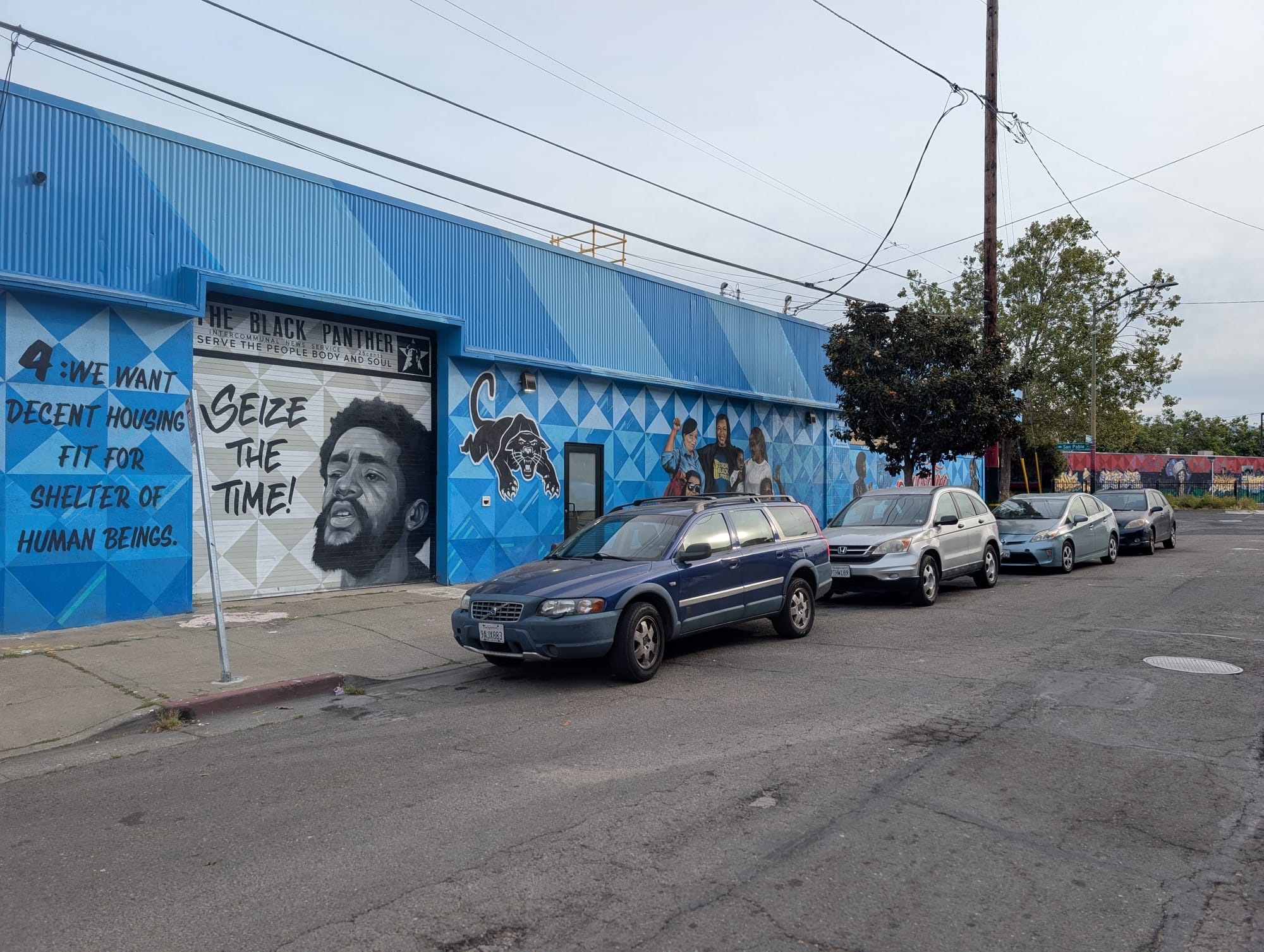
Once you see one, you'll starting seeing more; down by Jack London, for example, and another one under a tree at the self-help hunger program spot between Genoa, Stanford, and Adeline.
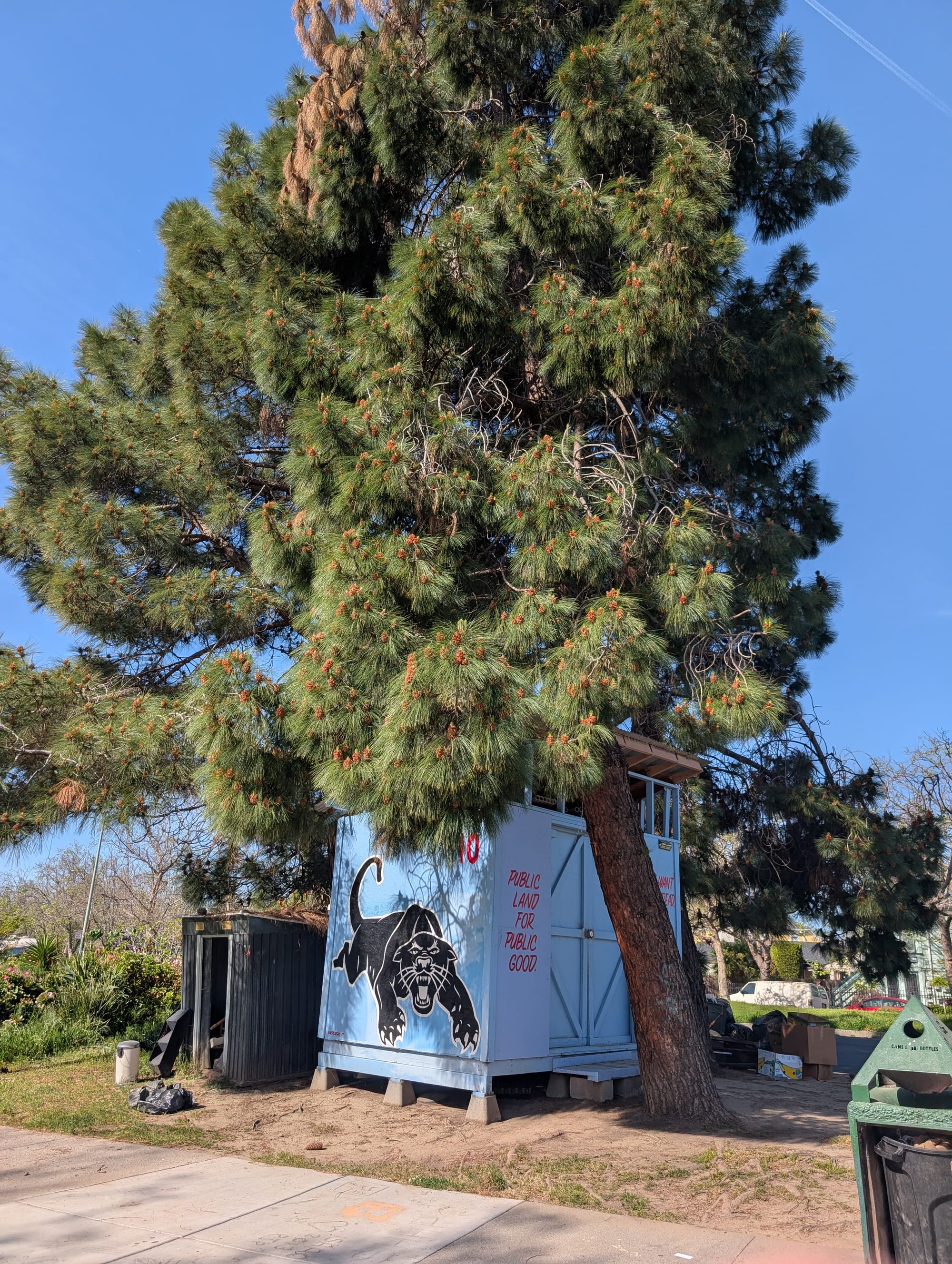
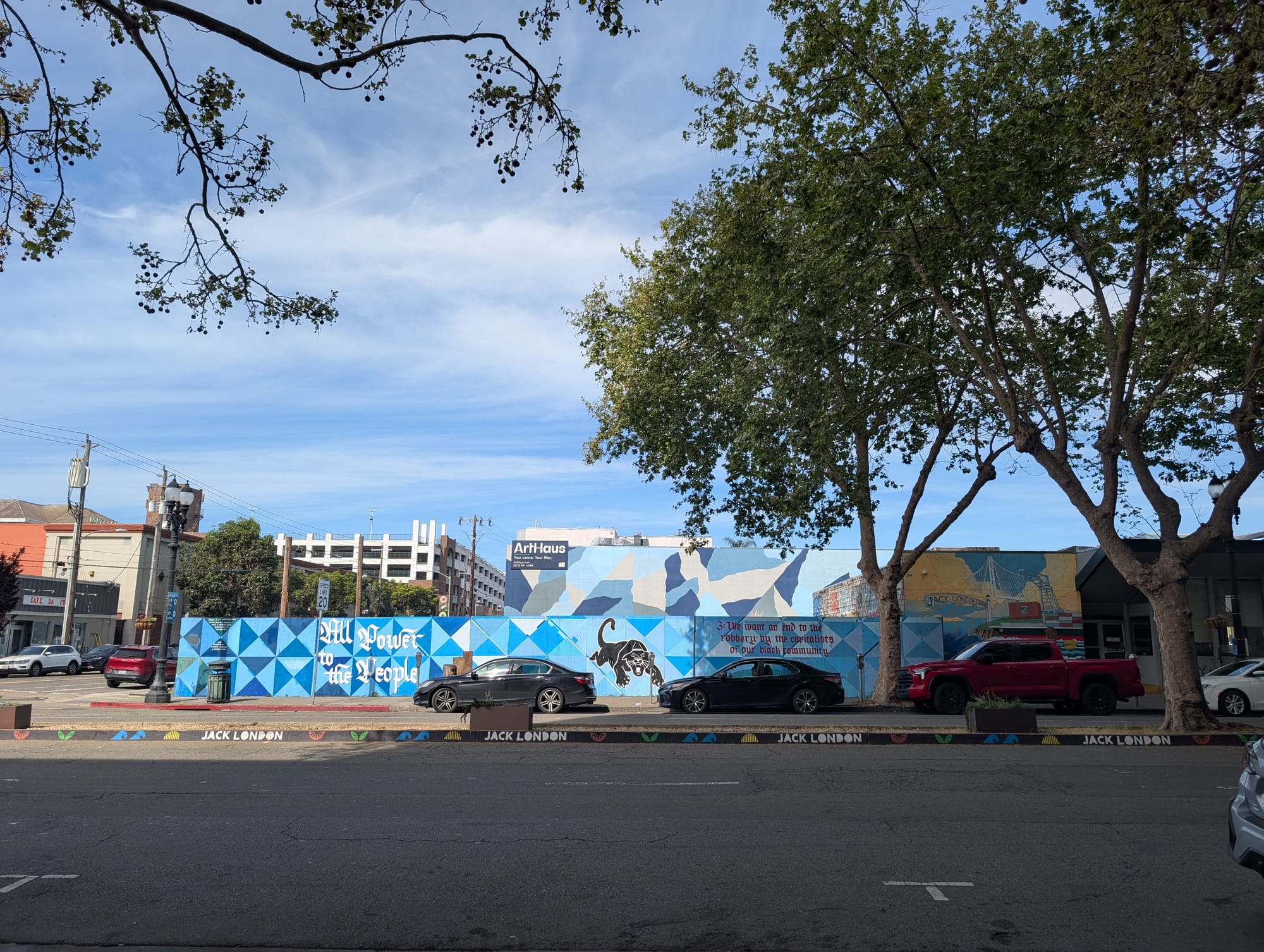
I assume there are more that I haven't seen. You can still donate to the GoFundMe.
It’s an effective form of countercolonization of “Oakland’s visual field.” After you start noticing them, that Panther blue lights up wherever you see it, and you see all manner of sites as potential spaces to be filled in the same way. A block from another of the “We want decent housing” murals, on West Grand and San Pablo—literally surrounded by an ongoing encampment—the wall of a St. Vincent de Paul looks like a canvas set out to paint on. Every time I bike past, I wonder when they’re going to get around to it.

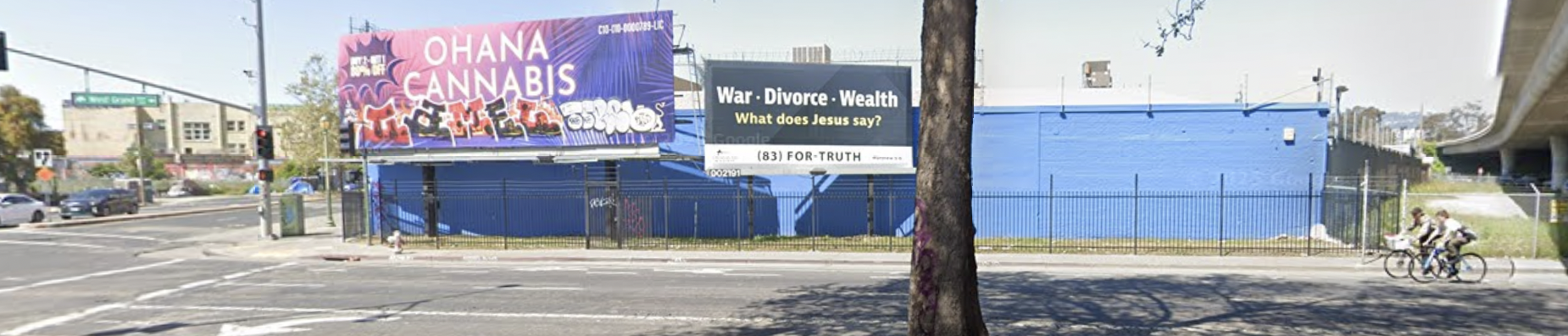
(I even find myself wondering if the light blue trim on Oakland Tech is that color for this reason, and it probably isn’t, really, but still: Now that it’s in my mind, it is, too, a little?)
For a lot of people, this is the real Oakland, its Black Panther past, or if not the Panthers specifically, a more general Black power moment in which Oakland became a “chocolate city.” It was a time when Oakland was, if not quite majority Black in raw numbers, close enough to it that its Black plurality felt like it, and was reflected in municipal governance. Freaky Tales is set in this moment, or in its wake, around when the tide was turning and a third to a half of Oakland’s Black population was about to be gentrified. And I suspect that this is an important aspect of our present reality that Freaky Tales fantasizes about predating, about being in the happy days before: Jerry Brown, basically, and his effort to gentrify Oakland into a suburb of the West Bay’s financial district (which almost feels quaint next to the more recent “Oakland would be a nice place for all the peninsula’s tech workers to live” project). 1987 is many things, but one of them is a moment when being white in Oakland didn’t signify gentrifier. In 1987, it might even mean the reverse: For the kind of white people Fleck and Hanks were, back in the day, it could mean you hadn’t fled, that you were choosing to be in the Town at a moment when the white thing to do was to flee into the hills where you’d been put by your parents (who were born at a time when The Birth of a Nation was in theaters).
Diversity can become a dull cliché when it gets caught in the mouths of people who don’t really mean it. But somewhere between the act of chapter-and-verse inscribing the Black Panther program onto Oakland’s landscape and the mushier multicultural Town pride of the Tom Hanks and Too Short mural—or perhaps out of the dialogue between—there’s something to be said about the inevitable multiplicity of both the past and the Town, and how many different names there is for it, how all sorts of things get piled on top of each other at once, simultaneously but also irreducibly. There’s a politics that necessarily comes into it, of course, if you start trying to boil “Oakland in 1987” down to only one thing—if you are forced to decide what is most essential to your point, so you can film it (or paint it). But it’s not because any single vision is untrue, exactly; each story is simply incomplete on its own. And neither is the artifice of doing so the problem. All the unavoidable choices about what to keep and what to leave out are just part of the territory, the work that has to be done when the canvas on which you paint the map has limited space. That’s why no artistic vision of the Town is ever going to be complete or sufficient: Whether you call it “diversity” or “multiculturalism” or something else, it really is an essential thing about Oakland how different so many of us are from each other, while all walking around Lake Merritt together or listening to the same musician at OMCA. It’s something no single text is big enough to capture, and there are lots of different things to call it.
I think “solidarity” is what Freaky Tales would call it, a movie which, believe it or not, I’m actually going to talk about. But again: I’ve given myself permission to write the longest essay anyone will write about Freaky Tales, as an exercise, experiment, statement, and/or self-indulgence; I like writing, and I am enjoying writing this, so I am. But the more I write, the more that length gives permission to anyone who doesn’t want to read it—even encourages them—to close the browser and move on. You’re not stuck with me, after all, the way you have no choice but to see a mural as you drive past it each day. You can go find something you like better and leave me to my fun. The internet is a very different space than a wall, or the running time of a film. It’s essentially unlimited in a very specific way: You can write as much as you want on it, spend as much time and fill as much space on the blank canvas of your word document as your silly heart desires, and no one else’s space will be infringed or diminished by it. Nothing’s keeping you here, and you are as welcome to stay as you are to leave. No one is charging you rent.
Killing Nazis
But let me say something about Freaky Tales, now. The best thing about this movie is that it’s less about Oakland in 1987, as a real time and place, than about a present tense desire for the particular version it gives us of a “Oakland in 1987,” one that’s decidedly in scarequotes, and which is basically made up and not real.
It’s a movie about what that desire says about us, that we’d make an entire, wildly uncommercial movie about it, and that we’d pack the Grand Lake Theater (for a hot minute) to watch it.
You can tell this movie knows it’s kind of full of shit, both by the fact that it’s telling “tales,” and by the gentle humor with which it carries its wish-fulfillment fantasies. Take the way Tom Hanks’s incredibly funny monologue interrupts Pedro Pascal’s deadly serious plotline, or think about all the little winks and self-aware diminishments of the mood that it otherwise works so hard and spent so much money—and, again “irked Oakland merchants”—to produce. This doesn’t mean the movie isn’t, also, quite sincere about what Oakland means, both to the filmmakers and what their idealized version of the Town, in the eighties, has to offer today. I’ll get to that. But for every moment that crystallizes that sincere and committed version of it—as when an ad hoc solidarity forms out of multiracial youths, coming out of a movie theater, at a truckful of Nazis driving by, to whom they yell, “Go back to Fresno!” (that made me instantly text a friend, less than five minutes into the film, “Why haven’t I already seen this movie?”)—for every moment like that there’s an almost immediate sotto voce joke or deflation.
In this case, so quickly you might miss it, or forget it, one of the punks (the white boy) remarks as they walk away, "Dude, you know I'm from Fresno?” to which his companion sarcastically, but not without affection, responds, “Yeah I've been trying to forget that." There’s a lot of Oakland in that moment, and not just because the Grand Lake Theater hulks behind them. It’s the mix of humor and fierceness, the “just trying to have some fun here” that nevertheless knows exactly what to do when a Nazi shows up to the party. But it’s also exactly the point that being from Fresno doesn’t make him from Fresno; that mere reality is a thing we can forget, when we want to. The same is true of the Nazis in the movie, who are from Oakland but are not, in a more important sense, from Oakland. That knowledge is also something we can, and do, suspend, as needed.
When Nazis are the guys who fight you, a term like “antifa” almost stops making sense. If the fa are anti-you, being antifascist is just the condition of being attacked, and pretending you haven’t been attacked is no choice at all.
Let’s talk about the Nazis, by the way. Let’s talk about making a movie about killing Nazis, in 2025, and about the fantasy being projected onto “Oakland in 1987,” which is that everyone at that time, and that place, understood one basic and simple thing, and it was this: When you see a Nazi, you fight them. That’s not an imperative, not even a rule; it’s a context that makes it an unavoidable fact. In this imagined and desperately desired moment in time and place, “Fuck Nazis” is such a basic and communal common sense that it’s not even a choice you have to make. When you see them—be you white, Black, Asian, Latino, punk, rapper, or hitman—the thing you confront, instantly, is the very absence of choice that the presence of Nazis forces on you. You understand what they are through their relationship to who you are: When Nazis are the guys who fight you, a term like “antifa” almost stops making sense. If the fa are anti-you, being antifascist is just the condition of being attacked, and pretending you haven’t been attacked is no choice at all.
In Freaky Tales, it is worth noting, there are exactly two kinds of people: There are creators and consumers of culture, and there are Nazis. Oakland is a town of music, movies, sports, and fantasy; the Nazis come from elsewhere—be it the hills, the City, Fresno, or an outside more conceptually construed—as violent parasites, who are drawn to and attack culture like the vampires in Sinners and have to be fought for that reason. That’s why the Nazis go after the movie theater, the punks, and the Golden State Warriors; the fact that they have “a sweet tooth for the dark stuff”—as Ben Mendelsohn says, while leering after ice cream—is what makes them menacing: that their hate is based in desire, and in need.
We viewers, meanwhile, are virtuously consuming something else: We get to enjoy watching a lot of the Nazis end up as corpses (as the others stand, awe-struck, terrified, and basically confused by the writing on the wall). We get to watch Ben Mendelsohn’s head explode, by the power of imagining it, wanting it, and then willing it to happen.
Movies like this hardly ever get made
All this is fun, a fantasy the movie is built around first enjoying and then exploring and then exploding. After all, only the first two freaky tales are “true” in that specific this-really-happened “period” sense. As we watch a group of young punks decide they have to fight Nazis, and win, and then we see a pair of young female rappers take on their male peers, and win their respect, the joy of those segments is knowing that these underdog stories really happened. The punks at 924 Gilman really fought the Nazis and beat their asses. Entice and Barbie of Danger Zone really did rap with Too Short, and roasted him for his misogyny (somewhat as is portrayed). These stories are re-created with enough attention to detail that you can play easter eggs and spot-the-reference, if you want to, and where major details are changed—as of course they must be—you’re not really meant to notice, or point them out. You’re meant to enjoy the fact these stories about East Bay underdogs were kind of true, and to enjoy how the good guys in them (kind of) did win.
This self-aggrandizingly local pleasure is why local media focused so specifically on those two stories during the movie’s (brief) wave of local enthusiasm. That KQED link on “the real-life tales behind Freaky Tales” discusses those two stories, along with Sleepy Floyd’s 51-point game, which he really did have, and those kinds of articles frame the movie by the “really happened” of it all; it’s “a nostalgic, thrilling ride through 1980s Oakland,” as the Oaklandside puts it, and “‘nostalgic ecstasy’ with Oakland as its main character,” in the Chronicle’s words. (And our comrade East Bay Yesterday strolled through the labor of the movie’s historical re-creation of yesterday’s East Bay, because much labor was necessary, and because that stuff is interesting).
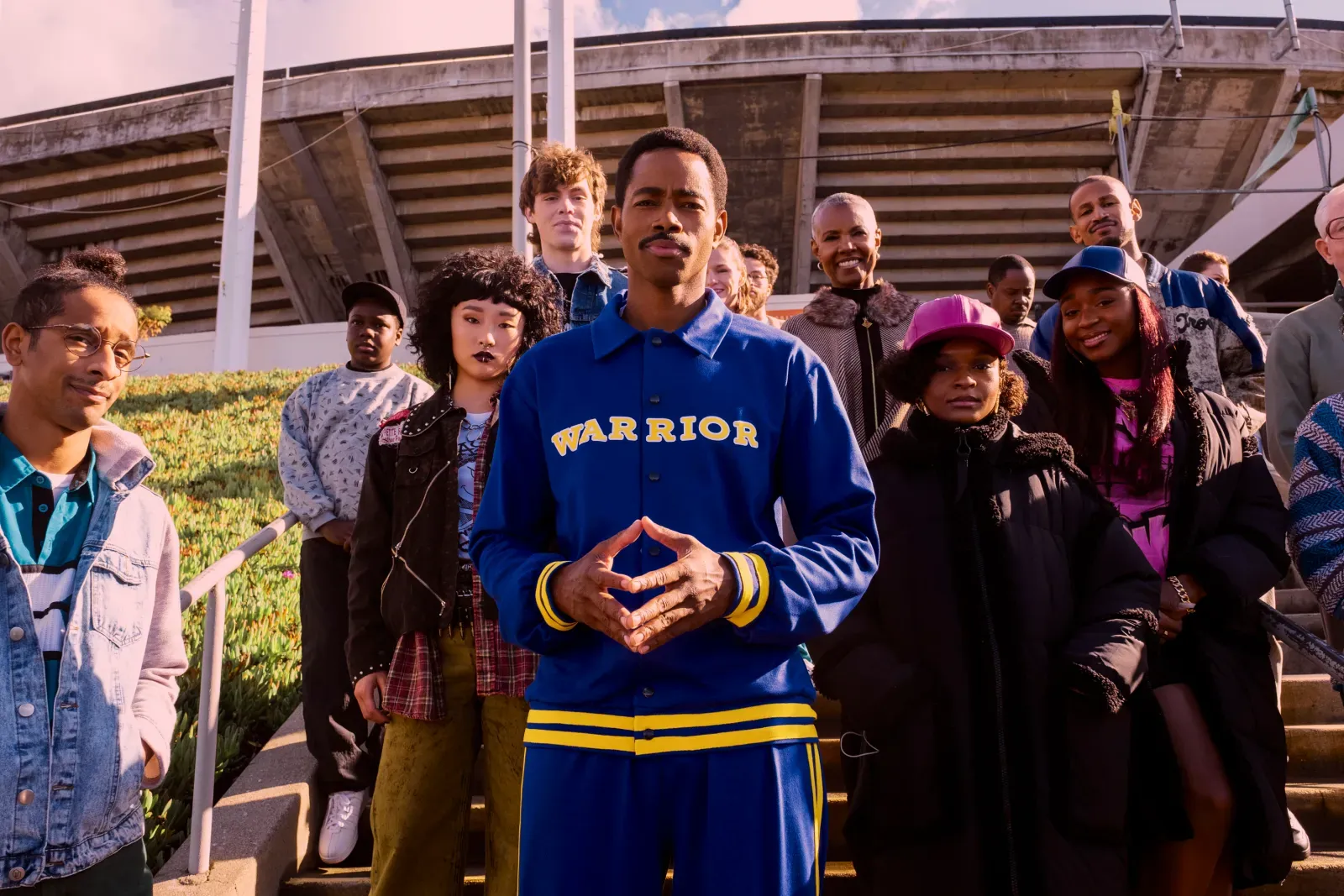
But the weird thing about all this emphasis on the “really happened” of the first two stories—and the nostalgic buttered popcorn comfort food of the remember when? it enables—is that most of the movie not only completely and totally didn’t happen at all but is at real pains to remind you that you’re just watching a movie. The local coverage was almost embarrassed by the film’s antirealistic and hyperviolent climax, using phrases like “without giving away too much” to excuse the omission, or just focusing so much on the true-ish parts that you don’t notice. But the result is that those articles would give you no concrete sense of what our Chilean American king, Pedro Pascal (born and raised in Texas and Orange County), is even doing in this movie’s wholly fictional third act, which is by itself almost as long as the first two stories combined. And while Sleepy Floyd’s “Superman” game did happen, the movie shows him massacring dozens of Nazis with a sword (which he did not, in fact, do) to avenge his wife’s death (which did not happen) during a string of robberies of the Golden State players’ homes which the aforementioned Nazis, in collaboration with the Oakland police, did not actually commit (as far as we know). If you read only the local coverage, in other words, you wouldn’t know what a Tarantino movie this is, with its explosion of violence that so punctuates Pascal’s convoluted third-act story about a hitman who wants to stop being a hitman, which laboriously shoehorns the first two stories back into the movie (through some MacGuffin-y information that they pass along) that it kind of retroactively subordinates the true stories to the fantasy. When you read about the true stories, you wouldn’t know that the movie will eventually make them feel (in retrospect) like disconnected shorts before the main presentation.
It's actually a very weird film, as a result. If you could call the first two stories “period” pieces, the third and fourth radically shift the tone away from them, in a way that most people simply found to be incoherent and contradictory, at least judging from the reviews it got (“doesn’t always make sense,” as the failing New York Times put it; “made with more love than juice,” per the democracy dying in darkness). It’s probably why the movie tanked so hard as a product on the marketplace, along with how hard it is to make money from an anthology film, or from a love letter addressed to only the four hundred thousand residents of the Town. Pulp Fiction is the exception to the rule that anthology films tend to sell about as well as short story collections do, and while Oakland’s presence in contemporary cinema is all out of proportion to its actual size, as a consumer base for movies, it’s still amazing that this movie happened at all. (I suspect it’s largely a function of Boden and Fleck cashing in their Captain Marvel chips, using them to make a movie, the point of which was just to have made that movie.)
After all, as the Tom Hanks character proclaims through the fourth wall, “Movies like this hardly ever get made.” In that scene, Hanks is playing “Hank,” a video store clerk whose three-minute scene stops the flow of plot and drama on its heels, with a winking, postmodern reminder that what you’ve been watching is a genre flick, an underdog movie, and one with the ambition of being the greatest, or at least of gaining the top of someone’s top five list: “When they're made this well,” he says, obviously, of the movie he’s in, “they become precious cinematic miracles.” This is especially clear after "Hank” names the first four greatest underdog movies—Rocky, Hoosiers, The Dirty Dozen, and The Verdict—and, when Pascal clarifies that "specific titles" is what he's after, Hanks demurs: “I'm trying to provide you with an experience," he says, and then declines to name the final movie. The film he’s declining to name “is” Breaking Away, or at least that’s the movie Ebert described as “a precious cinematic miracle.” But he declines to name it because he’s really talking about the experience he’s providing, the movie you’re watching.
That experience is a weird one because this moment changes what you’ve been watching under your feet, turning the first two stories into head fakes before the extended Tarantino-esque mashup of B-movie gangster revenge flicks and postmodern goofing that follows, in which an interracial pair of protagonists orbit each other—the way Tarantino protagonists often do—before the conclusion explodes with just enough hyperviolence to make you overlook the rather arbitrary choices that have preceded it (or feel strange about how much pleasurable masculine killing the movie motivates and warrants by first killing off the wives and girlfriends). Most of all, it’s like a late-Tarantino film in that it’s premised on the question: Wouldn’t it be great if history’s victims, instead of being victims, simply murdered the living shit out of the bad guys? Aren’t movies that say that’s what happened, actually, better than reality, where it actually didn’t?
Tom Hanks’s video-store clerk marks the transition into postmodern pastiche by making it extremely clear that what you have been watching, up until that point, has been exactly the kind of fantasy underdog wish-fulfillment movie that he codes as self-pleasing bullshit (even while absolutely reveling in, endorsing, and trying to interest you in enjoying). “We love the underdogs,” Hanks tells us, because “they're a projection of ourselves.” But of course we also know that the projection is false; we know that we’re lying to ourselves, and that, in actual fact, “We're all just a bunch of losers. We cannot kill Darth Vader, and we cannot win a rumble against the Soviets, and we definitely cannot beat LA.”
“And yet,” he muses, “the underdog believes they can achieve the impossible.”
Do underdogs believe the projection?
They shouldn’t. The entire time we’ve been watching this film (ideally projected on the biggest screen at the Grand Lake Theater), the movie has been reminding us that we’re watching a movie by doing things like shifting aspect ratios, adding animation and graffiti, and playing around with different kinds of color and film texture. If you’re the filmmakers’ age and grew up with VHS, you’ll see a lot of the same visual noise that we used to get when film was transferred onto magnetic tape and aged (even if, here, it has had to be carefully produced and added to a digitally recorded movie that was transferred flawlessly to a lossless digital medium). And I haven’t even mentioned the magical green light that shows up throughout the movie, which—as Too Short explains in the movie’s opening narration—is what made everything “so damn fresh” back in 1987, and which extra-diagetically enables all the different freaky tales to go down the way they are supposed to (helping a punk punch a Nazi, a rapper find her courage, and Pedro Pascal remember that ACAB and that if you saw something, no you didn’t).
That mysterious green light is the nostalgia, the mediating screen between what really occurred in the real 1987, which is gone now, and the 1987 that is reborn in this movie. It’s the trace of our present-tense desire for a certain kind of “Oakland 1987,” one in which everyone around you not only understood that “Fuck Nazis” but, if a truckload of them were to show up, would stand with you and keep you safe (and that you would, too). It’s that desire that compels the movie to follow that script.
When he’s in narrator mode, Too Short talks about what the green light represents as if it were real: “If you were there, you probably remember it, like an electricity in the air,” he says, and describes the theories people had about where it came from and what it was. And at the premier, the real-life Too Short talked about Oakland in 1987 in the same way: The movie is “about shit that really happens in Oakland,” he said, because “the bay is like that.”
And sure, why not. But if you are one of those people “who were there,” forty years ago, and if you do remember Oakland as “so damn fresh,” you also know, obviously, that “like an electricity in the air” is a simile, and there wasn’t an actual green glow that allowed normal Oaklanders to achieve superhuman feats. You might enjoy remembering the time Sleepy Floyd had a great game against the Lakers, but the part you also remember (if you maybe don’t talk about it as fondly) is that the Warriors lost that series despite his heroics. They did not, in fact, “beat LA,” because the thing about impossible things, after all, is that they are impossible. Underdogs lose, mostly. Kimmie Fresh has a great story, but she didn’t make it as a rapper; she’s been about $205 short on her GoFundMe for about a year.
What I’m getting at is that this movie not only knows it’s a fantasy but is interested in how our desire for that fantasy makes us willing to be sold something we know isn’t true. After all, doesn’t this movie also open with a commercial from Sleepy Floyd selling us his “Mind Wide Awake seminar” which it codes as crackpot public-access mysticism? The filmmakers made a whole fake website for “Psytopics” (and “Sleepy Floyd’s Mind Awake seminar” is a very funny name), but all the links go to 404s, and it’s framed as a product aimed at marks. The movie has fun pretending Psytopics are real; we have fun watching a movie that pretends they are real. But who knows better than underdogs that underdogs usually lose? Maybe underdogs just don’t particularly want to watch movies about losing; maybe underdogs prefer to watch the fantasy version of themselves, the ones where they win. But it doesn’t mean they don’t know.
“We definitely cannot beat LA”
This movie bombed. Compared to British horseshit dowries and NYC ethnic tenements, there exists a relatively small audience for “Oakland in 1987” nostalgia; if ticket sales stand in for “beating LA,” well, Hollywood got out the brooms. In ways our Gen X elders might find abhorrent, this is how the score is kept: Film fans routinely scrutinize the box-office take to judge a movie’s success, reading daily box scores like sports fans to determine how well it returned on the investment. “$400k on 393 screens” is only the closest thing we have to actual figures, but the fact that the people who usually keep track of such things couldn’t even be bothered to do so, well, that tells the story right there. Whatever this movie’s (undisclosed) budget was, it couldn’t have come close to breaking even from ticket sales. And if the question is “did the investors make a profit on their investment?” I think we can answer, with certainty, “certainly not from ticket sales.”
It wasn’t completely the movie’s fault. As the good folks at r/blankies explained to me, the movie was distributed by Lionsgate, which got stuck with it after acquiring eOne but which had never really wanted it; because they basically dumped it without much marketing or promotion, hardly anyone came out to see it. But whether Lionsgate decided not to throw good money at a movie they didn’t think was worth it (after a string of flops in 2024), or whether their string of flops continued into 2025 because they refuse to actually market their movies, the one thing you can say about Freaky Tales is that hardly anyone saw it when it came out.
(Except maybe in Oakland? A substantial portion of its box office take must have been located at the Grand Lake Theater, because the media told a story about what it was, and why you, an Oaklander, might want to see it. In Oakland, especially at the Grand Lake Theater—and possibly nowhere else—this movie makes so very much sense.)
I suspect that ticket sales get used to mark a film’s success because, on some level, film fans like to imagine that capitalism works in a certain quasidemocratic way: It’s nice to imagine that investors seeking to make profit on their investments must ultimately appeal to customers to purchase their commodity. We know capital has the power, after all; we know where we stand relative to them. But wouldn’t it be nice to imagine that the point of The Economy was still that capital needs to appeal to our tastes and desires? Wouldn’t it be nice to imagine that our consumer choices actually control the game?
Oakland is good at losing at capitalism, and even better at making art about it.
Unfortunately, of course, it mostly doesn’t work like that at all. The movie may have tanked, but I’m sure Lionsgate made its money back, because they understand what The Economy is really for, and does: Instead of marketing to consumers to buy tickets in a movie theater (and winning or losing based on our tastes), they dumped the thing and then sold it to HBO, which put it on their streaming service, where people pay a set monthly fee and where they watch whatever they’re given, and like it (or if they don’t, who gives a shit). I’m sure everybody involved got their payback.
In that context, the movie might even make a different kind of sense, as nostalgic for a time when movies made sense, a time and a place (Oakland in 1987) when culture and community still communed with each other in a democratic marketplace. I’d even go so far as to suspect that Fleck and Boden were fine with the movie “failing” in these terms, and may even have set it up to fail, consciously or subconsciously knowing that a movie with that weird title, anthology structure, and intensely local focus would easily shed the advantage of its star power. Deep down, might they have wanted it to become the kind of movie that a video-store clerk’s spiritual descendant would insist is actually an underrated classic? Having sold out hard with Captain Marvel, what better way to prove their Gen X cinematic bona fides than by producing a movie that flops but is loved by those who find it, who it is really for? You’re not a capitalist, after all, if you spend your money on having a great time, or work really hard at something that won’t pay monetary dividends.
Oakland is good at losing at capitalism, and even better at making art about it. If Too Short is right, that the bay is “really like that” then he’s right because Oakland really does punch above its weight, an underdog city that overperforms, is underrated, and rightly protests that it’s never quite given its due. It’s the sort of thing that everyone thinks and says about whatever their scrappy city is, of course; it’s the sort of thing that people like to believe is true (even if Oaklanders have the privilege of being a bit more correct when they say it). But part of Oakland’s “underdog city” mythology is that the city also never, quite, succeeds. Even the rambling anecdote Too Short told at the premiere is, if you pay attention, about winning respect by losing the fight. In that sense, perhaps, Oakland is the almost-won city, the could- have-won city, the city that shouldn’t have even been in the game and somehow made it a real competition, for a magical moment…only to lose. It still has to lose.
How else could Oakland stay the underdog? Our sports tell the story. Steph’s Warriors might have built a dynasty, but San Francisco took it away; the Oakland Raiders were rewarded for their Super Bowl victories by being moved to LA; and while Billy Beane “changed the game” as we see in Moneyball, the A’s never actually win the World Series, and were sent into exile for their hubris. It sucks that they left, it sucks to lose, but it’s also, totally, in keeping with the story.
Of course, none of this is the real Oakland, necessarily; we’re talking about the “Oakland” we get projected in movies and sports, on TVs and screens. But just as a story about Berkeley’s 924 Gilman has been incorporated into a movie about Oakland, the “Oakland” this movie is summoning up, and using “1987” to warrant invoking, that’s something a bit more conceptual than the very concrete 78 square miles which make up the municipal entity by that name (or the half a million people that live there). It’s an idea, which the actual Oakland is being used to evoke and represent. It’s why most of this movie is not about what “really happened” but about what didn’t happen but which should have, that kind of did, about something that we squint just hard enough that we can see it. The “Oakland” the movie is fantasizing about is a town that used to be, should have been, and isn’t; it’s a past which is made to be all the more present precisely because it is felt to be gone. To trample on Gertrude Stein’s grave, there used to be there, there, and that’s precisely why, now, you can say there isn’t.
Perhaps the most prominent thing about that “Oakland” is the story it is used to tell about the loss of Black power, about a historical moment that inspires and achieved, and yet didn’t quite win. It’s a story about how decades of racialized dispossession and gentrification made out of Oakland a place that used to be majority Black, or close enough to it, that makes “Oakland” knowable, now, as the site of that specifically diminished Black community and possibility. In such a frame of reference, “Oakland” comes to stand less for what it is, in the present—Oakland is not, for example, a town which is a plurality Latino, with a majority population that’s neither white nor Black—but it signifies as that present-tense lack of what has been removed from it. Oakland becomes knowable and desirable, in other words, as a place that was going to become something but didn’t.
The scholar Trish Barua made this argument in Utopic Oakland, a dissertation that didn’t become a book, that Oakland is where the revolution was going to happen and then didn’t. The moment it goes wrong, she argues, is, roughly but dramatically, the conjunction of a Black mayor and state government committed to a program of massive reinvestment in Oakland’s urban fabric that was blindsided by 1978. After the passage of Prop 13, all of it was gutted and abandoned and left as a could-have-been-but-wasn’t. Having consolidated so many of the revolutionary energies associated with the Black Panthers from the sixties and seventies, Oakland’s Black governments were able, she argues, to do little but “fight crime” and prepare the way for Jerry Brown’s reign of gentrification and displacement.
Through that sense of our present, our here and now—after a gap of time in which it all, somehow, went off track—the past can come to seem like the real Town, the one whose absence or diminishment still gives the current version its identity, by that contrast. And this might be all the more true for white Oaklanders who moved here in those decades, for whom that Town is the ghost that haunts your residency, reminding you that your very presence makes Oakland less Oakland.
Unless it doesn’t? Unless you fight Nazis, produce and consume culture, and are “known to make statements about the social conditions of Oakland”? This movie offers solidarity as a way to fix your heart, I think, telling a story about the past as a model for that solidarity. Back in the eighties, Freaky Tales suggests, movies understood that killing was what one did with Nazis, and so did the people who watched them. Nazis were orcs or aliens or zombies; they were killable precisely because they were not people you could identify with. And while as many movies are being made about Nazis as Oaklanders, these days, they tend to be films like Zone of Interest or Nuremberg, in which we identify with the Nazis as an exercise in cleansing self-hatred. Freaky Tales is more like Sinners in that it’s about resurrecting older cultural traditions of antifascist joy (and violent solidarity).
Before movies lost the plot
Have movies changed? Nostalgia is often reactionary, but it’s not going out on a limb to suggest that the public's common sense on the issue has become grotesque and unrecognizable. Being antifascist is, in a confoundingly literal sense, actually illegal: In any given week, some GOP official or key pundit—sometimes literally the president or the secretary of defense or something—has either expressed or made coded but unmistakably white supremacist statements. When respectable people demean themselves by saying things like “well, another controversial statement from the firebrand Republican!” or whatever, we’re left to feel like something has happened such that this could have become normal. That it’s come to this, that this is how we live now—and it isn’t front-page news, and it fades in the memory almost immediately because, well, yeah, that’s just how they are—well, something must have happened, right?
“Something has gone wrong” is, in this sense, distinct from simple nostalgia. If the more conventionally liberal “this isn’t normal” seems to imply that normal is what we want—and that Nazis are bad because they are abnormal, such that we should get rid of the abnormals so society can be back in the hands of the normal people (one of the most fascist-coded ways to be antifacist)—then “something has gone wrong” manages that sense that the world we live in doesn’t match the world we thought we lived in, and the world we thought we lived in has something to offer. Think about how people sometimes say—with exasperation, with incredulity, with pain—things like “there didn’t used to be Nazis and now there are. What happened?”
It can be a joke, like this John Mulaney bit, from way back in the first Trump administration (“And now there's Nazis again! When I was a kid Nazis was just an analogy you would use to decimate your child during an argument at the dinner table.”). But I bet you’ve said some variation of that yourself, in the last decade or so; if you haven’t, you’ve certainly heard other people say it.
Freaky Tales has a version of it in the opening of the second act:
Lenny G: “Nazis trippin’ again?”
Entice: “I don’t know how we went from Black Panthers to skinheads running wild in this city. But all I know is somebody fell asleep at the wheel, to let that shit happen.”
Lenny G: “People need reminding, ain't nothing cool about being a Nazi.”
Entice: “It’s 1987. You'd think people would know by now, but no.”
There’s always something funny about people in period movies talking about their present as if it’s the acme of modernity: It’s 1987, she declares, amazed; how, at this unimaginably late date, do people not know? It’s funny because of how long ago 1987 was, to us, as we watch two characters dressed in glaringly out-of-date clothes. Just as with the bit that Mulaney delivers in his affected 1940s transatlantic cadence, there’s humor in that subversion of the speaker’s confidence by its own anachronism. This is the sort of thing people are always saying, the movie reminds us, and always sound a little silly when they do.
And yet, how could the birthplace of the Panthers have become a place where skinheads are “running wild”? “Somebody” has fallen asleep at the wheel, a somebody whose job it was not “to let that shit happen.” That somebody might be then-Mayor Lionel Wilson or, indeed, the leadership of the Panthers, whose political power in the seventies had mostly evaporated by the eighties. But if the dialogue suggests the problem is elite failure, it quickly settles on people and what they know as the real issue. People need reminding; you’d think people would know, by now, but no. And that is the problem: The clear and obvious opposition between “cool” and “Nazi” is something which they have forgotten, or fallen asleep to. They need to be woken up to it; they need to be reminded of what makes a movie fresh and cool and good.
(Spoiler: It’s fighting fascism.)
In that sense, this movie is nostalgic for movies, more even than for Oakland; it’s nostalgic for a time when you could at least trust movies to know that underdogs were the heroes and Nazis were the villains. That, if nothing else, was something the Grand Lake Theater in 1987 could give you. Whatever horrors reality was providing, you could know that in the hearts of Americans—as projected in the movies we went to see—there was a basic understanding of who the protagonists and villains were. Was that true? Maybe, maybe not. But you used to be able to believe that the presence of Nazis would bring out the will to fight them, that everyone around you got it, and that “Fuck Nazis” wasn’t the sort of thing you needed to say. That taken-for-granted common sense is the wordless nod between the protagonists of the first and second parts of the movie, when a truckload of skinheads drives by the Grand Lake Theater and everyone there does what everyone there knows to do (and knows that everyone there knows to do). They don’t know each other, their worlds don’t overlap, but the one thing they do know is that crucial, first-person-plural thing: Fuck Nazis.
One killing after another
What about all that killing, though? I’m going to admit, that’s the part of the movie that I didn’t like very much, and not just because my fondness for the genre doesn’t match what seems to be expected of me, as consumer. The film most obviously resembles Pulp Fiction—everything from the anthology structure and postmodern kitsch to the implication that movies, actually, are the universe’s master code—but Freaky Tales also has the thing that gave Inglourious Basterds such a weird charge when it came out: What if the victims of the Nazis killed all of them, instead? Just fucking mowed them down. Wouldn’t that feel great?
In that vein, the movie appends a kind of “what if actually the losers had won back then” ending onto a story whose terms such an ending would actually neutralize. After all: You can’t be the underdogs if you win, and if Oakland won, it would turn into San Francisco (as Jerry Brown wanted). That’s why, I think, at a certain point, killing all the Nazis stops being something that feels good; turning human beings into killable bodies, into splattery bloody corpses, well, I don’t know, man. Is there something kinda fascist about enjoying all that dehumanizing death dealt out to outsider nonpersons? I found it kind of exhausting, watching the good guys kill all those bad guys, over and over again.
Maybe that’s the point. Maybe this movie is throwing another post- on the postmodernism, and, in that sense, is less an “unabashed homage to Quentin Tarantino” than a funny kind of inversion of him. Might something strange happen when you don’t just make a movie about movies, as all of Tarantino’s movies are, but make a movie about movies about movies? Is postpostmodernism a thing? Do you just disappear so far up your own asshole that you’re never heard from again? Do the two posts cancel each other out? Or some other secret third thing?
I don’t know. But when a movie this smart has an ending this dumb, this self-consciously crafted by middle-aged adults to appeal to the children they were in 1987—and to be clear, I would have howled with joy at that “fucked with the wrong Warrior” moment, were I watching this movie in, say, 1991, on somebody’s VHS—it makes me wonder if maybe they might be intentionally, well, going dumb.
Here is where I might have put a paragraph about how that little bit of hyphy lingo—and the whole zeitgeist it crystallized—feels so obviously responsive to the tech economy and the fetishization of smartness, how it’s a kind of from-below street response to the burgeoning total techification of the Bay Area, blowing up in places like Oakland and Vallejo because they were about as far from the peninsula--spiritually as geographically—as they possibly could be. Maybe. But who knows. I’m neither Fredric Jameson nor a scholar of hyphy; I’m not even Malcolm Harris, who noted in Palo Alto that at the turn of the 21st century, there were two kinds of “scrapers,” and one of them was the “not particularly fashionable American cars souped-up with aftermarket rims and other custom modifications,” which he notes as a hyphy “play on Reagan-era suburban material culture [that] lent even more postmodern flair to the Bay’s roads, which were already lined with inscrutably named tech companies.”
The other scraper being “a genre of computer application” allows Malcolm to gesture a similarly neat little opposition between street culture and the beginning of tech hegemony, as two dueling forms of postmodernity: One is an autonomous program that joylessly vacuums up culture, indefatigably scraping the internet for anything it can turn into code and profit from—vampirically transforming, if I may put it this way, culture work into disembodied value—while the other was a seventh-grader’s hyperactive inability to sit still in class, turned into a whole-ass youth culture of being in a body, laughing, and dancing until you locate the limits of physicality.
Exhaustion
And sure, why not. But I don’t have the energy to write more than that, just as you can’t possibly have the energy to read it, right? How are you still here, if you are? You can’t have read this through, from beginning to end? That’s the way history works, in a sense—one thing after another—but that’s not the way we experience it. We can’t. It would wear us out. We dip in and out, grabbing old memories and references as we need them (and forgetting them when our labors wear us out).
There’s also an exhaustion at the end of the American century that makes it hard to do more than gesture towards all that stuff. The real reason that Oakland in 1987 can’t become historical was, as Stanford professor Francis Fukuyama would notice a couple years later, because postmodernity had ended history. Over in Sleepy Floyd’s North Carolina, Fredric Jameson was already, in 1984, observing that the difference between modernism and postmodernism is the end of stories of futurity and new things beginning: For him, the postmodern is the moment after which everything that happens is already an ending. And certainly, for some, sometime around this moment—or maybe this moment was when folks were noticing what had already happened in 1978—Oakland stopped being a place where things happened and became a place defined by what had stopped happening. Oakland’s history started to become the story of what used to be here but now isn’t.
But if Oakland is only the place where the Black Panthers are memorialized and remembered, then maybe that says as much about the exhaustion of “the historical” as a frame for thinking about what the Town is. I suspect that’s why Paul Thomas Anderson tacked on Oakland at the very end of his dumb riff on Vineland, at precisely the moment when the film has run out of bad guys to pleasurably kill off, and steam, at the narrative moment when the older generation has given up trying to figure out what the youth are even up to these days. PTA and his white-guy protagonist alike let the kids go to Oakland—almost the only part of California the movie doesn’t show—hoping they figure it all out there. Something is still happening, there, even if you don’t at all understand why.
And that, too, is Oakland, and I think that’s why such an always-historicize-able work of Reagan-era postmodernism as Pynchon’s novel—all about nostalgic hangovers and a sense of Afterness to The Revolution—would become such a goofy and rollicking piece of nonsense in 2025. It’s why a movie that so resolutely refuses to let any of its historical references add up or settle into a sensible timeline—that opens in the present only to close, a couple decades later, in the present—decides to go to Oakland.
At the end of Freaky Tales, Pedro Pascal is tired, retired, and after his line about the “wrong Warrior,” he leaves. Sleepy Floyd gets on his bike and rides across the bridge in a glorious noisy cloud of exhaust. Ironically, though, the last shot of the film is that part of the Bay Bridge when you come out of the tunnel through Yerba Buena, when you see the huge cables of the bridge rise up into the sky and the towers and skyline of San Francisco come into view. Like the Warriors, apparently, Floyd is heading west out of Oakland. But that’s fine. The movie’s over, exhausted. And when history has run aground and left you nowhere else to go, Oakland is where you go back to. Because it’s so damned fresh.
If you made it this far, you might as well subscribe, right?