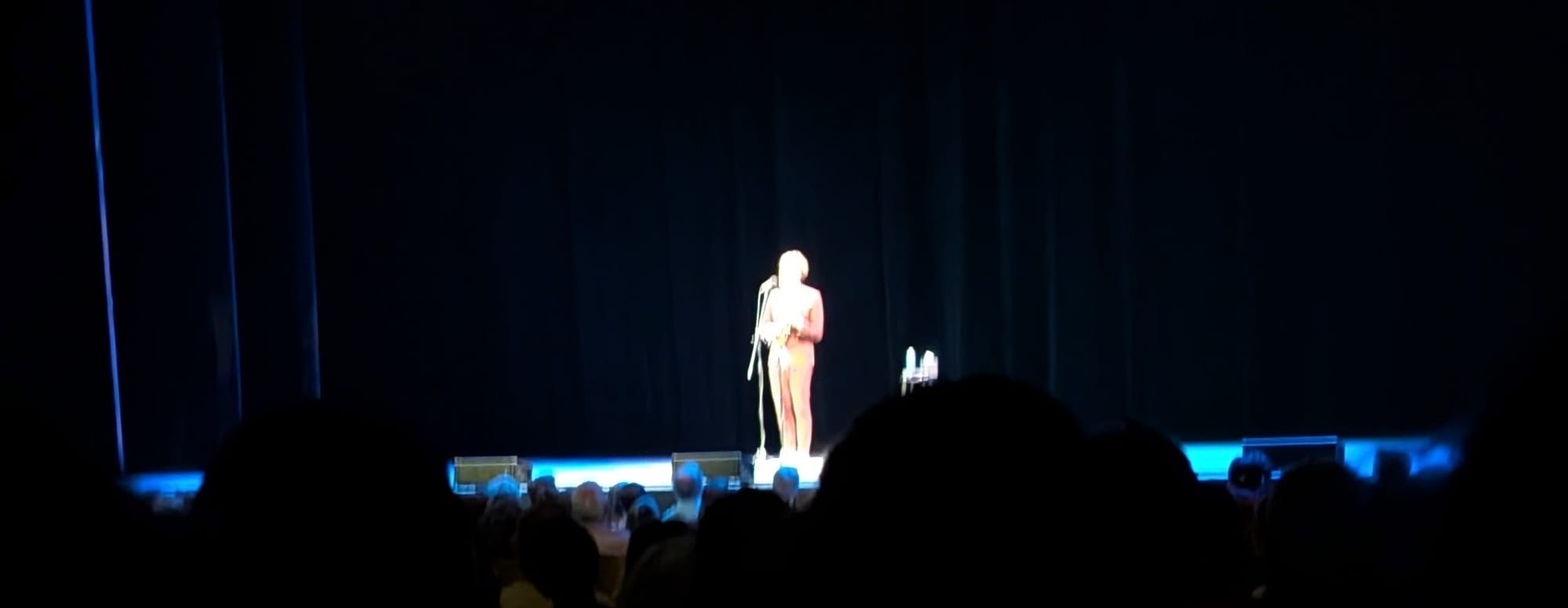
I think I’m done with that thing where musicians vaguely allude to how awful things are in the world, saying how saddened and ashamed they are by humanity, only to then suggest that music is, at least, one thing that’s good, and at least we can have music. That thing.
It’s a very particular genre of stage patter, delicately evolved to meet our particular social moment. At worst, it’s a pandering faux-humility that flatters the exact kind of indistinct political complacency that a middle-aged and very white professional class audience in Berkeley, for example, might be assumed to possess (even if, more charitably, it flows out of the horror at the death cult we occasionally notice ourselves to be embedded in, and the subsequent mortification of our souls from living with the knowledge). Musicians have been doing it since at least the invasion of Iraq, even if it really became a cliché with the election of Donald Trump, when the wrongness was such a given, such a generally understood commonsense that it followed you into the room and made you uneasy at the thing you were doing—the music, the pleasure, the ease—such that you had to say something about it, even if that was nothing more than vague flagellation twisted into justification. It might be an ironic joke about how dumb the president is, Daily Show style, and how shamed we all are by the contrast with our enlightened liberal selves; more likely, it will be as vague as the kind of thing you might say to a neighbor on the street, about how things are getting so bad out there, what even is going to happen next.
(It won’t, in short, tend to be a call for the international working class to throw off the sham that is the nation-state so as to unite against their common oppressors in the Epstein class, nor even the observation that both parties are the war party, and the genocide is still going on; viva the revolution! they won’t say, unless they are Billy Bragg, nor long live Palestine!)
When I was driving back down from the Chris Thile concert at Zellerbach last week, it would have been just around the time that US and Israeli missiles had started falling on Iranian “targets,” a euphemism for, among other things, “a girls’ primary school,” and I distinctly recall driving past Jerusalem Coffee House and looking out my window to see an Iftar crowd spilling out of the door, gorgeously decked out in their Friday night finery and illuminating a dark section of Telegraph Avenue. The news hadn’t yet dropped about this new round of murder and civilization-level crimes; I hadn’t yet seen the WhatsApp message on my phone (“Well shit. The US has attacked Iran with Israel”) so I was just thinking about how I’d gone to one of the most amazing concerts I’d ever heard, but that I had no one to talk to about it, and that—more to the point—I hadn’t spoken to anyone else at the concert, just sat in my seat and listened and awed and marveled. Which wasn’t even the wrong way to hear that music, burrowed deep into your own head. But especially afterwards, I found myself thinking how much nicer it would have been to be at Jerusalem Coffee House when the news told us about the new layers of grotesque depravity our leaders have sunk us to. It would have been nice to be among people who would know how to call the thing what it is, when it came.
In that one moment in the concert, when Thile alluded to “the state of the world,” or something as vague as that, it had been part of an extended stage banter about the uses Bach saw music being put to (“the glory of God and the refreshment of the soul”); Thile said he was leaning into the latter, these days, not being much of a Christian anymore, a thing the not-being-of-which he talks quite a lot about, usually the story about how, as a righteous teenager, he tried to convert Glen Phillips to Christianity only for the wet-sprocketed toad to pull something like the opposite trick on him, instead. He has a song about it, which he played. But to the extent that playing Bach had a meaning, at least for Thile it was a story about being reassured that we were Good, or could be: “We did that,” he said of the partitas he was playing. “One of us did that.”
And look: Chris Thile is doing things with Bach that defy my ability to describe, that make me shut my fool mouth. Because I play the mandolin a little, I have a little more appreciation for what a generational talent—or I don’t know, species-level event?—he is, how he is also the sort of musician you can look at and say “we did that, one of us did that.” But calling him a virtuoso is as helpful as saying Trump is a bad person: Who actually needs that information? When Thile is not holding a mandolin, a piece of his body has gone astray; him playing a wrong note—or even struggling—would be like water moving uphill. His flow state on the instrument is so profound and fundamental, and such a window into the depths of human sensitivity, that I find his fluttering and fey stage presence and patter a little off-putting. He skips out and literally taps his heels together, in his too-small suit with his big old sneakers, like a bluegrass Jacob Collier, telling goofy jokes and clowning ironically. In response, I become goddamn Salieri in Amadeus: Show some RESPECT for your own genius, I glower; do you not realize what you have accomplished?
In a different mood, in a different moment, this is the only thing I’d be trying to write my way around describing, how he can channel bluegrass-pop, Radiohead songs, and Bach partitas through his instrument and make it all feel like the same thing, genres and centuries and the vastness of human culture all compressed into one tiny little instrument—and a key fact about the mandolin is that its smallness is its power—until it’s all just Chris Thile playing Chris Thile. He can play Bach straight, of course; he can make the material gorgeous, sensitive, and coherent, just like a lot of musicians like him who learned to play their instrument by ear, and had to learn to read music much later (or learn classical music by ear without doing so). But when a Billy Strings or a Sierra Hull plays Bach, they’re demonstrating that they can. When Béla Fleck did an album of classical material in 2001, the point was to show that the banjo could accommodate it, like Mike Marshall, more recently, doing all the Bach cello suites on the mandocello.
These are Thile’s people—he’s collaborated with all of them—but in his new album and on tour, he is doing something more like a deconstruction, bringing out of Bach the things a solo mandolin can do that the violins the partitas were written for lack. The mandolin’s distinct, identifying percussiveness, for example—always remember that the mandolin, in a bluegrass band, is the drum—that has something to do with how close together the eighth notes it produces are, in several senses, as well as something in the texture of the wires and wood of it all, something in the way a mandolin is a singular and particular thing—a not-guitar, a not-banjo, a not-violin—that all allows it to form kinds of noise you wouldn’t tend to associate with Bach Played Well. There’s a grit to a mandolin, a sandiness, a slurring, and a chunk.
One of Thile’s original innovations as a player—compared to predecessors like Sam Bush or Dave Grisman or Marshall—was to give the mandolin a clarity and cleanness that the Bill Monroe–style players almost consciously eschewed. He certainly can play that way, of course; his stuff with Michael Daves, for example, is exquisite. But in his early solo work through the Punch Brothers era, even before he started playing a lot of Bach, there was already a bit of math music to his writing, and a kind of perfectionism to the performance that you could call “classical” if you want, if what you mean is just that every note is precisely in its place, without slur or swing, if you could imagine playing what he’s playing on the piano, and if it was hard to imagine singing the dense speed and textured complexity of the melody with your voice. A lot of the mandolin virtuosos that followed him (like Sierra Hull) sound distinctly Thile-ish to my ear, but while Thile’s 2013 Bach recording sounded like a bluegrass musician playing Bach, this 2025 second volume sounds like the pendulum has swung back, from virtuosic displays of perfect counterpoint to more gritty friction, plunk, and spit, and pop. But reveling in the solo space, it’s also much more intimate, vulnerable, and even minimalist; some of the most affecting moments in the concert were when he simply walked farther and farther away from the microphone, forcing the ear to strain to follow the music, and failing, leaving the mind to fill in the gaps.
Part of the trick with playing Bach, for the naturally improvising bluegrass musician, is that you can’t really alter the notes themselves, or shouldn’t; the text being set is sort of the point. Improvisation goes against the grain of the exercise; since the architecture of the harmonies and counterpoints and developments of the themes are the reason to play Bach, sure, you could noodle around particular themes, and that can be fun too, but if you’re not capturing the structure of the whole, the story of the beginning to end, why are you even playing Bach? You’re doing sketches of columns or a pillar or a piece of wall; you’re not capturing the totality of the edifice, and that building is the thing.
At this point, though, Thile is the strangely perfect totality, melded from bluegrass, Bach, progressive indie-pop, and, of course, Radiohead; at one point, he used the audience to pick a random Radiohead song (first picking someone from the crowd to name an album, and then picking someone else to pick a song from that album), and after getting the lyrics from a borrowed audience phone, he simply played, without ceremony, preparation, or even apparent anxiety, a strikingly original version of “Weird Fishes/Arpeggi.” It was jawdropping, like he’d been playing it for years, which of course he has: He hasn’t just played a lot of Radiohead covers, over the years; he literally played this same song, in the same fashion, at a concert in October, in New York (with a lot of the same stage patter, too, one notices).
It’s not his fault, of course, that an audience picking a random Radiohead song can’t manage to stump him, or that he’s become a good showman by figuring out which laugh-lines work, so he keeps using them. It’s also really not his fault that practicing the craft he’s spent a lifetime becoming the glory of God of feels so obscene, to me, at this particular moment of our being an absolute wet-pants-shit of a country. It’s not his fault that Trump and Netanyahu, neck and neck for the worst people in the world, decided to murder a school full of Iranian children the night I saw his concert. (After all, what have I done today that’s so great? Write a fucking blog?)
But even so. I don’t know what to do with my anger, and it spills out, and that thing where we let music refresh us from the shame of what it says on our passports–or glorify the God that allows such things to happen–it just didn’t do it for me.
We’re going to need a bigger Bach. It makes me think of the time when Thile played Dylan’s “Masters of War,” one of the great screams of rage that even so arch a song-and-dance man as Bob once allowed himself, and how Thile omitted the final verse, the “I hope that you die and your death will come soon” one. There’s nothing of Bach’s vertiginous harmonies and counterpoint in that line, just a rock embedded in the gut of a plodding old song, the kind of high howling wail that Bill Monroe would have recognized. But there’s a lot of times when that’s the kind of prayer one wants to hear, when the chipper reminder of how great we still are isn’t it, at all, and feels like kicking your heels at the funeral of someone your car ran over, and you weren’t at the wheel, sure, but you sure wish you could say you weren’t in the car, and you were, and so, what you want, all you have, is deep rage and fury at the hell that’s been made of us all.
(Other than that, the concert was fucking great.)