A review of a book by someone who has given us money
This may or may not become a recurring feature on the site. If you have something you would like us to review—a book, a painting, some artifact lying around the house—and more importantly if you have money, please hit the subscribe button and reach out to us at pitch@oaklandreviewofbooks.org. If we think it’s cool or fun or interesting in some way, we'll review it. We reserve the right to ignore you, as well as the right to tear your shit apart if we find you ideologically odious.
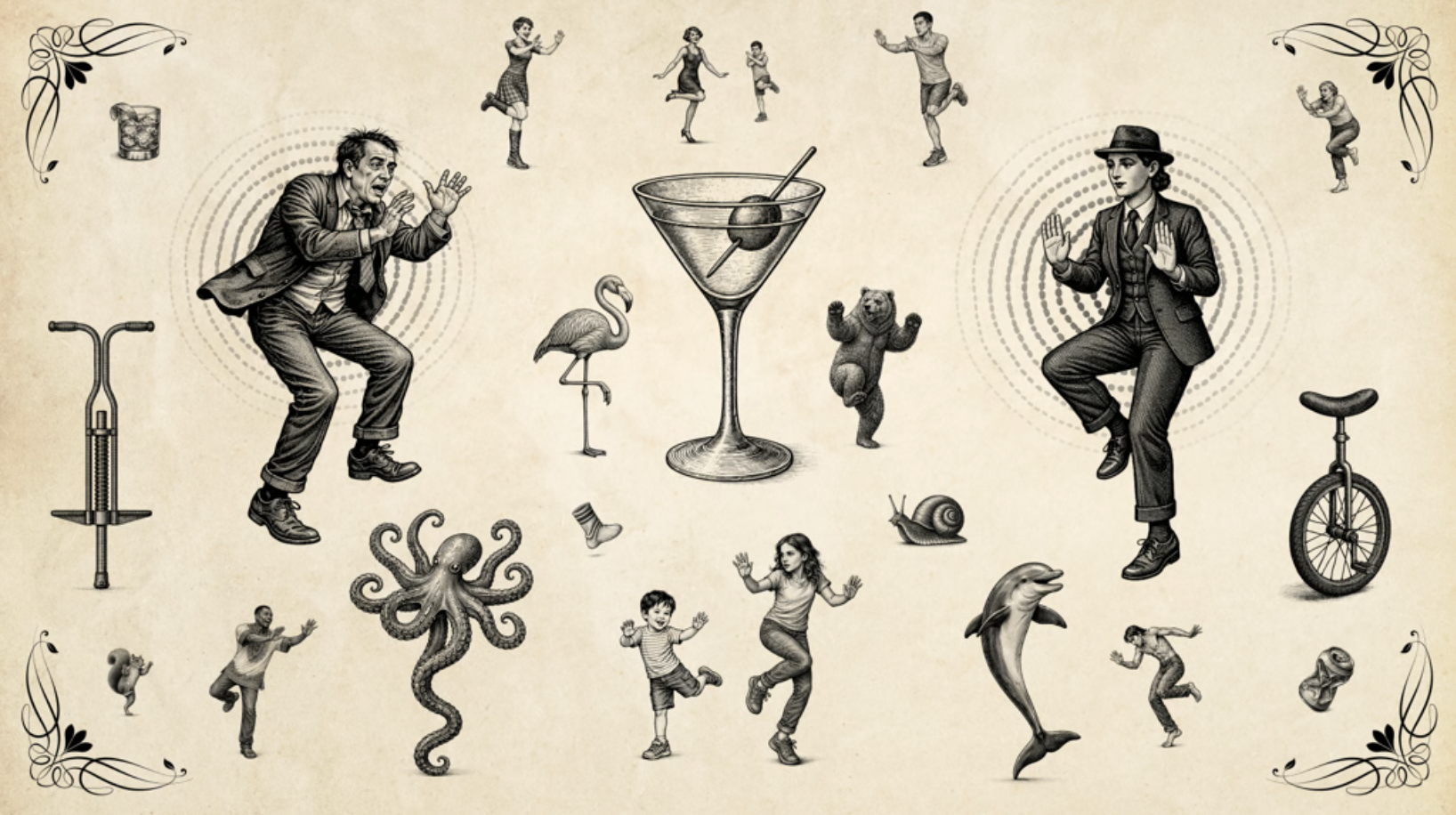
We decided to review the soon-to-be-published second edition of Frank Marquardt’s Hop Fight: An Authoritative Guide to a Drunken Sport Even a Child Can Play, because its Oakland-resident author sent us an e-copy, and because it’s a delightfully odd little book-shaped occurrence in the universe. It is a “satirical book,” as the author's marketing copy puts it, that “uses a metafictional frame to present itself as an authoritative training manual for a one-legged combat sport, complete with institutional voices, bureaucratic documentation, and technical guidance.”
Also, Frank gave us some money, becoming one of the sixty-five fine people who, as of now, have done so.

And look, I’m not saying that you can just sign up for a monthly membership and then we’ll write a review of your thing. That would be ridiculous, outrageous, etc. What kind of hack publication do you take us for?
Drop us an email, let us know what kind of hack publication would work for you. We’re still working on getting around to building out our membership tiers, and it would be premature to outline exactly on what terms we’re going to corrupt our journalistic objectivity and sell off our platform for a little money. But I want to be completely clear: if you wrote a whole book about a fictional sport you apparently invented over a decade ago, goddamn it, that kind of commitment to the bit is worth supporting, especially if you also became a founding member of Oakland Review of Books.
So, “Hop Fighting.” The clue is in the name. You hop around on one foot and fight with another person doing the same. If you google “hop fight,” you’ll find this Medium page where “Hap Tinkerman” apparently wrote some articles about hop fighting back in 2014, when I was still in grad school reading things like Julio Cortázar’s Hopscotch and also “Deep Play: Notes on the Balinese Cockfight” by Clifford Geertz, and even the Calvin and Hobbes comic where they invent “Calvinball,” recently cited by the Supreme Court. I have briefly perused the Hop Fight kickstarter page; Frank’s email told us that the launch party they’re having will occur in a DMV-adjacent North Oakland warehouse, but I guess you have to give him some money to find out more details (it’s all about the money for some people).
I have never participated in the sport of “hop fight,” of course, because it doesn’t exist and is completely made up. But: What if “Hop Fight” is a real thing? is what some part of your brain asks, as you read Frank’s book, the way part of your brain thinks about an elephant when you are told “think about an elephant.” I mean, it is obviously all made up; you can tell, quickly—or at least I can, because I read Frank’s email—that it’s a joke, a metafiction, an Oulipian lark, a postmodern exercise, and a bit of cultured bullshit. It claims to be “the second edition” of a book whose first edition was “printed sometime between 2004 and 2013” and was destroyed in a fire, at which time the now-deceased proofreaders of the first edition “carefully reconstructed and, in some cases, updated the original [u]sing a proprietary combination of hypnosis, hypnotherapy, hydrotherapy, aromatherapy, art therapy, cold plunges, lucid dreaming, psychoanalysis, past-life regressions, visualization, and plant-based inputs.” It was also written by the third cousin of the person who wrote it, Frank T. Marquardt, who went by F. T. Marquardt, and has an antagonistic introduction, written up by another made-up person, who contests much of what the book will say (which you haven’t read yet) and seems to despise its author, who he also, obviously, is.
All of this is very silly, but as Leslie Nielsen taught us, no matter how silly the things you say are, if you say them seriously enough, without laughing, the person you are saying them to will feel the weight of it and start to worry: if I laugh, do I show myself a fool? If I don’t, same? Relatedly, fighting while hopping around on one leg probably makes you look very silly, unless the only other people who see you doing it are doing it themselves. But misery doesn’t love company; misery is an asshole. Silliness is what loves company.
After suggesting that hop fighting predates the Columbian transfer, and probably can be found in Neolithic cave paintings, the book describes the present-day hop fighting scene as a contentiously composed narcissism-of-small-differences network of self-serious associations and competitions, exactly as silly as it sounds to have people explain curling or the NFL. But the game itself is so simple, and so stupid, that it probably really has been played and invented for the entirety of human history, by almost everybody. You have probably played and invented it yourself, on some lazy afternoon when you were seven, or four, or even younger; in one of that endless stream of lost moments in that vale of forgetfulness that we call “childhood” afterwards, you probably stood on one foot with someone else and tried to see who could push the other person over. I have a pair of three-year-olds who are always tussling and wrestling; they may well have invented hop fighting last week, and they may reinvent it next week again.
Can you invent something that doesn’t exist, but is so inherent in the structure of being—if you happen to be a human being, which you do happen to be—that it does exist, and that you probably invented it yourself, only you’ve since forgotten that you ever did? Of course you can. I would defy to prove that “stand on one leg with another person, who is doing the same, and try to push them over” is a thing you’ve never done or invented. You have, and you know you have, even if you have no idea if you have.
Meanwhile, Frank has jokes. Some of them are pretty good.
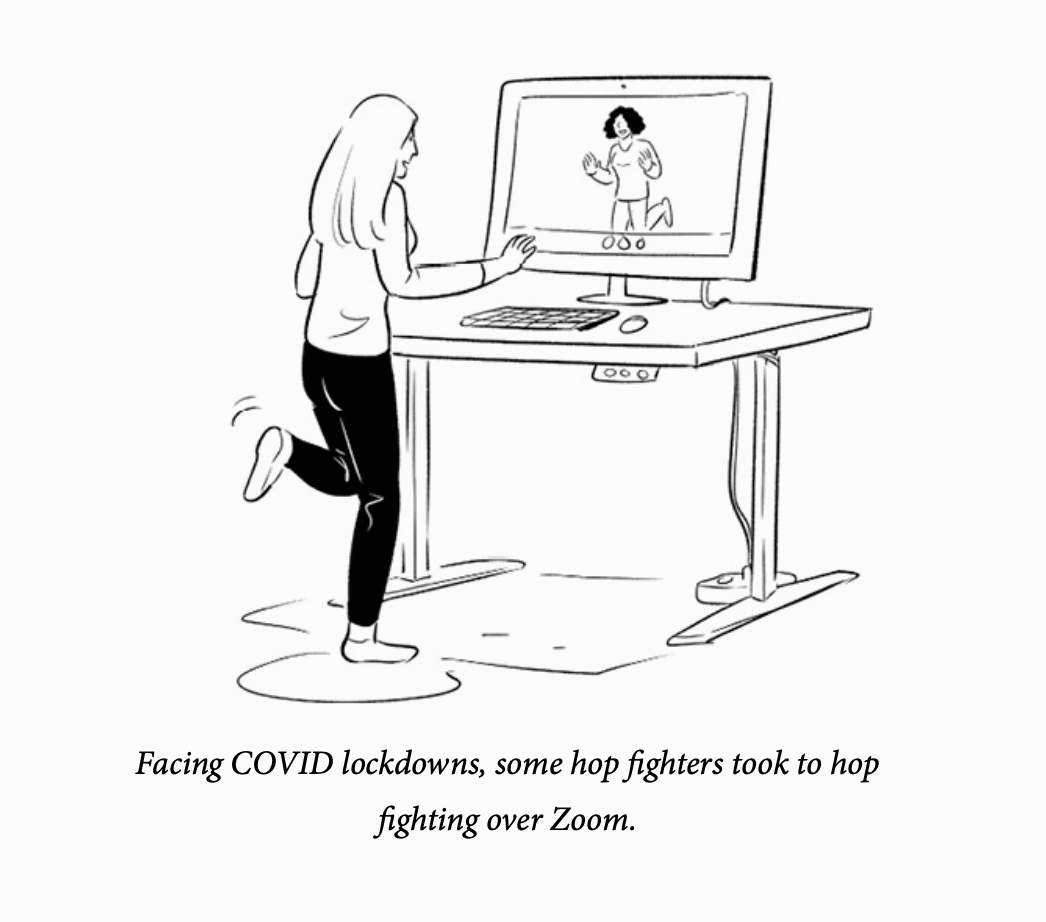
You can tell by its points of reference that the book was written in America in the early 21st century by the sort of person who would write a book like this. There’s a good bit where he implies that AIs like ChatGPT have hallucinated hop fighting’s non-existence, which is why “AI can’t hop,” a phrase I hear in my head like a line from Apocalypse Now. (“What’s unclear is how quickly it will learn, and whether AGI will develop devastating new hop fight tactics and combinations no human could possibly replicate.”)
But it’s got other, more random Borgesian jokes, as when our chronicler additionally proposes that “Hop fighters are divided on the matter of candlesticks. Some choose one with emotional significance to themselves or to their opponent, tie a string to it, hold the string in their mouth, light the candle, and reflect on the upcoming match. Others do not.”
It’s got a lot of stuff like that. He also observes that “Many in the information business propagate stories and ideas designed not to uncover truth but to obscure or directly contradict it”:
Billionaires and their multimillionaire sidekicks inject dark money into elections, mounting an on-going assault on democracy to protect their fiduciary interests. Social media has failed to meaningfully connect us, instead amplifying distraction and deepening polarization of political conversation. Human beings have been pulled to extremes, spreading disequilibrium and misunderstanding. Dishonest, selfish, and short-sighted forces divide even our best efforts to harmonize locally, nationally, and globally. The promised metaverse and vain pursuit of superintelligence are merely more ways to abandon the suffering that is intrinsic to an embodied state.
“Hop fight aspires to be a salve for these and other scourges,” he declares. As “a meditation on balance and possibility,” the sport teaches that “[s]tability is a delusion”; “Our only options are to master the psychological game of self-management on an ever-changing, nonstandard field of play or to not master it, or to master it only partially, say, just on Tuesdays.”
Correct: ORB agrees with all of that. I’m glad he wrote the book and sent it to us, and I’m glad I read it. A lot of books published by big publishers are a lot more the same than you wish they were—when even if they aren’t literally written by spicy autocomplete to confirm to an algorithmic sense of what a book will statistically tend to be, they still kind of adhere to a set of generic assumptions about what kind of book will be most frictionlessly converted into a commodity—and in that context, I think that more people should get weird and silly with it, and should write and self-publish shit like this, that literally no one else in the universe was going to make, much less predict. More people should stand on one foot and kick out at the universe; more people should take a silly thing really seriously, for years and years and years, and then call it a book and throw a party. What else is the point of being alive?
“All creatures live within a shared universal condition,” as Hop Fight reminds us, “an uneasy balance where falling down is always and forever a part of things.” When we invented standing, we invented falling down. And perhaps sometime after that, lost in the depths of time and humanity’s youth, we invented taking an arbitrary and silly thing—like being alive—really really seriously, and we made a game out of it.
Hop Fight: An Authoritative Guide to a Drunken Sport Even a Child Can Play
Frank Marquardt
Fiero; about 150 pp "with luxurious margins"; March 2026