Double-Double toil and trouble
Welcome to Taste Week! in our “Six Senses of Oakland” membership drive. Read more about the drive here. Check out other Six Senses stories here. Take a big bite of ORB by subscribing here.
◎
Do you remember when the In-N-Out near the Oakland airport announced it was closing? That was in 2024. If you’re a regular reader of this fine publication, you likely pay attention to Oakland news, and so you likely remember the affair. Then again, you didn’t need to be in Oakland to hear about it. You didn’t even need to be in the Bay Area.
“Could the closure of Oakland’s only In-N-Out help the city with its crime problem?” the Los Angeles Times asked at the top of a story that couldn’t be bothered to answer the headline’s question. By closing its doors for the last time, the Times reasoned in some wishy-washy, nonsensical, as-seen-from-300-miles-out way, the burger shop’s end could “possibly” be “a blessing in disguise for local leaders who’ve been pleading for help.”
Because, yeah…the mayor, the city council, the police department and anyone else charged with public safety had only begun to appreciate East Oakland’s property crime troubles now that their nearest source of animal fries was on the outs.
The voicey business press got in on the story, too, adding a dash of new commentary without any new facts. “Look, I don’t know what the situation is in that particular area, but it’s probably not great if a company is shutting down an otherwise profitable store,” some drive-by commentator/tech columnist named Jason Aten wrote in an “expert opinion” (yes, that’s what they called it) for Inc. “But, I do think it’s a valuable—if not bittersweet lesson—in what matters most: your people.”
Thanks, Jason. We’ll keep that in mind.
I happen to be coming out with a book on the history of fast food, and the industry holds a particular fascination for me. I also went to that In-N-Out, at least for a time, around when it first opened, when I was in high school, a friend was driving, and I didn’t mind idling in his or her car for close to twenty minutes in line waiting for fast food. And even if I didn’t have any personal experience with the place, I would’ve tuned in to the In-N-Out saga because, like a lot of Oaklanders, I am attentive to the tawdry ways the city breaks through in national media.
The real highlight of that affair, you may recall, came a few days before Christmas 2024, when In-N-Out heiress Lynsi Snyder made a rare media appearance, in a PragerU video, of all places, to talk about her family’s business. Snyder spoke briefly about the shuttered Oakland store, reiterated some variation of the same “safety” line that In-N-Out had fed every media outlet when asked about the closure, and said she was sad about the whole thing. Despite talking about plenty of other things over 44 minutes and offering basically nothing new about the Oakland matter, Snyder kicked off another round of coverage about that one store that had closed and the sad city that once hosted it. Not much is needed to bring to life the storytelling machinery of the Oakland sentimental narrative, the one about a city that can’t get out of its own way.
◎
What’s funny is that the In-N-Out thing was a national story before it was a local one.
On January 20, 2024, an apparently British Daily Mail reporter named Lewis Pennock published a missive from the terrifying heart of Darkest California.
“Is this the most dangerous square mile in America? Crime hotspot in Oakland where gas stations and In-N-Out are hit by brazen car thieves dozens of times EVERY DAY—but cops say they are powerless to stop it,” the Mail wrote in a typically verbose and sensationalist headline. For his story, Pennock rode along with an OPD cop who, along with his colleagues, described the problem and bashed city leadership for it. The biggest issue, at least apart from the crime itself, were “liberal policies” written by “progressive, woke people,” in the words of one officer.
Pennock’s sources were especially scornful of a rule barring them from chasing suspects of nonviolent crimes that was intended to prevent smash-and-grab robberies from turning into vehicular homicides.
Right-wing tabloids don’t usually send reporters anywhere. But for years now, Oakland has occupied a special place in the news priorities of a publication some 5,000 miles away. The Daily Mail never tires of covering our killings of one another, our property crimes against one another, our small business crises, our political dysfunction, our slighting of our poor beleaguered police force. The paper billed Pennock’s account as an exclusive, as if it were a frontline dispatch from the shithole country (to borrow a phrase) within America’s own borders. The day after it came out—in what was almost certainly the only public airing of a decision months in the making—In-N-Out corporate announced it would close the Oakland store. Other media, local as well as national, picked up the news from there.
◎
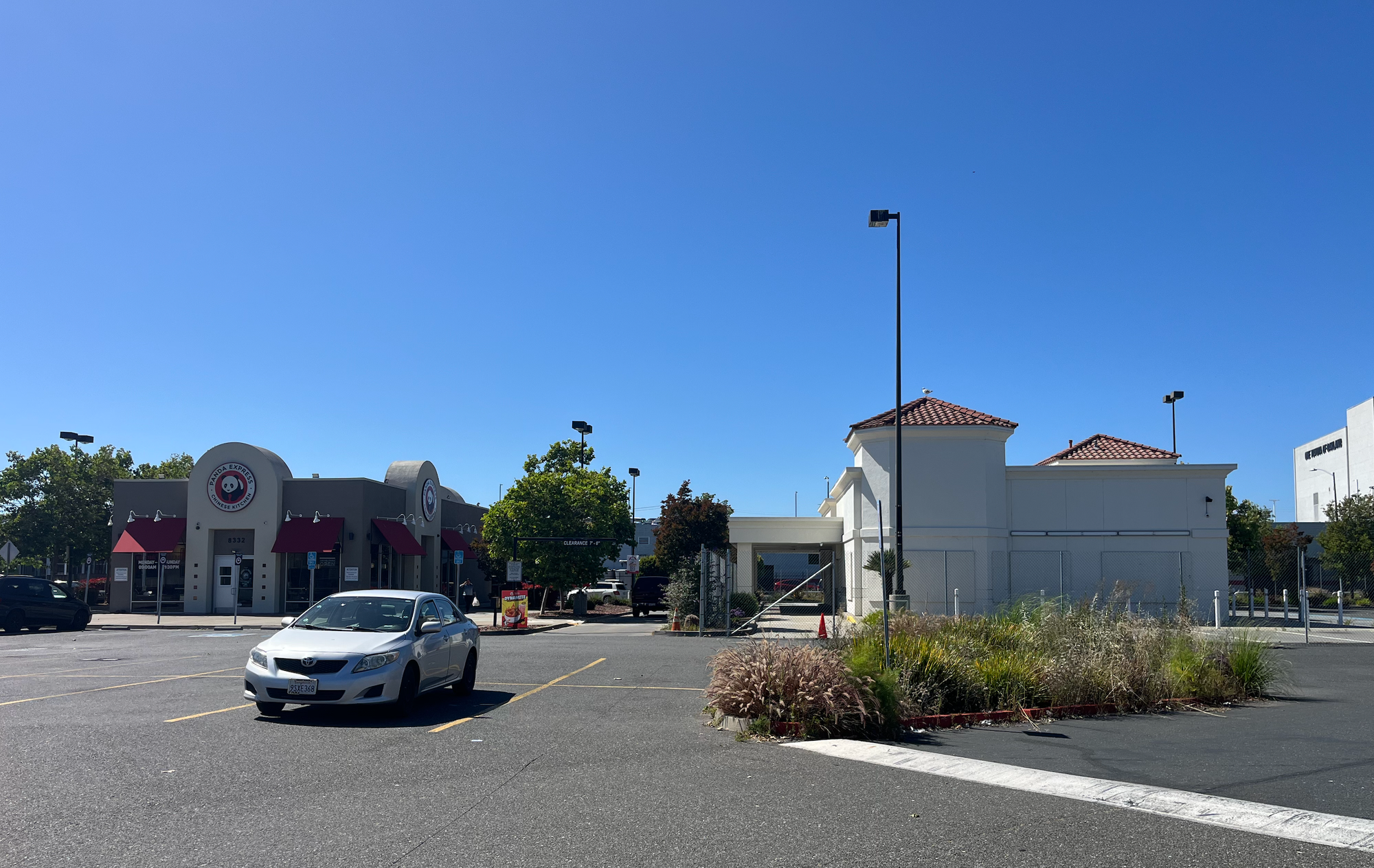
If you’re at all familiar with the old In-N-Out site, you’ll remember there were (and are) a few other fast food outlets surrounding it. Right next to the old lot on Edgewater Drive is a Panda Express. Nearby, on the other side of what used to be a Walmart, there’s a Raising Cane’s and a couple other buildings with a rotating cast of eateries that now include a Subway, a Round Table, a Jamba, a Chipotle, and something called Smashville Burger that looks like it’s part of a chain but isn’t yet.
The whole area has posed trouble to tenants and customers for years. Raising Cane's is a mostly Southern chain and opened to much excitement from fans for whom the next closest location is in Manteca, but less than a year after its 2022 arrival, it closed its dining room, citing crime. During the 2015 NBA Finals, a camera crew stepped into the Panda Express and came back to find their entire van cleaned out of some $40,000 in electronics.
When the Chronicle pulled the twenty addresses in Oakland with the most reported crimes in 2019–2023, the reporters found nine of them to be right within a ten-mile circle in Deep East Oakland, adding some statistical depth to the Daily Mail’s “most dangerous square mile” claim from a couple years before. The Chronicle also lent some credence to the special attention Pennock and his OPD handlers had paid to In-N-Out: With 1,335 recorded incidents, including 1,174 car break-ins, it was the lone address in town to crack a thousand incidents in that four-year period, apparently making it the most crime-ridden address in Oakland.
There’s no arguing that’s a horrible position for any business owner. I have to assume that In-N-Out’s chart-topping status owed to a far-reaching reputation, among not just customers but bippers, who must have noticed that a magnet for out-of-towners was also the site of more out-of-town behaviors, like leaving bags and laptops in plain view. (While we’re talking, I’ll add that visitors from far away are also perhaps more likely to file a police report after their bags have disappeared. I don’t doubt that In-N-Out saw a lot more property crime than most anywhere, but I also suspect the crimes that happened there were more likely to get tallied.)
Caveats are in order, since we’re talking about crime and popular media. For one thing, note the habit here of conflating property crime with violent crime, which made it all the more easy to depict the Town, in general, and this corner of it, in particular, as a perilous hellscape. (Not all property crime matters, to be sure. Wage theft, which affects workers in East and West Oakland disproportionately, and workers in the Deep East especially so, never rates a mention in any of the coverage.)
But even accepting the usual frameworks of crime coverage, there’s a reason not to take In-N-Out’s status as a list-leader at face value. Two pairs of other spots that ranked separately and only slightly below In-N-Out on the Chronicle’s list shared a parking lot. 191 and 185 98th Street (currently occupied by a 76 gas station and a Yemeni cafe) are right next to each other, and counted together, they registered more robberies than the nearby In-N-Out (though fewer car break-ins). (A Wendy’s also shares the same lot, at a different address. That one didn’t make the list, but I’ll go out on a limb and wager that its customers have suffered a lot of break-ins, as well.) If you count 449 and 451 Hegenberger together—that’s the pair of buildings near the In-N-Out site that now house the Chipotle and other outlets and also share a parking lot—you see that its robberies also break a thousand.
That In-N-Out topped a bad list surely made its departure easier to justify, though for restaurant and gas station managers in the area, the particulars about which crimes happened at which address, and which happened on the next lot over, don’t matter a whole lot. Every store in the area was afflicted by crime, and as Pennock’s OPD handlers noted, plenty of stores had already left before In-N-Out. “If you look around this area, just like San Francisco downtown, stores are closing,” one said, in what has to be a rare comparison.
The question might not be “Why did In-N-Out leave?” but “Why did its closure draw so much attention?”
◎
For the first twenty years or so that the fast food industry could be called an industry at all, Wall Street was generally not all that interested in staking money on it, so most chains relied on franchising to underwrite their expansions. A small business owner (or an aspiring one) staked his or her own capital to own a restaurant that carried the name and likeness of a corporate brand. Franchising allowed fast food to spread around the country rapidly beginning in the 1950s, appearing in just about every suburb that would accommodate it, along with the white residential neighborhoods of cities. But as white people fled cities in the 1960s, franchisees often fled with them, leaving their restaurants in chronic disrepair.
There’s a fascinating history, detailed in the historian Chin Jou’s Supersizing Urban America and Marcia Chatelain’s Franchise, about how, following the riots in Watts, Newark, and Detroit near the end of the decade, McDonald’s started to fear for its urban operations. To prevent stores from getting torched in the next wave of violence, the company reasoned, it needed Black people to own restaurants in Black neighborhoods. The federal government, trying to anticipate the next phase of the Civil Rights movement, reached a similar conclusion.
With separation, franchising came with a built-in narrative that protected the franchisor. If something went awry at a particular location—if the business suffered under whatever social ills were bedeviling its neighborhood, for instance—the burden was on the franchisee, not the company that owned its name.
Oakland plays an interesting role in this saga. On a mission from Lyndon Johnson, Eugene P. Foley, the head of the Department of Commerce’s Economic Development Administration, made five visits to the city to meet with Black locals and see what afflicted them. As Foley later wrote, people from all walks, “from militant young Negro leaders to conservative businessmen,” in his words, agreed that jobs for the unemployed “are the key to solving the problems of Oakland’s ghetto.”
Foley’s account informed a new effort by the Johnson administration to bring jobs and businesses to impoverished Black urban areas. Within that plan, fast food franchising held a special significance: It was a way to bring national businesses with a proven track record to areas where business of any kind faced every possible hardship. Tied into a national network, with national branding, and the support of an established corporation, business owners might have the advantage they needed to endure.
With McDonald’s looking to recruit Black franchisees, fast food was poised to be a means to achieve not just Black employment but also Black entrepreneurship. Ambitious Black entrepreneurs with plans to open a franchised operation went to the front of the line when they applied for federal small business loans. Simultaneously, McDonald’s leaned on white franchisees in eight cities—including Oakland—to sell their stores to Black buyers. By 1968, Oakland had its first McDonald’s, at 2901 68th Ave, near the Evergreen Cemetery in East Oakland. By 1970, there were five in downtown, East, and North Oakland.
(Fast food has proliferated in Oakland’s Black neighborhoods ever since. These days, East Oakland alone hosts five McDonald’s, two Wendy’s, four Burger Kings, and a lot of other outlets. If you’re wondering what other national enterprises are so thoroughly represented in the area…well, there aren’t any.)
The first outlets in high-crime urban areas reported a litany of problems, but Black franchisees were a dedicated bunch. “There were fights inside the store, gun shots fired. I had hell there,” Lee Dunham, a former NYPD cop who opened a McDonald’s in Harlem in 1972, told Black Enterprise.
As one of the first and most successful Black franchisees, Dunham became something of a legend among his peers, even if so much of what made him interesting was typical of Black fast food owners. He was from the area and knew it well. He was also committed to his restaurant’s success in a way that middle managers from a distant corporation could never be. Since police and even McDonald’s Corp.’s own field reps avoided his store, he often confronted trouble himself, answering “force with force,” as he put it. Once in a while, he would even get reckless youths to think seriously about their choices. More than a few came back to work for him.
Dunham paid employees the highest wages of any McDonald’s in the country, set up a scholarship fund for the ones who wanted to go to college, and tried, at least, to come up with a profit-sharing scheme. Out in the neighborhood, he sponsored a local basketball team and provided food to the Black Panthers’ free breakfast program. “It’s not like we’re trying to take money out of the community and not put it back,” he said. After a rocky first year, Dunham’s store earned a reputation as a safe place for locals young and old to pass an afternoon in an area that sorely lacked safe places. People came in droves. Before long, Dunham’s McDonald’s was one of the most profitable in the entire system.
Did McDonald’s corporate favor Dunham’s various managerial choices? Maybe, maybe not. They surely noticed, but almost certainly didn’t care. Dunham was a franchisee, after all. He worked under an arm’s-length arrangement that had been purpose-built to give him the final say on many, if not most, of the decisions that went into operating the business, and to shield the corporation whose name he carried from any responsibility.
With separation, franchising came with a built-in narrative that protected the franchisor. If something went awry at a particular location—if the business suffered under whatever social ills were bedeviling its neighborhood, for instance—the burden was on the franchisee, not the company that owned its name. The problems a franchisee faced were always, reliably, a local story.
In Oakland and anywhere else you’ll find it (or once found it), In-N-Out offers a different story.
◎
In the early 2000s, when it opened in Oakland, the SoCal company known for a nostalgic aesthetic, simple menu, and serviceware clad in Bible references was expanding about as fast as it ever had. Not coincidentally, the industry was changing, as well. The fast-growing corners of the wider U.S. economy were fewer than they had been in prior decades, and the smart money was willing to stake a lot of cash on chains with snappy concepts. Even a new brand could rise to prominence without selling its likeness to small-time entrepreneurs. Chipotle and Starbucks were already booming without franchising, and Shake Shack and Sweetgreen were at the starting gates. In-N-Out was almost as old as McDonald’s, but a once-unusual choice to own the entire system itself paid off as the industry caught up to it at last.
Moving into East Oakland around this time might have been a bold move, but it was one likely made by pencil pushers in an office in Orange County, for whom the plot was only one of many points on a map of the Western United States. Sure, plenty of other fast food chains had opened in the area, but In-N-Out was unusual in that it made its move without help from a franchisee.
It’s hard to blame In-N-Out for things going south after that. Car break-ins weren’t so widespread at the time they opened, and, for years, the place worked smoothly. Even at the time of its closure, the store was profitable. Surely there were some things the company could have done differently, though it’s difficult for people with hundreds of other locations to look after to anticipate and make the kinds of adaptations that Lee Dunham made, and to make them out of an office hundreds of miles away, no less. Maybe a local owner who had bet his life savings on the one project would have approached the whole matter in another way, though it’s always been too much to expect one small business owner to stave off a city’s problems alone. Maybe the people behind the Indian restaurant who plan to occupy the property next will crack the code. I’m less interested in what could have been than what happened, and what happened is that crime picked up around the store, along with all the other stores in the area.
It’s worth noting, the property crime problem was hardly unique to the Deep East. Especially after the 2008 crash and the ensuing housing and foreclosure crises, property crime jumped all over Oakland. But a phenomenon that was going on across town got especially bad in its most marginalized region. A friend who worked across the street from a nearby homeless encampment said she often saw guys dumping suitcases there after rifling through them.
But without a franchisee to shoulder the blame, the news of the closure pitted a fast-growing company that every red-blooded Californian adored, and every passing visitor was eager to indulge in, against our fair city.
In-N-Out’s struggles shouldn’t have surprised anyone. But without a franchisee to shoulder the blame, the news of the closure pitted a fast-growing company that every red-blooded Californian adored, and every passing visitor was eager to indulge in, against our fair city. Better yet for national news media, it confirmed the small, two-dimensional role that Oakland was allowed to play in America’s daily drama—that of a city so close to so much wealth that can’t seem to get its act together. “Why, yes,” national editors in Manhattan all said. “That’s news.” Such is the price of failure for so many of the U.S. cities that were sites of Black political possibility half a century ago: to be patronized for all eternity by the worst journalists in the world.
So it was that Oakland took the fall for In-N-Out’s dire straits. Whether In-N-Out should have known better or could have salvaged its operation was besides the point. It was our city that had failed to bring in more police, our city that tied the hands of what few cops it did put on the street, our city that couldn’t figure its shit out. So the story went, in any case.
Contrast that narrative to another closure last year—that of the McDonald’s on 14th and Jackson. When rats turned up in the kitchen, workers went on strike and health inspectors forced a temporary closure. Six months later, the franchisee permanently closed the store, giving employees—some of whom had worked at the restaurant for close to two decades—ten days to find a new job, and a few days before Thanksgiving, at that.
That affair got some attention in national media, partly thanks to the California Fast Food Workers Union. But the sweeping commentaries about how one closure revealed something profound and dispiriting about the state of the city that hosted it were nowhere to be found. The hot takes didn’t have anything bad to say about McDonald’s corporate, either. Just as it had with In-N-Out, the structure of the business played a role in the structure of the story. One franchisee’s problems (and they were, ultimately, one franchisee’s problems) weren’t a reputational risk for a brand that had, or at least could claim, only an arm’s-length relationship with either him or his store. When local media asked for comment, McDonald’s corporate said only that laid-off employees were welcome to apply to other stores. There were plenty to choose from.
◎
To see it through the eyes of the national news, Oakland is a city whose budding cool status has always been probationary. Maybe it’s been too gentrified, or not gentrified enough. Maybe it has something to do with historical inequities, or COINTELPRO, or “progressive policies,” or the Democrats, or…well, who the hell knows. Writing the news so often means floating questions without really asking them—and certainly without answering them.
Alex Park is a writer and researcher in the Dimond. He’s currently wrapping a book on the global history of the fast food industry. Find more of him at his website at www.alexcpark.com and follow him on Bluesky.