The future is here. Everyone on the train has a little screen with them. Canadian annexation is official U.S. policy. They put weed into fruit, into soda, into popcorn. You can order it on your little screen. Everyone on the video call has replaced their head with a blinking simulacrum. The “you’re fired” guy from that show where people pretended to be at work is our Pinochet. Gynophobic, libtard and man bun have been added to the OED. The new drug whose name you can’t spell causes crocodile-hued necrosis.
It’s time to read Infinite Jest, again.
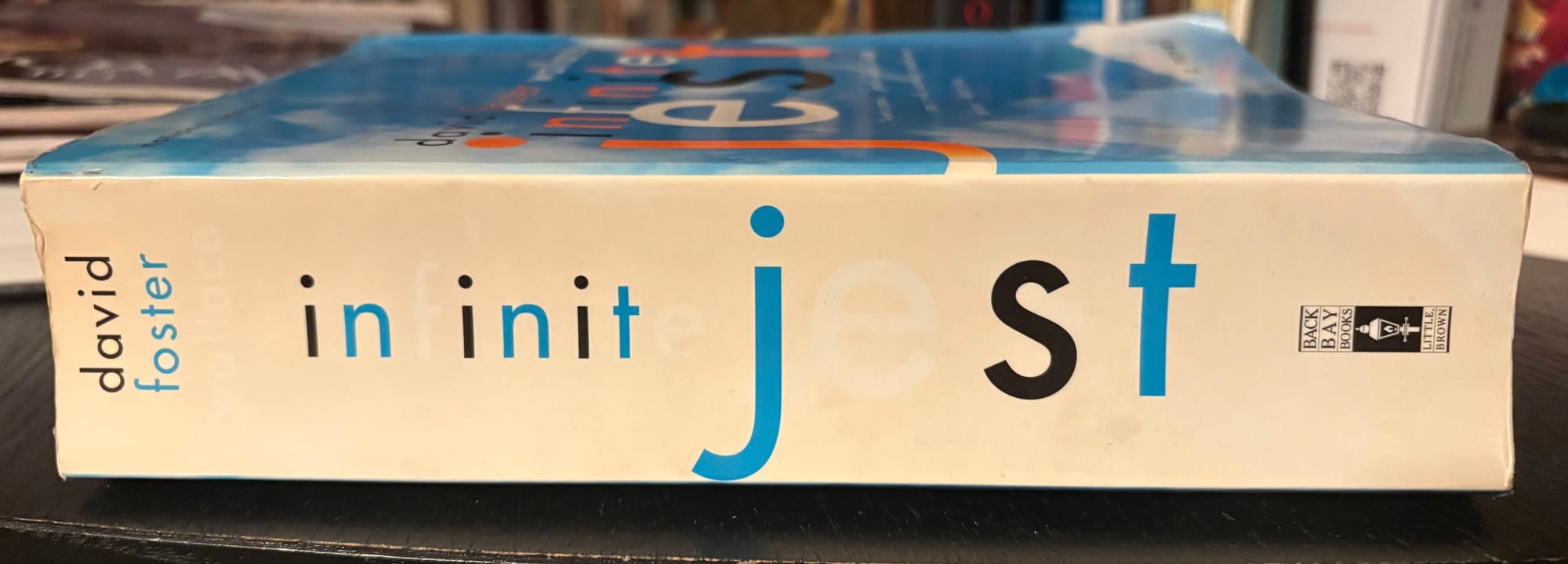
It wasn’t obvious that the book was going to stick around for thirty years. The Important Novels of the mid-nineties, if I remember right, were supposed to be American Pastoral and Underworld, chronicles of the past by laureled men over sixty. Infinite Jest came busting in among them like a graphomaniac Kool-Aid Man, young, brash and huge, slinging its girth everywhere. It wanted to be important (Little, Brown and Company really wanted it to be important), but it was destined for subculture, clearly too weird for the canon. Its move to centrality came gradually, at the same pace that its own reputation occluded it: a book name-checked but never read, 2.85 pounds of bragging rights, cringe to carry in public. It also got tagged as a bros’ book, no less toxically masculine than the Updikes and Roths it had displaced, the province of—as Michelle Zauner’s new foreword puts it—“a particular breed of college-aged men who talk over you.” When a thirtieth-anniversary celebration appeared on the ORB calendar, my first reaction was the warm glow of fandom. My second: But who else is going to be there?
It certainly hadn’t always been a bro’s book. The person who first insisted I read it was my ex-girlfriend. At age twenty I had a confused way of dating the women I wanted to be, and that psychic freight didn’t make for lasting relationships. L. and I made it less than a month before the fling fell apart, but some gravity kept us in each other’s lives. She went to study abroad in the UK, I consoled myself with Ani DiFranco and we emailed constantly. When she started to evangelize what I gathered to be a long hipster novel about Boston, it was only natural that I’d pick up a copy.
“It will be slow to start with,” L. wrote me, “but do keep with it. He’s SO good.”
“What are you talking about?” I shot back. “It hooked me after ten pages.” The problem, I said, was that I would have to shove everything else aside to finish it.
“Problem?!” came the answer. “Do you know how great it is to get hooked on a book so long that you can’t possibly run out of text for days?”
Days only: that was how young we were, with so much time on our hands. My memory of that first reading is that it was a luxury. What concupiscent bliss to sink into those multi-page paragraphs, to receive a traveler’s visa to an alternate world, to read with two bookmarks, one for the main text and one for the endnotes!¹ Obviously the book was having it both ways on addiction, sermonizing about compulsive entertainment as it pulled out every stop to hold your attention; and likewise on ambition, decrying the American cult of success while nakedly angling for the big time. It was easy to forgive. We believed in counterculture then; sharing the book with your friends felt like passing around samizdat, to use one of its keywords. And surely a writer so eccentric could never really sell out. The magpie vocabulary and manic trains of association weren’t there just because he wanted to impress you (although of course he did), but because he plainly loved what he was doing and couldn’t do otherwise. You’d never mistake one of his sentences for anyone else’s. At a time when the worst thing you could be was a poser, Wallace was obviously and overtly himself.
For pure seduction, take those opening pages. We meet tennis prodigy Hal Incandenza at a college admission interview, where a conclave of deans is trying to reconcile his submitted essays (sample: “The Implications of Post-Fourier Transformations for a Holographically Mimetic Cinema”) with test scores that are “just quite a bit closer to zero than we’re comfortable with.” At first it seems like we’re witnessing some kind of egregious application fraud. But Hal’s inner monologue is not exactly an unlettered jock’s (“It strikes me that EXIT signs would look to a native speaker of Latin like red-lit signs that say HE LEAVES”), and when he finally opens his mouth he starts to lecture the deans on Kierkegaard and Hegel. Surely the tables have turned? But the deans understand none of what Hal is saying; to them he simply appears to be gibbering and flailing, and they tackle him to the floor. At this point the book loops back in time and the question of just what is going on with Hal is deferred, and teased, and deferred again, such that r/InfiniteJest is still arguing about the real answer.
You need such a hook to pull you through the inevitable parts where Wallace is having more fun than you are. Different readers have different sticking points: I adore the James O. Incandenza filmography and don’t even mind watching teenagers rehash the Mean Value Theorem, but the near-future world-building tests my tolerance for stoner jokes. What if Maine was a toxic waste dump full of radioactive babies? What if a diaper company sponsored the calendar? The wheelchair assassins are a Monty Python bit; the whole premise of an incapacitating video entertainment is just the killer joke sketch done over as media theory. The debt to Pynchon’s conspiracy-weaving is obvious, but Wallace’s inventions in this mode never go as deep and are the parts where he most seems to be working with a borrowed toolkit. His heart as a writer was in the texture of everyday life: its absurdities, to be sure, but also its banalities and griefs. Far from the paranoia of the conspiracy theorist, his demon was what Gravity’s Rainbow called “anti-paranoia, where nothing is connected to anything, a condition not many of us can bear for long.” A state like that, in which the through lines of the world are stripped out, you could also call depression.
Infinite Jest is a Boston book, but it actually starts out in Tucson, where “the blue sky is glossy and fat with heat” and where I happen to have grown up. The coincidence was odd enough to goad me into a web search (on AltaVista!), where I learned that Wallace had lived in my hometown in the late eighties, when I was in grade school. I also turned up a gossipy article mentioning his admission to a psychiatric hospital, which seems to have been the very same institution that my parents checked me into a few years later, at age fifteen, when I felt unable to go on living in my body. An early scene in Infinite Jest puts a minor character through the same procedure, and even if I hadn’t known the biography, that person’s attempt to explain suicidal depression to a well-meaning, useless hospital doctor would have left no doubt that this was real experience talking.
The word “depression” misleads, of course. It implies that “you get quiet and melancholy and just like sit quietly by the window sighing,” when in fact the condition is a near and constant torment, “like every cell and every atom or brain-cell or whatever was so nauseous it wanted to throw up”:
It is a level of psychic pain wholly incompatible with life as we knew it. It is a sense of radical and thoroughgoing evil not just as a feature but as the essence of conscious existence. It is a sense of poisoning that pervades the self at the self’s most elementary levels.... The person in whom Its invisible agony reaches a certain unendurable level will kill herself the same way a trapped person will eventually jump from the window of a burning high rise.
I had never read such a plain and desperate account of what happened to me in my bad months. It left me relieved when the stoner jokes came back. For all its excess, Infinite Jest does quite a careful job of balancing the ludic and tragic; in the later writing the tragic takes over, and the work doesn’t gain by it. Lay preacher Wallace, as on view in the much-circulated Kenyon commencement speech, can use puerile Wallace to let some of the air out. The self-flagellating Wallace who shows up in later stories is even harder to take. But Infinite Jest is wise enough to lean into the audacity of what it’s doing, and mine it for joy.
The main characters are marvelous, as companions on a thousand-page journey had better be. Hal is our Stephen Dedalus, but we also have a Leopold Bloom in the recovering addict Donald Gately, “the size of a young dinosaur,” smarter and kinder than he thinks he is, who helps run a halfway house and does the humble work of convincing us that the clichés of Alcoholics Anonymous (which signal their clichédom through capitalization: Substance, Disease, Identify) can actually mend broken lives. Gately can’t bring himself to believe in a Higher Power, but his late hundred pages in a trauma ward, drawing on every inch of will to refuse the painkillers that used to possess him, are the book’s great act of heroism. Most of its people, however minor or flawed, get some opportunity for grace, and the heart in that method shines through even the sections that struggle with alterity. The misconceived passages in exaggerated Black English are infamous. And on this reread, there was no ducking the book’s take on trans people.
The nineties weren’t a great time to be gender-variant in literature, and Wallace’s weakness for caricature met the moment very unfortunately. Hugh Steeply, a secret agent who goes under deep but unconvincing cover as a journalist named Helen, mostly comes off as an Ace Ventura-grade joke. The narration can’t stop ogling his “gigantic prosthetic breasts pointed in wildly different directions” or hold back the assessment that “he appeared huge and bloated as a woman, not merely unattractive but inducing something like sexual despair.” It’s not that Steeply is trans, though there may be some masochism in the disguise; it’s just that a man in a skirt is never not funny.
What I didn’t recall from earlier readings were the smaller details around Steeply rehearsing feminine mannerisms. We’re reminded that a woman lights a cigarette with her elbow held close into her body, that her way of examining her fingernails is “to raise the whole hand’s back into view instead of malely curling the nails over in the upturned palm.” It’s not much, but it rings true, and sharply recalled to me the awkward first year of my own transition, when I was relearning how to inhabit gesture. Even when the broad strokes miss the mark, the minuteness of Wallace’s attention comes up on the side of the angels.
Then there’s Poor Tony Krause, a character created—if the name didn’t clue you in—simply to suffer. A “gender-dysphoric” rejected by his birth family, he (the novel’s pronoun) haunts the streets of Boston in heels and a feather boa, sleeping in dumpsters and earning heroin money through purse-snatching and sex work. His week-long, cough-syrup-soaked withdrawal in a men’s room is every bit as agonizing as the passages on major depression (which Wallace also calls “dysphoria”) and concludes with a tongue-swallowing seizure on the T. As with the Black English sections, you get the feeling that Wallace felt an obligation to show the full social spectrum of his city, and unthinkingly reached for characters like these to fill out the bottom rung.
But again, the details take it deeper. After Tony leaves the hospital, a former crewmate sees him walk past, looking “godawful: sucked-out, hollow-eyed, past ill, grave-ready.” Yet he still carries something of his old queenly hauteur, “never so much walking as making an infinite series of grand entrances into pocket after pocket of space.” A few pages later the scene repeats from Tony’s perspective, and we realize that he is riding the high of post-seizure euphoria, imagining himself “a charming and potentially once again in the not-too-distant future gorgeous creature.” Nothing is more usual, when writing about trans femmes, than to juxtapose glamor and abjection. But the rapid perspective shifts—Tony from the outside, Tony remembered, Tony from within—open up the basic disjunction of his experience in a way that, again, feels right; and with the mercy to save his inner view for last, rather than set him up for deflation. It’s only a moment. It certainly doesn’t save Tony from a horrible end. But if we pay attention to him wanting to be seen as the gorgeous creature of his imagination, we might draw connections; say, back to Hal’s college interview, with its yawning gulf between body and mind. We might even make the leap that Hal tackled to the floor, calmly and hopelessly telling the deans, “I am not what you see and hear,” is a picture of transness also.
To be feminine is to be on display: Wallace got that, even if his ensemble cast includes only two prominent women, one based on his mother and the other on his ex. I won’t review his well-attested appalling behavior during the years of writing, except to note that sexual loneliness runs through the book like an electric arc, and the character of Joelle van Dyne, aka Madame Psychosis, aka P.G.O.A.T. (the Prettiest Girl of All Time) is its ground wire. Her mystique comes in many guises; it’s not obvious that the host of a cult radio show will end up being the same person as the baton twirler who captivates Hal’s football-playing brother, or the veil-wearing crack addict who shows up at Gately’s halfway house. Yet she holds together. Apart from the dead hand of Incandenza senior, she is the book’s only artist, pursuing a cinematic career that’s cut short when she finds the male gaze no longer endurable. She wears the veil either to ward off amorous attention, or because such attention has brought a disfiguring accident upon her (this is another of r/InfiniteJest’s points of dispute). Either way, her radio show as Madame Psychosis grants her a power free from visuality, allowing “this kind of utter liberating equalizing darkness to descend so you can be reduced to nothing but a voice among other voices, invisible, equal.” No wonder Gately falls in love with her without ever seeing her face.
Joelle is also the star of the fatal Entertainment, the contents of which only come out by hints since no character can view it and survive. Much has been made of Wallace’s prescience on this topic, but our modern Internet and the compulsive scroll-screens that abet it couldn’t actually have been predicted in the early nineties, by him or anyone. In his imagined future, video is still distributed on physical cartridges. And rather than the short-form reels and parasocial relationships of our media world, the imagined film seems like an invitation to Liebestod. Joelle appears in it as an ultimate feminine archetype, merging mother and lover, birth and death, the passage from one life to the next. (Ulysses nerds will pick up on the Greek metempsychosis, or reincarnation, in her stage name.) We are very far from realism here, but I was always surprised that this artifact was supposed to enthrall women as much as men. A longing for the absent feminine ran through my life, but could everyone else be equally badly off?
The book ends in fracture. Ulysses, that original encyclopedia of male loneliness, spends hundreds of pages stoking our hunger for Bloom and Stephen to finally meet, and when they do it’s sheer anticlimax, drowned in the fickleness of words and apathy of the stars. Infinite Jest also is structured such that Hal and Gately have to meet, with Joelle as the link between them, but it’s done in the way of a conjuror drawing your eyes elsewhere. Blink and you’ll miss it. There’s a whole mirror half of the plot that happens only offstage and by implication; the crowning jest of this maximalist novel that can’t shut up is how much it actually leaves out. Maybe some of the characters get better. Maybe they do it together. But you won’t find it even in the endnote to an endnote. You can speculate, you can take your conclusions to Reddit. Or you can start over on page one.
I got better. L. got better. Wallace got better, at least for a while. The day I learned of his suicide I picked up the phone without thinking; L. would find out any moment, I thought, and the news should come through a human voice and not the Internet. This week, I let her know that the main anniversary event was happening in her city, at the 92nd Street Y, but I was on my way to a gathering in uptown Oakland.
“Cosplay as PGOAT!” she texted back.
Wearing a veil would have been a good bit. But I’d been going out dressed as myself for a few years, and that’s how I would have to meet whoever else was there. Would it be a room full of lit bros, I asked L., or a room full of Michelle Zauner? The only people I knew I wouldn’t meet were ourselves at age twenty, ambitious and lovelorn, confirmed in the knowledge that this book mattered but clueless where our world was going.
At the back of a co-working space I found twenty-odd people of all ages and genders, seated around a table with cans of sparkling water and plus-sized paperbacks. Some had the brand-new edition, some relics as creased and abraded as mine. Nametags had been written out in advance. There was a baby. There were Enfield Tennis Academy T-shirts.
If it’s too on the nose to say that the room had an AA vibe, there was still a testimonial feeling in how people shared what had brought them there. Some were simply curious. Some had read Infinite Jest many times. Some were working their way through the 64-hour audiobook, which apparently brackets the endnotes with a little ding. One person had read it “out of spite,” after breaking up with a boyfriend who wouldn’t shut up about it. Another was planning to teach it in a class on literature and love. There were allusions to depression and addiction; other people just felt like they had a phone problem. “I’m not what you might consider Infinite Jest’s target demographic,” Zauner writes in her foreword, but neither was anyone else there, and you had to wonder if that demographic was ever even a coherent idea.
Zauner also writes, “We will likely not see another book like this in our lifetimes. Ten years from now, Infinite Jest may exist as an artifact of an era when humans still wrote.”
I’m not so sure. We all know our mental ecosystem is badly poisoned, and nobody in the room was sanguine about the present moment. But there was also a palpable astonishment that so many of us had turned out, not to preen or posture but just to see who else would be there. After the co-working reservation ran out, we lingered to take a group photo and trade favorite passages. Gately’s hospital ordeal came up more than once, with its hard-won insight (which is also a cliché) that suffering is met only by consciously choosing where to place one’s attention. Delirious in bed, Gately has no one to tell this to and no way to turn his mind outward. Those of us pulled together by his story, it turned out, still had it in us to attend to each other.
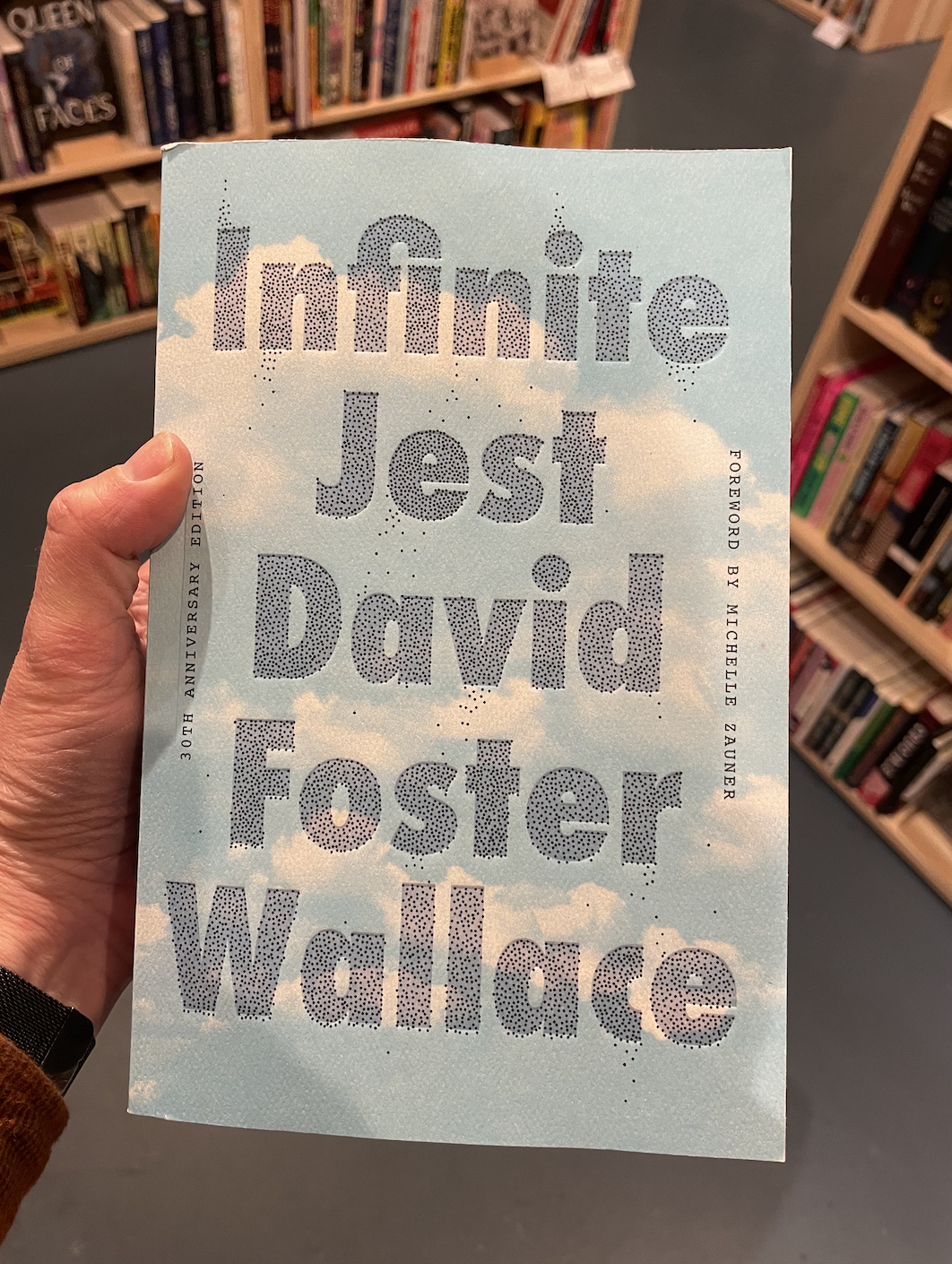
Infinite Jest (30th Anniversary Edition)
David Foster Wallace, foreword by Michelle Zauner
Little, Brown and Company; 1104 pp.; February 2026
1. Everyone calls them footnotes. They’re not. Given how long some of them run, it’s hard to imagine that they could even have been typeset footnote style, especially on nineties software.