Into a darkened back room
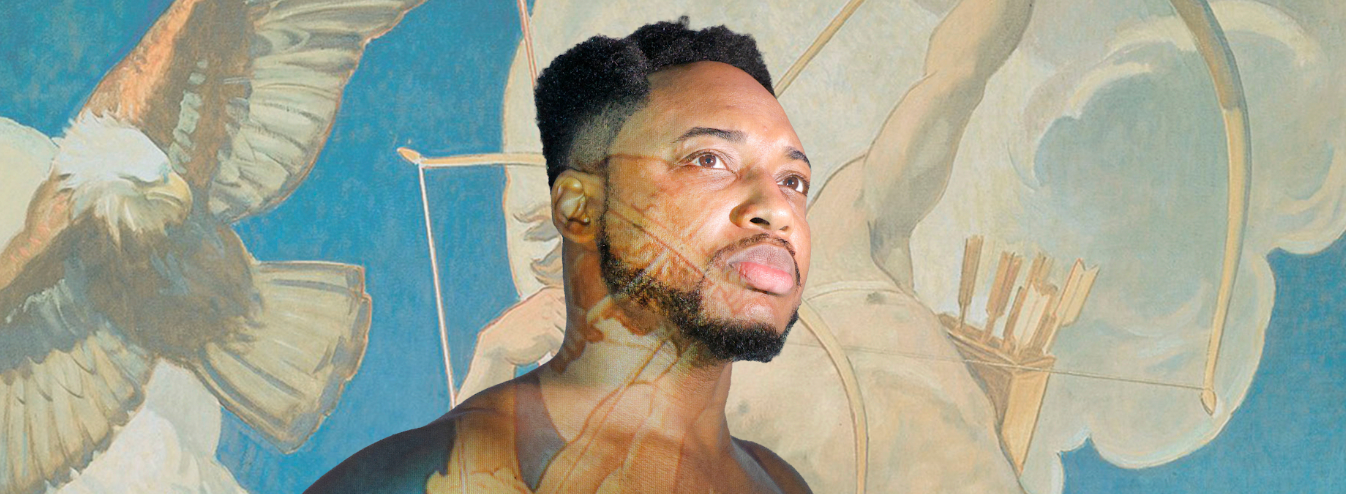
For several years in early twentieth-century Boston, a young Black man named Thomas McKeller was model and muse to the society painter John Singer Sargent. Today, McKeller’s taut physique can be seen distributed among the pantheon of neoclassical deities that adorn Sargent’s murals in public buildings around the city. His face, however, is absent, and his skin has turned white as marble. Other than a handful of letters and public records, all that survives of McKeller’s life are the images Sargent made of him, which only appeared with his name attached in a 2020 exhibit at the Isabella Stewart Gardner Museum. This show made clear for the first time how central McKeller was to Sargent’s mural work (and suggested that Sargent’s rapture towards McKeller’s body extended somewhat beyond the professional).
Visiting the exhibit, librettist Lila Palmer immediately saw a story. But there were yawning gaps in the story to fill. Sargent’s public life is far better documented than McKeller’s, but all we know of his private self is that he was a lifelong bachelor—a friend of Henry James and frenemy of Oscar Wilde—who formed close friendships with women but left no record of other attachments beyond the pictorial. In transforming this situation into the opera American Apollo, which just had its West Coast premiere as the final offering in West Edge Opera’s summer festival on Lake Merritt, Palmer and composer Damien Geter chose to make it a clandestine love story.
We know that in 1916, the 26-year-old McKeller was working as an elevator operator at the posh Hotel Vendome, and that was where the 60-year-old Sargent took notice of him and invited him to pose. West Edge’s production, directed by Nataki Garrett, makes this encounter into a seduction. McKeller, sung by baritone Markel Reed, is initially stoic and laconic in the face of Sargent’s advances, as pantingly voiced by tenor Jon Bellemer. But after the libretto supplies a blameless motivation in the form of a sick mother (and medical bills), McKeller can’t turn down the cash on offer. As a series of nude posing sessions shades into a courtship, McKeller’s vocal lines loosen and become lyrical, and he starts to return the painter’s attentions, as an equal partner.
Of course, the two are hardly on equal footing, separated by race, class and age; their idyll is shattered when Sargent’s former valet, model, and (we assume) lover, Nicola d’Inverno—sung with fire by tenor Matt Hidalgo—shows up to berate the privileged man who has cast him aside. While McKeller already knows that Sargent is using his body in ways that will erase his identity, he now sees his own future as a discarded prop; in a caustic solo passage, he lets loose his anger, both at Sargent for using him, and at himself for having believed that Sargent could ever see him as an equal. This was the moment the show became properly operatic, McKeller taking his place in a long line of spurned lovers with feelings extreme enough to overpower an orchestra, and—the evening I saw the show—it brought the house down.
_-_ritratto_di_Nicola_D%27Inverno_(1892).jpg?ref=oaklandreviewofbooks.org)
The show could have used a few more such moments. Palmer and Geter originally conceived it as a 20-minute chamber piece, and at that length, it must have worked superbly; the lines of the central situation are clear and charged. But the situation is essentially static, and doesn’t have sufficient dramatic shape for its expansion to an evening-long run time. The libretto is a matter of episodes, as is the score. Geter’s orchestral writing has an appealing lightness and clarity, something like Sargent’s own painterly style, and collects influence magpie-like as it goes. A love scene weaves in the period song “À Chloris” by Reynaldo Hahn, a onetime lover of Proust’s. Syncopation and minor leaps point to Black diasporic music. When characters start up the prop gramophone, castanet clacks evoke Sargent’s beloved flamenco. But these moments remain moments.
However few the known historical facts are, they still keep the drama from building an arc. Sargent never acknowledges McKeller publicly, and never paints his face into a mural. They are separated by World War I, then reunited. The power differential is stated and restated without resolution, and as inter-titles start to appear, showing how many years have gone by, we slip into the bagginess of a Hollywood biopic, dutifully ticking off the beats that history has given it. The last time we see the lovers together on stage, Sargent offers what is essentially a kept-man arrangement; they can meet when Sargent is in Boston, and McKeller can have the use of his rooms when he is away. But even this doesn’t quite square with the record. Sargent mostly spent his later years in London, and only sought McKeller out for modeling work when he happened to be in Boston. McKeller took a job with the post office, and after Sargent’s death wrote to the estate requesting help in paying off a loan. He received ten dollars. (Sargent’s partial fee for the murals had been $40,000).

In the opera’s last scenes, the score seems to know more than the libretto. Having exchanged what is written like a last reconciliation, McKeller and Sargent disappear together into a darkened back room, hands lovingly joined. But the orchestra is not so confident that all is not well, and whips into agitation as they go. One can imagine many reasons for this ambivalence, and one has to. Being left as open (or as closeted) as the historical record means the ending is dramatically underdescribed. The show doesn’t seem to quite know how to feel about its principal figures or the compromises they’ve made.
Whatever the shortcomings of the material, the West Edge team can be proud of this production. Reed and Bellemer make for a superb vocal pairing, and the supporting cast also comes out strong: soprano Marnie Breckenridge brings an especially nice comic timing to the role of Sargent’s patron and confidante Isabella Stewart Gardner. The young conductor Kedrick Armstrong nimbly led the orchestra through the stylistic leaps of Geter’s score, and to the good fortune of locals he’ll be back on the podium this fall as music director of the Oakland Symphony. Summer opera is over, but symphony season will kick off with an aria from Anthony Davis’s Malcolm X, together with a program of Shostakovich, Tracy Chapman and Lauryn Hill. The season’s theme is “Resist/Persist: Music of Defiance.” Take a breather and come back mad.