Introducing the Seize Piedmont Community, Art + Design Perennial
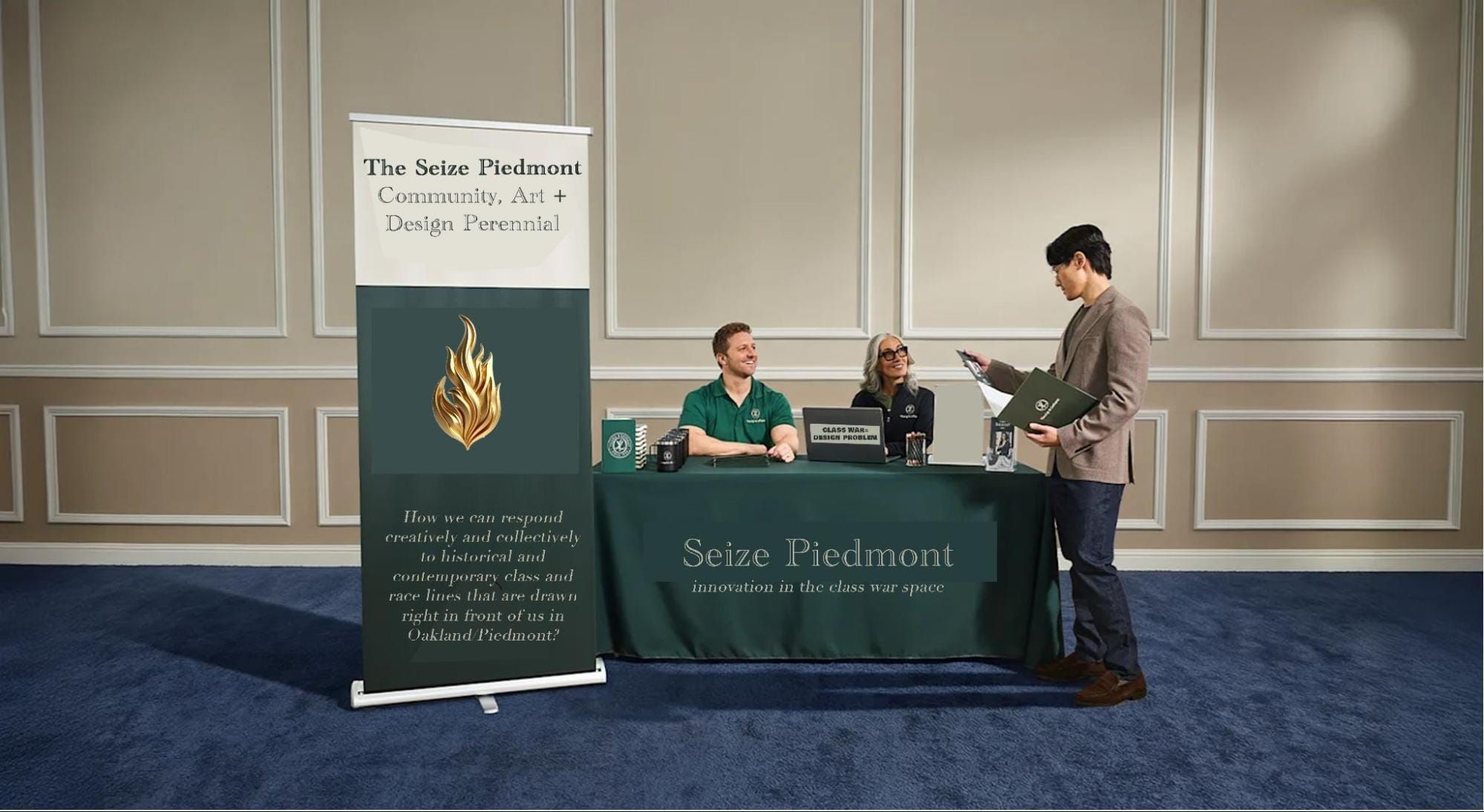
Now that the election is over, with peace, prosperity, and happiness restored across the land, forever and ever, world without end, it’s time to turn to the question that has been haunting Oakland for as long as anyone can remember: How do we seize Piedmont?
You already know why we should. Please don’t pretend that you don’t. You may not know what seizing means, of course, and maybe we don’t either. That’s the part we have to figure out together, and so, we are going to. And you should help us! But the one thing we know—once we figure out what seizing means—is that it’s the thing we have to do. It’s the next step. It’s how we get there, wherever there is. Let’s go together.
Here’s how: The Seize Piedmont Community, Art + Design Perennial, featuring…you. We are inviting proposals for creative projects that annoy, occupy, transform, invite, reveal, punish, or in some way seize Piedmont. BYOV[erb], and we will offer curatorial and production support, and also money: $500 for any proposal we accept. Ideas for written work, art interventions, bureaucratic experiments, performance, pranks, stunts, or other forms of cute and or vindictive creativity are desired.
Please send your proposals to ORB@oaklandreviewofbooks.org, and tell us things like:
- Your name, contact info, and proposal title.
- What is your idea?
- Do you want to do it or do you just want it to be done?
- What kind of effect do you want to have?
- What kind of projects do you usually do?
- Do you want help? What kind?
Basically, this is a community art and design project about the very strange fact that Piedmont is a City of Millionaires, most of them white, protected from Oakland by their own Nordstrom’s Police Force, while it is actually inside of Oakland, living off of our blood like an uncaptured Theranos. But the worst part is that a little bit of Piedmont also lives inside all of us, as long as we agree to continue living in a world divided by class and race that we will not try to stop, even though it is literally the foundation for every layer of the growing polycrisis we face.
The Seize Piedmont Community, Art + Design Perennial will be a festival of proposals put into practice, a comprehensive and neverending list of performances, interventions, experiments, research, and other forms of creative troublemaking that we’ll keep doing until Piedmont has been seized, even if we don’t know what that means yet.
We will have merch. We will make trouble. We will have fun.
And we will now take your questions.
What even is Piedmont?
We're so glad you asked. This is Piedmont:
Piedmont already is Oakland, as videos like the one above admit-without-admitting when they try to sell you on the idea of living in Piedmont by selling you on the benefits of living in Oakland. You wouldn’t know unless you know; we had to annotate to demonstrate. But because Piedmont is just a gated community—or maybe an overwrought HOA?—it needs Oakland in a deeper and more fundamental way than it can ever openly acknowledge. Anything a Piedmonter needs and spends money on will come from Oakland, including the Oaklanders who come into town to work there and be racially profiled. And what is life, if not spending money?
The key exception, of course, is taxes: Those, as the residential carveout that pretends to be a separate city is built to ensure, will go only to the children of Piedmont’s homeowners, and only the maintenance of its streets and infrastructure, and will in no sense benefit the children of the workers they hire from Oakland. That’s the Piedmont promise!
Wait, but, aren’t there tons of businesses on Piedmont Avenue?
Piedmont Avenue is in Oakland. All that stuff you’re thinking of is in Oakland. The fact that a big chunk of Oakland Avenue is in Piedmont just demonstrates the incoherence of pretending there’s a difference.
OK, but what about Mulberry’s Market? That’s an honest-to-God Piedmont business.
Yes, it is. Here is a Google Maps image of it: a security guard standing under a “Do Not Enter” sign, glaring at you.
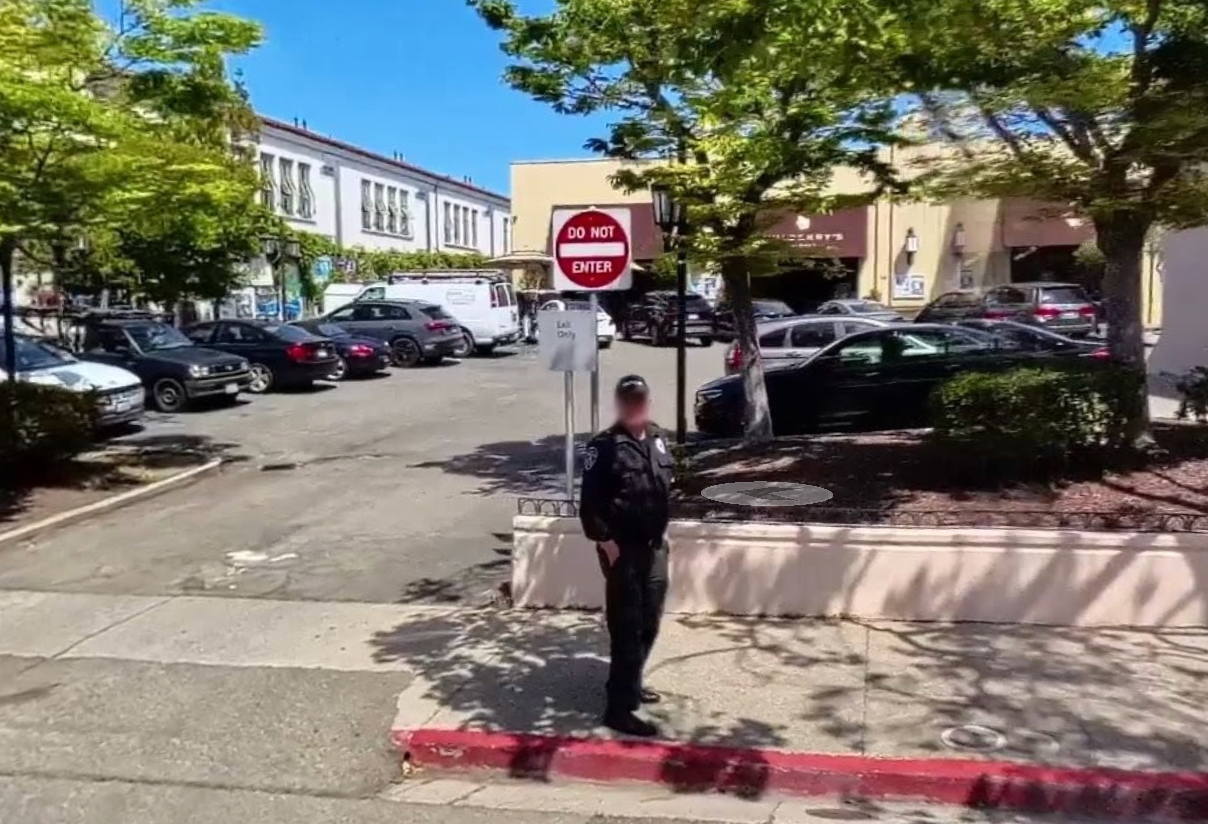
Congratulations. Piedmont has one place to buy food in. May I continue?
Please.
When Piedmont isn’t trying to pretend it somehow has all the shopping that it likes about Oakland inside it—with all the brown and Black and poor people neatly excused (as a fantasy of capital without labor)—it will occasionally sell itself by emphasizing its Oakland-phobic identity. This is another realtor video, for example, which describes Piedmont as “an exclusive small-town city in the East Bay,” a funny way of saying it’s in Oakland, which it excludes, and uses the ludicrous construction “small-town city” to glaze the difference. That video is mostly made up of empty houses, which is another way of understanding what Piedmont wants to sell you: beautiful and expensive property without any undesirable people in it.
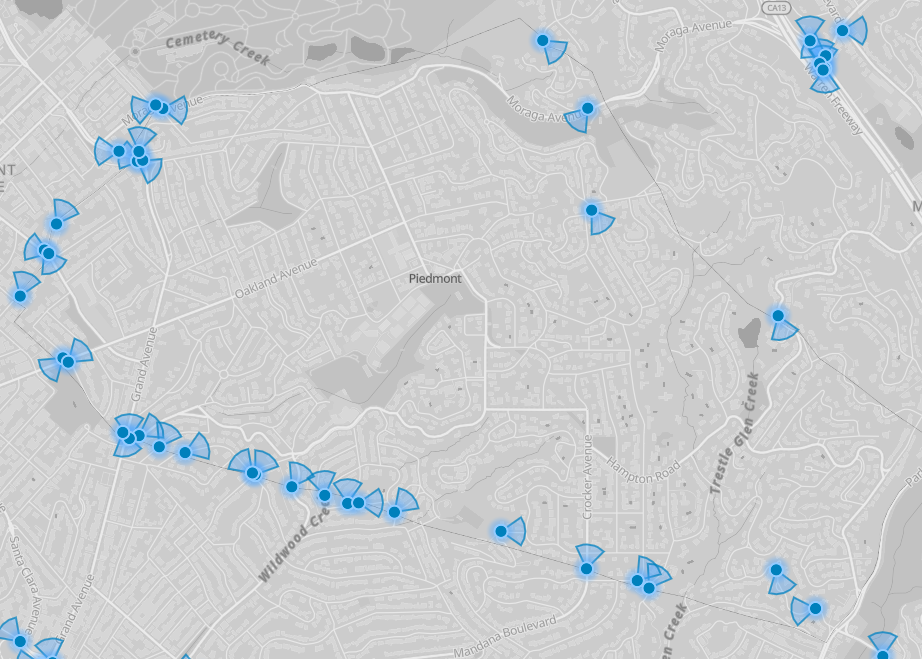
This is why, in short, you can make a map of Piedmont out of Flock cameras.
OK, but why should we seize Piedmont? Why can’t it just be its own city, if that’s what the people there want?
Well, those are two different questions, right? Why we should seize Piedmont is one, but the second presumes that it is its own city, and what we’re saying is that it really isn’t. It’s a secessionary fantasy, an ethnic enclave within a city, and a structure of exclusivity built to exclude and render unwelcome the working Oaklanders who make it possible for so-called Piedmonters to live there in comfort.
But it is a city, right? Like, it literally is a separate city from Oakland?
So the thing is this: As Oakland’s own D4 tiger of liberation explains in her rousing demand that we seize Piedmont “by whatever means necessary” (direct quote), Piedmont exists only as a distinct municipality because of antimajoritarian shenanigans that took place in 1907. Geologist Andrew Alden will tell you that the so-called Piedmont entity rests on Franciscan bedrock, but it mostly sits on a foundation of antidemocratic fraud. Even the Wikipedia page about Piedmont’s history will deceive you about what happened, because if you click that link, you will read that “Two elections were held among the citizens of Piedmont in 1907, both of which narrowly upheld the decision for Piedmont to become a city.” This is very carefully worded to obscure the truth while almost not quite being a lie (but still definitely being a lie).
What happened is that a very narrow majority of white men in what would become Piedmont voted to incorporate as a city called Piedmont in January 1907; then, another narrow (but slightly larger) majority of the white men in that area voted to annex themselves into Oakland, in March of 1907. This would seem to contradict what the Wikipedia article says, especially if you—a fool—imagine that this second vote of white men should obviously cancel out the first. Shouldn’t a democratic population be able to choose one thing and then, later, choose another thing and have the second thing stick? Shouldn’t that be how it works?
WRONG. California loves to empower a narrow majority to tie itself in the kind of knot that the powers-that-be prefer, and then to declare that another majority—even a larger majority—is not allowed to untie that knot. In this case, then, after a narrow majority of white male citizens voted for incorporation, the law in its infinite wisdom declared that it takes a supermajority of voters to undo such a vote (not just that slightly larger majority that they got a couple months later).
But here’s another twist: A mere six months later, in September of 1907, another election was held—the third vote that year, in case your arithmetic is not better than Wikipedia’s editors—and it fell a bare two votes short of the actual supermajority required. “Only” 92 white men voted for disincorporation (against the 63 that voted to stay an enclave). And so Piedmont’s borders would stay what they are.
Stop the steal, we say! Only the most lawyer-poisoned brain could look at this sequence of events and describe it as anything but a torturous contrivance for pretending not to understand what was wanted by a clear majority of even the white men who were allowed to vote in 1907 (since Californian women wouldn’t get that right until 1911). But “torturous anti-democratic contrivance” is Piedmont’s whole ethos, and so, that was it: After that sequence of three elections in 1907, Piedmont illegitimately was, and was where it would stay.
OK, but that was a long time ago, right? Who cares what happened in 1907?
Well, exactly. Why should a vote for incorporation in January of 1907 be binding on anyone, 120 years later? You can’t have it both ways. It can’t be so long ago that the technical validity of the process does remain binding, while the basic antidemocratic process doesn’t delegitimize it. Even women couldn’t vote back then!
Right, but I just mean that, at a certain point, it is what it is. It’s been that way for a long time. And if the people of Piedmont wanted to rejoin Oakland, couldn’t they just vote to do so?
Why is it their vote that counts? Why isn’t it a vote of everyone in the region? Why should the people hoarding their tax dollars behind gates and walls and Flock cameras be the only ones with a say?
But then Piedmonters wouldn’t really have any say in it. They’d be swamped by the much larger voting body of Oakland residents, who massively outnumber them.
Yes.
So?
Oh, that was a question! I’m sorry. I misunderstood. Yes, we think everyone in a region should have a say in how the region is organized. I don’t think, like, my house, or my neighborhood, should be able to just pick an arbitrary group of us and declare that now we’re our own separate city. That would be madness. But every day we pretend Piedmont is a thing, we are saying yes to that madness.
Also, ask me if the people of Piedmont want this.
I feel like you’re setting me up.
Yes, I am. The thing is, we don’t know that the people of Piedmont even want this, exactly. They want some aspects of it, sure; they want good schools, well-maintained streets, safety, all that stuff that literally everyone in Oakland will tell you they also want. The difference is that the people of Piedmont have somehow come to believe those are all things they can have only through racial exclusion and class-based geographical hierarchy. “Of course the people of Piedmont don’t want to be a part of Oakland! Oakland is terrible!” is a thing people say, and like, first of all, fuck off, and second of all: They are already a part of Oakland. That’s our whole point. They just get to pick and choose how they are in Oakland, while denying Oaklanders any say in how they are a part of Piedmont.
A few years ago, Devon Magliozzi wrote a fantastic dissertation at Stanford about how people in Piedmont “invoke the language of security to justify their suburb’s exclusivity,” and a thing that’s fascinating about her research is that, because Piedmont is actually a very Democratic-voting progressive-values espousing community of white people, a lot of them don’t like to think of themselves as living in a racial enclave of class privilege and exclusion. The thing they like about where they are, in fact—because they could easily move to Walnut Creek, or whatever—is exactly that they get to be close to Oakland, while keeping Oakland at arm’s length. “They claim affinity with the surrounding city of Oakland to recuperate cultural capital threatened by their suburb’s homogeneity,” as she puts it; that’s why the appeal to live in Piedmont features access to Oakland so heavily. Oakland is the draw!
But to go back to the thing I said a minute ago: Piedmont is the proposition that you can only have the things all people want—stuff like safety and good schools and nice public spaces—as a condition of exclusion, and that poor and non-white people are the problem to be solved, and kept out. The shittiest thing about it, too, is that a lot of Oaklanders have been convinced to think that way too! We have to cancel the Piedmont in our own hearts.
Aren’t you kind of picking on one town, rather than the structural cause? Like, why seize Piedmont and not Montclair? Why not focus on the real suburbs, over the hill, where all of the OPD officers live?
Yes. I mean, Piedmont is a great illustration of the general principle. You can stand on a sidewalk in Oakland and look across the street at a city of millionaires and racial exclusion who benefit from the culture of Oakland but who refuse to contribute to the survival of the municipality or its people. You can see it!
And to defend the status quo explicitly forces people to say it, explicitly. It forces them to look clearly at the fact that Oakland—whose schools barely escape bankruptcy—has the kind of working-class culture Piedmont wants and needs, as long as the people who produce it know they aren’t to drive in Piedmont at night. Piedmont is only livable through its access to Oakland. Meanwhile Piedmont pays for its own separate schools and police with no interest in preserving the livelihood of the people in Oakland.
Basically, our point is that Piedmont is a great example of class war. It is not worse than the tech oligarchs or anyone else who is poisoned by wealth but it is right inside of Oakland, so why not start there?
But isn’t Piedmont’s budget pretty small? Like, it’s got no retail, so there isn’t a lot of sales tax coming in, and the population is really small, so there isn’t a ton of property tax, either, even if the houses are expensive. It’s not like adding Piedmont to Oakland would suddenly fix Oakland’s budget.
Yes, but that’s the sort of thing that putting Piedmont in Oakland could allow us to fix. Piedmont is a very un-dense part of the East Bay, because it’s these giant houses with only a few people living in them, and lots of space in between them. Piedmont likes to keep it that way, but let us be YIMBYs for a moment, and imagine if they weren’t allowed to keep the place so sparsely populated. It’s also their own fault they have basically no commercial retail. The reason they struggle to balance their budget is they’ve starved their own revenue stream to maintain the exclusivity they want (after lavishly funding their own services).
Another thing is that Piedmont sets its own Real Property Transfer Tax rate very low, compared to Oakland’s, so that it can ensure that new and old residents keep as much as possible of their property value untaxed. What that means is that if this $22,500,000 property were sold in Oakland, the city would get about $562,500. But since it’s sold in Piedmont, the transfer tax will be less than $300k (and, obviously, go to Piedmont schools, not Oakland’s). There are lots of things like that, where it’s both how the revenue is kept within the enclave, and also how the needs of the wealthy residents dictate the shape of the budget in the first place.
Wow, so this is all incredibly persuasive and, honestly, kudos to you on utterly convincing me of the deep and howling void of illegitimacy that “Piedmont,” so-called, represents. But what should we do about it? What can be done about it?
We have to not only cancel and annex and seize Piedmont, we have to kill the Piedmont in our hearts. Piedmont isn’t a municipality, it’s a state of mind. To truly make Piedmont inclusive, residents would have to renounce the idea that they are entitled, by virtue of wealth, to better public services and amenities than their counterparts in Oakland. They would have to replace their past, not turn it into monuments. They would need to welcome people to use services and facilities in the suburb regardless of their place of residence; they would need to redistribute tax revenue and tax-exempt donations to create more equal services across the metropolitan region; and they would need to change how policing is organized, so it is guided not by local constituents’ interests but by a broader notion of the public good. To make Piedmont inclusive, residents can’t stop at persuading a wider array of people to buy houses there. Piedmonters would need to tear down the magic gates, throw open the one-way border, and give up their Nordstrom’s police department. They would need to expand their definition of “the public” so all people, not just tax-paying residents, are welcome in the suburb’s public life and invited to share its public goods.
It feels sort of aggressive, though? Like you’re blaming Piedmont and the people who live there for stuff that’s much bigger and more structural than just them and there.
Well, sort of. But we’re interested in Piedmont as a social, political and spatial phenomenon, rather than in imagining that every person who lives there is individually responsible for everything that has happened there. And we don’t want to spend the entire project yelling at people behind their hedges or fighting with (paying fees to) the Nordstrom’s Police Force. We want to understand and intervene in how wealth reproduces itself through ordinary things: land, schools, zoning, municipal boundaries, infrastructure, property values, policing, taxation, and ideas about who belongs where. Then we want to see what artists and organizers can do with that information.
Why should we focus on this when there are so many other real emergencies taking place right now?
We shouldn’t. We don’t think of this as an alternative to responding to other emergencies.
There is always a bigger emergency. A war, climate disaster, housing crisis, fascist government, collapsing health care system, genocide, a rigged election, another thing that demands our immediate attention. The problem is that emergency can become a way of organizing our entire political imagination and our lives. We become very good at responding to disasters and very bad at asking why the same people keep ending up with the resources to survive them.
Seize Piedmont starts somewhere we usually might overlook: a municipal boundary, a few square miles of land, a particular history of property and exclusion. The ways wealth, race, land, infrastructure, and political power are organized here are not separate from the larger crises. They are some of the mechanisms through which people experience those crises differently.
Who has a house when the economy collapses? Who has a garden when food prices rise? Who can leave when a disaster comes? Whose neighborhood gets protected? Who has access to good schools, clean air, shade, transportation, health care, and political influence? And who is asked to survive without them?
What does art have to do with any of this?
In a time and place where activism is treated like terrorism, we need different ways of addressing the deep social issues we face. There are so many frightening things happening that many of us feel immobilized. What if we used art to approach things that seem impossible or scary with curiosity, naivety, absurdity, and play? Some things about Piedmont are “real,” and others are fiction. Perhaps art can help us unimagine the things we’ve come to accept as normal—like organizing space around racial and class exclusion—and stop treating them as inevitable or eternal. There are a million other ways things could be. That’s the domain of art.
All right, fine. But why design, too?
Because apparently everything is a design problem now. Burnout is a design problem. Loneliness is a design problem. Your inability to afford a house is probably a design problem. Somehow even eating the rich has become a design thinking challenge.
So we’re going to take that seriously. If class inequality is a design problem, what would you design? A new municipal boundary? A public swimming pool? A new form of self governance? A wealth redistribution machine? A bus route? A neighborhood ritual? A very inconvenient statue? A system for moving resources across the Piedmont border? A way of making private wealth publicly visible? We don’t know. That’s partly what the project is for.
Why call it a “Perennial”?
A perennial comes back just like intergenerational wealth and racial segregation in our society. The Perennial is an annual or potentially a perennial occasion for collective imagination around the class and racial geography of the East Bay.
Is this a protest? It sounds like a protest.
It can be. But it doesn’t have to look like one. We are interested in the space between protest, performance, organizing, public pedagogy, prank, ritual, infrastructure, and collective fantasy. A good proposal might be beautiful. It might be ridiculous. It might be extremely practical. Ideally, it will be difficult to tell which.
I’m interested, but I’m not sure I’m right for this sort of thing. Who can participate?
Artists, organizers, designers, students, neighbors, teachers, gardeners, weirdos, people with municipal grievances, people who have been priced out, people who have inherited a house, people who have never understood why Piedmont is a separate city, and people who have very strong opinions about what should happen to a particular piece of land. You don’t need to be an artist or an activist.
What makes a good proposal?
We’re not looking for proposals that simply say, “Piedmont is bad.” We’re interested in proposals that make us think: That’s weird. Could we actually do that?
A proposal might expose something hidden, redistribute something, create a new public ritual, interrupt an existing system, produce a new piece of infrastructure, invite people across a boundary, transform a relationship to land, or simply make an absurdly obvious fact impossible to ignore. The proposal should have some relationship to the actual place. And it should make something happen.
So what happens if my proposal is accepted?
This is a “community” art project, not a venture capital accelerator. You’ll get your $500. But there will be no Series A funding round for your revolutionary municipal sidewalk intervention. The goal is to develop proposals collectively and create pathways for some of them to become part of the Perennial. But we also want to leave room for proposals to become something else: an organizing project, a public conversation, a new relationship, a failed experiment, a piece of art, or a genuinely useful idea that nobody had before.
\O/
Send your proposals to ORB@oaklandreviewofbooks.org