When Juliana Spahr reads
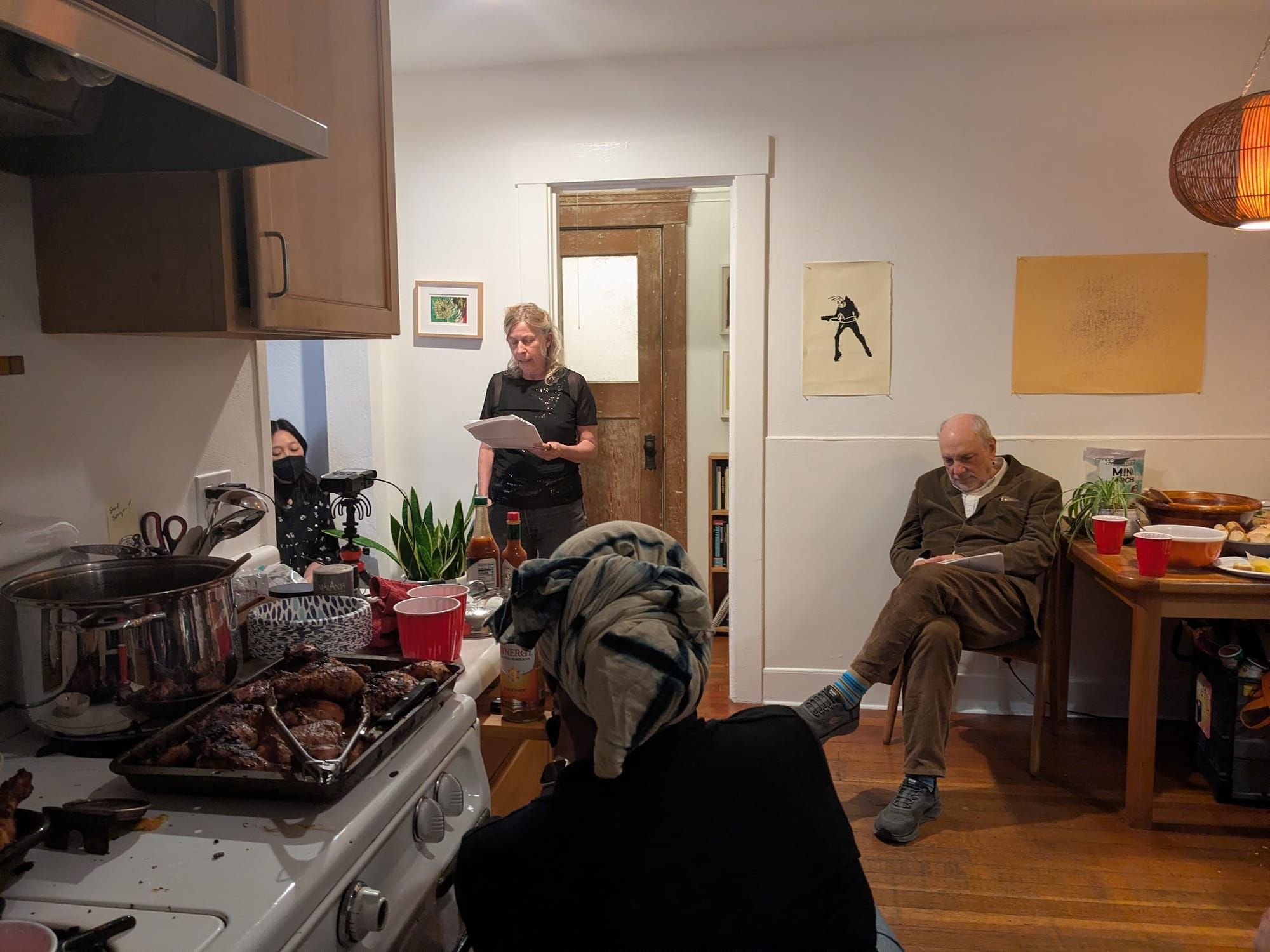
Juliana Spahr looks miserable when she isn’t performing but when she starts reading, I know I don’t want to be anywhere else.
We’re in David Buuck’s kitchen, and he didn’t know me when I walked in the door, but a friend of a friend of a friend had passed along that Charles Bernstein and Juliana Spahr were reading there and passed along the Berkeley address, and now I’m here, listening. The living room looks like a gallery and the kitchen looks like a galley, bottles stacked up six deep on the kitchen counter. People are stacked up too, and I spill out to the back deck to chat with a San Francisco State student who is working at the Poetry Center and having a cigarette and a writer from Alameda who gives me his zine. Juliana’s only making eye contact with the exits, and definitely doesn’t care to make small talk with fans. Some poets like parties and others don’t want to be in a crowd of chatty acquaintances. That’s why they put words down on the page, to avoid the talkers. Readings are their endurance events. Unfortunately for them, with writers whose words fit inside me like a missing bone, I begin to alert, to perk to them. I follow them around, drinking by ear everything they see fit to deliver. I can’t get enough. However great on the page, it’s the voice ringing and wringing and bringing us all together I’m after—please sir, can I have another?
David tells us where the bathroom is and launches the poetry part of the night. Juliana starts to read, and any misery left hanging around is thrown out of the room. I can’t remember exactly when or why I bought Juliana Spahr’s 2015 collection That Winter the Wolf Came. I didn’t know her work at all then, but I thought the cover was divine, it’s a gorgeous book from Commune Editions (RIP), printed by McNaughton & Gunn (RIP), and eventually I read it, and it was fine, good; I liked it, I kept the book. A decade passed. In fall 2025, I read her “Ars Poetica: Scotch Broom” and it takes on some similar themes, similar forms even, but every second of that ten years I didn't know I was waiting was worth it for a magnificent poem that builds an argument for poetry out of its own doubts, as well as from student protests and the Jepsen Manual: Vascular Plants of California and being poets together in the world. A poem made of some prose pieces and a nice tight eleven-syllable line set in couplets, each line just long enough for a breath. Just meant to be heard aloud.
A couple days later, some months before the reading in Buuck’s kitchen, I listened to her read “Ars Poetica: Scotch Broom,” sitting with a friend in the soft arm chairs of the Morrison Library and knowing a few other people in the full room, and we were all held, breathing together, by the lattice of the poem, by the rhythm and the build. I took A’s signed copy of the whole collection of Ars Poeticas home and read it straight through, and then read it again with a pencil to talk with the book, so it could teach me its ways. I have not given it back; he’s out of luck.
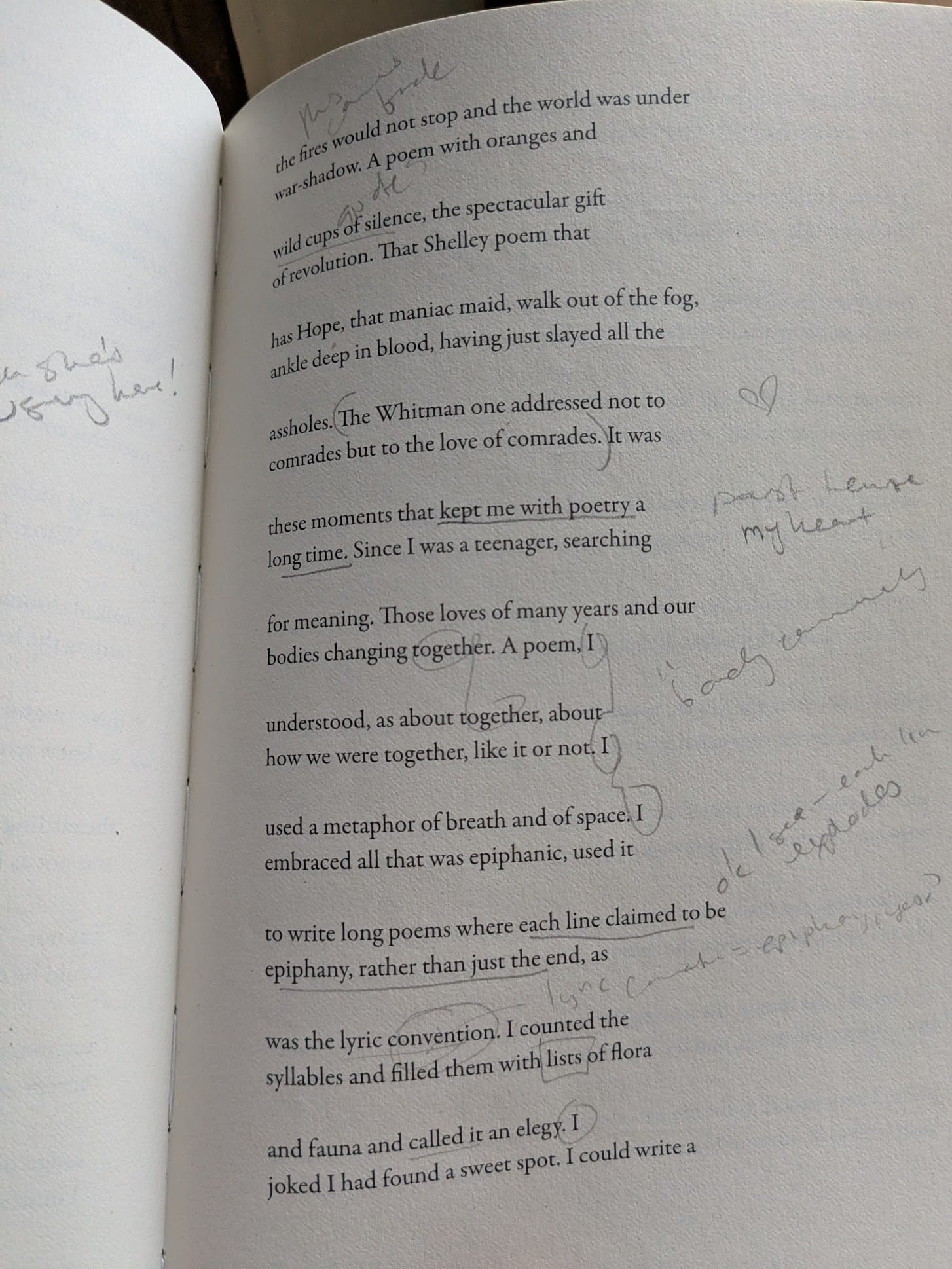
Juliana Spahr was Charles Bernstein’s student at SUNY Buffalo—the Berkeley of the East Coast, you might say, particularly when it comes to conceptual poetry. She wrote about Berkeley LANGUAGE poet Lyn Hejinian’s work in her book Everybody's Autonomy: Connective Reading and Collective Identity, and about Oakland poet Gertrude Stein too. And I wasn’t even trying to follow her around when I bought the City Lights edition of Tender Buttons and found Spahr lurking in the afterword, telling me, “it hangs fire in fragments” and that “It is hard to imagine Language writing happening without its influence.” She lives here now, teaches at Mills.
OK, so I’ve gotten you situated, right? We’re haunted by Lyn and Gertrude, David is hosting, Charles “Attack of the Difficult Poem” Bernstein mentored her, and we’re all of us in bed with poetry that swerves away from the saxophone of expressive lyric and deep into irony and theory.
And yet. Ars Poeticas is a book that took a long time to build because it’s clearly a reckoning with herself, with her practice, with camps of poetry she’s found comrades inside. And yet. She’s so funny. She’s earnest and wry, she’s poking fun at the Berkeley farmers market, she is using “terrible” over and over in a poem that looks at fascism and climate change and baseball fields, which of course makes me think of Yeats’s “Easter 1916” refrain, “A terrible beauty is born,” which is to say there is political violence and it is necessary. I love the craft of this long poem, the care, and Spahr’s use of refrain without it being a strict chorus. In this book, she gives us morphing, shifting anchors, a ritualistic form to hold us in a deeply felt anguish over loss of purpose with a demand that we find it again to serve the greater world, the more-than-human world, and ourselves within it.
Plus, a callback is the best way to get an audience on your side. Comics and poets know what they're doing.
So I am all in on Spahr by the time I get to David’s house, after walking for seven hours in East Oakland with friends earlier that day (trying to become creek people, one watershed at a time), and also after weighing whether to stay east and try out a blues jam or to go north and hear poems. Inevitably, I chose bougie and got wine and crab and a spicy po’ boy for $100 of indulgence at Snail Bar before heading to David’s lovely Berkeley bungalow to hear a couple tenured radicals get poetic in the kitchen. House readings are an East Bay word-of-mouth thing that have been going on a while but I just heard about them. The opposite of an open mic, another key local poetic tradition. I like both.
David says, when I meet him inside his house, that he’s hosted over a hundred readings over the years. The week before, I went to Woolsey Heights, another longstanding reading in a living room. Kind of fun to be on the inside, kind of weird to show up uninvited to a house. Luckily for my particular social awkwardness, it's getting to be that when I get to a poetry reading, I know a few people, at least to wave hi to so I am not feeling like a total interloper. I appreciate the blur of public and private, the tertulia of it all. What’s better than turning to your friends and saying, Let’s put on a show?
“There’s food,” says Susan Bee, and, “This isn’t my thing.” She says that a few times, but she’s the one standing at the door, greeting people, and she’s the one who invited the guy who invited me. I eat some salad, to balance the seafood feast from earlier, grab a red solo cup and fill it with wine, in fine poetic tradition.
Charles and Juliana have never read together before, despite all the decades of poeting in the same camp! What a lucky evening. My legs are aching from the long walk down through the heights and the flats, and I’m braced against a kitchen window trying not to step in a dog’s water bowl, and feeling so, so lucky it’s eight on a Saturday night and fresh poems are being served and I am here, listening.
Juliana’s new poem—“AI says it should take about twenty minutes to read,” she tells us—is about a class she’s still in the middle of teaching, “Creative Writing in the Age of AI,” and it’s so funny because this fucking world we live in is ridiculous. It’s confessional, not à la Plath but à la Bartleby. A confessional in the form of a narrative about the exhausting attempt to try to stay curious about ChatGPT as a writing tool. Certainly we can play with technology; it won’t run roughshod over us if we’re careful! We know better. We can play the machine and it won’t play us.
But the professor who is the subject in the poem (who may or may not be the person reading the poem who tells me later she has not yet finished teaching the class that’s in the poem), eventually gets defeated by the purposelessness of grading AI-created work and then asks AI to grade the work and then feels ashamed and disgusted, but also keeps asking the AI about her teenage son, will he be OK, tell me he’ll be OK. The bot suggests they seek professional help, and meanwhile she keeps using it to make cat-octopus art for her powerpoint slides and to research nudibranchs. Juliana doesn’t look up from her printout once.
I took some videos, transcribed some passages.
When she had written the assignment up for her slide deck, she had added at the bottom of the slide deck: make me cry or surprised or delighted....She had started reading the work she’d turned in and responding on her own without AI, but quickly she began to suspect that the students had used AI both for the chatbot and for the questions they were supposed to ask the chat bot. She was not crying, surprising, or delighting, and this annoyed her....
She was fine with the plot of the story, she liked it even; however, the way she taught had become so deterministic, and this embarrassed her. In the past she would never have told students to pick one of five possible plots. She’d said over and over she was a poet because she hated plot.....After she prepared what she thought she might want the class to do, she had to test it out….This process took hours. She had to do the assignments without AI and then do them with AI in several different ways so she could understand that the assignment could be done by AI in some ways she didn’t yet understand. She started writing her man-in-a-hole story. She began by asking the AI about the various points of view that might work for her story and then decided to use second person. As the AI put it, second person implicates the reader, occupies the character’s body and choices. It’s associated with interiority, dream logic, dissociation, and also with depression, because depressed people narrate their own lives in second person, as if watching themselves from a distance that is also somehow too close. It’s also the hardest to sustain at length without it feeling like a trick, the AI told her.
She and the AI were not friends, and were not conversing. Instead she typed some more. You are going for a walk with your son to see some tide pools. It will be early in the morning and the tide will be out. Right after you say to him that you hope to see a nudibranch, you will look down, and there in a pool just about as wide as his body, there will be a sea hare. A sea hare is not a nudibranch. It is much bigger than a nudibranch. You will have asked for one thing, and the tide pool algorithm will give you another, but you will be grateful for the sea hare anyways.
What’s important to know is that she reads in the kitchen for twenty minutes, just as the AI predicted, but she could have gone longer, and as long as my protesting thighs didn’t collapse me into the dog’s water bowl, I would have stayed there. When Juliana Spahr is reading, I don’t want to be anywhere else. She’s looping, nailing one piece to another. A sea hare becomes a mother’s anxiety, becomes a story she is telling the AI, the AI making nudibranch art for her class teaching creative writing in the age of AI. The loops get wider and then tighten up; there are mini repetitions inside the bigger spools (of the word “shell,” of sentences all starting with “she,” of a discussion of the narrative possibilities of the second person and later a story within a story told in the second person, of the ridiculously named tiny bright slugs we call “nudibranch,” of the word “hole,” the word “pool,” of a son who might not be well and his mother who is having a hard time watching him wander off on the slippery rocks—what if the tide comes in, what then).
Bernstein reads and he’s funny too. He’s got his poems on cards and he shuffles them into random order. “Feather Duster,” he announces, is a very sad poem, but it’s short. “Had a feather duster, found it in my stew, and every time I eat my pie, it reminds me of you.” Doggerel when you do it on purpose is highbrow, seems like. “These hot days no longer end in cool nights. It’s not the heat, it’s the humiliation.” Once you’ve set that tone, you can sneak earnestness in and it catches us off guard, and suddenly we’re sucking back snot and tears because he loves his father and he loves his children, and that’s all true, as true as the anticapitalist labor poems and silly language play pieces too.
I am not the last to leave the party, uncharacteristically. I am so tired. My feet especially are so tired, and I send videos of Spahr’s poem that I recorded to my friend C, whose art history students were asked to sit under a tree and write about it for a college assignment and then submitted a tree they found on Google Images and AI-generated journal entries. Sit under a tree, dammit. Express an experience in time that only you and your body had. That morning, C and A and I walked downhill for miles and listened to the wind in the eucalyptus, listened to the water in the pipes, puzzled together about consciousness and Buddhist practice, noticed invasive sorrels and rusting infrastructure, asked questions of strangers about collapsed creek dams and then hopped rock to rock, thinking with our feet as they found their way under twining ivy, and at one point, pounded a broken piano dumped at the creek bank with rocks and sticks to feel and hear the tones and how they vibrated back into our bodies. Be in your body, make poems from the love you feel and from the fear. Be in your body. Don’t be anywhere else.
I went home early from the poetry party. I lay down. I was happy. Juliana Spahr won the Pulitzer Prize on Monday for Ars Poeticas. I hope she’s crying, surprising, delighting.