We drive a few minutes over to International and park. Walking from the car, my younger kid says that something here smells bad; my ten-year-old wisely says that it's probably because of racism.
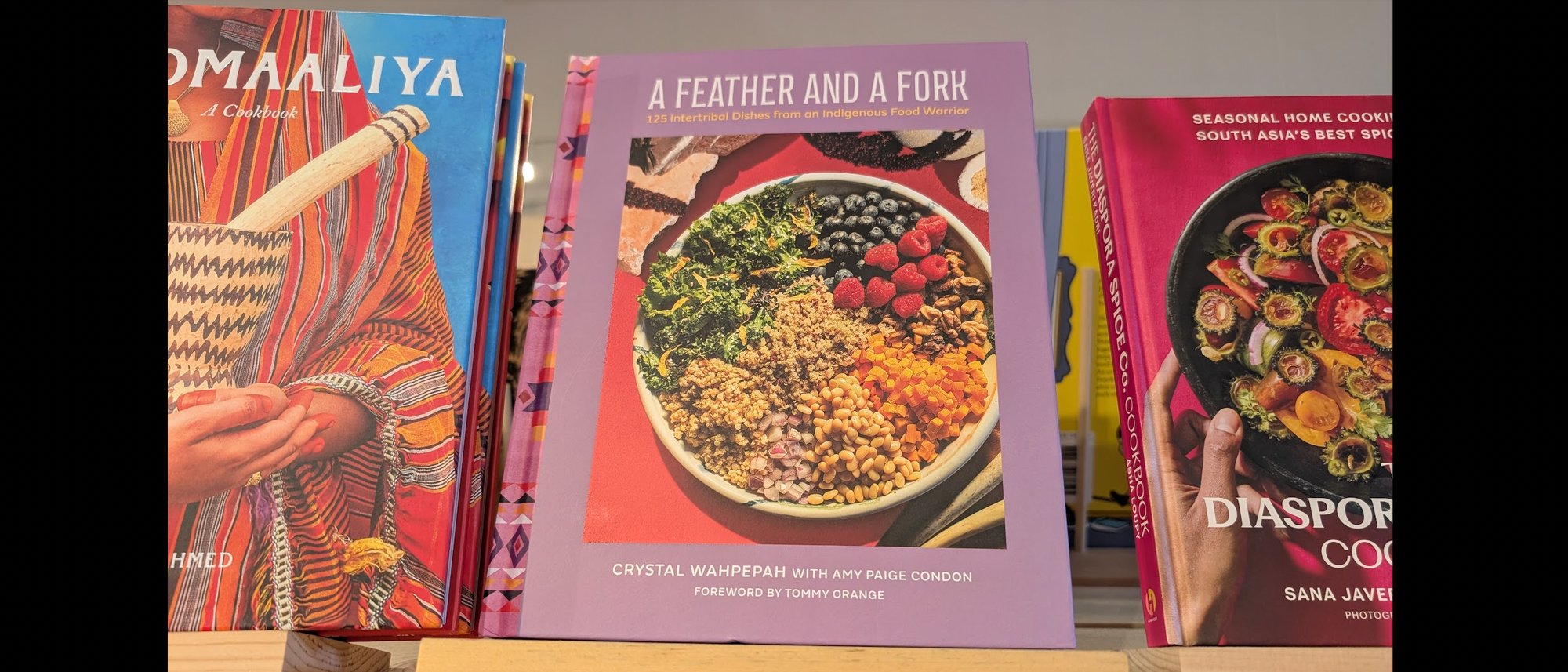
We’re heading to the Intertribal Friendship House (IFH), where Crystal Wahpepah (Kickapoo and Sac & Fox) is holding the book launch for her debut cookbook of intertribal foods, A Feather and a Fork. But first, she feeds everyone. Bison stew, cornbread, taquitos, and more. It’s a feast, with more than enough for everyone, and the room is full. A line starts in the dining area, continues to the book purchasing table the next room over, and doubles back to the serving tables. Everyone who hasn’t already sat to eat is waiting their turn in the hall, taking time to read the profiles of elders who helped create this space for the community of Natives who came to Oakland under the federal “Relocation” policy of the mid twentieth century. That drive toward assimilation reenacted immigrants’ own trauma of displacement and cultural loss by incentivizing Native people to leave their kinship networks on reservations and move to cities with a one way bus pass and fifty bucks. It was aligned with simultaneous federal efforts to terminate tribal collective ownership of reservations and reduce tribal sovereignty. The promised work never materialized, you’ll be shocked to hear, and community had to be rebuilt from scratch, across tribal, linguistic, ethnic boundaries, leading to the establishment of the pan-Indianism that flowered into the Red Power movement and the occupation of Alcatraz.
Oakland was one of the main places the BIA sent people to get lost; the IFH was set up to help people get found again.
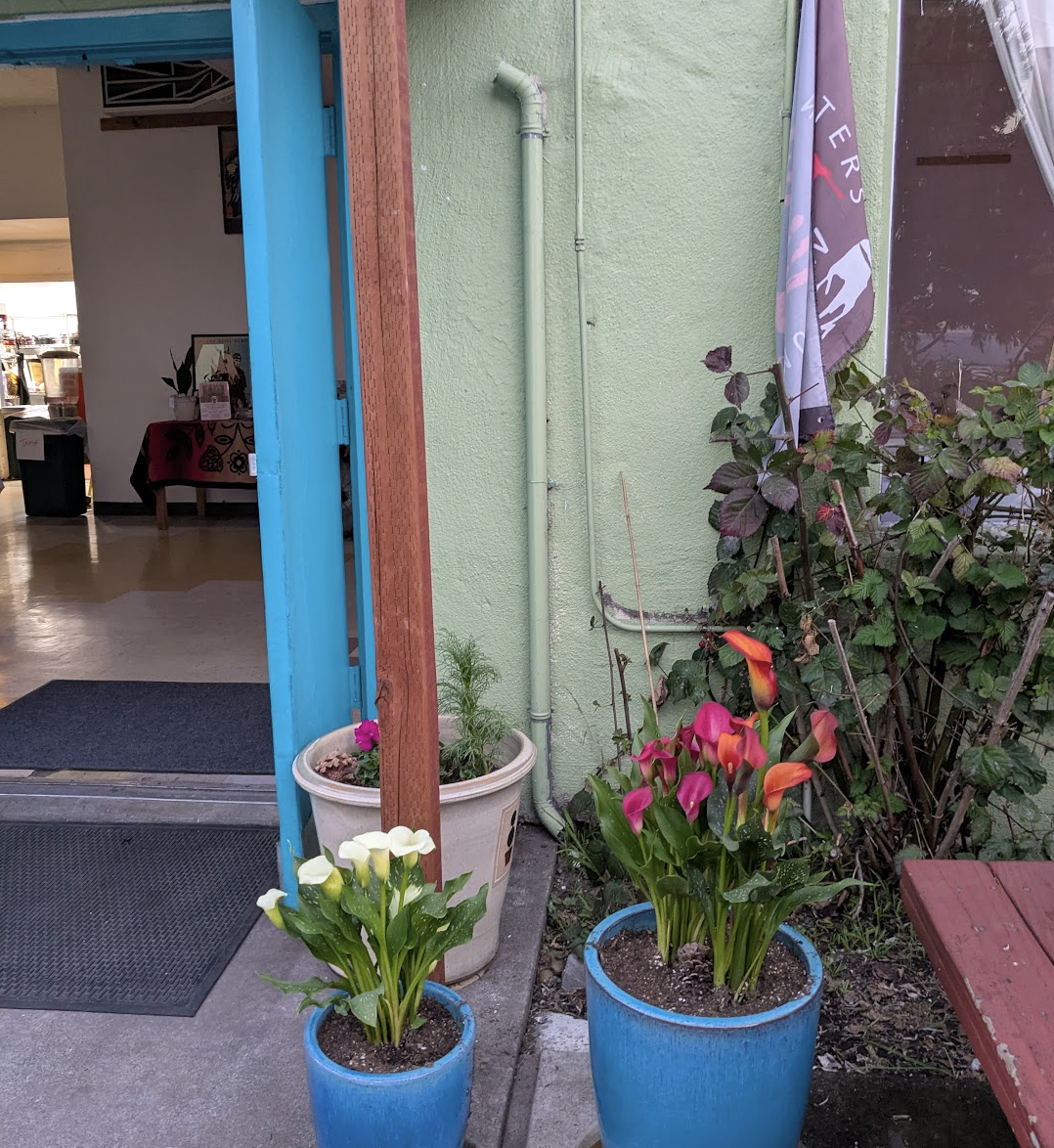
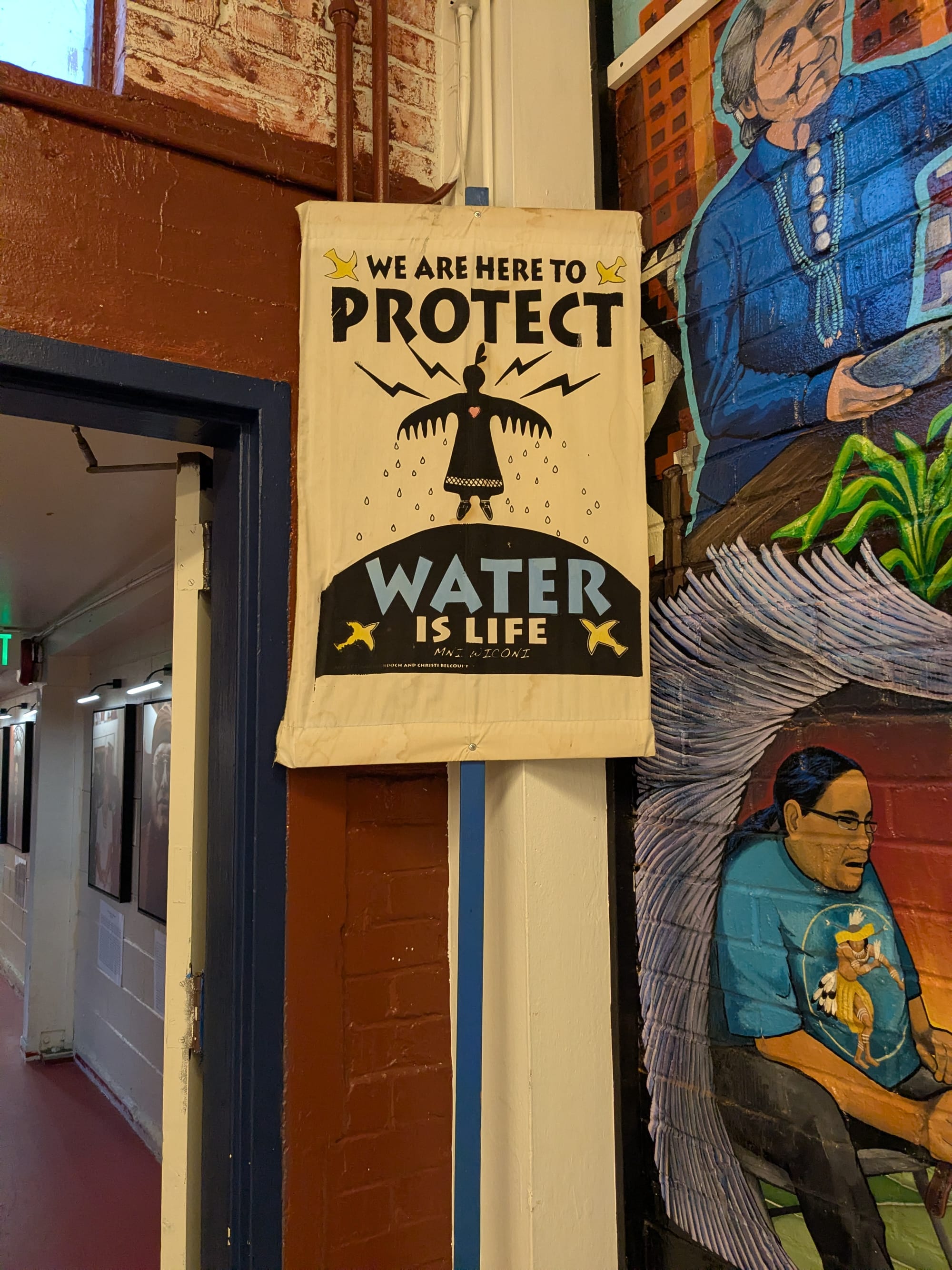
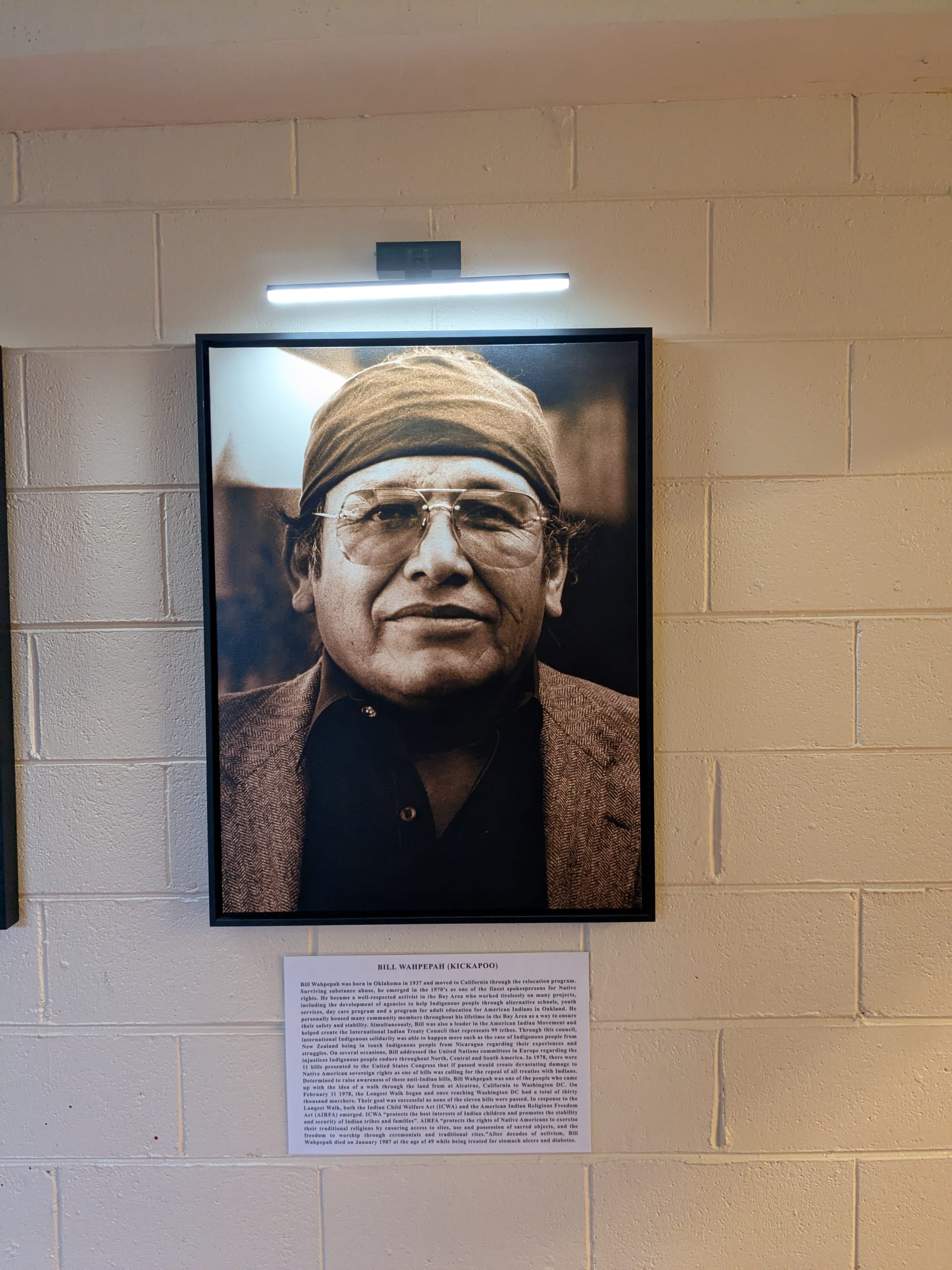
The heat dome is cresting; it’s warm even though it's the evening, so I set up my kids on the cement patio with bags of books and strict orders to stay put. I fed them on bagels before rolling down from my neighborhood on the other side of Park Boulevard. But they like cornbread too, so I head inside to check out the food – this is a cookbook party after all. My colleague Terria Smith (Torres Martinez Desert Cahuilla) is here and keeps a loose eye on the kids while I stand in line. Ribbon skirts and beaded earrings and singing necklaces and jeans and a Padres t-shirt and whatever else you want to show up in are all in line with me.
On the other side of the line, the side that lined up much, much earlier than me, are Lauren and Willow, who beckon me to cut in and join them. And my daughter, bored outside and playing fast and loose with the rules, runs up to stand with me too. We spot Sara Calvosa Olson (Karuk), food sovereignty advocate and author of Chimi Nu’am: Native California Foodways for the Contemporary Kitchen, glowing in the heat. She’s been chatting with her soul sister Morning Star Gali (Ajumawi Band of the Pit River Tribe) all evening and didn’t get in line until too late. She joins our cluster. Now we are five, and getting very close to the food. I met Lauren at the Rural Justice Summit, and Lauren met Sara last year at a Heyday event I hosted at Local Economy, and Willow and I discover other people in common too. This layering of tightly knotted foci of care, on top of the density of the city, is a tool for wayfinding.
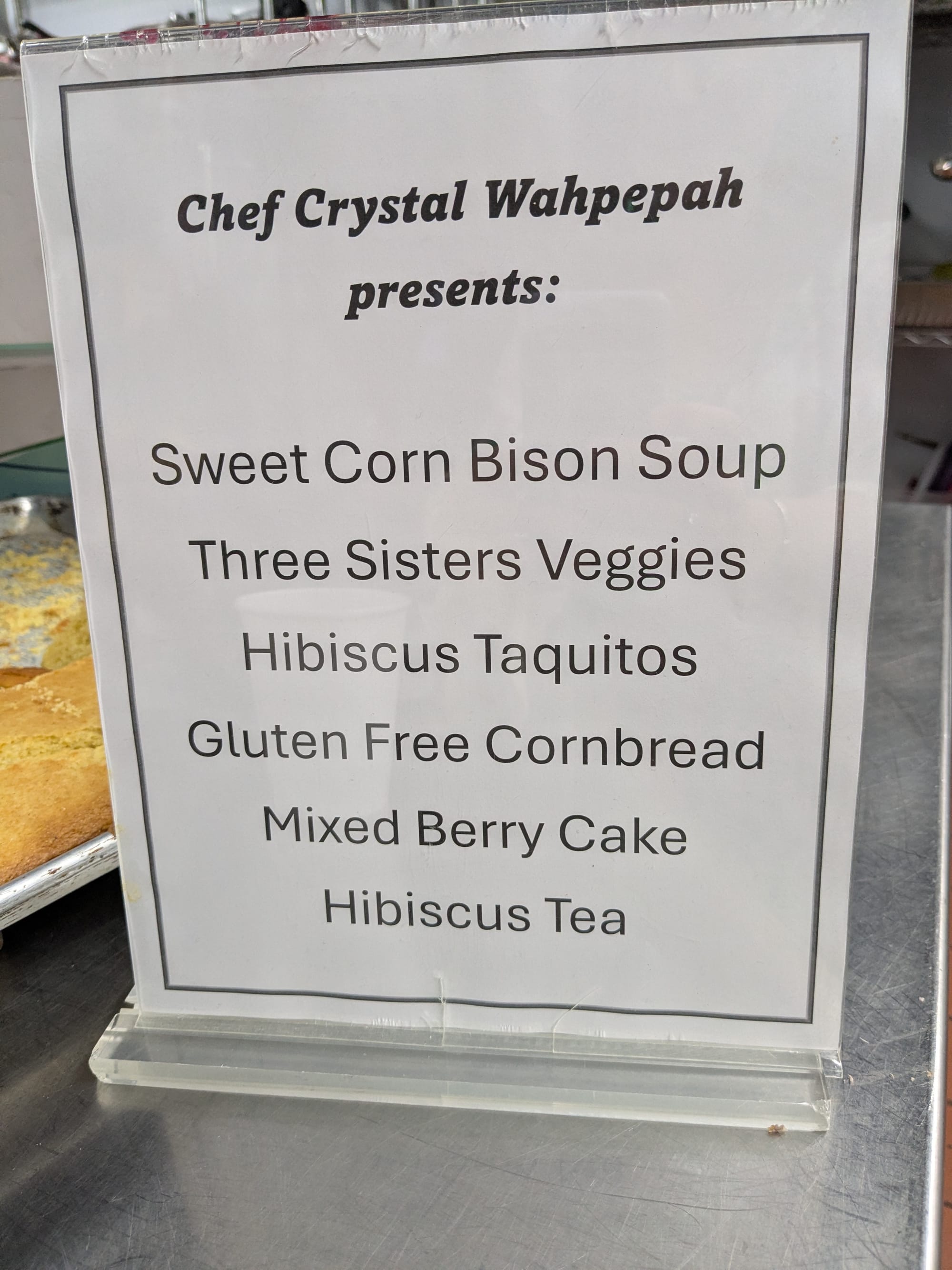
The food made by the people from Wahpepah’s Kitchen is rich and satisfying and generous; my children sit outside, nibble on the cornbread, eye the other children. I eat everything. Terria and I talk about her work, and what this news could be that’s humming about Cesar Chavez amid a series of celebration cancellations.
(The next day the full story lands and we’re both gutted, remembering all the men who have looked at us and seen opportunity, and all the silences women have held. My dad introduced us, and he took us to his funeral, Terria says. I didn’t know. That’s how secrets work, I say).
Terria hasn’t been to Intertribal Friendship House in a while, and echoes my kids: “Man, I didn’t remember how rough this neighborhood was,” with particular sadness about the women who walk the corners of this corridor wearing mostly fishnet body stockings and stilettos. I duck back inside to get the kids more water; the room is nearly emptied out. Is it over? I ask Lauren and Willow, who shrug, unsure. They might have to go. I thought there was supposed to be a talk? Wasn’t Tommy Orange (Cheyenne and Arapaho Tribes) supposed to be here? Has anyone seen him? OK, turns out it’s happening right now, all the people have moved into the next room!
Lorena Rivera (Confederated Tribes of Grand Ronde) the Executive Director of IFH, opens the talking part of the evening—the big room is full to bursting, every seat taken and folks standing in the back. I perch with my six-year-old on a storage box in the hallway, certain we’ll need to make a quick escape all too soon because the children are tolerant of Mama’s events, but have their limits. From the audience, “I love you Lorena!" Lorena to all the people: “I love you!" She introduces Crystal’s middle daughter who says, “I don't know how she does it: running a restaurant, catering, writing a book. I'm so inspired by my mom,” and begins to cry, overwhelmed. “It's just a beautiful book, I can't wait to share it with the world.”
Then Crystal invites her family up to sing an honor song. The whole family: cousins and more. A little girl about my daughter’s age with a long blond braid and a pink Hello Kitty shirt sits on her mom's hip and in her arms with her fingers in her ears as her relatives start to drum and sing. As the song continues, loud and rhythmic, she takes her fingers down, listens. As they end, Crystal’s nephews shake the last vibrations out of the hand-held drums and into our flesh and bones.
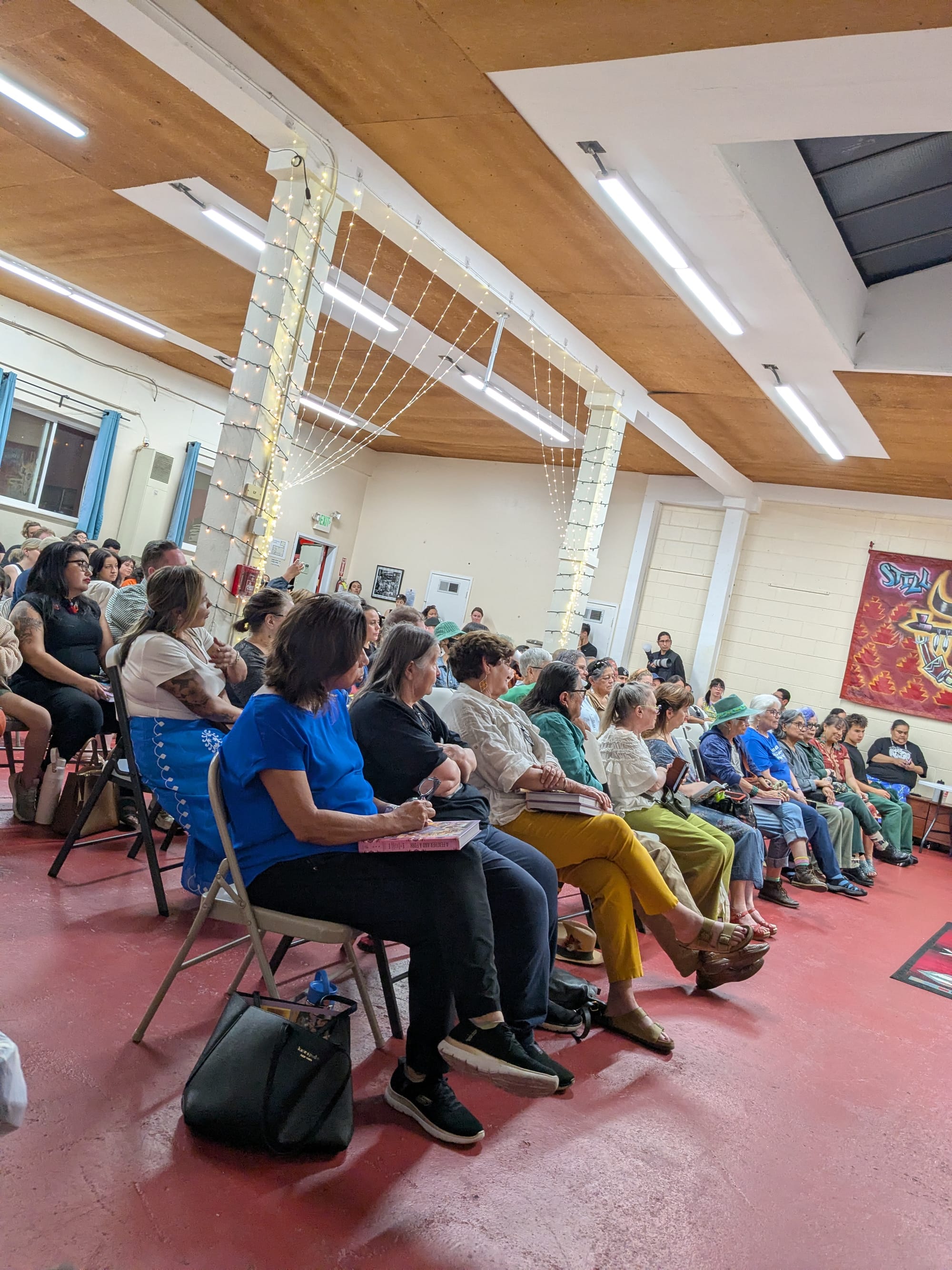
Tommy shows up, straight from the plane, he says, for Crystal, whom he grew up with here at the Intertribal Friendship House. There's a cheer for him. Louder now, we’re told! We rise to the occasion, louder.
The mic and speakers get tweaked, tweaked again. Feedback like a flute keeps following what Tommy says. We all laugh, enjoying the cat and mouse of speech and screech. They fix the mics. Now we’re going.
“Crystal and I have known each other a long time.” He recalls that the 2008 Gathering of the Lodges, celebrating sobriety, was her first catering event. Four hundred people! She says she was still in culinary school. Supported all the people gathering with ceremonial food.
Everyone claps after every answer—this is a celebration.
Tommy: “Stories and food belong together. Can you tell us a story?”
Crystal: “I approach food, asking, ‘Where do you come from?!’ It takes you on a journey and I am one of those kinds of people I guess. I look at food and approach it in a ceremony kind of way. My first time drying corn, I asked my grandmother, Why do we dry it outside?” Tells us about learning the story of her people's relationship with the grain.
Tommy: “In writing this book, did you have any difficulty in translating relationships into recipes?”
Crystal: “Wow, I didn't realize how much knowledge I have, how many relationships I have with the ingredients.” She says she needed to learn to build a relationship with acorns because she's cut off from the land and is not a California Native. Her ancestral grain is corn. But urban Native people learn from each other. “This room that we're sitting in, that was one of my first cooking experiences, with Sarah Poncho." She remembers another key relationship with ingredients:her aunt, who told her, "If you go pick those berries, then I'll bake you a pie!” There are a lot of berry recipes in the book, she says, because she has had a long, long relationship with berries.
Tommy: “Your restaurant is in Fruitvale Station: can you talk about the importance of location and why your restaurant ended up there?”
Crystal: “It's right in the Native community, right near where I went to elementary school. It couldn't be better, right in the center of an urban Native community.”
Tommy: “Can you talk about representing intertribal experience on a menu? The Oakland story that you come from is complex.”
Crystal: “Yes, I'm Kickapoo, but I grew up in the Bay Area, and if you grow up in an urban Native community, you know it's made of many tribes, and you respect that. I wanted to get creative without explaining myself every time. I want you to take a bite of those landscapes and taste what we represent.”
Tommy: “You've traveled all over the world as a famous chef [crowd cheers], representing Oakland as an urban native, can you talk about what that's like... Or maybe just share a good story from the road."
As Crystal starts telling a story about going to New Zealand, my children come barreling back in demanding to leave because the sun has set, and I fling us all up and rush us all out as fast as I can so we don’t interrupt the story for everyone else.
Oakland is a city where displaced people keep washing up, but people don’t forget stories, or food, even far from home. The San Antonio district, where we live, where the IFH was established seventy years ago, has the highest linguistic and ethnic diversity in the city. It’s where my brown husband called me from the Lucky’s on 18th Street, gleeful after five years living in North Berkeley, and said, “This is just like Queens! There are no white people anywhere!” The flats have streetwalkers and some parts smell like piss and uncollected garbage, but they also have the real and metaphorical docks for all the real and metaphorical ships that bring us to the city. We are an amalgamation of so many homes. Tonight another one is building within and around the Intertribal Friendship House, inviting us in to sit down, share a meal, listen to our neighbor’s story, remember what they remember.