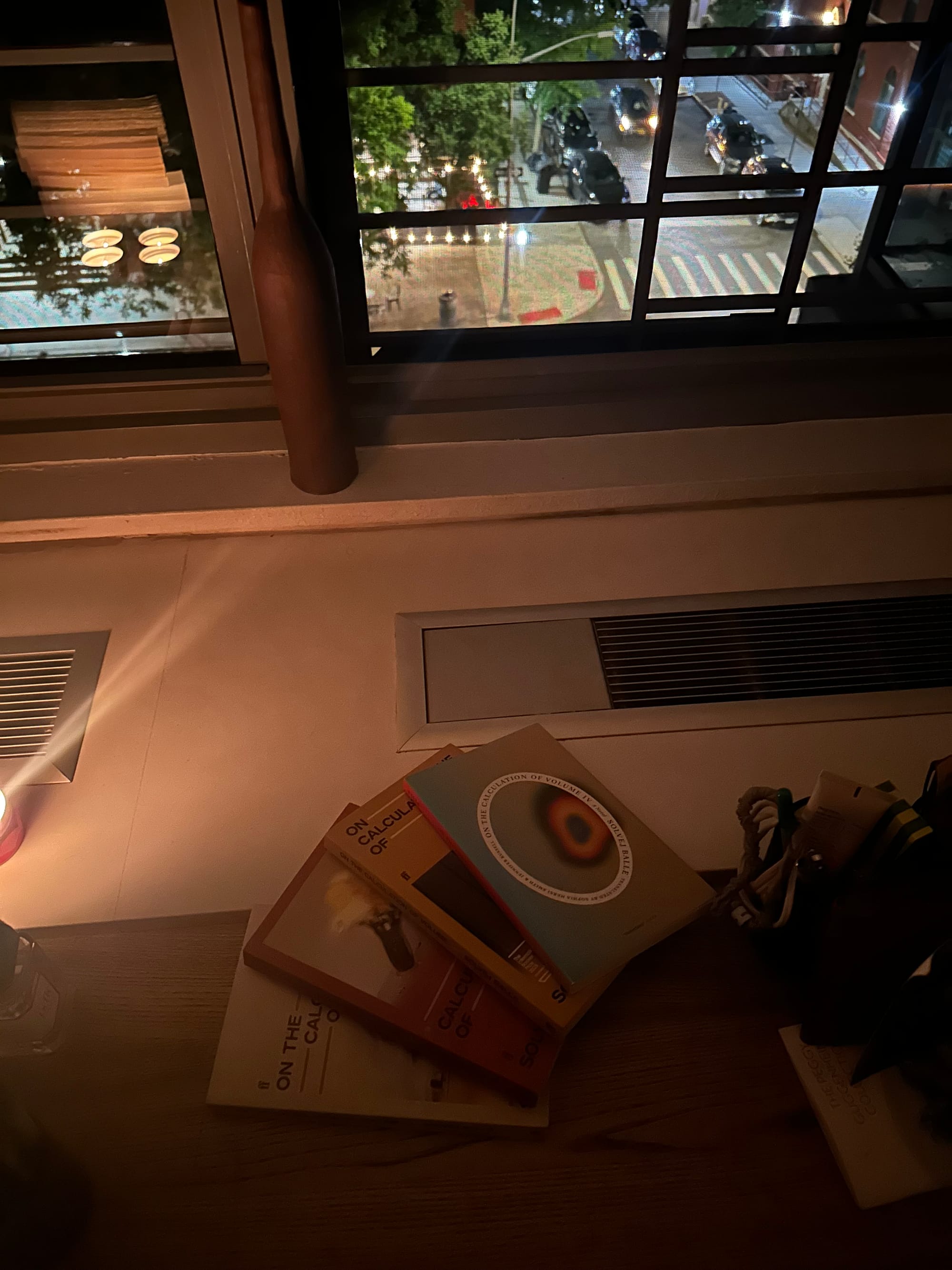
Maybe it will happen today
In my last semester of college, a week before finals, a friend who maybe wanted to ruin my life introduced me to a series of fantasy novels so embarrassing and lurid that I’m not going to name them here. I immediately put my life on hold until I’d finished every book in the series. The four consecutive all-nighters I pulled the following week, to make up for the time I’d spent reading instead of studying, led to sleep-deprivation hallucinations so vivid I still remember them more than a decade later. I still kind of think it was worth it, though. Those books were absolutely riveting.
The only other books that have ever forced me to put everything else on hold until I’d finished reading them in this same way are a series of slim, restrained Danish novels-in-translation about a middle-aged academic stuck inside a single uneventful day in November.
If you try to describe Solvej Balle’s On the Calculation of Volume to someone, it sounds like a joke from 30 Rock about self-serious literary fiction: Listen, it’s great, you’ll love it! It’s a seven-part fourteen-hundred-page novel with a wordy, obscure title referencing Archimedes, taking place over a single day; the protagonist is a French antiquarian bookseller in her thirties who spends a lot of time thinking about the Roman Empire; it was written in Danish on a remote island by a semi-reclusive author in her sixties; it's been compared by reviewers both to Samuel Beckett and Groundhog Day, shortlisted for numerous prestigious awards; and every time you take the subway, you see someone reading it.
I’ve found it hard to describe these books without saying something like “Okay, I know how this sounds.”
I do know how this sounds. It’s why I resisted reading them for months after the first volume came out in translation. More and more people I knew read them and started recommending them, telling me “they're not like anything else you've ever read,” and then refusing to explain what made them so singular. These books are impossible to talk about without becoming very annoying. They’re also the single most riveting thing I’ve read since those fantasy novels ruined my life in college more than a decade ago.
Initially, I thought it might simply have been that I read the first volume in weirdly ideal circumstances. The series begins with Tara going on a work trip to a nearby city, where she wakes up in still the eighteenth of November, for the second time in a row. She takes this stutter out of reality oddly well at first, focusing on details and logistics. She notes which objects disappear overnight and which remain, what she’s able to change and what (like her bank balance) resets. Even from the very first repetition, she begins to observe patterns and attempts to sculpt a system from them, architecting a logic onto the anti-logical way her single existence has been untethered from collective time. She goes home from her work trip to the house she shares with her husband and tries to fit herself back into his day. Most of the first book is concerned with their relationship, and with Tara’s previous life (whose irrecoverable previousness it takes her nearly the whole two hundred pages to understand and accept).
This first book is almost unbearably tender, its prose like someone trying to embrace a heavily injured friend. Tara strains to leave no impression on her former life’s surface: Every utensil in the kitchen, every tree in the garden, every rug or book or chair or doorway, all of it summons up memories, and each memory makes her aware of its loss. It’s as though her life is someone else’s, glimpsed from the outside through a warmly lit window. The more she tries to stay in her own familiar life, the more she realizes she can’t. Her life as she has known it has no place for her endless November eighteenth.
I read the first book in London, in late November, a week or so after the day on which it takes place. I was staying by myself at my best friend’s house while he was out of town, caught in an awkward span of days between a family obligation and holiday plans; because both were nearer to London than to New York, where I live, it made more sense to stay than fly home and fly back.
I told myself I wouldn’t be lonely, that it would be great, actually, and that I was so lucky I could do this. I was, and was also incredibly, unreasonably lonely. And that was how I ended up reading the first On the Calculation of Volume: on a long dark afternoon alone in someone else’s house, in a city where I don’t live, during a few weeks that felt stuttered out of the regular progression of calendar time, while desperately missing my husband who was back in New York and who, as it happens, has the exact same first name as Tara’s husband in the books.
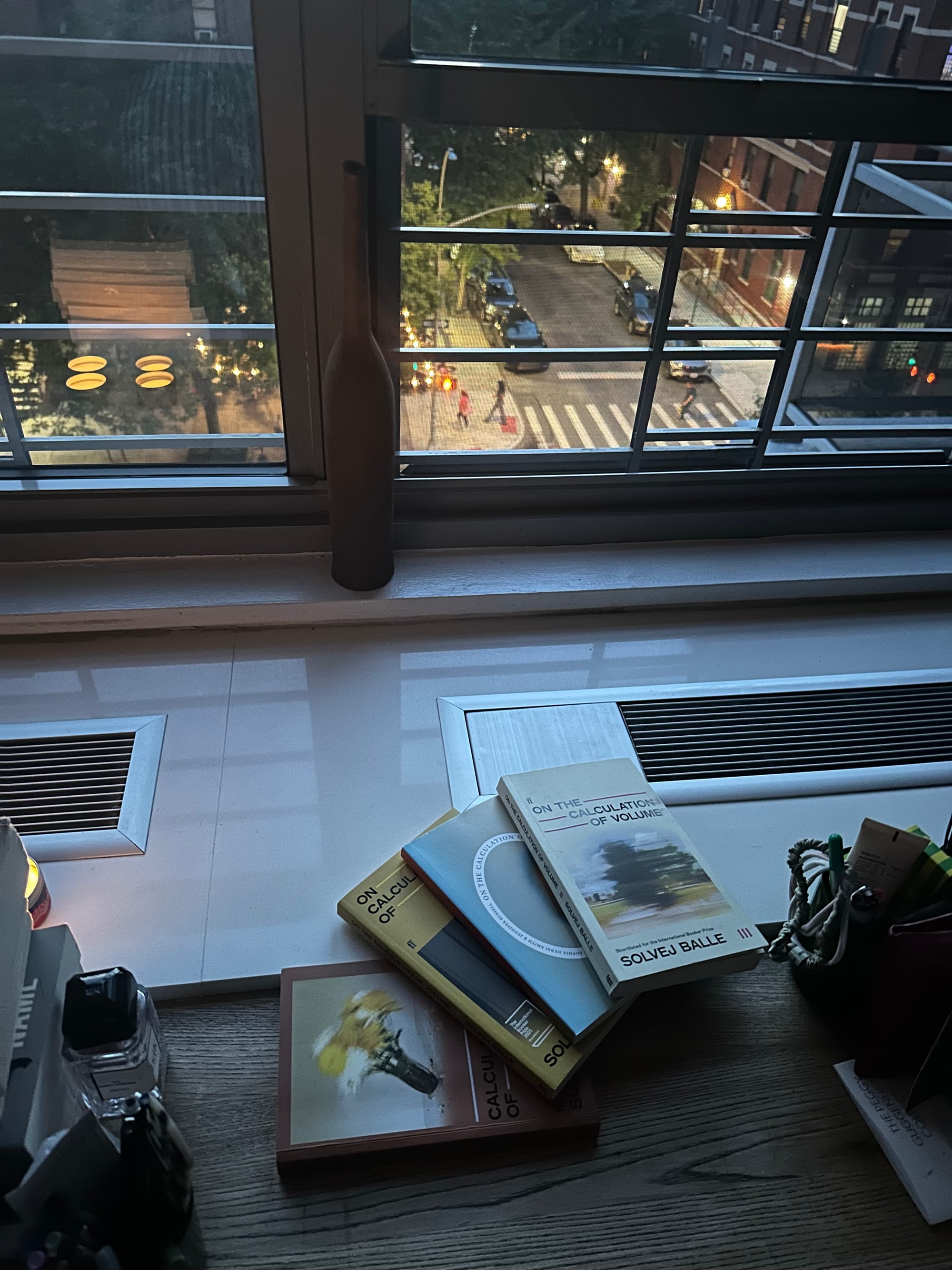
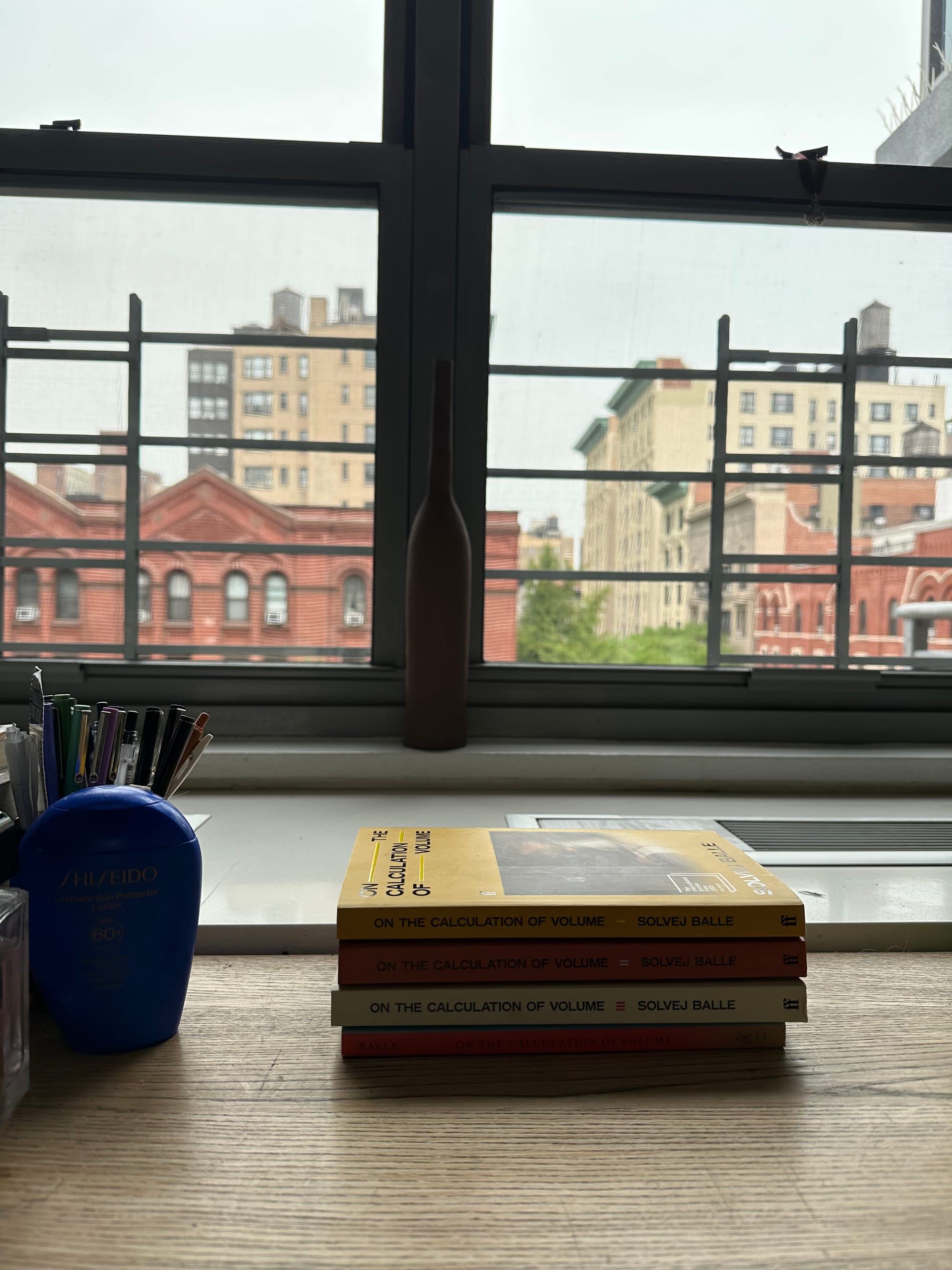
I'd gone out to get groceries, picking up ingredients for a large meal I'd planned to make so that there'd be leftovers for myself for the next few days and my friend when he got home. Passing a bookstore on the way back, I'd noticed that the third volume of those books that people I knew in New York wouldn't shut up about had come out, its repeating cover crowding the bookstore's window in an ecstatic display like a gigantic floral arrangement. For whatever reason, maybe just because the UK editions of these novels are, in my opinion, way nicer to look at than the US ones, I decided I should get over myself and stop refusing to read these books just because so many other people liked them. Also, it was raining, and I wanted to go inside. Who knows why we do anything, really.
“These are my favorite novels,” said the bookseller at the counter when I went to pay for them. I asked her what she liked about them. “They're impossible to describe,” she said, and I remembered why I'd been so resistant to them. But by then I'd already paid.
Hearing that same pronouncement yet again must have made me curious, though, because when I got back to the house, I put my groceries away, got ingredients out, and then decided I'd read the first few pages of the first book before I started all the elaborate cooking I was planning to do. Just for a couple minutes. Just to see if I could figure out what everyone meant about it.
Several hours later I closed the book, stood back up, put all the untouched ingredients away again, cried inconsolably for a few minutes, and then went upstairs to bed.
It felt as though I’d read the book in a single inhale. I told myself that maybe it was just the circumstances in which I read it, that made it feel as though it had been written for, or rather, at me. But a few months later, the same thing happened when I picked up the second and third installments. I started reading, and then the whole afternoon was gone in a single inhale, the hours snapped clean out of the day. I resisted buying the fourth one for about a week after it came out, and when I finally did, it happened again; the only difference was that this time it wasn’t a surprise.
\O/
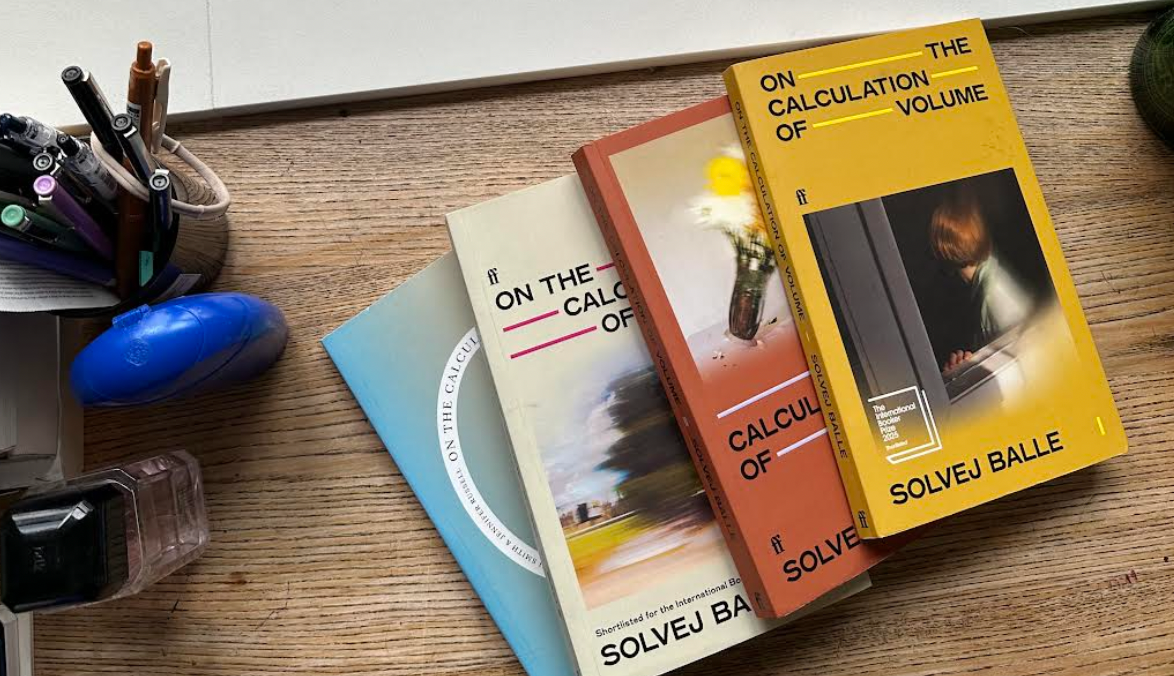
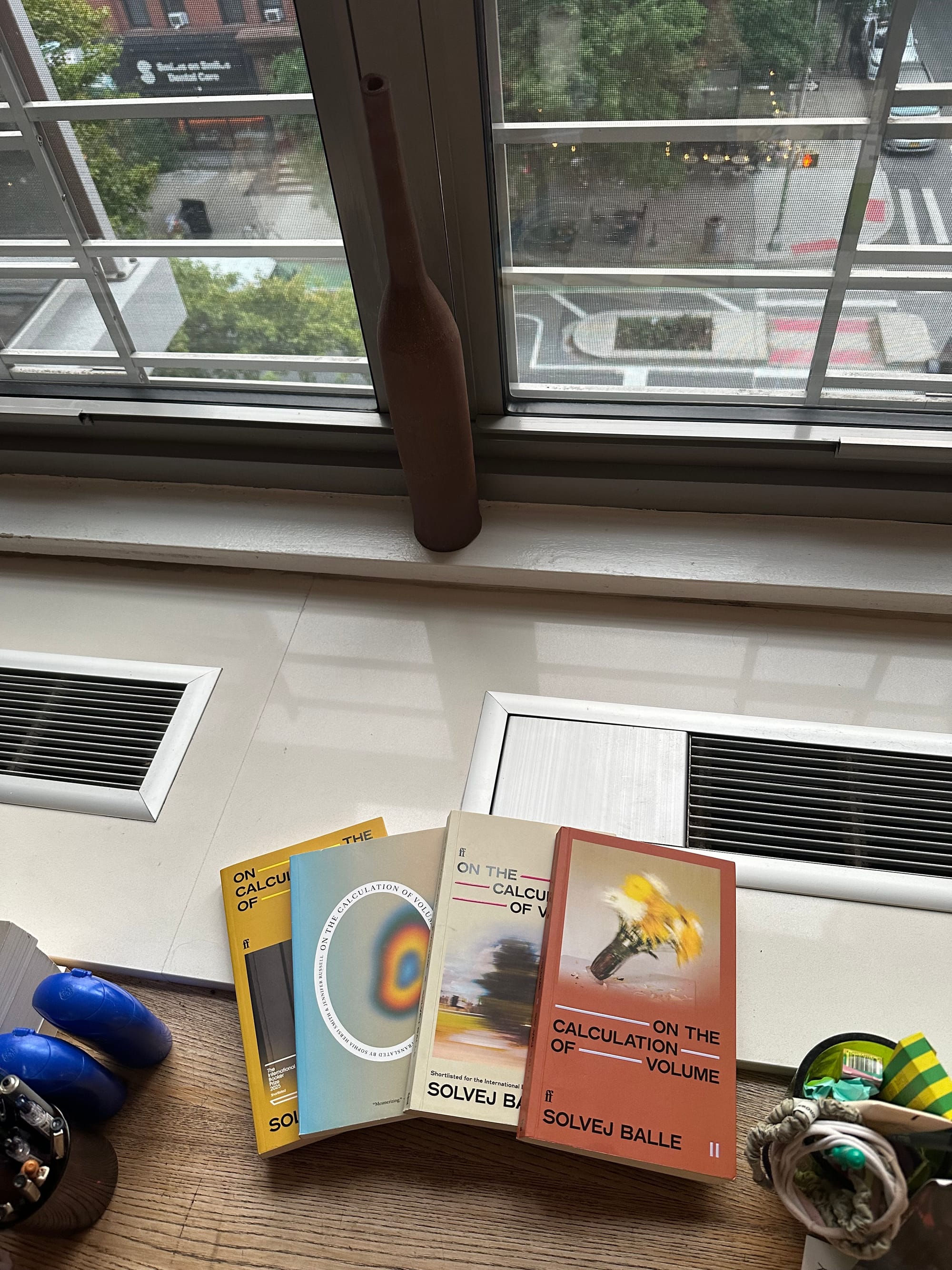
Since I started writing this essay, trying to understand why these books have had such an overwhelming effect on me, I’ve seen at least a dozen people reading one of the novels in public, on the subway, in waiting rooms, in bars, in the park. As soon as I became aware of the books, I began noticing them all around me, that memorably ugly American paperback edition with its neon amoeba on the cover suddenly inescapable.
On the Calculation of Volume is everywhere, for some very modest version of everywhere, a small but notable phenomenon. Karl Ove Knausgaard was an early champion of the books, which, like Knausgaard’s own multi-part autofictional opus, find their way into conversation at a certain kind of party, highbrow work rendered middlebrow by its frequent presence on Instagram. New Directions threw a midnight release party in Brooklyn for the fourth volume's English translation, and The New York Times Magazine gave a Balle a massive, glossy profile, flying out to photograph the small island where she’s lived for over two decades and the ramshackle house in which the books were written.
At some point they achieved the ultimate marker of literary triumph: It became cooler to say that you didn’t like them than to say that you did. Articles about the publishing industry used them as a metonym for over-hype: opaque, unreadable, and pretentious, the scourge of plotless literary fiction that nobody actually reads.
No one reads at all anymore, after all. Literacy rates are falling. Public education is being gutted and eaten, like wood infested with termites, by AI and its attendant, gleeful conmen. The internet has destroyed attention spans, particularly in its turn away from text toward short-form video. No one can focus on anything, least of all a book, and certainly not a series of seven books translated from another language, with a strange, experimental premise, in which much of the narrative is taken up with philosophical digressions, mulling over historical details from the end of the Roman Empire (or, in the most recent installment, long discussions about how to name new definitions for units of time).
And yet. In this moment of debased literacy and attenuated focus, these books have become some small version of a smash hit. Even if we concede that their audience is tiny in real terms, that “smash hit” is only accurate relative to other literary novels in translation, their popularity is still remarkable. In Defector, Kelsey McKinney writes “each of the translated books so far in the series ends by leaving you wondering if the next day of Tara’s life might be different than the one before it, and these cliffhangers become their own repetition.” She describes finishing the most recent installment and being “once again desperate for the next one.” At a time when no one has retained the attention span for any kind of longform reading, an obscure septology of Danish novels set on a single day is, at least to some readers, myself included, a series of cliffhangers that leave us desperate for the next one.
Despite its single, repeating day, the series does, however, have its own version of forward movement, and that movement is part of what creates the cliffhanger effect. Near the end of the second book, Tara meets another person trapped in the eighteenth of November. I shrieked out loud when I learned that “His name is Henry Dale […] he is trapped in a November day […] I am not alone.” The entry of a whole second character into the narrative made me feel the way people claimed to have felt about the first big death on Game of Thrones. By the end of the third book, there are nine people in the eighteenth of November; by the end of the fourth, there are over a hundred. I held my breath with the arrival of each new person, or group of people, every muscle in my body involuntarily tensed. I read each character’s introduction, each explanation of gentle, pedestrian detail, as though I were watching a horror movie, wary and vigilant, anticipating a jump scare.
After two people become four, they begin to strategize about their predicament, discussing it materially and philosophically, not only how to get out, but how to make use of the time loop. What should their goals and obligations be within it? Eventually, they move into a house in a quiet, wealthy neighborhood in a small city, and more people trapped in the same day show up, in pairs and clusters and occasionally alone. The expanding group assigns chores and debates what words to use for the version of passing and not-passing time in which they exist. They hold long house meetings that stick in the narrative’s gears, at which they discuss strategy, vocabulary, systems, and protocols for their time loop, trying to agree on what their priorities and concerns should be. Most of this discussion centers immediate, tangible concerns, food and other resources, calendars and records, the time loop’s effect on their bodies. They often ask the same questions that had itched at me as I read the books: How does money work? How would travel work? Can they get on a plane? What about an overnight flight? Do they age inside the time loop? Do they still look like their IDs? What about illness? What about death? The swerve of the narrative from Tara’s interiority to largely external community discussions itched at me as I read it. It made me anxious as though I were sitting in the back of one of these house meetings, silently picking at my nails, listening to all these people as they tried to control the controllables inside of their larger predicament, as they tried to identify what elements of their reality respond to their actions, and what obligations that might mean they have.
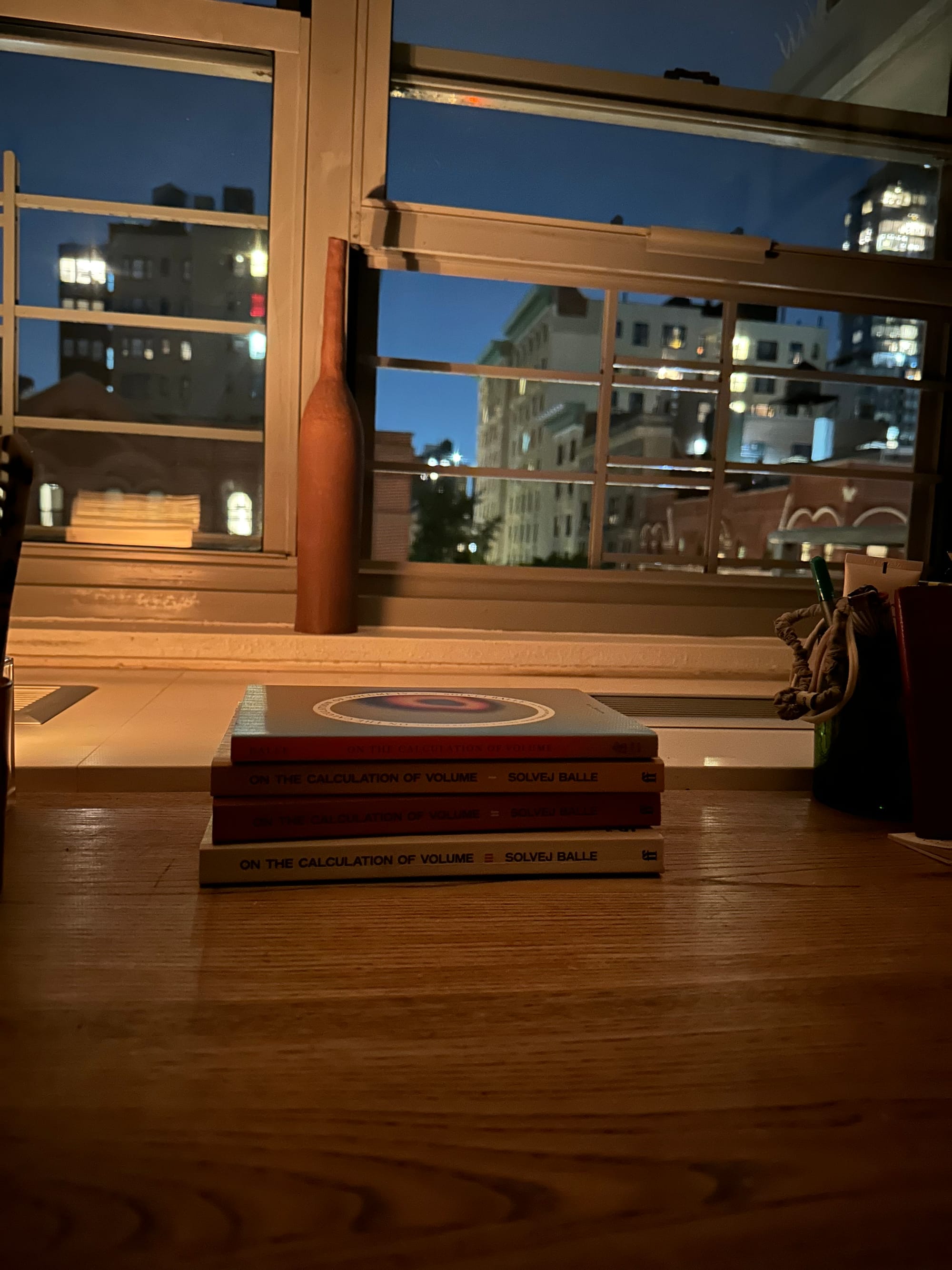
Early in the first book, Tara notices that when she buys groceries, or eats at a restaurant, what she takes isn’t replenished overnight, even though the same day restarts the next morning. Everyone else in the eighteenth of November reports the same thing. This is where the novels differ significantly from fantasies of play and capacity in time-loop movies like Groundhog Day or Palm Springs. These repetitions have consequences, and exert some chillingly unpredictable accumulating effect on the rest of the world outside their loop. Tara and her housemates aren’t inside of linear time, but they don't seem to be wholly outside of it, either. They age more slowly, but they do age, and their hair and fingernails grow. In the background, like an incessant, rising hum, there is an awareness of finite resources, of something being used up, of the traces the looping day and its inhabitants leave on the linear time which otherwise refuses to pass.
As years pass inside the eighteenth of November, Tara’s journal entries become irregular, hinting more and more at her unreliability as a narrator. Time-within-timelessness takes its own kind of toll, and keeps piling up. A character tries to return to the office where he worked before November 18, and finds he no longer looks enough like his ID to be allowed inside. More people arrive at the house with their own stories of their November eighteenths. More meetings are held. A couple who fell in love inside November eighteenth get pregnant, leave the house together, and return again, saying only that they “lost the baby.” The lack of any further explanation made me almost scream out loud in horror. More November eighteenths happen. The repeating day is dull, and quiet, and slow, and everyone in it tries very hard to be gentle with one another. It is absolutely terrifying.
Sometimes we miss whole days in a blink, and sometimes our lives change completely in a single day, in a few hours, in a single moment. Because Tara must concentrate so intently on this single day, trying desperately over and over again to solve its riddle, because her whole life takes place in such a small container, because the container holds more and more people, even the objectively small things that do happen seem enormous, shocking. Things like the lost baby are recognizably tragic, but events such as a plant growing or not growing, an object disappearing or not disappearing, feel almost equal in scale. Nothing really happens, yet that nothing happens as dramatically as possible, with maximum tension, the highest-stakes, most suspenseful possible nothing.
\O/
“The drama of nothing happening” might also describe the kind of narrative media that’s become increasingly popular in recent years. Weirdly enough, our era of debased attention spans is also, from a certain perspective, a golden age of longform. No one reads anymore, but everyone is always reading, the constant text chains and group chats and video captions and Slacks and newsletters and headlines inside our phones churning out an endless scroll of words to read. Even outside of that constant, thoughtless reading, though, prominent trends complicate the notion of a viewership unable to tolerate anything longer than thirty seconds. This era’s longform works have grown up out of reality television and social media in the last few decades. These distractions have transformed our narrative imaginations at attention spans. But in the newer forms that transformation has spawned, there seems to be no upper limit on the length. Successful podcasts often run to dozens or hundreds of hours. On YouTube, nine-hour video essays and twenty-four-hour nonstop livestreams are often wildly popular. While a three-hour movie is too long, an infinity-hour movie is riveting. In a sense, all social media, or even the whole internet, is one endless livestream, playing our own lives back at us on a continuous loop.
Maybe we have not so much forgotten how to pay attention as we have forgotten how to stop.
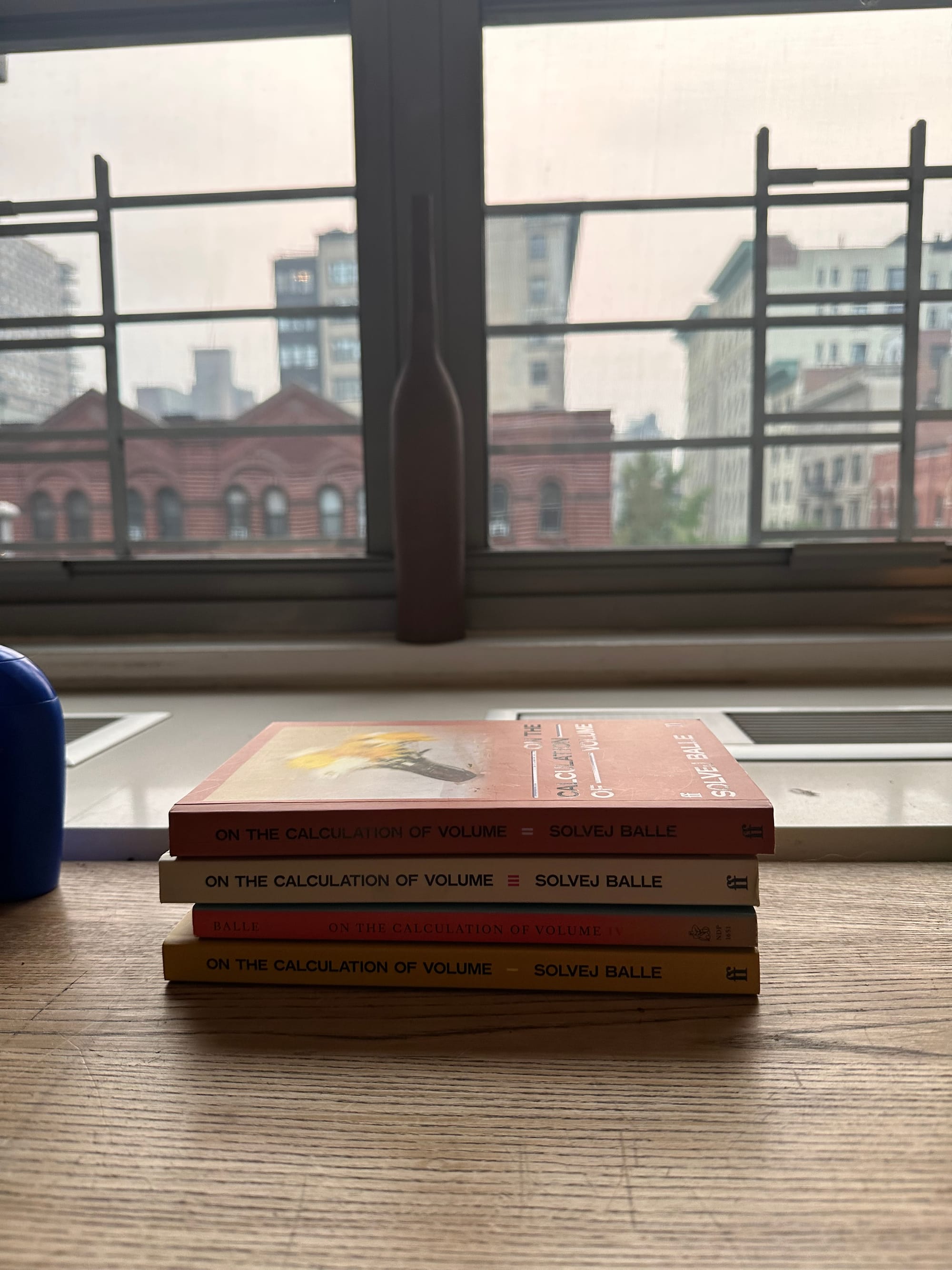
A phrase has become popular, recently, in certain corners of the internet, like a mantra or a code: Maybe it will happen today. The “it” usually refers to a particular possible-future event related to American politics, one that might be euphemistically described as the hope that the current administration will be ousted from power by the simple, inevitable force of time. The phrase is used most frequently by, and is mostly contained to, a certain cringe-liberal demographic. On occasion, some likely inconsequential rumor or piece of news activates a certain part of the already-small group of people who pay attention to this sort of thing, and the phrase suddenly proliferates. If you were to log onto, say, Bluesky at the right time on the right day, when somebody’s picked up on some detail or morsel of gossip, you’d see posts iterating on the phrase, rearranging it grammatically, adding it to other quotations or references, posting that one song from Cabaret, and then making fun of how much people post about it, or telling people to stop posting about it.
The same reasons I sometimes find maybe it will happen today annoying are why I find it profoundly heartbreaking. Is that really the only thing you think any of us can do to change any of this? Sit around and hope something falls out of the sky? I sometimes want to scream. But I spend plenty of time sitting around waiting for something to fall out of the sky, too. I try hard to imagine change as something I can effect with my own actions and choices, to curb my tendency to hope for magic, but I also keep an unopened bottle of champagne in the fridge.
When I consider maybe it will happen today in a broader sense, it’s unbearably tender, so abjectly human it makes me flinch. When I think about its memetic popularity, I feel the way I feel when an animal rescue posts the dog who’s been there the longest without any applications: Maybe it will happen today.
It’s the constantly renewed hope in miracles, the same miserable yearning thing that drives religion and wellness scams and gambling addictions. It’s the feeling when someone buys a lottery ticket or goes on a date with a stranger or tries for the thousandth time to have the same conversation with the family member that they should probably have cut off long ago. It’s the reason Al-Anon exists. It’s the evidence-free perennial advice that love will find you when you aren’t looking for it. It’s among the saddest tendencies in the human condition, but it’s how so many of us get ourselves from one day into the next, bargaining ourselves through the ongoing of a life. Maybe it will happen today. We know that change does occur this way sometimes. Things do in fact fall out of the sky, and one single day does sometimes transform the whole world. All the things I’ve worked hard for, all the goals I’ve tried with white-knuckled determination to reach may have come to nothing, returned only to futility, but maybe something will change anyway, without me doing anything at all.
Maybe it will happen today.
\O/
In The Washington Post, on the occasion of the third installment’s release in English, Jacob Brogan called Balle’s multipart work “the great modern novel of depression.” Over and over, the books ask how one might impose meaning onto the meaninglessness of an endlessly repeated day. The futility of attempting change or progress, only for it to reset the next morning, is made literal, as Tara’s November eighteenth actually is, again and again, the same calendar day repeating. But this is different only in degrees from what many of us experience, even if our days do change numbers and proceed along the track of familiar, linear time. What Woolf in Mrs. Dalloway called “the work of living,” the “adding day to day” can often feel pointless, a painful and meaningless repetition.
As the series goes on, the narrative is taken over by Tara’s heartrendingly futile (and often bizarre) attempts to systematize and give shape to her repeated day. The first book ends with her leaving home on a train, and the second begins with her setting out to create a year of seasons for herself, chasing first colder and then warmer weather up and down a relatively small section of Northern Europe. She pursues this artificial year fiercely, until she doesn’t. She visits her family, tells them about her predicament, and asks them to celebrate an imitation Christmas with her on the eighteenth of November, then leaves and rarely mentions them again. She journals meticulously about the rules of her time loop, then stops writing anything for long stretches. She rents an apartment in a small town in Germany and obsesses for almost half the second book about the Roman Empire and its collapse, dwelling on minutiae, dietary habits and grain consumption patterns, in some oblique way convinced that this is how she’ll solve her own mystery. Sooner or later, however, she lets the Roman Empire drift out of her focus, too, replaced by her next lightly manic preoccupation.
That desperate combination of hope and futility, grasping for a solution like trying to start a car in the cold, looks a lot like a depressive episode. I’ve also spent weeks or months throwing increasingly bizarre strategies at the problem, hoping the next thing I try might be the one that sticks, the next day might be the one in which time’s progress doesn't refuse meaning. Depression, too, says maybe it will happen today. Maybe today I’ll wake up and it will be different. Maybe this medication, this new habit, this change in routine, in location, in diet, in exercise, will be the one that does it. Maybe today, for no reason I can know, I’ll wake up transformed. Maybe today will be when everything finally changes; maybe today will be the nineteenth of November. Maybe it will happen today.
What we do while we wait for it to happen is, as another phrase that’s become a bleak sort of meme puts it, “monitoring the situation.” This one doesn’t really need to be explained. It’s what it sounds like, the modern condition, at least for people who spend too much time reading online. Every day, my phone shows me an endlessly unfurling reel of the worst things I’ve ever seen or heard. Staring at my phone isn’t actually doing anything about any of it, yet the feeling that I can’t do anything about any of it is exactly why I keep staring at my phone. The joke is that “monitoring the situation” sounds so serious, so consequential, a child’s idea of an adult going to war in a movie, but it just means staring at your phone. It’s the hypervigilant stasis that maybe it will happen today eventually creates. Monitoring the situation means doing nothing, as hard as you can, an all-out, maximum velocity, white-knuckled doing of nothing.
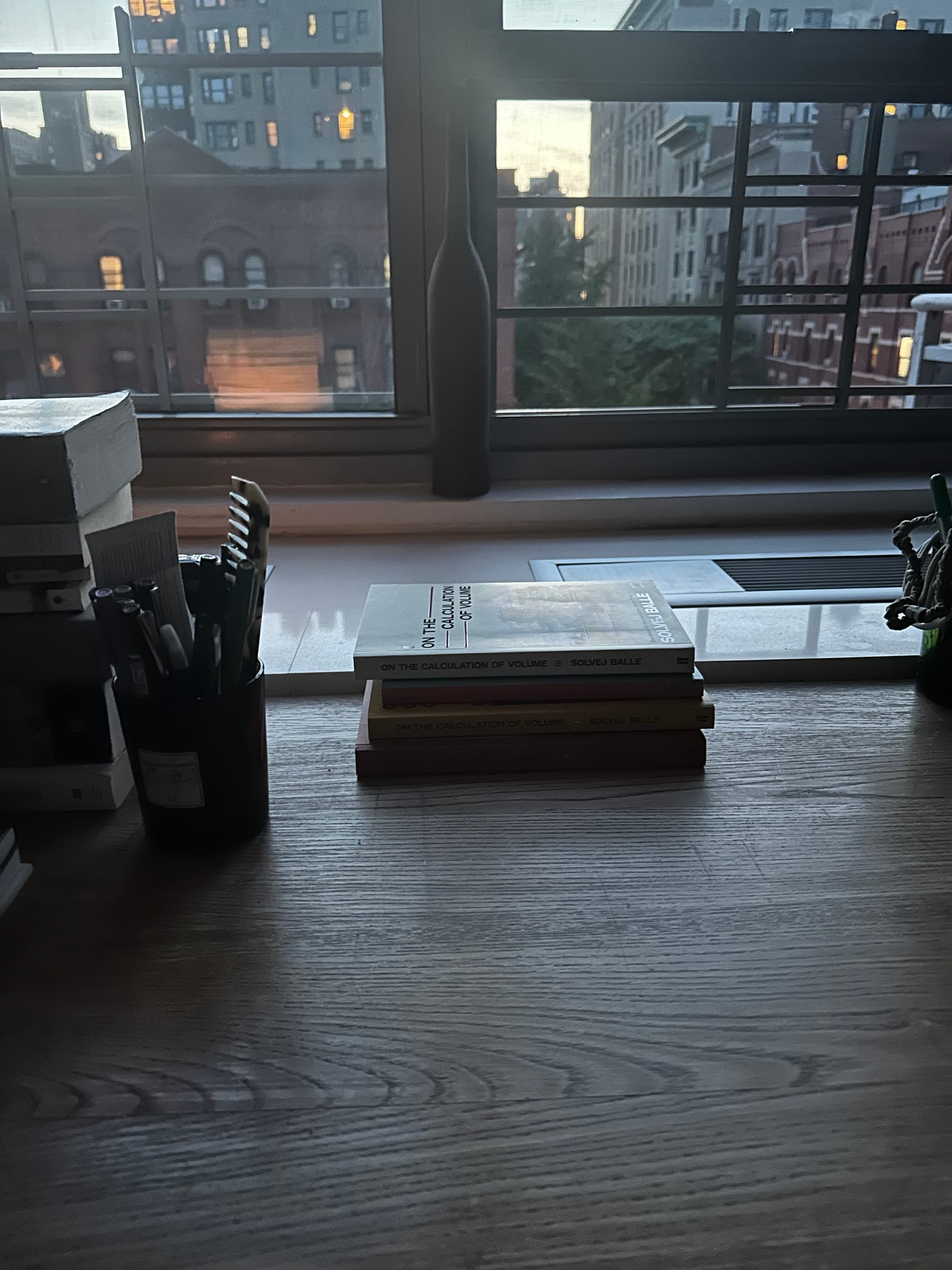
What made Balle’s novels so bizarrely compelling for me, what made me unable to stop reading each next volume until I had finished it, was, I think, the same impulse that draws readers back to the ceaseless livestream of social media. On the Calculation of Volume grabbed my attention the way the internet does, and I read each new novel the way I open up Instagram, again, a second after I’ve closed it. The vigilant nothing of the novels is compelling because I have taught myself, in weeks and months and years of days online in the twenty-first century, to be compelled by exactly this: monitoring the situation, waiting for nothing to happen, hoping to solve problems whose scope is beyond my understanding by simply staring very hard at them and doing nothing else, all tension and no expectation of linear narrative.
The literature of our era is the literature of Maybe It Will Happen Today. Balle lives far from the US, writes and publishes in Danish, came up with the idea for these books more than thirty years ago, and as far as I know, she isn’t on social media at all. I can’t imagine she was thinking about our sweaty present-day online hellrealm when she wrote them, or intended these books to be about either the American political climate or the internet. Literature is, however, as much a record of the moment in which it meets its audience as it is of the intentions with which its author constructed it, and in that sense, On the Calculation of Volume may be the great contemporary novel of monitoring the situation.
What makes Tara’s repeated days read like the climactic sequence in Jurassic Park is the same nauseous combination of hypervigilance and boredom that defines our current, worldwide garbage moment. Because the books are themselves trapped in a single day, their action is necessarily set outside of familiar narrative shapes. Nothing can progress; no forward motion is available. Stuck in their one day, neither characters nor readers can count on expectations of how stories work and what might therefore come next. There’s no roadmap, no way to anticipate anything; even the smallest events arrive out of the blue, appear around the corner as jump scares. It seems as though nothing at all can happen, all action or change out of reach. At the same time, that impossibility opens up a space in which anything, or everything, could happen. There is something almost liberating about this loss of agency, a kind of total possibility emerging from total futility. When all possibilities are shut down, when the reader has no way to anticipate anything, whatever happens next can only be a miracle or a tragedy, a thing that falls from the sky.
No wonder these people spend so much of their time on exhaustively detailed house meetings, arguing about definitions, vocabulary, units of time, calendars, milestones, and record-keeping. They’re trying to create a set of expectations, a system in which it would be possible to anticipate what might happen next. Nothing continues to happen, which means anything could happen: I can control nothing, so I monitor the situation. It’s always possible that tomorrow is November 19th. The novels are desperately compelling, in the exact same way the internet is desperately, horribly compelling, these livestreams of my own and everyone else’s life, at once mind-numbing and riveting. Over eight hundred cumulative pages, each time there was a new entry with another numbered day, I held my breath, thinking this one could be when Tara and everyone else woke up into the next day, returned to linear time and their once-familiar lives. Maybe it will happen today.