More and more, and everyone loses
The thing about AI is that there are so many different reasons to hate it. And so when the Musk v. Altman circus came to town a couple months ago, I shut my laptop (plagiarism) and took a bus (carbon emissions) to the a-little-bit-too-empty Oakland downtown (job losses), to see which of these evils the trial’s protesters were most upset about (and also to sort out my own feelings about this battle of the Bad Guys).
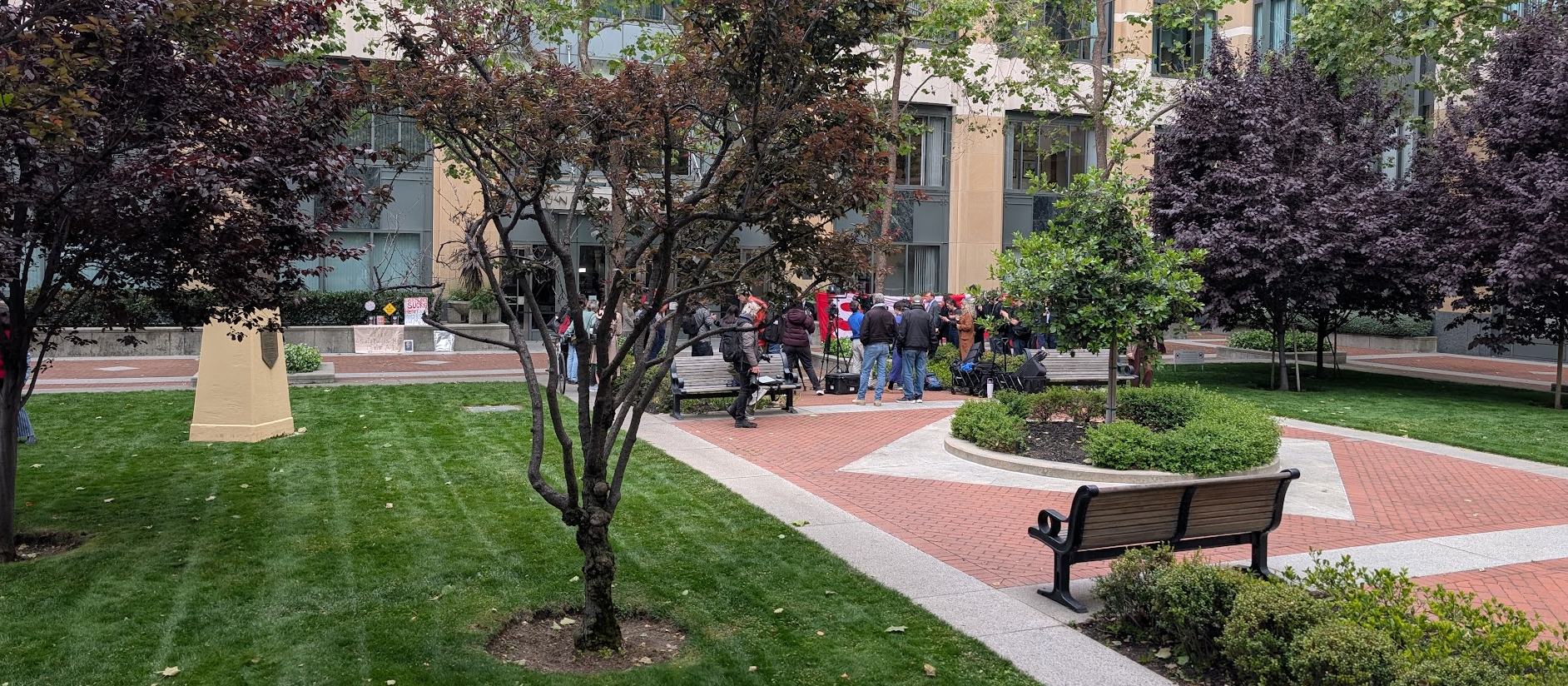
There were, however, more cameras than protesters when I arrived outside the Ronald V. Dellums courthouse, around 11:30, on the fifth day of the trial. Perhaps it was bad timing. But the plaza outside the courthouse, nested just below street level and surrounded on three sides by office buildings like a judicial conversation pit, was mostly empty when I arrived, other than a few bored-looking camerapeople and reporters, workers passing in and out on to purchase lunch across the street, and the three protesters I came to talk to.
They didn’t seem to mind. One of the three greeted me warmly, Phoebe, wearing a pink, rose-patterned shirt screen-printed with STOP AI. Her reason to be there? “Because AI will cause human extinction if it continues,” she explained, as one of the other protesters vigorously signaled agreement. I should have asked how they think AI will accomplish our collective murder but I was too eager to push back: “Don’t the companies want you to believe that?” I asked. “Doesn’t likening their software to the Terminator just make their products sound cooler?” The way the third jumped in to agree that it was a marketing ploy made me suspect that he’s previously bit his tongue in internal discussions among the STOP AI crew. But the other two seemed neither convinced nor particularly bothered by this skepticism. Phoebe pivoted smoothly to water and energy usage, copyright violations, datacenter noise. “Oh yes,” I said. “No argument there.”
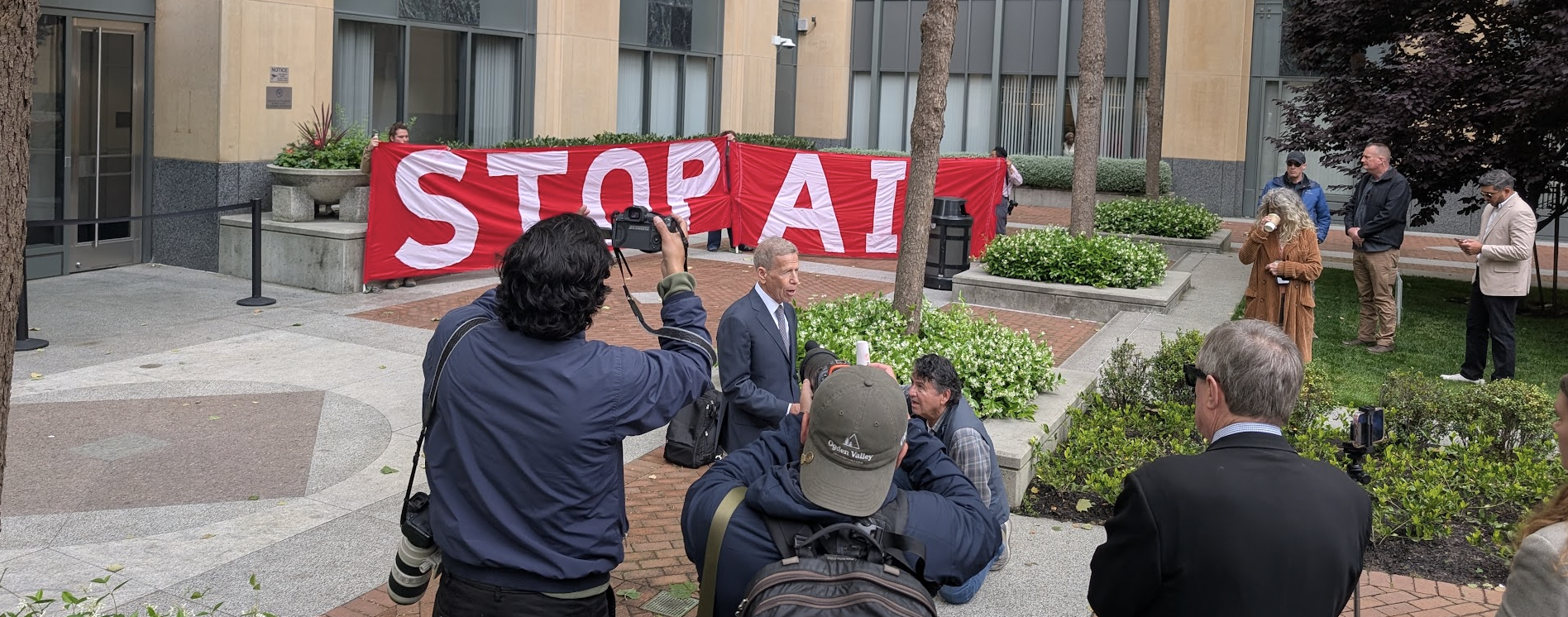
There was not much to do for a while. The protesters were few, but practiced. Another arrived with a huge red banner reading STOP AI, which they were going to hold behind Musk’s and Altman’s lawyers when they came out to offer their spin on the day’s proceedings to a bouquet of microphones and cameras. It was all very routine, by then: Phoebe told me the court marshal who was guarding the door was new, and much meaner than the usual guy, whom she previously befriended. She also pointed out the parents of Suchir Balaji. Balaji had been an OpenAI employee and then whistleblower, speaking to the New York Times about what he believed were the company’s rampant copyright violations; when he died of a single gunshot wound to his head, police and the medical examiner classified it as a suicide. His parents don’t believe his death was a suicide, Phoebe told me. “Can you imagine,” she said, “your only child, that young?” Later I’ll see a reporter talking to Balaji’s parents; the parents also approach and speak briefly with Musk’s lawyer. I couldn’t hear what they were saying, but I found myself surprisingly glad that someone was listening to them.
As we waited, Phoebe told me about the “funeral” they were planning for all the people killed by ChatGPT, driven to suicide by an endlessly reinforcing sycophant digital voice or the victim of someone who turned to that inferential ghost to help plan a killing. And she admitted, somewhat sheepishly, that she had asked Gemini for a list of such fatalities, to avoid having to read the details of each death. But Gemini wouldn’t answer, which she found suspicious, so she ended up combing through the articles herself, while trying to learn as little as possible about each victim to avoid getting swallowed up in grief. But grief is certainly part of this: She and one of her fellow protesters told us that they were recruited to join Stop AI at a protest against the genocide in Gaza, and that they were moved to join in part by the role the technology has already played in directing Israeli bombs. They went from protesting one Apocalypse to another.
When the lawyers eventually came out, first Musk’s, then Altman’s, they were hard to hear; the microphones were just for recording, not for us. I inferred that OpenAI’s president, Greg Brockman, testified that day. While Musk’s attorney was performing his outrage at the notion of a charity converting to a for-profit corporation and issuing stock to the charity’s board member, I found myself thinking about the estimated 762,000 people who died in just the first year following Musk-directed cuts to USAID, and the 14 million expected to die by 2030 and the $5.9 billion SpaceX will receive from a single government contract signed in April 2025. I also found some comic relief in the Homeland Security agent who chose this moment to leave his prior post on the sidewalk and march in a seemingly pointless circle around both the reporters and the loosely-clustered hangers-on; he had the ever-so-slightly-crotch-first gait of an off-brand Colonel Lockjaw, sunglasses on, hat brim pulled down, earpiece in.
I wonder if he was hoping for more of a protest. I wonder if I was.
Was this billionaires’ battle royale so self-indulgent and pointless that even our town’s famed protesters couldn’t be bothered to show up? The organizers of the protest on the first day announced their slogan as: “Both sides suck.” When we asked the three protesters there, that day, who they hoped would win, they could only admit that if really forced to pick a winner, they’d go with Musk (as the nominal defender of OpenAI’s nonprofit status). But their real hope was that both would somehow lose (which, spoiler alert, they kind of did).
\O/
Oakland did not show out for the trial, but a month ago a considerably larger group of protesters marched through San Francisco to bring the anti-AI movement to the companies’ doorsteps. A few hundred people marched to Stop the AI Race. For them, as for Phoebe and her comrades, the stakes are existential: According to the San Francisco protest’s organizer, AI “will only get smarter and almost certainly more powerful than us.” Phoebe felt similarly, and asked me if I’ve read If Anyone Builds It, Everyone Dies, a book by a so-called AI “safety researcher” Eliezer Yudkowsky; a protester who arrived later, with banners and other props, sets two copies of the book up as part of their display.
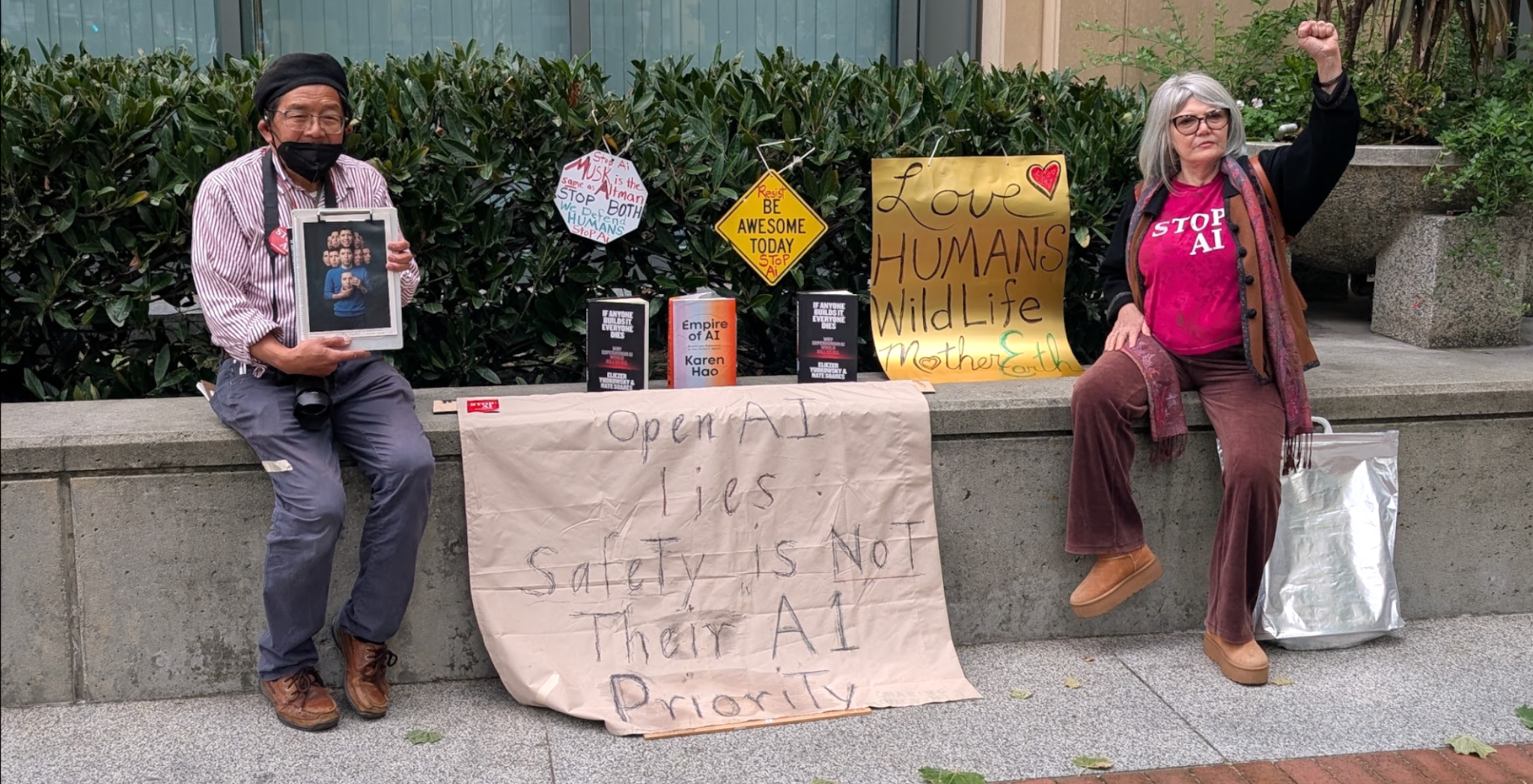
I have not read Yudkowsky's book, but it is not the first time someone told me I should, lest I fail to anticipate our dire potential future. I have resisted doing so, in much the same way I (to this day) refuse to read Hillbilly Elegy, waging a defensive war on the ill-defined belief giving it my attention would be, somehow, giving in.
Giving in to what? Well, AI “safety researchers” like Yudkowsky argue that large language models, if pushed far enough, will become superintelligent and destroy humankind in a quest for resources. “But,” I say, holding tight to my deliberate ignorance of these arguments, “in our post-modern-late-capitalist-whatever-you-want-to-call-it-already-apocalypse, these dire warnings have mostly been a maybe-not-so-shockingly effective marketing ploy.” And this is also the conclusion Amanda Gefter reached after actually reviewing the transcripts of some of the more popular AI horror stories and learning the machines were not behaving quite as autonomously as their manufacturers and marketers suggested. A lot of worrying news stories seem to turn out this way, if you dig into the details.
One could reach a similar conclusion based on a survey of incentives and vibes. After all, Elon Musk was the third signatory (of 33,705 at time of writing) of a letter calling for a six-month moratorium on large language model experimentation, then four months later launched his own AI startup. I can’t help but notice (I say to myself, archly, reading the coverage of the San Francisco protest) how many of those most convinced of the threat of AI to destroy humanity seem also to be literally invested in the technology. The article covering the larger march against AI in San Francisco held in mid-July quotes fellows at AI safety research thinktanks, former employees, even the CEO of a company using AI for chip design; Academics bemoan its effects on students, towns oppose data center construction, but the loudest voices raising existential alarm invariably owe their wealth to the technology. Even as they compare Claude to 2001’s Hal, the SF protesters’ hedged their bets: what is needed is a collective pause, they say, but they want an agreement, not a law.
Is this unfair? Wouldn’t those most intimate with its capabilities be the earliest to ring the alarm? Didn’t you see Oppenheimer? (I did not.) I spent almost six years of my life employed full-time attempting to stop global warming but I still take long-haul flights. “Sure, it might kill our children,” they might be saying, “but won’t that IPO be sweet? Somebody else will stop it in time.”
If my cynicism at the existentialist anti-AI movement’s motives is well-founded, it’s because I have read the second book Phoebe and her colleagues displayed as part of their trial protest. Karen Hao’s Empire of AI offers a very different vision for how the machines might kill us (or some of us): by deploying the existing extractive tools of Silicon Valley capitalism on such a scale and with such ruthlessness that we choke on the material byproducts of the computing power that’s been amassed, in the end, to chase a VC pitch run amok. Meanwhile, the same folks in the Global South who end up as disposable labor for the latest US consumer trends are further immiserated, albeit via cognitive and emotional exhaustion rather than physical.
In this way, Empire of AI is a very odd companion to Yudkowsky’s book in the micro-canon of the Oakland anti-AI protesters. As Hao tells the story, the world-transformative step forward in artificial intelligence represented by ChatGPT was almost an accident. It had not been the primary goal of OpenAI’s early efforts, just a side project pulled together to impress Microsoft enough to prompt investment. Prior to ChatGPT, OpenAI was focused on programming an AI agent to beat a particular “battle strategy video game” as a proof of concept. Since Watson had done chess and Jeopardy!, they needed an even more complicated and open-ended human reasoning task to prove a computer could mimic. And they didn’t know what true “artificial intelligence” would look like, or which of humans’ many productive and recreational endeavors it would prove capable of, at first (and according to Hao, they still don’t). What OpenAI’s leadership did know at its founding was that artificial intelligence is inevitable, and so it was incumbent upon them, the Good Guys (and not Google) to achieve it first, and thereby to ensure it served the public good. And so they (again on Hao’s telling) more or less threw technical spaghetti at a wall.
The strands that stuck were large language models: first GPT, but now Claude, Gemini, Grok, whatever Meta calls theirs. (It’s Muse, I had to look it up.) But OpenAI did not conclude, a priori, that synthesizing the internet and producing intelligible text was how machines would become sentient and set out to produce a machine that did such a thing. What they had needed was a killer app to sell the possibility to a giant tech conglomerate and, in the process of programming computers to do all sorts of things that seemed human, they stumbled upon the fact that with enough data, you could get a computer to produce text that very closely resembled human language processing. It was an achievement to do that, but it was largely a brute-force function of more. This is worth reiterating, that there aren’t any real paradigm-shifting technical innovations and no new programming tricks or innovative hardware that have made LLMs the seductive interlocutors they are today. No, GPT-3 was only so good at sounding like humans because it was trained on so goddamn much text.
Because the leap forward was such a function of more, the empire of AI has gone all in on more. Hao describes this desperation for more, both to scrape yet more content from the internet (going lower and lower in the barrel of quality, and scooping up slurs and porn as a result), and to employ more and more “compute,” or computing power, which in turn requires more hundreds of thousands of Nvidia chips and gigawatts of electricity (and more workers in Kenya, Colombia, Chile, etc). More has yielded dividends. But OpenAI is also the dog who caught the car, latching onto a technology which turned out to be extremely useful to an industry (and more than that, individuals) with way too much capital lying around, and which turns out to produce intelligence (or profits) precisely in proportion to the resources that can be subsumed into it. AI is, in this sense, a story that found itself economically viable—even explosively profitable—because of all the other stories that could be stuffed into it, both metaphorically and literally. And in a moment when there was more capital looking for opportunities than opportunities looking for capital, “AI” turned out to be a bottomless container for all that more, more, more.
How all that capital came to be available is not a story Empire of AI tells. Instead, Hao walks a fine line between structure and agency; she is telling a story about historical forces but also one about Bad Men. She does not herself seem to be completely sure of which is ultimately responsible for the atrocities committed in the name of AI.
This tension shows up in how the book is framed. To the extent there is a narrative throughline, it is built around the company intrigue that would eventually lead to a trial in Oakland, California (and to a mostly empty courthouse lawn where her book would be displayed). Her drama is full of unlikeable characters but Sam Altman is its Big Bad. Activists in Kenya, New Zealand, and Uruguay technically get the final word, in an epilogue, reminding us that all that more has to be dug up, materially, out of the ground and assembled. But Empire of AI both opens with the Succession-style corporate boardroom battle royale over Altman-as-CEO and closes, in the last sixty pages, with the story of the corporate intrigue around the failed ouster.
To tell that story briefly: Musk threw his weight around, Altman was briefly dethroned, and Hao ended up as a first-person real-time narrator when she got access to a shared email account that was used to coordinate an aborted employee uprising that challenged the move to for-profit status. When the uprising was quashed, the book ends with Altman restored to his place at OpenAI, his enemies expunged, giving grandiose quotes to reporters (even as the company was still hemorrhaging leadership).
Before all that, however, Altman and Musk had been friends and allies brought together, precisely, by the concern that AI would destroy the world. It began in 2013, when Musk got into a fight with Larry Page (one of Google’s three co-founders) about (to quote Hao) “whether AI surpassing human intelligence was in fact a problem.” Page didn’t think it was, but Musk “began to speak incessantly about the existential risk of AI,” and this incessant speaking drew the attention of Sam Altman, who wrote to Musk to say he’d been worrying about similar things. Then running the startup “accelerator” Y Combinator, Altman had concluded that while it was not possible to stop humans from developing AI, it would be better for the world if an entity other than Google were the first to produce it. After a fancy dinner in June 2015, the two became “key leaders” of a nonprofit ostensibly intended to conduct “safety research” on AI (while accelerating it).
Was their fear real? When Altman and Musk founded OpenAI, did they really believe AI could destroy the world, or was it just that AI in the wrong hands (i.e. not theirs) could do so? Was the fear simply of missing out on the Next Big Thing?
It’s not a novel fear. The nightmare of a robot uprising is deeply baked into American popular culture, an anxiety arising from the constitutive role of chattel slavery in our country’s history. AI evokes this epigenetic fear among white Americans that the workers performing intimate labor or supporting an unearned leisure (whose subjugation has been justified through categorical dehumanization) will suddenly reveal themselves to be full agents, and that they will rise up and take their reparations. Before they fell into Silicon Valley’s orbit, Altman grew up in the segregated western suburbs of St. Louis; for Musk, child (in multiple senses) of apartheid South Africa, the underlying psychological explanation is almost vulgar in its obviousness.
For Hao’s story about Great Men clashing in dramatic board rooms and courtrooms, the two men’s respective egos drive the conflict. Sitting atop the spigot for tech startups at Y Combinator proves insufficiently fulfilling, so Altman contemplated a run for California governor (before discovering his broad unlikeability). In 2017, Altman pivots to make a play for control of OpenAI, which Musk—with his own issues around grandiosity—also wants.
One could imagine the kind of The Social Network–style movie that might be made of all this. But what an Aaron Sorkin script would never emphasize is how the machines these egos set in motion not only have material consequences, but also a material and economic logic of their own. That would be a story about path dependency, flowing along well-established grooves of venture capital and oligopoly built through previous tech bubbles. It would explore how the defining feature of OpenAI, of large language models, and of “AI” as a technology more broadly, is its compulsion to consume compute, and with it electricity and capital, and then to consume more and more and more of it, and then still more and more more. AI’s much-reiterated “inevitability” is always a reflection of this compulsion, a hunger for more compute (electricity + chips) and more training data (human-authored text), and a hunger as unquenchable and as inimical to slowing down—one might editorialize—as a Musk or Altman’s for ego validation.
We might pause, at this point, to note that insisting on the inevitability of a technology that is also more capital intensive in its initial invention than any technology previously in existence is not the most intuitive thing. We might question whether a hunger that grows the more it is fed has, as its culmination, satisfaction.
Or perhaps we must not pause, so that we do not ask these questions? The OpenAI team—Altman, accompanied by Greg Brockman and Ilya Sutskever—certainly do not pause in their pursuit of the inevitable, setting out on a sometimes-desperate quest for the funding necessary to run every human utterance committed to digital text through a computer program. According to Altman, this need for more compels the company to invert its ownership structure, after he defeats the effort to oust him from the organization. To make what is inevitable happen—but the good version of it—OpenAI’s only choice is to cease to be a nonprofit with a for-profit subsidiary, becoming a for-profit “public benefit corporation” (with the nonprofit remaining as a separate entity). This is because they need more: “The world is moving to build out a new infrastructure of energy, land use, chips, datacenters, data, AI models, and AI systems,” as Hao quotes Altman. “We once again need to raise more capital than we’d imagined.”
Musk’s case was that the conversion of OpenAI into a for-profit company violated Altman’s fiduciary duties as a board member of the nonprofit. Nonprofit board members are not supposed to personally benefit from their leadership and Altman’s decision to convert the nonprofit to a for-profit corporation redounded to his financial benefit. (Of course, according to Hao, even when OpenAI was a nonprofit, Altman remained invested in Y Combinator, which stood to benefit on the order of $1B even before OpenAI converted its structure.) This is why Musk sued, ostensibly.
But after a trial that was embarrassing for just about everyone involved, in which tech titans’ personal correspondences were revealed and the Great Men themselves were subject to the indignity of being asked questions they had to answer (and of following a woman’s directions), neither Musk’s altruism nor Altman’s motives were vindicated. Instead, the jury simply concluded Musk had waited too long to sue, and the judge dismissed the case.
For those of us on the AI-skeptical sidelines, on the sunken lawn beneath the Ronald V. Dellums courthouse, maybe this was a Pareto-optimal outcome: Musk looked bad, Altman looked bad, and still neither man could say definitively that they had done the right thing by their Frankenstein’s monster of a company. Lawyers got rich, the New York Times had live updates for a bit before it lost interest, the New Yorker captured just how pathetic the whole thing was, and the then-circus left the Town.
\O/
What of The Town, in all this?
Nowhere, somehow. “Oakland” does not appear anywhere in Empire of AI, which was published a year before the trial; you can scrape its data, search for the word, and it does not appear. During the trial itself, the fact that it was held here always felt like an in-joke. Big Tech is not here. San Francisco is home to the company formerly known as Twitter and so many forgettable, illegible SOMA startups, as well as OpenAI itself; you find all the sprawling tech campuses in that amorphous urban aggregate armpitting the South Bay. The exceptions prove the rule. Those who have been around Oakland for a decade or so can remember the Ask Jeeves sign atop a skyscraper, once visible from I-980, an ironic gesture at the scrappy off-brand city’s identity vis-a-vis its booming search engine sibling. There was talk a decade ago that Uber would move its headquarters into the refurbished Sears building at Broadway and 20th, but that plan was abandoned after Travis Kalanick resigned in shame following reports of rampant sexism and harassment within the company (having had the bad luck of such behavior becoming public during the six months when a person could actually get fired for that sort of thing).
Today, Uptown Station is occupied by Block, which makes Square and CashApp, and there’s the Pandora building a quarter mile away; across the street from that the Kapor Center, which is home to several nonprofits and perhaps the most Oakland tech company of the bunch, Kapor Capital, a self-consciously woke VC firm. But that’s it.
If Oakland’s tech scene is confined to its Silicon Intersection, its proximity to the AI boom has not left it untouched. Oakland is where many of the tech workers building, using, and being replaced by LLMs live; its home prices and rental rates rise and fall (though mostly rise) with the fortunes of these employees.
Are they “workers”? Along with the founders, Empire of AI is very interested in the workers in the Global South, and Hao travels to Kenya, Colombia, and Chile, to describe the lives of individuals tasked with training large language models, as well as those living adjacent to the mines from which lithium for the countless Nvidia chips is extracted. She argues that the Great Men of AI have deliberately directed regulatory and popular attention to the potential for artificial general intelligence—and the threats such a hypothetical technology would pose to humankind—as a ploy, essentially, to avoid scrutiny of the concrete, contemporary ways in which the production of large language models is exploiting people in the Global South. She is surely correct. But Empire of AI has less to say about the Bay Area–based mid- and lower-tier tech employees, and not much to say at all about LLMs’ users, or how the technology is altering workers’ lives on the way to AGI. What of the employees (disproportionately tech workers) who the Great Men tell us will be displaced by this technology?
That is not a criticism of the book, really; no book can tell every story. But this blank space in the imperial picture is where Oakland does play a starring role: Oakland may not be where the tech companies live, but it is ground zero for the experience of working for tech—whether as a programmer, in-house barista, or gig worker—and for being laid off when the industry lurches in another direction. The apps come to Oakland first, and the dramatic economic gradient across the city’s footprint means that its residents are on both sides of the transaction.
So let’s talk about labor, tech, and Oakland.
Until quite recently, Oakland’s tech workers (at least the W-2 employees, not the 1099-gig workers or subcontractor staff) were mostly the beneficiaries of disruption, as the consumers who found their lives made a little easier by the venture capital-subsidized lifestyle gig services. And it is very much possible to tell a story of LLM use that is simply the next chapter in this story, where chatbots slot smoothly into a lineage of startup technologies that benefit exactly the kind of people that Oakland’s tech workers tend to be. As Adrian Daub put it in What Tech Calls Thinking, “The famous knock against tech startups is that about 90 percent of them seem aimed at answering the question, ‘What things isn’t my mom doing for me anymore?’”
There are a lot of answers to this. Want someone to assemble your Ikea furniture? Call a TaskRabbit. Need a ride to your concert? Call an Uber. Don’t know how to write a thank-you email? Need some help with that essay due tomorrow now and you’re no longer living at home with mom? Claude to the rescue. Derek Thompson (of Abundance fame) posted about the possibility of using ChatGPT to plan a five-year-old’s birthday party overnight (while the Dad sleeps). Seen this way, large language models are the next step in an ongoing quest to alienate feminized labor, further invisibilizing it through reliance on a sub-employee economic underclass of “gig” workers (or “agents”); the result is producing the aspirational masculinized subject untroubled by mundane tasks of self-maintenance.
So far—for aspirational masculinized subjects—so good. That is, right up until an LLM does a white-collar job. And according to Altman et al., AI is coming for everyone’s jobs. (Well, until this spring, when some of the people with those jobs started exercising their veto power on new data centers in their respective towns.) The putative threat of worker replacement by AI is well-worn discourse, a discourse recently reignited by two commencement addresses at which graduation speakers were booed for their AI boosterism. But as LLMs threaten to gig-ify the labor of the tech worker class itself, the great irony is that computer programmers, themselves, are most vulnerable to replacement by their technical creations. (LLMs: Very good at code! Less good at writing. Perhaps there’s a lesson in this.)
For the tech workers of the Bay, the threat is that their labor will be feminized and gig-ified just like the cab drivers and food workers and cleaners before them. But if the prospect of unemployment is concerning, the real danger is to their sense of indispensability in the great technological future they once thought they were bringing us all. Might it not, then, be easier for those who joined the San Francisco march to believe that they are building a superintelligent Skynet that will destroy the world—that while they are the villains in an elegiac story about the loss of the arts, at least they are still the charismatic antiheroes and protagonists in a sci-fi apocalypse narrative—than to admit that their day jobs don’t require the genius the world has spent the last twenty years assuring them it did? That their labor, too, can be feminized and cast off?
I don’t want to be mean about it. Or maybe I do want to be mean about it: As a humanities person and someone tasked with filtering out AI slop from my students’ written work, it’s hard not to feel some schadenfreude at this outcome, having long had to defend the value of teaching political theory and writing against the chant of “learn to code.” But, that said, it’s not the individual coders facing unemployment who are responsible for the college divestments done in the name of preparing students “for the next generation of work,” or whatever nonsense is being put out there. They, too, are exploited by the tech capitalists, in that their wages, however generous, still fall short of the value they produce; they are “workers” in that very specific Marxist sense. And for better or worse, Oakland is where a substantial subset of the tech-worker class find their homes and meals, and is thus where the ebbs and flows of tech salaries lift, drown, immerse, and strand other residents and businesses, and which has quite a strong interest in what happens to them.
For her part, Hao provides an entirely sympathetic account of AI pieceworkers, but her more limited forays into the experiences of OpenAI’s low-level but well-remunerated employees reveal a more complicated moral mix. Although Hao finds herself in accidental communication with mid-level employees who are frustrated with Altman’s manipulation and abandonment of first safety principles, ultimately OpenAI’s employees are collectively in favor of Altman’s continued tenure, a choice Hao describes as, if not decisive, highly influential.
Why do they throw in with him? Hao does not provide a definitive answer. But one explanation is that, simply, Altman is good for stock prices. According to Hao, these employees were most outraged not by Altman’s dishonesty, the conversion to a for-profit structure, or other ethical concerns with the technology; what “radicalized” them was the revelation that the NDAs they signed at the outset threatened to strip them of their stock options if they disparaged the company after their departure. The workers do not collectively own enough stock to make OpenAI anything like a worker cooperative; indeed, tech stock offerings and compensation packages are structured to maximize employees’ incentives for price increases without actually giving them control over managerial decisions. Beginning with Google (and then Facebook, and then startups generally), tech companies have used a previously uncommon type of dual-class stock to ensure their founders (the Great Men) could retain eternal control of the company, regardless of how many shares were subsequently issued.
But when you are paid for your labor not in money but in shares, well, the Marxist just-so story about labor and ownership gets, shall we say, complicated. How does Hao’s imperial metaphor suggest we understand these tech workers, as residents of Greater Oakland attending parties with tech employees, competing for apartment leases with them, or directly benefitting from tech employment (in my case, as I must disclose, via marriage)?
Quinn Slobodian, co-author of a critical biography of Musk (Muskism: A Guide for the Perplexed), has pushed back on the moral Manicheanism of this imperial metaphor, as applied to technology users. We (as he interpellates the reader) gain from our use of these technologies, they bring us pleasure, connect us to other, non-imperial cultures and persons; as investors in Vanguard index funds, we also personally profit from our collective data exploitation. But Slobodian does not address the more geographically and socially circumscribed relationship between worker and empire. Should we think of the thousands of Bay Area Google employees as sepoys or nabobs? As metropolitan beneficiaries or collaborators-under-duress? Should we welcome the AI replacement of coders as a kind of imperial boomerang cannibalizing its wealthy officers or a tragic inevitability, as even the educated elite of the subject population succumb to the forces of economic domination?
The question of where, exactly, tech workers fall along the great economic dichotomies propounded by Marx, Occupy, and city council meeting attendees is perhaps the defining question of Bay Area political cleavages. It is not a debate I will attempt to settle. But on the specific question, how one should feel about programmers losing their jobs to AI, well, I can say with some certainty that it rests on a premise that is yet another example of AI self-mythologizing. As cruelly satisfying as the narrative of tech optimists hoisted on their own petard might be, the tech bros aren’t really being replaced by AI.
For one thing, the data on whether people are actually losing jobs to LLMs points in both directions, and some companies are backtracking on prior human redundancies. But when tech workers lose their jobs, what they often aren’t doing is watching their labor being done cheaper and better by a machine, at least not in a straightforward way. What appears to be happening is that tech companies are firing programmers (and other human workers) to free up capital to build data centers, not because they don’t need the workers, but because they need more more. Amazon has said it would spend $200 billion-with-a-b to build data center infrastructure in February; this month Google promised its investors it would spend $180-190 billion this year; and Microsoft has similarly put the annual tab for boxes of servers at $190 billion. This level of spending requires cutting from anything and everything else, like burning furniture for warmth.
In short, it’s not that robots can do the jobs people do now. They can’t. The idea is that future robots, trained on some future data set (because all the data sets in existence have already been cannibalized) will prove so profitable that they must be built now, even at the cost of current operations. And the amount of more is mindboggling: Each company will have spent roughly the cost of putting a human on the moon, in a single year. The entire Apollo Space Program cost $257 billion, in 2023 dollars.
Expense is not the only thing not being spared, of course. Tech companies are so impatient to get these Nvidia chips online that they’re abandoning climate commitments left and right and buying up every gas turbine that can be built between now and 2030 in a frenzied attempt to win a race with no clear finish line. In that sense, we are trapped in a twenty-first century version of The Lorax, watching our collective resources get sucked into the production of a thneed that is infinitely useful but never needed, a means of producing more (text, code, images, video) without regard to what that more is for.
Hao uses the metaphor of empire to describe this phenomenon. But the imperial tentacles, the data centers churning through electricity aren’t sending back much in the way of profits to our metropole. Eye-watering stock valuations that add a few hundred more millionaires to the Bay Area single-family-home market cage match, because among the ambivalently proletariat tech workers, many are remunerated primarily with equity rather than wages. Yes. But corporate income, the rents on that capital, the surplus value extracted from labor? Not so much.
As OpenAI vacillates on an initial public offering, selling stock to the general public and converting equity into long-promised windfalls to its early employees, the company continues to lose money—$21 billion last year, to be exact—with no immediate plans to turn a profit. This doesn’t mean the profits won’t flow eventually. LLMs might, again, be nothing radical and new, just another round of the same old tech story: Amazon’s strategy of multi-year losses (founded in 1994, it first posted a quarterly profit at the end of 2001) effectively drove smaller retailers out of the market, because as long as the venture capital funding kept flowing long enough, monopoly was possible. (Recognizing this strategy and the failures of existing antitrust law to grapple with it was the key insight that earned Lina Khan her appointment as FTC chair).
However, what’s new is the sheer magnitude of the thing, the sense there is no bottom to the tank of money that tech oligarchs have amassed over the past twenty-odd years of boom and bust cycles, such that the economic rules that would once have limited their egos no longer apply. And so perhaps there’s another, more apt metaphor than “empire,” one the LLM boosters themselves would recognize: the paperclip machine. This is one of the more popular metaphors invoked by AI catastrophists: Told to make paperclips, a morally neutral and mundane task, this machine begins turning everything into a paperclip, until, eventually, it destroys the planet out of its misguided obedience. Machine superintelligence, the metaphor goes, will not destroy us out of animosity—there will be no AI Toussaint Louverture—but simply as a side-effect of the maximization function we have programmed it to fulfill.
Here is the twist, though: in a supposed attempt to anticipate and forestall such a possibility, AI companies are crawling the surface of the Earth in search of compute, sucking up intellectual property, human labor, and electricity alike not into a machine superintelligence, but into a start-up that starts to feel like it’s running away from its own inevitable collapse. It’s an almost too-pat narrative. Obsessed with one existential risk, the Great Men of AI have produced another one. It is OpenAI, not ChatGPT, that is the paperclip machine.
But whether we view LLMs as another in a long line of loss-leading technology, a paperclip machine, or a hype machine attempting to outrun its rapidly encroaching economic collapse with no there there, the response from those of us who would simply prefer not to use an internet mediated by chatbots or see gas plants built to run them is the same: refusal. As Gefter argues, similarly skeptical about ChatGPT’s intelligence, these machines are mindless because they engage in resource maximalization. True autonomy is the capacity to say no and a robot truly hell-bent on self-preservation at human expense would, in fact, say no.
Of course we can’t refuse, not really; we don’t control VC funds or contracting for our employer; we are, against our will, compelled to scroll past the Gemini search results in seeking out actual sources for internet resources. There’s no political will, much less organizing structure, capable of anything like a consumer boycott of OpenAI. There is labor organizing, and many tech workers have acquitted themselves admirably in organizing from within and in their public refusal to collaborate with certain genocidal applications of not just AI, both other (earlier) technologies. This is good and important work, just like the fight against gas turbines used to power Musk’s own plagiarism machines is. But resistance can take quieter forms, just the refusal to engage on imperial terms, rejecting the premise that large language models are “AI” at all. Humanity in all its wonder and complexity cannot be approximated by a chatbot. They’re just paperclips, and we can just stop making them.
This is why, standing amidst the press conference on Day Five of the Musk v. Altman trial, mildly embarrassed to be there, listening to these lawyers attempt to convince the media their clients are fighting for anything other than themselves, I found a perverse pride in Oakland’s collective shrug at this Battle of the AI Titans, a response befitting the smallness of the men’s souls who fought it. Oakland will protect its own, of course. But we have better things to do than debate the proper ownership of a fantasy. Tech empires rise and empires fall; the Town is forever.