Mysteries and Exes
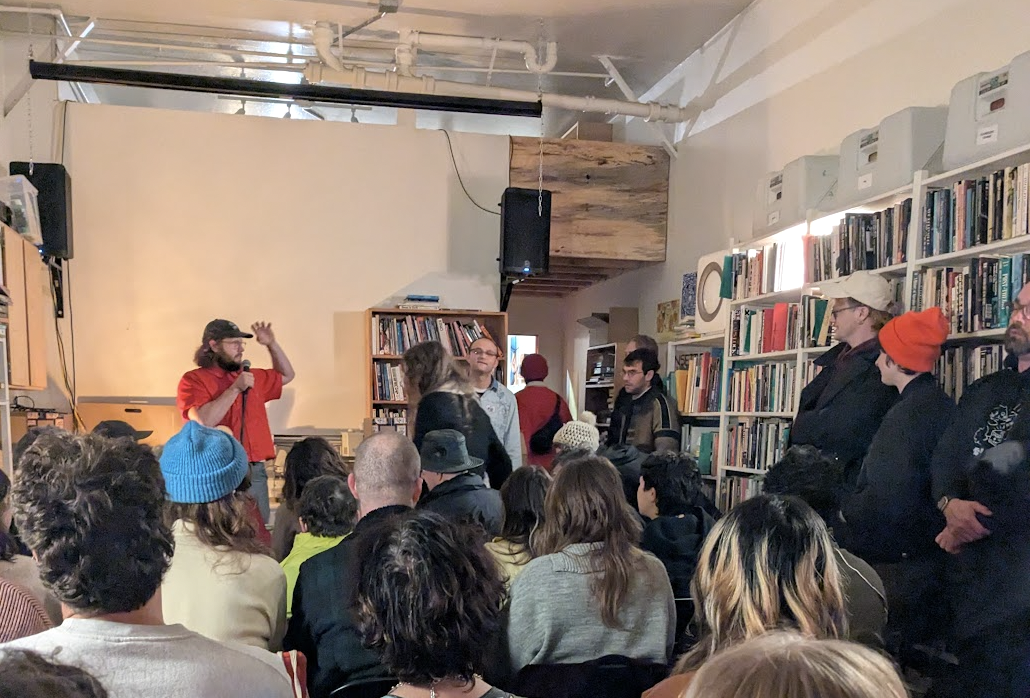
J and M are sitting in the back, near the wine (not a coincidence), as Justin introduces Bather’s Library: “The first shall be last and the last shall be first," he says, since all the chairs are full and he’s adding more in front for those still sidling in. Jacob, poetry arranger, takes over the welcoming: “Please take this seat! Yes, the mystery has been solved! We were waiting for you."
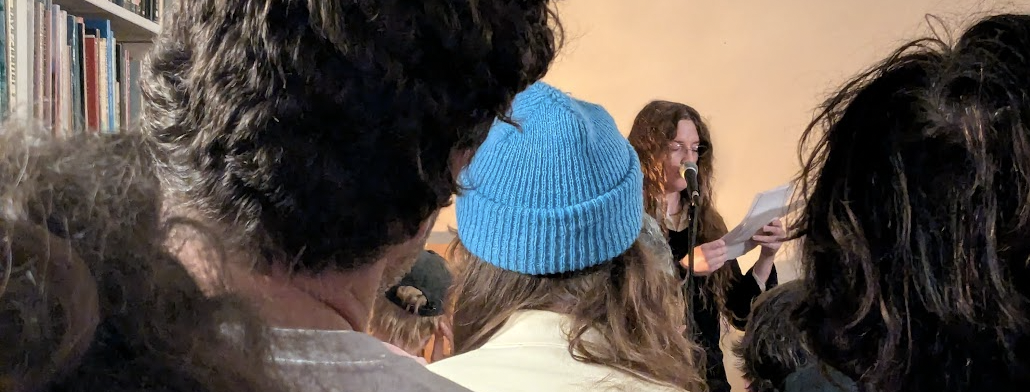
Joni Prince is the first reader; "It’s so cozy in here,” she notices, and reads a 2025 poem with seasons and feelings in it, all of which the crowd loves. What a reader to launch the new year! Our favorite lines: “One can only engage in so much sex and destruction before one begins to engage in an experiment in ‘communal living.’” And “Someone in the 16th century thought it was a good idea for the year to both begin and end with winter. Fuck you, Gregory.” And most importantly, “The purpose of poetry is to launder the truth,” which M quotes back to her when chatting with Joni afterward about the vulnerable and personal nature of the poem, which was intended to be confessional even if it was inevitably tumble-dried.
J’s ex is texting the whole evening. Buzz. “I want to hold you.” Clicks it away to watch the reading.
Joni’s second piece, titled September 6th, "I guess it's kind of a grief poem,” about Joshua Clover, about losing him last year, a poem swathed in black and clouded in pink. Someone purrs in appreciation. Joni says, “My new year's resolution is to be nice, so I'm just going to read one more poem and you can talk to me about the mean one later."
Buzzz. “Will you come over here and talk with me.” Texting quickly back as if in rapid whisper: “No. We broke up.”
JJ Mull is up next, visiting from NYC, a semi-homecoming. There’s some question of who will introduce him (Joni Prince to Jacob: “I don't want to take your job.” Jacob to Joni: “I'd love not to work.”). JJ Mull when finally taking the mic: "I'm interested in the mean poem!" and on returning to the Bay, “It feels poignant to be here." One row up from the last row of chairs, someone with dark hair, in a dark jacket, is knitting with dark yarn, fingers twisting and delivering it back to the needles. JJ’s first poem, “Usufruct / Use of Fruit” is a poem like a gathering kind of like we all are now, with quick wit and good observations, all piled up like the people keep piling into the room, the door giving a gentle ring-a-ling-a-ling every time they come in. "At every art party the small talk drives me wild what's not to loathe." And, “crumple would be a better word if you could do it to yourself," and best of all: "Mistakes made like beds.” Then, “What am I the sum of my embarrassments...We're all somebody's boyfriend despite ourselves.” Aphoristically, "It’s a thrill to be denounced a pity to be forgotten." He’s playing Wildean, he’s a bicoastal unpunctuated poet.
BUZZZZZZZ. “Should we stay broken up then.” Quickly, looking up to hear what the poets are saying: “Yes, it’s over, what you wanted.” Slides him back into her purse.
JJ’s fourth poem is titled the only thing we want to say to everyone we know: "Are you mad at me?" And it ends with the line that will live with us always: “For better or for worse, California."
Last poet, Turner Capeheart Canty, all the way from Ridgewood, Queens. (“But my heart is still in Oakland.”) The knitter has taken off her jacket, is still building a new sweater or scarf or sock stitch by stitch. Ring-a-ling-a-ling-a-ling, people are still coming in, they’re stacked from back to front.
Turner thanks Joni for leading off with confession and grief. “I'm going to put the pedal to the metal and go hard with lyric, just all lyric." But none of the poems he read would be what most would call lyric, if you mean something expressive and cohesive, written from a solid subject position expressing its relationship to other people and the world through lucent, recognizable, consistent language. Rather, we’re in the realm of language play, absurdity, and sudden swerves in register, sentences stacked up like lists, or accretions of found language. Think Gertrude Stein, think Tender Buttons, which I am trying to read again. He had posed that the alternative to lyric, when reflecting on Joni’s poems, was “social realism.” Perhaps that is way over on the far side of the lyric from where he speaks, over where words exist to do something, to be put to work.
(If all of this is coming across as obscure weird poet quibbling, just read Robert Hass’s “Meditation at Lagunitas,” which articulates most clearly, in a lyric, what the whole argument is about.)
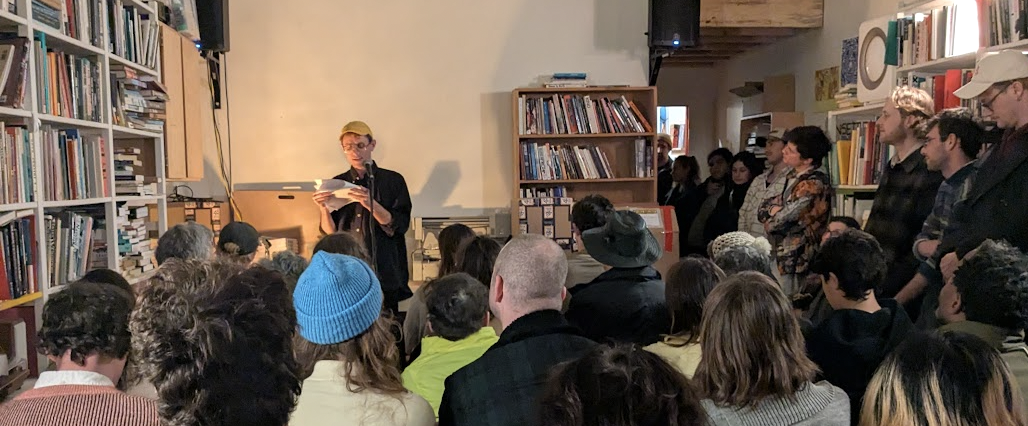
Anyway. The most memorable bits: from “Untitled Oakland": "Skimmed over by fleet week.... Here in this sunny town of sunken freeways" and ending, “so help me god is there a way that doesn't belong to anyone?" In “Rounders”: " When we play Texas Holdem, my tell is unrequited love"– that was a good one. Commenting elliptically, on little free libraries, perhaps: “So many books left unread they're starting to build little houses for them,”
The reading is over, the mingling begins. We talk with Humphrey and Ana, last seen at the Bather’s holiday party. J thinks Ana looks familiar and remembers too late that she met her at the tail end of the Zyzzyva LitCrawl event. The Costco goldfish donated to the ORB holiday party, then carried to the Bather’s holiday party by J&M, are still here to cushion the wine, as stale as they were in 2025, a whole week ago.
Then, separating, M goes to talk with Joni (a host for the Tamarack readings, she’ll be reading on the Tamarack anniversary on 1/23 and says there’s a dance party to follow; if it’s a good party, no one will be talking about poetry, she says). Here comes someone toward J, a man J went on a date with once. She thought it fizzled out since she hadn’t heard from him. Saw her across the room and said he had a new number and deleted Hinge. Tonight, he said she was glowing, said he couldn’t stop looking back at her. She had no idea. She was glowing from the heat in the room and the anger from the ex. She can’t remember the date’s name, but he knows hers; she gives him her number, he sends her a text.
We leave, head out into the drizzling rain, only to remember we forgot we were going to pull a one person introduces their friend to the person they can’t remember the name of and thereby pulls the name out to hopefully hold onto this time, so we go, but the person in question is gone. We told Justin we had two weird questions for him, both of which were, What is that guy’s name. He found one by consulting the Bather’s Yearbook, but the name of the app-deleter was left to our further detective work. It was a night of solving mysteries and banishing exes with poems, poets, and real life connections.
He texts, “It’s K. Good to run into you.” He’s a poet, oh boy. J saves him in her phone as K the Poet. They make plans for the following week.