Oakland funk
We’ve reached the olfactory portion of our Six Senses of Oakland membership drive. Read more about the drive here. Check out other Six Senses stories here. Get a great big whiff of ORB by subscribing here.
◎
“Where Eucalyptus dips her boughs / In Merritt’s silver sheen.”—Unknown author, “Oakland Hymn”
“Cross the Bay Bridge and sniff the wonders of Oakland.”—Herb Caen, 1951
In August of 2022, hundreds of thousands of fish washed up dead across Lake Merritt, their silvery corpses lining the lake’s perimeter. The “Jewel of Oakland” smelled like rot for months as city workers and volunteers removed the decaying flesh from the shore. At Lake Chalet, patrons were reportedly put off their seafood dinners by the offensive odor of dead fish.
Whether you call what happened a “die-off” or a “fish kill” can depend on whether you blame human intervention, specifically, or simply attribute it to more general “environmental factors,” a distinction with an embedded argument about the relationship of humans to the environment. But either way, what happened was the local manifestation of one of the largest red tides in Bay Area history, a runaway explosion in aquatic algae populations—or an “algal bloom"—that started close to Alameda and spread as far north as San Pablo Bay, burning like “wildfire in the water” through the bay’s dissolved oxygen, asphyxiating anything in it that needed to breathe when the oxygen level reached zero. Afterward, the city of Oakland installed an aeration filter to inject oxygen into the water to protect the lake from future blooms.
Massive fish die off going on right now in Lake Merritt #oakland #fish #lakemerritt
— Damon Tighe (@damontighe) August 28, 2022
May be related to the HUGE algal bloom that’s been happening on the east bay since the start of the month in front of Alameda where effluent flows…https://t.co/1H1byxoWOk pic.twitter.com/FJBAU0InIb
The broader bay-wide event was documented by citizen scientists, but the scale of fish death in Lake Merritt was particularly staggering, as was the stench. Oaklanders who were mortified by the magnitude of dead fish still marveled at how many there had been in the water in the first place, having assumed that the murky lake is too polluted to have supported so much life. Some waved it off, just another day on the shores of Lake Merritt, if a bit more than usual. After all, isn’t “stink” what the lake always does?
◎
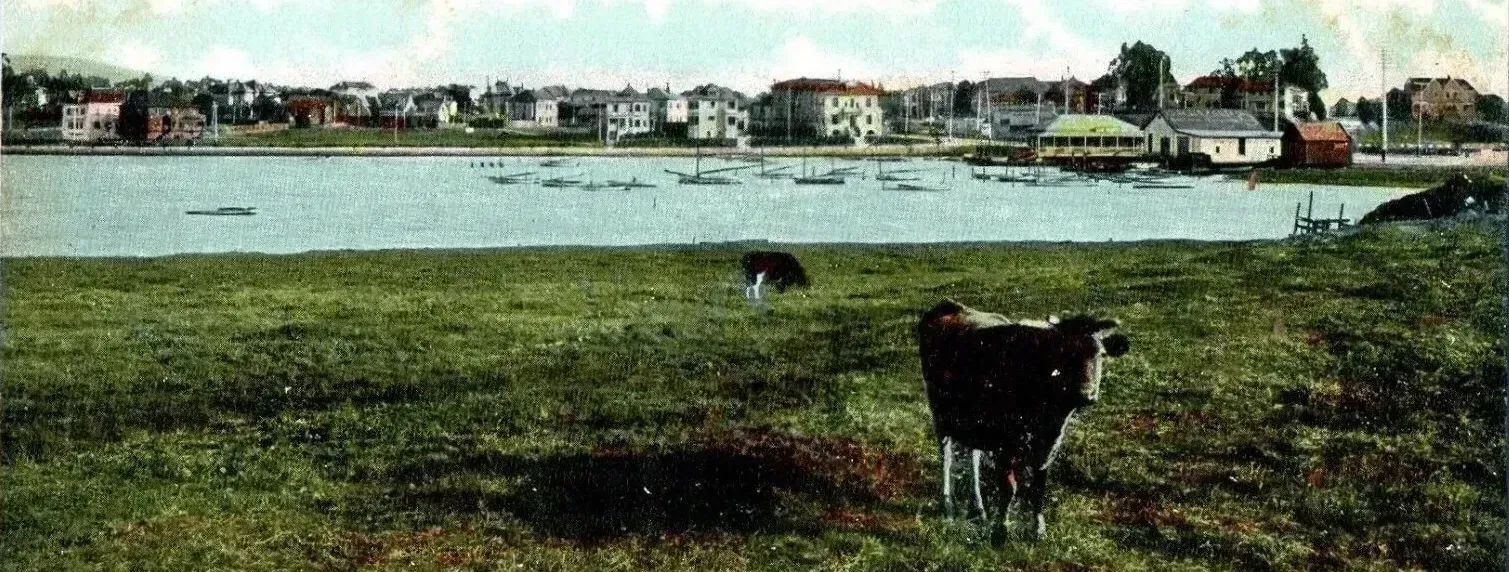
The history of Lake Merritt’s pungency spans the Oakland municipal timeline. When residents of the newly founded city first began building homes and neighborhoods on its shores, the so-called “lake” was, then, more obviously what it still actually is: a marshy and brackish lagoon, the interface between the water carried down from the hills by Oakland’s creeks into the estuary that connects Oakland to the Pacific. When there was hardly anyone else around, when it felt and was “natural,” the tidal slough’s shores made for a perfect home for those who wanted fresh air, low-lying land to build on, and a game-filled wetlands, perfect for bird hunting and fishing.
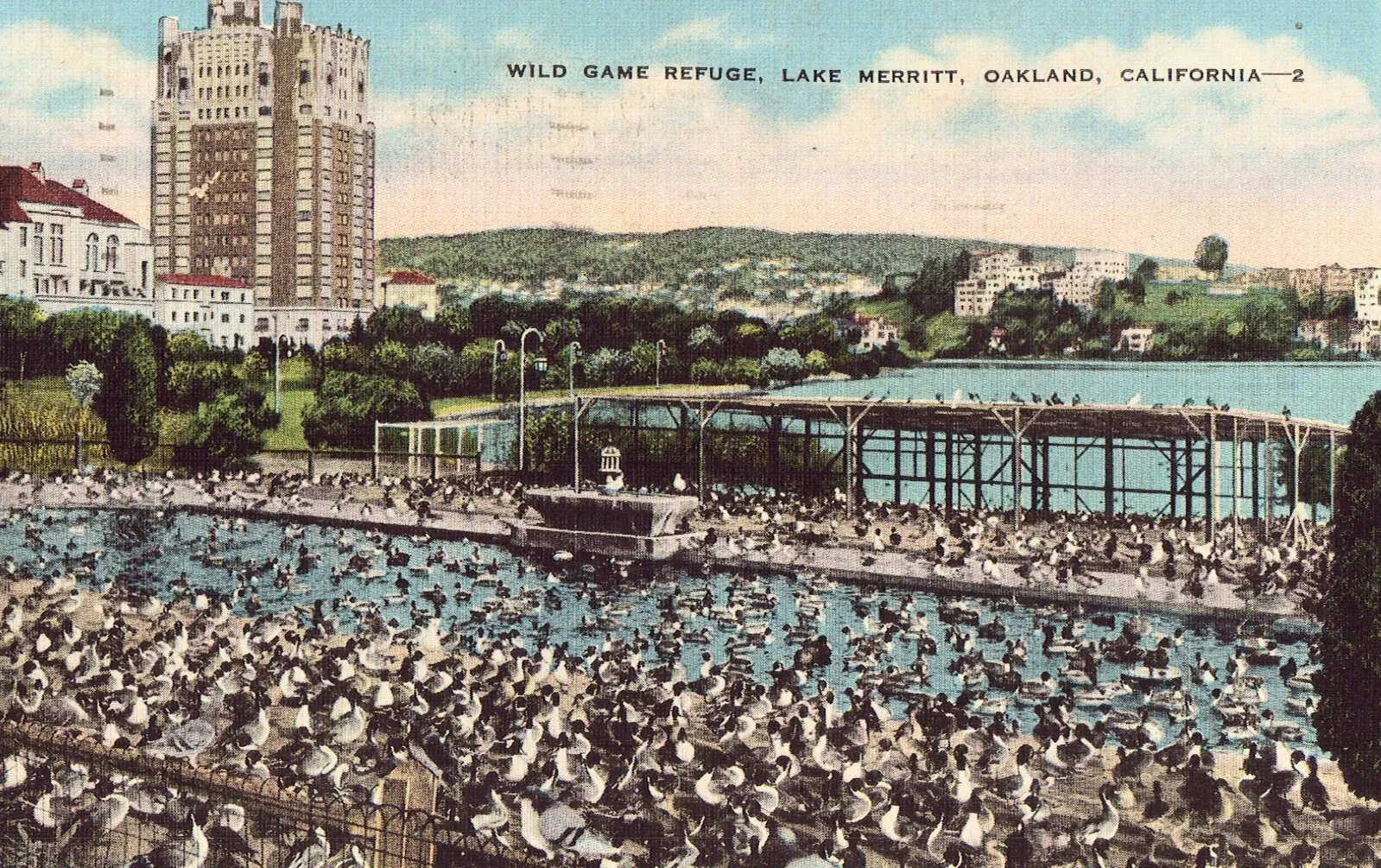
In the 1860s, it made perfect sense for Mayor Samuel Merritt to dam the “lake,” by cutting off its connection to the rest of the waters of the bay, deepening and regularizing its shorelines. This manufactured lake, Merritt believed, would be ideal for boating or swimming, enticing more people to come to the lake’s shores, and make their home in his growing young city. It was the nation’s first wildlife refuge, particularly for migrating birds, and the city built islands out of construction debris to shelter them.
In one sense, Merritt was right: Making it into more of a lake (or what a lake looks like) drew new residents to our then-growing city, as it still does. It’s a great place to sit and look out over the water, and to birdwatch. But what he didn’t understand was that marshes and tidal lagoons don’t really work like that, and just as the body “sloughs” off dead skin, a tidal slough’s connection to the movements of the oceans is what keeps its waters fresh, flushing out the dead organic matter. Without that daily flow washing in and out, the foul, sulfurous stench—that funky, eggy smell we know and love—will only deepen and thicken.
More than that, while Merritt so successfully created a beautiful watery center for his city that the lake would be named for him in 1874, the people moving to Oakland brought with them their own daily rhythms and movements: “Civilization brought toilets,” as the Lake Merritt Institute puts it. “Lake Merritt became a harbor for ‘the necessities of nature.’” And as almost all of the city’s sewage flowed into the northern arms of a lake now dammed off from the ocean and unable to flush itself, the stench grew powerful. In 1891, a city engineer reported that it was filling in by about an inch per year, and by the time Oakland’s population peaked in the mid-twentieth century, decades of industrial tampering and human excrement had left it with a new nickname: “the lake of a thousand smells.” Boating was prohibited and signs dotted the shores urging people not to swim in the lake.
The signs are still there, and—with glorious, hubristic exceptions—people mostly heed them (and get arrested if they don’t). But as the city was fully connected to the EBMUD sewer system, the lake began to recover. A pumping station was built in the sixties, and in 1985, a major dredging operation removed much of this human detritus and deepened the lake to more than ten feet at the center (since the widgeon grass and algae that consume the oxygen and kill fish grow best in shallower water). The operation was repeated in 1997. In 2002, under Jerry Brown, a master plan and a $200 million bond measure were passed to transform the lake, which they did. Most significantly for the smell, the narrow and often-clogged culverts at 10th and 12th streets were replaced with bridges over widened channels that pass directly into the estuary, allowing increased water flow from the lake to the ocean.
Next to the boathouse on the west side of the lake, a 1909 fire department pumping station that had been long in disrepair was renovated with $12 million of public funds and opened as Lake Chalet, the only restaurant directly on the water. It’s a lovely place, particularly the tables on the dock that goes straight out on the lake. But as the comments on a recent r/oakland post that dared to praise the ahi tuna salad illustrate, its reputation has long been mixed at best, known for inconsistent food and a generally stuffy, sir-is-this-the-place-for-you? atmosphere.
◎
Does Lake Merritt smell?
There is an objective answer and a subjective one, and in one way, they are the same: less than it used to, but yes. You will have to have lived here a long time, now, to remember when Lake Merritt really smelled bad, when it was still locked in from the bay, shallow and stagnant. But if you’ve spent any time near the lake, you will have smelled…something.
In 1899, Professor Edwin Emery Slosson “poured a clear liquid over a pile of cotton and told his students that a ‘strong and peculiar’ but ‘not too disagreeable’ odor would soon spread through the classroom,” and used a timer to track their reactions. “After just fifteen seconds, the students began to shift in their seats. More and more students raised their hands to show that they could smell it, first those in the front and then those in the back. After just one minute, the experiment had to be stopped—the smell was too intrusive for some students.”
We can often “smell” things with our brains before we smell them with our noses, if we know what we’re smelling is there (or if we believe that we do).
Jonas Olofsson recalls this experiment, in The Forgotten Sense: The New Science of Smell—and the Extraordinary Power of the Nose, because Slosson was testing psychology, not chemistry: The liquid was just distilled water, with no odor at all. Smell is an uncanny thing, undeniable and real—and capable of astonishing detections—yet also imprecise, ambiguous, and essentially unreliable. “Olfactory processes start not in the nose but in the brain,” as Slosson relates; we start smelling “even before the odor molecules reach their destination.” In this sense, we can often “smell” things with our brains before we smell them with our noses, if we know what we’re smelling is there (or if we believe that we do).
Smell, in short, mixes subjective impressions with objective reality as surely as salt water mixes with fresh in a creek-fed tidal slough. Variations on Slosson’s experiment have demonstrated that putting yellow food coloring in water makes it “smell” a lot worse than if you didn’t, and that the brain will light up differently under imaging scanners depending on where you tell the participants the smell comes from. But even when detecting smells that are really there, genetic and other physiological differences can cause different individuals to react in very different ways to the same thing. We can also become, quite literally, desensitized to smells, such that we only detect them when they change.
And yet, for all that, the nose is capable of knowing things that no other part of the body could. Dogs can famously smell cancer, but in premodern times, even human physicians could smell disease: “diphtheria smelled sweet, scurvy smelled pungent, typhus smelled like freshly baked rye bread, and scrofula, a type of tuberculosis, smelled like stale beer,” as Olofsson notes. He describes smell as the “forgotten” sense because of Western modernity’s emphasis on sight as the seat of higher rationality and knowledge; though smell was once important for finding food (and knowing if it was good to eat), it came to stand, symbolically, as a reminder of the prescientific, the embodied, the outright stinky that we might imagine ourselves to have left behind. (Today, we judge our food by reading labels and restaurant reviews, and we are never deceived).
Olofsson is only the most recent writer to attempt to reclaim the sense from its modern disrepute. In the last few years—or, to measure time another way, in the half-decade since the Covid-19 virus was named for the year of its discovery—books like Harold McGee’s Nose Dive: A Field Guide to the World's Smells, Jude Stewart’s Revelations in Air: A Guidebook to Smell, Mandy Aftel’s The Museum of Scent: Exploring the Curious and Wondrous World of Fragrance, and Elise Vernon Pearlstine’s Scent: A Natural History of Fragrance have focused on what the nose could do, if we let it. That this publishing bloom corresponded with an airborne pandemic that primarily infects through the nose of unmasked people—and can even take their sense of smell—might be more coincidental than meaningful. But it’s still an evocative coincidence: At a moment when so many were becoming suddenly aware of how they shared the air with so many other lungs (and wearing stinky masks in response), books like these began urging us to open our noses and breathe in the world.
As all of these writers observe, smell is intimate because it’s real: Unlike the ways artificially produced light and sound can fool us into thinking, for example, that Radiohead is actually in the room playing for us—or that the train coming out of the tunnel is about to hit us—the things we smell mostly really are there, in a chemical sense. Those molecules actual enter our actual body, as Stewart puts it:
“[Y]our worst fear about awful smells is true. The smell—that is, tiny airborne molecules from the smelly substance—really does invade your body’s interior and bind to your olfactory receptors deep inside the nose. Smell’s intimacy isn’t a problem when you’re sniffing something pleasant. But smell is largely involuntary: if you’re breathing, you’re smelling. Pungent smells can signal an unnerving proximity to food, to sex, to garbage, to pooping.”
At the same time, there’s nothing like smell to make lost memories feel present. Proust’s famous madeleine in lime-blossom tea is dutifully referenced in every one of these books, illustrating how famously the smell of a moisturized cookie, as it flows up the throat into the nose, can transport us into the deepest and richest reaches of our lost emotional past. Emotions can make us smell things that aren’t there, smells can bring back loves we’ve lost, or homes we miss, real things that are, now, gone.
These books converge and overlap, but—to generalize—McGee, Aftel, and Pearlstine focus more on the most human-manufactured and -processed version of smell, with nouns like “scent” and “fragrance” partially indexing their books’ orientation toward cooking, perfumery, and other intentionally constructed experiences. Olofsson and Stewart work more to theorize smell, as a verb and a social activity, and so, following in the footsteps of Rachel Herz’s 2014 The Scent of Desire: Discovering Our Enigmatic Sense of Smell, they tell stories about how Western civilization built a hierarchy—really a binary—in which sight came to seem supremely rational and intellectual. They all set out to reclaim a sense which has been diminished and regarded as “merely” physical, an animal remnant suitable only for prescientific “oral” cultures, but essentially unreliable and emotional. This binary, of course, maps neatly onto lines of race, gender, and class, from stories about women with their deceptive and manipulative perfumes to racial theories about how Black people or Jews (or the poor) smell, which Andrew Kettleman calls “olfactory racism” in his The Sense of Slavery. Meanwhile, high above it all, stands the wealthy white man, seeing everything and smelling of nothing, scientifically.

All of that is why, today, if you say something “smells” and say nothing else about it, you are saying that it smells bad. If Lake Merritt “smells,” then, to a lot of people, that does indeed mean that it smells bad, and that it is something other than what is should be: a place to stand and take in the scenic vista, for example, or the backdrop for sitting and enjoy seafood (untroubled by the smell of dead fish). It should be a place to walk with a friend (or more than a friend, if you can find a reasonably private place to make out in), to go for a run, to listen to the drums, or just to sit on the grass (or in your car) and be unbothered by anyone.
Smell can interrupt all of these activities, if you’re smelling something you don’t want to smell. And so, one answer to “does the lake smell?” is yes, it smells like weed (if you don’t like it). Another is yes, it smells like homeless people, because the unhoused often find the lake to be a place they can go and not be bothered by you (and your police officers). The east side of the lake might smell like the charcoal grill that “BBQ Becky” was offended by, in a phone call that everyone understood, instantly, was always and immediately about race. But we can apply the same lens to the places where it (normally) doesn’t smell: On the other side of the lake, it doesn’t smell like BBQ at the Lake Chalet because, when Jerry Brown was spending most of that $200 million on lakeside amenities, he—allegedly—promised the concession to the owners of Everett & Jones Barbeque, in exchange for defending him against the charge of racism, but in the end, he gave it to Gar and Lara Truppelli, the white owners of San Francisco’s Beach Chalet.
◎
As Stewart notes, Herz’s The Scent of Desire argues that human emotion literally developed out of our brain’s ability to process smell, that “the human emotional system is a highly evolved, abstract cognitive version of the basic behavioral motivations instigated by the olfactory system in animals.” That “emotions are to us what scents are to our animal cousins,” in other words, is what distinguishes us from presocial creatures: “Smell for animals informs survival in direct and explicit ways; for us its primary survival codes have been transformed, into our experience of emotions.”
It’s a fascinating idea. If animals need to know about molecules because they need to know what to eat—and what not to eat—we highly evolved humans use emotions to manage a very different and more complicated problem, the ambiguous and multifarious nature of the social world we’re embedded in and which keeps us alive. When smells trigger nostalgia or memory, they are indexing complex forms of social belonging through the olfactory cultures we share (or don’t), as when the smell of a particular dish can make you feel at home among strangers, or the reverse. Think about how often we shorthand complex emotional relations to irreducibly dense textures of sociopolitical reality by reflecting, for example, that a particular politician makes us puke (or when he declares that “their country stinks, we don’t want them”).
It can also index a relationship to time: “You can’t smell anything unless that thing is changing in some way,” as Stewart observes. Researchers have argued that “disgust sensitivity [is] associated with socially conservative political views”: a desire to smell nothing might flow out of an antipathy for the ways your social environment is changing, populating itself with new and different smells than the ones you grew up to see as normal. But doesn’t living with the plurality of human society—instead of standing athwart and yelling “eww”—require a more expansive understanding of these merely physical reactions? Someone who enjoys a breakfast of fermented soy bean natto is statistically likely to find a slice of American cheese absolutely foul (and Olofsson opens his book with an a propos anecdote about Swedish sour herring).
There are as many examples of how culturally and experientially motivated disgust turns out to be as there are cultures and experiences. Whether you like the smell of cannabis has everything to do with how you feel about the drug, and even something as self-evidently “bad” as body odor is far more of an acquired distaste—and a feeling about crowds and bodies and unwashed masses—than one might otherwise imagine. And as the existence of these pro-smell guidebooks demonstrates, one can learn to enjoy the smell and taste of a great many things that once disgusted you, if your brain decides it wants to (or perform the opposite operation, as needed). One can even become a connoisseur, and one orientation toward scent and fragrance is to cultivate an appreciation of the archive and museum of possibility, and to elevate one’s nose-palate.
Another is to get down and dirty in the funk of it all. The connection between emotions and smell flows both ways, after all, which also says something about the border “between” animals and humans, which is—like the boundaries of Lake Merritt—more apparent than real. Animals feel emotions, humans use their noses to figure out what we like to eat, and smell puts us back into our bodies as much as it distinguishes us from animals. If Enlightened Western Man is sometimes idealized as an individual, standing clean and clear and unaffected by society, nature, and the world around him, other theories of the human are possible, in which we resemble watersheds and estuaries and tidal lagoons, more like points of confluence and change and transformation than islands.
From such a perspective, Lake Merritt’s funkiest odors might even please us, if we can learn how to breathe them in, and want to do so. “Water unlocks smells, so wet the things you sniff whenever feasible,” as Stewart counsels. “Free your nose and your mind will follow,” as Parliament Funkadelic didn’t quite say, but maybe should have.
In reality, where water unlocks smells, Lake Merritt smells because it unlocks the smells of Oakland.
What, after all, is a lake? “A lake is often a naturally occurring, relatively large and fixed body of water” and “typically larger and deeper than ponds,” as Wikipedia tells us, along with explaining where “natural” lakes are “generally found.” But qualifiers like “often,” “typically,” and “generally” tell us something else, about how strained this definition is, as does the interesting way a lake is so often defined by what it isn’t, what it doesn’t do, and what it isn’t connected to. Lakes tend to lack strong currents, and don’t have tides flushing in and out, because of their supposed isolation from the oceans that, actually, connect every part of the world to every other part of the world. Lakes stay where they are, in theory, and don’t change, smelling of nothing but whatever is around them, the trees, plants, or city. In practice, it’s only the efforts of man and capital that keep them in place, or suppresses their natural funk.
In reality, where water unlocks smells, Lake Merritt smells because it unlocks the smells of Oakland. Lake Merritt smells because it isn’t a lake, never was, and never will be.
Throughout the formation of the city of Oakland, this essential fact, so essential to its scent, has often been lost, forgotten, or denied. But the more you learn about it, the more obvious it is, even if most people will be surprised to hear it. Lake Merritt smells like the ocean, like all the organic matter that washes up from it, and all the monsters that swim in and out. The particular eggy and sulfurous smell that haunts the lake, for those who find it distasteful, is just the normal and natural smell of a healthy and functioning salty marsh or lagoon, all those decomposing layers of dead plant matter mixed with salt water. If that process happens too fast, of course, it can burn the oxygen out of the water, suffocating anything in it that needs to breathe. Naturalists instinctively compare it to California’s endemic and natural (and necessary) wildfires, because trying to prevent nature from doing what it naturally does is often what creates the problem in the first place. But whether gentle or stinky, it’s the calling card of a past that mayors from Samuel Merritt to Jerry Brown have hoped to transform and cover over, digging deep and building walls, but which always outlasts these efforts, remaining in the air, long after they’re gone.