Prison tours
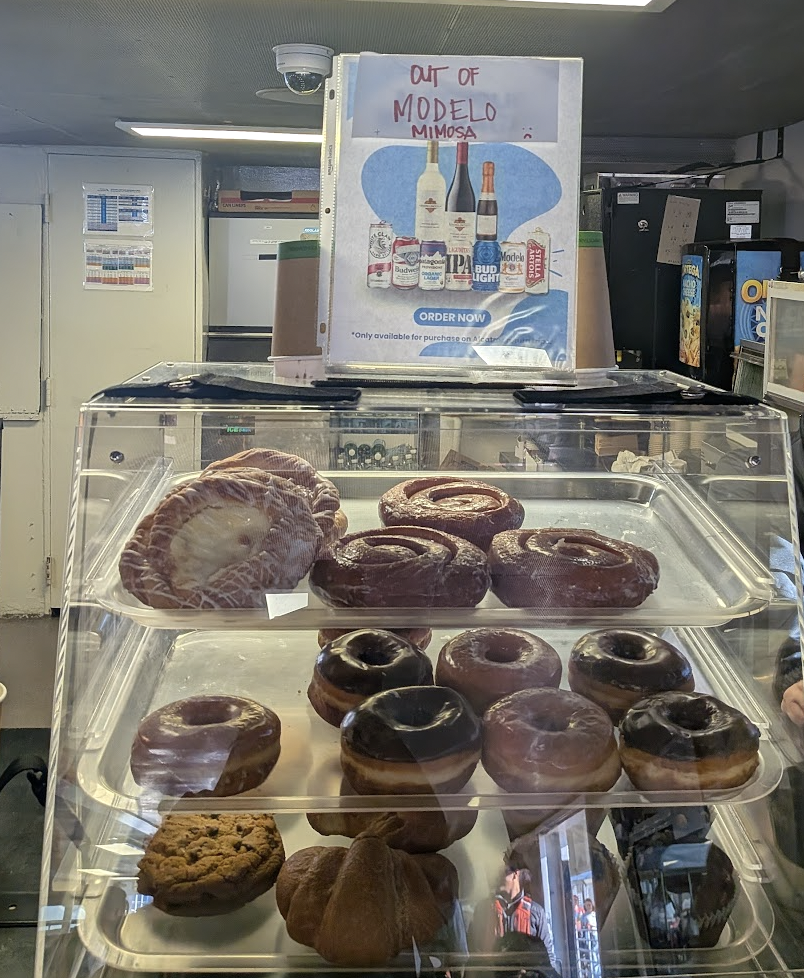
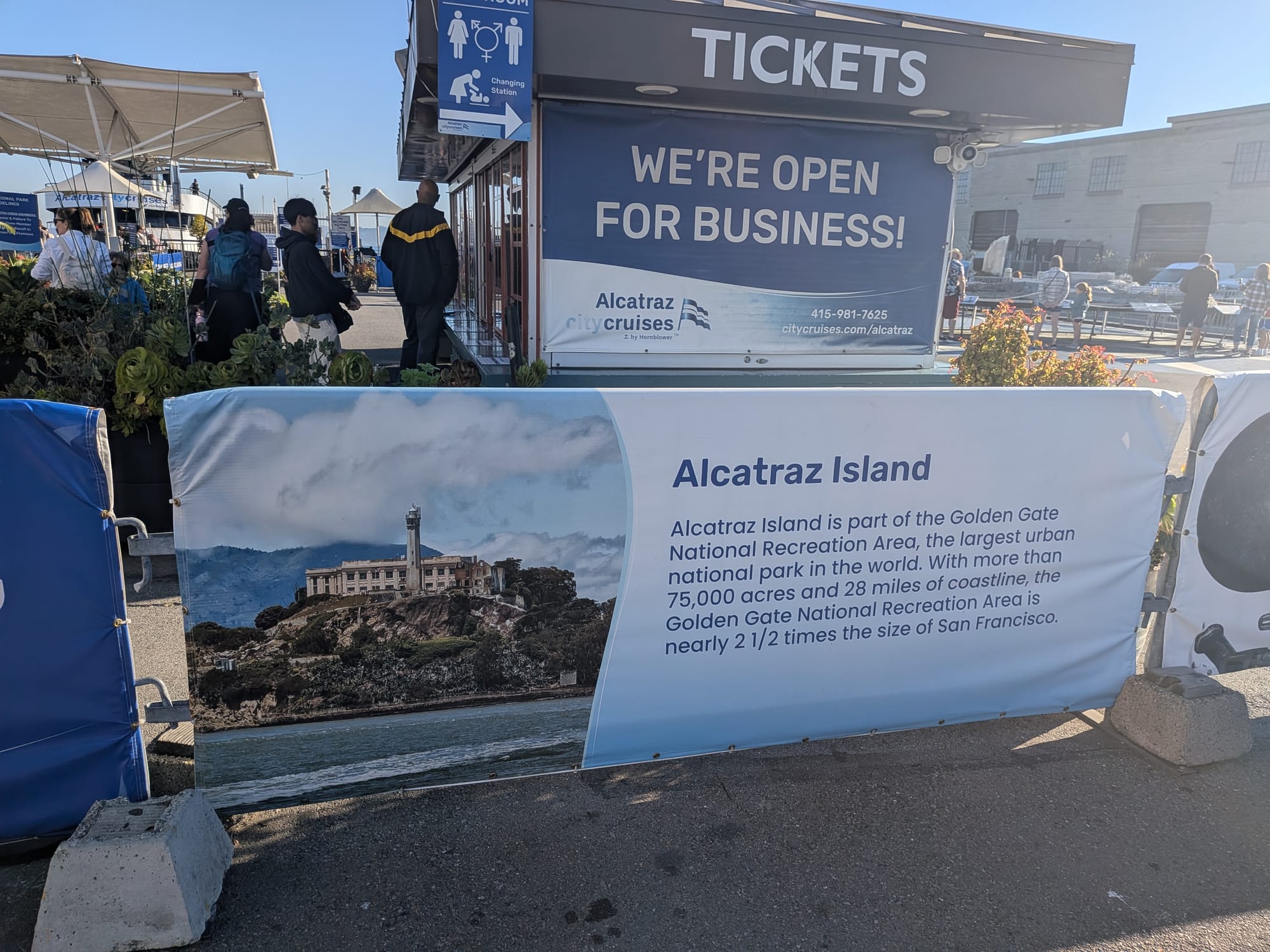
I’ll admit I approached Left in the Bay’s “Radical History of Alcatraz” walking tour with a bit of skepticism. Self-conscious counterprogramming to a tourist attraction that makes incarceration into kitsch, giving rise to its own meta-clichés? Was this an exercise in superciliousness, an opportunity to mock the tourists? The signage at Pier 39 and on the ferry (owned and operated for profit by a private vendor) transporting passengers to the island and back certainly made for an easy mark. As I entered the ferry—alongside throngs of “normal” tourgoers—I was immediately confronted by a handwritten sign, over a case of donuts, informing passengers the boat was “Out of Modelo.”
I succumbed, and took a picture of the sign.
But our tour guides had no interest in self-satisfied laughs at ironic contrasts. Instead, upon arrival on the island, our guides deftly steered our group of thirty or so away from the mass of less radically oriented ferry-mates, to give us our own orientation (in the unused designated smoking area), which resisted the island’s fetishization by trying to ignore that fetishization entirely.
The tour was an experiment, our guides explained, a collaboration between popular historians (Left in the Bay, an archival project) and the Center for Urban and Critical Environmental Studies at University of California Santa Cruz. Left in the Bay’s Matt of told us that this was the first such walking tour they had tried, and hoped to do more (and I hope they do, too); Martabel, completing a dissertation at UCSC on nineteenth century photography of the island, explained that she (and many of the attendees) were in town for a geography conference. The tour was officially unsanctioned, but we were met with benevolent smiles from National Park Service rangers at several points.
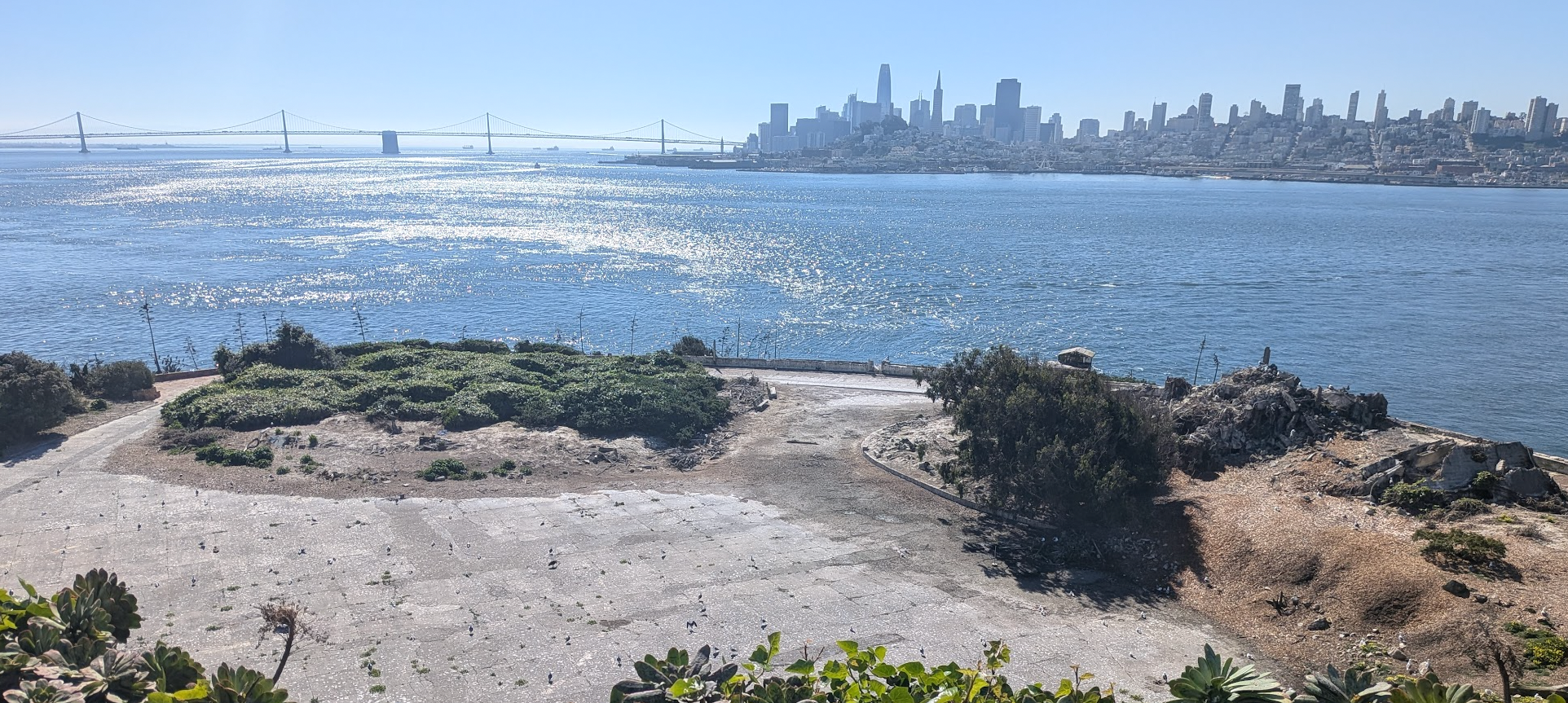
The island of Alcatraz was a construction project, Martabel explained, and the island’s current contours were as human-made as the structure that sits atop it. The buildings were built with materials mined from Angel Island, where the scars left by that extraction are still visible from where we stood, as we gazed out toward that larger island, with its own history of incarceration. But while the quarry marks a scar in Angel Island’s otherwise untouched profile, Alcatraz was carved, stacked, and leveled down and up. The island’s summit once reached 125 feet, but was reduced during the Civil War to a uniform 60; A beach disappeared in one place, elevation was added in others, and a sweep of perfectly horizontal ground was dug out by hand in what was once the parade ground (but now serves as the setting for a sunrise ceremony by indigenous people each Thanksgiving).
Walking the island, then, it’s appropriate that the overwhelming impression one gets is of concrete. From the flat plaza onto which the tourist ferries empty, up a wide ramp through crumbling buildings, we take a detour off the standard path around a corner to see slightly more intact industrial-looking structures (and the island’s power plant), before switching back and climbing the remainder of the wide ramp, to the top where the first lighthouse on the West Coast of the United States was built and the massive concrete cell block structure stretches up above you. There are gardens, and a few buildings have been partially reclaimed by green (“hope in your heart,” says one of our guides, noting that it is the officers’ barracks and entertainment center that has been most consumed by wind, water, and plants). But it is mostly gray, occasionally shaded with light pink.
A photo displayed above the parade ground (occupied solely by birds during our visit) depicts the ground’s construction, by hand, by prisoners. Prisoners built much of the island for the military, our guides explained, flattening parts and filling in others to enhance its defensive capabilities, as a sentry in the bay. This forced labor was less punitive than practical, less a problem of a surplus prison population needing to go somewhere than a construction project that needed doing. We don’t have records of all the people that were held here, Martabel tells us, but “the landscape itself is a record,” a “monument to punishment.”
It is with respect to which prisoners toiled and suffered and died on Alcatraz that the Radical Tour diverges from the official narrative, as inscribed in signs (and lurking within my own unexamined assumptions). The National Park Service, like the popular imaginary, is overwhelmingly concerned with a very particular subset of Alcatraz’s inhabitants: those who were held in the federal penitentiary that operated from 1934 to 1963, when Alcatraz was most famously the site of Al Capone’s incarceration, the “worst of the worst,” men in striped uniforms in cell blocks plotting elaborate escapes.
Before that era, from 1857 to 1907, Alcatraz was very much a military fortress, used to hold military prisoners. Not only military prisoners, though: when the ships anchored in San Francisco Bay holding criminal prisoners were overcrowded, they were unloaded onto Alcatraz, or onto the tip of the peninsula north of Alcatraz, where they would be forced to construct San Quentin. And when the U.S. extended its imperial reach beyond its oceanic borders to Cuba and the Philippines, in the late 19th century, Alcatraz held domestic defectors, no longer serving as a defensive bulwark against attack, but now containing internal threats to the expansionist program. It was also a tool of internal colonization: Next to the lighthouse at the top of the island is a photo depicting the “Hopi Nineteen,” parents who refused to send their children to boarding school, who continued to plant their own wheat, and who were incarcerated here from January to August 1895.
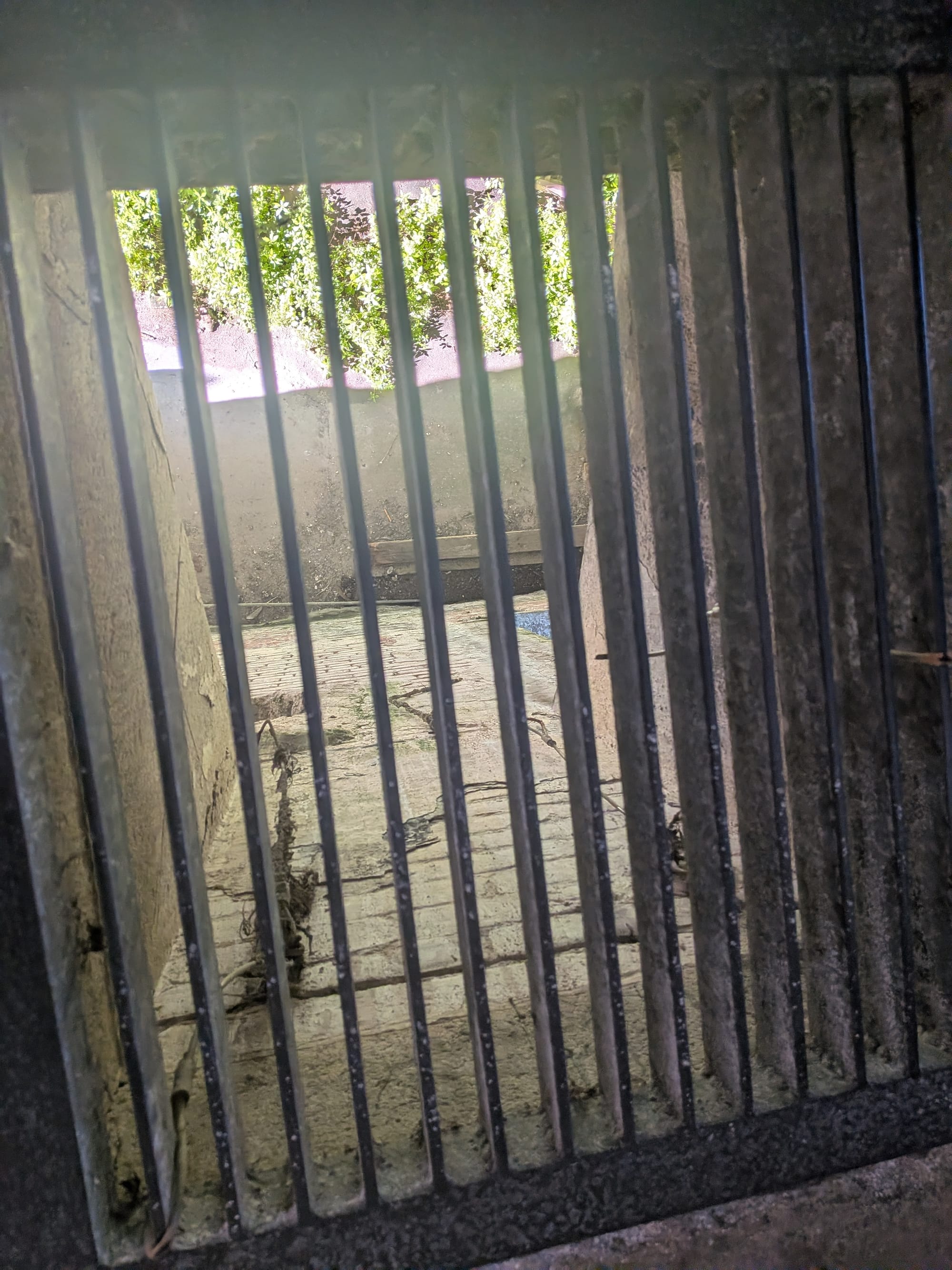
This history is not exactly missing from the official tour, but some is left out and the rest is left uncontextualized and fragmentary, just some things that happened before the main thing the island is known for. But by focusing on the first seven decades of Alcatraz’s history, the Radical history emphasizes Alcatraz as a site where penal and imperial violence intersected and reinforced each other, where the U.S. military leveraged its capacity to isolate individuals within cell, island, and bay to facilitate its outward expansion. I learned for the first time on this tour that earlier prisoners were held not atop the island but within it, in underground cells beneath the military structures, shut off from natural light, in spaces still visible through slots in the floor of the crumbling barracks structure. While these slots are still marked, they’re easy to miss, in aboveground structure set off from the main pathway up to the penitentiary.
Although the island had been used to hold prisoners since at least the Civil War, the famous penitentiary structure that sits atop it was not completed until 1912. Before it was exemplary as “The Rock,” a towering, world record–setting cement block visible from anywhere in the bay, Alcatraz was a hidden prison, its prisoners physically, historically, and archivally buried in the bowels of the island. The building that would hold the famous and more cinematic gangsters, in other words, was built by men whose terms of incarceration were only made visible, as Martabel explains, in the reconfiguration of the island’s topography itself.
Matt and Martabel take turns recounting this history in a matter of fact, almost amiable tone; they are secure in their knowledge and moral judgments, and perhaps too in the understanding that their self-selected audience does not need browbeating. The unmitigated sunshine is hot on our shoulders and faces; Matt and Martabel are apologetic that their instruction to bring jackets was unnecessary. The island is also noisy with seabirds, the namesakes of the island. (The etymology is uncertain, but our guides and Wikipedia agree the island’s name is likely a form of “alcatreces,” referring to an unspecified seabird in eighteenth-century Spanish but usually translated as “Pelican.”) The air is crowded with flies, who land on me and the notebook in which I’m frantically transcribing the tour.
No one seems bored. Participation is encouraged but sparse, which I attribute to respect. One of the tour participants used to work for the National Park Service but quit when they realized that the agency’s mission of conservation simply continued and reinforced nineteenth- and twentieth-century indigenous displacement. Alcatraz is a case study in this phenomenon: The federal government abandoned the island after the penitentiary closed in 1963, allowing members of the American Indian Movement to seize the island, in 1970, claiming title under the 1868 Fort Laramie treaty. After the year-long occupation was broken by federal marshals in June 1971, the national park was a compromise; the former Parks employee describes it as “museumification,” a derogation of sovereignty rather than a victory.
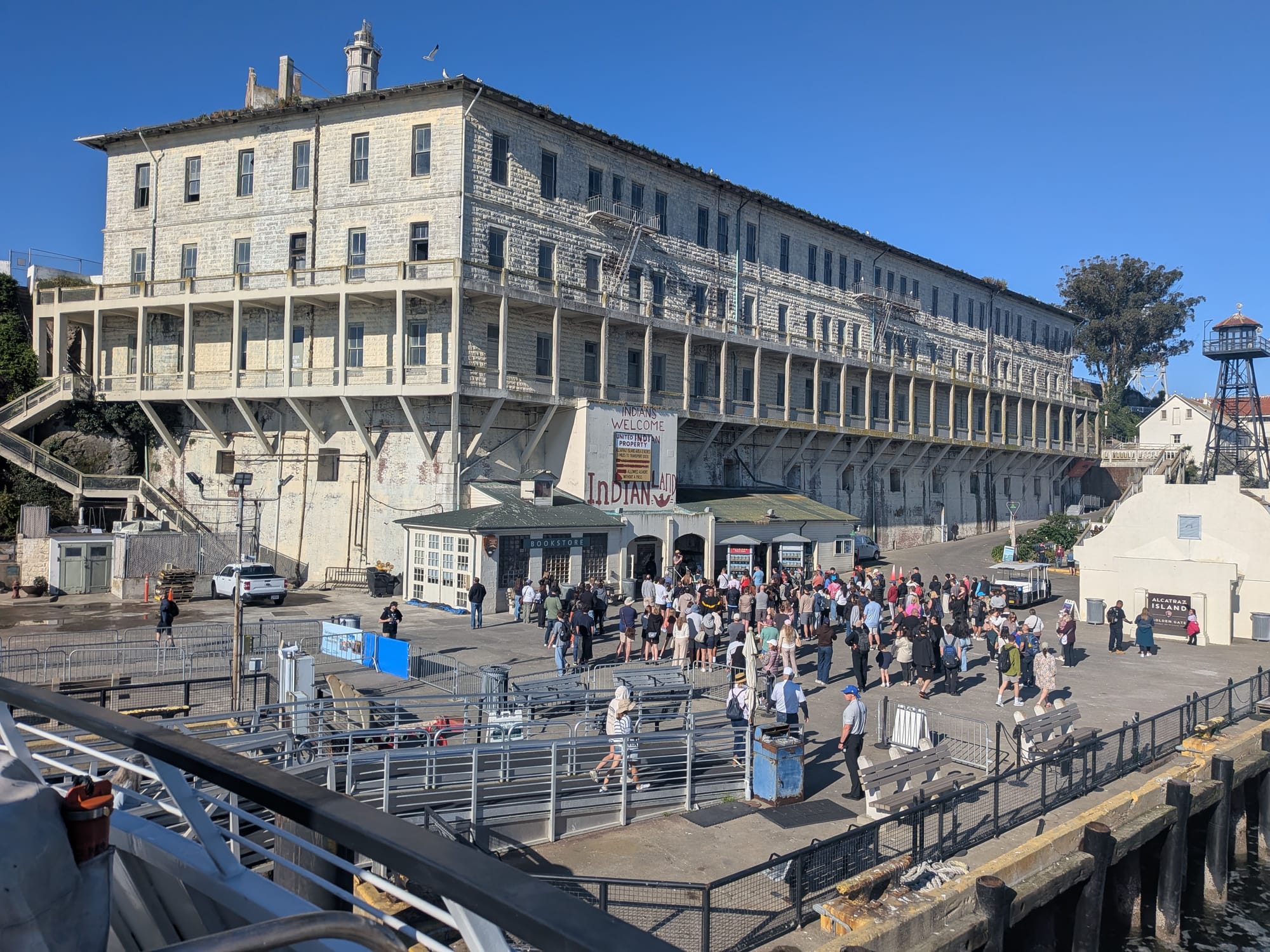
Today, again, just as when it was a place for the “worst of the worst,” Alcatraz serves as a monument to punishment, prison-as-spectacle, a place that performs itself. Eighty years ago Alcatraz’s spectacle might still have been believed to serve a deterrent purpose, as a threat; now, reconfigured as a tourist attraction, this performance also serves to obscure the underground cells and the immense human labor that went into cutting and moving and laying the rock of the geological island on which the cell block sits. Whether by National Park Service design or neglect, popular inertia or failure of moral imagination, it is Al Capone’s toilet and not the photo of nineteen Hopi men posed in front of the lighthouse that becomes the synecdoche for this place, and for the experience of the United States’s punitive violence.
The force of Martabel’s and Matt’s narration is, in part, a critique of this spectacularization, but even their tour moves forward in time, upward in space, and culminates in the cellblock, Alcatraz’s symbolic core. When the penitentiary was built, our tour guides tell us, it was the largest reinforced concrete building in the world. They discourage us from taking the audio tour and suggest we break from the flow of tourists and move through the space independently. At one point, as we are falling into step with the flow of tourists, Matt shouts, “It’s not a prison anymore! You can move any direction you want!” (He is unheard by the bulk of those wearing audio tour headphones.) In my instinctual obedience to this counterauthoritarian authority I step abruptly through a passage between cells and briefly become a salmon, swimming upstream against the unhearing scrum of conventional visitors.
But I soon give up and go with the flow. The unmarked but well-worn path through the cellblocks is quite long—which I suppose extends the time visitors can spend listening to the audio tour. It’s also repetitive, numbing. People rush up the ramp outside through the wreckage of the island’s military history, then spend half an hour walking past identical cells. They take selfies in those left open for this purpose. A dad, rejoining his young son who I’d guess is about seven years old, asks him excitedly: “You see the grenade holes yet?” (Matt has already told us about the grenades, which marines dropped through drilled holes in the prison’s roof during a 1946 uprising.)
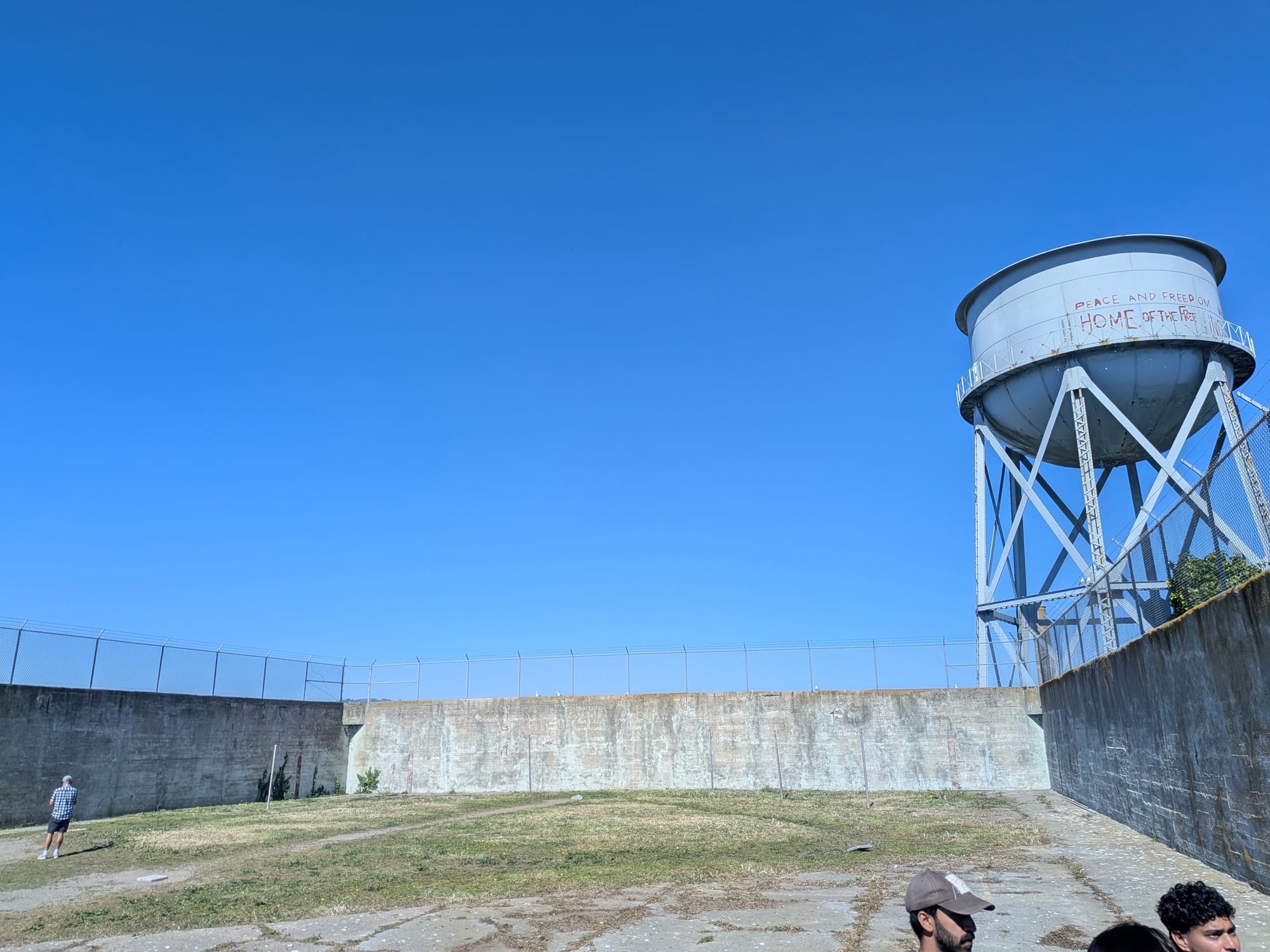
I lose track of my fellow radical tourists in the crowd, until we reconvene in the recreation yard, a large dirt area with concrete steps in one corner, all completely surrounded by a wall. There is a small gap through which I can see the glittering dark water and white-blue sky. A man wearing a sports jersey and cap pretends to run baseball bases on the yard, laughing. After our tour guides invite comments and give us a brief debriefing, the tour ends, allowing us to find our way back to the return ferry in our own time.
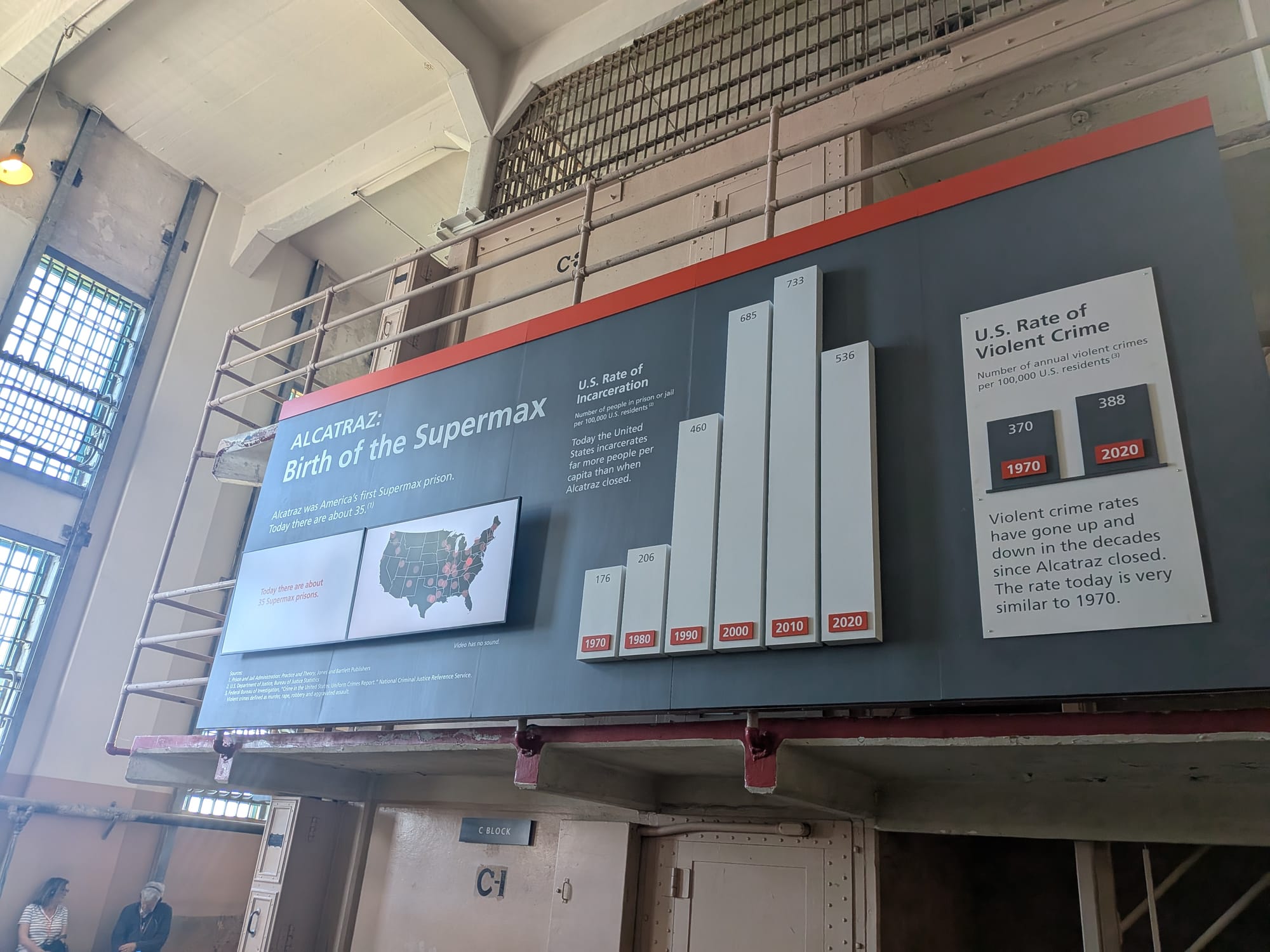
No one is currently incarcerated on Alcatraz, although Trump, the-man-who-would-be-spectacle himself, has asked us all to pay to “reopen” it. But Alcatraz-the-museum does nod toward more recent penal practices. On my way out, I lingered by a sign declaring that “Alcatraz was America’s first Supermax prison,” with a map of the lower forty-eight states and the thirty-five currently-operative supermaxes marked in red circles (while a looping video shows images from inside the supermaxes themselves), and a bar graph shows the rate of incarceration (rising from 1970 to 2010 before finally falling in 2020). To the more progressive visitor, this exhibit—placed a little too high on the wall, requiring the viewer to strain ever so slightly to view and read it in its entirety—feels like an implicit nod, an acknowledgment. Yes, we know, it says. It’s not just Al Capone in these places.
But this sign, I confirm with a longtime friend who is a scholar of supermaxes, is wrong. (She says the curator who worked on the display has promised to fix it.) Alcatraz was not a supermax in any meaningful sense. Prisoners were not held in completely enclosed cells, and they were able to engage in recreational activities, eat with their fellow prisoners, shout across the passageways between cells easily through the bars that rendered them visible to their interlocutors (and vice versa). Craning my neck to read the exhibit’s text, I am irritated. Even in its partial, halting attempt to acknowledge the ongoing horrors of U.S. imprisonment, the sign elevates the myth of this historical, defunct prison over the reality of solitary confinement, which is, after all, torture.
California’s actual first supermax was and is named Pelican Bay. That is, the observant reader might note, an English near-translation of the Alcatraz’s eighteenth-century name, a perhaps-subconscious concession to the ironic rhymes of history. But if Alcatraz was sited squarely amid one of the state’s iconic metropoles, Pelican Bay was hidden: As Keramet Reiter (the aforementioned scholar of supermaxes) documents, only a single legislative document described its construction, which was funded through off-the-books lease-revenue bonds, and it was built for the express purposes of economic development in Del Norte County, thus tucked away in the remote California coast, often literally obscured by fog.
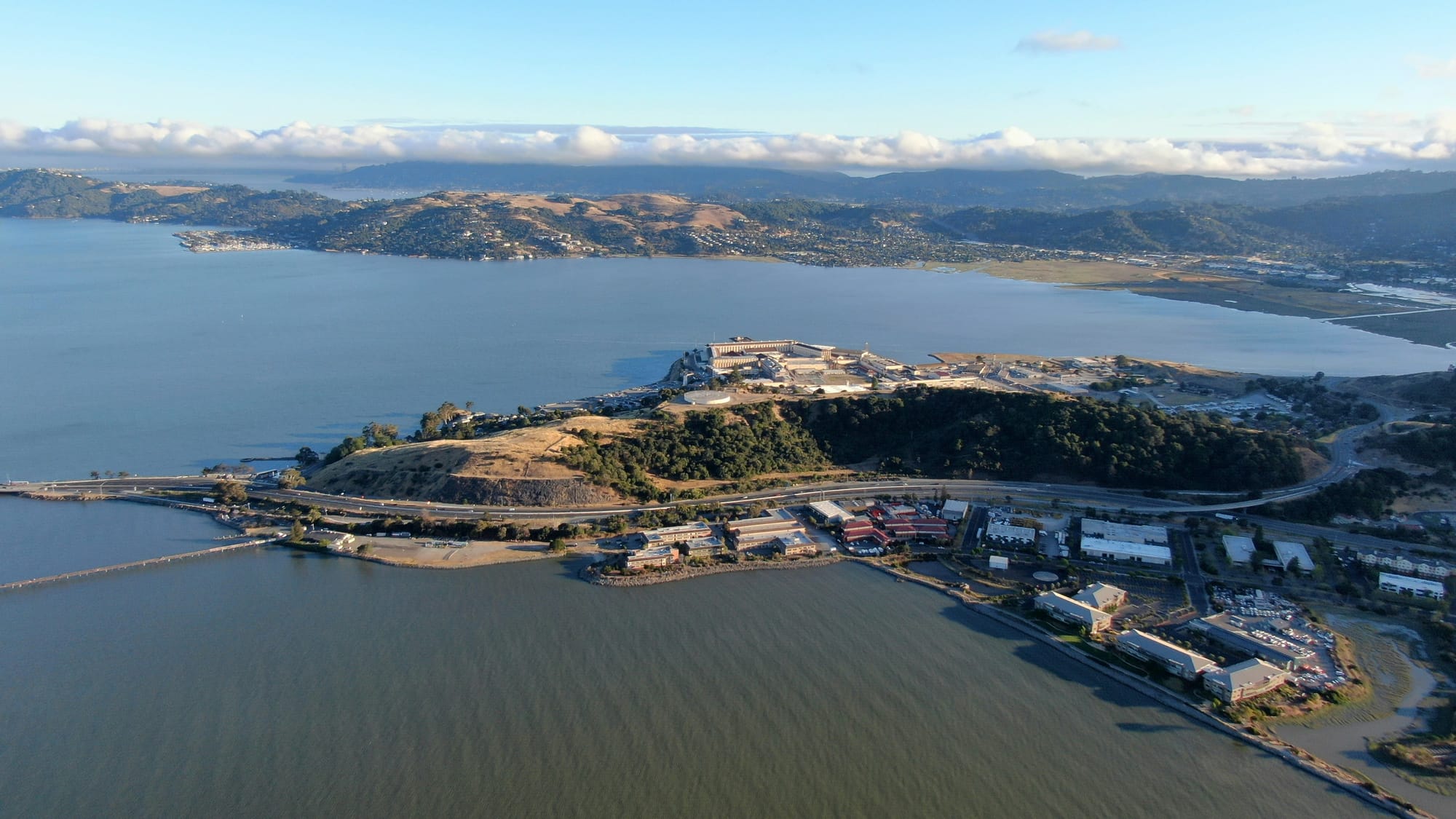
Alcatraz’s true hypervisible heir, and its present-day twin, is a much more permeable institution, and located much closer: San Quentin, an icon of our more “progressive” era in penology and visible across the various peninsulas extending out into the bay. This tour was only my second time on Alcatraz, but I’ve spent hundreds of hours in San Quentin, from 2008 to 2012, and again since 2023, teaching college courses there as part of what was originally called the Prison University Project and is now the fully accredited Mount Tamalpais College. San Quentin, in the last decade, has become a stand-in for California’s penal pivot, the churn of reforms that began with a “realignment” moving prisoners from state to local prisons in 2011, the site of press conferences.
Exactly as Pelican Bay is not, San Quentin is visible, accessible, and on display, the site of the latest in penal innovations. The week after I took the Alcatraz tour, Mount Tamalpais classes moved into their new home, the $239 million, 81,000-square-foot Learning Center within San Quentin’s walls; a February press release bragged that it was the “fastest state project in history,” having been built in eighteen months, part of Governor Newsom’s multiyear effort to make San Quentin the “crown jewel” of a new, warmer, kinder, state prison system.
Although it is now home to the Learning Center and, as of 2009, a $136 million hospital built to comply with a court order, San Quentin is old, sixty years older than the penitentiary atop the rock. When men were moved from overcrowded prison ships in San Francisco Bay, as Martabel told us at the start of the tour, they were deposited not just on Alcatraz, but further north, in Marin, and it was those early prisoners who built San Quentin. The bulk of the prison looks its 172 years. Before Newsom’s moratorium on executions, San Quentin housed the state’s death row in a closed-off section of the prison; the revolutionary George Jackson was killed in 1971 as he tried to escape the then maximum security prison. In the 1990s San Quentin was reclassified as the second-lowest security level; to be transferred there, prisoners had to have years of “good behavior.” In 2023, Newsom renamed it a “Rehabilitation Center,” and commissioned a 150-page report on “Reimagining San Quentin.”
San Quentin is the only prison in the California Department of Corrections in anything like proximity to a major metropolitan area, one reason it sees so many, many more volunteers than other prisons. There’s a public bus stop just outside the gate, so that it is possible to visit the prison without owning or even renting a car (while prisons in the far north of the state require many hours of driving from San Francisco for visiting families, a solid day or more from LA). San Quentin’s accessibility doesn’t just draw volunteers, but also professional athletes, celebrities, and reporters: In October 2024 the New York Times covered the first annual San Quentin Film Festival, featuring Jerry Seinfeld and Kerry Washington, and in November of last year, the paper published a story—with plenty of photographs—about the prison’s baseball team, the San Quentin Giants, which hosts high school, college, and recreational teams from the Bay Area and beyond. Both stories juxtapose the drama of sport and, well, drama with the tension of potential parole for the prisoners-made-good through sport or art. San Quentin is also the setting of the popular podcast Ear Hustle. Begun in 2017 as a project of two men inside San Quentin and a nonincarcerated artist, the show tells “stories of the daily realities of life inside California’s San Quentin State Prison, shared by those living it”—and later stories of parolees, now that its cofounders, Earlonne Woods and Antwan Williams, have been released. It’s been covered in the Atlantic, Rolling Stone, and the New Yorker, won awards, and is listed among Time’s Top 100 Podcasts.
I find all of this unsettling, though I am a participant in the San Quentin rehabilitation project (in the form of algebra classes and stats tutoring). All of the popular media about San Quentin feels like a cousin, if not a sibling, of the Alcatraz gift shop adjacent to the cellblock structure. Newsom’s grandstanding, of course, invites an easy cynicism: San Quentin’s “transformation” allows the governor to placate powerful entities whose income derives from constructing, managing, and exploiting labor within California’s prisons, while also shoring up his progressive bona fides in a state with significant proreform voting blocs (and perhaps for a future Democratic presidential primary). But CDCR also gains from doing this reform dance, even if it is, nominally, the thing being reformed: When you read an article about celebrities viewing films produced by prisoners, do you find yourself thinking, even subconsciously, even just a little, that perhaps prison cannot be all that bad? They’re smiling in the pictures, aren’t they? The film festival, Ear Hustle, articles about the prison newspaper, all of it builds empathy among a general public mostly disinclined to consider the well-being of prisoners at all. But they also, perhaps, build a degree of complacency.
Even I only see my students in a classroom, with classroomlike things on the walls; I do not see them when they are held in single-person cages, cages I have only seen one time, when we were once rerouted to exit the prison not through the yard but the dining hall. I do not see them when they are routinely awoken at four in the morning (sleep deprivation is endemic to prisons), or when they are pulled away from parents or children because visiting hours have expired.
And that is within San Quentin. How representative of the general incarcerated population is San Quentin itself? So much of what we see, there, is exactly how it isn’t, elsewhere. Baseball can be played year-round in Marin, but at Avenal State Prison—a few minutes off I-5 almost exactly halfway between San Francisco and L.A.—running the bases kicks up dirt infected with Valley Fever spores. Four thousand California prisoners have been diagnosed with the disease since 2005; fifty-three have died. Foregrounding San Quentin obscures the experiences of those in California’s thirty-three other state prisons, like Avenal, which are absolutely not saturated with programming or hosting film festivals. That the vast majority of California prisoners live in hotter, more crowded, more dangerous, more lonely, and more brutal institutions is precisely what one does not see at San Quentin.
For the men inside San Quentin, of course, there is much to be gained by being put on display in this way: They get more programming, more outsiders coming in, more access to information (my students have laptops now!), and more opportunities to speak to an audience of nonprisoners. They should have these things; I am glad that they do. But if the official line of the State of California is that we can trust these individuals with celebrity visits and baseball bats and internet access, why can’t we trust them to leave? Why spend so much money to provide services to mitigate a system of violent enclosure rather than just letting folks out and (God forbid!) offering the same services on a voluntary basis?
Recreating a simulacrum of a community within a place literally walled off from the natural beauty that surrounds it, divorced from any of the prisoners’ families or friends, staffed with volunteers and staff who have little ability—and in some cases are actively barred from—continuing to maintain relationships with men once they are released, all this begins to feel not quite about addressing the prisoners’ needs as much as fulfilling a fantasy of magnanimous control. Perhaps the spectacle of San Quentin is not just about protecting CDCR, or promoting Gavin Newsom, but about soothing our political consciences, we the Ear Hustle listeners, the New York Times readers, the (sung in Phil Ochs’s voice) liberals.
The need to reform criminal justice has become sufficiently mainstream as blue-state left-center doctrine that it’s easy to forget how recently Californians voted in favor of a constitutional amendment to “strengthen victims’ rights” by making it harder for prisoners to gain parole (2008), and also decisively voted down a measure to increase funding for drug treatment and rehabilitation programs in prisons (also 2008). California’s prison population had previously surged after the 1994 enactment of a three strikes law, predicated on the notion that anyone who committed three felonies was either fully disposable or so incorrigibly dangerous as to be incompatible with being “on the outside.” Today, the pendulum may be swinging back to those days: In November 2024 Californians overwhelmingly voted to reclassify various drug and theft offenses as felonies, a mere decade after voting to classify them as misdemeanors to reduce the number of people in prison. We (“we”) have just knowingly voted to put many more people inside.
This back and forth has kept the politics of carceral cruelty front and center for Californians. Whatever opinions folks over thirty hold now, their adolescence (and for older adults, much of their adulthood) was spent marinating in political advertisements, news stories, speeches, campaign promises, and popular sentiment that cast criminals as dangerous, in which “crime” is an irreducible category in which any kind of felony is understood to signal a capacity for the worst violence, in which prison is necessary for “our” protection, and in which any effort to make prison more comfortable gets construed as both undermining its all-important deterrent effects and as a slap in the face to the victims of those prisoners on the inside. We have all been taught, and most of us believe, even if only subconsciously, even if only a little, that prisons exist to keep us safe.
Walking into a prison—an active prison—compels one to confront this belief a little more directly. When I started teaching at San Quentin in 2008, my friends and family asked if I felt safe teaching. I did, and do. I was glad to tell them that, eager to do my part in disabusing stereotypes, happy to convince myself as well as others that I taught in a kind of inverse state-of-exception, an island of mutual trust. My students behave like, well, students. Someone always jumps up to help distribute handouts. Some sit quietly (and maybe a little sullenly) through class, others raise their hand every time I invite participation, some good-naturedly grumble about the material, some laugh at my attempts at humor, some needle me a bit when I make a mistake at the board. They groan in frustration or shake their heads when a concept proves difficult and I’ve seen some pump their fists when handed a quiz with a near-perfect score. No one says or does anything that feels remotely threatening, and the only time they raise their voices is to be heard over ambient conversation. There are no guards in the classroom; instead one or two sit outside, around a corner, watching TV. I know what my friends and family are asking and I try to answer in the negative: No, I’m saying, I don’t depend on the institution’s threat of violence to feel safe.
But…of course I do. How can I not? I am forbidden from wearing blue (and green, and gray) into the prison so that, if a riot were to break out, the guards can tell at a distance I am not one of the inmates and do not try to shoot me. Ironically, being shot on a “normal” college campus has crossed my mind; it’s in prison where a “school shooting” is not a worry I have ever had. And yet, of course I rely on the institution’s control over my students’ lives, if only for the perception of safety; anything and everything I do in San Quentin happens within, is permitted by, the control the institution has over my students’ lives, and is inseparable from it.
If magnanimously “reimagining” San Quentin along kinder and gentler lines serves a political purpose for Newsom and his fellow carceral liberals, it also serves a psychic purpose for all of us who are implicated in the violence of U.S. prisons. Alcatraz is fetishized, but so is San Quentin, which has become almost a shorthand for resolving contradictions in how progressives imagine their relation to state violence. The “good prison” can obscure violence we are all embedded in and of which at least some of us are interpellated as beneficiaries.
San Quentin tells a story of progress, of moral absolution through social change. But this is exactly the thing: Prisons are always reforming, they are never reformed, and the history of prisons is of institutions always on-their-way-to-becoming the thing that renders itself unnecessary, but never quite getting there. That enables people (maybe even me) who feel a little bit safer knowing certain people are “behind bars” to engage with and cheer for those same persons’ redemption narratives while still eliding, to the maximum extent possible, the role of state violence in continuing to structure those narratives and the reform project itself.
After all, San Quentin allows people like me to engage with prisoners who we feel should be outside, who can do “outside” things like write news articles, take college courses, or make films. It also allows us to participate in their reform (and, implicitly, in the reform of their prison, which we make kinder and gentler with our presence and work). But none of my students are actually outside. They are kept, involuntarily, in prison. And because they are, the journalist, or visitor, or volunteer can sidestep any uncomfortable questions about whether we really do think it’s safe for the artists, and thinkers, and writers of San Quentin to be outside, with us, when guards and an entire surveillance apparatus aren’t just a door away. More than that, San Quentin allows us to talk about crime and punishment without answering the much harder moral question of what to actually do with people who break the law, because the state has already done it. It lets us off the hook. We are allowed to recognize the humanity of people convicted of crimes without weighing that humanity against their sins, or our own safety, because the state has absolved us of the violence it performs for us, quietly, in the background, which it buries under the much more visible and pleasing spectacle of reform. Similarly, we are excused from having to reconcile the simultaneous humanity and horror in people who have done violent or cruel things, precisely because the San Quentin inmate is reformed, repentant, on the path to rehabilitation.
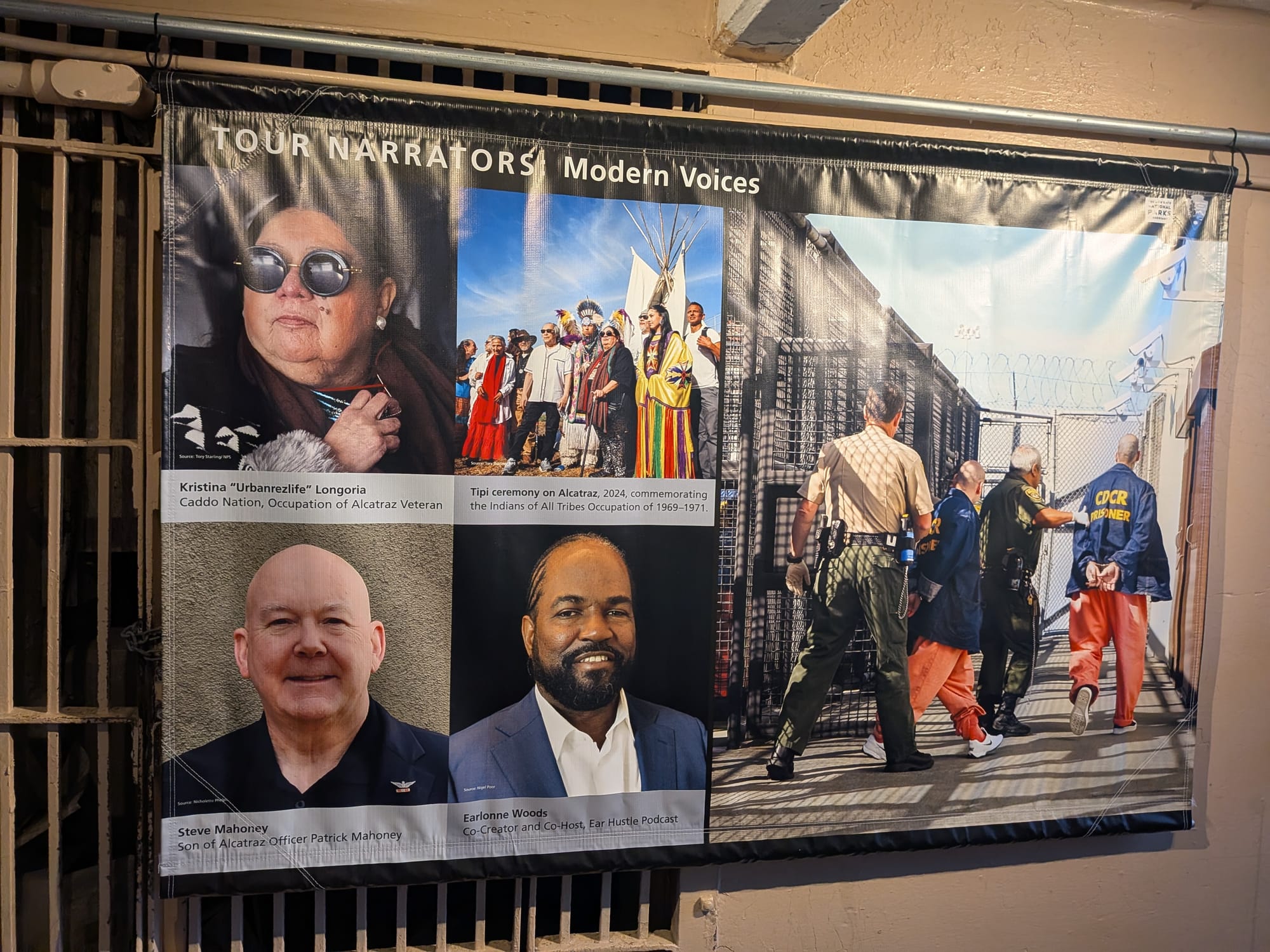
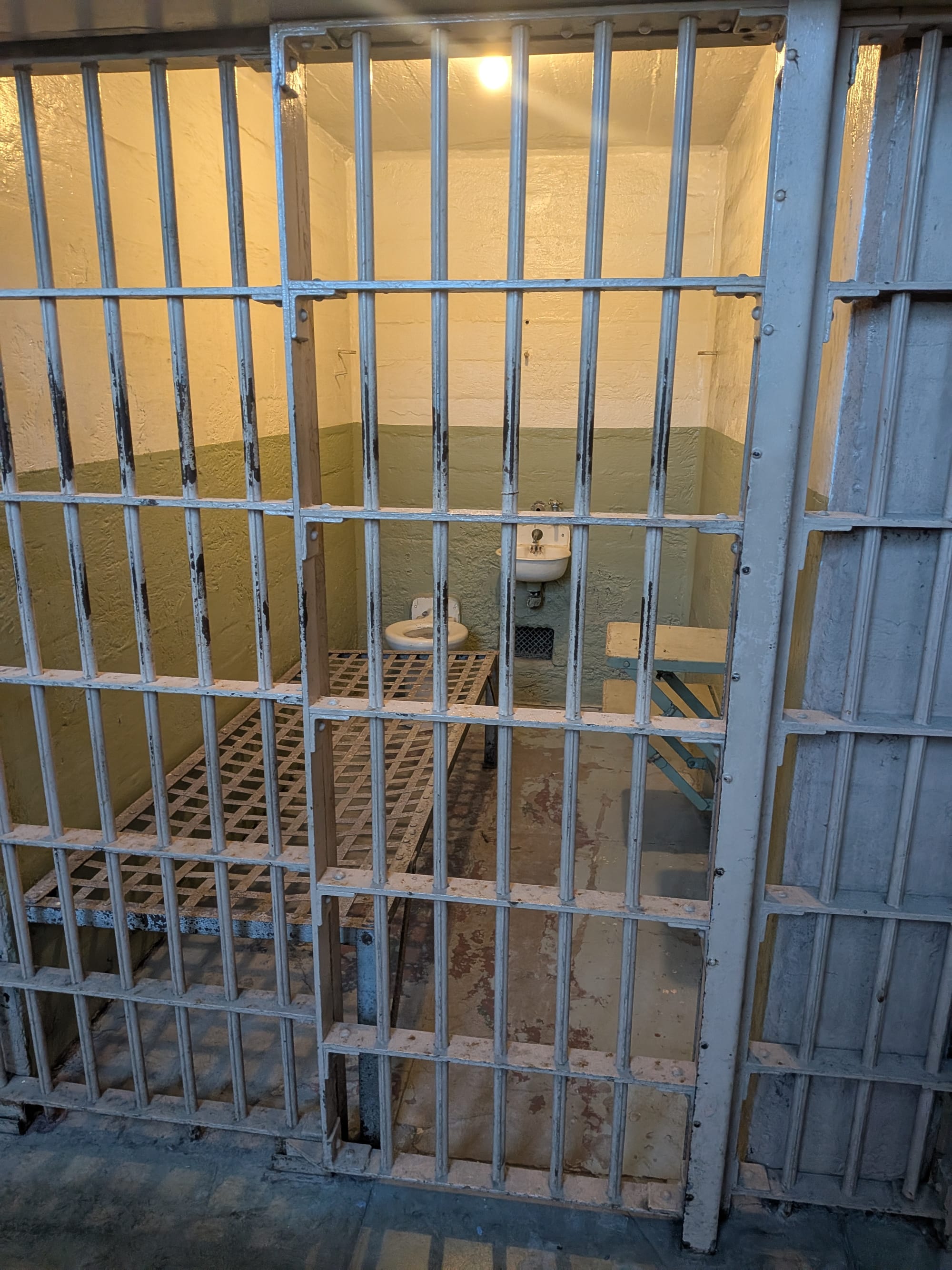
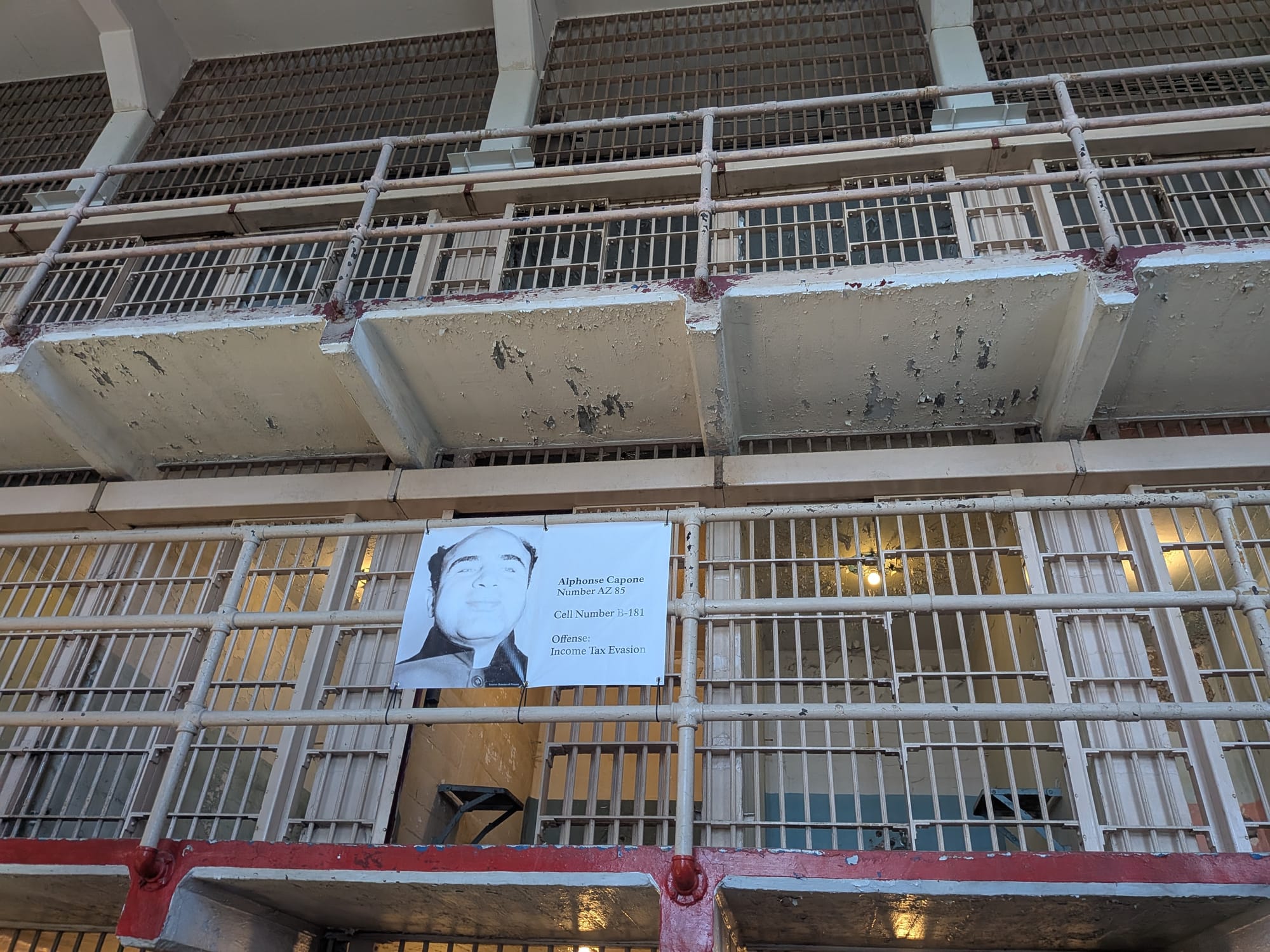
At Alcatraz, across from the supermax display above the open area at the end of the cellblock rows, where visitors enter and exit, there is a sign hung at eye level, full color, with photos of the audio tour’s narrators. One of these narrators is Earlonne Woods, commuted from his incarceration at San Quentin (and eventually even pardoned), in part, for his work on the Ear Hustle podcast. The prisoner-run San Quentin News also features prominently in a side room at Alcatraz, where curators have placed copies of a variety of prison newspapers. Here at Alcatraz the cells are open, available for anyone who would like to step inside and snap a selfie. The tourists who do so beneath the Al Capone banner may be imagining themselves in a historical tableau, going back to a time when, for example, prisons had not yet been “reformed.”
But they are seeing the almost literal conditions of living humans less than nine miles to the north. The cell blocks of San Quentin look exactly like those preserved in the Alcatraz museum.
Or at least, so I’ve been told. For all my hours in San Quentin, I’ve never been on a cell block. Instead, each time I enter I cross the recreation yard with the open sky above me and Mount Tamalpais visible above the wall, climb a few steps, and walk directly into a classroom building that, unlike the cell blocks, is air conditioned in the summer. When I start teaching again in August I’ll take a right turn instead of a left, and get to see the new gem of an education building for myself. After class is over I’ll walk out through the various checkpoints, metal bars clanging opening for me and my fellow volunteers, cross the parking lot, and get into my car and drive across the San Rafael bridge, from which San Quentin is spectacularly visible, jutting out into the glittering San Francisco Bay. And I’ll wonder if, for all my enthusiasm for algebra and the joy of comprehension in my students, I’m just another tourist, being shown the prison its architects and wardens and maybe I, too, want to see.