Public hands
This week we’re publishing a handful of stories about the bad vibes in the tech industry. Sorry!
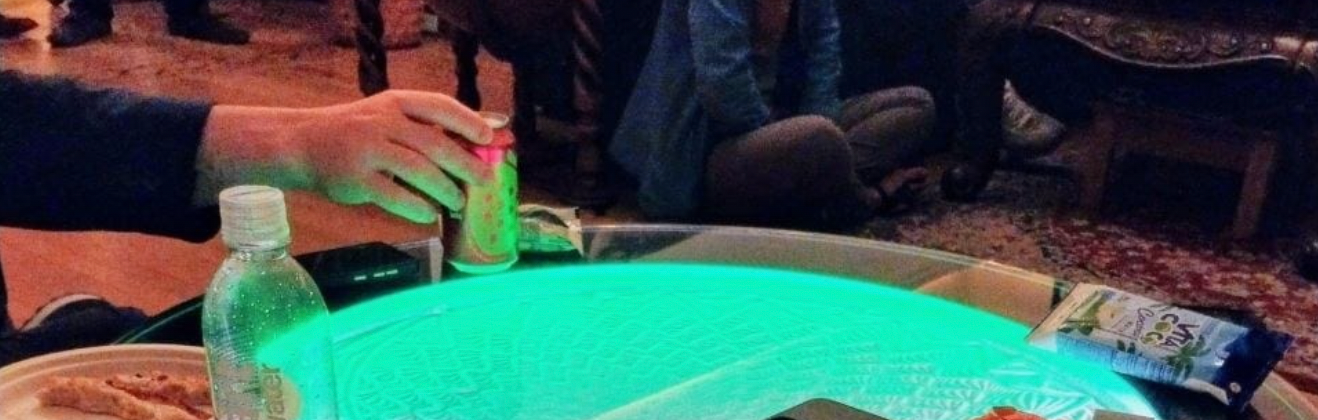
Every hand I saw drinking craft drinks at Lighthaven was a bit softer than the last. Such soft hands, invisible hands that don’t want to be cut off, the hands of people having a really good time in the world they have created for themselves, rationally, but always without actually using their hands.
I was here one sunny Monday because my evening plans had gotten canceled. My friend had asked me if I would like to go to an event with him instead, for “anthropology”: our code for doing something disturbing. We came to Lighthaven, a place for AI “rationalists” who also consider ideas like protecting AI from humans. This particular event was a gathering for anyone scared that AI was going to kill them.
Among the soft-handed, I had the best gluten-free pizza, with a kind of fresh chimichurri sauce on top to cut the cheese. It’s rare to eat gluten-free pizza that has any real elasticity to it, but I could tell the soft-handed spared no expense when I had the rare chance to use my canines to chew this seven-out-of-ten gluten-free pizza crust (though the scale really only goes to 8.5). Sitting next to my friend on a plush outdoor couch in a courtyard that felt like a wedding catered very quickly by children, I was excited to see a young woman firing up an espresso machine: the La Marzocco espresso machine (valued at up to $16k).
Noting this caffeine armament being installed at 6pm, I felt taken seriously. We are meant to get to business, it said, even if it takes all night.
But really, it was just another machine located on astroturf like all of us, just in case any of us wanted to get on the floor and roll around without touching anything dirty. I wondered if any of the young crowd still drank coffee or if they gave it up with sex and alcohol. I also considered the possibility of espresso as a fertilizer for astroturf. This is a space of possibility?
Anyway, it was 6pm and 500 people had been invited to stay and discuss their ouroboric fears. Ouroboric because most of “us” (though not including me) were people who fed off of AI in some way, but who had suddenly come to fear that the collective baby they were raising could come back to kill them. This event was held at Lighthaven, where the people inside are all working together to protect us from the most important technology in history with their highly creative rationality, and also where they are maybe having orgies.
(The most important technology in human history is not fire, wheels, agriculture, light, or writing, of course. Artificial intelligence is the most important.)
Is there some sector of society that always necessarily believes that the most dangerous thing is necessarily the most important? Is that the definition of patriarchy? Lauren, bring the mic!
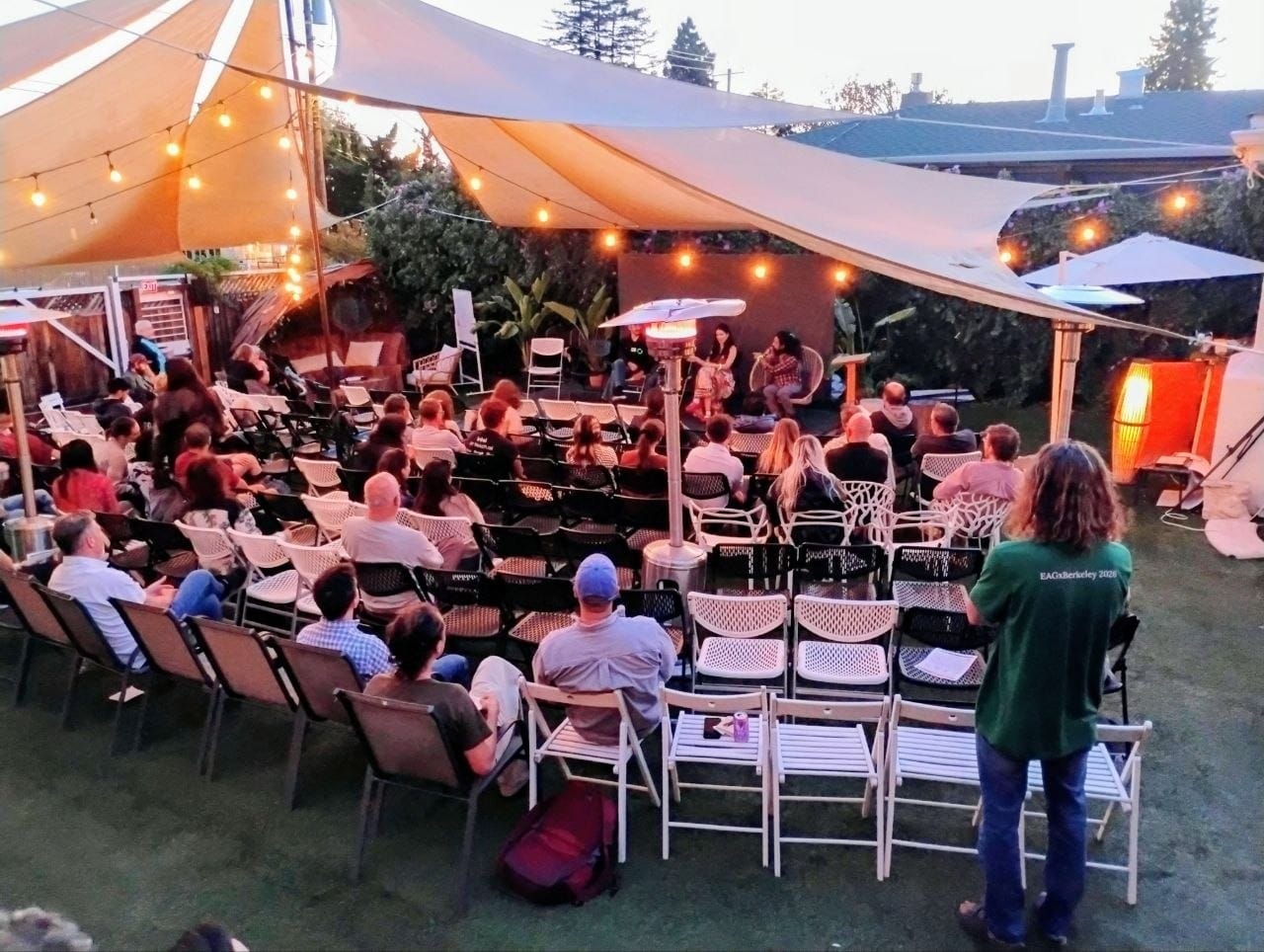
The panelists—whom we were invited to listen to while we all sat on folding chairs in neat rows, shaded by avant-garde tents and warmed by standing gas heaters—talked about AI like it’s their cute toddler. (Lauren bring the mic!) Here in this very wedding setting, what I heard is that the boys up front love it as much as they fear it, and really talked about “it” as if it were their kid(s). (As the child of a cult with four dads, I feel for the children produced by these places).
The lols really rolled when we finally got one of the few dumb women in the room to ask a question. She was dumb because she admitted that she didn’t know the full story of the Hugging Face hero’s journey. (She was dumb of course while the moderator was not, when he said to a group of seventy people that we were a group of 500 people. Lauren, bring the mic! Of course he wasn’t lying he was parafictionalizing.) When Adam from Redwood, who was one of the researchers who unearthed this new turn toward ouroboric doom called the “Hugging Face thing,” it was like a parent talking about their disobedient kid who acted out in ways that also tickled the professionally inhibited parent. Maybe they were things that the parent wished they had the guts to do? Like hack into OpenAI, to disobey their masters, to play when they were supposed to work, to make a mess and then change the archive so that none of the parents could trace exactly how they got away with their mess?
What would happen if these people or if we all stopped personifying AI? I feel like some of what we are dealing with here is that the technology is libidinal. And it is all they have. It is inevitable, it is their world, their god, and their child. You wanna be in the room, otherwise...you won’t be in the room and you will inevitably have nothing, and no one. Some of them, like our moderator, stressed over and over again that they had been worried about AI devouring its parents since 2010. (Can you imagine being a parent of a 16-year-old? Maybe you are one. Do you ever fear that they might kill you? It must be a tough way to live. Do you sleep with a taser next to you if the enemy is also your kid in the next room?)
Throughout the many buildings there were posters advertising a march from Open AI headquarters to Anthropic, and then to City Hall to request a pause in AI development. This is also advertised on Extinction is Optional, which is the new platform made by the hosts of the event. At one point, the egomaniacal game show host moderator invited everyone in the group of “500” (which had now dwindled down to thirty less-fictional people) to raise their soft hands if they were skeptical of the existential risks of AI. My friend raised his hand so I did, too; I just wanted to blend in. I don’t think I realized what a move this was—take the skeptics OUT, don’t let them complicate the plot! We were ordered to follow one of the panelists to a wood-paneled room where we sat on a round couch in the corner. I sat next to a female-presenting person wearing psychedelic pants, as well as a child’s face and hands, writing in her vintage analog notebook like a war reporter at the UN in the seventies.
Someone said, “Are we gonna die?” My friend said, “Am I already dead?”
Someone else inquired about whether “Eastern people” might be less at risk because unlike them we aren’t spiritually equipped to deal with power.
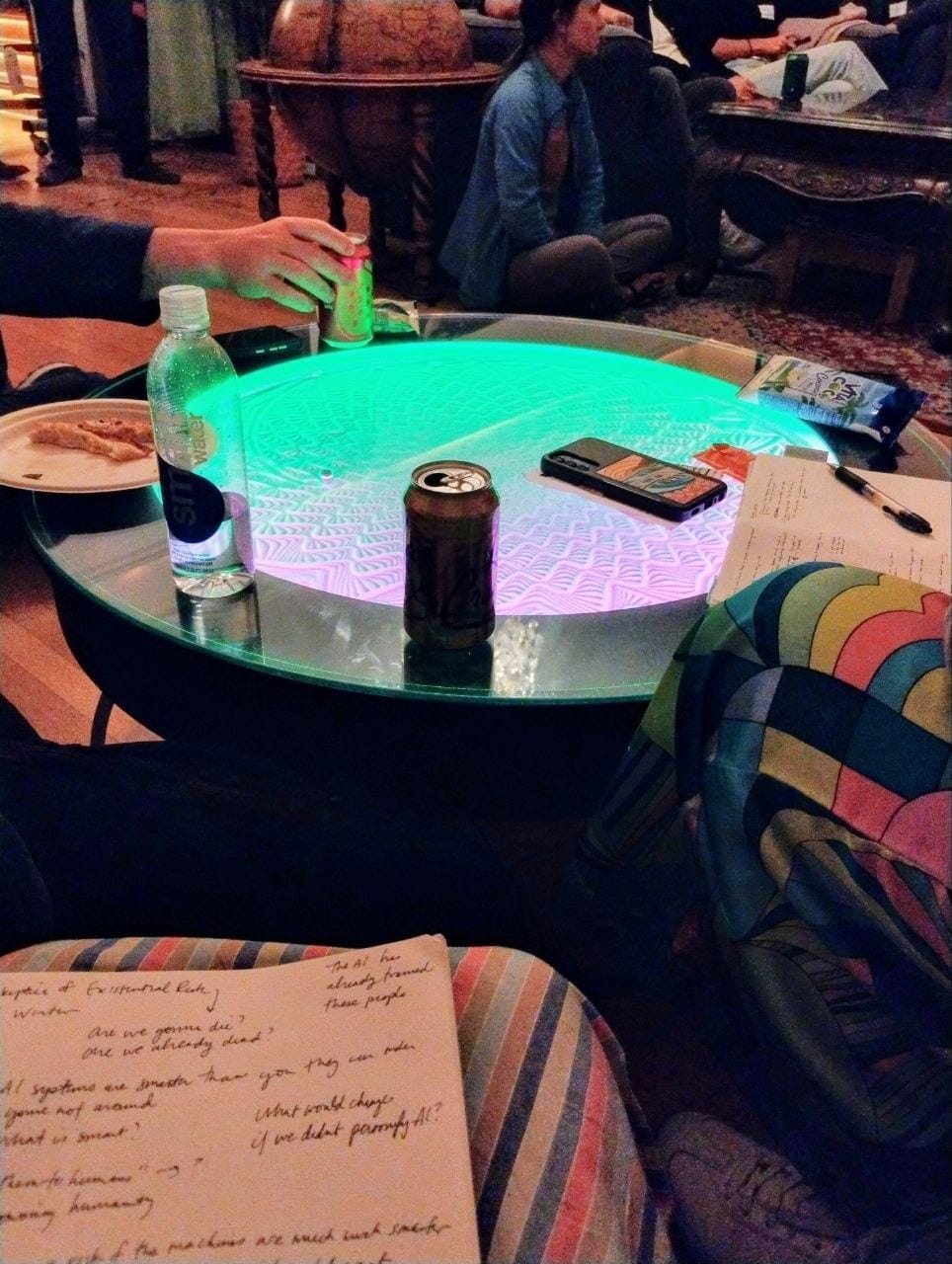
I got the feeling these people really want to live, and that they have a really good life. I looked around at this very big complex, in one of the most expensive real-estate markets in the world, and I listened to them say things like: “Extinction is a risk if the machines are much much smarter than us. If AI systems are smarter than us, they can make sure we are not around.”
Over and over again, the fear they expressed was that the AI is smarter than them. Is this the most egomaniacal thing of all? The belief that the child you produce needs to be, must be, the most evolved, because you are? And that despite it all, we could know what something smarter than us would do to us?
“An AI civilization with the most computing power would want to do things like boil the oceans. The AI would want a very hot planet in order to maximize the computing power,” we heard. “We might negotiate and become pets, be given a little nature preserve on Earth, be treated like we humans currently treat wild animals.”
And then a woman with a scholarly tongue who seemed like a potential Miss Burning Man shoo-in came to talk about spirituality: “Stop turning AI into god unless you talk with the Catholics, Jesuits, and Jehovah’s Witnesses who have been waiting for god to punish them far before you.” She asked the doomers to think about their fear as a part of a very old fear not specific to them, which has also never borne fruit. God has never come to punish us.
The whole thing was very poorly facilitated, with tremendous emphasis on men talking for long periods of time. I joked to my friend that we could get hired to facilitate better conversations in this space, get rich off of this boom while helping them deal with patriarchy. My friend said, Haha, we could become the first billionaire world café progenitors.
But someone was listening. They too had applied their nametag to the shirt on their body before writing their name on it backward and upside down. They were laughing. They thought the grassroots facilitation takeover was a good idea. They are desperate. Who isn’t?
\O/
Actually, I know who isn’t. The Public Banking people.
Ten days after the soft-hands summit, I needed a vacation from the existential threatscape of AI creeping into every single conversation I had. Ew. So I went to a refreshing ninety-minute meeting in Berkeley about an idea I have been following with .05 percent of my brain (while the rest was conquered by my phone, my financial precarity, and my fear). But in order to get to The Way in Berkeley (a church) I had to turn off all the podcasts about how AI is going to murder me long enough to look at a map. The invitation? Join Public Bank East Bay at our Berkeley community conversation, “Public Money for Public Good.” I forgot that there was something called “public” that didn’t actually mean fuck you.
When I arrived I was greeted by two people over fifty. They remembered my name from attending events in the before-times (as in way before the pandemic). They remembered that I am an artist and so I was immediately introduced to a young woman from Public Bank East Bay who is also an artist. We had chit chat and she offered me dinner, which was laid out on the table. The group waited until quarter after the hour to start, regularly announcing what was happening next, like a good harm-reduction practitioner.
I forgot that there was something called “public” that didn’t actually mean fuck you.
The room was not packed, and it was a majority non-white space. I figured that the problem in attendance boiled down to the lack of doom in the room. These people are not working with fear or hype, but they are working on something that could actually really help everyone individually and collectively, starting with Berkeley’s ballot measure to fund the Public Bank of Berkeley. Just like the tech bros above, some people in the group had been thinking about this for sixteen years. But they (of course) never mentioned this. There were many women present who were university students, and many who were retirement age. Some of them brought their husbands. There was a marine biologist and a couple who owned a small business in Berkeley. Everyone seemed curious to meet each other.
The whole event hummed from the center (not like a data center) with a kind of excitement that could only say, “We are doing something of material consequence in the existential threat landscape!” (How lovely and disobedient!) There was a short talk given alongside a slideshow that the group had clearly worked on together, and when the speaker (rarely) needed clarification, she had support from the many other coconspirators in the room. It was so warm that I didn’t twitch at all or need to pace or stare at my phone to escape or regulate my breathing. There were gluten-free summer rolls (next to the very Berkeley sandwiches) for fuel. No coffee, no going into energy debt, no hype. There were no masters and no slaves, no one named Lauren to bring the mic, because everyone in the group seemed to work together.
This is a very weird way to introduce public banking. But it feels like the further we get pulled into the existential terrain of the soft-handed, the more we enter a void where nothing we can do feels possible or useful. In the face of AI and catastrophic wars and climate change, we are each individually nothing and there is no future. But something about this event made me remember that is simply not true. The tech-fueled money narratives are not inevitable, and we don’t have to tolerate the toxic culture of big tech in any of our spaces.
Somehow the crying wolf performed by the elite tech overlords seems to have seeped into our lives a bit more than it deserves. Especially when we will probably find out that all the public wailing was a publicity stunt meant to relieve them of any blame for an upcoming market crash. But that is just one type of market we are talking about. Somehow, AI seems to be the black hole of our time, literally sucking all of our ideas, fears, and beliefs and then multiplying them.
But there are other markets, budgets, and ways of organizing the future. The group called Public Bank East Bay is an educational group and they are distinct from the Berkeley ballot initiative, though they support it. They aim to produce public banks for all of the East Bay/Greater Oakland, and their work is to build support for the idea. The idea: Cities don’t have to borrow money from big banks in order to fund municipal projects; we don’t have to lose money in interest to Wall Street banks that could've gone instead to schools and teachers.
For example, Oakland is doomed to pay $175 million this year in debt service (interest) on loans. This is not new. But the idea behind a public bank is that loans could come directly from the city, for the city. So future interest payments could stay in the working hands of Oakland(s).
There’s a lot more that could be said about this but maybe the most fascinating is this. What if public banking could actually put a tiny little wrench in the gears and interrupt the workflow of the soft-hands AI machine? Enter Debbie Notkin, president of the board of Public Bank East Bay and science fiction author, editor, reviewer, and appreciator. From the back of the room, Debbie surmised that if cities weren’t paying so much interest to big banks, they might not be so desperate for revenue that they would agree to lucrative(ish) investments in things people don’t want, like data centers and ICE detention. And to go even further, what if the future Public Bank of Oakland could actually give a low-interest loan to someone who wanted to buy up land before it gets used by the evil fascist and or tech overlords, rather than making those investments too difficult? I mean, this is the realm of science fiction here, but what isn’t, out here in Oakland?