The noise about sideshows
Welcome to Sound Week, part of our “Six Senses of Oakland” membership drive. Read more about it here. Check out other Six Senses stories here. Subscribe here.
The following is adapted from On Loop: Black Sonic Politics in Oakland, published in 2025 by University of California Press.
◎
The moon is full.
Look at the dark clouds.
Sittin’ in my scraper
Watchin’ Oakland goin’ wild.
Tadow!
E-40, “Tell Me When to Go” (2006)
I first met Yakpasua Zazaboi at a café in Old Oakland, around the corner from my office, on a sunny day in 2022. “I’ll be the guy in all green,” he said, over text. Sure enough, when I arrived, I spotted a man wearing a single shade of green, from his hat to his Adidas shelltoes, the tint an exact match for the avocado on his toast. Born in “Frisco” and raised in Daly City, he came up across the water (it might as well have been the world) from East Oakland. But he was so obsessed with the idea of mobility that he bought a car at 15, before he could legally drive it. On the night that he turned 18, in 1995, he and his friends decided to cruise to Oakland in search of an adventure. “We didn’t know anything about Oakland,” he told me. “The only thing we knew was Too Short. Short was always rapping about the ‘Foothill Strip.’ So, we said: ‘Let’s go find the Foothill Strip!’”
It took them a while, without smartphones or maps, but eventually they stumbled into Foothill. Within minutes, they ran into a sideshow. It was a marvel. There were people playing music, selling T-shirts and rap tapes, and passing out flyers for events. But more than anything, Zazaboi remembered the smiles. Black people smiling. A lot of them. More than a thousand, he guessed. It opened his mind to new possibilities of Black freedom and pleasure. “I had never seen Black people hanging out like that,” he told me. “I was instantly sprung.” Smitten, he and his crew began to come back every weekend.
The 1990s were a troubled time for Zazaboi. Coming of age amid the tail end of the crack epidemic, he—like most of his friends—tried his hand at selling drugs. “Everyone I ran with was selling rocks,” he told me. Starting at 15, he cycled in and out of the carceral system: first juvie, then jail. Eventually, his mom—a white woman from Cape Cod—sent him to live with his dad, who was from Liberia, in Oakland. But Zazaboi’s involvement in the drug trade ran its course by the time he turned 21. “That was my last time going to jail for actually doing something,” he told me. At the time that we met, in 2022, he was running for an open city council seat in Oakland’s District 6. The race, which he lost, would leave a sour taste in his mouth. But in retrospect, he recalled that his arrest in 1999 would be his first real introduction to the unpleasantries of electoral politics. At the time, San Francisco Mayor Willie Brown was running for reelection. According to Zazaboi, Brown, who’s African American, told the police to drum up a lot of drug arrests to prove that he was tough on crime. Caught in a sting operation, Zazaboi told an undercover officer where he could score some crack. He was eventually convicted to six months behind bars.
When he wasn’t on the street or at the sideshow, however, Zazaboi was in the classroom at Oakland’s Laney College, where he studied film. He had meant to study music. “Like everyone else back then,” he recalled, “I wanted to make beats.” So, when he saw a course on “production,” he signed up without realizing that it was for video production. He decided to stay anyway. That semester, he was nabbed in San Francisco. While locked up, he saw a news report about a police raid against a sideshow that he had attended the previous weekend. The segment made him sick. “The news was calling us ‘barbarians,’ ‘dangerous,’ ‘disrespectful.’ It hit me like: ‘Yo, you’ve got access to all this equipment. You can actually do something about this.’”
Released after three months, Zazaboi returned to his studies. Borrowing equipment from Laney, he began to document his beloved events. In 2000, he produced his first film—a five-minute short called Sydewayz—as a school project. It was a hit. It received a standing ovation from his classmates, who asked whether they could buy a copy. That gave Zazaboi an idea. Like the entrepreneurs selling T-shirts or tapes, he started selling copies of his video at the sideshow—“five dollars for five minutes,” went his pitch. It was so popular that he started to carry a camera with him at all times. In the early 2000s, it was still rare for a young person—at least, a young person in East Oakland—to have access to video equipment. So, Zazaboi became the de facto documentarian of the scene. In 2001, he released a second version of Sydewayz—this one, $20 for 32 minutes of footage—which was again eagerly received. He estimated that he sold a couple thousand copies hand-to-hand. But the film, which was widely bootlegged, reached the screens of several thousand more.
Still, for Zazaboi, it was never just about the money. It was about providing a counterpoint to the civic narrative that demonized the sideshow as nothing more than a nuisance or, worse, menace. “We were representing ourselves,” he told me. Zazaboi would become a go-to source for reporters who wanted to see things from the point of view of sideshow enthusiasts. But only after the popularity of his videos forced them to reckon with it. “The news never came to talk to us—ever—until after I put those documentaries out,” he said.
The early sideshow thus served as a site on the margins where residents could create their own spaces of communion and pleasure.
Back in 2022, Zazaboi and I discussed the roots and routes of this now notorious part of Oakland’s cultural landscape. The sideshow could be traced back to the city’s postwar car cultures. In the wake of World War II, the car became the apotheosis of consumer citizenship and personal sovereignty. For Black Americans, whose movements had been regulated since slavery, however, it came to represent a literal vehicle of fugitive freedom. According to the critical race scholar George Lipsitz, Black people “created cultural forms”—everything from musical records to car clubs—“that celebrated movement in defiance of segregationist constraints and confinement.” In addition to this cultural significance, the car might be the only private space—the only private property—available to working-class African Americans. In Oakland, for instance, the drummer Earl Watkins recalled that, amid the city’s Jim Crow, it was common for white businesses to sell Black people cars but not homes. Black car culture thus emerged as a self-determined source of pleasure in opposition to Oakland’s regime of racial domination.
In the 1960s and ’70s, as more and more Black, Latine, and Asian American families moved to East Oakland, this proto-suburban landscape became the ideal space for young people of color to create automotive identities and communities. Emptied of streetcars in 1948, corridors like Foothill Boulevard and East 14th Street became transformed into popular “strips” for cruising. Cougars, Mustangs, and Falcons. It was like a cavalcade of muscle cars. Motorists from around the region would parade up and down the street, or post up at the 76 Station or San Antonio Park, to peacock their prowess, creativity, and capital.
The cruise, like the sound that resonated from the cars’ stereos, was one of the only ways for working-class residents of color to cross the racial and class lines that divided the region. Members of Oakland’s car clubs would ride throughout the Bay Area, meeting and mingling with motorists from San José to Walnut Creek. But it wasn’t long before suburban cities retreated behind the color lines that had come to define the region’s social terrain. In the mid-1980s, amid an increasing emphasis on restoring a sense of social order through measures to regulate public space, one city after another passed anticruising policies. It was like a game of whack-a-mole. Hit the cruise in Fremont, it returns in Walnut Creek. Knock it out in Danville, it’s back in Dublin next week. The more remote the suburb—the wealthier, the whiter—the faster it moved to nip these “nuisances” in the bud. And as more and more doors slammed shut—extending, it seemed, the legacy of the region’s “sundown towns”—the parade of revelers was routed back to Oakland, where the cops were waiting. For Black Oaklanders, then, the car embodied both freedom and its enduring limits.
The crackdown on cruising was yet another instance in which the recreational space available to young people of color was curtailed. As the War on Poverty was replaced with the War on Drugs, disinvestment stripped Oakland of the public and private capital needed to sustain its once lively landscape of commercial entertainment. In the long economic decline that followed World War II, many of the city’s art deco movie theaters, music venues, department stores, and roller rinks went dark. These closures were tempered, for a time, by a spate of state-funded programs, including recreation centers, talent shows, and sports leagues. But the rollback of public spending in the 1970s soon led to their demise, as well. This process of intentional neglect pushed more and more social and cultural activities among working-class youth of color into unsanctioned spaces, like streets and parks, where they were exposed to new forms of policing that targeted their very presence as a nuisance and portent of crime.
In the 1980s and ’90s, caught between the dangers of the crack wars and the OPD, many young people of color simply decided to stay inside. But for others, like Zazaboi, the drive for some measure of social connection, excitement, and reprieve from the struggles of everyday life was strong enough to brave the street. And this put the car at the center of an increasingly contentious conflict between young people and the police over the control of public space.
The sideshow, explained Zazaboi, emerged out of this cultural and political milieu. Originally, the term referred to the ways that drivers would recline and lean to the side as they cruised in a style of masculine cool known as “sidin’” or “high sidin’.” But the term also said something important about the geography of these impromptu gatherings—the spatial relationship between the margin and the center, or the sideshow and the main event. In the 1980s, rather than suffer the rigmarole of admission and security, many working-class residents of color started to congregate with their muscle cars and souped-up stereos on the outskirts of sanctioned commercial spaces, like carnivals and sporting events. This spot on the periphery provided an arena of self-determination for people who wanted to be in on the action, but were too young, poor, or fed up with being surveilled by venue management to participate in a permitted manner.
The early sideshow thus served as a site on the margins where residents could create their own spaces of communion and pleasure. Upending the rules of participation, the sideshow became the main event. This partition process reached an important milestone in the 1990s, when, after years of being attached to other events, the sideshow became a standalone attraction at East Oakland’s most conspicuous site of capital flight: the Eastmont Mall.
◎
In cavernous spaces, silence makes a peculiar sound. The sporadic eruption of noise sends vibrations ricocheting off of reflective surfaces that are far apart. The echoes—which take a long time to run their course, or “decay,” in acoustical terms—fill the space with an atmospheric din that, oddly, signifies emptiness. Originally built to the standards of midcentury American shopping centers, the Eastmont Mall consists of 600,000 square feet of commercial space. But whenever I visited, in 2017 and 2018, it felt more like a mausoleum. It had all of the trappings of a typical mall: soaring atria, spacious corridors, and spotless floors. But rather than beckon consumers with the names of popular brands, the signs that lined the walls advertised the safety-net services of the Oakland Head Start Program and Alameda County Self-Sufficiency Center—signs of poverty, that is, rather than prosperity.
In the late 1960s, in a rare case of private investment amid the exodus of capital, jobs, and tax revenue, the Eastmont Mall was built on the site of a shuttered Chevrolet plant. For a time, it served as an important source of employment and pride among East Oakland’s growing communities of color—a convenience that marked the area as something other than the margin of the margin within the postindustrial marketplace. It became the sole monument to commerce and recreation in an area increasingly stripped of investment.
But East Oakland’s economic crisis eventually came for the mall, too. In 1993, the middle-of-the-night departure of Mervyn’s, a department store, left it without an anchor tenant or even a single national retailer. Confronted with an enormous space and a vacancy rate of 30 percent, a new team of owners—Jack Sumski and Bob Bridwell—decided to take the mall in a new direction. Convinced, it seemed, that there was always a dollar to be made on poverty, they recruited social service agencies to replace the clothing stores and movie theaters that had abandoned the neighborhood. In 1996, the mall was rebranded the Eastmont Town Center—no longer a commercial space, but a hub of community services. In the process, writes the sociologist Cristina Cielo, the mall became a site that was, from its tenants to its name, “unmistakably marked by the departure of capital.”
Most consumers got the message and followed suit. But among East Oakland youth, the opposite was true. The mall, after all, had long been central to the cultural geographies of young Black residents. According to the music writer and journalist Eric Arnold, the cable television station Soul Beat—which, starting in 1978, recorded performances by funk acts and ran music videos by up-and-coming rappers and R&B groups—was filmed at a studio on site. In the 1980s and ’90s, when local rappers were by and large barred from mainstream radio and television stations, Soul Beat transmitted their sounds from the mall to living rooms around East Oakland. Fans, in turn, would come to the mall to visit a record store called T’s Wauzi, where E-40 and Too Short, who were still marketing their own recordings, sold tapes on consignment. Caught between the closure of recreational venues and chaos of the street, the mall became one of the few spaces where young Black Oaklanders could enjoy themselves with a modicum—however partial or precarious—of freedom and safety.
Today, longtime participants remember the era of the Eastmont sideshow as a time of comparatively tame and creative expression among neighborhood youth. The gatherings got wild from time to time. But according to proponents, attendees tended to care for the sideshow because it was one of the only spaces where young people of color—stripped of property, and the rights that come with it—had de facto, if not de jure, control. “You used to see people stop fights at a car show,” explained Zazaboi, “because that was almost like the sanctuary out there—the place you used to go to have fun, and not have to worry about the day-to-day struggles you’d be going through. People didn’t want to see that messed up.”
The youth, perhaps. But the mall management had other ideas. To Sumski and Bridwell, the sideshow wasn’t a sanctuary of community and creativity. It was racialized nuisance, another form of “Black noise,” that threatened to keep well-to-do consumers—already a rare sight—ensconced in the suburbs. “We want the mall to be for everyone,” declared general manager Leopold Ray-Lynch, “but we don’t want anyone to be uncomfortable. We will be asking young people to leave.”
In an act of police gentrification, young people of color were evicted. Once the meetups were pushed from the mall parking lot, where they were somewhat contained, into surrounding neighborhoods, it set off a three-decade game of cat-and-mouse that continues today.
Indeed, any sense of the sideshow as a safe space for youth was put to an end when the Oakland Police Department moved in—literally. In the 1980s, when the parties began, East Oakland’s patrol officers were based out of OPD headquarters in Downtown Oakland. But in the 1990s, as part of a move to community policing, which included a return to neighborhood-based beat cops, the OPD began to shift operations back to Deep East Oakland. And out of all the potential sites, it chose the mall as its outpost, eventually taking over the space vacated by Mervyn’s. At 64,000 square feet, the Eastmont Precinct became not only the Town Center’s new anchor tenant but also one of the largest police stations in the state. While young people had seen the mall’s massive parking lot as an opportune spot to party, the OPD—which, importantly, made Eastmont the home of its Traffic Section—saw it as the perfect place to stash row after row of police cruisers. By 2002, when the station renovation was complete, the OPD had moved 140 officers—half of its total patrol force—out to the mall.
In an act of police gentrification, young people of color were evicted. This moment is often remembered as a turning point in the struggle over the sideshow. Once the meetups were pushed from the mall parking lot, where they were somewhat contained, into surrounding neighborhoods, it set off a three-decade game of cat-and-mouse that continues today. By scattering young people to scour the streets in search of other spaces to call their own, the displacement of the sideshow redoubled its identity as a fugitive practice. It turned revelers into renegades and intensified the generational struggle between Black youth and the OPD. In time, the focus among sideshow participants shifted from partying to flouting the police. In practice, the two became one and the same.
Redirecting traffic
“We used to cruise for hours,” recalled Gino Pastori-Ng. “We’d all chip in a dollar for gas. We’d put four bucks in the tank and drive around all night.” When we connected by Zoom, in 2023, Pastori-Ng was—true to his name—living in pastoral Napa County. But he was raised in the Fruitvale neighborhood of East Oakland. His parents met as volunteers at Berkeley’s leftist La Peña Cultural Center in the 1970s. Soon married, the couple started to look for a home. The realtor “took one look at them,” explained Pastori-Ng, and steered the mixed-race Italian and Chinese American pair to a deteriorating part of the flatlands. Born in 1982, at the onset of the crack epidemic, he was instructed to stay indoors. “It was intense,” he recalled, of the disinvestment, dealing, and guns that racked the neighborhood. “Violence was normalized.”
As they got older, Pastori-Ng and his friends set their sights on the ultimate escape from the grim realities of the neighborhood. “The most important goal that I had as a teenager was acquiring a car,” he said, echoing Zazaboi. As soon as he hit the legal driving age, Pastori-Ng started working—running errands, washing dishes, loading trucks, all “horrible jobs”—to squirrel away enough cash to purchase a vehicle. His perseverance paid off. After a stint behind the wheel of his parents’ 1989 Toyota Corolla—nicknamed “The Bucket,” for its dilapidated look—he managed to save up enough for a 1990 Nissan Maxima with 12-inch subwoofers in the trunk. The first of his crew to own a car, he finally had a ride that was ready for prime time. He just needed somewhere to take it. For people his age, though, there was nowhere to go that was both fun and safe. There were no movie theaters in the neighborhood. No youth programs to nurture his interest in music. “It was a complete wasteland,” he sighed. “We’d just drive around, smoke weed, and listen to music. I spent so many hours sitting in random places in parked cars.” At least, that is, until the cops arrived to harass them and move them along.
Caught between the police, their parents, and their peers, young people of color like Pastori-Ng had to learn, at a young age, how to navigate a complex and dangerous terrain of risk. In the 1990s, the flatlands were carved into minute turfs that reflected the factionalism of the drug trade. “It was provincial,” he explained. “I pretty much never went to West Oakland or North Oakland because I didn’t know anyone there. I didn’t know what streets to avoid. Every ten blocks, it was like a different nation.”
“Were there any spaces that were neutral?” I asked.
Now a meditator, Pastori-Ng sat for a moment in silent contemplation. “Downtown felt kind of neutral,” he said, “just because there was no one there.” After a beat, he added, “And the sideshow—that was probably one of the most neutral places.”
This, he explained, was because the sideshow—now evicted from Eastmont—would constantly change locations, making it impossible for one neighborhood or crew to claim ownership. And this convinced young people to venture across the geopolitical lines that divided one set from the next. “It was expected that people from all over the city would be there.”
So, while the authorities would come to condemn the sideshow as inveterately reckless, for young people like Pastori-Ng, it was relatively secure. Violence might have been “normalized” in other spaces, from the streets to the schoolyard, but—out of the 30 or so that he attended—he recalled only one sideshow where a fight occurred. “Everyone came there for a common purpose,” he said, “to have fun, see the cars, and listen to music.”
The night would go something like this: Pastori-Ng and his crew would gas up the Nissan and set out on the streets. They would drive, park, drive, park, turn around, drive again—listening, all the while, to the latest records from local rappers, which would loop through the 12-CD changer. “I pretty much only listened to East Oakland gangster rap,” he told me. “People who talked about things in our exact neighborhood.” It was “thrilling” to hear someone from the neighborhood boasting about Oakland, even if it was for things like drug dealing that he found threatening. The artists that he loved—like Yukmouth, Dru Down, and 3X Krazy—took the city’s outlaw reputation and wore it as a “badge of honor.” “As a young person, I was afraid and powerless in the world,” he told me. “But Oakland was feared and respected. These rappers made being from Oakland feel powerful.” Driving around to their music made him and his crew feel like they could tap into that power, too, “even if it wasn’t for the most positive reasons.”
Eventually, on a good night, the group would run into a sideshow. In the wake of eviction from the Eastmont Mall, this itinerant version of the sideshow wasn’t planned or promoted. In the 1990s, drivers didn’t have cell phones or social media to coordinate their movements. Instead, the events would emerge spontaneously out of collective action and attraction wherever people craved some fugitive fun. “It was organized vehicular chaos,” wrote the journalist Pendarvis Harshaw in his memoir. “After zigzagging across both lanes throughout the eastern portion of the Town, the crowd would commandeer an intersection and an automobile that weighs thousands of pounds would begin to dance.”
After Eastmont, how you drove became more important than what you drove.
According to Zazaboi, the original sideshow wasn’t centered on stunts. Instead, as a cousin of the cruise, it was a space where drivers—mostly men—showed off their custom cars. As time went on, however, the next generation sought ways to distinguish themselves, to take the culture to the next level, through displays that were even more spectacular, more attention-grabbing, than those of their predecessors. So, after Eastmont, how you drove became more important than what you drove in making an impression at the sideshow. Besides, it was “exhilarating.” “The attention you get from it is like a drug of its own,” said Zazaboi. For young men with few opportunities for social recognition, spinning donuts to the delight of a crowd felt something like value or valor. “It’s like being an artist on stage with 30,000 fans singing your song,” he told me.
But the next generation’s desire to leave its mark on this outlaw culture meant their automotive antics became increasingly rebellious and risky. In addition to donuts, sideshow drivers created an entire movement repertoire—a set of automotive dances—that included individual and collective routines such as “zigzagging,” “three-man weaving,” and “ghostriding the whip,” which gained notoriety through music videos like E-40’s “Tell Me When to Go” (2006). The move involved putting the car in drive so that it cruised along while its occupants—the driver included—danced on or around the car as it continued to coast. Ghostriding, like most stunts, derived its performative pleasure from reveling in the tension between the risk of danger and the talent to avert its realization (at least, most of the time). The anthropologist Pascal Menoret, who has studied the culture of joyriding in Saudi Arabia, describes this as a dance between surrender and skill—a process of “losing control to regain control.” At the sideshow, young people just called it having “bars” (as in “handlebars”).
Along with the stunts, the second-generation sideshow created its own automotive aesthetic, which centered on the “scraper”—a middle-of-the-road sedan, like a Buick Regal or LeSabre, with custom paint and colossal rims. According to Zazaboi, in the 1990s, the OPD started to target the classier cars that dominated the early days of the sideshow under the assumption that they were paid for with drug money. So, dealers started to drive more nondescript ones—the kind associated with their grannies—to move about under the radar. Eventually, they started to pass those cars on to other kids in the neighborhood, who would pack them with friends and, weighted down, “scrape around” East Oakland.
In the early 2000s, young people started to develop ways to distinguish these otherwise dull rides, like adding bright coats of iridescent paint and massive rims, from those of their peers. In this era, the name came to refer to the fact that the rims—a sign of mock elegance—were so massive that the wheels would “scrape” against the car as they turned. Indeed, the scraper came to be defined by its oversized sound as much as its look. It often featured a souped-up stereo and, for a time, “whistle tip”—a device that, inserted in the tailpipe, made the car scream like a steam train. In this way, the scraper scorned the white, middle-class norms of “good taste.” It took the elements of mainstream consumerism (e.g., aftermarket accessories, GM cars) and flipped them into something outrageous—an eye- and ear-popping provocation. In a kind of ode to marginality—what Roberto Bedoya, the writer and former cultural affairs manager for the City of Oakland, calls rasquachismo—it took an unregarded and unremarkable car and made it unmissable.
The scrapers. The stunts. All of this added up to a raucous soundscape. At the center of the sideshow, drivers would spin donuts, releasing the sound of screeching tires into the night air. On the sides, the audience would create a ring of cars, like an arena, each slapping with songs by neighborhood rappers like Yukmouth and 3X Krazy. There was never a “DJ car,” said Pastori-Ng. The music, like the sideshow, didn’t have a conductor. Still, there would often be one car with “four 15’s in the trunk”—a reference to 15-inch subwoofers, as celebrated in the eponymous song by Berkeley rapper Sirealz—that simply dominated the rest. “It was all about the bass,” recalled Pastori-Ng. Local producers, he explained, would test out their beats by driving around to see how the soundwaves felt rumbling out of their cars. That exciting sensation, that “out-of-body experience,” was a “mandatory element” for any track that would become popular among him and his peers. “The sound of a rattling trunk is one of my most common memories from childhood,” he said. “It was often so strong that it’d shake the pictures off the walls.”
Taking back the streets
In the 2000s, the increasing popularity of the sideshow was met with a moral panic among local media, property owners, and public officials. In one particularly vivid account, the journalist J. Douglas Allen-Taylor, writing in the East Bay Express, parodied the fear that came to color the evening news: “Cars whirling in madness as if living beasts. Smoke rising like hell’s fires, as if from the tortured streets.” While connecting these concerns to contemporary struggles to revitalize “Oakland’s image and economy,” he also noted that the tendency to demonize the sideshow resonated with old, colonial tropes. “The images call up…visions out of Euro-America’s worst nightmares,” he wrote, “savages, drunk and dancing, natives rising in the jungle, a frenzy that must surely end with the burning of homes and the murder of sleeping settlers.” “God help us,” he added, ironically, “it’s the Oakland sideshows.”
By taking over commercial strips and retail centers ruined by the retreat of capital, and filling them with Black bodies, Black marks, and Black noise, the sideshow seemed to make some neighborhoods ungentrifiable.
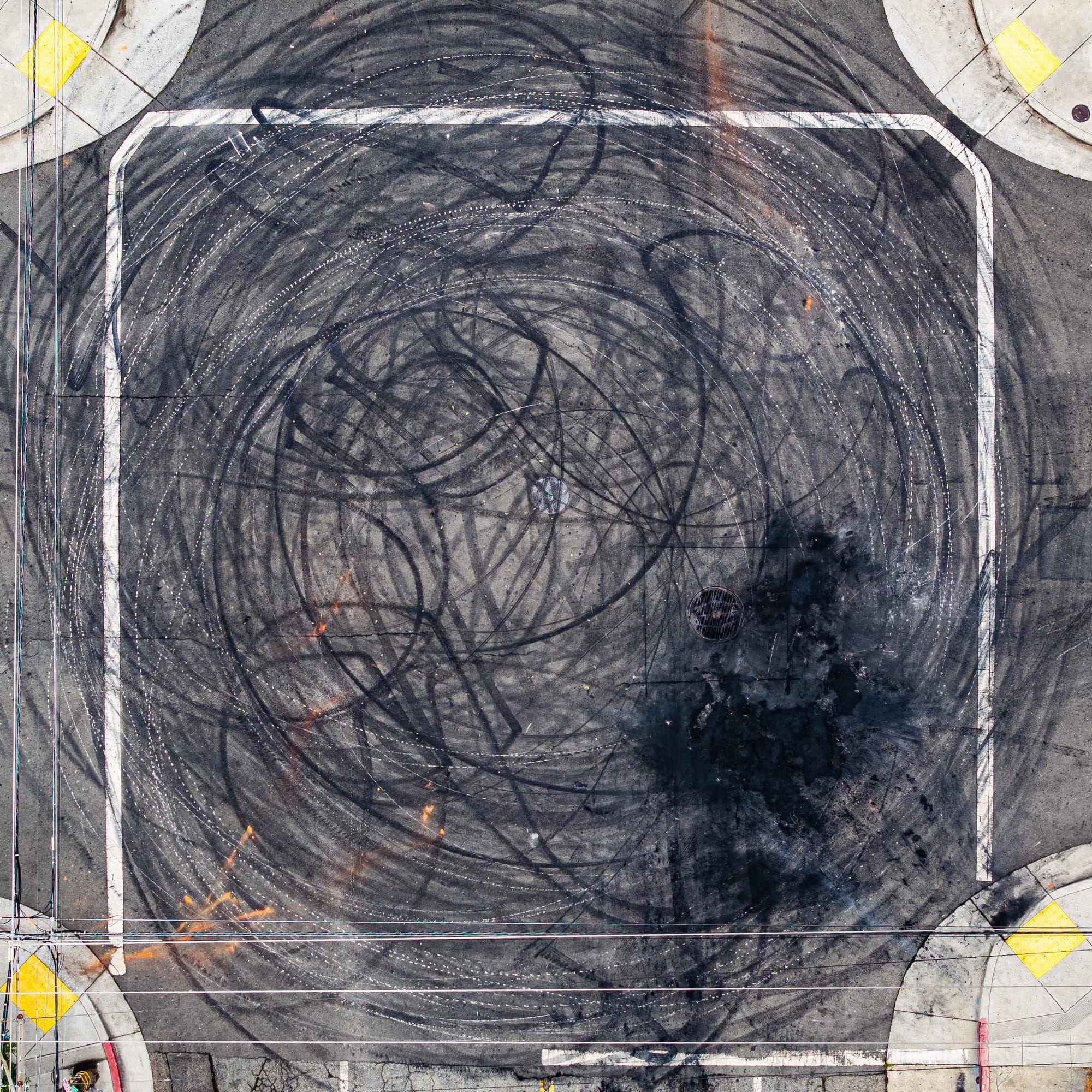
The sideshow might have given young people of color a playful way to antagonize the authorities who sought to govern them. Among older residents and regulators, however, it represented the ultimate nuisance—an intolerable threat to their dogged but delicate attempts to resuscitate the city’s reputation as a terrain that was safe for redevelopment. In the words of the anthropologist Jennifer Tilton, the mandalas of tire tracks that marred the flatlands “literally marked” these areas as too poor and out of control to receive an investment in anything but more police. If Oakland had an “image problem,” as it was often said, then here was its anarchic archetype. By taking over commercial strips and retail centers ruined by the retreat of capital, and filling them with Black bodies, Black marks, and Black noise, the sideshow seemed to make some neighborhoods ungentrifiable. Officials responded in kind, doubling down on their embrace of broken-windows policing.
Like other attempts to control “crime and grime,” the antisideshow campaign started under Oakland’s Black political leadership. But it ramped up in the late 1990s and early 2000s with the rise of Mayor Jerry Brown, the former governor, who had wooed disenchanted voters with visions of economic development in working-class communities of color. Once he took his oath, however, Brown did little to address neighborhood concerns. Instead, like Mayors Lionel Wilson and Elihu Harris before him, he took up the torch of downtown redevelopment, courting investors with financial incentives and redoubled support for the police. In the midst of the Dot-Com Boom—which, in the late 1990s, set off a land rush in San Francisco and Silicon Valley—Brown doled out subsidies to developers who, after decades of neglect, were now scouting a real-estate frontier across the East Bay. And scaring up memories of economic deprivation, and anxieties that the city would be skipped over by the latest wave of growth to sweep the region, he resisted calls to require tenant protections and affordable housing in return. Oakland could have it one of two ways, he threatened, either “gentrification” or “slumification,” and he was all-in on the former.
But overcoming the city’s reputation as a “ghost town” would require even more assertive policing. According to the investigative journalists Ali Winston and Darwin BondGraham, within months of taking office, Brown invited New York police commissioner William Bratton to Oakland. An evangelist for the broken-windows theory, Bratton counseled Brown on “quality-of-life policing that targeted street-level drug dealing, homelessness, and petty crime.” The OPD had never been a gentle hand. Still, Brown insisted that reforms implemented since the 1970s, in the wake of the city’s Black Power revolt, had allowed crime to run amok. So, he increased the OPD’s budget and staffing, called for saturation patrols in working-class communities of color, and reinstated quotas for stops and arrests to make good on a promised, but unrealistic, 20 percent reduction in crime.
According to Winston and BondGraham, this militant approach encouraged more corrupt and violent conduct toward residents of color. From 1998 to 2000, complaints about police brutality nearly doubled. This trend crescendoed in 2003, when the OPD relented to a negotiated settlement agreement after being sued by 119 men (all but one of them Black) who were terrorized by a gang of street-crime officers that called themselves the “Riders.” (The OPD still hasn’t met all of the terms of this roadmap for reform, making it the longest-running federal consent decree in the history of American policing.)
But drugs weren’t the only blemish that Brown wanted to erase; he pushed the OPD to take a similarly unremitting approach to the sideshow and the stains that it left on the city’s pavement and reputation. At times, he acted as though the sideshow was a personal affront. In some ways, it was. On more than one occasion, the mayor—who, at the time, lived in a $1.3 million loft in Jack London Square, where he had moved from San Francisco’s posh Pacific Heights while preparing to resurrect his political career in the East Bay—was woken up in the middle of the night by drivers burning rubber. In addition, as he sought a path back to the Governor’s Mansion through the Office of the State Attorney General, he worried that the curse of the sideshow—which, according to the OPD, had resulted in eight driving- or shooting-related deaths, and thousands of arrests—would tail him among law-and-order types on the campaign trail. “We’ve got to use every legitimate tool to prevent this invasion of Oakland’s neighborhoods,” he stumped to reporters in 2005. And the man that he appointed to be his general was David Kozicki.
◎
In December 2017, I met Kozicki at the Peet’s Coffee in the Dimond District of Central East Oakland. In the 2000s, the Dimond District—perched, ambiguously, between the fortified hills and the “lawless” flats—was precisely the sort of neighborhood in which residents and business owners battled against the “crime and grime” that seemed to imperil its economic comeback. But by 2017, back it had come. The café buzzed with customers, most of them middle-class people of color, who converged to work, meet, or carry out their first dose of caffeine. In this scene, Kozicki and I stood out. Tall, white, and wearing plainclothes, he now worked for the Alameda County Sheriff’s Office on its Sex Offender Task Force. Until 2010, however, this son of Oakland (but citizen of the leafy suburb of Moraga) had served on the OPD as lieutenant of the Traffic Section and, in time, deputy chief.
In the late 1990s, Kozicki’s increasingly aggressive campaign against the sideshow raised the status of the Traffic Section within the OPD. As the organization returned to a neighborhood-based command structure, the Traffic Section—now run out of Eastmont—was tasked with overseeing all “special events” that transcended these spatial divisions. By roaming the streets, inciting an at times massive police response, the sideshow fell squarely within Kozicki’s scope. So, as anger and panic over the sideshow grew, the Traffic Section accrued legal, tactical, and financial tools to attack the problem.
At first, explained Kozicki, the Traffic Section attempted to prevent sideshows from starting through a strategy of preemption. Taking a “zero tolerance” approach, officers began to roll up on any crowd of young people of color that might, in their view, turn into a sideshow. “We don’t give them an opportunity to do anything,” explained Officer George Phillips, tellingly, in a news report at the time. “Anytime an officer sees a group starting to gather, he radios up, gives their location, and everybody responds to chase them away.” “No crowd is too small to break up. And no ticket is too small to hand out,” confirmed a reporter, who went for a ridealong. “People were pulled over for every imaginable offense, from a booming stereo, to standing up through their sunroof, to a broken brake light.”
In line with other aspects of broken-windows policing, this approach ran roughshod over young people’s constitutional rights to assembly and normalized racial and sonic profiling. Pastori-Ng remembers this time as one of “constant police harassment,” “stop-and-frisk on wheels.” A night of cruising around East Oakland wasn’t complete without a member of the Traffic Section pulling him over and scanning for warrants against everyone in the car—perhaps even cuffing someone or writing a ticket—before releasing them with their freedom, but not their nerves, intact. It was “traumatizing,” he recalled, over two decades later. “Seeing them [the police] never equated to ‘safety,’” he said. “It pretty much only happened if I was driving with my Black friends.”
Ultimately, this approach proved more effective at aggravating and arresting young people than stopping sideshows. So, Kozicki adopted a new tactic that he called “posting and pushing.” In this maneuver, officers would pull up within range of an active sideshow (“far enough that the rocks and bottles wouldn’t hit ’em,” he said) and whoop their sirens. Inevitably, participants would scatter and regroup a couple of blocks away. So, the officers would do it again, disrupting the events, ad infinitum, until dawn. “It pretty much always ended with the police showing up,” confirmed Pastori-Ng.
The second installment of Sydewayz is replete with scenes of posting and pushing in action. In some, the police remain in their cars, either pursuing a driver in a high-speed chase or parading by in a martial display of vehicular might. But in others, they are right up in the mix, corralling and handcuffing people, at times with guns drawn. In one particularly striking scene, three officers stalk two men by driving onto the sidewalk and nudging them along with the noses of their motorcycles. One of the men covers his ears as he walks away, indicating that the din of the police sirens, motorcycles, and helicopters created a disturbing counterpart to the noise so often ascribed to the sideshow. Indeed, Zazaboi—who said he was targeted by the OPD for filming their sorties against the events, including his own arrests—told me that he was repeatedly cited for charges related to the volume of his music or exhaust “even though the cop was on a Harley.”
As the OPD tried to tackle the sideshow, then, it reinforced the dragnet-style approach to minor violations of the law that was typical of Oakland’s broken-windows tactics. But maintaining this dragnet required massive numbers of police. So, the OPD increased the capacity of its “dogwatch” shift through a mix of mandatory overtime and mutual aid. In 2002, Chief Richard Word announced a plan to reassign the antisideshow sweeps, which had come to involve 60 people, taking them away from their normal responsibilities, by requisitioning off-duty officers to work overtime—an approach that cost $25,000 to $30,000 per night. In a windfall to members of the Traffic Section, between 2000 and 2005, the city spent an estimated $2 million on overtime, most of which came from the cash-strapped General Fund, to hit the sideshow.
But even this increase in overtime resources didn’t seem to meet the OPD’s needs. So, it turned to neighboring police departments—at times, enrolling one hundred additional officers from Hayward, San Leandro, and Alameda—through mutual aid agreements. According to Kozicki, these cities were reluctant to participate in Oakland’s antisideshow operations. But they agreed once the OPD pressured them into it. “We’d block ’em [sideshow drivers] in and put ’em on the freeway,” he explained, “and block the exits down 880 as far as we could go.” This pushed drivers from the flats into neighboring cities, attracting the attention—and ire—of law enforcement agencies across Alameda County. In response, Kozicki made his counterparts an offer they couldn’t refuse. “If you don’t want us to send our sideshow into Hayward,” he told them, at a regional meeting, “then send us a few officers on Friday and Saturday night. We’re not paying ’em. You pay ’em. But we’ll do our best to keep ’em [sideshow participants] off the freeway and out of your city!”
In the end, the initial stages of the antisideshow campaign, which relied upon the show-of-force method, proved as expensive as they were ineffective. The events continued to grow, often attracting over a thousand participants from around the region. In the early-to-mid-2000s, then, the city and OPD pivoted to more punitive means to control the street. “I actually wrote three state laws,” said Kozicki of this new approach. At the time, the law allowed police to place a 30-day impound on cars that were seized from street racers. But at the sideshow, where the goal was to reclaim space for revelry, rather than race through it, the OPD was restricted in its powers to a tow. This meant that cars were back on the street as soon as their owners were able to scrounge up the money to retrieve them.
So, Kozicki and his political allies advocated to expand the racing law to spinning donuts. State Senator Don Perata, who represented most of Alameda County, introduced the bill in 2002. Kozicki and Larry Reid, a Black city councilmember from Deep East Oakland, rounded up residents from District 7 to testify in Sacramento. This, it seemed, was critical to convincing lawmakers that the measure was meant to protect deserving and sleep-deprived people of color—who, according to Perata, who is white, were being “terrorize[d]” by the sideshows, their communities “ravaged”—rather than increase the OPD’s power to target local youth.
Next, Kozicki worked with City Attorney John Russo to pass “an aggressive tow policy” that allowed the OPD to take cars for “loud music.” This turned out to be an even more popular tactic than the impound law. “We did a lot of towing for loud music,” Kozicki told me, “because that was just a citation and a tow, whereas a 30-day impound required a crime report, which was more paperwork.” Amid their ongoing attempts to regulate the sonic presence of young people of color, then, the automotive soundscape—what Pastori-Ng called a “cacophony of bass”—seemed to give the OPD its most practicable means to police the sideshow. According to a 2005 report to the city council, these tactics resulted in hundreds of impounds, thousands of citations, and “numerous arrests.” Young people took note. “Oakland police officers not only take the joy out of the joyride,” wrote Harshaw in his memoir, “they take the ride too.”
◎
After almost three decades of roaming the streets, this cat-and-mouse game has become something of an arms race between participants and the police. On one side, drivers seek out increasingly spectacular stunts—for instance, throwing a sideshow in the middle of the San Francisco–Oakland Bay Bridge—as a means to leave their generation’s (literal) mark on the landscape. On the other, law enforcement agencies invest in new surveillance technologies, like car-mounted license-plate readers and aerial drones, to control a nuisance that has gone into overdrive. Predictably, this causes the loop to start again.
Today, the sideshow remains a prominent site of cultural and political struggle in Oakland. If, in the 2000s, Zazaboi was one of the only people with the means to capture and distribute videos of these events, the spread of social media has sparked an era of viral imitation and competition. Copycats have emerged in cities across North America, including Los Angeles, Chicago, and Toronto, giving rise to a practice that—uprooted from its origins in Oakland—is now referred to by the press and police as the “street takeover.”
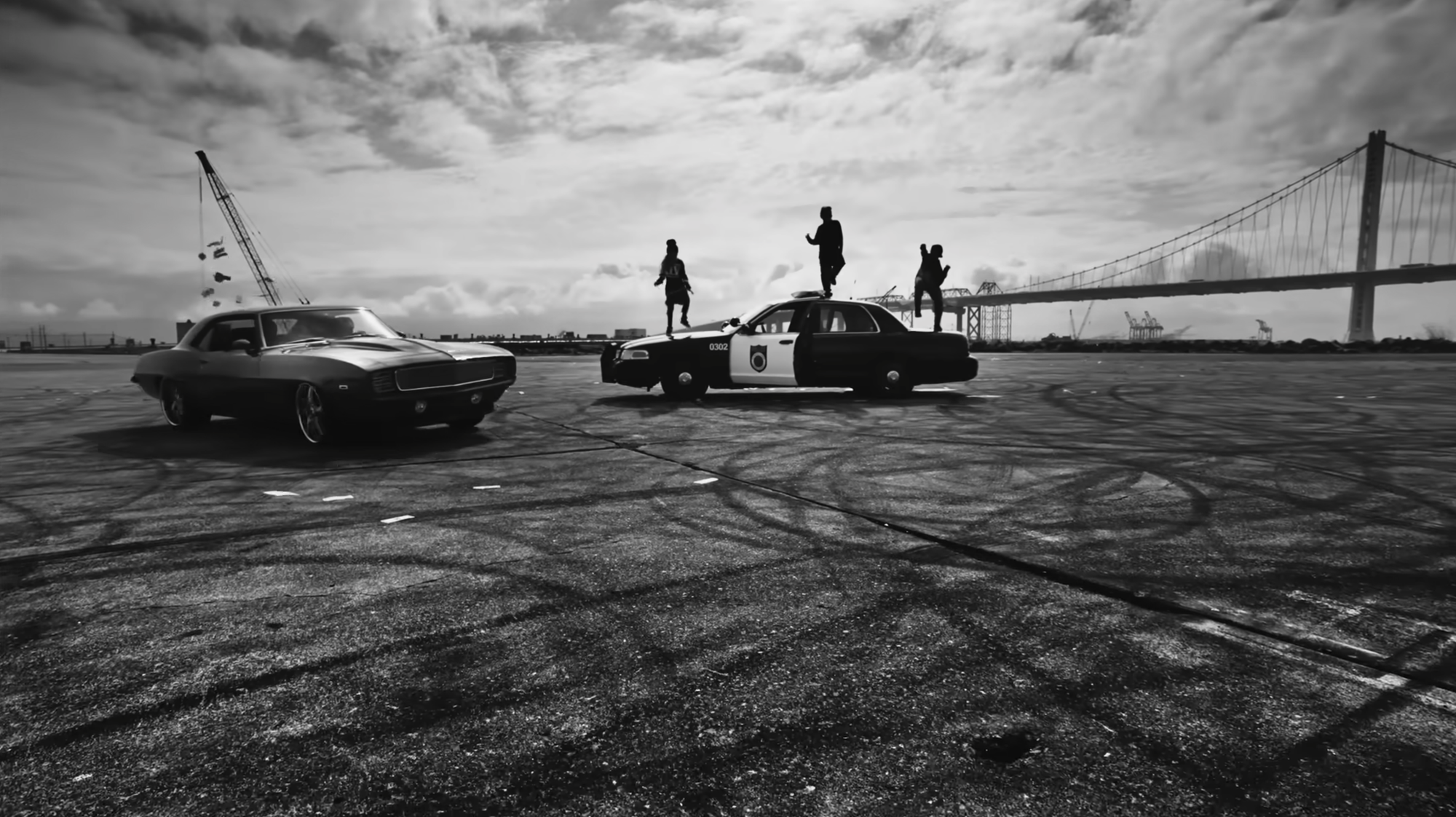
But even as images of cars spinning in circles circulate across borders in ways that were once unimaginable, the reputation of the Oakland sideshow as an emblem of Black masculine rebellion remains indelible. Take the music video for “Alright” by Kendrick Lamar, which, released in 2015, became an anthem for the era of Black Lives Matter. As soon as the beat drops, the rapper appears in a 1968 Camaro, spinning donuts around a cop car—not in his native Compton, but on Treasure Island, in the center of San Francisco Bay, with the Port of Oakland rising in the background. The rest of the video is peppered with footage of local turf dancers, who perform in iconic sites like the Alameda County courthouse and Lake Merritt. In this way, the video connects sideshows, turfing, and the ongoing Black freedom struggle into a single constellation of meaning—one with Oakland at its center.
Reprinted from On Loop: Black Sonic Politics in Oakland by Alex Werth, courtesy of University of California Press. Copyright 2025.
Alex Werth is a geographer, DJ, and housing justice advocate.