The faster future is already at Burger King
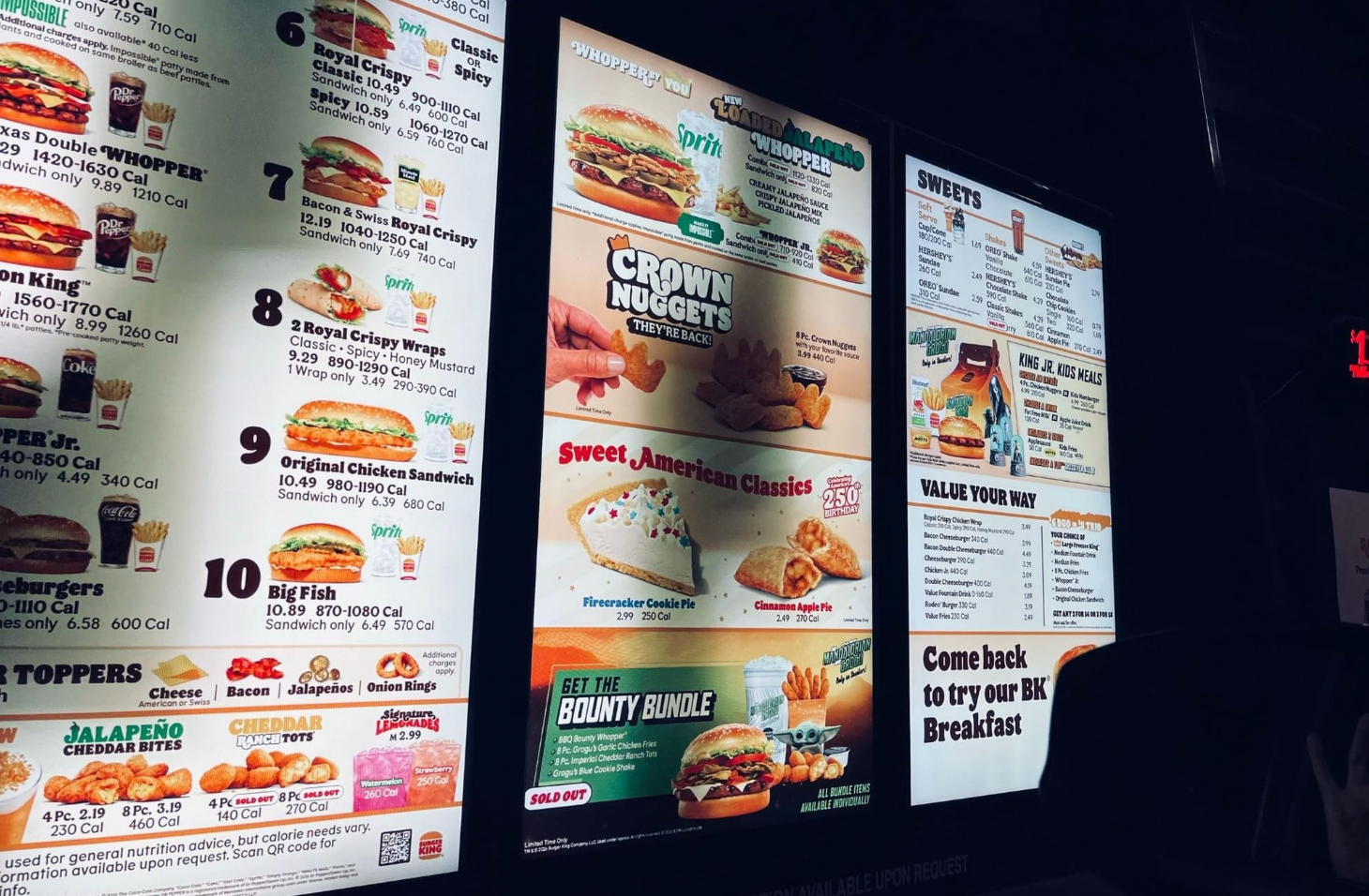
Writing a book about fast food, I try to keep up with industry trends, though I do that more often by skimming the trade press than eating burgers and fries. But when a friend who goes to drive-thrus more often than I do told me the experience of getting a Whopper at his local Burger King had been a little strange, I figured I should try it myself. So at the BK across from my old high school on Broadway, I pulled up to a typical drive-thru order screen and got a hail from an auditory chat bot.
“Welcome to Burger King, where you rule. What can I get you?” The bubbly voice sounded a bit like it emanated from a valley girl. After reviewing the menu, I asked for a Royal Crispy, BK’s entry in the chicken sandwich craze that swept the nation a few years ago. A screen listed my request, just as it would if a person had entered it into the system via a touchscreen. On the other side of the voice, and out of my sight, one or several workers could see the same display. In a sense, you could say the crew and I were talking to each other, with the voice serving as a sort of interpreter, converting my voice into text to be read by humans (and data points recognizable only to a GPU motherboard on site or in a data center far away).
Burger King developed this AI system with OpenAI, called “Patty,” and has been working it into its operations across the country since February. By the end of 2026, the plan is to have “Patty” taking orders at all 6,588 US Burger Kings. “Patty” can recite the menu and make recommendations, and BK can update it with new items and catchphrases automatically from its Miami-area headquarters. And like any good fast food worker, it never forgets to tell customers about the latest special.
“Wanna add four-piece mozzarella fries or chicken fries?” it asked during my pass.
“No thanks,” I said, though “Patty” added an order of chicken fries to the on-screen list, anyway, and asked which dipping sauce I wanted.
“Oh, I said no chicken fries.” After the screen noted my correction, the voice carried on in its unnatural fashion.
“Sounds good! What else can I get you?” Since we hadn’t covered sauces—a subject that the voice had been the first to raise—I asked it to list the available options.
“OK, I’m working on your order,” it said. I felt a little miffed, like I’d been cut off. But why did I feel anything at all? It’s not like “Patty” had acted with intention. After a moment, it didn’t matter. The voice returned with a list. “We have barbecue, buffalo, honey mustard, ranch, sweet and sour, and zesty dipping sauce,” it said.
“I’ll take ranch,” I said, and repeated when my order didn’t show on screen. “Ranch?”
“You got it!”
Then it was quiet. The voice may not have been real, but the awkward silences still were. How would “Patty” register the end of our exchange? “That’s it,” I said, finally, very ready to be done.
“Cool! What else can I get you?”
“That’s it,” I repeated.
“You’re all set!” the voice said in a last bout of computer-generated imitation enthusiasm. “We’ll see you at the window.”
\O/
In trying to work AI into its operations, fast food is a lot like many other industries in the United States today, though, unlike so many of them, it’s actually finding a use for it. The relentless nature of the business is enough for a fast food chain—really, any fast food chain—to embrace a technological adaptation that promises to make things more efficient. But while AI has failed elsewhere because it struggles to account for the constant variability of human experience, it’s found a place in fast food precisely because the industry already treats its workers like robots.
Of course, even within the fast food industry, it’s fitting that Burger King would be the first company to make AI so widespread in its system. The company’s story reads like an allegory for the last fifty years of American capitalism.
Burger King was a successful but mid-tier regional chain out of Florida when the fast food boom turned into a wave of bankruptcies and mergers at the end of the 1960s. Like some other chains in the industry’s budding middle tier, the company survived as a subsidiary of a much larger food manufacturer when the baked goods giant Pillsbury acquired it in 1967 (partly to sell more buns). But by the late 1990s, the role of manufacturers, like Pillsbury, had diminished as the US economy became more international and more financialized. In 2014, BK joined a conglomerate called “Restaurant Brands International,” formed and controlled by a private equity fund run by a firm in Rio de Janeiro called 3G Capital.
Under new management, a chain that was always a bit of an also-ran on the national stage faced even more pressure to distinguish itself from McDonald’s. “Chicken fries” became a permanent fixture on the menu. The Whopper, its load-bearing burger and once a single menu item, became the umbrella term for a panoply of variations and promotional schemes, from a “Ghost Whopper” made with ghost pepper to a “breakup box” that customers could exchange for a printed photo of their exes. (From a 2020 press release: “Burger King® Restaurants Partner With DC’s Harley Quinn and the Birds of Prey to Flame-Grill Memories of Your Ex and Emancipate Your Heart This Valentine’s Day.”) For a time, some locations offered Whoppers with a cup of Hidden Valley Ranch that was big enough to dip the whole burger. There was even a website where you could find the nearest source.
AI is yet another way for Burger King to stand out, an attempt to try something new and news-making that can pique the interest of both food influencers eating burgers in their cars before millions of TikTok followers and Wall Street analysts. It makes the company look not just like a culinary innovator, but a technological one.
At the same time, as the fast food industry absorbs more people into its ranks of customers, AI gives it a way to smooth out the differences that might otherwise inhibit it. As Jonathan Crary writes in his terrific 2014 book 24/7: Late Capitalism and the Ends of Sleep, when a market becomes so huge that it spans the earth, a “generalized sameness” is the inevitable result. We arrive at homogeneity “not by the making of similar individuals, as theories of mass society used to assert, but through the reduction or elimination of differences”:
Thus, above a relatively low stratum, a new blandness flourishes almost everywhere that accelerated consumption has become normalized—not just in certain professional strata, social groups, or age groups.
The “new blandness” is achievable even in California, where more than a quarter of the state’s 630,000 fast food workers are immigrants, most of whom speak English as a second or third language (if they speak it at all), and whose customers are often immigrants as well. They patronize fast food restaurants for the same reason Americans do on their vacations abroad: because it’s familiar and welcomes anyone and everyone without question. The industry is as happy to take labor from one group and money from the other as it is from anyone else. But especially at a drive-thru, where most fast food restaurants earn most of their revenues, such differences pose a risk to the efficient flow of traffic.
When I worked at an East Bay McDonald’s some years ago, our manager instructed us to spend a few added seconds uttering the phrase “Will you be using the mobile app today?” along with our usual greetings to customers. If you think saying “Will you be using the mobile app today?” is awkward, try saying it a hundred times an hour. Better yet, consider what it must be like for a person who struggles to communicate in English. For the mostly Spanish-speaking staff at my store, most of whom worked far longer shifts than me, repeating a phrase like that was a serious hindrance, and one that became a problem not just for them but for the entire operation. Yet as anyone who’s worked under similar circumstances can surely guess, our manager didn’t see why doing so should slow our order-taking times. It was as if she (and the franchisee above her, and the corporation above it) had thrown hurdles into a foot race and still expected us to match our prior time.
AI promises to quash not just the cultural differences that inhibit the flow of traffic, but normal physical limitations, as well. It doesn’t get tired of repeating whacky phrases handed down from upper management, or anything else. It doesn’t even think the phrases are whacky to begin with. When I went back through the drive-thru a second time, late at night, “Patty” asked if I wanted mozzarella sticks to go with my apple pie, in the same tone of voice it always uses.
The industry has never given much consideration to the cultural variability of its workers or customers in the United States, and AI makes sure it doesn’t have to. For now, “Patty” speaks only English, but that’s just a software update away from changing. In whatever language it speaks or may speak in the future, it reduces any communications to the common language of menu items listed in bullet points, anyway. More to the point: It keeps the cars rolling.
Under the circumstances, it’s easy to see how an AI interpreter might be a welcome addition, not just to managers, but to workers, as well. In an environment where one is effectively punished for not being a robot, AI makes workers more compatible with the ever-more robot-like apparatus of which they are a part. When I drove up to the window to pick up my order, the worker I met was enthusiastic about the AI “assistant.” Not having to enter orders themselves meant the crew had more time to make drinks, he said.
Yet for all its appeal, the new technology can also be quite invasive, isolating, and dehumanizing, as its functions go beyond taking orders. In a situation where workers might have gone to a colleague for help, like trying to figure out how to assemble a new burger, for instance, workers can speak to “Patty” directly and receive instructions through their headsets. What’s more ominous, “Patty” listens to workers even when they don’t ask for help. As BK described it during the February roll out, the new system would use workers’ headsets to monitor their use of phrases like “thank you” and “welcome to Burger King” in those (now rarer) interactions with customers. BK said the system would anonymize data so that no single employee would have to suffer a dressing down from a manager over what “Patty” recorded them failing to say. Rather than a means of surveillance, they insisted, “Patty” is a “coaching tool” that would give managers something substantive and statistical on which to critique the entire staff.
“Nothing was your own except the few cubic centimetres inside your skull,” George Orwell wrote of life under a high-tech authoritarian state. With “Patty” in your headset, even that space becomes less your own.
\O/
AI shills have tried to ease people’s hesitations about the new technology with the language of inevitability. Of course, one day you’ll let Claude write your emails for you, if you haven’t already made the switch, as the pitch goes: Once you see for yourself how efficient it is—how easy, how much time it leaves you to do yoga or shop for pet supplies online instead of relaying duties to your underlings or explaining your dietary preferences to your private chef—you’ll wonder how you ever carried out such cursory administrative tasks all by yourself. No, the tech evangelists tell us, you’re not a robot if you use AI. But try donning the robot skin for just a little bit during those most soul-sucking tasks. You’ll see it leaves more time for you to be the human you truly are.
And yet, the same evangelists go on to say: consider how many more emails you’ll be getting when your bosses, clients, colleagues, and yes, your private chef, all take up the technology that you’ve so far refused. As the world is remade by AI, for AI, hadn’t you better find some working arrangement with this juggernaut, before it overwhelms you?
Those of us who resist the rhetoric may do so because we want to be human even when carrying out the most mundane tasks. We want things to be harder for the same reason that we walk those four blocks from the bar to the BART station instead of closing the gap with help from a rideshare app. Because we value our humanity, and want it not in controlled doses that we note in advance in the calendars we keep in the cloud and check on our phones, but at every moment of every day for the entirety of our lives.
Yet in fast food, the tech people may at last have a case for AI’s inevitability. Scripted lines written in offices and taylorized repetitive motions have been features of the industry’s source code basically since it was an industry at all. Sensors to track a car’s motion at every stage of a transaction and feed the second-by-second times into databases for industry planners to mine for ways to make it all run faster have been standard features since the 1990s. It is a system built for robots. With AI, the industry has at last found its robot.
In a recent article for QSR Magazine, one of the industry’s leading trade publications, Matt Britton, an AI evangelist and the founder of a consumer data company, waxed optimistic about how the technology was already “redrawing the division of labor between humans, machines, and algorithms” in fast food. Of course, to a guy who wrote a book called Generation AI, everything looks ripe for more “optimization.” But, as he gleefully predicted, the changes we see at Burger King and could soon expect at McDonald’s (which has plans to add its own AI ordering system, developed with Alphabet, to all of its US restaurants in the near future) were only the first salvos in a broader assault on workers across America.
“There’s a reason this is happening in quick service”—the fast food industry’s preferred term for itself—“before it hits everyone else,” Britton wrote.
McDonald’s has massive scale, highly standardized processes, enormous transaction volume, and razor-thin margins. That’s the perfect environment for AI: tons of data to learn from, clear definitions of success, and workflows that repeat thousands of times a day.
If AI can reliably take orders, optimize kitchens, and manage labor during an evening rush at a busy McDonald’s, it can do the same in big-box retail, pharmacies, convenience stores, hotels, and airports. McDonald’s is effectively funding the R&D for the rest of global retail…You may not have McDonald’s budget, but you’re absolutely going to live in the world their experiments create.
People like Britton admire fast food because it has never slowed its search for greater “efficiency.” It’s always on the hunt for new technologies that can make the lines move faster. But inevitably, the job of realizing the gains that those technologies promise falls to workers. Even as menus get more complex, restaurants stay open later into the night, kitchens become more dangerous, and workers take up more and longer shifts to overcome a rising cost of living with wages that do not keep up with it any other way, the expectations are always the same: to move fast, then faster. In the fast food kitchen, greater efficiency doesn’t mean more time for whatever else you want to do. Any gains in efficiency accrue for management to use as it pleases, and for workers, that usually means more of some other, more physical tasks that OpenAI has yet to disrupt (only faster now that the system allows for more customers).
The threat of a speedier, busier world that will overwhelm you unless you internalize its customs is not an abstraction to fast food workers. It’s real, and it’s now, just as it one day could be for workers in every service industry. As Britton sees it, restaurants not using AI at every turn will soon look pitiful next to the ones that do:
“First, frictionless service stops being a differentiator and becomes the minimum requirement to be in the consideration set” he writes, using the present tense, as if the future he describes is so inevitable it’s already here. “If your brand can’t match the speed, personalization, and reliability of an AI-powered QSR experience, you’re invisible.”
“Second,” Britton adds, human interactions at fast food restaurants will soon become “a premium feature.”
So, along with scrambling faster, workers can expect to have to smile more, too.