The cookie that wasn’t there
Welcome to Taste Week! in our “Six Senses of Oakland” membership drive. Read more about the drive here. Check out other Six Senses stories here. Take a big bite of ORB by subscribing here.
◎
I started thinking about it that morning. I spent my workday watching the clock, waiting for the moment I could log off, get ready, and get out the door. I tried to maintain presence, composure, and a good attitude on calls with my colleagues, but my mind was elsewhere, projecting several hours into the future. As soon as I turned off my computer, I took a shower and did my hair and makeup. I found out that my companions that evening had fallen ill, and sent out some halfhearted attempts to replace them. I knew that experiencing it alone would be the purest form of pleasure.
But first there would have to be some preliminaries: the BART ride through the sunny El Cerrito hills, the people-watching as the train filled up on its march through the East Bay, the terrible white negroni alongside baffling food in Union Square, the shame of having naively interpreted an SF Standard “best new restaurants of 2025” article as a serious and reliable source of food journalism and recommendations, a trip to Sephora, a walk down Market Street, a flash of anxiety that I might be too late to gain entry.
But, no—a crowd was gathered outside the Orpheum Theater, and I was on time. Patrons of all ages and all varieties ranging from current to former theater kid opened their bags and scanned their tickets. I slipped into line and made it to the lobby quickly, efficiently. As an old hand when it comes to sitting in a seat in a theater and watching something uninterrupted, I knew to scurry in and out of the bathroom before curtain. The first act was good, and then the stage lights cut out and the house lights turned on. It was showtime.
In the lobby, I took my spot. It was a big crowd, and I felt the time pressure of intermission. Two prepubescent teenage boys in front of me debated whether the villain fluctuated between baritone and bass before shaking both of their hands and chanting “Tenor Gang” at each other. I was restless and hypervigilant. When the crowd in front of me cleared, I rushed to the open spot. I scanned the shelves and found it—the white bag, the subtle pink script, the peek-a-boo plastic cutout featuring the gentle curves and golden glow of the thing itself. It was the last one. I blacked out at the $14 price for water and my treat and then found an errant chair to sink into while I communed with God.
As I broke off a piece and put it in my mouth, I pondered the question: Why is the best cookie in the Bay Area only available at the concession stand at Broadway SF shows?
◎
Soon enough I would have much more profound questions, not the least of which was whether the cookie even exists. But first: the cookie itself.
I think the first time I ate it would have been during intermission at Chicago (mediocre leads, but a showstopper “Mister Cellophane” from that night’s Amos). At Shucked, I encouraged others to get it as well. After I saw the light, I kept my eye out during any intermission. The War Memorial Opera House does not carry it, so at the ballet or opera I instead have to settle for a $24 plastic cup of prosecco. I haven’t been to the Symphony since these cookies entered my life, and the press room has yet to confirm for me whether they sell them at Davies Hall.
I couldn’t understand it. I’ve been to the tourist traps (Hot Cookie, disgusting). I’ve been to Jane The Bakery (overhyped). I’ve had the sesame chocolate chip cookie from Ok’s Deli (delicious, but the richness-to-size ratio undermines the overall experience). For a region with a vibrant food culture, why could I reach the highest levels of satisfaction only with this specific cookie? Specifically, the brown butter sugar cookie from Caia’s Cookies, a Dessert Hub® brand?
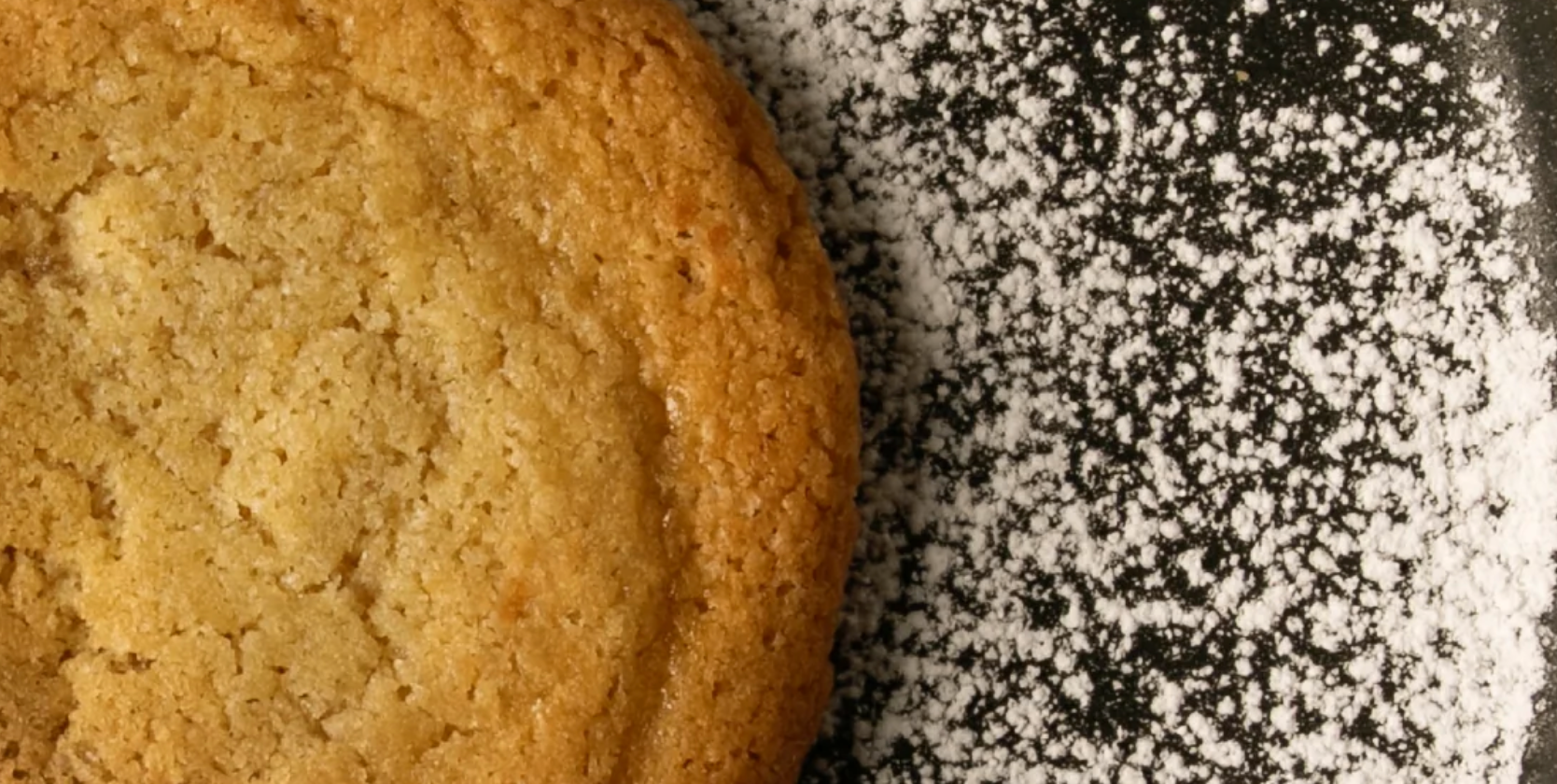
I have never felt so constructed as a subject by a baked good before. Other baked goods, memorable as a confection or as a relic of a specific era, kept me at a sufficient distance to retain self-possession (and self-respect). The Levain cookie and Dominique Ansel cronut in the mid-2010s, the almond croissant at the boulangerie next to the Jules Joffrin Paris Metro stop, the madeleines they sell in bulk at Costco, the guava cheese strudel from Porto’s—none of these personal quasi-Proustian objects have captured my attention and my allegiance like these cookies. First of all: They’re a perfect size. Eating one takes longer than a few seconds, but not so long that it requires rushing and/or any self-consciousness about making such a sensory commitment during a short window of time. They also taste amazing. The brown butter gives the cookie a subtle and sophisticated edge, in the way that vanilla ice cream can be really good and not boring if the vanilla flavor itself is well-calibrated. The texture is dense but pliable—you can break off a piece of the cookie without triggering a crumbling fiasco. And they are incredibly consistent: Every cookie I’ve eaten has yielded an identical experience, and yet it never feels like I’m eating something mass-produced. I wanted to know more about them, but I had nothing to go on. I didn’t even know where they came from.
◎
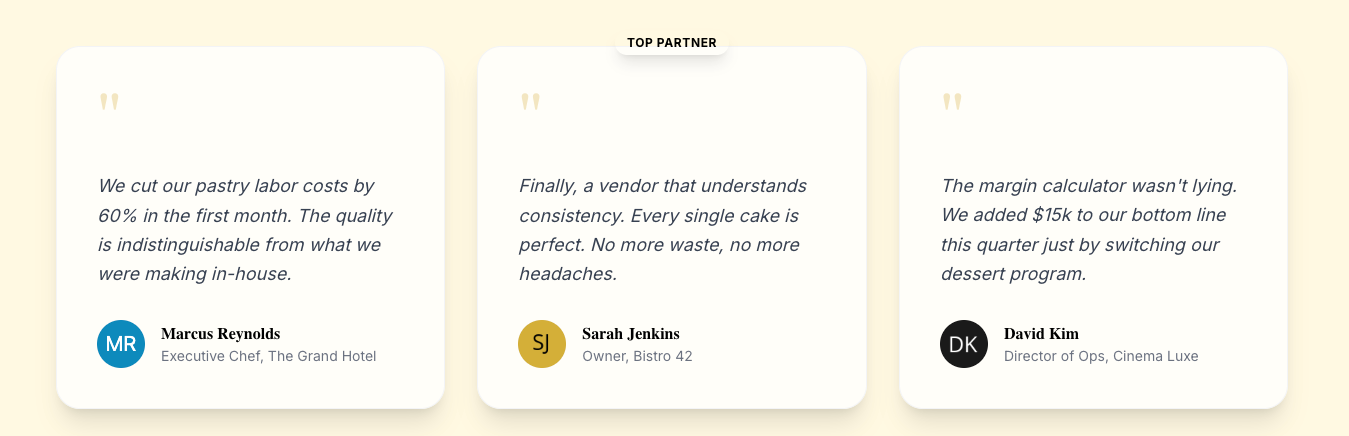
First I googled Caia’s Cookies. The first two hits listed San Antonio as their location, which I figured had to be wrong because the back of the actual cookie’s bag listed a Sacramento address. I looked up Dessert Hub, and started getting somewhere. It describes itself as “Premium B2B Dessert Solutions,” and the search entry states “Dessert Hub provides gourmet, pre-portioned desserts for high-volume venues. Zero prep, high margin, and consistent quality.” I clicked through onto a 100 percent AI-produced website that told me about a pastry chef I don’t have to manage, built for high volume, and sourced like a Michelin kitchen. I learned that if I purchased a hundred per week for $2.50 each, and sold them at $8 each, I would earn $550 per week in pure profit. I read three testimonials from an executive chef, bistro owner, and director of ops whom I’m almost certain don’t actually exist.
The website has no way to contact a team, but it does offer a way to book a tasting, or at least book a slot on a Google calendar that purports to include a tasting. I scheduled a time and got two direct emails as a result, for a Jean-Paul and a Courtney. I canceled the “tasting,” emailed them instead, and never heard back.
I decided to try Caia’s Cookies again, and I realized that despite the San Antonio location, this was in fact the specific cookie brand I was looking for. The dedicated website—caiascookies.com—is a broken link, or was when I first tried it, but the Instagram looked promising (flashes of the cursive pink logo, a Bay Area focus). The page linked to a Square site for ordering cookies that included an email icon. The brown butter sugar cookie was on the menu of possible cookies, so I was certain this was the right company. I emailed them and decided as well to place an order on the Square site. I could pick up in Vallejo or San Antonio. I chose Vallejo. The failed delivery bounceback from my attempted email inquiry ended up in my spam folder.
The Instagram itself promoted ordering the cookies via DoorDash (but also hasn’t posted since March 2025). When I looked up the company on DoorDash, nothing came up. Googling “caia’s cookies doordash” yielded several hits, though, including Vallejo, San Francisco, and Sacramento options. I looked up the addresses for each search result. The Vallejo one is Morgen’s Kitchen, a commercial kitchen; the San Francisco one is Charter Oak, an eerie touchscreen-interface “food hall”; and the Sacramento one is Maker Kitchen, another rental commercial kitchen. Actually clicking on the hits, though, brought me to error pages on DoorDash. “Sorry, Caia’s Cookies is unavailable,” the website told me.
I started to worry that I had thrown $16 into the ether and that I would not be picking up a four-pack of cookies in Vallejo.
I turned to the final online tool at my disposal: LinkedIn. Dessert Hub® has a company page and I finally got some concrete information:
Caia’s Cookies (pn. kai-yuh’s) are crafted without shortcuts, our cookies are moist, delicious, and made with love. Our journey began in North Berkeley, California, the birthplace of California Cuisine. Each batch is freshly baked and hand-packaged daily in our new home of San Antonio, TX. We continue to honor the principles of California Cuisine, a culinary movement that started in Northern California, by emphasizing the use of local, sustainable ingredients, and focusing on seasonal produce and the abundant offerings of the region.
This is marketing speak, but it’s not wrong. The cookies are moist and delicious, and the ingredient list is about as short as that of a homemade cookie recipe. If Alice Waters’s legacy is that this cookie brand can claim allegiance to her philosophy and give me a chewy, sweet-but-not-too-sweet, gently browned sugar cookie to eat every time I watch the B-team of American musicals, I see no problem with that. At this point, the cookie is more memorable than any dessert I’ve had at Chez Panisse.
◎
The experience of the cookie probably has as much to do with the environment in which I encounter it as it does with the cookie as such. The concession stand is usually an exercise in humiliation, mostly owing to the feeling all of us performance patrons have had, that we are little hamsters in a cage, finding out there’s a sugar water dispenser in the corner. Is a drink that necessary? We have fifteen minutes! Also because it requires throwing money on fire for, again, a fifteen-minute break. The cookie, by contrast, contains the satisfaction of a decent consumer interaction, one in which I have received something that is worth the $9 that I paid for it. I’d found that rarest of things among mass-produced commodities: something that’s better than it has to be.
It’s also a rare concession stand item that is specific to the concession stand experience. Sure, I’ve only ever eaten peanut M&Ms at the movie theater, but I could buy a box at CVS any day of the week. W. David Marx, the prominent (and correct) theorist of the cultural usefulness of elitism and status, locates the flatness of contemporary culture in the absence of scarcity. “There’s no sense of anticipation, there’s no sense of endings,” he said on a podcast that I didn’t listen to but instead read some of the transcript of. Scarcity begets an increase in value, as all luxury fashion houses know, and I am hard pressed to experience something scarcer than a quarter-of-an-hour window three to five times a year.
And yet, maybe because of the unusual conditions of its scarcity, I couldn’t leave the cookie in its place. I had to understand where they came from. In part for a practical reason: Was there a way I could increase the likelihood of eating this cookie in my day-to-day life? But also for a more existential reason. Living in the Bay Area of the 2020s is an exercise in trying and often failing to locate nonalienating and locally specific texture in daily life. I thought maybe that opening my life to the possibility of satisfaction in unexpected places would yield an as-yet-untapped resource of, for lack of a better term, flavor.
Rather than discovering an upstart local bakery making inroads into corporate sales, though, I discovered a B2B dessert-as-a-service company leveraging dispersed logistics and internet infrastructure to ensure there’s a cookie in my hand while I release the Act I tension of mainstream musical theater. The Bay Area-ishness of the product is just some echo, a vestigial place-specific reference that has floated free of its moorings in actual space and time.
◎
A couple days after placing my order, I drove the twenty-five minutes to the kitchen in Vallejo to see if my cookies existed. I was not optimistic. I had received no confirmation from the company, no “your order is ready!” notification. But I was determined to see it through. I arrived at the location and found a small strip mall with a sign for the commercial kitchen company. The only other signage around was for a place called Momo’s Cafe, which appeared to operate out of the commercial kitchen.
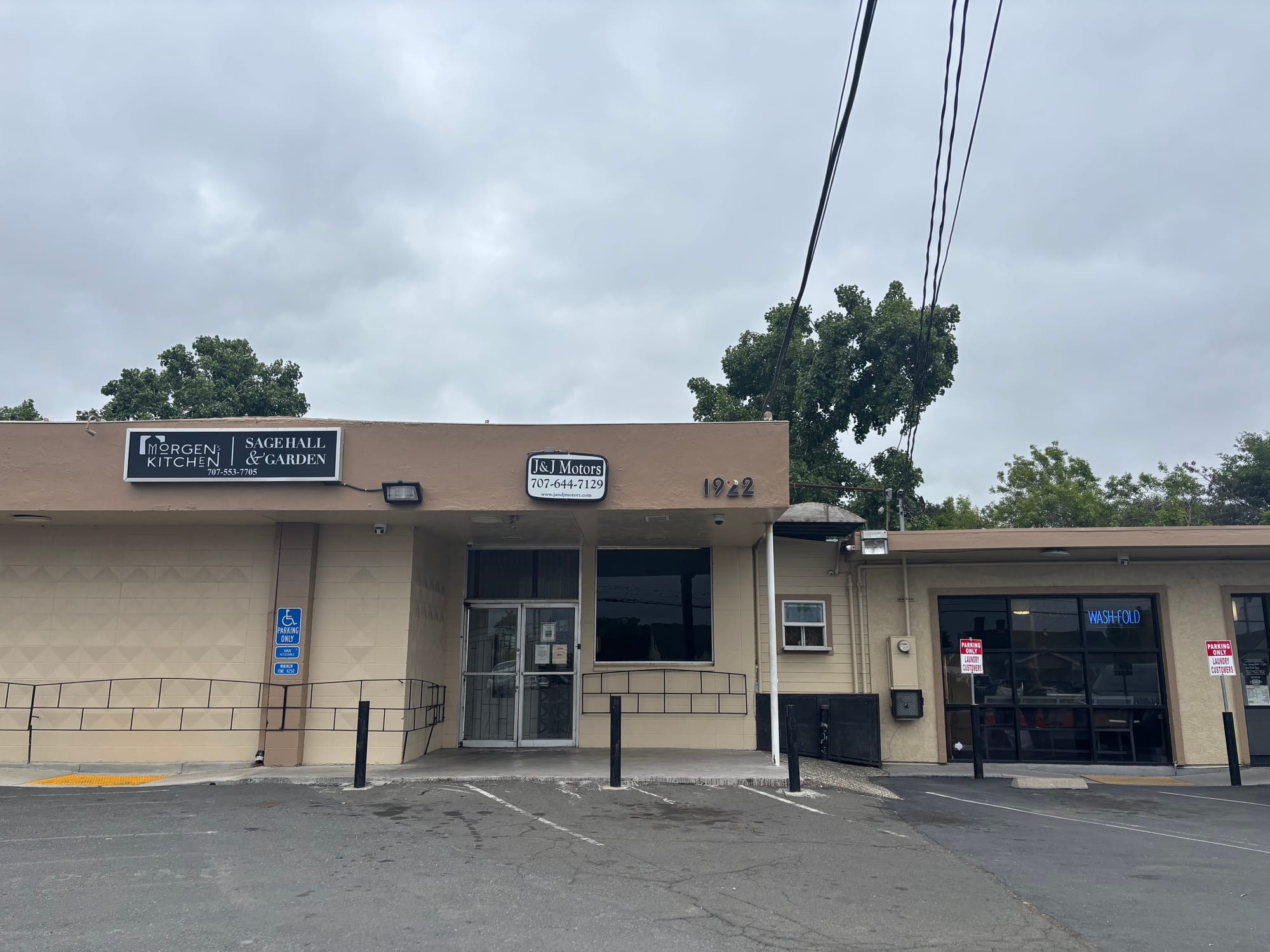
I wandered around looking for someone to talk to, some signal that I would be finding a four-pack of cookies waiting for me. Instead, a man walked out of the front door and had a look on his face that was very, “Are you lost?” We chatted for a bit and I learned that a cookie company operated out of the space before he moved in, which was over a year ago. “No one has ever come here looking to pick up an order from them before,” he told me. “I’m surprised you can even still place one.”
The company itself probably is, too. I DM’d the customer success manager on LinkedIn to explain my predicament and seek recourse. She viewed my profile and never replied. The $16 has since fully cleared my bank account.
I’ll probably never get that money back. And I’ll just have to wait until Oh, Mary! hits town to have another cookie.