There’s a monster in Lake Merritt
Welcome to Sight Week, part of our “Six Senses of Oakland” subscription drive, dedicated to how the Town looks, sounds, feels to the touch, tastes, smells, and just, like, ~vibes~, man. It is also dedicated to getting us enough members to make this whole ORB thing sustainable. Read more about the drive here. Subscribe here.
Right here in the heart of Oakland by Lake Merritt, there is a bird refuge where wild ducks and geese will eat out of your hand!! Wild pintails and canvasbacks and bluebills and a host of other free flying birds that have swooped over the Sierras—looking down on the most rugged of wilderness areas—come to this refuge where they dwell with city and man in sweet accord.
—Rex Burress, “Letter To John Muir” (1962)
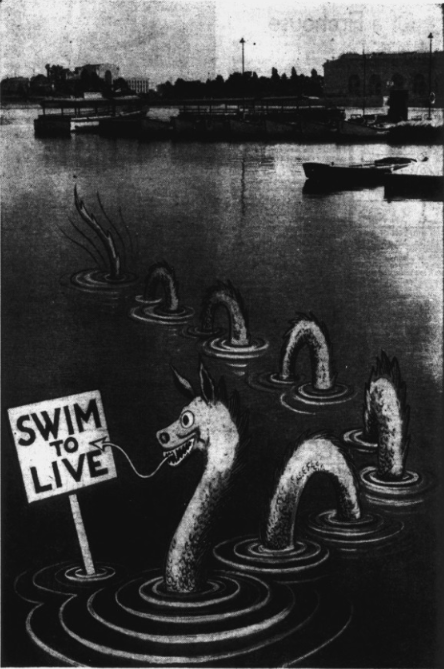
From what one can gather from accounts over the years, the creature in Lake Merritt has a long protruding neck, like a brontosaurus or the Loch Ness monster. “Sooner or later every loch must have its monster,” wrote Oakland Tribune columnist Jack Burroughs in June of 1946, describing it as “serpent-like” in the earliest account of the legend that I could find. After a heavy storm, “the amphibious creature slithered along one of these water courses into San Antonio creek, waded along the creek till he came to the estuary, swam out the estuary into the Bay and thence out to sea,” Burroughs wrote. “But before he left [for the ocean] he hollowed out with a [flip] of his tail, the basin that later became Lake Merritt.” Oddly, the article leads into a story about a performance in which a group of dancers wore an old dragon costume from the San Francisco Opera in Lake Merritt to promote recreational swimming. Aside from this, the creature and its whereabouts largely remain a mystery.
The existence of aquatic “cryptids,” creatures unrecognized by mainstream science, requires a cloudy body of water to suspend our disbelief. Without this opacity, legends of these creatures would eventually go extinct. We need the surface to remain murky: a simple “yes” or “no” would rob us, the mystified public, of the excitement of uncertainty, of living in a world in which humans’ ecological knowledge and dominance are put into question. And yet, when we examine these mysteries more closely, we learn much of the history of places themselves. In the case of Loch Ness in the Scottish highlands, for example, we may never have discovered the cavernous caves deep below the waters of the loch without the tale of a creature to lure explorers below the surface with sonar. Similarly, the legend of the Lake Merritt Monster and its disappearance can only be understood through the story of the Lake Merritt’s ecology and its direct connection to the greater bay.
Dredging up old tales
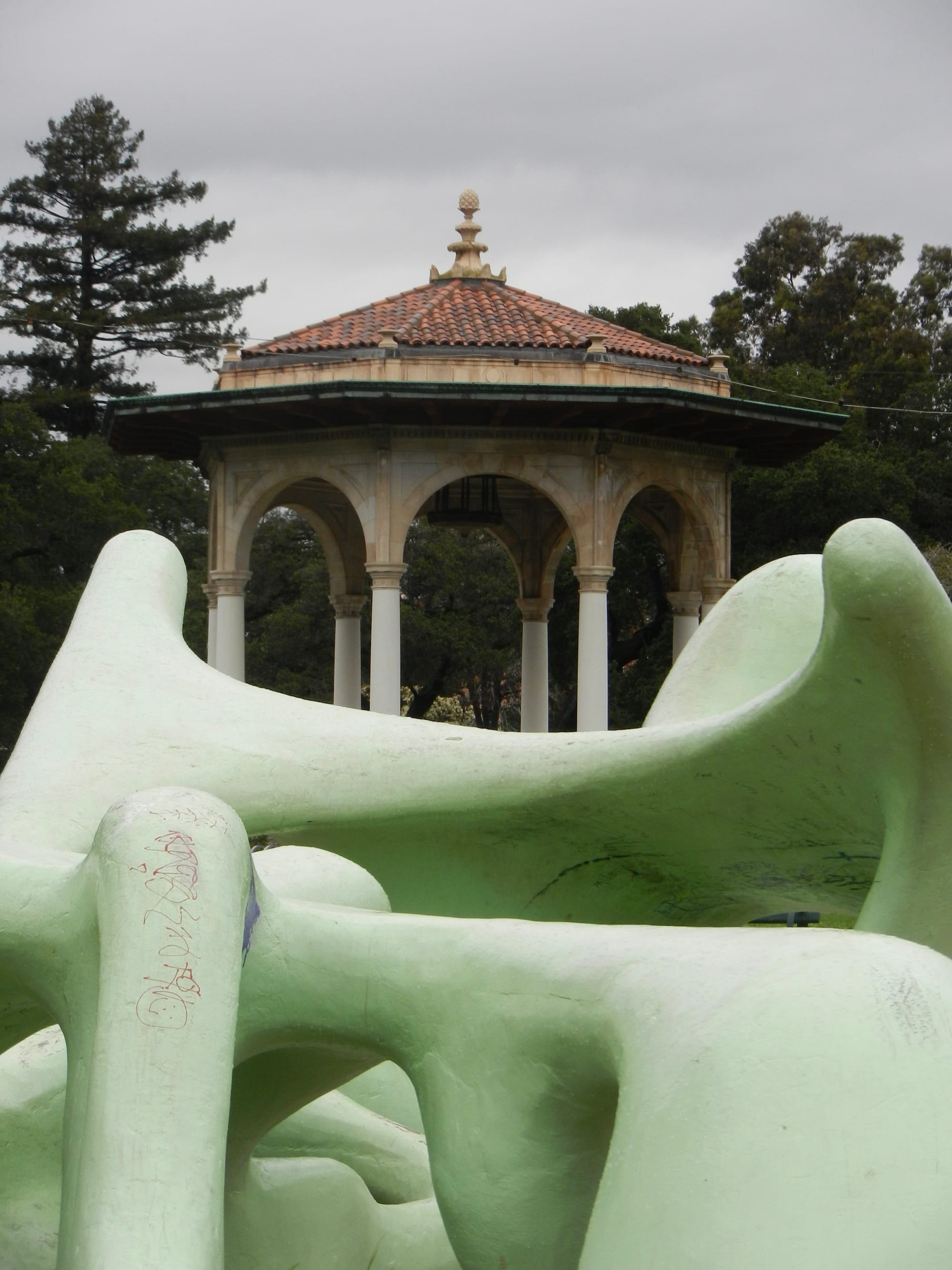
The story of this mysterious creature has shifted throughout the years, originating as a fun aside in the Burroughs article and later cementing as local lore, occasionally rearing its quiet head up from the depths. The green Lakeside park play structure, designed by Bob Winston in 1952, was dubbed the “Monster,” or the “Mid-Century Monster” by its fan club. Sly and the Family Stone iconically posed atop the sculpture for the cover of Dance to the Music. It was the inspiration for The Lake Merritt Monster, a 2023 short film by Benjamin MulHolland that depicts the monster as a kind of triceratops-meets-Stranger Things creature. It also persisted as an urban myth amongst Oakland schoolchildren, a fun discussion topic during recess if perhaps nothing to take seriously.
That was, however, until the Lake Merritt Monster reappeared in an Oakland North article in 2011. The feature included the testimony of the respectable scientist and then-director of the Lake Merritt Institute Dr. Richard Bailey, who claimed to have personally seen the creature in the lake: “It’s black, it’s big, it has spikes on its head and its tongue sticks out,” he said, noting its “typical round monster humps.” The Lake Merritt Institute is a nonprofit dedicated to caring for the lake—could this have been a publicity stunt on the director’s part? Or was it an earnest firsthand account? I searched for traces of Bailey online, attempting to contact him from multiple avenues, but I found only silence. In journalism, sources can be as mystifying as long ripples of water on an overcast day.
Because they are alleged to exist in the absence of concrete proof, cryptids create the ideal backdrop for projecting one’s own preconceptions and beliefs onto the world, the veil in front of them leaving gaps for narratives to filter through. "Cryptids don’t just live at the geographical margins,” as Colin Dickey writes in The Unidentified, “They exist perpetually at that margin between the scientific and fantastic.” Yet a peculiar thing about the Lake Merritt Monster, as Dr. Bailey observed, is that the “Oakness monster” was sighted in the immediate aftermath of a successful large-scale cleanup of the lake, after its murky depths were rendered suddenly transparent: “Dr. Bailey believes the creature prefers clean lakes,” as Dara Kerr wrote, for Oakland North, “so perhaps it is no coincidence that he says these appearances come with massive lake clean-ups that make it easier for lake-goers to spot monster-like objects in the water.”
Mysterious ecologies
Sightings are often few and far between, but some have been verifiably false. One Oakland Voices writer witnessed something monstrous at the mouth of Lake Merritt, which was ultimately identified as a sea lion (which, admittedly, is still bizarre). But this was hardly the only strange sighting in the lake: Two years ago, local outlets were stunned to find an odd “alien-like” creature in the lake—a jellyfish, as it turned out. Six years ago, a poster on Reddit claimed that their friend went fishing at Lake Merritt and caught a five-foot sturgeon, a designated threatened species by the California Department of Fish and Wildlife (before you ask, yes, recreational fishing in the lake is illegal). I recently spotted a dead shark on the northwest corner of the lake, and even with the help of a local shark biologist, I am still having trouble identifying the species. While investigating the possibility that the Oakness Monster exists, I found far more bizarre things afoot in Lake Merritt.
The first oddity is the lake itself. With a circumference just over three miles in length and a shoreline vaguely resembling a baseball glove, Lake Merritt is not in fact a lake, but rather a dredged and concrete lined estuary. A large marsh that was once called the San Antonio Slough, Lake Merritt is the confluence of many small tributary creeks that trickle into the area before the water slowly makes its way out into the greater San Francisco Bay. It was named after Samuel Merritt, former mayor of Oakland, who oversaw the closure of the slough from the bay. Merritt had built his home on the banks of the lake, recognizing it as an ideal place for real estate development at a time when many thought he was foolish for living on land widely seen as worthless.
But what does this tell us about the monster? Simply put, Lake Merritt is a profoundly strange body of water, from its misleading name to its peculiar biodiversity and ecology. All of these oddities, and the history of human expansion that has created them, make it easier to see why some people insist that the Lake Merritt Monster exists today. An estuary called a lake, a wildlife refuge with few indigenous species in its waters, and probably the most diverse and mixed human environment in the city: An anomalous and paradoxical place like Lake Merritt is a natural home for a creature that exists outside the normal bounds of belonging. Those seeking to debunk the monster’s existence might point out that the lake is too small to support the needs of a large animal over the course of its evolution: With a modest area of 155 acres, Lake Merritt is nearly 2,000 times smaller than Lake Tahoe (which is home to its own cryptid, Tahoe Tessie). And unlike the Jewel of the Sierra, the Jewel of Oakland is extremely shallow, only ten feet at its deepest.
Of course, the world of science has plenty of odd stories to share about the lake as well. Lake Merritt has been described by biologists as a kind of wild zoo with its assortment of unusual creatures from across the world's oceans. These odd taxonomic discoveries, for many, began in earnest with a 14-year-old boy in 1962 named Jim Carlton.
“I was at Lakeside Park with my family on a little picnic, and I wandered away, and I went down to the shore,” Carlton recounted to me. “I stepped onto a clump of large white tubes and I didn't have a clue what they were.” His curiosity led him to the Rotary Nature Center. “I saw the thing I had stepped on was in a glass display case [the Australian tube worm, Ficopomatus enigmaticus]. But under the name of this tube worm, it said it was from the South Seas. That, I thought, was pretty interesting,” Carlton said. “I wanted to know what else was in the lake and where everything was from.”
From that day Carlton’s curiosity about the creatures of Lake Merritt only grew. Carlton began sharing his findings with members of the Academy of Sciences in San Francisco, contacting anyone willing to hear him out, and eventually began a successful career in marine biology. He is now an emeritus professor at Williams College in Massachusetts, studying how marine creatures enter new ecosystems and the impacts caused by these new residents.
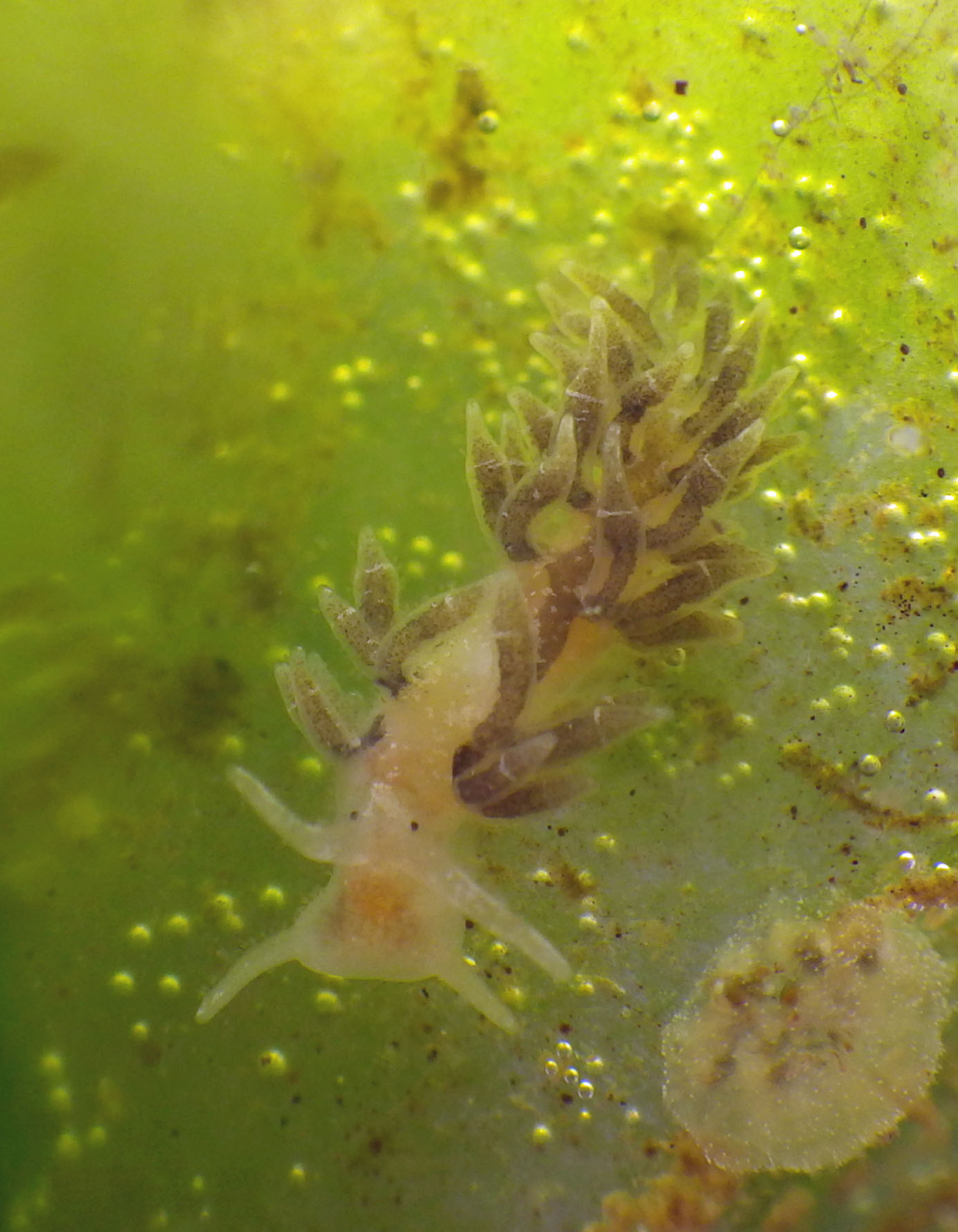
Through decades of research and careful observation, Carlton has come face-to-face with many previously unknown residents of Lake Merritt. When he was only nineteen, he discovered an unassuming shrimplike beach hopper and determined—with the help of several tenured scientists—that he had discovered an entirely new species, now known by its scientific name Transorchestia enigmatica. Once hidden to science, now revealed: It hadn’t evolved in Oakland (or even in California), but it was only discovered after adopting Lake Merritt as its home, hardly the only resident here from a distant (or unknown) place of origin. Some 99 percent of the biomass of Lake Merritt is introduced species, with 97 percent of the biodiversity coming from other regions of the world. Hence, biologists describe the lake as a zoo. The Lake Merritt nudibranch (Cuthona perca), a sort of sea slug, for example, was first discovered at Lake Merritt in 1967 but was later discovered to have also existed in numerous parts of the world (its place of origin still unknown).
Carlton represents one destination for those who follow their curiosity. But while scientific rigor (and the arduous labor that can make it opaque to the greater public) is Carlton’s domain, the other side is Richard Bailey’s adamant insistence that the Lake Merritt Monster is real, without need for concrete proof. But the abundant, distinct, and frankly weird biodiversity of Lake Merritt and Bay Area waters in general makes it easier to suspend our rational disbelief: if scientists keep discovering odd, even alienlike creatures in Lake Merritt, the potential existence of a monster seems a lot more plausible. Perhaps in understanding how these creatures arrived in Lake Merritt we may better understand how, or why, the monster could exist in the lake.
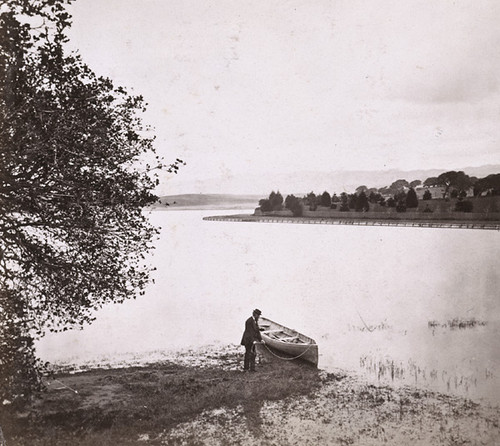
New arrivals
Lake Merritt, like Oakland, is a defining microcosm of the Bay Area itself. Tucked to the side of the bay, often forgotten in favor of its bigger, more boisterous neighbor, its ecology is a smaller playground in which we may discover the history of trade and transit through the introduction of new species. Perhaps it was at the beginning of all this change that the Lake Merritt Monster said farewell to its home, priced out by new development like so many other lakeside residents.
Like Carlton’s beach hopper, many new creatures arrived in the sand which was used to shore up beaches, or in the sea walls that prevented the encroachment of the native marshland ecosystems (decimated by regional commercial development). They also came in ships, when the ballast water—kept in the bottom of the ship to help maintain its equilibrium—was dumped in the port, releasing any stowaways that had survived the long journey. In that way, countless creatures survived their journeys and made Oakland their home.
If the Oakland Tribune story is true, the arrival of these new residents was an early warning sign that Oakland was changing. And perhaps all this change was too much for the Lake Merritt monster to bear.
The world was shrinking, the map being filled in, the marshes of Lake Merritt being dredged, new creatures arriving. The monster’s home was stripped and transformed into its new state, with new creatures taking up residence and warning the mysterious watery cryptid that, perhaps, it was time to leave.
The tragic loss of the mysterious serpent’s original home is often linked to the creation of the city of Oakland, in the mid-1800s, at the inception of the industrialized world as we know it today. All across the world ships were moving in and out of new ports, bringing with them new commerce through the advent of industrialization’s steam engine, large-scale manufacturing, and the assembly line. With these inventions, and the desire of their owners for their expanded growth, things needed to be moved. As Oakland became a hub for all this international commerce, Samuel Merritt—who already owned a large estate on the western shore of the slough—looked into the waters and saw a real estate opportunity. He saw the potential to build a lake.
For many years Lake Merritt had been a dumping ground and an ad-hoc urban septic system. As the Oakland Tribune boasted in the mid-1800s, the estuary was “without exception, the most perfect sewerage main in the world, no other city having such natural facilities.” For those who lived along the banks of the estuary, the foul stench of human detritus in its waters represented the other side of this convenient sewerage. Samuel Merritt, however, saw these waters as better suited for beauty, and so he made certain his vision came to fruition.
Linda Watanabe McFerrin wrote in 2001, for Bay Nature, “Merritt proposed, spearheaded, and—when he found support lacking—personally funded construction of a dam at the 12th Street bridge that would control the tidal rise and fall through the inlet. This, he reasoned, would transform the slough from mud flat to lake, from a sewer to a source of civic pride.” This transformation stoked distaste for the bird hunters who prowled the still-marshy shoreline for game. These hunters were particularly grating to Merritt himself, not merely because of the sound of gunfire, but also because of the stray bullets that sometimes flew straight through the walls of his parlor room as his family ate breakfast. Merritt used his influence with the state legislature to enact laws to protect the area from hunters in 1870, effectively creating the first wildlife refuge in the nation.
The shoreline was eventually dredged, and the edge of the estuary was made solid with stone and concrete. The mudflats began to vanish, with the estuary controlled by a tidal wall underneath what is now 12th Street on the south side of the lake. Lake Merritt took on the shape that is now familiar to contemporary Oaklanders. The stench of the lake, still present, is much more mild, coming and going with the tides, as it has been since before the creation of this city. Lake Merritt remains a lake in name only, a pungent tidal estuary in perpetuity.
Over the years many have wanted to “revitalize” Lake Merritt. Much of the work to preserve the lake’s health has fallen into the hands of dedicated volunteers, organizations like the Lake Merritt Institute, the Friends of Lake Merritt, and the like. But “preservation” raises some complicated questions for stewards of this completely reshaped waterway. If “conservation” is the preservation of land from the encroachment of people and industry, what could that mean in a place like Lake Merritt, where the lake is no longer a marshy estuary, where the historically indigenous species are seldom seen, and where the mysterious Oakness monster has yet to return? What is it we are attempting to preserve? A return to the lake’s original state would mean dismantling the city of Oakland itself. Do we want to see the monster, or let it live on as a legend?
However, if we simply want to know and care for the creatures that live here currently (and those who may return), the solution might be much more simple, and begins with the water quality—specifically, the amount of oxygen in the lake. “One doesn't want a beautiful urban lake with a beautiful Lakeside Park where the water is foul and you worry about putting your hand in the water,” Carlton said. Periodic oxygen-depleting algal blooms caused by runoff are a major contributor. In 2022, for example, low water oxygen levels caused a massive die-off of fish in the lake, as well as a monstrous smell. Today, the city monitors the oxygen levels in the water in order to better understand what causes these dips, a resource-intensive program that keeps the Lake Merritt ecosystem healthy. “My personal feeling is we have a lake which is pretty unique, the salt water lake in the middle of a major, highly populated city,” Carlton said, “To keep it so that it is appealing and not foul requires a lot of work.”
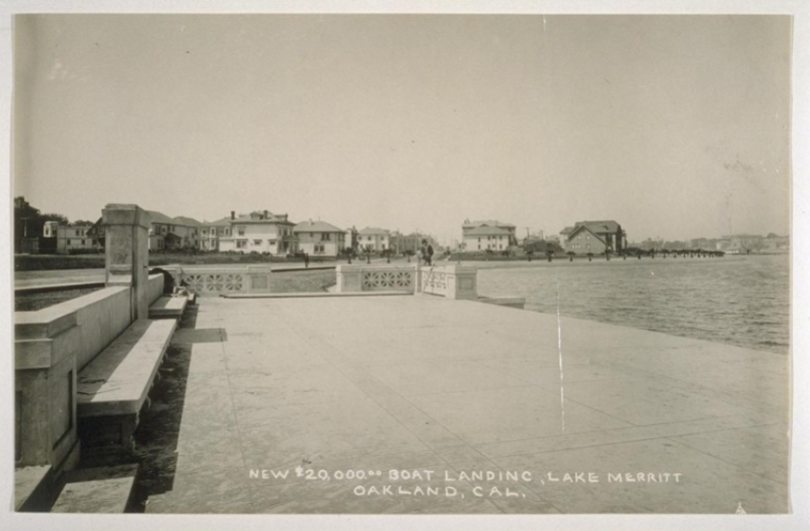
Brackish waters today
In older, traditional environmental circles, the loss of the estuary that was Lake Merritt is often lamented. Looking at old images of the lake, staring at pictures of the open and barren hillsides where my own apartment building sits, just off the lake, I find myself saddened by the transformation of that world into the one we have here today. I do love Oakland, but I’m saddened by the genocides, the conquest, and the selfish prospecting of the city's founders that lay the foundation for the city I call home today and the estuary where I spend my idle time. Lake Merritt now is a world zoo, full of cultures and histories and life from all over this blue green speck in the infinite vacuum of space. And in that zoo, we can find beauty.
A local Oakland naturalist and writer, Rex Buress, saw it more clearly and distinctly than most, and was adept at capturing the important beauty of Lake Merritt, and the small parks that line its waters. In 2007, after rereading the writing of John Muir, someone he admired, he found it frustrating that Muir’s love of nature necessitated that love to be out there, far away from people's homes—far away from cities such as Oakland. Rex penned a short letter addressed to the icon of conservation, writing:
NATURE IS NOT LOST IN THE CITY’S MAZE. Each spot of plant growth supports its share of wildlife. Each tree supports a resting and nesting place for birds. Around each corner a bit of nature can be seen; enough to keep our minds tuned to the fact that nature exists and is waiting in full glory for us over the hill.…And this is a goal to strive for; the merger of man and nature. And it must be if we are to keep burning before us the hopeful light of scenes from the world of nature. There is no need to make our cities a tomb of machines, because man can merge with nature and make a place practical for wild things and beautiful for homes.
So it is here in the city’s maze, on the shores of Lake Merritt, where Burress and the rest of us find respite from the responsibility of our days. And where, some of us, wait for the monster of Lake Merritt to return.
In The Unidentified, Colin Dickey points out how many of our modern day cryptid stories, like our beloved Oakness monster, begin in the 1940s, or even after WWII. The world saw everything nearly turn to dust, and the atom bomb made us collectively reflect on human mortality, even as imperial maps encroached upon all corners of the globe. As scientific progress reached new heights, the world seemed drained of its charm and mystery. As Dickey argues, those who seek the Yeti, Bigfoot, Loch Ness, or extraterrestrials all fight in some way against the certainty of science, defending the lights of wonder that they see these creatures preserve. As Dickey writes:
Cryptids require physical spaces that can’t be fully reached, fully documented, fully inhabited by civilized people. They require the borders between places, the edge lands. Cryptids are nothing without their habitat, and their habitat was, at least for a time, destroyed by colonialism and capitalism throughout the nineteenth century, as the “blank spaces” on the map were filled in, and as cultural differences were more and more assimilated through trade and tourism.
For the Lake Merritt Monster hunter, when looking into Lake Merritt and spotting a small leopard shark, a bat ray, or even maybe a sturgeon, it is not satisfying enough on its own, not wondrous enough in and of itself, to see the known and gaze upon it with awe.
So is the Lake Merritt Monster real? The journalist in me would say no, with a high degree of certainty, after many jogs around the lake over the years. But this isn’t the right question to ask. It’s more interesting to ask why we look for a creature like this at all.