Things had gone wrong long before they came

In the early 2010s, a second San Francisco sprang up over San Francisco. Watching from across the bay, it was obvious that the newly built structures had nothing to do with the twentieth-century concrete skyline beneath them. Their arched glassiness was a free-floating daydream, as placeless as the economy that had spun them up; in the evenings, when the marine layer rolled in, their upper stories seemed to cut their moorings and drift into mirage. The rest of the world had gone through crisis and recession, but these buildings were still pumping out technologies no one understood on the back of an even less scrutable financial system.
In other words, the city had been colonized by aliens: an event that is also the subject of M. John Harrison’s novel The End of Everything, which last week won the Booker Prize.
As apocalypses go, Harrison’s is a subtle one. It descends through the arrival of something called the iGhetti, not enemies to humanity so much as a radically incompatible order of being. Apparently extraterrestrial, variously appearing as star jelly or “tall writhing bursts of light,” they also display an attraction to capital: Wherever they originally came from, they now tend toward “primary nodes in New York, Dubai and especially the great Chinese banking cities.” In the UK their preferred haunt is the City of London, which is not the whole city of London but the particular square-mile financial district that in the run-up to the 2008 crisis got a West Bay–style millennial makeover. What exactly the iGhetti are up to in there is a mystery. But in tune with the times, the effects manifest as “new buildings...elaborate, not entirely stable parodies of 00s vanity architecture, which lasted a week or a month before toppling slowly away into a kind of dark blue air.”
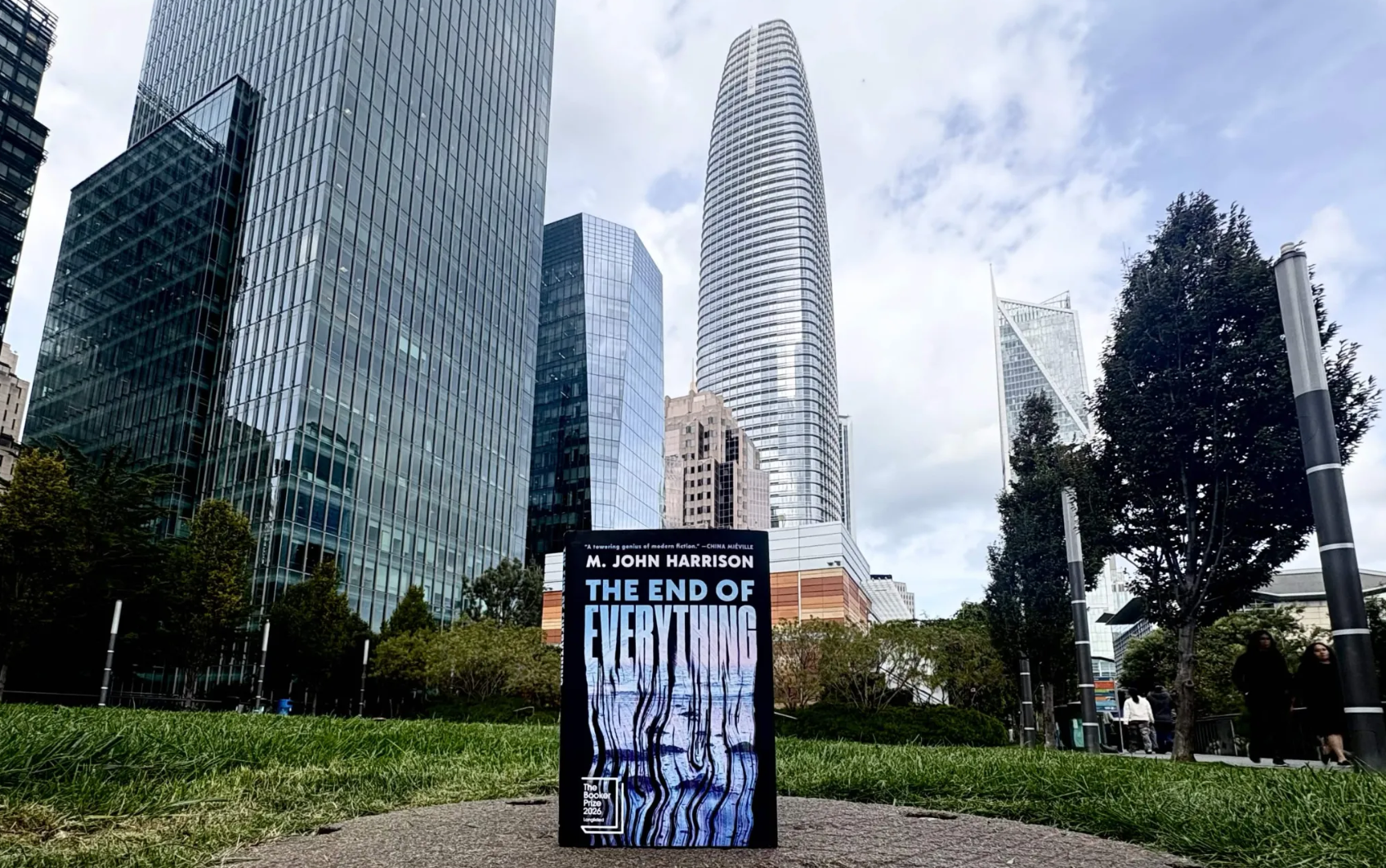
Or so it looks from one angle. The spell of this novel is that it tells a story in lustrous prose, with exquisite tonal control, about a world where it has become impossible to actually know things. Not only are the iGhetti themselves a black box, their arrival has triggered a global epistemological short-out such that the inhabitants of the world can no longer make sense of their surroundings, or each other, or themselves. “Life’s grain had suddenly become both knotted and indistinct. Events which had previously flowed together in a dependable stream became sketchy and indeterminate.” Perhaps humanity is at war; perhaps nothing has changed. A lost continent may shimmer on the horizon, or it may have sunk forever. Shops may or may not be open and roads may or may not be passable, not because of obvious disasters but because individuals no longer understand why they do what they do. They carry on desultorily with their lives, out of a sense of ritual.
Our protagonists, so far as this world can have them, are Phillip Tennent, a refugee from London who now works the Kentish coast as a beachcomber, and his aunt Marnie, a onetime bohemian artist whose aesthetic practice, like everything else, has lost its rationale. Weird things wash up on shore these days, and when a gelatinous lump the size of a baby appears on the beach, Tennent recognizes it as an iGhetti artifact that before long will grow into a more or less humanoid entity capable of motion and speech. It expresses itself in uncanny, out-of-context locutions: “I don’t want to see it, I just want to be it,” or “I think you’ve given us all permission.” (Admittedly, since the disaster, actual humans no longer do much better at sustaining purposive conversation.) Tennent would like to unload the artifact for profit; he also senses that it heralds some decisive and not necessarily fortunate change in his life. So begins as much of a plot as this novel will allow.
Whether it’s correct to call Harrison the first science fiction author to win the Booker depends on where you draw the genre boundaries. In his long career he has worn many labels, but these days the only camp to which he professes allegiance is “the Weird,” meaning fiction that works to “strip out affects, conclusions and motivations, then replace them out of order and at an odd angle,” such that any attempt at interpretation “should fail; or even better, almost succeed.” His beginnings were more conventionally generic: From 1968 to 1975, as books editor for Michael Moorcock’s New Worlds, he took potshots at the overblown sword, sorcery, and spaceship epics of the day, and mingled with the up-and-comers who would later be canonized as science fiction’s New Wave. His first books were competent tributes: an apocalypse tale with Moorcock and J.G. Ballard all over it, a far-future fantasy after the Dying Earth stories of Oakland’s own Jack Vance. A partial breakthrough came in 1974 with The Centauri Device, which he now remembers with little enthusiasm but marked a step on his path out of predictability:
I never liked that book much but at least it took the piss out of sf’s three main tenets: (1) The reader-identification character always drives the action; (2) The universe is knowable; (3) The universe is anthropocentrically structured & its riches are an appropriate prize forthe colonialistpeople like us.
Refuting those tenets would become his life’s work.
Having tired of space opera and “stories in which people hit one another over the head with swords,” Harrison departed London for the north of England, where he took up rock climbing and fell running, and also deeper literary excursions into the weird. Along with some standout short stories, this period produced The Course of the Heart, a treacherous tale of magic gone awry, and Climbers, an ostensibly realist novel about the men driven to break themselves on the cliffs of the Peak District. In these works he developed a uniquely honed sentence, brief and plain in presentation, where one or two words pull loose from familiar usage to signal a left turn into the unknown. Scenes never land quite where you expect; seemingly simple threads lead to sudden aporia. In the 2000s, Harrison began smuggling these techniques back into science-fiction packaging in his Kefahuchi Tract trilogy. Since then he has moved among genres as he pleases, never solving his puzzles but always sounding unmistakably like himself.
Like its predecessors, The End of Everything is committed to the alienness of the alien. The trope of scavenging strange artifacts is one Harrison has used before, and is indebted to Roadside Picnic by Arkady and Boris Strugatsky (known outside SF circles as the source for Andrei Tarkovsky’s film Stalker), in which extraterrestrial disjecta are both magical and threats to life and sanity. Harrison has been open about the influence, but where the Strugatskys gave us a recognizable noir antihero stalking a limited zone of alien impact, Harrison’s global catastrophe is much more obscure in its rewards and its dangers. It’s not clear what the humanoid artifacts are good for; some people try to eat them, others to extract information about the crisis, either through direct questions or, more nightmarishly, by hooking their bodies to monitors as receivers for astral transmissions. Prolonged contact with the artifacts, as with anything connected to the iGhetti, risks a “bad patch” of hallucination. One might experience a recurrent car or helicopter crash, or false memories of a sea voyage. However, some things remain constant, as British upper lips remain stiff to the end: “I’m going through a bit of a bad patch,” people say. “The country’s going through a bad patch.”
Through a narrative characterized as much by interference as signal, the characters of Tennent and Marnie appear only hazily, but they are still human in their confusion, and claim our sympathy. We flash back to Tennent as a child before the crisis, and read emails that a younger Marnie wrote to him, touchingly combining a real warmth for the boy with uncertainty over how to play the familial role. In the present day, for all that their relations are damaged and strange, it still feels like love. Both of them commit acts of violence, which erupt suddenly and are neither explained nor overdramatized. It’s simply within the range of what people do now, and even the victims show little in the way of resentment. In a world made up of recombinant junk from past decades, it’s hard to be sure what is alive or dead.
“The world’s over,” one character declares. “But that doesn’t matter. Because another one will be along soon enough.”
(Pauline Kerschen)
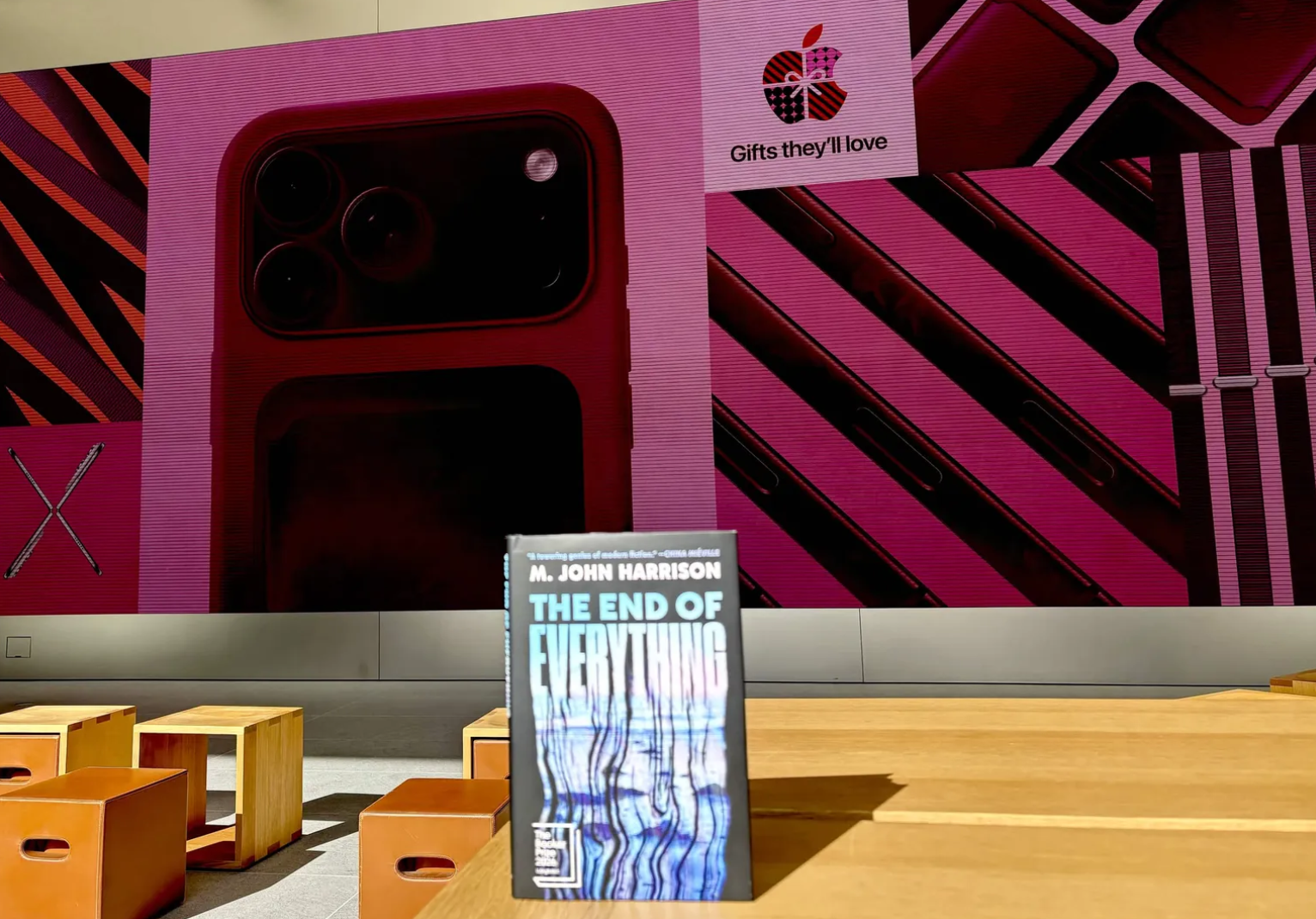
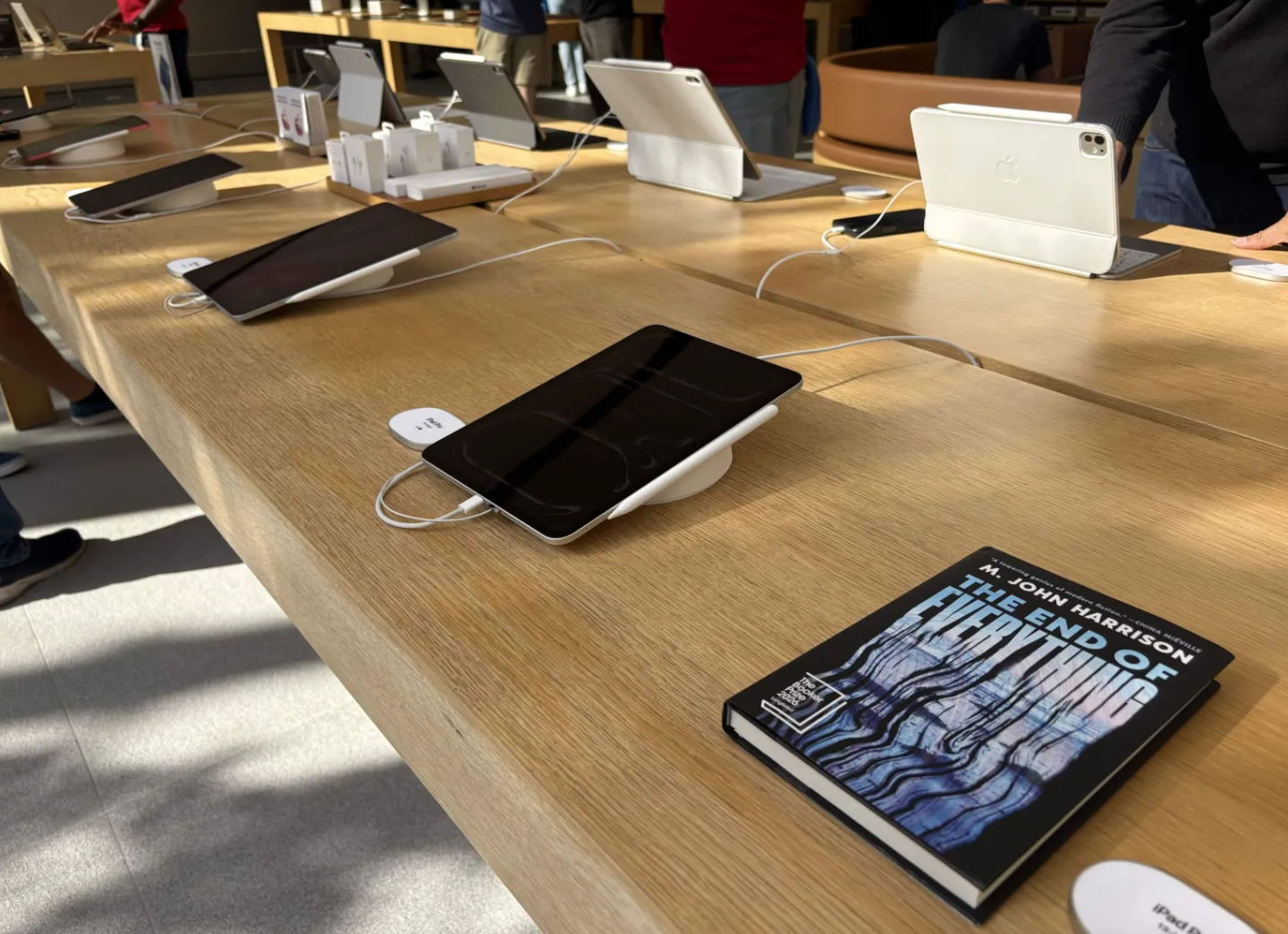
The new world may belong to the humanoid artifacts, viscously embracing each other as they do their best to imitate our speech. Naturally the image provokes a shudder; we don’t understand what we’re looking at, because it’s not intended for us, if we can speak of intent at all. The question of whether AI can have consciousness is fascinating to some, but the truly baffling problem may be how to fathom the mind that would put up a billboard on 80 reading “That’s so agentic,” or that would feel addressed by such a message. Barbed as some of those advertisements are, for the most part they aren’t even hostile; they simply can’t recognize those of us who live in their shadow. One obvious resonance of the name “iGhetti” is the earthly paradise of the Apple store, and when a frustrated Marnie demands of the artifact, “What are you supposed to be?” the answer comes back with pixel-perfect blitheness: “We’re always here to help.” What else could such a being have to say?
Near the end of the book, gazing into a London beset by alien specters, Marnie reflects that “things had gone wrong long before they came, and it was possible to admit that now.” A discarded notebook acquired by Tennent is full of theories diffusing the blame: “Long before the iGhetti arrived, everyone was playing out a separate fantasy,” and “They may not even know we are here.” It also relates a dream encounter, seeming to speculate that the invaders are as hapless as we are: “They were trying to explain how badly things had gone wrong. How they had been blown here by circumstances they could not control....They had never been meant to be here, on Earth as we knew it then.”
You can see why the Booker judges decided this was Harrison’s year. Our historical bad patch has been getting manifestly worse of late, and the prize announcement couldn’t have had a better sequel than a week of our crucial infrastructure blipping out of service for no adequately explained reason. But even before collapse was so blatantly thrust in our faces, its roots were twining around us. The erosion of knowledge, the evacuation of language, the hollowness of our triumphal tales: Harrison has been alert to these for a long time. There’s no need for a word like “prescient.” It’s enough to say that throughout his career he has been telling us the same things, and his sudden elevation to an award winner perhaps means only that our self-understanding has finally caught up with his. Welcome to our new home.
\O/
The End of Everything
M. John Harrison
Penguin; 208 pp.; October 2026