Things we do in the night
On a hot night in Fruitvale, 25 people—wearing the kind of hoodies and homemade clothes that made them look like they could organize a blockade or work at Food Not Bombs—all sat in a huge circle inside Hasta Muerte Cafe in Fruitvale. The tattoos and subtly asymmetrical haircuts, with the secretly shaved parts, had been mostly hidden during the day, when they were working in hospitals, clinics, and other health centers. And I know the room was filled with social workers, acupuncturists, nurses, therapists, and other healthcare workers—many who also identify as anarchists—because we did a go-around.
This meeting was called “Interdisciplinary Liberation Medicine: Case Studies,” and had been promoted by the Bay Anarchist Free School, one of Oakland’s secret weapons, and also by at least five excited friends who sent me the invitation:
We will present a case study each session and collaboratively discuss case conceptualizations through our respective practices. We welcome medical providers, therapists, people with lived experience, herbalists, acupuncturists, etc. Focus on capitalism, class, decolonization, the critique of the state’s role in medicine. We hope to inspire conversation across medical/healing disciplines that might inspire future projects.
\O/
On my way to this gathering, I had walked my bike from the corner of Foothill to Tacos Guadalajara #2. When I was crossing the street, I found myself waiting for the light next to a tall man, with no shoes. He seemed to control the intersection with his mind. He asked me for fifty cents, I assumed this was for his work controlling the intersection. But I didn’t have any US money, and anyway, my “policy” is not to give change: Especially in Oakland, where the neglect and poverty is so extreme, I want to give somebody $20 or $50. I want to get them somewhere, or at least give them a real break from panhandling. It’s my favorite form of clowning with reality, to look poor and then takes a wad of cash out when a person most needs and least expects it. But when I didn’t do that, we stayed walking together, anyway, having already come this far across Fruitvale Avenue, all the way inside the gate of the taco place. As I waited in line, I dug around in my bag, and found fifty cents at the bottom, and gave it to him. He groaned.
I have always felt close to homelessness in the Bay Area, and frankly, I fear the consequences if I don’t pay my taxes to the people who run the street. He looked me in the eyes with disappointment; all I can help him with is 50 cents? And he didn’t want me to get him a taco, or so he said. But when he walked to his station, just outside of the iron gate that surrounded the astroturf-covered ground that held up the glowing trailer (with our taco factory in it), watching me, I was not afraid. I felt like he was waiting for something to happen. To be honest, me too? Who knows where this guy has come from, what he has lived through. He’s got a story and that is for sure, along with needs that are not being met. Maybe an ever more surprising adventure is to imagine how much he has to offer that he is not able to. I relate.
The kindness of the particular guy working in the glowing hovering taco truck almost killed me. It was like seeing a therapist just getting two veggie tacos please. What did I need? What does he need? Are we ever going to be ok? He seems great as he laughs about hot sauce with the teenagers. I felt like he was running a clinic from the taco truck—the medicine is affordable food and a smiling energy that works like a trampoline, makes you bounce.
I hurried up with the tacos, and biked on the sidewalk to Hasta Muerte, the political space and cafe where people who work in healthcare were meeting to talk about and brainstorm new forms of interdisciplinary care.
\O/
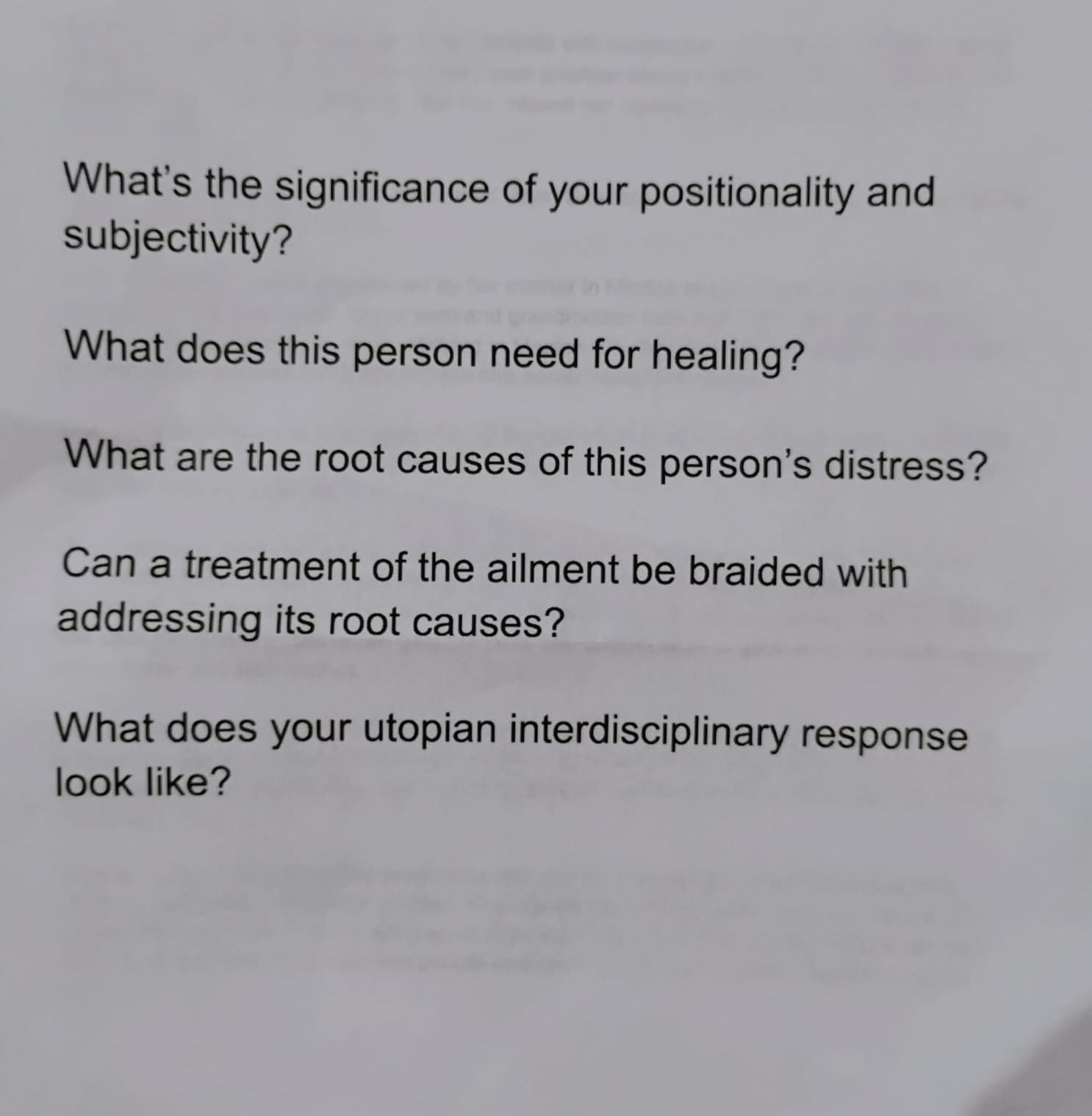
At Hasta Muerte, the case we look at was fictional, typed up by an overworked and existentially exhausted social worker; it was an amalgamation of some number of the very difficult youth cases they have seen and worked with. It was this: a fourteen-year-old girl with many overlapping symptoms and difficulties related to family and societal trauma. Some involved physical suffering, other issues were psychological. But this young person was also, simply, living with fear for her safety while growing up in a fascist state with less and less protection or promise for the future.
I was vibrating, as we passed around this imaginary girl, got in groups, and read.
I already knew that I can’t really do workshops like this. I used to try to go to the famous “stop the bleed” workshops that help politicized people become street medics for street protests and to prepare for living in a place with more danger than care available on the street. But while I can handle the hands-on stuff, what I can’t really do is imagine other people’s suffering. It’s like my imagination is too dangerous a place, and too much detail creates a type of vacuum, that sucks me in, a vortex of collective pain that fills my entire body with some kind of radiating pulsating black goo. My body tries to fight this off by making me check my phone every two minutes. I can deal with real emergencies. Imaginary ones? nawh.
The room remained steady as we discussed questions about our own positionality in relation to this imaginary patient, as well as some utopian solutions to her situation. But I found myself almost YELLING when I wanted to say something; I was boiling on the inside, trying not to overflow too violently. Not because I had a clear idea. But every story reveals everything about what is wrong.
I wanted to propose that the care that the imagined person in the case study needs might not be medical, that it might be just about having a place to go with contact to peers who are interested in them, and with elders who can walk with them through some experiences until they get on their feet. A different society, that’s all they need! Not necessarily the work of experts or professionals. But many people there were professionals, professionally wondering about how to treat the symptoms of the imagined patient. They wanted to kindly ease the symptoms of living in a very harsh reality, because this is a group of people that lives and works with symptoms and root causes. That is also why it was amazing to be in there,
I jumped between total overwhelming shut down, imagining how every person on the avenue and in the room had as many overlapping conditions as the imagined patient, and even just this one person is like a huge exploding imploding universe, impossible to know or fix.
We know that the cuts to healthcare are already being felt. We know that fascist immigration policies are already keeping people from care they need. It is going to get worse as the feds begin to require that people who get medicare have a piece of paper that show that they work enough to deserve the disappearing care they might have gotten. For these very good reasons, I felt dizzy at some moments. And then someone would say something very very kind, or from a site of real experience or curiosity. I would relax. The tension would melt. I would feel that, also, we can do so much more than we think we can.
At the end of the night a group of stragglers hovered in a kind of excited and overtired social space—calm and overwhelmed—where we agreed: we want to start a clinic. So I think we will be doing more things like this, in the dark.
\O/