Touch water
Our “Six Senses of Oakland” membership drive gets tactile now with Touch Week. Read more about the drive here. Check out other Six Senses stories here. Reach out and fondle that subscribe button here.
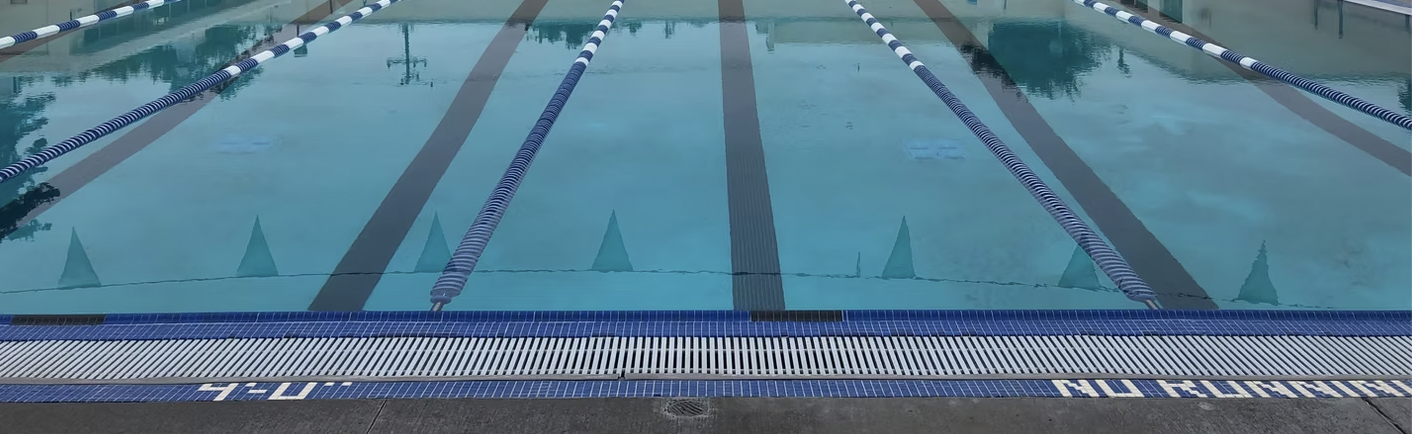
The water at the Temescal Pool is never very cold. Most of the time, my skin adjusts to the temperature immediately and I only bristle if the Oakland air already has a bite to it. After getting my feet wet, I slide fully into the pool and stand there for a few seconds before dunking under. It’s nice to take a minute to let the feeling of being outside and in the water wash over me. The often sunny sky beams just overhead and the sounds of other swimmers sloshing in the water creates a rhythmic white noise. Once I get on the pool’s wavelength, I duck my head under and let my eyesight adjust to the view through my goggles. The buoyant feeling takes hold. I come back up for air and my skin tingles with some kind of latent amphibious instinct. I push off from the wall and let the water envelop my whole body as I swim, slowly, back and forth. I feel the water less and less with every lap, the boundary between my skin and the slightly salty water dissolving. It’s only when I finish and hoist myself out and readjust to gravity do I notice the rivulets working their way down my arms and legs and the cold suction of my swimsuit.
To get in the water at Temescal Pool, you have to do three things. First, pay $6 to the City of Oakland by way of a teenager behind the glass entry window. Second, change into your bathing suit, in a run-down locker room that features a foggy piece of metal that may or may not be a mirror (opposite a community bulletin board with the East Bay’s requisite three-four minimum advertisements for some variation on “pregnancy service.”) Finally, pick a lane. It can be slow, medium, or fast, but all feature a similar experience: no fewer than three people, maybe even six or seven on a really busy day; that easy, temperate water; and a thirty-three-and-a-third–yard length. According to pool bloggers, this length is atypical for a non-Olympic-sized pool. It makes me think of the 33 1/3 series.

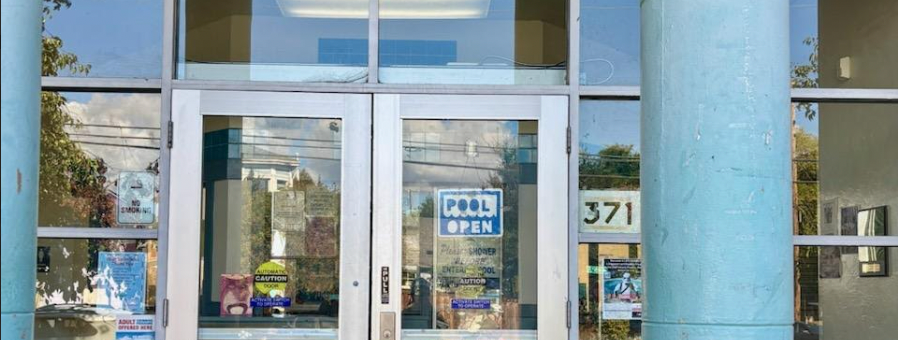
The boxy pool building looks like an extension of the nearby high schools; it’s a simple, angular structure with two columns, light blue accent paint, and TEMESCAL POOL in all caps over the front doors. The building is a facade, though; the pool itself is outdoors. Gates and hedges contain the pool area, which includes the surrounding concrete and a small grassy area.
When I swim, which started only recently (this is not a lifelong affliction), it’s become an exercise in trying to think less. In practice, this entails swimming a passable breaststroke for as long as I can until I get worn out or my on-land responsibilities swim back to the forefront of my mind.
The Temescal Pool was the first pool I went to when I started swimming regularly. I had been a few times before, but only ever during the summer’s open free swim (a two-hour affair during the afternoon), when I had to struggle to wrest a sense of summerness from the East Bay’s cold clutches. I often left those visits disappointed, chilled by their distance from the chlorine-filled and jam-packed social environments of my Midwestern youth. I hadn’t yet learned that, as with many things in the East Bay, the way to connect with the pool is to reject any preconceived notions of what going to the pool is supposed to look and feel like.
Relating to the pool as a swimmer, not a lounger, flipped the script. I now think of the pool as a mecca. As a result, I’ve also become attuned to the place’s most distinct quality: with every stroke in the water, the “Temescal” of the Temescal Pool starts to fade.
Temescal: the Telegraph, Broadway, and 40th Street business corridors, flanked by a not quite square, not quite trapezoidal residential neighborhood. The area is tense with overlapping claims to space. Small-but-expensive California bungalows and apartment buildings line the inner streets. Telegraph from 40th to 51st Street boasts destination restaurants of the Korean, Eritrean, and up-market millennial variety; also, a McDonald’s and Jack in the Box; and a dive bar where it’s Halloween all year round. The children’s hospital is a stone’s throw away. Seemingly abandoned high-rise apartment buildings near the MacArthur BART station recall a gentrification process that the pandemic interrupted, as does the recent exodus of small, expensive businesses in and around Temescal Alley. Every day, Temescal-Telegraph Business Improvement District workers pick up trash in a sisyphean effort to control the area’s rhythms, creating an ever-present reminder of which sections of the neighborhood are in the BID, and which aren’t.
45th Street cuts a horizontal line through all of this tugging and striving. Where Temescal broadly is a stomping ground for the visible hand of Oakland’s commercial and residential real estate market, 45th Street is the City of Oakland’s territory, where municipality and occasional chaos reign. Three different Oakland Unified schools line the half mile block. Throngs of teenagers appear in the morning, around lunch, and in the afternoon. The biggest of the schools, Oakland Technical High School, anchors a microdistrict on 45th, one that represents the City in its most essential form: through the provision of public services. Oakland Tech, Studio One, and the Temescal Pool are all gleaming, historic structures whose public programs (and the buildings that house them) have managed to stay put despite the vicissitudes of the surrounding market.
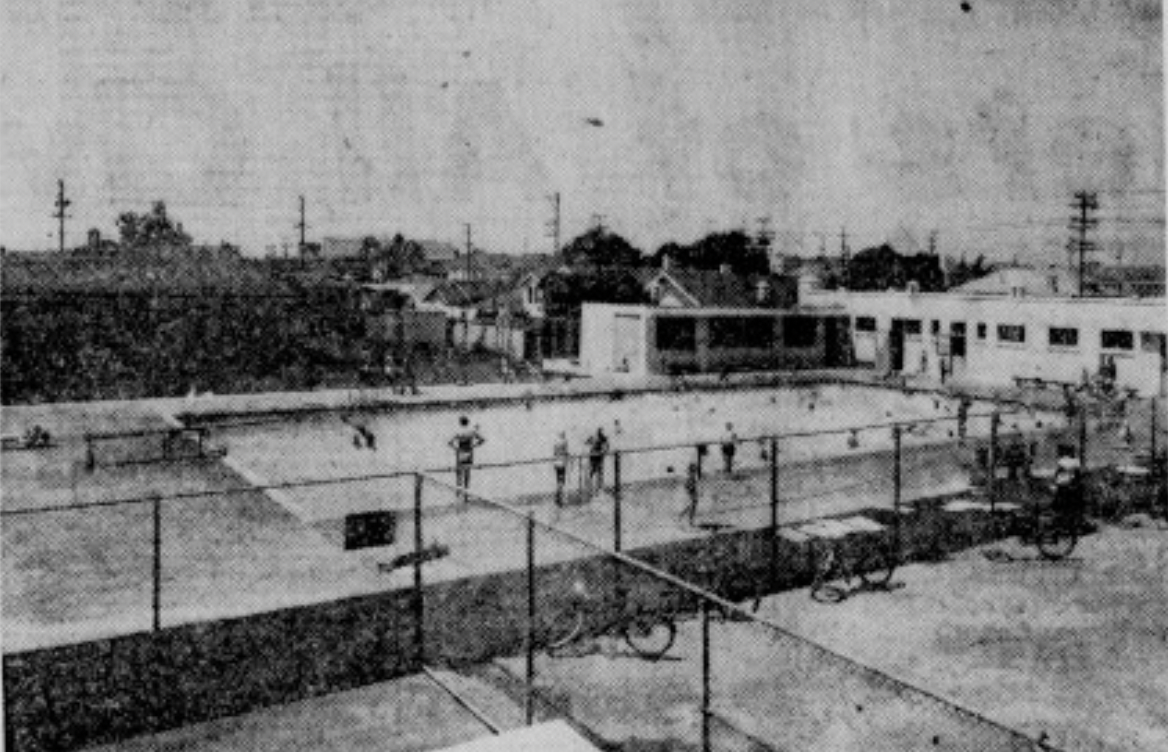
To be specific: The pool opened in 1949 using a $600,000 bond measure that Oakland residents approved in 1945. The architect, Irwin Johnson, also designed the deFremery, Fremont, and Dimond Park pools, as well as the San Leandro City Hall; the pool’s WPA-influenced architecture would have, at the time, communicated a connection to earlier public works projects in Oakland, like Dimond Park, City Hall, and public schools. Since 1949, the neighborhood and North Oakland as a whole have seen the construction of the Grove-Shafter Freeway and BART, demographic turnover from mostly Italian to mostly Black Oaklanders, the birth of the Black Panther Party, and years of being the next “something,” gentrification-wise, whether in 1993 or 2008. But through it all, the pool stayed put. It hosted national synchronized swimming competitions in the 1950s and 1960s. The pool’s Masters’ swim team has been around since 1983.
I wasn’t sure whether my impression of the pool’s meaning for the neighborhood had any bearing in reality, or whether it was all downstream of my own membership in the mostly transient, mostly transplant Oakland demographic. To get a sense of perspective, I spoke on the phone with Leon Sykes, the aquatic program coordinator for the City of Oakland, who remembers being on the kids’ swim team at the Temescal Pool in the ’90s. The locker rooms and the pool itself were different, then—the pool underwent a renovation in the early ’00s—but its role as a neighborhood hub was the same. He did swim team to get out of having to help out his dad with work, and ended up swimming alongside Marshawn Lynch. Sykes grew up a mile away from the pool, and the rest of his team all came from North Oakland.
The gentrification of North Oakland has inevitably changed things, and Sykes considers the pool now to be the “lap swim pool.” “It’s more competitive,” he said. People “come get their laps in, not to talk. The swimmers reflect the neighborhood—getting in a swim before work, or during lunch.” And yet, he still considers Temescal Pool to be the quintessential community pool. “It’s open year-round, it has proximity to schools and a recreation center. It is the idea of a recreational facility for the community,” he said.
What Sykes is describing—this longevity, this concreteness, this, I don’t know, rootedness—creates a protective shell around a swim at the pool. Even when the conditions of the day seep through its walls, like when you take a shower alongside someone who might not have any other easily accessible shower to use, or when you look over the group of swimmers and notice the majority are almost always white, the place itself, the pool and what it offers, feels bigger than any of those things. When you step out of the boxy building, the force of ever-changing historical conditions returns. But inside the pool, the bottom dappled with light from the bright Oakland sun, it can feel like maybe, just maybe, it’s possible to get a handle on things, if only for a moment.
Because I’ve spent the bulk of my life on the Internet, when I go to swim, I often think of the invocation to “touch grass.” The concept has the right idea in mind but it thinks too small. Of course, the phrase doesn’t literally mean to touch grass. It means get off your phone and go engage with the real world. But the metaphor concedes too much territory to the hard- and software it seeks to antagonize; it may conjure the image of someone surfacing from an underground bunker after years, only to smell and kiss the ground and thank god for the return of his life, but touching grass in a day-to-day way offers no such guarantee of freedom. If anything, touching grass means noticing how little grass there is to touch and how everyone around you is usually somewhere else. Try not looking at your phone on BART, for example. Without a book to read or someone to talk to, the only thing your attention can linger on is other people staring at their phones.
If you want to snap back into your body, engage with the terms of life directly in front of you, and to allow the tense cacophony of digitally mediated life to recede from your attention, let me posit an alternative: get in the water. Have you ever tried being online under water? You can’t. Your phone will break and you’ll eventually drown.