Tracing the many paths of the analog synth
Welcome to Sound Week, part of our “Six Senses of Oakland” membership drive. Read more about it here. Check out other Six Senses stories here, Subscribe here.
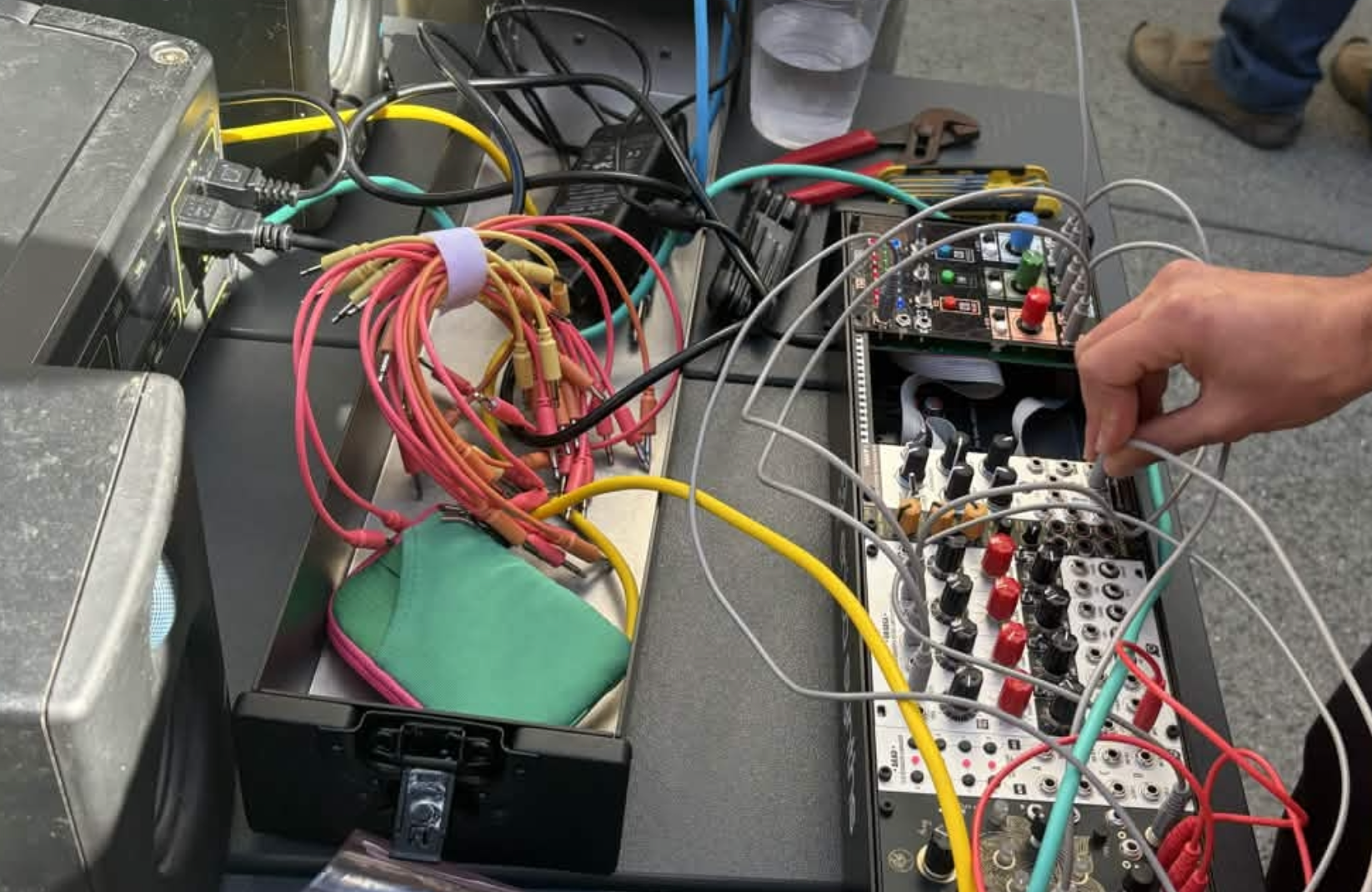
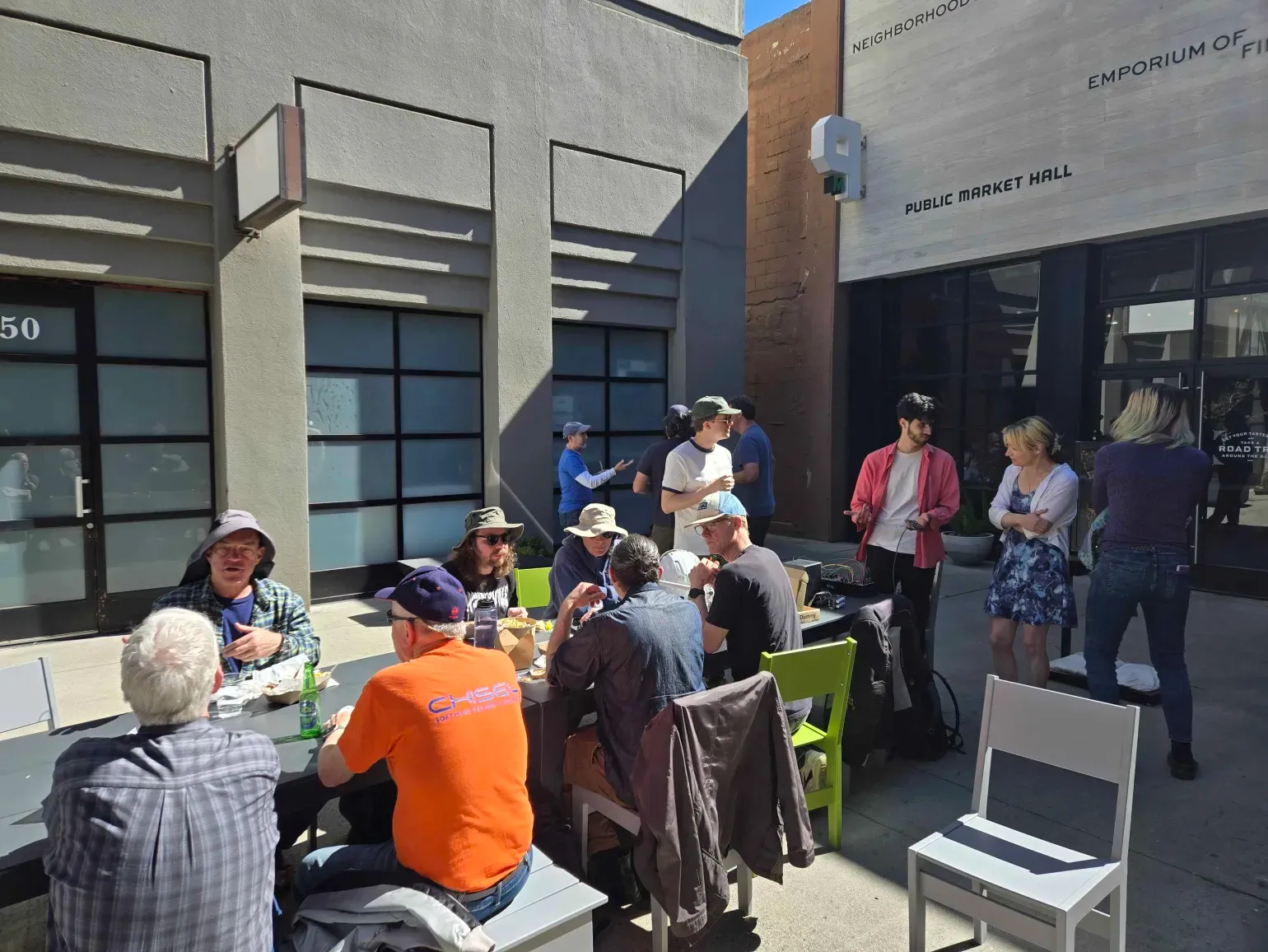
Once a month, the Bay Area Modular Synth Group hosts an open gathering at the Public Market in Emeryville. They used to meet at bars, but splitting the bill was a pain and it was hard to find table space for everyone’s gear. But anyone can bring their lunch to an outdoor table marked with a colorful sprig of patch cables, and if they’ve brought a sonic box capable of being hooked up to other people’s sonic boxes, they can plug into the collective.
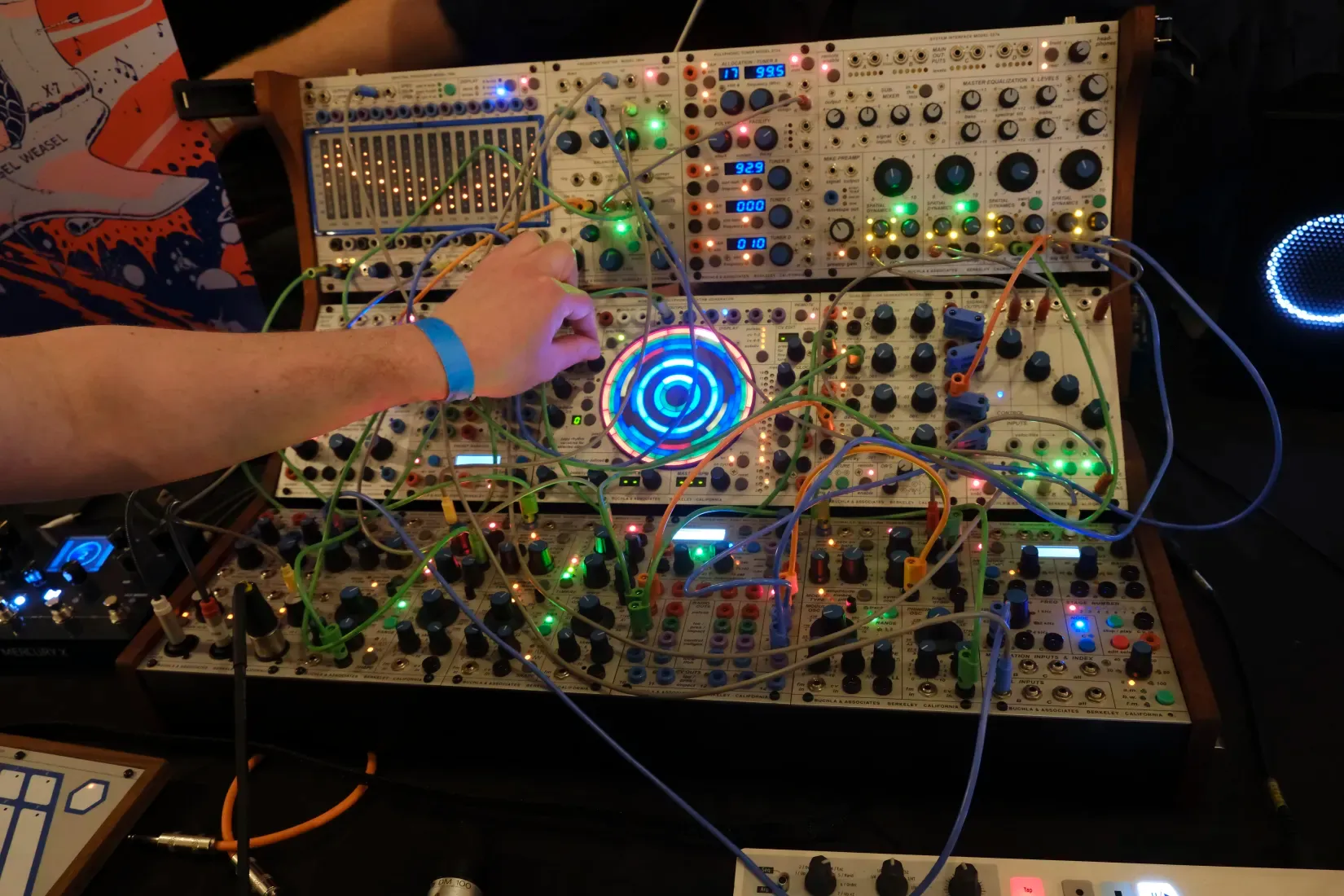
I stopped by last month, having just finished The Composer’s Black Box: Making Music in Cybernetic America by Theodore Gordon, an academic study of the synthesizer’s earliest days. The word “synthesizer” suggests the digital instruments that conquered the world in the eighties, but the modular analog synths you’ll see at the Public Market are more primitive and daunting pieces of gear, still sporting the brutalist look of the sixties. Instead of a piano-style keyboard you’re faced with rows of switches and dials, blinking lights and exposed wiring, like something that might have controlled the first moon landing. There’s no particular button to dial in an organ or string section. All you get is raw electronic sound, and an abstract set of possibilities for shaping it: pitch, amplitude, phase, harmonics. The real fun—or so I gathered from the folks at the cable table—emerges when you start patching your components into someone else’s.
A dozen men of various ages, plus a couple of trans women, were chatting over noodles and sandwiches and appraising each other’s devices. Some had chained their components into a pair of speakers and were bobbing their heads to its bleeps and squelches. “Can I add mine in?” asked a newcomer, holding out a wafer-thin circuit board. “It’s an eight-bit shift register. Three of them, actually.” Once it was plugged into a vacant slot, a layer of rhythmic crackle appeared in the mix. He clapped in delight. “Okay! What else can we modulate?”
“Patch it there,” said the owner of the speakers, pointing to a jack input. “That triggers the envelope.”
When I asked what had gotten people into synths, the most frequent answer was Covid. “I was at home,” said one man in his fifties, “and I needed something to do. I worked on my sourdough and I got into modular.” He’d spent the pandemic in Palm Springs, among “NIMBYs and bitchy queens,” and found Oakland a better fit. “At first it was culture shock. I was looking at everyone’s front lawns and thinking, no one’s bothering to edge them. Then I realized they’re not doing that because they’re making culture.”
Another member of the group was happy to walk me through the history. Back in the eighties, he remembered, when everyone from Whitney Houston to Brian Eno had embraced digital keyboards, modular seemed as obsolete as AM radio. But in the late nineties, underground artists fell back in love with its eccentricity. “A digital synth will give you an exact pitch,” he explained, “but an analog oscillator can’t—and that’s great! The drift gives it character. And there’s the fatness. Analog just sounds fatter.” (Nowadays there are even digital filters that try to emulate that fatness.)
My own memory of modular’s big break comes from one evening in October 2000, when Radiohead went on “Saturday Night Live” to support Kid A and left their guitars at home. For some fans, the giant electronic cabinet that they wheeled on stage was rank betrayal. (A friend called me up afterward in a rage: “Why is the guitarist playing a broken stereo? Like, if you’re going to do that, why not just play a working stereo that makes those noises?”) For me—though I didn’t know what the contraption was, or how it connected to the sounds I was hearing—it opened a trapdoor I didn’t know I’d been standing on. A song like “Idioteque” gets its nightmarish running-in-place quality in part from the harmony (a single major seventh chord, endlessly climbing the same inversions) and in part from the beat, which struck me as the most purely mechanical drum machine I’d ever heard. The simplicity of the sound made it seem primitive and futuristic at the same time; it was inhuman, the work of a pitiless cosmos. It certainly had nothing in common with the club beats that were going by “electronica” at the time. The election was three weeks away, and I’ll always remember that performance as a moment of frozen foreboding, channeling bad news from outer space.
The Composer’s Black Box covers an earlier and more hopeful stage of the dialectic. The synthesizer came out of an optimistic postwar moment, even if, as with so much of sixties counterculture, the Strangelovian hand of Cold War science and industry was propping things up from below. In 1962, composers Morton Subotnick and Ramon Sender founded the San Francisco Tape Music Center (the subject of a separate UC Press title) in an old Victorian on Russian Hill. They’d collected cast-off equipment from the military-industrial complex, salvaged from World War II bombers and what was apparently called the “UC Berkeley Department of Physics and Cosmic Rays.” There was an equalizer, a two-track Ampex tape machine and a couple of the audio oscillators that were Hewlett-Packard’s first product ever, created in the Palo Alto garage that’s now the mythic birthplace of Silicon Valley. Electronic compositions were constructed note by note in advance of performance, by laboriously cutting and splicing physical tape. An early performance at Mills College, with loudspeakers wired to a moving metal sculpture, was covered by KQED-TV as a novelty happening. But the founders had wider ambitions, and high hopes for new technology. Subotnick had been reading Marshall McLuhan, and dreamed of creating a “black box” for musical composition that would serve as an effortless extension of the user’s imagination: “a tool for any person who wanted to be creative with sound, to be able to afford it, and to have it in his or her own home.”
Yes, it sounds like an Apple commercial. Nor will it surprise anyone who’s spent time with tech visionaries that the breadth of Subotnick’s vision went hand in hand with his having no idea how the box’s innards would actually work. He’d cribbed the term “black box” from cyberneticist Norbert Wiener, who defined it as any system, from a single transistor to a human brain, treated solely as a matter of inputs and outputs, without reference to what happens in between. As a means of reducing complex systems to thinkable dimensions, it’s foundational to computing. It’s also a quick path to magical thinking.
Unsurprisingly, once Subotnick found someone to build the box for him, it turned out nothing like his vision. In early 1964 Donald Buchla showed up at the Tape Music Center, a Berkeley engineering graduate employed at the Lawrence Radiation Laboratory in the hills above campus. He designed and built transmitters for a living, which NASA implanted into live animals to monitor their physiological reactions to extreme, outer-space-like environmental conditions. (The implantations were cruel, the simulated spaceflights fatal.) In his spare time Buchla dabbled with tape equipment to produce musique concrète collages; he also tinkered with his own brain, using LSD. He had initially only wanted to use the Center’s tape recorder, but once he’d heard Subotnick’s pitch for a composition device, and realized that it was unworkably vague, his engineer’s itch took over. A few months later he wheeled the first “Buchla Box” into the Center: two large wooden cabinets holding an array of switch-and-dial components with a rat’s nest of cables patched between them. The modular synthesizer was born.
Like any academic in love with a metaphor, Gordon stretches the black-box conceit as far as it will go and then some. Its many transformations keep the book lively; they can also make the argument difficult to follow. In one sense Buchla’s box, with its wiring promiscuously on display, was the exact opposite of the black box Subotnick had hoped for. In a different way it was a perfect proving ground for Wiener’s cybernetic theory, provided you took it not as a single box but as a network of them. Since each component module had the same inputs and outputs, the cleverness of the design was that anything could be hooked up to anything else. An oscillator generating a sine wave could be patched together with, say, a separate sawtooth wave so that the second signal modulated the amplitude of the first, producing a tremolo effect; the modulated signal could then be further patched back into the original input, producing God knows what. In theory, patch layouts could be designed in advance, but in practice, their behavior was, in Wiener’s cybernetic argot, “nonlinear”: small changes in input would alter the output unpredictably. The user of the box was necessarily an experimenter, responding to the system’s behavior in real time.
As his all-caps poetry from the period makes embarrassingly clear, Buchla wasn’t just taking LSD for a good time: he sincerely believed in the expansion of consciousness. In the first year of its existence, the Buchla box saw use at what can only be called an early rave, the “Trips Festival,” which was held in the modernist octagon of the Longshoreman’s Hall and had Tape Music Center artists on the bill together with psychedelic rock bands and a light show. The Center’s visual director spent the evening lying under the stage on acid, with his hand on the main circuit breaker in case it tripped under the load. Buchla installed a version of his box on Ken Kesey’s magic bus; he also developed contacts with the Hell’s Angels through the drug trade, and was running the sound system at Altamont when Meredith Hunter was killed.
Though only a few years older than Buchla, Subotnick belonged to another era, committed to what he wryly called the “19th-century mythology” of the individual artist. He wasn’t interested in expanding consciousness or overturning authority, and didn’t mesh with the new crowd drifting into the Tape Music Center (like the briefly employed technician who cut every power cable in the studio to free it from “government electricity”). In 1966 he left the Bay, taking a replica box to New York to compose in the lone visionary mode he’d always intended. Thirteen months of ten-hour days with the recalcitrant instrument yielded thirty minutes of sound; released on Nonesuch as Silver Apples of the Moon, it ended up becoming his legacy.
Today it’s considered a milestone (Pitchfork says it’s the eighty-third best album of the 1960s), and it still sounds fantastic. But at early performances, Subotnick was surprised when his audience started dancing.
In the wake of Subotnick’s departure, and with the help of a Rockefeller grant, the Tape Music Center relocated across the bay to Mills, where the original Buchla Box is still housed for students to play with. Like many women’s colleges of the time, Mills offered co-educational (in practice, mostly male) graduate programs, chief among them the music school: European luminaries Darius Milhaud and Luciano Berio were on the faculty, and alumni included Dave Brubeck and Steve Reich. (Phil Lesh attended for a semester, in his pre–Grateful Dead, mail truck–driving era.) Unlike most stories of artists relocating from the West Bay to Oakland, this one actually marks a rise in prestige; it’s the moment that electronic music moved from the hippie fringe into the academic mainstream. The Center’s first director in its new home was the composer Pauline Oliveros, who’d worked alongside Subotnick and Sender for years, though she wasn’t involved in the modular synth project. Her original instrument was the accordion, which she played in unorthodox ways; for example, its piercing sound was well suited to combination tones, a psychoacoustic phenomenon where two simultaneous notes seem to generate a phantom third. Her perception-focused approach translated well to electronics, though in a quite different way from her colleagues’.
There’s a lot to say about Oliveros, and Gordon is hard put to say it all in a single chapter. She was interested in music-making and listening as embodied, physical processes; there’s doubtless something cybernetic in her explorations of human-machine interaction, but the black box metaphor (which Gordon here applies to the network of instrument and player) may not be the most illuminating lens. She was a woman among the Tape Music Center’s overwhelming male artists and technologists, but it was in her long later career that feminism came to the fore; a year after the Mills move she left for UC San Diego, and to consider her only in light of the men she worked alongside for a few years leaves a great deal implied. Likewise her lesbian identity is invoked, but a deep treatment of its relation to electronic music would make for a whole different book (one that would consider, for example, her collaboration with Annie Sprinkle). Queer culture, like drug culture, has been with electronic music from the beginning; one day we’ll get a definitive study of the symbiosis between trans women and synthesizers, starting with Wendy Carlos’s 1968 bestseller Switched-On Bach, ending with Arca’s posthuman reggaetón, and ideally explaining why every other trans girl you meet in Oakland turns out to have a room full of vintage synths at home. But for now, this black box remains closed.
Gordon switches scene to the East Coast for his final chapter, on Buchla’s opposite number Robert Moog and the one and only Sun Ra. Moog’s synthesizer, developed independently from Buchla’s on similar principles, had hit the big time with Switched-On Bach, which turned into the bestseller that Silver Apples of the Moon was never going to be. The next year Leonard Bernstein took a Moog on TV, and George Harrison used one to make some of the weirder sounds on Abbey Road. The fact that it included a piano-style keyboard and looked less like a broken stereo certainly speeded its adoption. But to Moog these were minor victories. He was waiting, he said, “for that musician who has the sound-scope to play the synthesizer as a musical instrument, not an effects box.”
Art draws its power from the resistance of its medium and the traces of creative labor left behind.
In 1970, a journalist for DownBeat suggested to Moog that Sun Ra might be the musician he was looking for. By then Ra and the Arkestra had been channeling interplanetary harmonies for decades, but were still a “best-kept secret in jazz,” playing small houses and selling records by mail order. Moog had no idea who Ra was, but was willing to give him a shot.
Together with a dozen Arkestra members packed into multiple cars, Ra drove up from Philadelphia to Moog’s factory in Trumansburg, New York for an encounter that Moog later delicately described as a “piece of sociology.” The robed musicians had to wait in an ice cream parlor while locals gawked (fictitious complaints were later lodged of bounced checks and a stolen sweater), and when Ra was permitted into the factory, he ended up being given a prototype “Minimoog” that engineers had assembled from leftover parts. It had a three-octave keyboard but couldn’t play notes in tune and had no place in arrangements with the full Arkestra. Instead Ra put it to work in extended solo passages of inharmonic chaos: “It does lightning and thunder. I hit a note here, and three minutes later it starts lightening and thundering on them.”
Gordon sees Ra’s relationship to the synthesizer as fundamentally different from the Tape Music Center’s. The California visionaries were searching for freedom, but Ra rejected that word as “what the white people have been selling.” His watchwords were “discipline and precision, because that’s what nature does. There’s no freedom in nature. You have your particular place, and you do what you’re supposed to do.” The inscrutable Minimoog, with a mind of its own, went along with that anti-humanist vision; here Gordon takes the black-box conceit to the edge of plausibility, racializing it as a “Black box” and placing it alongside Ra’s radically pessimistic view of American society, in which “the Black man is under the name of death.” As with the chapter on Oliveros, this account opens more paths than it can explore, but there is something bleakly inspiring about a cosmic vision in which, as Ra wrote, “the music comes from the void, in response to the burning need for something else.”
We’ve been through a few cycles since then. Subotnick is still with us at age 92, but the other figures in Gordon’s book are gone: Ra departed this planet in 1993, Buchla and Oliveros in 2016. As of 2022, Mills College is a satellite of Northeastern University, the fate of its music program unclear. What is it that still brings people together at the Emeryville Public Market, or at house parties, to grapple with an opaque technology more than a half century old? It can’t just be that analog sounds fat. Nothing is easier, these days, than to have a computer emulate any sound you like.
But the virtue of these devices is that they aren’t too easy. They don’t conform to our ways of thinking about sound; you have to adapt to theirs, and this stubbornness stands out all the more at a time when something like Subotnick’s dream composition machine is finally with us. It’s estimated that about a third of the new music now on Spotify came out of a black box: someone put in a vibe, got a fully realized artifact out the other end and uploaded the slop for profit. Gordon doesn’t draw a parallel to generative AI, but it’s impossible not to think of it at a moment when the rhetoric of creative imagination has been made to serve a wholly opaque process parasitic on the works of the past.
With all respect to the artist’s vision, the most pointed lesson in the book is that art draws its power from the resistance of its medium and the traces of creative labor left behind. A truly black box is boring; anything produced without effort and consumed without friction you may as well not have had at all. It’s why you would use an oscillator that can’t maintain pitch rather than a digital filter that pretends it can’t; it’s why you would wheel a giant cabinet onto the “Saturday Night Live” stage and patch it together in real time, rather than just play a working stereo that makes those noises. Now more than ever, what we want to hear is the grit in the gears.
The Composer’s Black Box: Making Music in Cybernetic America Theodore Gordon. Oakland: University of California Press; 286 pp.; December 2025