It was going to be a late night, so I stopped at Sana’a Cafe and chugged a cardamom coffee before pulling up at Clio’s Books a half hour shy of its 11pm close. The Saturday night crowd was lively; I picked up my program for the after-hours show—The Fever, a monologue by Wallace Shawn—and took my negroni over to the shelves, which Clio’s organizes by the sweep of history, from ancient Mesopotamia to our murky present. There was a whole shelf of Aristotle, with his belief that drama should show the high-born fallen into adversity. Das Kapital gazed out boxily from a corner across the room.
“The festival’s all EDM this year,” said someone at a bar table. “I’m not going.”
“Honestly,” from a different table, “if Point Reyes just doesn’t happen, that would be fine with me.”
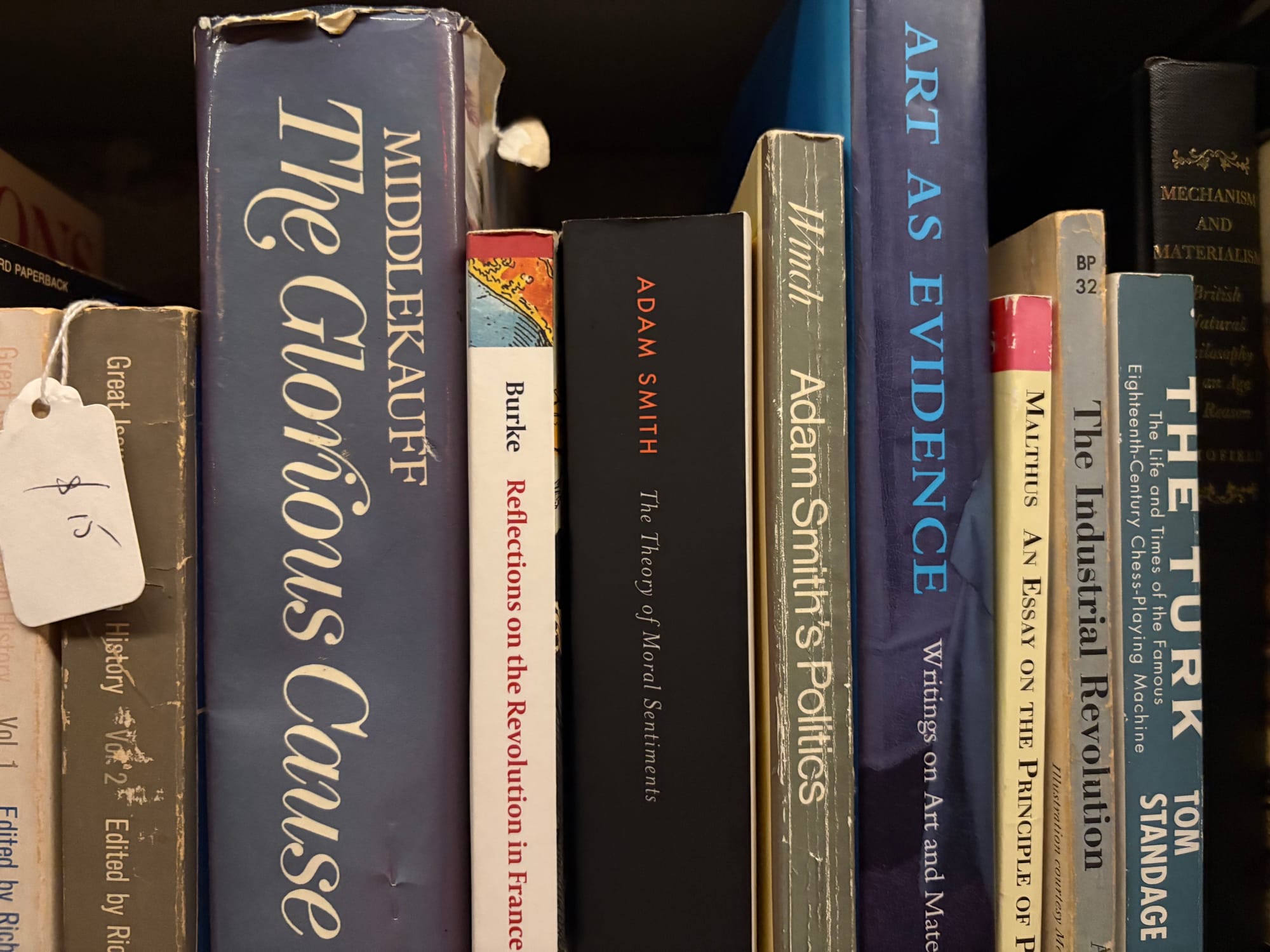
Strolling through the centuries, I got held up in the Enlightenment. Adam Smith’s Theory of Moral Sentiments caught my eye; written a few years after the 1755 Lisbon earthquake, it contains an early account of the globalized condition in which we contemplate distant suffering from a position of absolute comfort. A “man of humanity” in Europe, hearing of catastrophe in a distant land, Smith wrote, would “express very strongly his sorrow for the misfortune of that unhappy people... enter into many reasonings concerning the effects which this disaster might produce upon the commerce of Europe.... And when all this fine philosophy was over, when all these humane sentiments had been once fairly expressed, he would pursue his business or his pleasure, take his repose or his diversion, with the same ease and tranquillity, as if no such accident had happened.” Yet for his own sake, “if he was to lose his little finger to-morrow, he would not sleep tonight.” Of course the man of humanity would never choose to have a multitude of foreigners perish in place of his little finger. That would make him a monster.
“What was this play about again?”
“I was reading up. The playwright was in The Princess Bride!”
Of the many plays Wallace Shawn has written, The Fever is the most autobiographical. Born into the Upper East Side household of New Yorker editor William Shawn, educated at prep school and elite universities, young Wallace came into middle life broadly sharing the values of his set: good taste, high culture, Cold War liberalism. It was the Reagan years, and a trip to Central America with his partner Deborah Eisenberg, that radicalized him. “I actually turned very much against myself and people like me,” he recently told Current Affairs, “and I certainly went through a period of extreme nausea and self-hate.” The Fever, completed in 1990, is the document of that nausea.
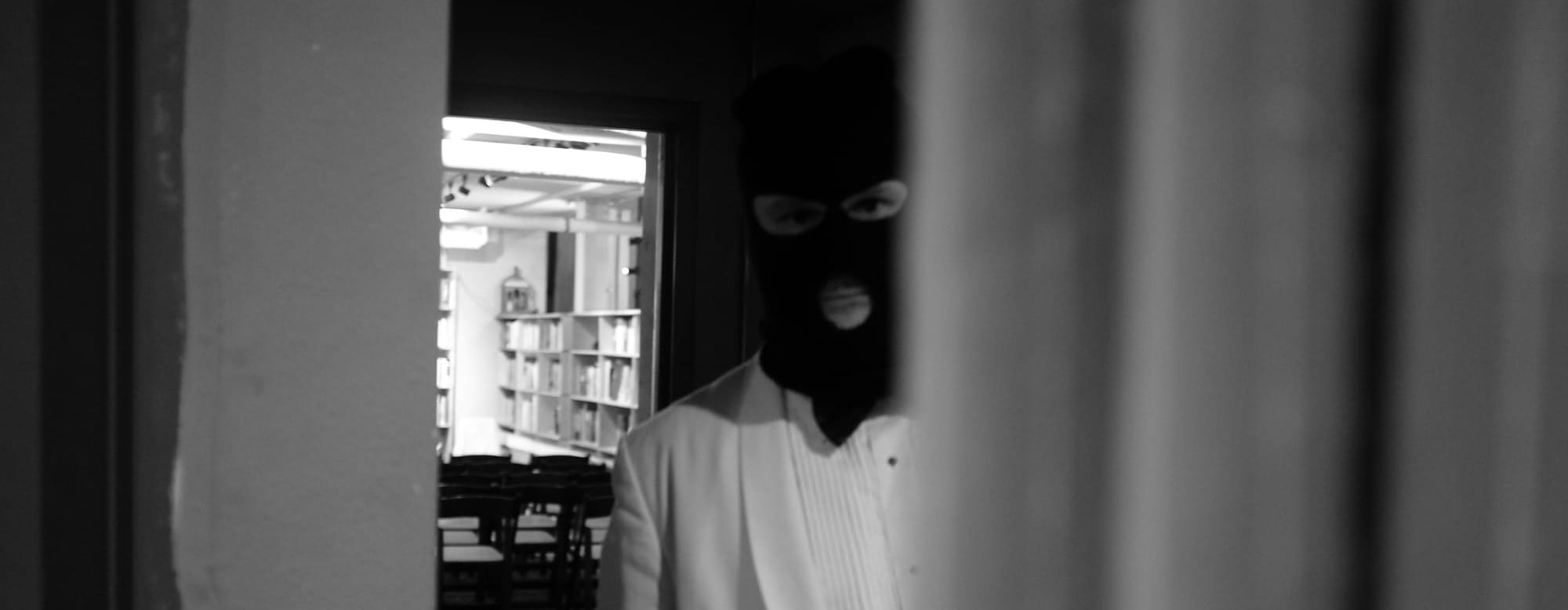
As closing time drew near, groups of friends and couples on dates were ushered from their tables and the space quieted. A couple of formally dressed staff walked around the edges of the room, setting up lights and hanging wires. The rest of us were guided to a small cluster of seats. One of the light-setters turned out to be director John Wilkins, who gave a few words of introduction; then the lights were killed, recorded gunfire rang out, and actor Benoît Monin leaped to the front of the room in a ski mask, raving about illness and torture, with a strobe light held so close to his mouth that the gleam of his teeth was painful to the eye.
There’s a haze that settles on a bar or café past midnight when you find yourself out later than intended. The space turns dreamlike, and if another late-night patron starts talking to you, their dream can infect your own. It’s like that to watch Monin perform: The monologue keeps changing topic, and as he writhes in pain or paces the floor in a tuxedo shirt with carnivalesque striped pants, you feel the urgency of his address (at one point I was apostrophized as his mother) but are kept guessing at his motives. And this is all before he beckons you from your seat to follow him in an hour-plus course of somnambulism through the darkened store, with lights, sounds, and unexpected prop arrangements touching up the phantasmagoria.
Shawn originally wrote the play to be performed for small gatherings in friends’ apartments, and it works by near immersion. The apparent situation is that a traveler in a poor country at civil war has come down with illness and is enduring a dark night of the soul. Between bouts of vomiting on the bathroom floor, he recalls the Proustian joys of his youth, his past life of privilege and taste, and his dawning awareness that others have had it far worse. That knowledge has become intolerable to him. The leaps in his monologue show the wanderings of a fevered brain, but they are also a search for a position from which the fact of inequality can be endured: he tries on the aesthete’s mantle (“I like Beethoven”), remembers small kindnesses (“I tell entertaining stories to people. I make jokes to the janitor”), pleads his own merit (“For God's sake, I worked for that money. I worked hard”). He undercuts his sympathies with reminders that his privilege travels with him—“Poor countries are beautiful. Poor people are beautiful. It's a wonderful feeling to have money in a country where most people are poor”—and finally falls back on the specter of violence: “The rule of the poor will always be incompetent, and it will always be cruel. The poor are bloodthirsty.”
He can rest easy in none of these stances. In the end there is no response to the fact of inequality, because to a man of humanity that fact is—in the word we all most associate with Shawn—inconceivable.
What we’re witnessing is a conversion narrative. But does it end in a true shift, or simply another point in the oscillation? As in Harold Pinter’s political plays, the text’s abstraction places the fever dream at a remove from the world. We don’t know the name of the country being visited, or the specifics of its beauties and terrors. A couple of figures—a chambermaid, a guerrilla fighter—represent the poor, but they remain a concept. There is a darkly funny fantasy in which the traveler imagines having poor friends, and visiting their squalid home for a repellent meal, but it remains fantasy. If inequality is impossible to deny, it may be equally hard to confront in a sustained way. As the traveler ruefully puts it, recalling his first reading of Marx: “For two days I could see the fetishism of commodities everywhere around me. It was a strange feeling. Then on the third day I lost it, it was gone, I couldn't see it anymore.”
Wherever we’re headed, we’re in good company. Wilkins and Monin have fleshed out the text with great ingenuity; the shifts in tone are vertiginous, the prop comedy is charming until it turns queasy, and the staging conceit keeps the audience active and off balance. As far as activity beyond the curtain call, we may have a better vantage point than Shawn’s imaginary traveler. We live in the real world; we know about protests, mutual aid, tenants unions. Wheels are waiting for shoulders.
At one thirty in the morning I stepped outside and found Grand Avenue as I’d left it: storefronts, scattered lamps, a few thumping cars. The man on a mobility scooter in front of a liquor store, jiggling imaginary drumsticks in his hands, caught my wry smile as I came down the sidewalk. It can be so hard to know when you’re meeting a person as himself, I was thinking, and not simply taking him as representative of his condition.
“Hey there, mama,” the man said to me. “Top of the morning. Wish I had a friend like you to take home.”
“Have a good night,” I answered, half smile in place, and drove home alone.
The Fever runs at Clio’s Books in Oakland, 353 Grand Avenue, Friday and Saturday nights at 11 p.m. through April 4.