War is Over (Because UC Wants it)
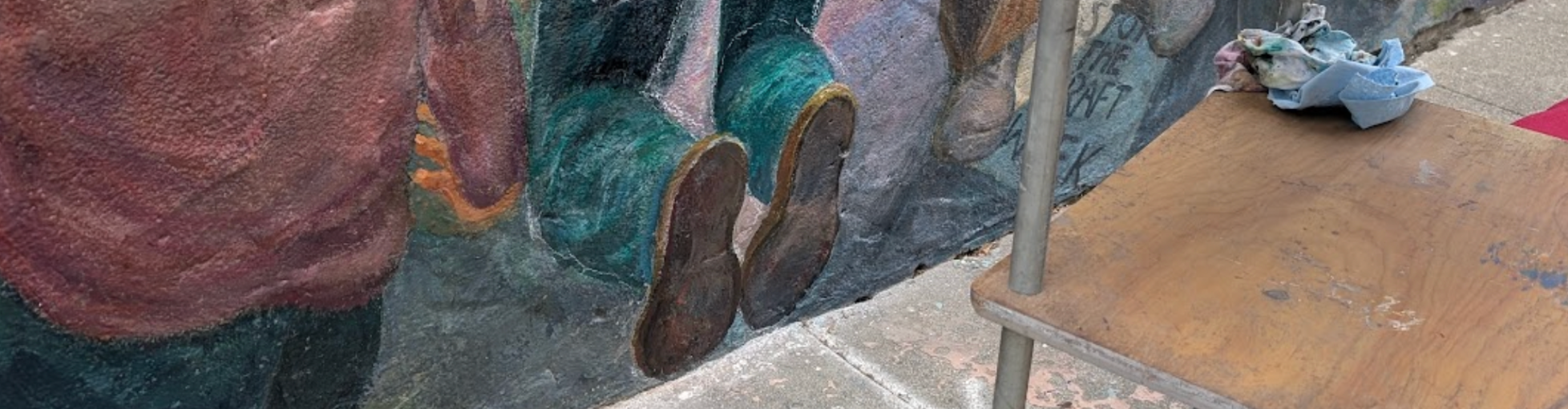
I spoke for a minute with a painter named Nick while he was touching up “A People’s History of Telegraph Avenue,” the mural on Amoeba Music, just off Telegraph Avenue, there, in the shadow of the towers where People’s Park once was, and where nothing has ever been as comprehensively gone as People’s Park currently is. Nick told me he was patching cracks and wear and other obvious damage, in preparation for a layer of protective coating, but also that one of the original muralists was going to come by later that day, to work on a pair of feet they’d been finding dissatisfying. We chatted about the idea of fixing a pair of feet that have been part of that mural, now, for nearly fifty years. At a certain point, wouldn’t you just let it stay the way it is?
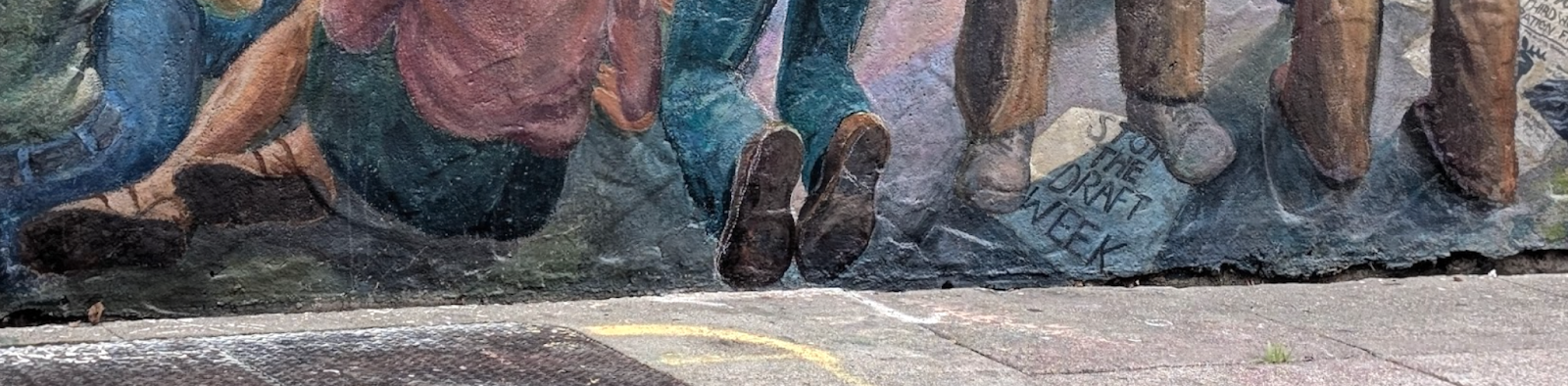
But things don’t tend to stay the way they are. Plaster cracks, colors fade, and things get replaced by other things, unless you work to prevent it. So (as I assume it says in the copy of Slaughterhouse Five that I sort of just assume that street bookseller is selling, on the blanket in front of the boarded up shops that used to be next to Moe’s, in front of those stores where I bought a mass-produced photograph of lemons, where I sometimes ate soup, and where I remember not going in but smelling various oils and perfumes wafting out) it goes.
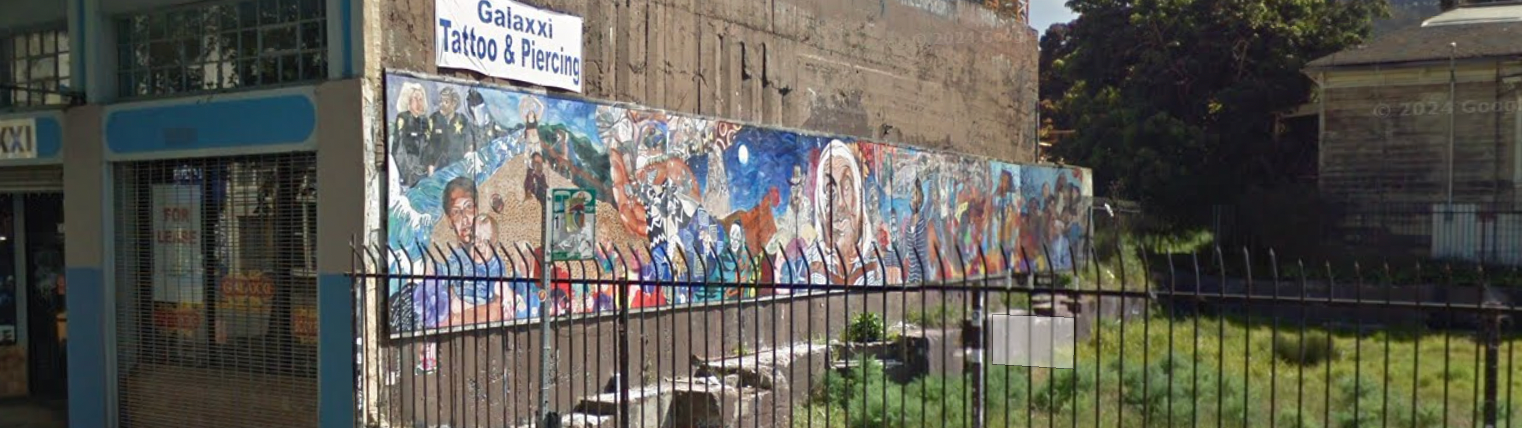
Those stores I never paid a lot of attention to, but got used to just assuming they were there, were here, on the block of Telegraph Avenue, in Berkeley, between Haste and Dwight. Now, there is now only this mural, giving this sort of wallpaper, screensaver version:
So has gone the people's “Telegraph Avenue.” You might assume it’s still there, the way you might assume that guy selling books on a blanket is there, and that he’ll have a copy of Slaughterhouse Five, because he’s the sort of guy who should be there, and that’s the sort of book a guy like him should be selling, on that block of Telegraph. But even if Telegraph still connects Oakland City Hall to the University of California at Berkeley–along the path once taken by a telegraph line between Oakland to Martinez, a line once trafficked by horses, then streetcars, and then buses and cars, and now, mostly, by students–that’s not really what people mean by “Telegraph,” when they mean it synonymously with “Berkeley,” and when what they really mean by that is “the sixties” (even if they mean the part of the sixties that mostly happened in the seventies). They mean a place where a very specific kind of social disorder congregated, smelling and sounding and looking a particular way. Beatniks, freaks, hippies, punks, it changed by the decade, but you knew it if you saw it. It was there. There was the place where it was.
Now you’ll only see it on the mural, because the streets are clean and well-policed, and because People’s Park has been so comprehensively defeated that it’s no longer even plausible. This is what you’ll see where it once was, this magnificent mountain of barbed wire, capital, and concrete:
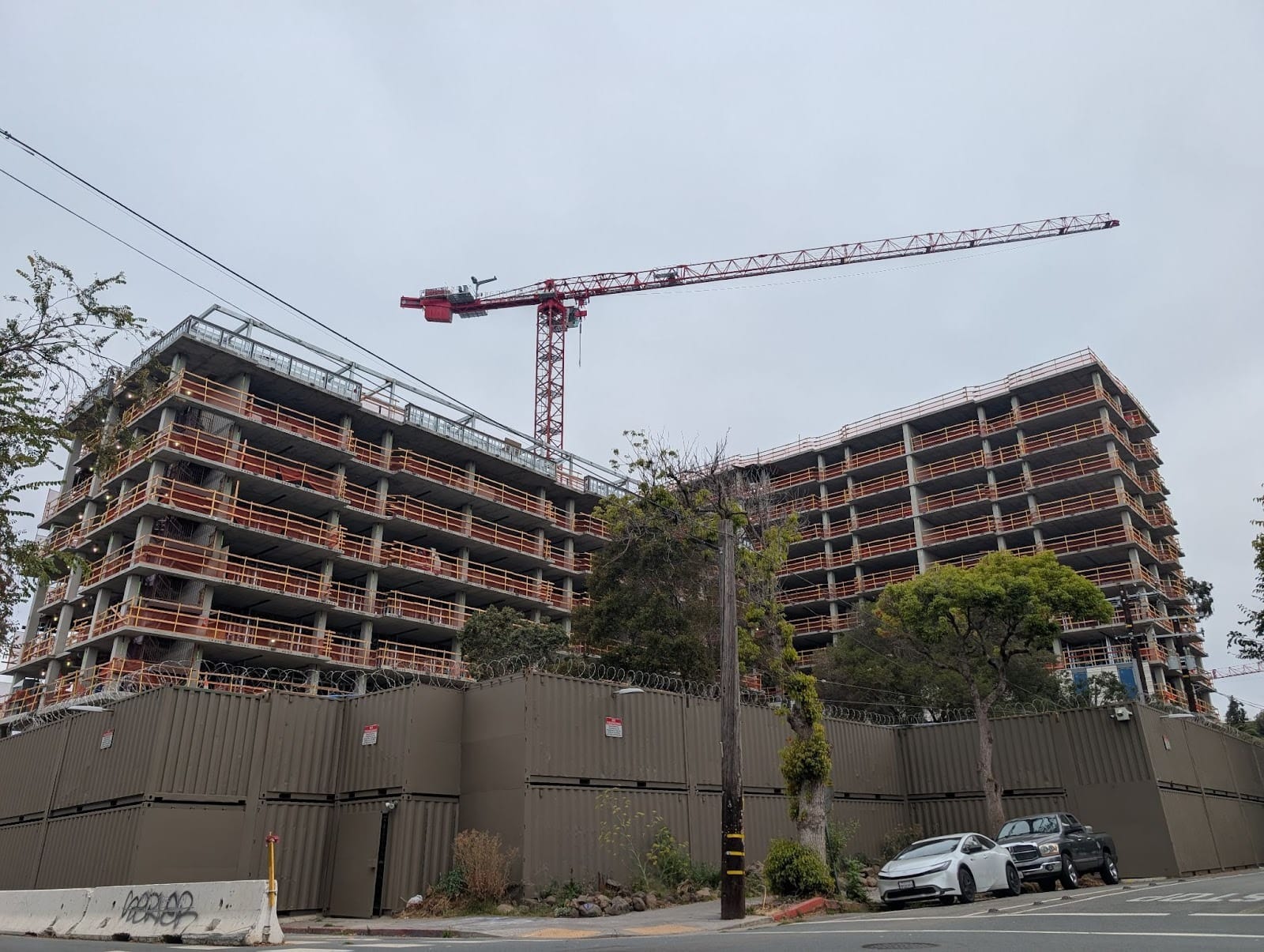
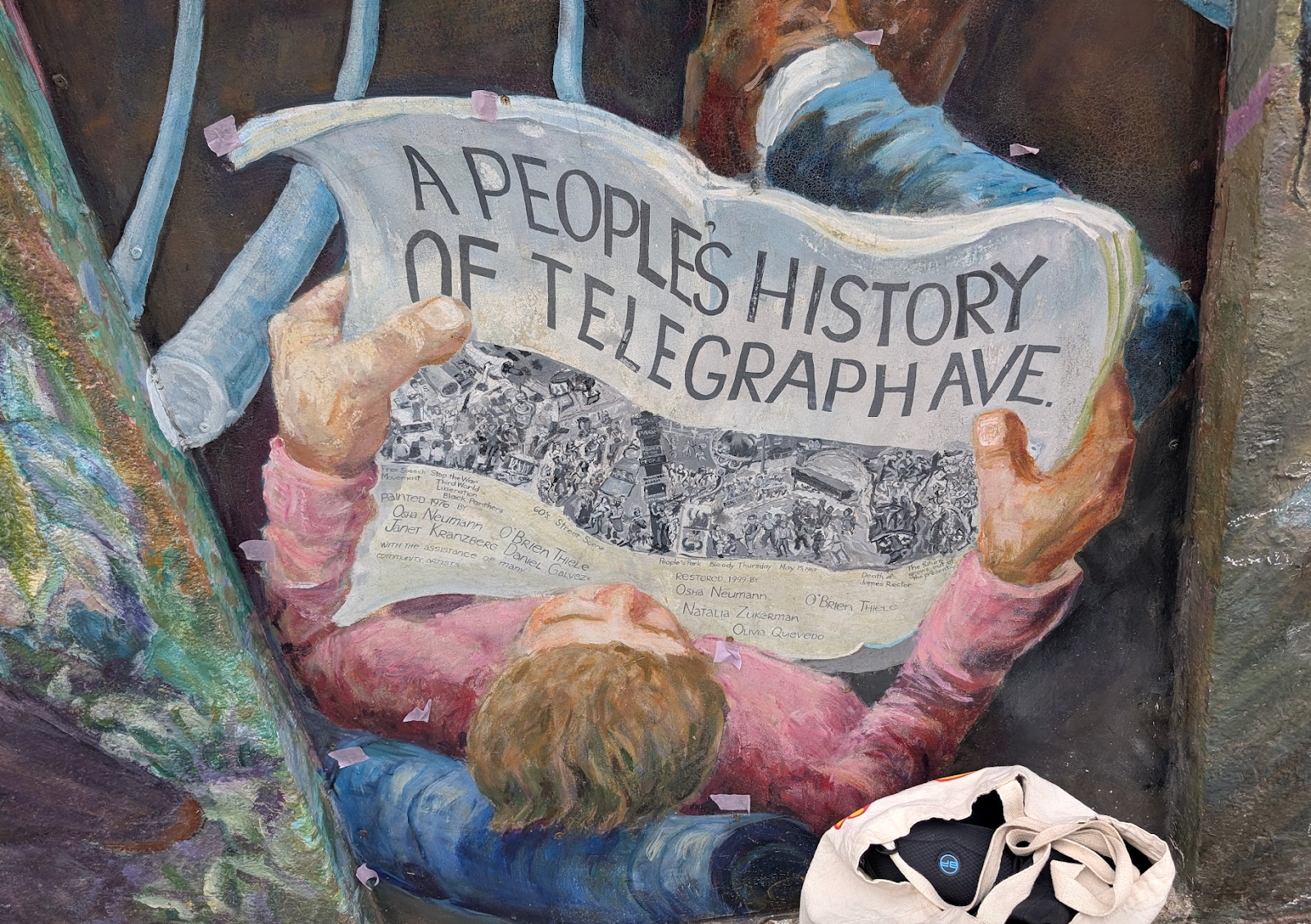
It makes it easy to forget that when Osha Neumann designed “A People’s History of Telegraph Avenue,” in 1976, he was telling a contemporary story, meant less to commemorate what had happened than to mirror what was still happening. The mural tells a story about kids fighting the university’s cops, something they used to do a lot back then: first, students fighting for their rights to protest the Vietnam War and for the rights and well-being of Black people, then it's the Black Panthers, and then the community protesters who seized a plot of land whose residents had been evicted by the university, that was leaving it fallow. And when that mural was painted in 1976, the story of the sixties was how those fights could be won.
“The continued existence of People's Park proves something dangerous,” as Left in the Bay put it; “you, too, can seize something from the most powerful people in town, make it into whatever you want, and hold it for half a century.” It proved that the people could change things.
But after half a century of failing to take it back, the university took it back. Now People’s Park’s nonexistence tells a different story, one that even includes the mural itself, which will be preserved while Amoeba Music guts itself for university housing, building around that facade: Described in terms of maintenance, preservation, even sustainability, the project is to keep things the way they are, as the developer explains. Since the record store, the mural, and their creators and maintainers are all aging, to ensure their continuity “for future generations,” the redevelopment will transform all of it into “an endowment.”
So it goes. And a record store is not a temple from which moneychangers are to be whipped; this one, after all, was built in 1990, and if it harbored and sustained the particular vibe that people mean when they say “Berkeley,” it was always already an attempt to memorialize and profit off of that vibe, during a revival of sixties nostalgia, an attempt–now that history had ended and we were all postmodern–to bring them back in a new and commodified form. Amoeba only opened its second location in the Haight, after all, long after the beats and then the hippies had first flooded into that district, after a proposed-and-then-canceled freeway project had scared all the money away, leaving blight, decline, and space to be occupied. By the time Amoeba came, in 1997, the Haight had become “historic” real estate, that could be capitalized on precisely because it was no longer the welcoming void that had drawn all the freaks in the first place. A place like Amoeba needed land that had come to be worth something.
But I think there’s a useful clarity in the way “a people’s history” becomes an endowment, the way a story of ongoing, polymorphic dissent by young people has become an object to be encased in polyurethane varnish. The gift of the past will be used to maintain what is, now, in perpetuity, but only precisely and because that past is gone. "The mural preservation is also extremely important,” as a local YIMBY posted, pleased at more housing: “It told people more about the history of the political period during Peoples Park and the 1969 revolt than the actual park did. It would be hard to imagine a Telegraph without it.” There, too, a useful clarity: People’s Park must be gone so we can imagine Telegraph, properly, without it, as a "history," so that it can become what it should be, an endowment from the past to be capitalized on.
(A moment later, he deleted the tweet, which feels equally appropriate.)
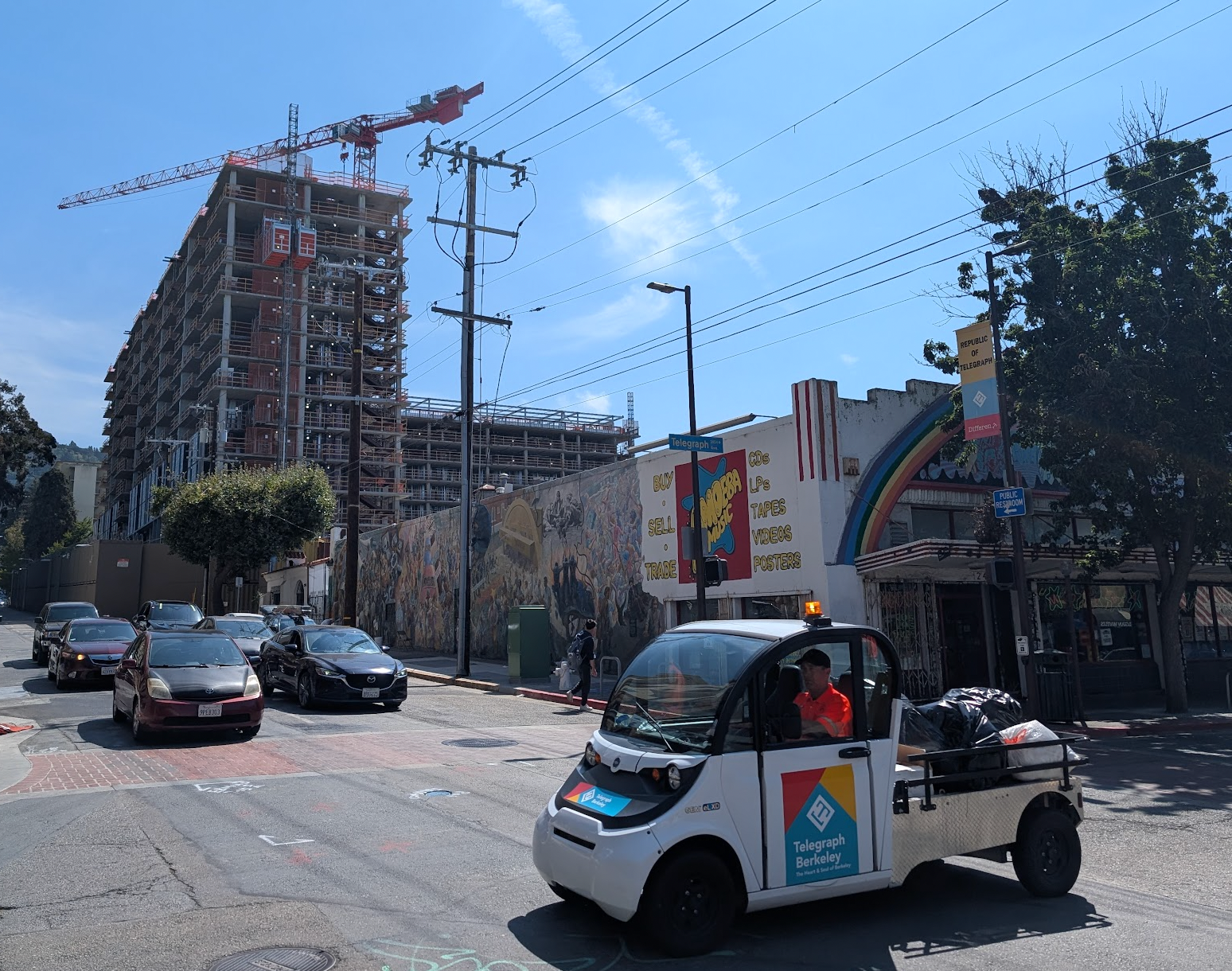
What is "Berkeley"? A university can be many things, and it was here, and in the sixties, that Clark Kerr coined a term–the multiversity–that few now use, to describe how many different and irreconcilable things a university did and was. "A community should have common interests," he wrote; "in the multiversity they are quite varied, even conflicting." He was thinking in terms of different departments, different faculties, different research agendas and projects, and in a very optimistic and early-sixties way, imagining the unum that could be made out of that pluribus, how it could be a good thing that so many different kinds of agendas could be housed under one institutional name and one form of governance. And maybe he was right. But even if a university can be many things, and occasionally still might be, the one thing that a University like Berkeley’s mostly is, and will be, always and forever, is a pile of capital. Whatever else it might be and do, the permanent continuity of its fiscal existence–the growth of its endowed assets–is the one thing that it will sacrifice anything to maintain, in perpetuity.
In 2008, when Aaron Cometbus had to describe Berkeley in a paragraph, he described it as “Balkanized,” as a war, united as a single place only, parenthetically, by its antagonism with the university, which was once named for the community it lives in, but these days can seem like the other way around:
Outsiders may view Berkeley as a country of its own, but insiders think of it as nine separate war zones: Telegraph, Northside, West Berkeley, the Hills, the Flats, Ashby BART, North Berkeley, Fourth Street, and Downtown. (The separate country is the common enemy smack dab in the middle: UCB.) To a Flatlander, the Berkeley Hills may feel as remote as Mount Everest. To an Elmwood resident, the glorious waterfront may seem as distant and dangerous as the Middle Ages.
I wonder when this was last still true. Was the war still going on in the eighties, when Cometbus was part of the Gilman punk scene, and started writing his zine? The nineties, when he was still writing his zine, but by which point, punk was dead?
Today, the war is surely over. Today, surely, Telegraph between Haste and Dwight is more like Berkeley’s Time Square: legendary for how it once harbored so much matter out of place, but now, mostly, just the legend is left, as the common enemy rules victorious over all that it has conquered.
You may not have heard about PM press’s republication of Cometbus's The Loneliness of the Electric Menorah, last year (issue #51 of Cometbus’ zine from 2008). Publishing hype is about creating the sense of an event, of novelty, but when he first wrote that book, seventeen years ago, he was already memorializing something that had ended. “My Berkeley—what I defend and try to represent in print—isn’t Berkeley anymore,” as he said in a contemporaneous interview: “I imagine someone reading what I’ve been representing as Berkeley and then coming here. It’s heartbreaking.”
How heartbreaking it is might depend on how attached you are to the place, or what it represents to you. When the book was reissued last year, the Supreme Court had just sided with the University, allowing them to begin construction on the People’s Park site; six months earlier, after driving out the last of the residents and protesters, they had surrounded the site with “a seventeen-foot-high wall of shipping containers around its entire perimeter, ensuring no activist, no crustpunk, no sunbather, no student cutting a diagonal desire line across the grass, no unsanctioned person at all could set foot on the hallowed ground,” as Kelly Pendergast put it:
[It was] a clear statement that the right to look, the right to hear what’s going on, the right to engage, now belongs only to the university and its developers. Now, the only people allowed to look are the security guards posted up on every corner of the fortress and the unseen watchers who review the footage from security cameras mounted ostentatiously around its perimeter.
In 2008, Cometbus was able to write his oral history of that block of Telegraph because you could still walk around and see what it had been. It already wasn't that, of course, which is what the book was about. But at least you could still see it.
And the book is good, you should read it, if you've read this far. It’s basically just a peripatetic scrapbook of stories, but he unums its pluribus by deriving everything back from a founding argument between Moe and another guy over “Rambam,” a short-lived bookstore out of which every other story can be seen to flow, in that way, creating a found family tree linking Shambhala, Cody’s, Rasputin, Amoeba, Shakespeare and Co, Re-print, and so on. PM’s marketing copy frames it as “the social history of one of America’s most legendary streets, and a family tree of the movements it fostered: the paperback revolution, the graphic novel, Slow Food, New Age, the Free Speech Movement—and even the Symbionese Liberation Army,” and that’s not wrong, exactly. But it's not even wrong. Cometbus’ book is anti-nostalgia, not about origins or glorious progenitors but about spending a ton of time at a place, knowing the people and also being angry and annoyed about them, until one day you realize they are dying and soon, won’t be around anymore to be mad about.
Cometbus had cathected onto that block as a young man growing up in Berkeley, but when he wrote the book, he had been spending a lot of time coming home to helping his dying parents, which he does not mention in the book, but you can see it everywhere in the text if you look for it. It's not surprising that his feelings about the block are mixed, generally, and with the feeling one has about seeing one’s own past and origin pass away. The “loneliness” of the title is that creeping feeling he has that he’s the last person who even remembers what used to be there, that “at this point, I may know more about Rambam than anyone alive.” And so, these are the kind of family stories one collects only to wake up one day and realize you’re not only the only person who remembers them, but, even worse, maybe the only person who still wants to fight over them.
This is an experience you don’t have to have Berkeley-feelings to access. When he wrote that “by the time you’re ready to take on your elders as equals, they’re dead,” man, I felt that. If we “come of age” by tussling with parents and elders, we come of something else entirely when they’re no longer around to fight with. The worst thing about the death of your parents might not be mourning them, because that’s when you still can still remember them being alive, and when the pain keeps them present. The worst thing might be the moment that comes later, when their death has become so permanent and fixed that you can't remember what it felt like when it was still fresh and impossible to understand, when you can't even access that hole in you that tells you they were there.
I have mixed Berkeley and parent feelings, by the way. I bought a lot of books on that block after I came to Cal in the early 2000s, when my mother was still alive, and one of the reasons I came to Berkeley in the first place was that this block of Telegraph instantly reminded me of State Street in Madison, next to UW, where my mother went to college and was tear-gassed in the sixties, and where I would shop for used books when I was a kid, when we were visiting her family. By the time I got to Telegraph, of course, it smelled more of boomer memories than tear gas. But whatever I saw on Telegraph, then, is not what a young person would see now. You can dip into old google street view photos to get a sense of the storefronts and facades that used to be there, that anchored the enterprises Cometbus writes about. But there was something else about it, something about the texture of the street, and the people, something about the feeling you had walking around that Google street view won’t show you.
For that, you need Cometbus. And there are a lot of really good stories here, told with such verve and abandon that you almost don’t notice what a good storyteller he is. You may also not notice how his anecdotes from the past have passed into their final forms, memories and feelings digested and replaced by the story he’s telling about them, how much he has figured out the lessons he took from them.
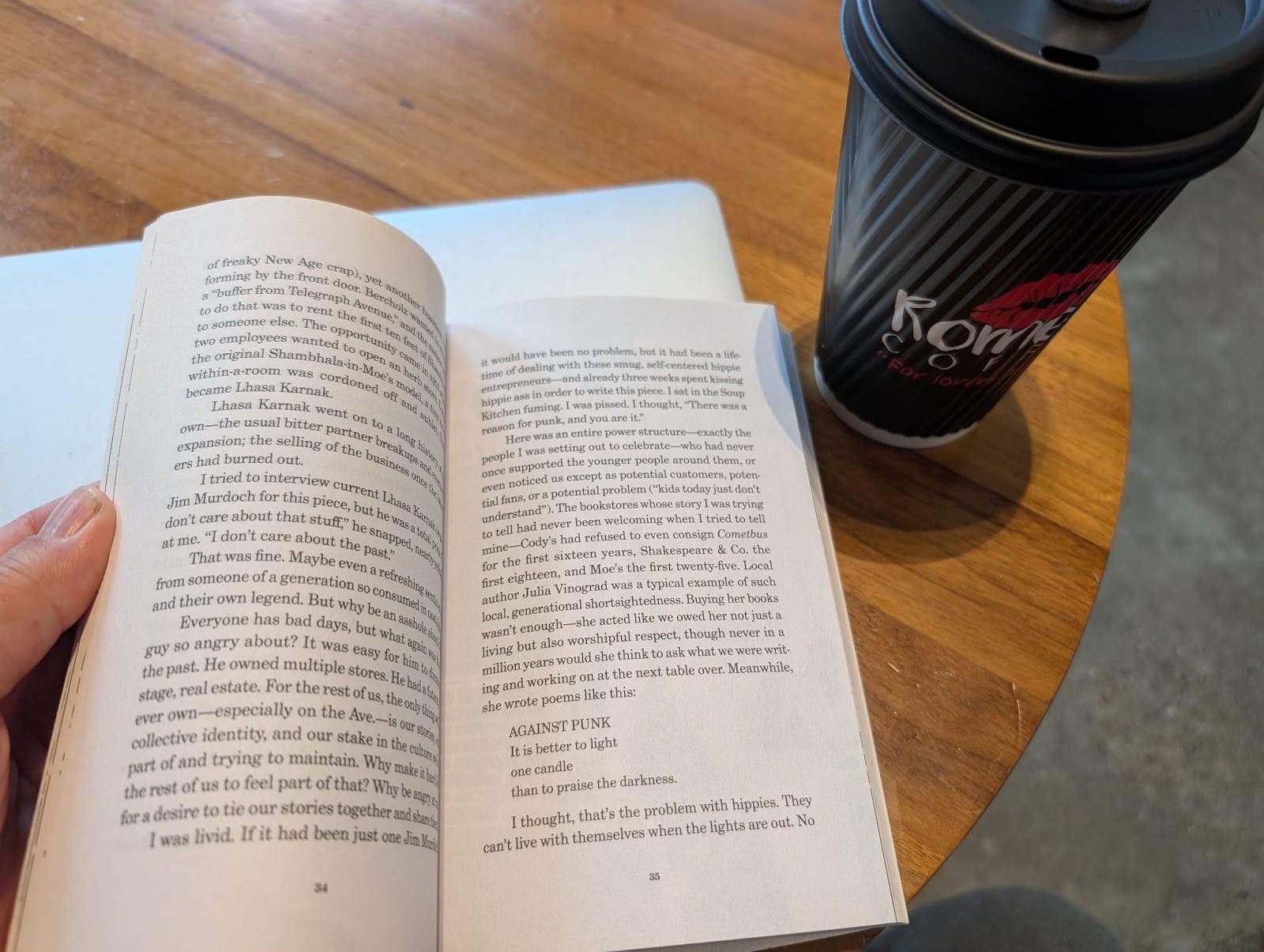
For example, maybe the key moment of the book is when, after “a lifetime of dealing with these smug, self-centered hippie entrepreneurs,” he declares that “there was a reason for punk, and you are it”:
Here was an entire power structure—exactly the people I was setting out to celebrate—who had never once supported the younger people around them, or even noticed us except as potential customers, potential fans, or a potential problem (“kids today just don’t understand”). The bookstores whose story I was trying to tell had never been welcoming when I tried to tell mine—Cody’s had refused to even consign Cometbus for the first sixteen years, Shakespeare & Co. the first eighteen, and Moe’s the first twenty-five. Local author Julia Vinograd was a typical example of such local, generational short-sightedness. Buying her books wasn’t enough—she acted like we owed her not just a living but also worshipful respect, though never in a million years would she think to ask what we were writing and working on at the next table over. Meanwhile, she wrote poems like this: "AGAINST PUNK / It is better to light / one candle / than to praise the darkness."
I thought, that’s the problem with hippies. They can’t live with themselves when the lights are out. No wonder they’re so angry at us, able to accept the darkness and even celebrate it. It would be funny, if only they hadn’t taken all the rent-controlled apartments for themselves. All of us Berkeley kids had to move away in order to find a place to live. Now here I was, back in my hometown for the holidays, with no one to light the candles with.
If you’re Cometbus’ age, maybe you still have some remaining anger for this kind of person, though if you’re younger than me, “OK Boomer” might be what you say to people my age (if it isn't, simply, "6-7"). Most of what he wrote about in that book was already “looking none too bubbly,” as he described the now-late Vinograd in 2008 (famously, the “bubble lady” at People’s Park protests). But in 2025, now, it’s really gone. All there is, now, is all the stuff that there now is in the shadow of People’s Park Tower: new stores and new people, and lots of them, but absolutely no fighting.
Is it a bad thing that this, what Dustin Hoffman iconically saw in The Graduate, looking over at Moe’s from Caffe Mediterraneum across a Telegraph Avenue filled with people, is so different now?
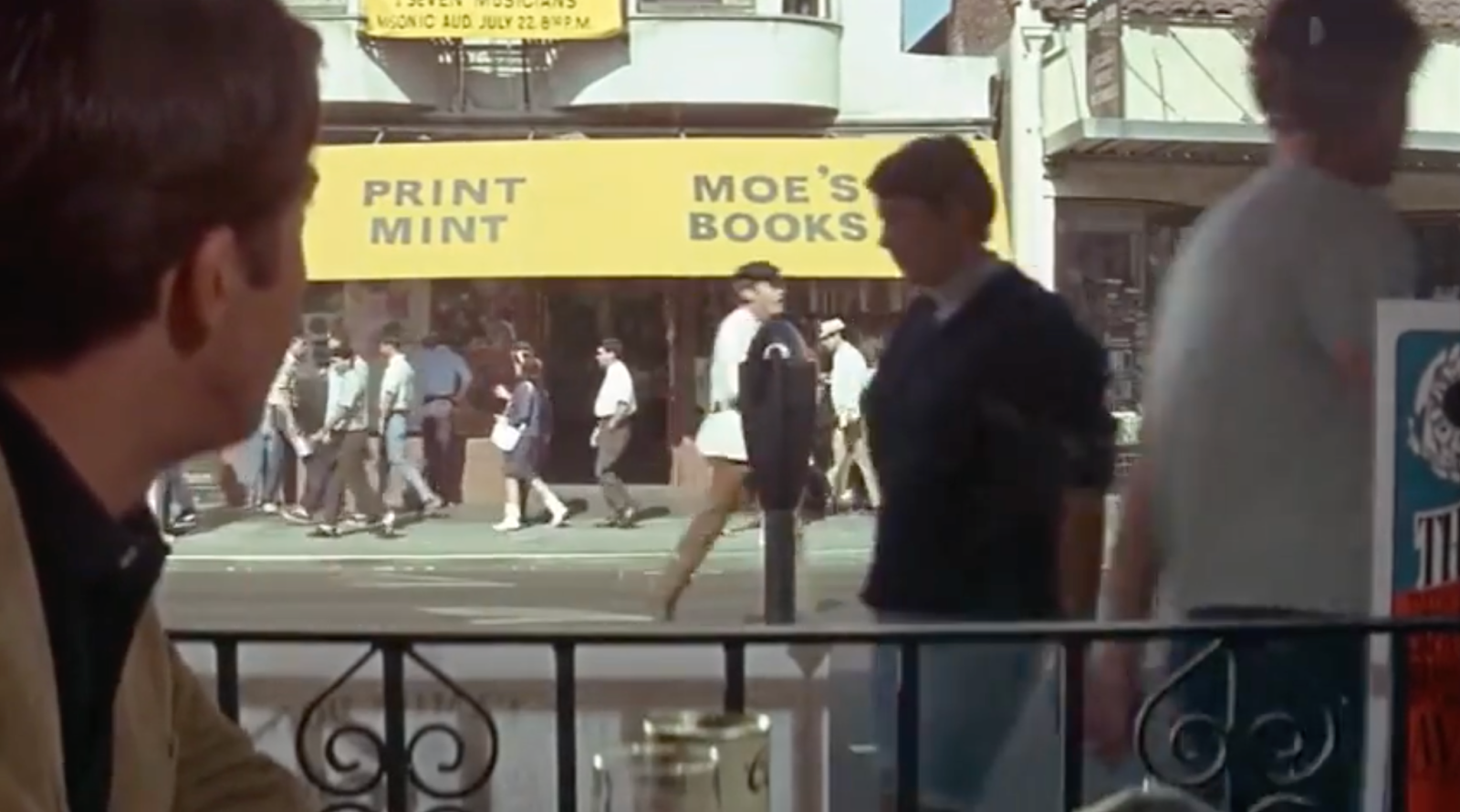
Is that scene worth remembering? Preserving? Should it be touched up, updated, kept alive?
I’m genuinely not sure. I am writing this now, in Med’s successor, "Romeo’s Coffee," where the basic coffee is so vile that I'd suggest you go for the “Golden Latte," instead, in all its appropriative, gentrifying creaminess. The whole place makes me feel as out of place as I am, everything from the EDM they’re playing for students working on their powerpoints to the incongruously horny sandwich and drink names on the menu. Osha Neumann’s father, Herbert Marcuse, might have some things to say about eros and civilization, were he forced to choose between "Seduced in Seconds," which is BLTA on Dutch crunch and "Good Girl Gone Bad," which is BLTA with ham, onion, and cheese on dutch crunch. (He might have said "The high standard of living in the domain of the great corporations is restrictive in a concrete sociological sense: the goods and services that the individuals buy control their needs and petrify their faculties." That's the sort of thing he would say.)
The bathroom says it's for “guests only ($3 or more),” a very legible code for who is welcome here, and the sort of thing bathrooms around here say. I find the current view depressing:
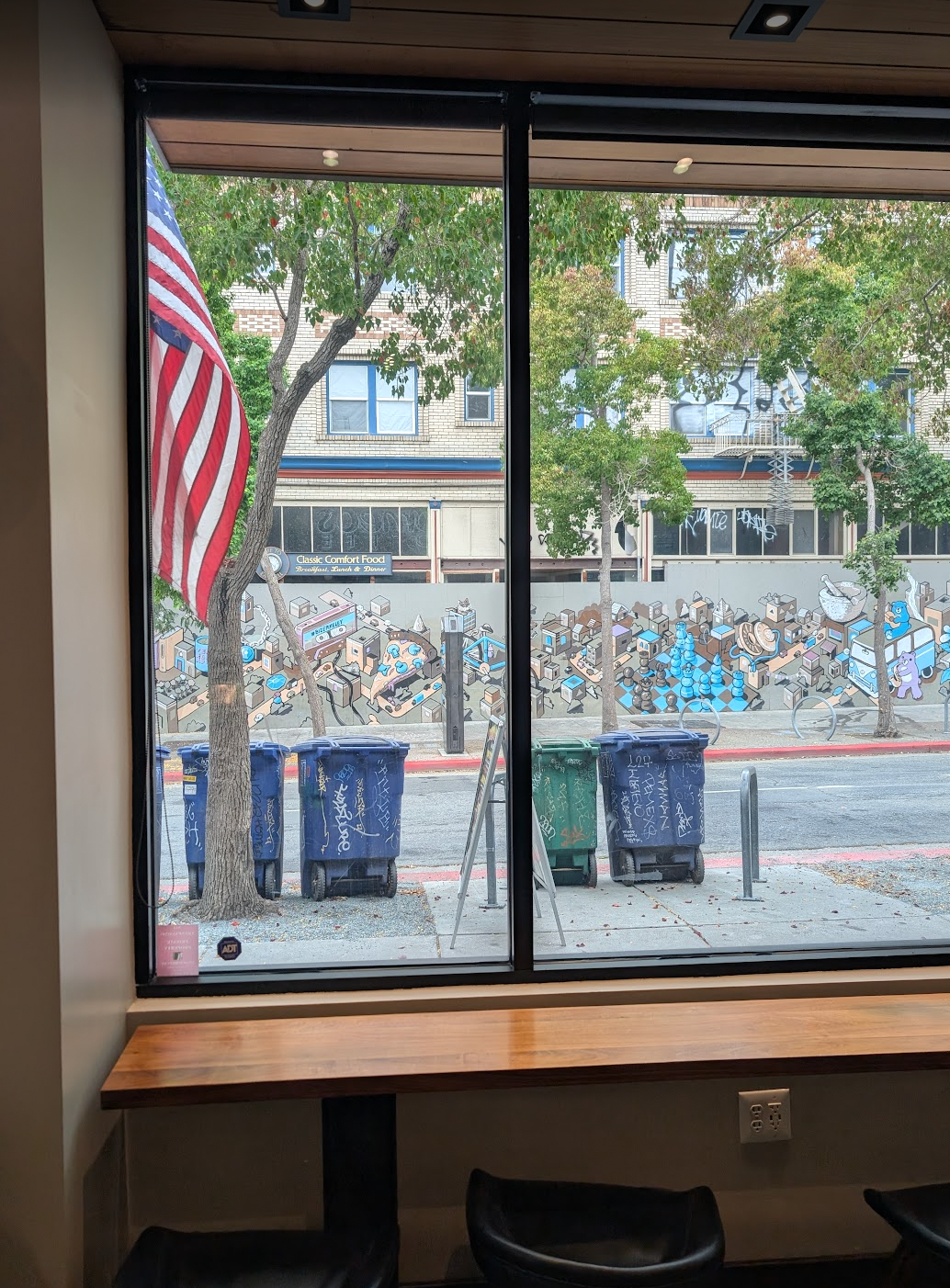
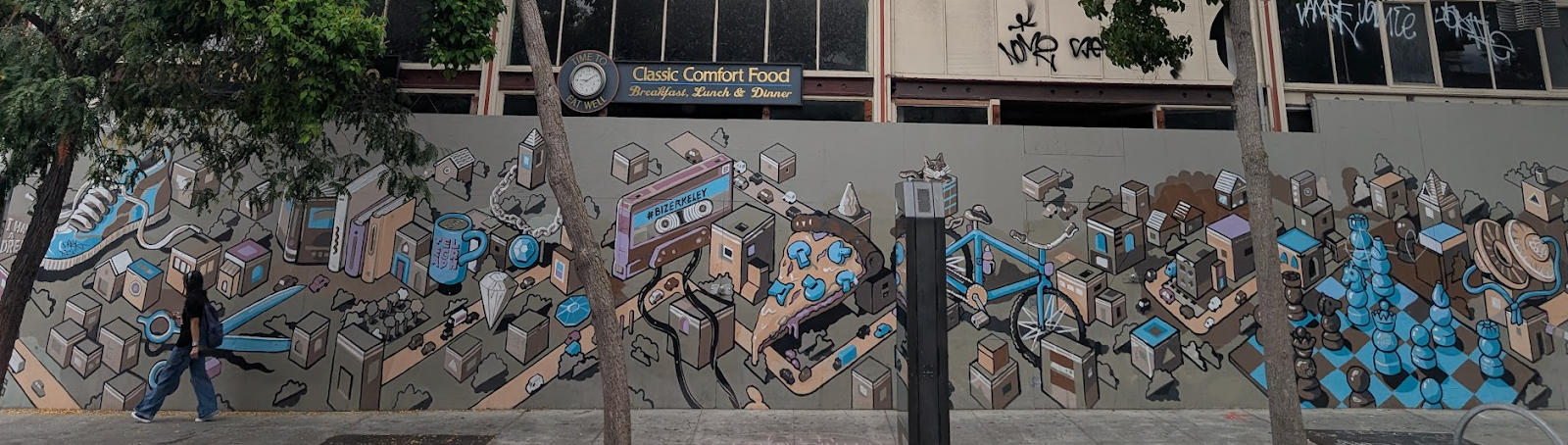
It’s not only the flag that bums me out, but the combination of nationalist banality with the affected clip-art whimsy of that Sim-pastel mural across the street, all those charming and witty commodities mashed together with a contextual agnosticism that an AI would envy, if it could. The hashtag #bizerkeley on a cassette tape–just under the “classic comfort food” you can no longer get–gives the thing its name, but it’s as conceptually incongruous as a beatnik buying cannabis in a licensed dispensary would be. Like a medieval knight ordering a book from Amazon, the sentence is an oxymoron which cannot and should not be. And yet it is, all aesthetically smoothed together into a single, continuous harmony.
If Neumann told “a people’s history” through social action and ferment, struggle, hopes, and communal dreams, the Telegraph Business Improvement District commissioned a mural to cover over the vacant place where so much of what Cometbus memorializes had been, and now isn’t, and what they got, and were presumably happy with, was a wall of objects with no people on it. It’s completely correct, in that sense, that what Herb Caen called “Berserkeley” has been so quietly updated to #Bizerkeley that you might not notice that it happened, or what has been covered over.
What could be more in tune with the spirit of our times? Neumann’s mural depicted a much-desired and deferred revolutionary apocalypse, a desire for things to change; its chaotic jumble was meant to mirror the disorderly anarchistic gatherings that were still happening, then, on the streets themselves. It was to be a wall on which people could see themselves, what they were becoming, and what they still hoped to be: “The dream of revolution is deferred,” Neumann declared, as late as 2015, but “we end on a hopeful note.”
This current mural reflects, quite correctly, what Telegraph Avenue has ended up being. It’s economic art, meant to arrest chaos and ward away change, art that pacifies, an affirmation that conceals what’s empty beneath it. They've been renovating that empty building, if they even are, so gradually since 2018, that the artist had to touch up the mural three years ago, and they specifically wanted something that no one would mistake for a welcoming void. “Construction in the Bay Area can be ominous and apocalyptic in some places where they are developing big blocks of construction,” as the artist has said. “It also deters unwanted tagging which happens if it’s left blank.”
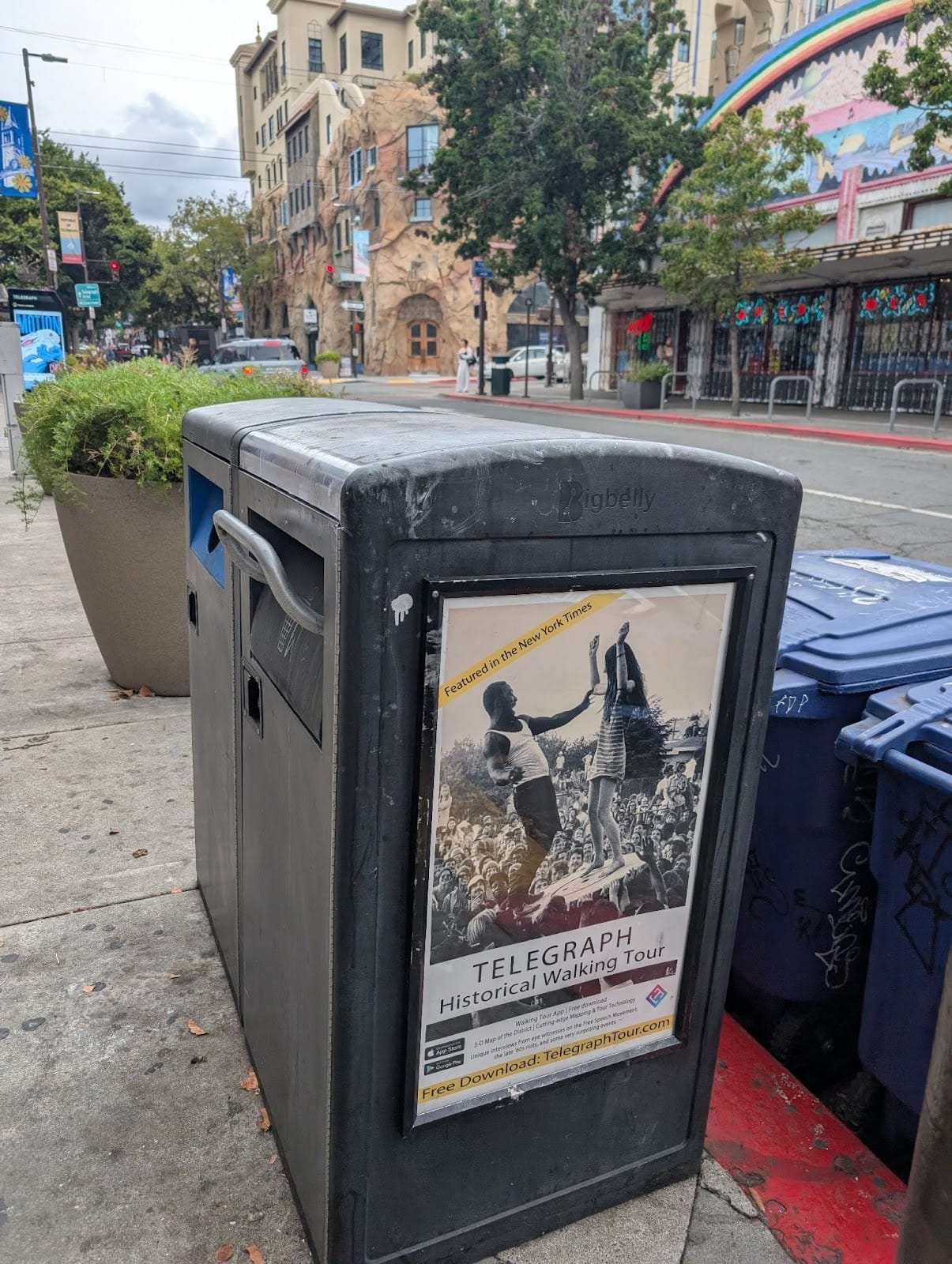
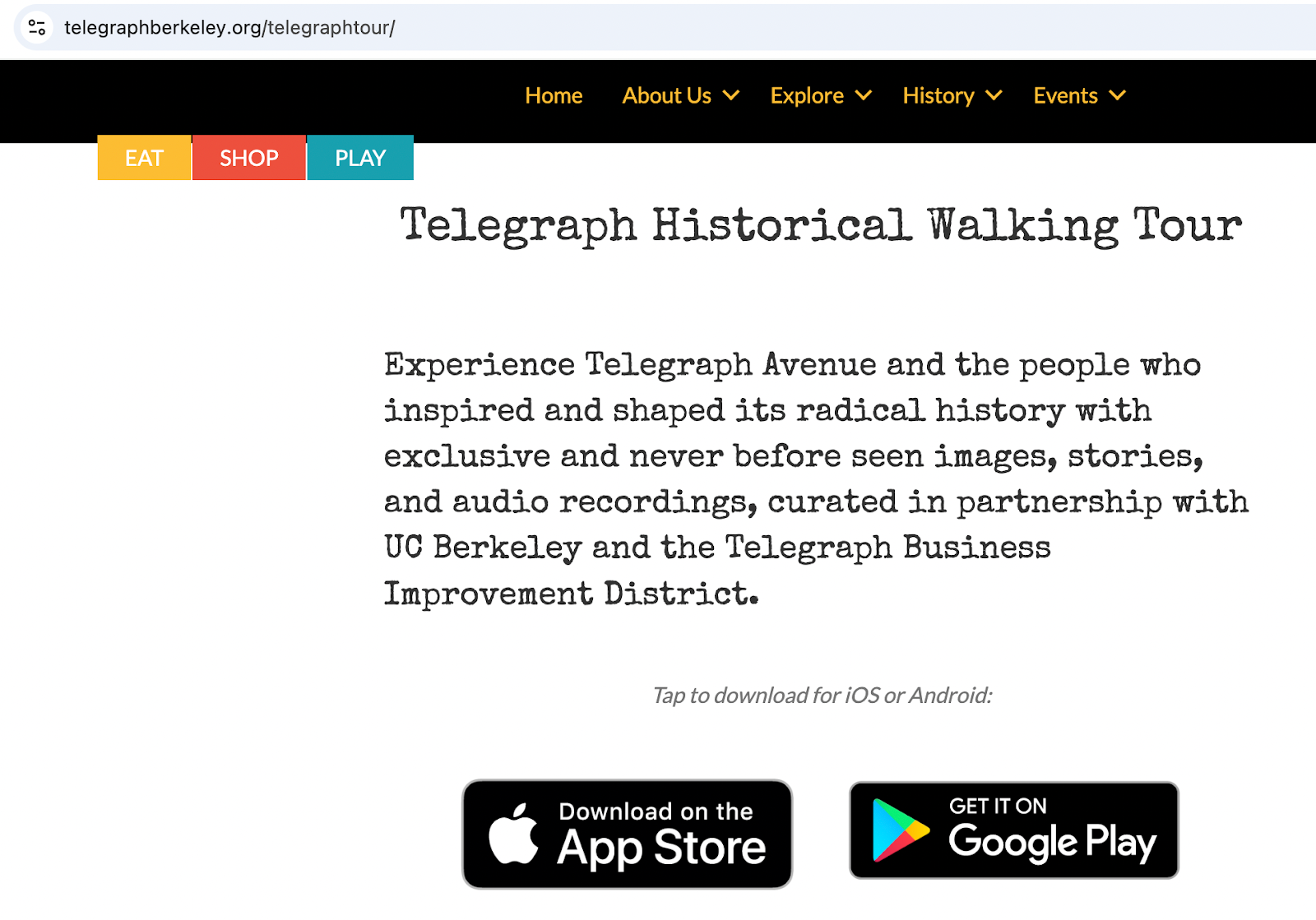
Another sentence that has no business existing is that Telegraph Business Improvement District is “a nonprofit representing Telegraph Avenue landlords,” but if you want the story of this block given to you in a more efficient way than Cometbus’s book, or Neumann’s mural, you can download an app they’ve produced. “‘Telegraph is a really unique community,’” as Stuart Baker told Berkeleyside:
the executive director of the Telegraph Business Improvement District who came up with the idea for the tour. ‘It’s an interesting intersection of some of the brightest young people in the country, up against classic hippies from the sixties, next to intellectuals who are quirky. Every street and every side street has something going on.’
(I literally couldn’t download it because I had neither the right apple product to do so, nor is the google play link current. To be honest, that, too, tells a story.)


There was a time when the "digital revolution" promised to preserve everything, forever, after mere books faded. Ours is a time when it's possible to wonder whether the real point of digital media is that it's easier to turn them off, when no one is looking. In any case, there’s a moment in The Loneliness of the Electric Menorah when Cometbus dings “the media” for lamenting the closure of Black Oak Books in 2008, and for “not bothering to note that the number of bookstores in Berkeley is actually at an all-time high—reportedly the highest per capita of any city in the world.”
That take, however, hasn’t aged well. The indies managed to outlast the Waldenbooks and Barnes and Noble whose closures everyone celebrated in the early 2000s (and Cometbus throws a shovelful of dirt on the grave of Crown Books, calling it the “Barnes and Noble of its time”). But after Amazon put the big box stores out of their misery, Bezos came for the little guys next. Other than Pegasus and Moe’s itself--and Sleepy Cat, which is newish, but forgettable--it’s bookstore desolation in Berkeley: even the Books Inc. that took over the shell of Black Oak Books is dead now, University Press Books is gone along with SPD and Eastwind, Half Price Books is closing, and even the actual UCB "campus bookstore” is barely even a bookstore. It’s like that with every other bookstore that I vaguely remember a younger version of me wandering through, wide-eyed and disoriented, from Shakespeare and Co. and Cody’s to all the littler, weirder stores I’ve forgotten I’ve even forgotten, like Anagram or Serendipity. In 2016, the Bay Area Book Festival struggled to insist that bookstores still thrive in Berkeley, and I do mean "struggles": half the stores they name have closed since then, or are in Oakland. Even PM Press has left the East Bay for upstate New York, like Cometbus himself.
So it goes. But I think nostalgia is the wrong word for what one misses, here. Cometbus’s 2006 novel I Wish There Was Something That I Could Quit opens by throwing bricks onto a train carrying armaments to a war in Iraq, a war so forgotten that it's become permanent. Maybe writing this book helped Cometbus quit Berkeley. But I suspect PM Press republished Electric Menorah because now is a moment when we are likely to be nostalgic for that time in the 2000s, before the Great Recession and iPhones and the digitalization of everything, when it still felt a little more possible to protest a war. It wasn’t that Berkeley Was Still Great, of course, or ever could be again. But perhaps it was easier to be nostalgic, then, for when it had been? For when wars still seemed like they could be stopped?
At least then, you could still shop in lots of different used bookstores run by bickering neighbors nursing their obscure grievances. In the final chapter, Cometbus walks one last time through that block of Telegraph, to see how everything is ruined or dying or gone, but in 2008, he could still mourn the past, because you could still smell its corpse. Today, even the open pit that once sat across the street from Amoeba, a hole whose long and contentiously petty history Cometbus delightfully sketches, has been filled by one of the most wildly extra buildings you’ve ever seen, so lavish and excessive and multi-architectural that it’s almost impossible to remember around it. Maybe that's the point of it.
That hole is so long gone, now, that even I—who walked past it, hundreds of times—was surprised to be reminded that, once upon a time, I remembered its existence, that I'd walked past it so many times and wondered what used to be there. Digging into google, I learned that it was the Berkeley Inn. But I also discovered that another strange mural once used to glare across that void at the one that remains, that Nick has been touching up.

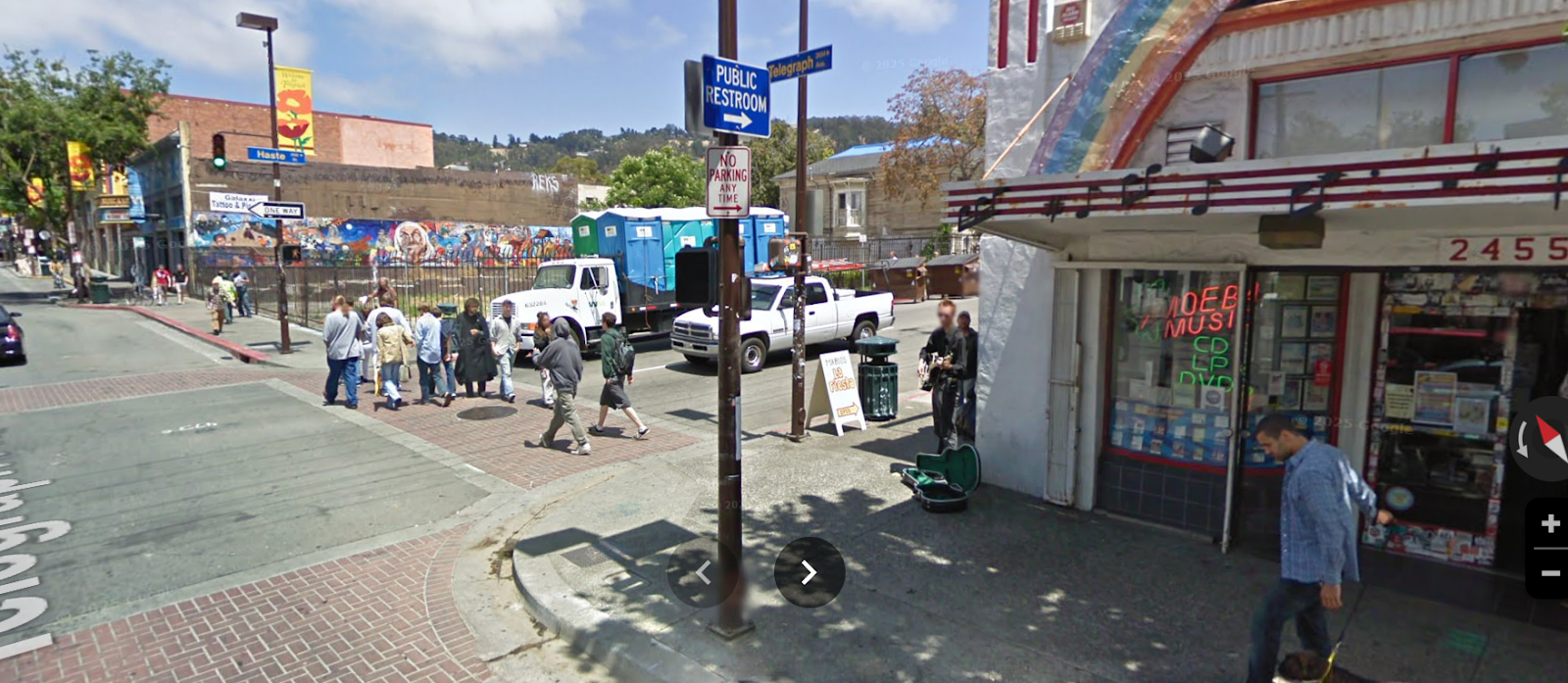
I wonder where it is now. Did some one preserve it? Did they just bury it? But I also wonder if I had ever noticed it was there in the first place, if it ever mattered to me back then. I suspect it’s only now that it’s gone that I look for it, and wonder about it. Maybe that's how if goes: only the passage of time filled it up with something I could miss, that I could light a candle for to forget about.