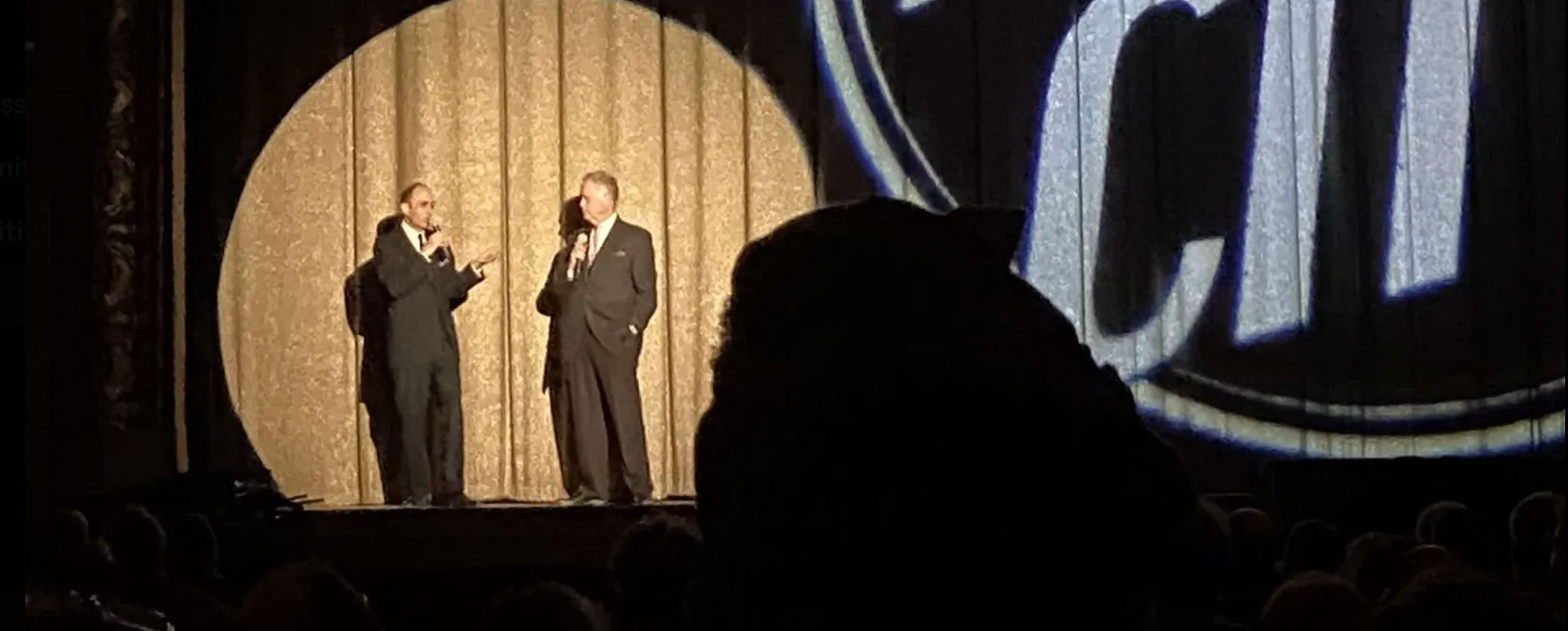
I get to the Grand Lake Theater later than I’d like, which is a shame because the live music before each screening is such a fun part of the Noir City Film Festival. Instead I get directly in line for popcorn with my friend Alex.
I am not only a huge fan of old movies and jazz music, I am also a swing dancer. To me and those like me, guitarist Nick Rossi is a star. He knows everything, any band he puts together swings hard as hell, and somehow he’s also nice and has good politics. He organizes all of the music for Noir City (part of why I’m so sad to miss that) and this year the festival is music themed, so he’s also a cohost. This, to me and Alex (another jazz nerd and swing dancer), is very exciting.
I remark to Alex, who used to work in vintage clothing restoration, that the people I’m seeing here are wearing less head-to-toe vintage attire than they were when we came here last year. I look like I just got off a long day of work on my feet, because that is my actual situation, but enough people around me are casually dressed that I’m not aberrant. It should put me at ease but it makes me uncomfortable—I want to be outclassed! Alex surmises that this is because it’s a Tuesday (last year we came on a Friday, which is more of a “night out”) but I’m not satisfied.
It also appears to be a bit more mixed in terms of age—I’m 32 and have been going to events like this since I was a teen, and I still tend to be on the youngest end of attendees, but I’m definitely seeing more people in their forties than usual.
We walk in during an elaborate, beautiful trailer for the festival. When host Eddie Muller comes onstage, he calls the trailer a “cinematic puzzle box” for the movies in the festival. My first thought is that the phrase describes any movie trailer, but I'll let him have it. He brings out his podcast cohost, Anne Hockens. They host their podcast on Facebook Live; in which they take questions about noir films over Zoom. He likens the project to a television program called “Dialing for Dollars” (which Wikipedia tells me is “a franchised format local television program in the United States and Canada, popular from the 1950s to the early 1990s”), which gets an enormous laugh.
At this, I realize that the age spread is, in fact, pretty typical. It's just that the vintage over-60 crowd got here earlier than me to hear the music and get a good seat. I’m delighted. This night would be a bust without the right audience.
Nick Rossi takes the stage to chat with Eddie about the first film, All Night Long, a jazzy adaptation of Othello from 1962. No offense to Eddie, but next to Nick, whose suit is 1940s-perfect and whose voice sounds like it’s from the same era, Eddie looks like a casual. Nick describes the context of the film and points out notable musicians: American superstars Charles Mingus and Dave Brubeck, as well as unknown-to-Americans British jazz musicians Tubby Hayes and Johnny Dankworth (we used to name people). Each musician gets applause from the audience, but the biggest interaction comes from Eddie Muller, who says one of the tertiary actors was in the British sixties TV show The Avengers (cheers) before Diana Rigg was on (awws) but wasn’t Diana Rigg a babe? (cheers).
The movie is good. The movie’s Iago, a talented but unlikable white jazz drummer played by Patrick McGoohan, is appropriately cartoonishly evil. He smokes a joint as thunder and lightning crash around him. He cracks a joke about how the film’s Othello, a Black bandleader (Paul Harris), is so whipped by his wife he would move to Johannesburg for her, which gets shocked, nervous laughter from the crowd.
The jazz is very good. The first number Brubeck bandleads in the film earns a round of applause from the 2026 audience along with the diegetic one, and honestly? He earned it.
The film understands that any scene where jazz is being played should include at least one lit cigarette. It is absolutely non-negotiable. A cigarette makes any jazz scene transcendent. Don’t believe me? Watch the greatest jazz short ever made.
At the break, I finally see some outfits. Tailored suits, painted ties, dresses made of heavy textiles. I’m no vintage fiend, but it’s a rare and special experience to see a bunch of people in the Bay Area putting this much effort into wearing their clothes.
I lose too much time in the bathroom line to hear most of what Nick and Eddie have to say about A Man Called Adam. The film has a warning beforehand about historical attitudes that may be offensive to modern audiences—this gets an uproarious laugh. Sammy Davis, Jr. plays a trumpeter (with all of his solos played by Nat Adderley) and Louis Armstrong plays a Louis Armstrong surrogate whose career is going worse than Louis’ ever went.
The next big laugh comes early, when Adam (Davis, Jr.), stone drunk, wipes a record on his pants to dust it off. He’s funny, so he gets laughs throughout the film, but the story itself is a dour morality tale about addiction. It contends with structural reasons for addiction—Adam is continuously plagued by microaggressions and hate crimes—but never follows that thread too far.
The jazz, mostly shot in real clubs, is great. I recognize Count Basie’s longtime drummer Jo Jones in Louis Armstrong’s band and react as if I’d seen Jungkook.
On the way out of the theater, I see my favorite outfit of the night: a white woman in an outfit my grandmother would definitely wear to the theater, made of some heavy jacquard, topped off with something my grandmother would not wear: a color-coordinated keffiyeh.–Max