Where Did Ian Shoales Go?
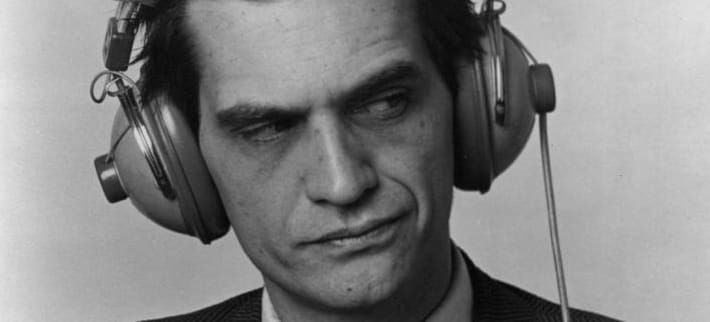
Ian Shoales was everywhere, once. The fast-talking commentator and alter ego of Merle Kessler, born from an egg laid by comedy troupe Duck’s Breath Mystery Theatre, was in films, on vinyl, on television and the radio—your parents likely watched Shoales quip about world events with Ted Koppel on Nightline, and your weird aunts and uncles listened to him on NPR’s All Things Considered. How about this? Shoales’s tagline is “I gotta go.” Ring any bells?
Shoales’s collected commentaries were published by Penguin if you require a soupçon of literary reputation, and later by Henry Rollins, if you want Gen X cred. Ian Shoales, an anagram for “I, an asshole,” was also all over the big-I Internet and what used to be called “cyberculture” back before everything became the little-i internet, and then just died. And in Oakland, where Merle Kessler now lives, Ian Shoales almost died. Kessler, too.
Kessler is a writer of the old school, with not one but two MFA degrees from the University of Iowa. “When I was in the famous writers’ workshop, I didn’t like it so much,” Kessler says. “So, I scooted over to the playwright’s workshop across campus, which I loved. Your writing is not published, but it is spoken by actors. Gratification and embarrassment in one place!” The live performances, and the rapid-fire cynical and occasionally faux right-wing Shoales persona, came from the need to create a market for his writing.
Just as the Ducks relocated from Iowa to the bay to make it big in 1975, so too did a couple of men named Steve launch a little company called Apple. Cable TV was going national. The Ducks and their characters Dr. Science, Randee of the Redwoods, and Ian Shoales were ready to go from busking at Ghirardelli Square to the legitimate stage and to new platforms. Shoales was an asshole but also a romantic, an aphorist but also more than capable of longform work, a cynic and a philosopher. One of his best lines: “The word ‘relationship’ best refers to the connection between parasite and host, or shark and remora. It’s a biological term. I’d rather be a jerk than a scientist when it comes to love.”
Name it, Ian Shoales was there. He had a feature on ABC World News Now, the news program for insomniacs, which was also, in 1995, the first-ever TV program to be streamed online, via the CU-SeeMe videoconferencing client. (I don’t remember CU-SeeMe either.) On World News Now, he was introduced as “the most bitter, jaded, cynical, dark commentator of them all,” and the “spiritual heir to H. L. Mencken.” It was a time when television viewers could be expected to know who H. L. Mencken was, without recourse to Wikipedia or ChatGPT.
Shoales could be found on the radio, too, on hundreds of National Public Radio affiliates. His form was the two-minute snarl of pop cultural and political commentary. Sure, nobody today cares about the Wendy’s “Where’s the Beef?” commercial or other cultural flotsam, but how about his piece from 1984, the one called “CIA Murder Manual,” recorded soon after the Associated Press got its hands on a photostat (remember “photostat”? How about “Xeroxing”?) of the CIA’s “Psychological Operations in Guerrilla War”? The ninety-page pamphlet full of tips on assassination and terrorism was distributed to various anti-Sandinista forces. Shoales’s NPR piece, in part:
That’s okay. That’s [the CIA’s] job. I’ll concede that we have the right to enter any Latin American country we please and tell them exactly who their leaders should be and what kind of government they should have. I mean, after all, we’re neighbors. We have the nicest house on the block. We have to make sure the neighbors’ lawns are well-tended so the property values don’t go down.
That could have been on AM radio (or more likely X.com) this past month, albeit coming out of the mouth of somebody who meant it. And that commentary would not have gone on to say, “But fair is fair. If we can send agents to our Latin American neighbors, why can’t they send agents here?” After terrorizing the imaginary small American town of Smallville with a foreign overthrow, Shoales concludes, “It can’t happen here. It will always happen over there.” In 2026, it did, “over there” being Venezuela.
And over here being Oakland. Oddly, I had never listened to NPR, and World News Now was on way too early in the morning for me. I remember watching a Duck’s Breath comedy special on cable once, but it was troupe member Bill Allard’s character Mr. Nifty that stuck with me. I was turned on to Shoales in the late 1990s, when I was living in the Oakland of the East—Jersey City, New Jersey. I had a best friend I’d met online who compulsively reread Ian Shoales’ Perfect World—Shoales’s 1988 fantasy novel about $9 billion and a reality-influencing universal remote control (and it’s all a dream!)–and who carried the paperback around as a talisman while escaping a tempestuous and abusive adolescence. I devoured the book, too, and we were both Shoales fans for life once we got decent internet and cable TV and could stumble across Ian Shoales practically everywhere in what people were still calling “cyberspace.”
Then, in this century, when everything became computer, both my former roommate and I moved to the East Bay within a year of one another, albeit under widely divergent circumstances. One day, via Facebook, I got a message: “I found Merle. He’s in Oakland. He lives a few blocks from you.”
I cleverly asked, “Merle who?”
“Ian Shoales!” From then on, we schemed to meet him. But we were going to meet Ian, or Merle?
◎
Shoales is a character. He was born from Merle—“a country-western singer’s name,” he once told the Chicago Tribune—as a self-obsessed rock critic. But that’s a one-and-done joke, so Merle evolved Ian into an all-weather curmudgeon, seemingly infinitely adaptable, like an Internet-type Pokémon ready to flame anything. Not all his work was political. He made little critical bumpers for The Movie Channel, which in the 1980s and 1990s tried to differentiate itself from the competition with VJ-style guest hosts and thematic programming blocks. About The Teenage Mutant Ninja Turtles (the 1990 film, not the 1991, 1993, 2007, 2014, 2016, 2023, or forthcoming 2027 films) Shoales declared, “They’re named for Italian Renaissance painters. He-Man isn’t named for an Italian Renaissance painter, now is he?” Sufficiently extravagant cable packages still include TMC, but as three companies own all broadcasting, cable, and streaming channels, there is no need for it to compete with anything.
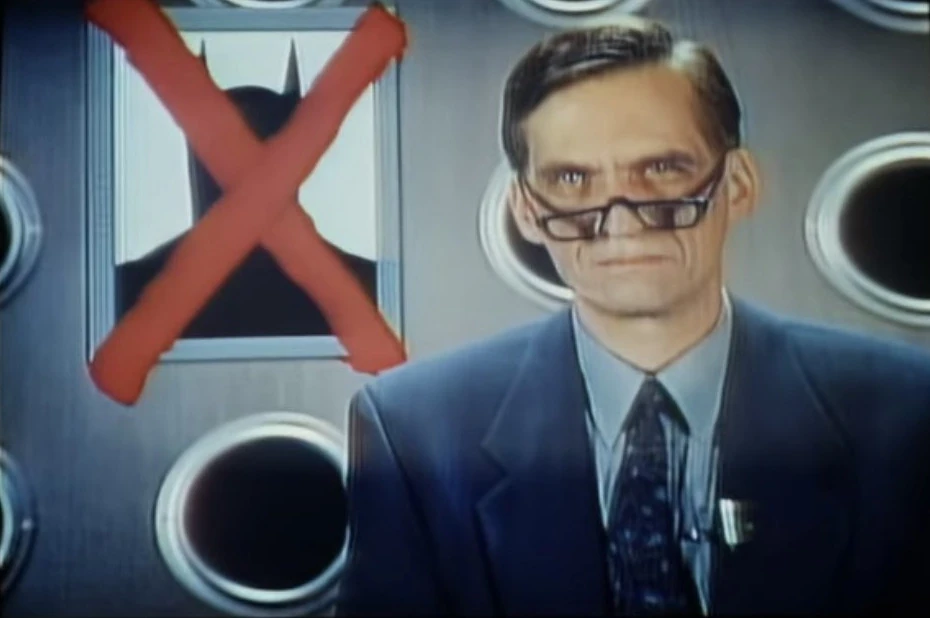
Kessler dabbled in movies, including writing and performing in the Duck’s Breath-themed Zadar! Cow from Hell (1989) which is not quite as good as the title suggests. At least the film is not about a cow from hell, but rather it is a film about a film about a cow from hell. A certain YouTube channel with all of nine subscribers has a pirate copy up for the curious. Also credited as Kessler, he had a bit part in Batman Forever (1995)—director Joel Schumacher was impressed with the Shoales NPR commentaries and brought him on as broadcaster Kenneth Frequency. You know, as in the R.E.M song “What’s the Frequency, Kenneth?”? “I get little checks from Batman, still,” Kessler says. “Whenever a new Batman movie comes out, people start watching the old ones again.” My old roomie and I hooted when we saw him on screen. Also, Zadar! is superior to Batman Forever.
Shoales also had a regular column on Salon, a web magazine which was once the morning go-to for hundreds of thousands of people and now...still exists. But when was the last time you typed s-a-l-o-n period c-o-m into a web browser? Most of Shoales’s essays have fallen to link rot; one surviving piece, about Elizabeth Dole, begins, “By the time you read this, William Clinton is probably leading the bored parade over the bridge into the 21st Century.” It was the 1990s, and little did we know what the 21st century had in store.
Speaking of the 1990s, Shoales wrote for CD-ROMs (“What a ridiculous fad that was!” he says now), and developed and scored video games for the Sega Saturn. I made my twelve-year-old play a version of Shoales’s Mr. Bones I found on a web browser-based Sega emulator. The game involves everything from competitive bongo-playing to Mario Bros.–style swinging around obstacles to a bossfight with a skeletal T. Rex, and is full of jokes, now-obscure references, and some pretty hot blues licks. “Is this...an indie game?” my son asked. He liked it, though.
Shoales even wrote, in character, for the apotheosis of 1990s culture—the Sharper Image catalog. One memorable piece of junk they sold was a landline phone in the shape of a duck decoy. The product call-out read, “Pleasant Quacking Replaces Harsh Ringing.” He was in the cyberpunk magazine Mondo 2000, too, suggesting we pay off Iraq rather than engage in the first of two wars that would go on to kill millions of people.
Shoales’s location in the bay and his understanding of social change, tech, science and philosophy also made him perfect for a “last word” style column for a trade magazine by the name of Database Programming and Design, “which of course nobody read,” he says. Shoales knew as much about database programming as any clever, philosophically minded Bay Area resident who had worked in radio, movies, and games, so the columns were usually along the lines of “Man, what about those cell phones?!”–type observational humor. The gig didn’t last because the magazine didn’t last. “Consultants came in,” Kessler says, “and changed the name to Intelligent Enterprise—if they say so!” That magazine is also dead. So is its website.
◎
Consultants came in elsewhere, too, like a plague. He says Salon told him, “We’re gonna do some regrouping and then we’ll get back to you,” and never did. The Shoales NPR commentaries were good enough to be recorded from the air by such youthful alpha nerds as Vlogbrothers John and Hank Green—who copied the Shoales rant-style for their 4.1 million YouTube followers—but the gig went from “every couple of months” to “then I found myself on a phone call with four people, and it was all over.” KQED was running his segments even as late as 2009; all you had to do was wake up at 5:34 on Saturday and Sunday, then spend the next minute futzing with your clock radio to tune in. Ted Koppel retired. Dan Aykroyd’s House of Blues Radio Hour, which Kessler also wrote for, was cut to thirty minutes and Kessler was let go.
All this, and neither Shoales nor Kessler has a Wikipedia article. As far as the internet is concerned, Shoales may as well not exist.
“Every job I had is gone,” Kessler says. “The internet hasn’t been the cash cow I thought it’d be.” Kessler moved across the bay to Oakland, “dragged by my wife,” he says, who “wanted weather. San Francisco doesn’t have any.” Amyellyn Anderson Kessler is also a professional performer—she’s a soloist at St. Paul’s, a very Oakland Episcopal church with a multiracial clergy and congregation, and which is involved in social outreach services including both gun buybacks and workshops on using worms to compost.
Not only does Oakland have the sort of weather San Francisco lacks, it’s just a better place, mostly. “People are friendly,” Kessler says, shifting a bit to his Shoales persona. “They’re not really friendly in San Francisco. I’m not exactly a barrel of joy, but I don’t close the curtains when people pass by.” Now he's back to the aesthete and philosopher: “Weird artists that work with melting cars, twisted sculptures—that’s Oakland. Oakland is just more real, authentic” than SF.
Though we friended Merle on Facebook, and he indulged our fannish ways, neither my old roommate nor I actually got to meet him. And then…
◎
Oakland authenticity introduced itself to Merle Kessler the hard way on November 7, 2012, around 5:30pm, when he was hit by a car, thrown over its roof, and left in a heap on the side of the road. The car sped off, a true hit-and-run, and the police never had any leads, as even the person who called 911 upon seeing Kessler reported that the old guy on the street must have had a heart attack.
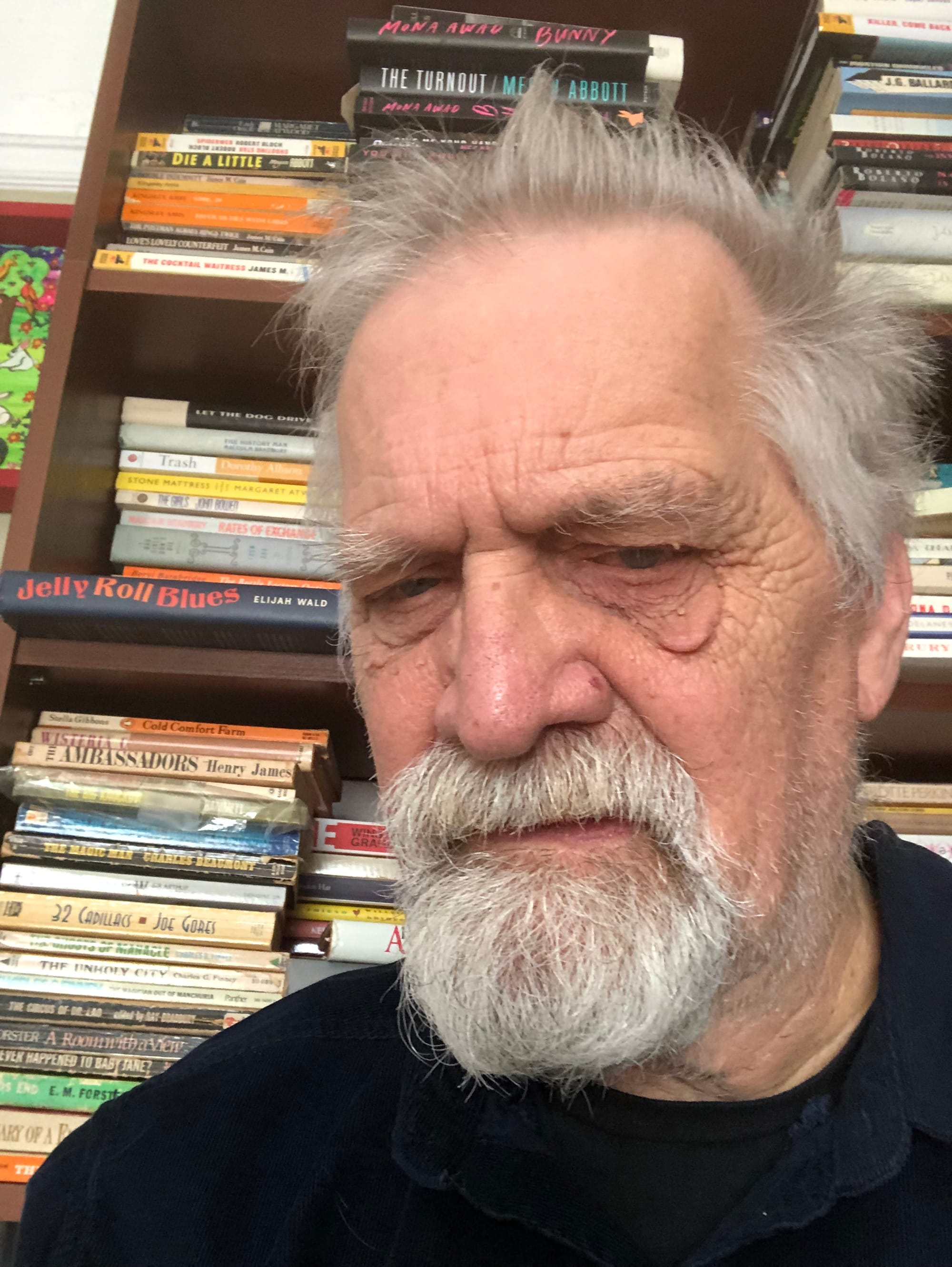
The area in North Oakland, where two-lane Stanford Street and two-lane Market Street bend and cross, is treacherous. I’ve interviewed Kessler/Shoales twice, once for this article, and once for his forthcoming PM Press title, Veni Vidi Venti—and I was nearly hit by a car myself, both times. In fact, PM’s office used to be in the same neighborhood, and whenever I’d visit the publisher I’d find myself rushing onto a traffic island to avoid getting splattered. I admit that I am often looking down at my phone while walking, but I am pretty spry. Seriously, anywhere south of Sweet Adeline Bakeshop and north of Sideshow Kitchen, and you’re taking your life in your hands, fellow pedestrians.
Kessler remembers nothing of the accident. Neither does his alter ego Shoales. He was unconscious for three days, and after he awoke he spent weeks in Highland Hospital and Kaiser, before moving to rehab facilities. His right leg was shattered and a cervical vertebra broken. According to Amyellyn Kessler’s Facebook update at the time of the accident, "[H]ad the break been vertical instead of horizontal, he would have been paralyzed or killed.” He spent time in a wheelchair and a rigid neck brace. “If you shake your head too hard you can die,” a doctor told him—a particularly cruel fate for a mordant social critic. Kessler then used a walker to get around, before graduating to a cane. Now he walks well enough sans any equipment that a casual observer would not know that a car had mowed him down and left him for dead.
But Kessler knows. “I am full of titanium,” he says, “especially the leg,” and when it rains all the metal in his body throbs. So much for moving to Oakland for the weather.
Shoales still appears on Philosophy Talk, a public radio program out of Stanford, as “the Sixty-Second Philosopher”—most of the pieces hit three minutes or so, though—but “President Trump himself,” Kessler says, ended the show’s National Endowment for the Humanities grant in April 2025, leading to the show’s “Wise Women” series being discontinued. Trump didn’t even bring in any consultants before cutting the funds, except perhaps for Elon Musk and Big Balls.
Ian Shoales was everywhere, once. Now, with brief forays into Berkeley—where the Ducks held a reunion-slash-final live show in 2015—and Albany for one-man shows along with his accompanist Joshua Raoul Brody (“the one-man shows are so big they require two people”), he’s mostly in Oakland. He’s not gotta go. He has a book coming out this year. I’m publishing this article in the Oakland Review of Books in the hope it inspires some local greasy nerd with the skills to launch a Wikipedia page to start one. C’mon, guys! Ian Shoales is here to stay.
Nick Mamatas is the author of several novels, most recently the Bay Area science fiction tale Kalivas! Or, Another Tempest. His literary journalism has appeared in Fine Books & Collections, Poets & Writers, The Smart Set, and many other venues; his Short Reviews of Short Books column appears in The Fabulist. Nick is also an editor—his most recent anthology is 120 Murders: Dark Fiction Inspired by the Alternative Era.