It’s like I wandered into the comments section on an NPR article and got trapped. That’s the vibe at the December 16th Oakland City Council Meeting. I was among some of the most informed people I’ve ever heard, each rushing to complete their statements before their mic cut off at the one minute mark–and beside them, I found some of the most ignorant people I have ever encountered. The latter were saying the kinds of things you’d expect them to, like that he would personally go to DC and beg President Trump to send in the National Guard if the Flock contract in Oakland is not extended.
That’s why I was there: to protest Flock, the feckless surveillance firm that has, as of December 16th, 2025, been awarded a $2.25 million dollar contract by the City Council in Oakland. This, in spite of the proposal for this contract failing in committee three times and despite overwhelming public comment made against the contract by the voters of Oakland. These comments were made across multiple meetings whose times regularly changed and were always scheduled during work days when most people cannot attend, a method of evading ever growing public opposition that I associate with red states.
This strategy of evasion was not the only anti-democratic tactic at play. At a previous meeting, Councilman Ken Houston accidentally signalled that he likely broke the Brown Act when he, over Zoom, asked fellow council members something to the effect of: but you got the email about this right? We’re all voting for it? The Brown Act demands that councilmembers not whip votes outside of committee–this allows for maximum transparency in the process for constituents. But this comment signaled the votes had been whipped. The committee meeting was, evidently, a farce.
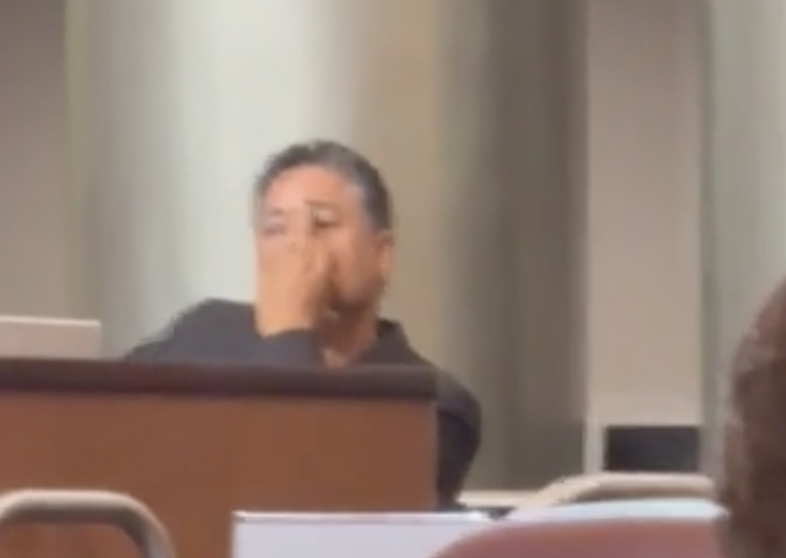
Which brings me to Councilman Ken Houston. The tone of the Oaklanders in attendance was, largely, one of warm solidarity for their chosen side with the occasional outburst of annoyance at their opposing side. Meanwhile, Councilman Houston’s was one of open disdain. As speakers took the mic he rolled his eyes, pulled faces, refused to make eye contact with those addressing him directly, had numerous side conversations, and simply walked away (at one point with a plate of food). He took pains to make it clear he wasn’t listening to a damn word any of us said.
Many commenters brought it up. Other councilmembers had the decency to at least pretend to be chastised. But Houston continued, unabashed. When it was my turn to speak, I tried to catch his eye, but he wouldn’t look at me. I didn’t waste time pushing him. I’d seen how he’d treated the rest of us, and I didn’t expect I would be treated any differently. That I was speaking to the lack of ethics and erosion of democracy in my testimony made it all the more fitting that he would not meet my eye. I thought his incuriosity, his disrespect, his disdain for us all could not have been clearer.
Until it was. Later, when a larger group of people shared the mic to read a joint statement, abiding by the cumbersome council rules, Houston indiscreetly started giving them the finger. He played it off like he was scratching his nose–and surely, once footage of him acting like a petulant sixth grader is covered by enough local press, that’s exactly what he’ll claim–but I’ve spent enough time writing for and speaking with teens throughout my career to know a “fuck you” when I see one.
By day, I am the president of Authors Against Book Bans, which is what it says on the tin: seeking to protect the freedom to read all across the nation. I attended Tuesday’s Oakland City Council meeting solely as a private citizen, not as a representative of AABB. That said, I carry the lessons I’ve learned from that work everywhere I go. And one lesson I’ve learned painfully and repeatedly about the places where fascistic, illiberal policies arise is that they share a single origin:
Elected officials who treat their constituents with disdain.
Houston has received close to a quarter of a million dollars from Philip Dreyfus– the Piedmont hedge fund manager who bankrolled the Sheng Tao and Chesa Boudin recalls. To those who are familiar with the landscape of local politics, this should come as no surprise. Houston’s behavior is afforded to those who know they do not need small dollar donors to get by. This is the behavior of those backed by special interests and billionaires. Who no longer care about serving the public good.
The din of Houston’s corruption rings in my ears as I type this. I am trying to hold on to the hope I felt in that City Council meeting, where I was surrounded by so many people who care as deeply as I do about Oakland and our protection from irresponsible tech firms–but I cannot help feeling that the din is louder than my hope. That big money corporate interests will always get more consideration than the needs of regular people. That this is the way of all politics in this country.
Until we decide it’s not.