Who owns the Spanish Civil War?
I suppose I was expecting a bit of sectarian fuss. I was radicalized in the 1990s, when the end of the Cold War was taking a lot of the oomph out of The Left, or at least the “authoritarian left” (they never called themselves that), or the “Stalinist left” (they never called themselves that either). Political arguments at a demonstration or some event could be reduced to anarchists barking “Kronstadt!” in reference to Bolshevik suppression in 1921 of a sailor strike and insurrection. “Frick!” could be the response, since, back in 1892, anarchist Alexander Berkman had tried to assassinate Homestead steel plant manager Henry Clay Frick during a militant strike, and failed rather comically. And then, finally, “GULAG!” one might scream at the last Stalinist, who could sneer and respond, “Hitler” (as in Who was it who actually beat the fascist threat?).
Above it all, though, were the members of the Abraham Lincoln Brigade, those brave American volunteers who in 1936 sailed off to fight in the Spanish Civil War, counter fascism, defend democracy, and maybe even push for a new kind of society. And even by the early 1990s, in New York where I was then living, there were still a handful of volunteers left, and two or three could be seen marching under their old banner at nearly every big radical event. They were not to be polemicized against, or trifled with. Radicals of every stripe had a stake in the Republican side of the Spanish Civil War, both some claim to its successes and some blame for its ultimate failure. Arguments could still happen behind closed doors. But only when the volunteers were not around.
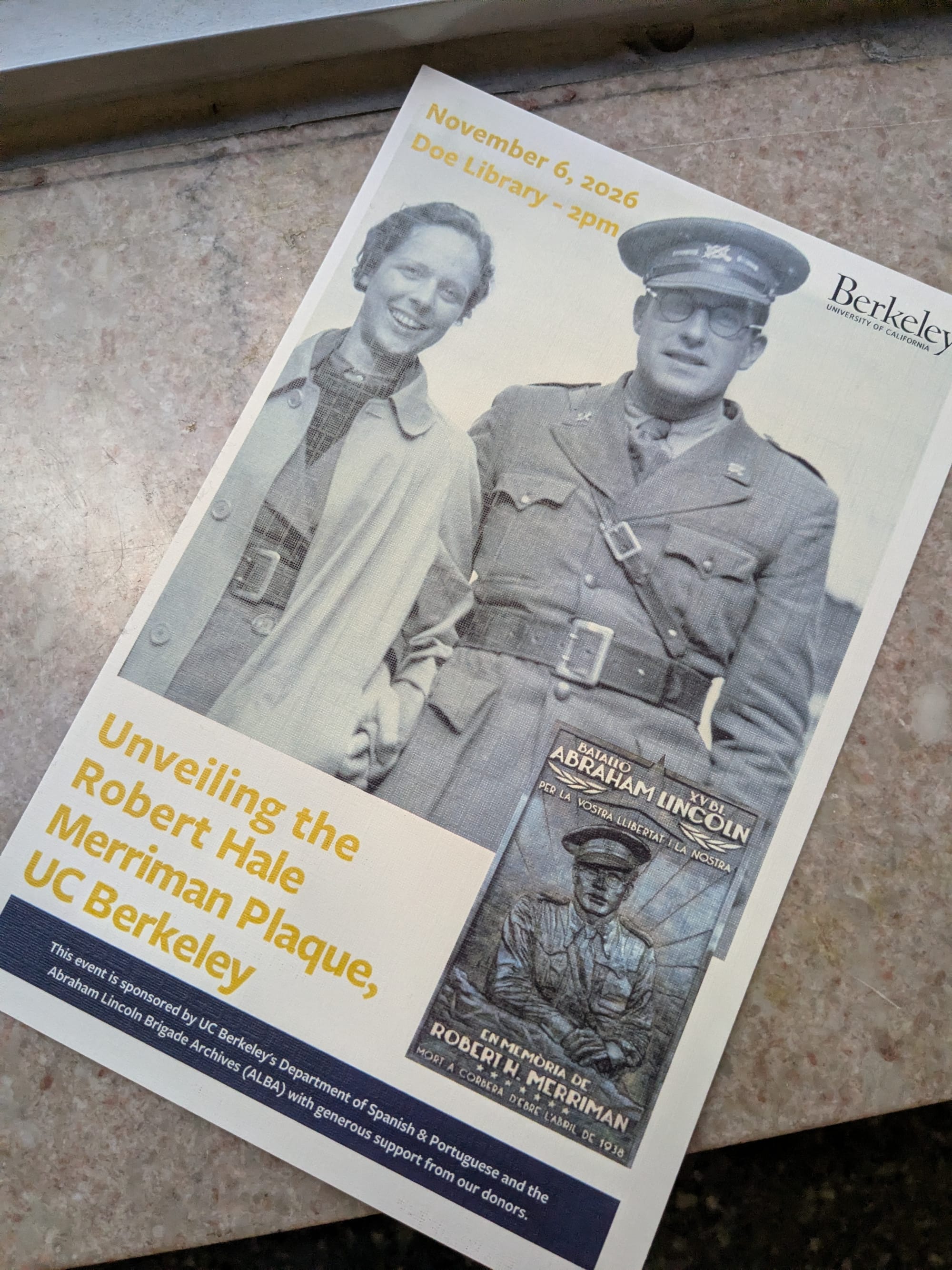
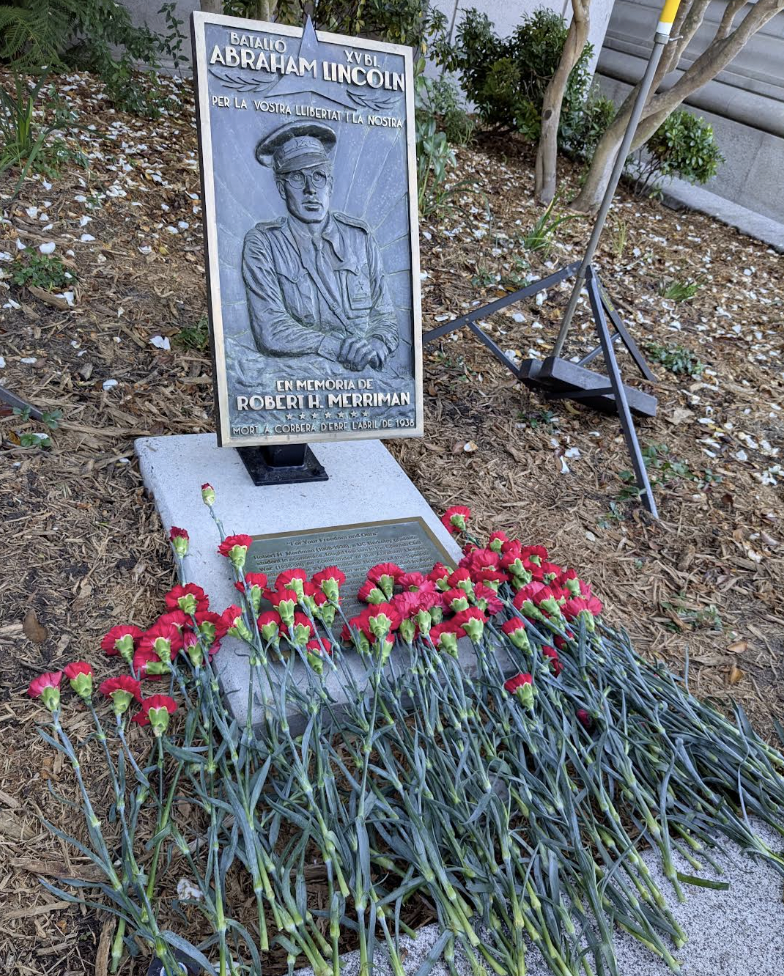
Now, there are no living Abraham Lincoln Brigade volunteers left. But on the afternoon of November 6, 2026, on the UC Berkeley campus, a plaque was dedicated to the memory of one of them, a Berkeley graduate student (in economics, of all subjects!), Robert Hale Merriman was unveiled outside the Doe Library. I’d received an email invitation, so I went. I ran into some radicals I knew. One, a former Cal employee named Steven, asked me what email list I was on that rated me an invite. Hey man, like any radical, I’m on a lot of lists.
Merriman had been radicalized by the militant San Francisco longshoreman’s strike of 1934, and became interested in Marxism. When he got to Spain, he was more than a volunteer; thanks to the slim credentials of having been in the ROTC as an undergraduate and his role as a reserve lieutenant in the U.S. Army, Merriman was made brigade chief of staff of XV International Brigade, responsible for organizing and training troops. Merriman had also come not directly from the U.S., but from the U.S.S.R., where he’d relocated along with his wife Marion to study Soviet collective farms. Merriman was a member of the Communist Party USA. So were lots of people, back then.
It was in Spain that Merriman had come to the attention of Ernest Hemingway: “Robert Merriman, former University of California professor and chief of staff of the Fifteenth Brigade, was the leader in the final assault. Unshaven, his face smoke-blackened, his men tell how he bombed his way forward; wounded six times slightly by hand-grenade splinters in his hands and face, but refusing to have his wounds dressed until the cathedral was taken,” Hemingway wrote in the New York Times in September, 1937.
According to Marion, Merriman was even the model for Robert Jordan in For Whom the Bell Tolls. Both the man and the character were American academics, and tall, an inch taller than Gary Cooper, who at 6’ 3” played Jordan in the 1943 film version. Merriman was Hemingway-tough, too. His nickname among the troops was “Bob Murderer.”
The plaque, 100 pounds of bronze portraying Merriman in bas relief, was made in Spain, and a second casting was sent to Berkeley after years of wrangling. On which boulder could it be mounted? Did the campus, or the world, need another celebration of a straight, white man? Who’d even see it? Berkeley professor Peter Glazer told Spanish newspaper El Diario in 2024, “few Berkeley students even know that the Spanish Civil War existed, let alone Merriman’s contribution. If the monument is completed as designed, thousands of students will encounter the plaque every week and learn about this remarkable figure and his story.”
The library location was chosen in part because students would necessarily encounter it, but for the unveiling, I, at age 54, was one of the youngest people in attendance. Thankfully, my friend Pablo, a younger man and theology student, was there, as were a sprinkling of others who might actually study at Cal. But do younger people read Hemingway anymore?
The other great book about the Spanish Civil War is, of course, George Orwell’s Homage to Catalonia. Orwell, another tall glass of water at 6’ 2”, also volunteered to fight in the war, but he threaded the needle by joining POUM, a non-Stalinist agglomeration of Trotskyists and Right Oppositionists. To Orwell, the Communist forces were “bourgeois Communists,” and the anarchist forces were good allies in the fight against fascism. The CP and the Republicans ultimately turned on POUM and the anarchist CNT in May 1937, just a month after Merriman’s death. Nearly one thousand lives were lost in this brief civil war within a civil war. And the anarchists were split, POUM disintegrated, and the victorious Soviet-backed forces... lost to the Nationalists anyway and Spain was ruled by Franco until 1975.
(Also in May 1937, in Huesca, George Orwell was shot through the neck by the fascist sniper for his troubles, but survived. Had Orwell been any less tall, high school syllabi all over the US would be shorter by two famous novels.)
(NM)
None of this came up at the unveiling ceremony. Any young undergraduates unfamiliar with the Spanish Civil War at the event—had there been any—could have concluded that the left had won! But every major radical faction has some legitimate claim to the Civil War, because the left lost the war. What if Merriman had been on the Communist/Republican side in May, and had shot or been shot by anarchists or Trotskyists? Would there be a plaque today in Berkeley, California? What of Spain had turned red, or black, or black and red? There might be so many plaques of him, and so many statues, that it would hardly matter that he was once a Cal grad student.
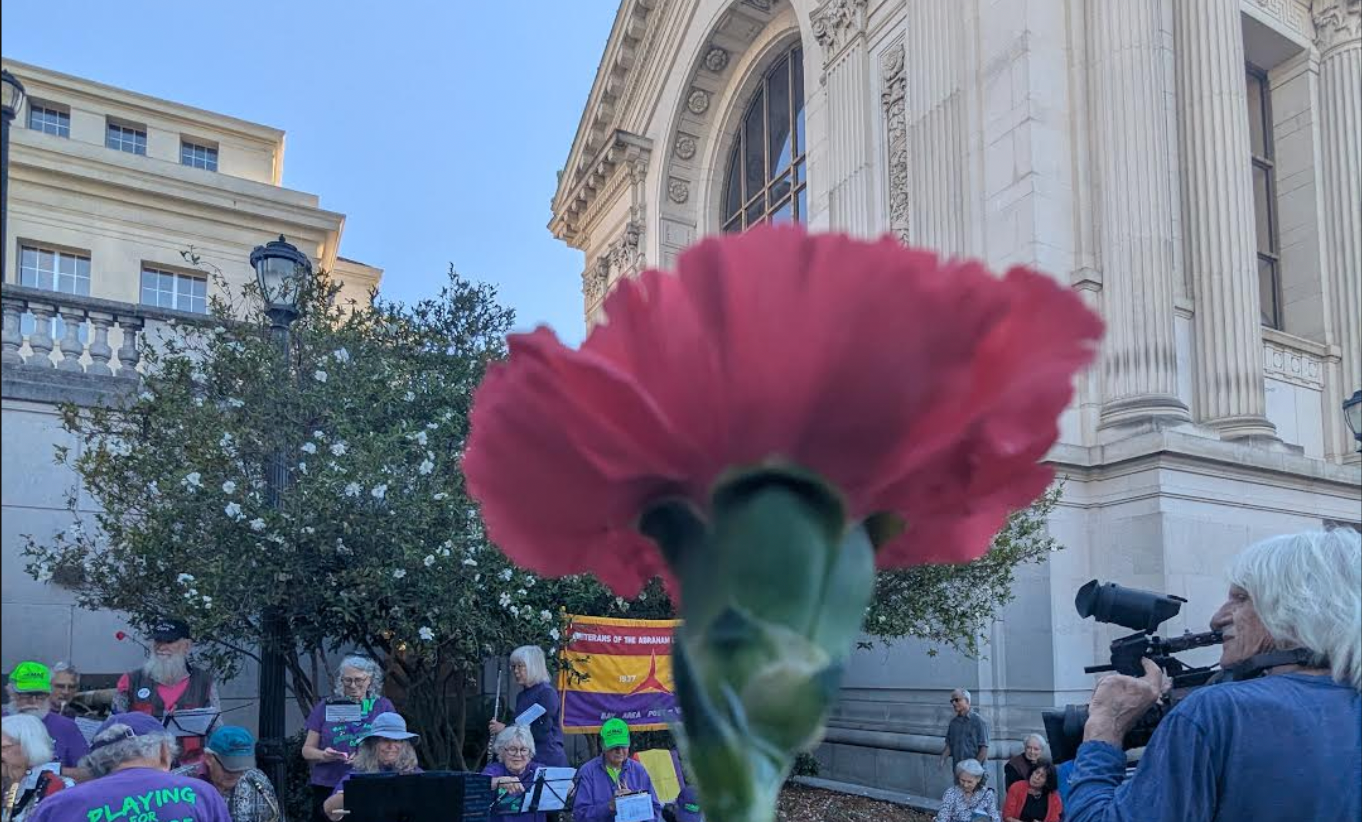
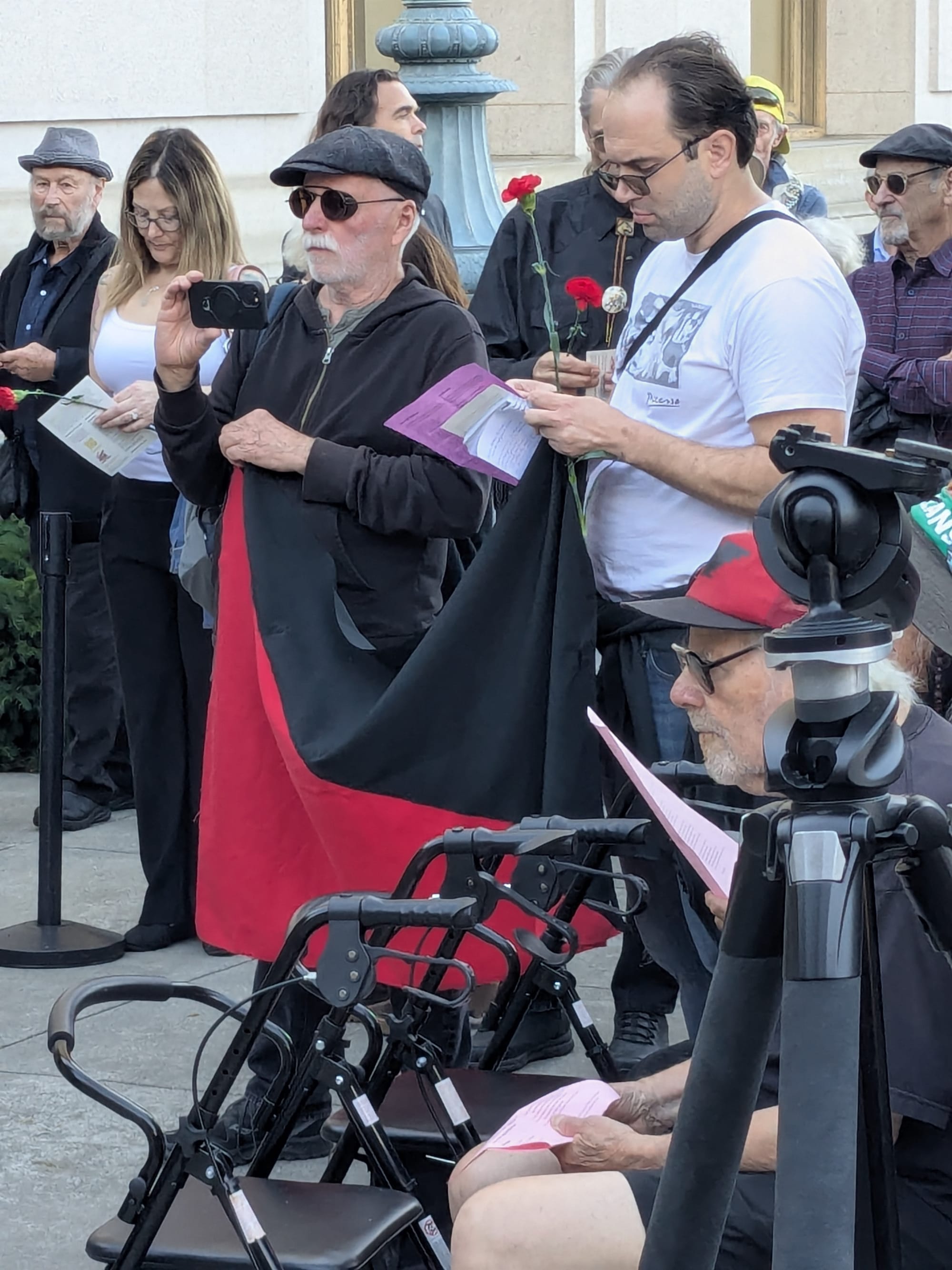
Contingent history and counterfactuals aside, it was the anarchists who carried this day, in Berkeley. I spotted an organizer for the Industrial Workers of the World of my acquaintance (nearby Moe’s Books is now an anarcho-union shop!), and two fellows held aloft the red and black flag of anarchism for the entire event. Nothing official, mind you—they’d brought it from home. But the CPUSA—Merriman’s own party!—didn’t show up at all. Nor were there any Trotskyists selling their newspapers off on the side. There wasn’t even a heckler. (A political event on the campus of the University of California, Berkeley, and nobody heckled it!?)
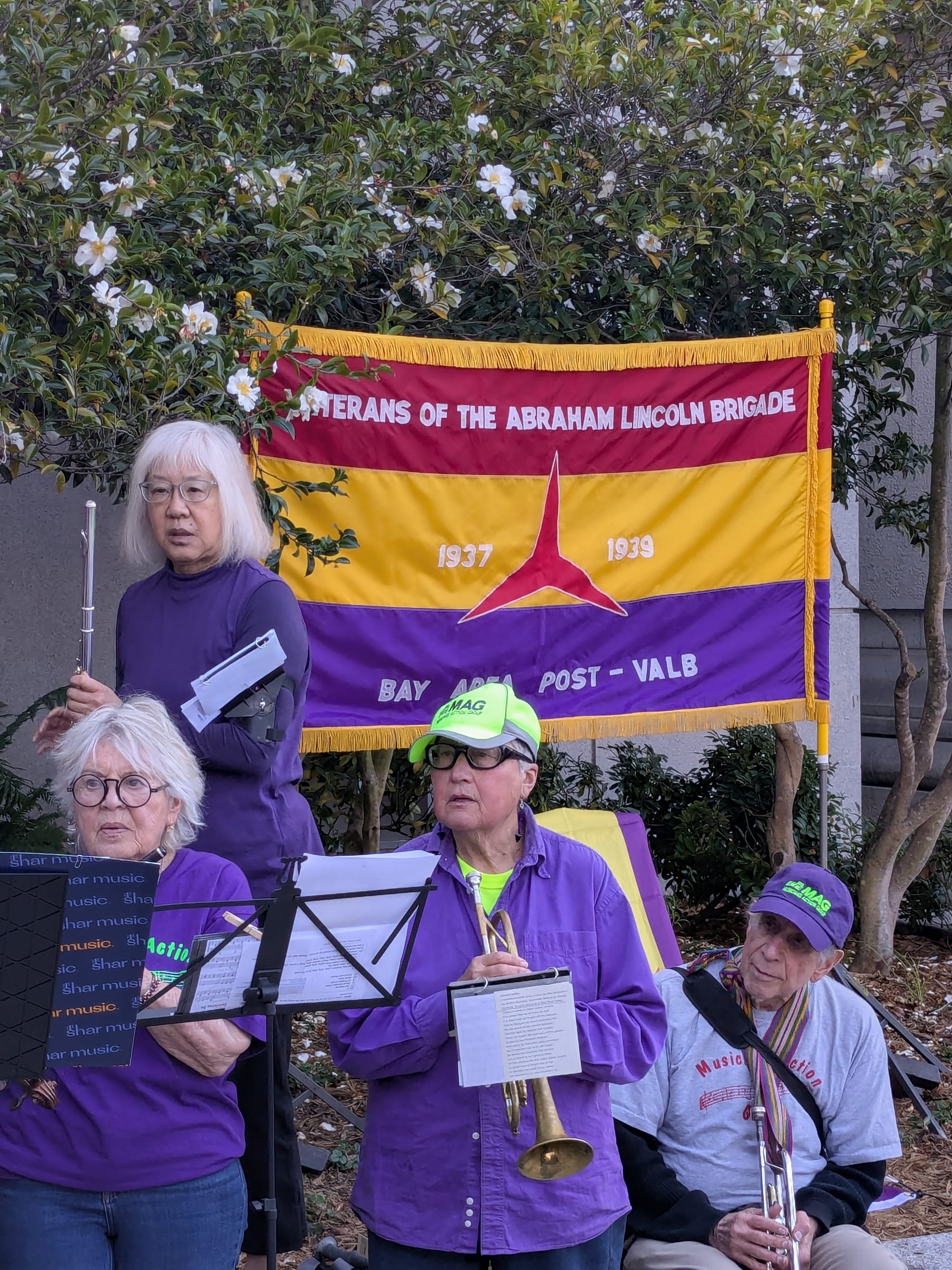
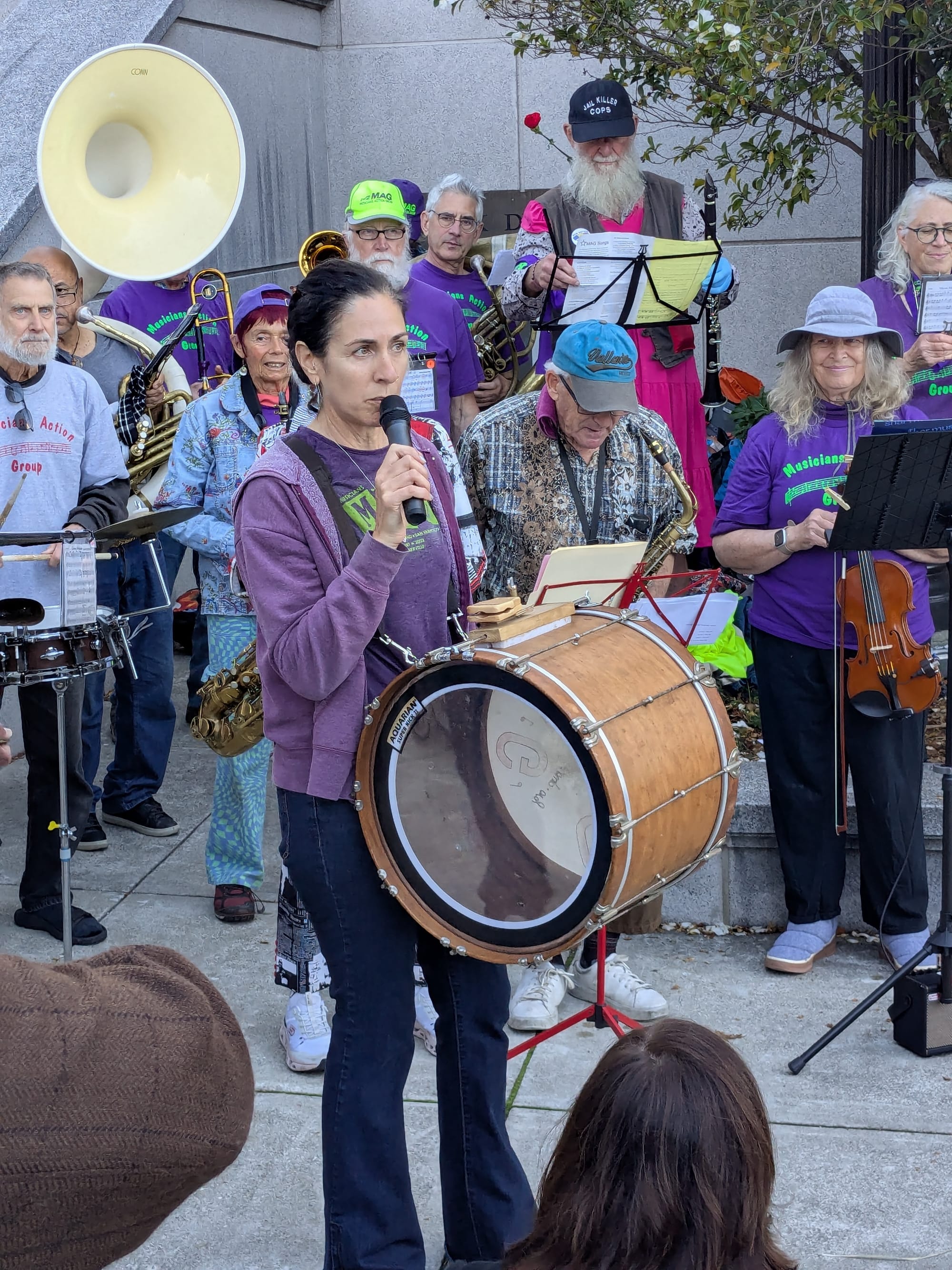
The Musicians Action Group played a number of tunes, and we sang along. There were chants: “The people, united/while never be defeated,” but I heard Pablo completing that one with the alternate rhyme “divided”! I spun my head. Political disagreement? United people get divided all the time. Then they get defeated. Case in point: the Spanish Civil War.
We finished up with “The Internationale,” and this time I was the odd comrade out, singing the ultimate line “the international working class/shall save the human race.” Everyone else, under the influence by the twin forces of a. the historical inevitability of full communism under Marxism-Leninism, and b. the lyric sheet somebody handed out, sang “shall be the human race.” Yikes. Good thing I wore my union jacket with the Communications Workers of America logo on it.
The reception was perhaps also bereft of hardcore Stalinists, I concluded, though my main evidence for this was that the speeches were short and pleasing to listen to. Linda Lustig, who is the daughter of volunteer Dave Smith and an alumna of both Cal and the Free Speech Movement, was positively delightful. Most of the speakers thanked the college, and the activists in Spain who commissioned the plaque, and made broad appeals for internationalism, solidarity, and, once or twice, even anti-fascism. But about anti-fascism, what is to be done? Anyway, the speeches ended a little early, after starting a little late (anarchy!) and then there was a little bit of food, including fruit and cheese and crackers and Caprese salad-kabobs, and spanakopita, and...not one molecule of meat. Not even those little pepperoni that usually accompany cheese and crackers.
Berkeley, man. Radical.