Why Cat Frazier matters
Text in the computer age has never wanted to be just text. In the 1960s, Ted Nelson coined the term “hypertext,” now a foundational part of the World Wide Web, which links pieces of text together in an infinite chain via hyperlinks.
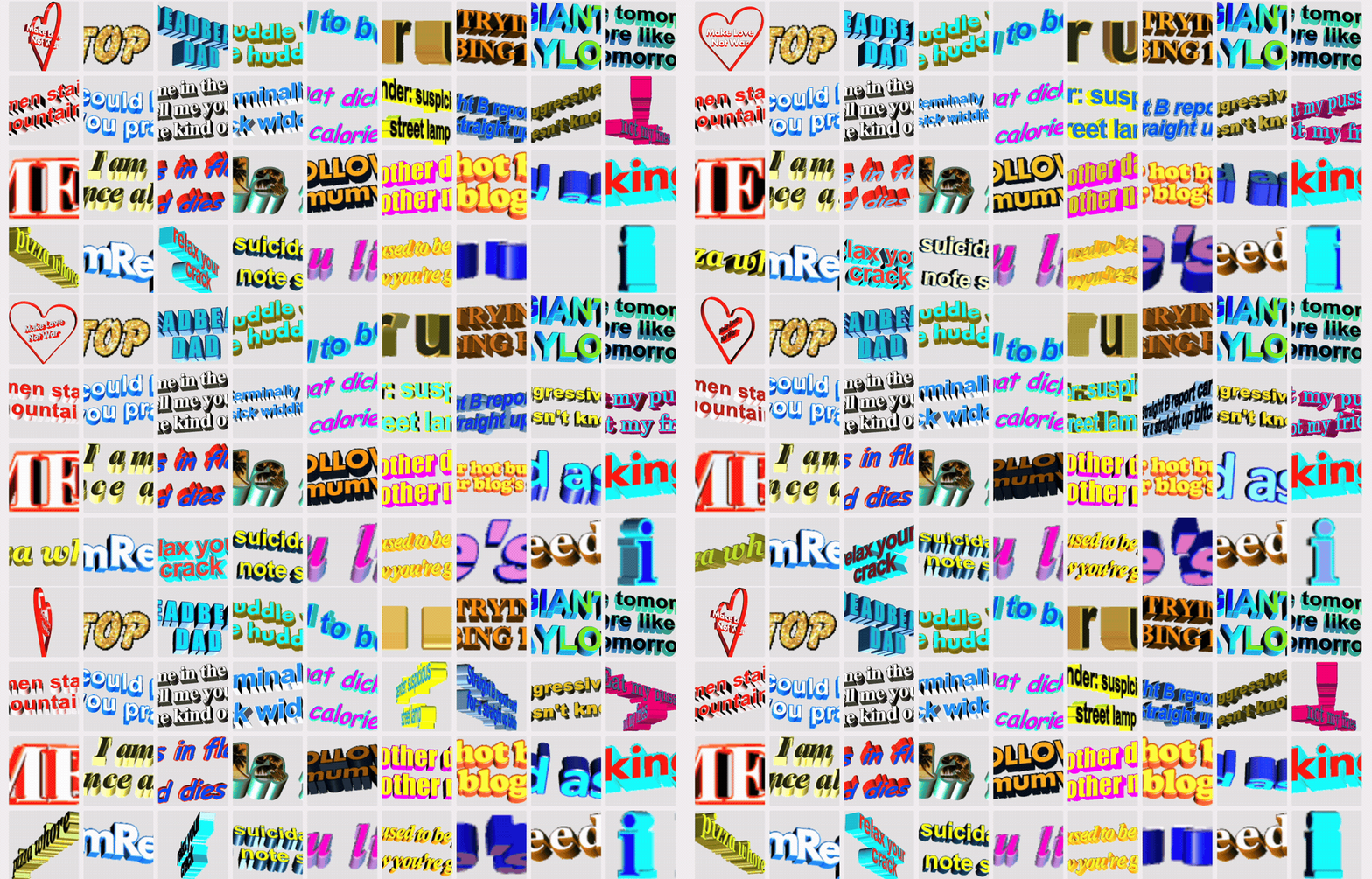
The early web gave people ways to style it that would never have been possible on paper. There was the \<marquee> tag that scrolled text across the screen, and the nonstandard \<blink> element could add motion and dynamism to text on-screen. When text was converted to the animated GIF image format, the sky was the limit, particularly when used in conjunction with Microsoft’s WordArt or the sparkle-heavy editing service Blingee. Across the early hosting platform GeoCities, which provided a blank HTML canvas to use (or abuse), garish pieces of text became the norm.
The design language of the web had not been solidified at that point, and the appeal of GeoCities was that it allowed anyone, mainly amateurs, to host a website. It was dynamic and exciting, but also rudimentary—some might say ugly—on a visual level. Slowly, social media brought uniformity. MySpace gave every profile the same skeleton structure, but still let users pick the colors and add some Blingees. Facebook locked users down even further, preventing then from deviating from its white-and-blue color scheme and refusing to support animated GIFs.
In late 2012, after Facebook’s ascendancy but before people realized that maybe that was bad, the graphic designer Cat Frazier started a Tumblr called Animated Text. Nostalgic for the freeform expression of GeoCities and armed with an ancient-by-computer-standards piece of software called Xara3D, she began uploading GIFs of pithy phrases, heightened by 3D lettering and looping kinetic typography.
An early favorite was the spinning text “lol nothing matters.” You’ve probably seen it.
In August, Animated Text was updated with a message from Frazier’s family announcing that she had died earlier this summer after a heart-related medical event in June. Her family is currently raising funds to lay her to rest. She was 35. Animated Text may have been Frazier’s most prominent work but, her family wrote, “it was her quick, unique wit and kind, wild heart that made her truly special. She was able to relate to anyone and everyone, making people feel included and inspiring people to accomplish hard things cause her idealism and bravery were contagious. Her creativity, sense of art and humor, as well as her gravitating personality enabled her to build community wherever she went, breaking down walls and crossing silos to bring people and ideas together.” In recent years she had been an integral part of Oakland Secret, the housing cooperative and DIY event venue.
I saw Frazier give a talk about her work on Animated Text during the blog’s heyday in 2014. This was at the old event series IRL Club, what someone once called “TED for weird internet stuff.” She was a known quantity on the weird internet, back when the internet seemed small enough that one could conceivably map parts of it as “weird.” A year earlier, Gawker’s Adrian Chen had called Frazier’s “lol nothing matters” the “GIF to End All GIFs.” Her blog had 43,000 followers at the time, pretty large for the web broadly and Tumblr specifically. By the early 2010s, the web had built up enough history that it could be viewed in hindsight. An affect and aesthetic accompanied the nostalgia, a sort of arch atavism. In addition to Animated Text’s twist on GeoCities-esque visual motifs, a corner of Twitter known very creatively as Weird Twitter was developing a self-referential style of posting that parodied social-media and message-board archetypes across countless tweets and more sustained projects like @dasharez0ne that were steeped in edgelord rhetoric. The web had finally built up enough unique behaviors and communication styles that its users could look inward on themselves, sort of like how Hollywood quickly started making movies about the process of making movies.
In her presentation, Frazier extolled the virtue of GeoCities as a collection of self-built communities. These were communities such as Man, I Just Love Burgers: “This is a group of people who love burgers and they wanted to be in their community and take pictures of them eating burgers. It’s great.” Tumblr, she said, was the closest modern equivalent that allowed internet users to “make blogs about random shit.” She recalled getting her start in various underground groups related to transparent GIFs with names like “Transparent Mafia” and “Transparent Illuminati.”
Rewatching the presentation recently, about as far removed from it chronologically as her talk was from peak GeoCities, I was struck by how quaint it all sounds in retrospect. It’s not difficult to imagine that Animated Text, if it came about today, might be referred to as a “meme account” or positioned as a brand, angling for paid partnerships. But Frazier viewed it as a fun way to do something for others: “I designed animated text GIFs for followers.” At the time she was fielding around 100 requests a day (she said a standard request “takes me like two minutes”) and filtering out bad submissions.
Harvesting GIFs in the early 2010s was an individual endeavor, and for some, a point of pride. Being able to respond with a GIF as one might an “lol” or an emoji was a marker of internet fluency. If you want an overwrought metaphor, collecting GIFs in those days was a little like collecting neat seashells—you build up the collection by spending a bunch of time on the beach, not by ordering in bulk from Amazon. GIFs were accrued through “effort,” by which I mean just spending a lot of time on GIF-friendly forums like Tumblr, swapping them with friends and followers, and/or possessing the technical know-how to produce one’s own. Before large platforms built out better support for video files, GIFs were the best way to produce an easily shareable, low-bandwidth clip, but there was just enough manual technical work required—wrangling file formats and encoding schemes, and having access software like Photoshop or Xara—that it made production specialized. There was, one could argue, an artisanal quality. Those who were able to act as providers, either by making GIFs or sharing their collections, earned some clout for doing so.
That was Frazier. The inception of Animated Text could not have been better timed. Less than six months later, a service called Giphy launched to solve the problem of GIF availability. The web’s supply of GIFs was now centralized and searchable. Smartphone and app makers integrated the service into their products, making GIFs readily available to people who didn’t spend any time on Tumblr, from which many of these files came.
Frazier quickly hit upon a formula that still largely applies to the social media ecosystem: A good animated text GIF, according to her, was both arrogant and self-deprecating. The most popular post at the time was a pulsing GIF that read, “looking rad feelin sad.” In 2014, the online market for people who were (somehow!) both attractive and depressed had not yet reached saturation. The other important criteria was that a request could not be offensive, nor could it be an inside joke. She also took pride in animating progressive messages like “stop romanticizing selfharm,” a briefly useful combination of medium and message before Instagram activism became so pervasive that the messages became buried by the aesthetics.
Animated Text also benefited from the gap in understanding about the tools involved: The 3D-animated GIFs appeared labor-intensive (anyone who has attempted 3D modeling by hand knows that it is) but actually wasn’t, thanks to the convenience of Xara3D. Her GIFs feel like how one remembers Microsoft WordArt through the fog of memory. Her kinetic typography also presaged recent innovations in automated closed captioning. Those viral clips on TikTok and Instagram Reels with captions in playful, colorful fonts—words literally popping on-screen one at a time—are operating within a visual idiom established by Animated Text.
Animated Text’s success came from Frazier’s understanding of, and embrace of, social media’s internal contradictions. Posts that were humble but also boisterous, emotionally universal yet aesthetically and topically specific, simple to produce but with a veneer of technical complexity. Frazier understood that balancing act as well as anyone, and earlier than most.
It is impossible to accurately quantify how popular Frazier’s work was, but her profile page on Giphy is a useful proxy. According to Giphy’s own metrics, her works have been viewed 50.3 billion times. If each of those views lasted just a millisecond, that means people have collectively spent 582 days enjoying her work. And that’s not counting anywhere else her GIFs were used, whether on blogs, public social media, emails, or group chats. There is no doubt her work will live on, so long as there is a need on the internet for emotional shorthand, some bit of text set in motion, trying to transcend itself.
Brian Feldman is a lapsed blogger and software engineer based in Brooklyn.