Women aging in public

Let’s be real: It’s objectively embarrassing to be the target audience for a nostalgia tour, which is why I felt something less than unmitigated excitement as I hiked the full length of the Berkeley campus to attend the Liz Phair–Sleater-Kinney joint headline show at the Greek. I found the college friend (appropriate) I had roped into attending the show with me, and as we climbed even more and entered the venue it seemed my fellow attendees were similarly muted in their anticipation. It was clearly not a sold-out show, the number of empty seats in the amphitheater enough to trigger some secondhand embarrassment for the performers as well as a defensiveness: C’mon guys, I thought, at least one of these bands is legendary.
That semi-sparse crowd was decidedly middle-aged and I felt a renewed sense of cringe at being very much of a type, which I was surrounded by: Berkeley women in their forties, dressed practically for the heat. I’ve been attending Sleater-Kinney shows since 2003 and have observed the percentage of visibly queer people steadily decrease (although this, too, may just be a function of aging; my husband likes to joke that Tammy Baldwin won Wisconsin because “lesbian” hairstyles become indistinguishable from “Midwestern mom”) and the percentage of men increase. I’d put the gender ratio tonight at two-to-one in favor of women. I’m surprised to see some folks who I maybe self-delude into thinking have half a decade on me, but this fact is explained when Liz Phair begins playing (Sleater-Kinney went on first) and both the level of energy in the crowd and the physical level of heads noticeably increase as the audience stands up, the microgenerations of 1990s music fandom revealed in gradient.
There are a few young people scattered amidst the crowd. The two nearest to me are dressed straight out of a Delia’s catalog (iykyk): one in Doc Martens, a denim skirt, and a peasant top; the other in a floral slip dress. I feel an overwhelming surge of affection for them both, an irrational conviction that their presence here justifies my own. They sing along to Sleater-Kinney and have disappeared by the time Phair is onstage. There’s also at least one kid who looks like she’s eleven or so, standing near the stage next to a woman I assume is her mom, putting in earplugs between sets. I wonder if I should have brought my daughter, bedtime be damned.
This is the first Sleater-Kinney tour you could plausibly call nostalgia bait. Along with Bikini Kill (represented on a half dozen T-shirts in the crowd), S-K were the most mainstream breakthrough bands of the 1990s Pacific Northwest riot grrrl scene. Sleater-Kinney released two punk albums testing the edges of listenability in the mid 1990s (I love them both) before breaking through to a wider audience with Dig Me Out and a new drummer in 1997. They released another four albums to a steadily growing but still decidedly indie fan base until 2005 (the last being more of a classic rock album and, as a result, attracting a stepwise increase in their male following) then broke up in 2006. The breakup seemed permanent, albeit not acrimonious; they were simply tired. Then they reunited in 2013, released an absolute banger of an album, and returned triumphant, meriting New York Times coverage, their reputation having grown in their absence.
And then—they just kept releasing albums, kept touring. Having completed the narrative but still having something to say, they just kept going. The new albums were fine but not exciting. Janet Weiss, the band’s longtime drummer, left, a departure that was clearly painful but not scandalous, the result of discovering after two and a half decades together the artistic bonds were not as symmetrical as the members once believed. The remaining two guitarists, Carrie Brownstein and Corin Tucker, persisted.
I think about how when they wrote this song, Carrie and Corin were dating, how the album that follows this one is full of their breakup songs, how they stopped sleeping together but kept playing together, and kept playing together. How Carrie has spent three decades writing songs for Corin to belt out to strangers.
At the Greek the two guitarists played with a backing band of three slightly younger women. Carrie and Corin were dressed as they have for every concert over two decades: Corin in a thigh-length dress with puffy sleeves and skirt, heels, a slightly exaggerated but not parodic femininity; Carrie in trousers and a constructed blouse. At a distance they were indistinguishable from the earlier versions of themselves, their gender performances consistent, their styles unaltered by age. Carrie complained about the heat and promised they’d jump around more once the sun went down, and they did: She pogo-jumped and high-kicked and windmilled and at one point lay down on the stage while playing her guitar. All the markers of youth remained intact. The crowd standing at the front of the onetime moshpit bounced appreciatively. The set was a mix of old and (relatively) new songs. They played “Price Tag,” the most expressly political album off their 2013 comeback, and I am reminded, in the age of affordability discourse, that I have lived through a time in which low prices had the opposite political valence. Excoriating the labor exploitation and ecological consequences of big box stores and the consumption they enable, Corin sings “we love our bargains / we love our prices so low / with the good jobs gone / it’s gonna be raw.”
Liz Phair was never political, not in the same way. She released a string of three critically beloved albums about heterosexuality in the mid nineties, went on her own (briefer) hiatus, then came back and attempted to play the pop sexpot to widespread ridicule among her former fans, myself included. She never got the triumphant return. During her set she sings and plays in front a drum with the cover image of her debut album, mouth ambiguously open (to yell or fuck? is the core question of the album), nipple visible if you know where to look. Her backup band is all men, wearing jeans and baggy T-shirts, a uniform she also wears. Behind the band is a constantly changing animated backdrop which it takes me embarrassingly long (almost the length of a song) to realize is AI-generated. I spend the rest of the set distracted and irritated.
There’s a line from a 2019 Sleater-Kinney song that the band did not play at the Greek: “There’s nothing more frightening and nothing more obscene / Than a well-worn body demanding to be seen.” Corin Tucker and Carrie Brownstein are 54. Corin is a mom to teenagers. I cannot tell at my distance to the stage how worn their bodies are (both have the biceps one would expect from career guitar players), but they are on display, as much as they ever were. The 59-year-old Liz Phair performs a rocked-up version of the song from her debut album (released when she was 26) in which she sings, liltingly and explicitly-for-the-nineties, about how she wants to fuck an unnamed man “until [his] dick is blue.”
My mother likes to say that “women’s careers are long.” I understand why: She quit full-time work when I was less than a year old to become my full-time caregiver under circumstances in which she felt she did not really have a choice, and wouldn’t work full-time again until I was in high school. She retired a couple years ago after what is by any measure a successful two decades in non-profit development. I don’t disbelieve her, exactly, but I am acutely aware that hers is the first generation with enough women with careers to test the hypothesis. We’re in relatively uncharted territory.
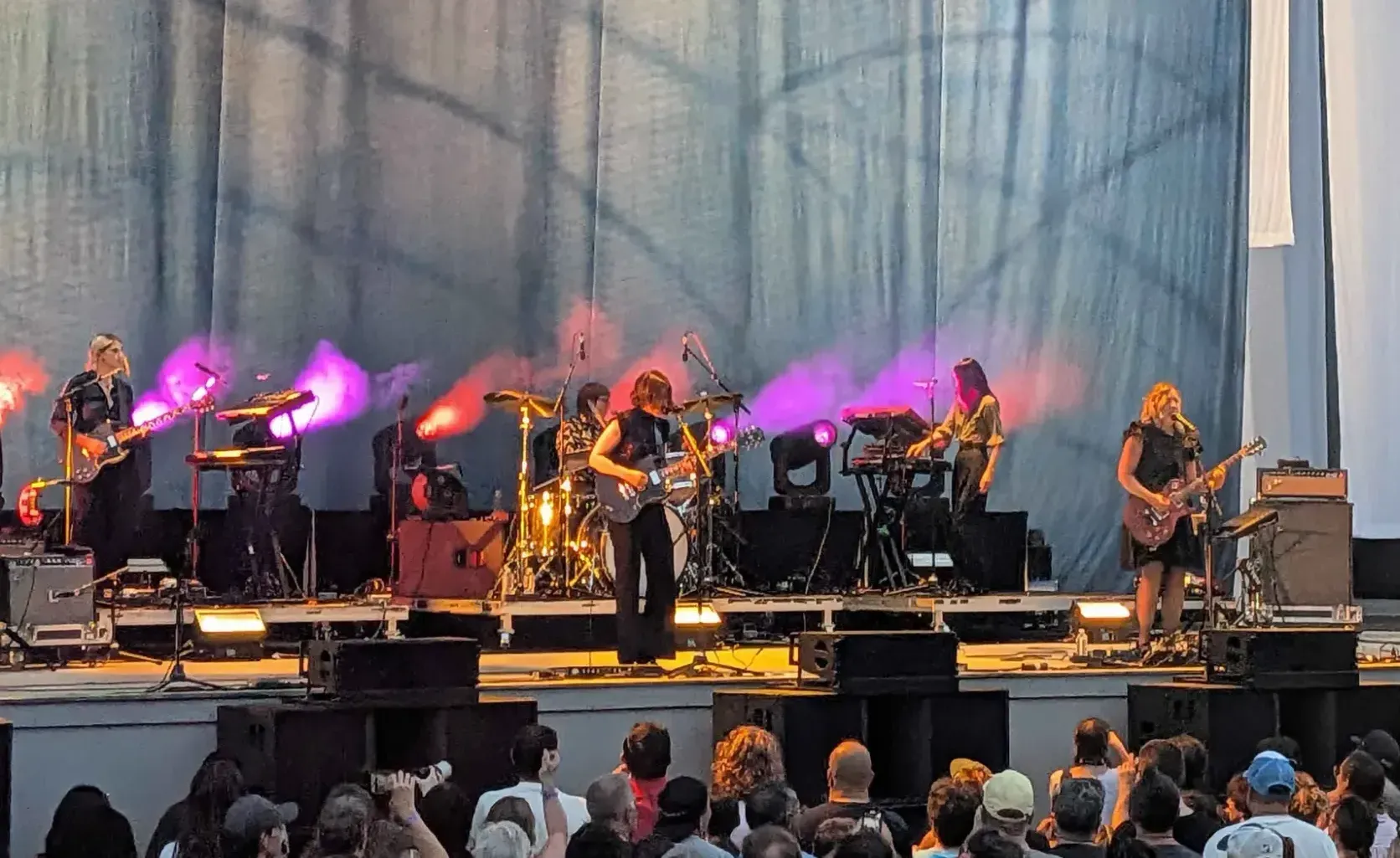
About two-thirds of the way through their set, Sleater-Kinney pauses for Carrie to give a speech about how she once worried about being too loud and insistent but now, with everything happening in the world, she’s grateful for that volume. She urges us to be loud, too, about Palestine, about the victims of the Trump administration. And then she and Corin play the oldest track they’ve played all night, “Little Mouth” (off Call the Doctor), a two-minute manic episode of a song, all urgent guitars and breathless, unremitting screams.
I think about how when they wrote this song, Carrie and Corin were dating, how the album that follows this one is full of their breakup songs, how they stopped sleeping together but kept playing together, and kept playing together. How Carrie has spent three decades writing songs for Corin to belt out to strangers. I yell, I head bang, I throw my fist in the air, I (for the first time all night) absolutely throw down.
I have a lot more to be angry about than when I was 19.