Write me a Commonwealth story
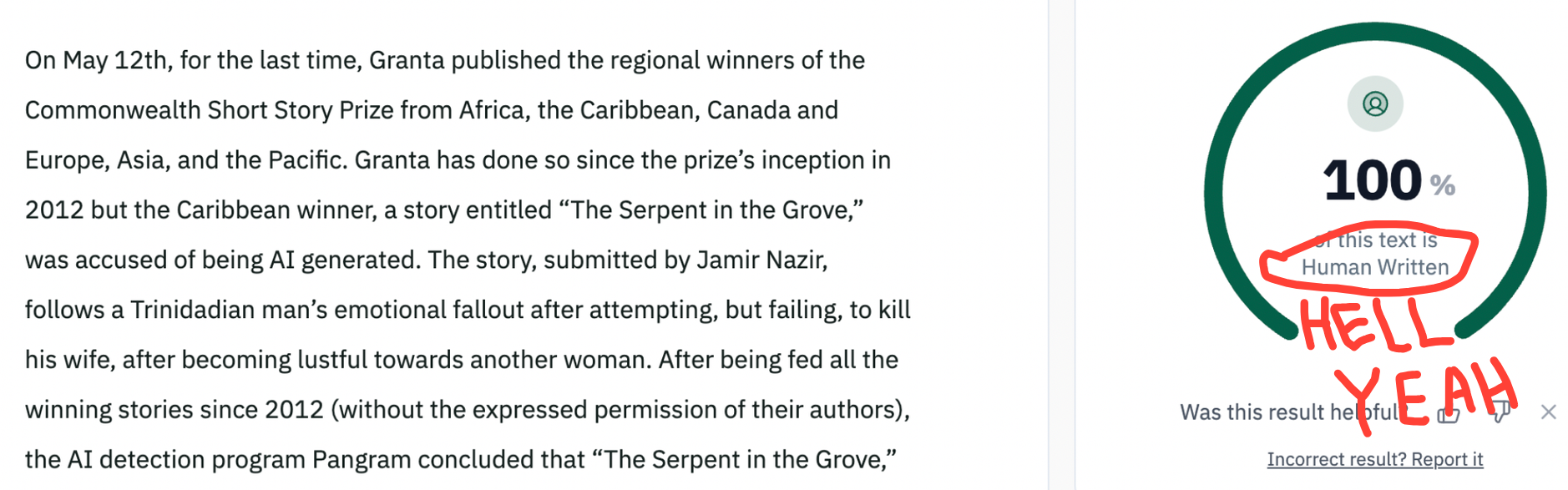
On May 12th, for the last time, Granta published the regional winners of the Commonwealth Short Story Prize from Africa, the Caribbean, Canada and Europe, Asia, and the Pacific. Granta has done this since the prize’s inception, in 2012, but that came to an end after the Caribbean winner, Jamir Nazir’s story “The Serpent in the Grove,” was accused of being generated by AI. The story follows a Trinidadian man’s emotional fallout after attempting, but failing, to kill his wife, after becoming lustful towards another woman. After being fed all the winning stories since 2012 (without the expressed permission of their authors), the AI detection program Pangram concluded that “The Serpent in the Grove,” and two other writers’ stories, were created with at least “some” use of AI.
AI detection tools are both unreliable and biased against “non-standard” English speakers, particularly in the case of creative writing. To exculpate it of bias, Pangram was tested on 91 TOEFL (Test of English as a Foreign Language) essays, 3,907 ELLIPSE (English Language Learning Insight, Proficiency and Skills Evaluation) essays from high schoolers, and 5,600 ICNALE (International Corpus Network of Asian Learners of English) essays produced by undergraduates. None of these datasets are particularly relevant to fiction, especially fiction by Africans or those of the Caribbean. Thus, using Pangram to determine that a short story by a writer outside of these datasets (and even then) doesn’t make a convincing argument.
That all said, because Jamir Nazir has made statements praising LLMs, the rush to judgment was at least plausible. But what caught my attention were the comments that Nazir’s flawed story only won because literary institutions like the Commonwealth Prize prefer “formulaic” postcolonial literature, stories so generic that they could easily be generated by a bot. Of course LLMs do not follow strict formulas. Indeed, because they remix from the largest possible datasets of writing available to them, as Tuhin Charkabarty puts it, “LLMs don't follow genre conventions; they cherry-pick expressions from wherever, genre be damned.” But the charge of postcolonial formula was in the air. And it came up again this past week, when the winner of the Caine Prize for African Fiction was accused of using AI to write his story—again, largely on the testimony of Pangram—and “the presence of stereotypes about African life common among outsiders” was offered as corroborating evidence.
Because I was shortlisted for the Commonwealth Prize in 2020, the thought that my story might have been shortlisted because it was “formulaically postcolonial” haunted me. So, I set out to see if this was true, rereading my story against and alongside every winning story since 2012, scraping in a more analog way, the same data set that Pangram did. What I found surprised me. There were commonalities, along larger literary trends, but the stories could hardly be called formulaic. I was reminded that the short story is a great form for experimentation. And the results of this experimentation often echoed each other, showcasing that these stories play and talk with each other across cultures.
The stories do share some common grounds, beginning with genre: most of the stories are “literary fiction,” tending to have little plot, relative to more speculative work, and centering characters having reflective moments. Most of Nazir’s characters in the short story stop to think about what a failed spousal murder means for their world. There is a lot of yearning for distant loved ones, separated by either death, work, conflict, or emotional barriers. My story, for example, is about a diasporic Gambian woman who meets the former dictator of her country at an American airport and debates whether she should punch him or not; she ponders whether violence towards him will heal the wound of being separated from her larger family and culture.
They also tend to cater to the attention economy, like most short stories written today, getting to the general narrative point in the first two paragraphs. Magazines, journals, and prizes ask first readers—often volunteers—to read hundreds of stories in a short amount of time. Unsurprisingly, these first readers veer towards writing whose narrative scope is a quick study so they can easier—and faster—judge the work as a whole. In other words, because judges cannot read at the speed of a machine, but are nevertheless asked to do so, an aesthetic preference emerges from their human limitations.
The stories follow other cultural trends. For instance, as speculative fiction has come to be more recognized, speculative stories have been awarded more prizes (though I was sad to see science fiction, a genre constantly tackling the legacy of colonialism, barely represented). The surreal—or irreal—broke through first, with Siddharta Gigoo’s 2015 winner, “The Umbrella Man,” reminiscent of Kafka’s existential, pre-absurdist approach to imprisonment. Magical realism followed with 2016’s Tina Makereti’s “Black Milk,” about a bird who takes the form of a woman. Only one science fiction story has ever won, Sofia Mariah Ma’s “The Last Diver on Earth” in 2022. Featuring a futuristic dystopia, it is an intriguing contrast to the historical glimpses of colonial dystopia one sees in stories like 2014’s “A Day in the Death” by Sara Adam Ang. As is the case with writers like Vajra Chandrasekera, the speculative stories more directly parallel the way colonialism bent reality. In 2025’s “Margot’s Run,” by Subraj Singh, a woman chases away a demon who has come for her newborn child on the day the British are to leave Guyana.
In style, the stories are all modernist or postmodernist, with none of them being commercial. When I say modernist, I mean the literary and artistic developments stemming from the global industrialization that fed into imperialism and, ultimately, the twentieth century’s world wars. Modernism challenged or outright denied the meaning offered by European tradition; postmodernism, as a direct response to modernism, challenges the feasibility of meaning at all. That the stories are all modernist or postmodernist is not surprising. As João Melo put it in “The Revolutionary and Counter-Revolutionary Duck,” from his collection Angola is Wherever I Plant my Field, Angolans “were post-modern before the concept was even invented.” What is true for the Angolan is true for most Commonwealth citizens and writers as most of us were recently under colonial rule. The historical confluences that resulted in Western modernism were the same that led to imperialism and colonialism, thus postcolonial literature.
Modernist and postmodernist techniques are still called experimental, despite their long history of use. Fragmentation, for instance, plays a part in many of the prize’s stories. In “A Day in the Death,” we go backwards in time chronicling the events behind the suicide of an opium-addicted worker in Singapore, with metatextual commentary from the present that he helped build. I felt I had just walked through a museum exhibit. Museums—a sign of colonialism—are a direct motif in “Black Milk.” In reading these stories in quick succession, I kept seeing these craft—not thematic—parallels in stories across the various regions.
A few of the prize’s stories are written in some type of vernacular, particularly ones by writers from Africa, the Caribbean, and the Pacific. These vernacular stories, and the ones translated into English later in the prize’s life, speak to the prize’s relationship with colonialism. Whether it be Standard English, Pidgin, or Creole, a legacy of British colonialism is the English language. Vernacular, and the choice to write in it, captures the ghost of extreme cultural clashes, as was the case when Chaucer chose to write in Middle English.
Literary vernacular is, arguably, a formulaic expectation of postcolonial literature. But 2018 overall winner Kevin Jared Hosein told me, by email, that he felt encouraged by the Commonwealth Prize choosing his stories written in Trini Creole English, which Trinidadians were conditioned to think was a “dirty, broken language—no doubt because of colonialism.” Moreover, the presence of vernacular seems to me more to do with the demands of the text than anything. Noncolonized writers since at least Mark Twain wrote in vernacular. Before postcolonial literature was a concrete concept, colonized and formerly colonized writers were writing in vernacular. Amos Tutuola’s The Palm-Wine Drinkard (1952) was criticized and then celebrated for its usage of vernacular Nigerian English and Yoruba myth, seen as a direct challenge to the Western view of proper literature. Mário de Andrade’s Macunaíma (1928) did much the same thing with Brazilian Portuguese and indigenous myth—with a mix of Brazil’s African heritage as well. Famously, Tutuola wrote a letter asking his English publisher to fix his “wrong English,” and change the novel as they saw fit, but his publishers sought to capture English as spoken in Nigeria and left the narrative as it was. This could be seen as a form of primitivism that laid the groundwork for the supposed formulaic work from the colonized or formerly colonized adored by Western publishers and readers, but I don’t think so. De Andrade did not seek for his Portuguese to be fixed. He just thought it fit the work.
Is postcolonial literature a useful term? It has its academic uses, I suppose, but most of us aren’t sitting down to specifically write postcolonial fiction. As Hosein puts it, the term simply describes “a writer grappling with colonial history, which isn't fundamentally different from any writer engaging with their own past.” Postcolonial literature was once called Commonwealth literature. Salman Rushdie strongly argued, in “Commonwealth Literature Does Not Exist,” that the older term made no sense. I use modernist and postmodernist as they describe the craft of the work, thus being more accurate. Still, when so many of us are writers from formerly colonized places, we are burdened with examining our literary relationship with the ghost of empire.
One particular imperial ghost haunts the Commonwealth Prize: the grid. As Ritesh Babu has deftly argued, the colonizing imperative and reflex is to destroy “by carelessly drawing a few lines with a pen,” and this fetish for charts and gridding led to the dominant nine-panel grid in Western, particularly Anglophone, comics. The Commonwealth Prize also cordons our stories off into distinct regions, first judged against each other before the overall prize. The Commonwealth Prize is clear that longlisting, shortlisting, and judging are collaborative processes, involving numerous readers from various parts of the literary world. But I do not see how this initial regional categorization is helpful, or reflective of cultural reality. Grouping Canada and Europe together but excluding New Zealand and Australia has me wondering, exactly, what distinguishes the North American colony from the Pacific ones. Is it the French presence, or the maple syrup?
Moreover, we are more connected than not across oceanic grids. African spirituality is practiced throughout the Caribbean. The Indian Ocean connects East Africa and Asia. Within regions, there might be less connection than one expects. What insights does, say, a Gambian writer have into the literary background of a white South African writer steeped in Afrikaans literature?
Perhaps doing away with region-specific judging would change nothing and I am just a ghost-hunter after powerless spooks. But I wonder if more craft parallels across distance might not be noticed, celebrated, and explored if we weren’t bound by that grid. 2019’s “Death Customs” (Cyprus) by Constantia Soteriou is my favorite story of the bunch because it so beautifully, and heartachingly, mimics the Greek chorus, separating it from the prose with em-dash sections. But the Greek chorus reminds me of the djeli’s (griots) assistant, from West African tradition, that is mimicked in the prose of West African writers like Ahmadou Kourouma in Waiting for the Wild Beasts to Vote. This little bit of call and response gets at what Johan Huizinga might have called the ludic heart of all art, culture’s social, playful, performative modes. On the page, the call and response reads as if prose is being followed by sections of poetry, or something like poetry. Outside of these traditions, 2012’s “The Ghost Marriage” by Andrea Mulaney (Scotland), 2014’s “The Human Phonograph” by Jonathan Tel (UK), 2020’s “When a Woman Renounces Motherhood” by Innocent Chizaram Ilo (Nigeria), and 2024’s “Dite” by Reena Usha Mungoo (Mauritius) all interrupt their regular prose with brief italicized poems, to some degree.
Any change to the prize that could further the exploration of these parallels, and why they appear when and where they do, is worth considering. “I entered the Commonwealth Short Story Prize because I write in the spaces where cultures have conversations,” 2021 Caribbean winner Roland Dell put it, “I couldn’t ignore a platform that is dedicated to the very same thing.” Our histories with the British empire—that make us “commonwealth”—are precisely the means by which we have contact with one another. And, in this way, the prize manages to encourage what I would call nonformulaic work, precisely amidst this cultural overlap, propelled by histories of empire.
Still, when Amitav Ghosh declined being honored by an earlier incarnation of the prize, he did so at least in part because it did not allow for non-English literature. Echoing Rushdie, he, too, is against the very notion of Commonwealth literature and describes the whole grouping as a "memorialisation of empire that passes under the rubric of the commonwealth.” His view is not without some merit. Though only a ceremonial role, the head of the Commonwealth is King Charles III (Charlie to those of us with aunts and uncles still upset about Princess Diana). He was voted into the role after the death of his mother, Queen Elizabeth II. Commonwealth citizens are eligible to serve in the British military. Many countries are in a grouping with the nation that owes them reparations, a country that often refuses to bring up the issue officially.
There are also other restrictions on specific nationalities; when I first learned of the Commonwealth Prize in 2017, my attempt to submit was curtailed by the fact that Gambian dictator (and general piece of shit) Yahya Jammeh had removed the Gambia from the Commonwealth before his ousting. Zimbabwean writers are currently in this same limbo, excluded since Mugabe removed the country from the Commonwealth in 2003. If other Commonwealth nations, particularly the UK, make noise about Zimbabwe failing to meet democratic or human rights standards, those same countries materially support genocide and crack down on those who protest or organize against it. Though the UK has been dwindling for decades, its imperial specter lingers across the Commonwealth.
In any case, Ghosh’s criticism of the Anglocentrism of the prize is no longer relevant. Submissions can be in twelve other languages from the Commonwealth, and a story can be translated into English from any language. It is not surprising that the prize changes and adjusts; my experience of the Commonwealth Foundation has been that it is run by people from around the world who care deeply about global literature, as in tune with modern writing, and dumbfounded by AI, as the rest of us. And as Hosein observed of what constitutes a Commonwealth Prize story, an “unfitting element would be nostalgia for empire, or exoticisation of setting.” He feels that he, and other Commonwealth Prize writers, are partially “pushing back against the empire, while taking its money.” My reading corroborates this sentiment. None of the stories I read feature either of these elements. (Though Commonwealth Foundation funds are drawn from many of the member nations, much of the foundation itself is based in the UK).
Whatever discomfort many of us writers feel with being grouped together because of our colonial history, and acknowledging the scars left by imperialism and colonialism, that never really fade, the Commonwealth Foundation and prize offer a widening avenue to writers from countries without much literary infrastructure. Gambia, for instance, doesn’t even have a literary magazine. The prize gets thousands of submissions each year because, simply, it is good for a literary career, has a financial incentive, champions experimentation, and allows writers without access to other resources a large audience composed of cultures connected to them by empire.
Of course, I—and certainly some other writers—will not submit to the prize, or promote it, unless it deals with AI submissions more thoroughly. Will people across the world accept to judge work they aren’t certain is human? How can cross-cultural literary play, resulting from experimentation, be possible if institutions that facilitate it rely on work that is possibly regurgitated and plagiarized? Though I do not think the prize generates formulaic postcolonial fiction, the AI controversy will likely hang over its head for some time, despite the fact that they have delayed the submission date for this year to better figure out AI detection.
That all said, the Commonwealth Prize is not the only short prize prize where AI stories might have won but it has received the most coverage. Almost all literary institutions are having to navigate AI submissions. Partially, the prize has always gotten a large amount of coverage because of a dedicated media team. Yet, I do think some of this intense focus stems from the view that non-Westerners do not deserve our accolades, that our achievements are the result of guilt-based positive discrimination (despite the scope of the British empire meaning that the prize is also open to many Westerners). This ignores the barriers, such as a lack of literary infrastructure, that many of us experience, leaving us feeling that we have to work harder than writers with Western origins. Nor, in all this, has it been fully considered that non-Western literature might seem to have parallels with AI writing because poorer tech workers in the global south are the ones training LLMs. In light of all this, the charge that our stories are formulaic, in my view, is steeped in spite so bitter that a LLM will never be able to recreate it.