A field guide to Bay Area camps

This is not a book review of John Washington’s How to Close a Camp (for that, read LARB or SSIR). This is also not a vibe report from Washington’s upcoming talk at Local Economy—with Lauren Markham and Julia Neusner—because that hasn’t happened yet. It will happen Thursday the 10th, at 6pm. You can still get tickets.
Let’s instead call this a field guide to the Bay Area’s camps, an introduction, so that when you read How to Close a Camp, or hear Washington speak, you will know where to get started on doing so.
\O/
If you can’t immediately think of any immigration camps in the Bay Area, don’t self-flagellate too much. There aren’t any camps specifically for immigrants. Certain West Bay mayors and tech CEOs took credit for talking Trump down from his threatened surge of immigration enforcement, after Customs and Border Patrol agents began staging at Coast Guard Island in Alameda last October. I prefer to thank the hundreds of people who put their bodies on the line to prevent CBP from crossing into Oakland. But the most important reason the surge was called off was probably the simple absence of places to put people. The main reason the Bay Area has not been under siege like Los Angeles, Chicago, Minneapolis, or Memphis is because there are no camps nearby.
That is the first lesson (in order and perhaps in importance) of Washington’s book: A camp expands outward, as a concentrated penal structure that sucks in bodies from its surroundings, until everywhere within reach of a camp becomes a less intensive form of staging, part of the filtration system (to use Washington’s phrase, in turn borrowed from Agamben).
This is why, of course, the Department of Homeland Security is trying to open camps in the Bay.
In January 2025, DHS signed a 20-year lease for 24.5 acres of land at 7240 Holsclaw Road (described as “east of Gilroy Premium Outlets” in reporting), in unincorporated Santa Clara County, at a cost of $26.5 million, for a facility that would hold up to 150 people. In June, the County of Santa Clara and California Attorney General Rob Bonta filed a lawsuit alleging, for example, that DHS was proceeding to build the facility without first considering the environmental impacts of constructing a site on what had previously been agricultural land (and which may be contaminated by hazardous pesticide waste from past occupants), and also that the site is not “appropriate” (as federal law requires immigration detention facilities to be) because its septic system is too small to handle the waste of forty employees and 150 detainees, and the facility would sit in a floodplain. Environmental organizations are also suing. Gilroy–the closest incorporated town to the unincorporated site–has declined to join either lawsuit, although the Gilroy City Council has voted to oppose the facility.
(In the battle against camps, environmental laws have proven a surprisingly effective tool, and How to Close a Camp helpfully instructs the reader how to identify and use them. For example, the Miccosukee would have had 30 acres restored to their control after the tribe joined litigation against Alligator Alcatraz—the detention camp built by Ron DeSantis that imprisoned thousands of individuals on an abandoned airstrip in the Florida Everglades with worm-ridden food and non-functional toilets for a year before being shut down in June—had not a revengeful president vetoed it. The Department of Homeland Security failed to consider the environmental impacts of building such a facility, and failed to consult with the Miccosukee Tribe about historically significant artifacts on the site. Perhaps you might be inclined to interpret this fact cynically, as a statement about the relative values afforded detained persons and endangered species. Or perhaps it might make you reconsider the recent rush to jettison these laws as standing in the way of needed development. Perhaps you might be pleasantly surprised to find that environmentalists, only a few decades removed from endorsing anti-immigrant and eugenicist politics, devoting resources and reputation to protect migrants. Or perhaps you may find yourself brought to tears by the historical rhyme of a native nation risking so much to make manifest the slogan that no one is illegal on stolen land.)
In Santa Clara, at least, DHS has agreed to pause construction to buy its lawyers more time to respond to the lawsuit. Whether they can begin construction again while the case goes forward will be decided tomorrow, on Sept 8th, and you can attend the hearing, in San Jose, if you want. It’s at 2pm at 280 South 1st Street. There’s a bus from Berryessa BART, or nearby parking. You might even bring a sign.
\O/
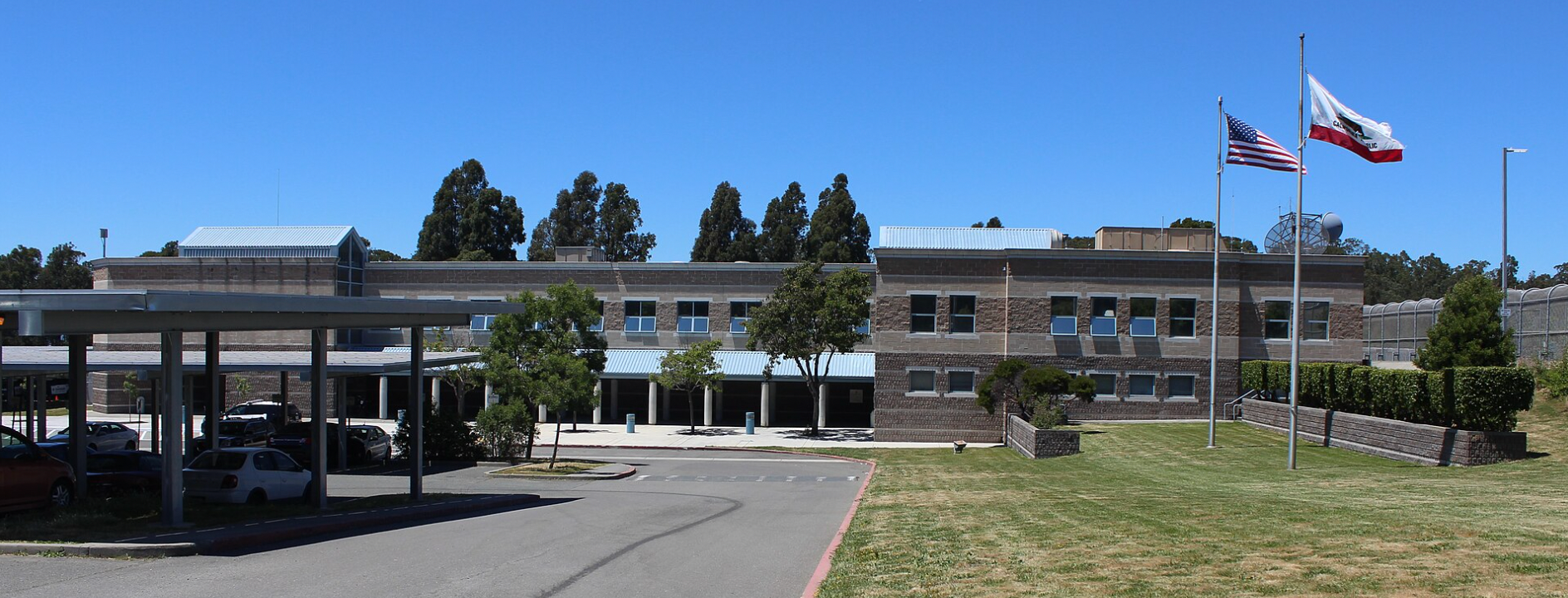
The East Bay, too, may get a camp, but DHS won’t have to build it, because the “40 primary buildings and associated structures” have already been built. The Federal Correction Institution in Dublin has sat vacant since December 2024, a “campus-style facility…constructed with slab-on-grade concrete floor with metal frame or built up concrete walls with metal or shingle roofs and is surrounded by two 12-foot-high chain link perimeter fences with razor ribbon.”
On May 1, the Federal Bureau of Prisons released an Environmental Assessment (from which the above description is quoted) of the potential impacts of permanently closing and deactivating the facility. By permanently closing the facility, the Federal Bureau of Prisons can transfer it to the General Services Administration which—according to the League of Women Voters and ACLU—is on the hunt for places to put people kidnapped by ICE. These activists’ well-founded fear is that the prison will be reopened as a camp.
Why did FCI Dublin close in May 2024, and why has it been sitting empty for close to two years?
Because, between 2019 and 2021, eight officers at the “low-security” women’s prison, including a former Warden and chaplain, were charged for specific incidents of sexual abuse of prisoners. (Two more pleaded guilty in 2025.) In 2022, an investigative report revealed rampant sexual abuse at the facility, and in 2023, women who were or had been imprisoned at Dublin filed a class action lawsuit against prison officials who allowed or facilitated their abuse. You can read the (amended) Complaint, which describes in sanitized terms some of what those women endured, and who ignored it. Widely read reports of mass rape and parallel lawsuits proved too much for the Federal Bureau of Prisons (at least under the Biden Administration), and beginning in April 2024 they began transferring women out of Dublin. A judicially enforceable settlement overseen by Yvonne Gonzalez Rogers (the same judge who wrangled Musk and Altman) still applies to the treatment of those women and sexual abuse allegations wherever they are moved throughout the federal prison network.
Here in the East Bay, the women who have been released and their allies are now fighting to prevent immigrants from being held in the place where they suffered. If you want, you can see their photos, read their declarations, and learn more about their allies.
\O/
The West Bay does have a camp. You’ve probably been there. Perhaps you were even one of the people who swarmed the arrivals area of SFO’s International Terminal, in January 2017, when Trump announced the first Muslim Ban (though there is a (less well-known) second), one of the thousands of people who dropped everything to stand, chant, and hold signs. On either side of the Arrivals Hall there are two Customs and Border Patrol offices, what the agency terms “hold and interview rooms,” and these, too, are camps. On September 1, the San Francisco Chronicle reported that CBP had held more than two dozen immigrants in these bed-less rooms, without access to attorneys or doctors, for days. Unlike the thousands of people who are turned away each year at the legal border of immigration processing at SFO, these detainees were mostly permanent residents, held without showers or changes of clothes while agents scoured their records in search of some basis for deportation–an old arrest for marijuana possession, perhaps. You cannot see photos of the rooms because CBP did not grant reporters access.
John Washington—in his book or at Local Economy, Thursday, the 10th, at 6pm—can help us recognize the camp, hidden behind those unassuming doors at the glittering airport where you can enjoy sushi or view Afrofuturist art while waiting for your plane to begin boarding. As he puts it, the camp is not a place; it is a logic, a technology, a status. The camp is the process by which people are turned away and others pass through thoughtlessly; it is the isolation of the interview room, and the disregard for a 67-year-old’s diabetes medicine, and the belief that a person detained after an international flight would only need a shower after three days of sleeping on the floor.
\O/
There used to be a camp in Richmond.
In July 2018, the Sheriff of Contra Costa County announced he would end a contract with DHS to house up to two hundred immigrants at the West County Detention Facility in Richmond. Over six years, a coalition of community members led by faith groups held vigils at the camp, raised money to secure immigrants’ release on bond, and directed media attention at the facility.
In How to Close a Camp, Washington describes the “years-long effort to shutter the West County Detention Facility” as “successful.” But as the organizers of this effort themselves acknowledge, most of the immigrants imprisoned there were not released. Instead, they were sent elsewhere, to other camps. As with the women of FCI Dublin, closing the camp did not mean letting the people within it go out into the world. A camp is merely an island in an archipelago, and closing it does not mean a Kristof-style rescue, does not afford immediate emotional gratification as its prisoners enter, blinking, into the light of freedom.
Washington, a former organizer, is clear-eyed about this: You don’t get to meet the person you “saved” from a camp; closing a camp means someone never enters it. Without a place to put the people they kidnap, ICE kidnaps fewer people.
\O/
Except here’s the thing about the West County Detention Facility: it’s not closed at all.
The ICE contract has ended, but the Contra Costa Sheriff's Office still detains people there, up to 900, according to the 2:42 minute video on the website. It’s like Etowah County Detention Center, the Alabama facility which is still open, even though Washington describes the “successful” campaign to “close” it in the introduction to How to Close a Camp. You can see the faces of the people imprisoned there. The migrants are gone, but the criminals* remain.
Criminals with an asterisk, of course, because jails are not prisons. You can spend a weekend in jail only because a cop decided you mouthed off too much, which might have something to do with your skin color or accent. You can spend months or years in jail because a judge didn’t feel like granting bail or you live in a state with cash bail and you can’t afford it. So far this year 26 people have died in LA County Jail, which is the largest jail in the U.S. The most recent was just last Sunday. (Twenty-four have died in ICE detention in 2026, nationwide).
You can spend years waiting in county jail or state prison to be deported. Yes, even here in California, in what Trump administration’s mouthpieces like to complain is a sanctuary state. Way back in 2019, the state passed the “California Values Act,” prohibiting “state and local law enforcement agencies…from using money or personnel to investigate, interrogate, detain, detect, or arrest persons for immigration enforcement purposes.” But there are exceptions. Law enforcement may inform ICE of a person’s release date from a jail or prison, and indeed transfer that person to immigration custody, if the person has been “convicted of a felony punishable by imprisonment in the state prison” or has been convicted, in the last five years, of a long list of offenses.
Enforcement doesn’t have to turn over immigrants to be deported if they have been convicted of a felony, but they can. And you will probably not be surprised to learn they have done so. As of August 1, California Department of Corrections and Rehabilitation has turned over 901 people to ICE for further detention and deportation in 2026, out of 1,036 requests. In 2025 they turned over 1,453 people. Of the people released from California prisons this year, approximately 6 percent have been “released” to a camp.
\O/
According to Washington, almost 90 percent of people locked up in immigration camps are in camps privately run by for-profit corporations, including by companies you may have heard of like CoreCivic (NYSE: CXW, up 72 percent in the past year) and GEO Group (NYSE: GEO, up 49.10 percent in the past year).
But publicly run camps are not always or even generally freestanding structures. They can simply be contractual arrangements with jails. A camp can be a place for criminals* that is now, also, holding immigrants.
Although Washington sometimes describes successful campaigns to convince local officials to end the ICE contracts with these still-open jails as “closing” a camp, he is attentive to the imbrication and interoperability of immigration and criminal detention: “Immigration detention as we know it in the 2020s,” Washington writes, “was constructed atop the scaffolding of the late twentieth century’s embrace of mass incarceration—the primary response to what politicians, policymakers, and prison companies alike called the ‘wars’ on crime and drugs.” In the book, he succinctly and effectively summarizes this history, laying blame (where it should be) on legislation during the Clinton administration, and quotes Silky Shah, Executive Director of the Detention Watch Network, warning against the trap of “innocence frameworks,” which “accept that while some people do not deserve the camp or shouldn’t suffer, others should…When we argue against the camp by focusing on the innocence of the people inside, it accepts that public safety is the central thing to consider when it comes to immigration.”
Still, in defining the camp, in building a political program to close camps, specifically, Washington leans on this contrast with criminals. According to Washington, a camp is not a prison, but is “categorically different.” A camp (as opposed to a prison) is a place where people are held based on who they are, not what they did. A camp is a place where you are sent because of who you are and, once you are there, you are no longer a legal person, at least not in the same way as before you were sent there.
One may disagree with this binary, philosophically. One may argue that criminal punishment, in 2020s America, is not a response to wrongdoing, but an immense superstructure designed to identify people who must be excluded, who are deficient, or surplus labor, or racialized threats, and for whom any particular crime and conviction is merely evidence of their underlying inhumanity. One might argue this explains felon disenfranchisement, three strikes laws, sex offender registries, all sorts of things.
Either way, the camp expands outwards. If a camp is anywhere a person is deprived of legal status on the basis of where they’re from, is a camp is anything that enacts the logic of exclusion inherent to the ethnonationalist state? Is it the borders themselves, the billions spent to create and preserve an ordering of people across the planet? If a “camp” is any space of enclosure and dehumanization, can you find a camp in the basement cells of any local police department, excused by a gesture to the due process that might arrive, that is, if the detainee doesn't plead out first?
But I’ve gotten far too abstract here. Let’s get back to what Washington’s book is, which is, after all and to its enormous credit, wonderfully practical. A camp is a technology, Washington says, a political economy, a putative jobs program, and a tax base in search of human material. And so here is one lesson from How to Close a Camp: Any jail can become a camp if and when a Sheriff decides to make it one. When officers need new uniforms or the department budget is facing cuts, and DHS will pay the Sheriff to house immigrants too, they will do so. Let that be the second lesson: Once the machinery of dehumanization is in place, it is easy to flip the switch as to what people get fed to it.
\O/
There’s a book of teachings by ancient Jewish rabbis entitled Pirkei Avot ( “Ethics of the Fathers”). One of the more widely quoted aphorisms, printed on a laminated posters in my childhood Reform synagogue, is usually translated as:
[Rabbi Tarfon] used to say: “It is not your duty to finish the work, but neither are you at liberty to neglect it.”
This is not a book review or a vibe report. Read How to Close a Camp, go hear John Washington speak. Pick a camp. How will we close it?