Do androids dream of public banks?

On Tuesday, Berkeley voters will decide on Measure Z, a parcel tax to fund a regional public bank that would offer low-interest loans to municipal projects of social value. The way public banking works is that, instead of turning to Wall Street to finance affordable housing projects and small businesses and the like, a city would use its own bank to provide the capital, with any surpluses reinvested in the community and all the antisocial profit-seeking of the private system cut out of the process. It’s all pretty simple, but the private banking system is so embedded in the “normal” way of doing things on a municipal level that the simplicity of public banking’s premise seems almost fantastical. “Our money, our choices,” is how Debbie Notkin, one of the leaders behind the public banking push in the East Bay, puts it.
Notkin is perfectly at home in the fantastical. In some ways it’s her life’s work. She is a longtime editor of science fiction books, and from 1977–1994 she was a co-owner of The Other Change of Hobbit, a science fiction and fantasy bookstore in Berkeley. Her own activism likewise has been devoted to what we might call possibility maintenance. I first met her organizing an economic justice group called Strike Debt, and I was immediately taken with her. Here was another person with an interest in dismantling capitalism using science fiction ideas. We became friends, and we’ve kept up a conversation since then, as her work as an activist moved from debt to public banking. (She is now the head of the California Public Banking Alliance’s finance committee and chairs the board of directors of Friends of the Public Bank East Bay.) While her attention may have shifted over the years, the animating impulse has remained the same: a desire to expand the spectrum of what’s thinkable by focusing on relationships as the main material.
Recently we sat down for several in-person conversations. We talked about public banking and science fiction, how the two relate to one another, and how either connects to more expansive visions of love and sex and friendship. What follows is the result of those conversations, the transcripts for which have been stitched together and edited for the sake of readability. In a few cases Notkin expanded on her answers in writing.
\O/
Cassie Thornton: You had said something to me about living outside the box. What was it?
Debbie Notkin: It is living in the box but not caring about it [the box]. Living in the box but not letting it limit me. It means that when a lawyer says to me, “Your plan offends my lawyerly mind,” I say, “That’s too bad.” Or it means that when a friend comes and clearly needs a large amount of money that I can get access to, and I absolutely know how trustworthy she is, I just give it to her and I get it back. And if I don’t get it back, then I don’t have it, right? It means letting go of some of the fear and paranoia.
Especially the fear and paranoia around money and class, which makes it so hard to live here in larger Oakland, because we seem to have accepted money as the guiding force behind our decisions and it acts as our motivation so much of the time. It’s so weird to live somewhere with so much wealth and so much poverty and to pretend it is okay.
Leaving aside, sort of, the oligarchs and the superrich, there’s still all that money that’s floating around out there, and it’s doing nothing for anybody except the people who don’t need it. And mostly it’s not doing anything for them in the present; it’s just a guard for the future. To me, that’s probably why I wound up in public banking and economic justice. The only thing money is, is what it’s good for. Right?
If I have a million dollars and nobody is benefiting from it, including me—because I’m afraid to use it, I’m afraid to spend it, I’m afraid to loan it—I don’t know what to do. Most financial advisers will only talk to you about making it bigger, right? And I don’t want it to be bigger. I want it to be of value to me. My house isn’t money. I couldn’t have it without money, but it isn’t money. My ability to travel isn’t money, but I couldn’t have it without money. But money itself is just boring.
I think about that a lot—how people who have a lot of it aren’t necessarily even having a nice time.
No, money does not make people happy. The world is full of unhappy rich people who think, “If I only had a little more...”
Edward Espe Brown from Tassajara says the reason you can’t eat just one potato chip is that potato chips don’t actually taste very good. You’re always grasping for the taste you think you want from potato chips that isn’t there. You keep trying because you are convinced it’s eventually going to work. And I think that’s how people are about money: “I only have $3 million that I’m not using. If I had $4 million that I’m not using, everything would be great.”
And the fact of the matter is, if you don’t want yachts and you don’t want private planes, there’s a limit to what you can spend. But there’s no limit to what you can give, loan, and support. That’s where I get my pleasure from my money. This person is able to build his counseling practice, and that person is out from under this toxic guy who offered her a job with invisible strings. These friends had an unexpected car repair, and they could save money if they could pay it in cash and not put it on a card. Most of it comes back to me, and what doesn’t come back to me comes back in kind—in happier people and richer friendships.
You have to be really careful not to let the loans get in the way of the friendship. That’s the danger. The danger is that people will start thinking of me as the money or as the bank. The other danger is that people who can’t pay won’t want to see me. I think one of my skills is assessing people and thinking, “If I loan this person money, it’s going to be weird and ugly between us. But if I loan that person money, we’ll be fine.”
Because sharing money in our society means going through something with people.
It does. It either makes a closer connection or it creates a barrier.
How did you become like this? Did somebody do it for you?
I think there are two things. One is that my mother was the most people-savvy person I have ever known. She taught me how to assess people, not by sitting down and teaching me, but just through living around her and with her. The other thing—I don’t know if I got this from my mother or where I got it—but I have a very strong concept of enough. I know what I need, and thus I know how much I have that is more than enough. And I don’t touch the bedrock, right?
Just before the pandemic, a beloved friend needed money, and I helped her more than I’ve ever helped anybody. She was moving and was really having trouble putting together enough money to make the move. She needed quite a substantial sum, and a big percentage of my cushion, and she comes from real poverty. My financial adviser was like, “You’re crazy.” And I was like, “You’re crazy. Watch.” She paid every penny of it back in about three months. And now she has this beautiful house with a stunning garden. It’s not like she’s ever come back to me for more, and it’s not like it messed with the friendship.
People will say to me sometimes, “You’re so generous.” I don’t want to be generous. I want to be connected. I’ve been doing some antiracist work, and through that I met a Black woman who was trying to open a general store in the Mississippi Delta. I loaned her some money, and that money gives me more pleasure than almost anything. That store is now open, and she’s having all the troubles of a small businesswoman, but she’s also deliriously happy to see her dream come true. I bet I will get that money back, but if I don’t, it will be completely worth it.
And I think somehow there aren’t that many examples to show people what happens when you make a culture of redistribution rather than just self-sufficiency.
I think that’s exactly right. And there are people who, if you give them something for free, don’t think it is worth anything, right? I used to have a bodyworker friend, and she did some free sessions with another friend of ours. The friend would come out of the sessions feeling so much better, and then a week later would be like, “No, it didn’t do me any good.” And it was completely about “free equals worthless.”
But we don’t have examples of regenerative ways of using money in this fucking individualist culture. Like, I have to have everything that’s mine, and it has to be for my family, right? And I don’t know. I have affluent friends with no kids, and what are they going to do with their money? They don’t even have a clue. I don’t have kids. You have to think about where you’re going to leave your money.
At this point, I feel like it’s getting really weird with money when different forms of climate collapse are imminent. I think there’s this real confusion: Do you save money for the apocalypse, or do you spend it all and make life possible now for more people? I think most people are just saving it for themselves, as padding for the unknown.
I don’t want to live through the apocalypse, and I felt that way when I was 30. I just don’t. I like my comfortable life. I like my relative safety. And the older I get, the less I want to live through the apocalypse, and the less I see value in living for the apocalypse. So use the money, man.
My partner Alan, who died this year, had another partner. She will not be short on money when we settle Alan’s estate, but she’s short on money now. I really had to push him to give her what she needed. He said, “I don’t want to look like a sucker.” He didn’t say, “I don’t want to be a sucker.” He said, “I don’t want to look like a sucker.” I thought that was clearly deeply important to him, and we didn’t have time to explore it. But I don’t honestly care if people think I’m a sucker.
This conversation makes me think about the other side of debt, which is trust. It is so complicated to share money because people don’t really know how to engage with need. Instead, we follow protocols that don’t really make sense. I think especially as a person who has a need, which is actually everyone, we would so often rather die than reveal that.
Exactly. We’re afraid of talking about money and we’re afraid of talking about nonmonetary need.
This goes back to our work together in Strike Debt, right? People think their debt is their fault, and you don’t need to step very far back at all to see that it’s not.
Yeah, but I think it’s really hard to have a straightforward conversation about money.
I used to joke that, by Notkin’s Law, almost everybody’s funny about sex, but everybody’s funny about money. It’s so hard to just say, “Well, I have this much money, and I have this much money that I could pass along to you on these terms.” And if that’s hard, how hard is it to say, “I need this much money”? It’s easy for me, sitting here on more than enough money, to make it sound generous. But it’s regenerative.
But it’s really, really different to not know where your rent is coming from and think about who you can talk to about that. I think it’s so much harder here than it is anywhere else.
That’s right. It’s so loaded. I think it’s a combination of crazy American individualism and crazy American capitalism, which is its own kind of capitalism, right? You’ve lived in other countries and I have not, but my sense is that American capitalism is really different.
I feel so bad for anybody who grew up here and didn’t get to live in a place where you didn’t live to work. Living in Berlin was so wildly different, just in the way that time works much slower, the way that food sharing happens much easier. The background for this difference is that there is a social safety net that’s been there for long enough. It’s not like scratching at the walls to survive. You can have a good life and not work very much.
And when I was in my twenties and thirties, that was true here. And I’ve talked to people older than you who got understandably jealous when that went away.
How did you end up in Strike Debt?
I ended up in Strike Debt because I was excited by Occupy. The only politics I had been doing for about twenty years were body image politics, which count but are different. The person I knew who was involved in Occupy was J.P. [Massar]. So he and I got involved in foreclosure defense in Oakland, and from there, after we had one major victory, it kind of died away in the way political things do.
Now that I’m a person who gets journalist interviews, they always ask, “How did you get into public banking?” I have two answers, and one is that I’ve come to the conclusion that economic justice is one of the cleanest ways there is for white people to do racial justice. Which doesn’t mean it’s clean. I’m not saying it’s clean. But I think it’s cleaner. By clean I mean, less white savior, less “I know what you need,” less “let me tell you people of color how to run your organization.” More about an issue that affects everyone, even though it disproportionately affects BIPOC people.
Even before I joined Occupy, which was around 2011, and by the time I joined Strike Debt it was probably 2013 or 2014, Ellen Brown [the founder of the Public Banking Institute] had already been out there talking about public banking. Susan Harman, a member of Strike Debt, had picked it up from Ellen and was pushing it at every Strike Debt meeting, just reminding people of how interesting and important it was.
[Public banking] was about building something good, and also about redirecting money away from the monsters and into the hands of the people who need it and can build something good with it.
In 2016, Trump was elected for the first time. I decided then that, while I was certainly going to be engaged in resistance, I also had to be involved in building. Something that was just resistance was going to make me crazy, with a government that I hated trying to destroy all the things I do actually like about this country, which are many. And so public banking seemed like the thing.
Public banking moves public money—taxes, fees—out of Wall Street and into locally owned banks with, ideally, local boards of directors, local input, local values. It moves bank loans away from data centers and fossil fuels into neighborhood small businesses, affordable housing, green infrastructure projects. Public banks need to make a profit, but they don’t need to maximize profits or make their staff and directors rich.
Sitting in the original moment, it was about building something good, and also about redirecting money away from the monsters and into the hands of the people who need it and can build something good with it. In significant part due to Susan [Harman], but also due to things happening in other parts of the state. By 2017 there was the California Public Banking Alliance. By 2019, that group, entirely grassroots and with no money, got the law passed.
That was a huge experience for me. I’d never been involved in legislative politics. I discovered that I really like going to Sacramento and lobbying representatives’ and senators’ offices, which surprised the hell out of me. Getting that law passed was like opening a door. By [2022], the East Bay has a pretty robust group working for public banking, and we really get serious about capitalizing it. In 2024, we have capitalization in our back pocket. It’s all set. And then the powers that be at the county just shut it down. And they never tell us why. We think the reason they wouldn’t tell us why is that the real reason was: We don’t like it, and we don’t want you to do it.
At the end of 2024, Trump is reelected. At that point, I’m the chair of the East Bay group, and we had identified a bunch of people who we thought would be good bank directors. We were working with them, and we were realizing that without a capitalization path, we had to merge that group with our group. And I said to everybody, “Look, the next years are going to be horrible. It’s going to be pushing a rock uphill. Do we want to quit? Or put this on ice?” And not one person in the group thought it was a good idea. And so I was like, okay, if everybody feels that way, then they’re right. And we just kept going.
Then a few things happened. We had this amazing influx of late-twentysomething and thirtysomethings. We hired a woman who was a graduate of the Goldman School of Public Policy on the UC Berkeley campus, and she’s still working for us. She’s become one of my closest friends. She brought with her this vast influx of volunteers, many of them Goldman School graduates, many of them brown and Black, all of them politically savvy and activist-savvy. And suddenly we were a whole different group. It was just the most amazing thing. And I don’t feel like we did it. I feel like the world was ready for it. I’ve heard people compare it to the Mamdani victory, that it’s part of the same zeitgeist.
What do you think the new younger generation of volunteers see in the Public Bank East Bay project?
One of them says repeatedly: “Every activist project I do, I realize if we don’t get to the money, we’re never going to get anywhere.”
Something was happening with public banking in the country. In part due to some of the movers and shakers in the California Public Banking Alliance, in part due to the New Economy Project in New York, there was just a sea change in 2025. In the midst of all that horror and all that disgust and all that shame, there was this renewed interest in solutions, and public banking started looking like one of them.
By the end of 2025, there was a public banking conference at Harvard, by invitation. One of the things that came out of it was a national webinar with opening remarks from Elizabeth Warren. Meanwhile, in New Mexico, they invited the new CEO of the Bank of North Dakota to come talk to them. And he gave this—I never quite know how to describe it because it’s not a barnburner speech. It’s not a thrilling speech. It’s just this levelheaded, even-handed, “Here’s what we can do with public banking. Here’s what we do in North Dakota.” And it is so compelling. He’s speaking to people in New Mexico, and he starts out by talking about his family and his kids, and he just builds this case for careful, rational public banking. At the end of October 2026, the Public Banking Institute held a big national conference in Philadelphia, with a declaration of financial independence.
Meanwhile, in the East Bay, we’re starting to look seriously at philanthropy. If we can’t get government capitalization because government money dries up completely under Trump, what else can we get? We have a parcel tax initiative on the ballot in Berkeley right now, with a decent chance of passing. If it passes, we’ll be accumulating the necessary capital to open the bank. A different measure is on the ballot in San Francisco. Even if they don’t pass, they are changing the conversation about public banking.
Public banking is in the air quietly, but it gets less quiet all the time. If the United States economy is collapsing, then something is going to have to replace it. I think we’re going to start seeing some very real public banks. But it is just the people’s money for the people’s needs. Our money, our choices. It’s the way things have to go if we’re going to rescue anything from this mess.
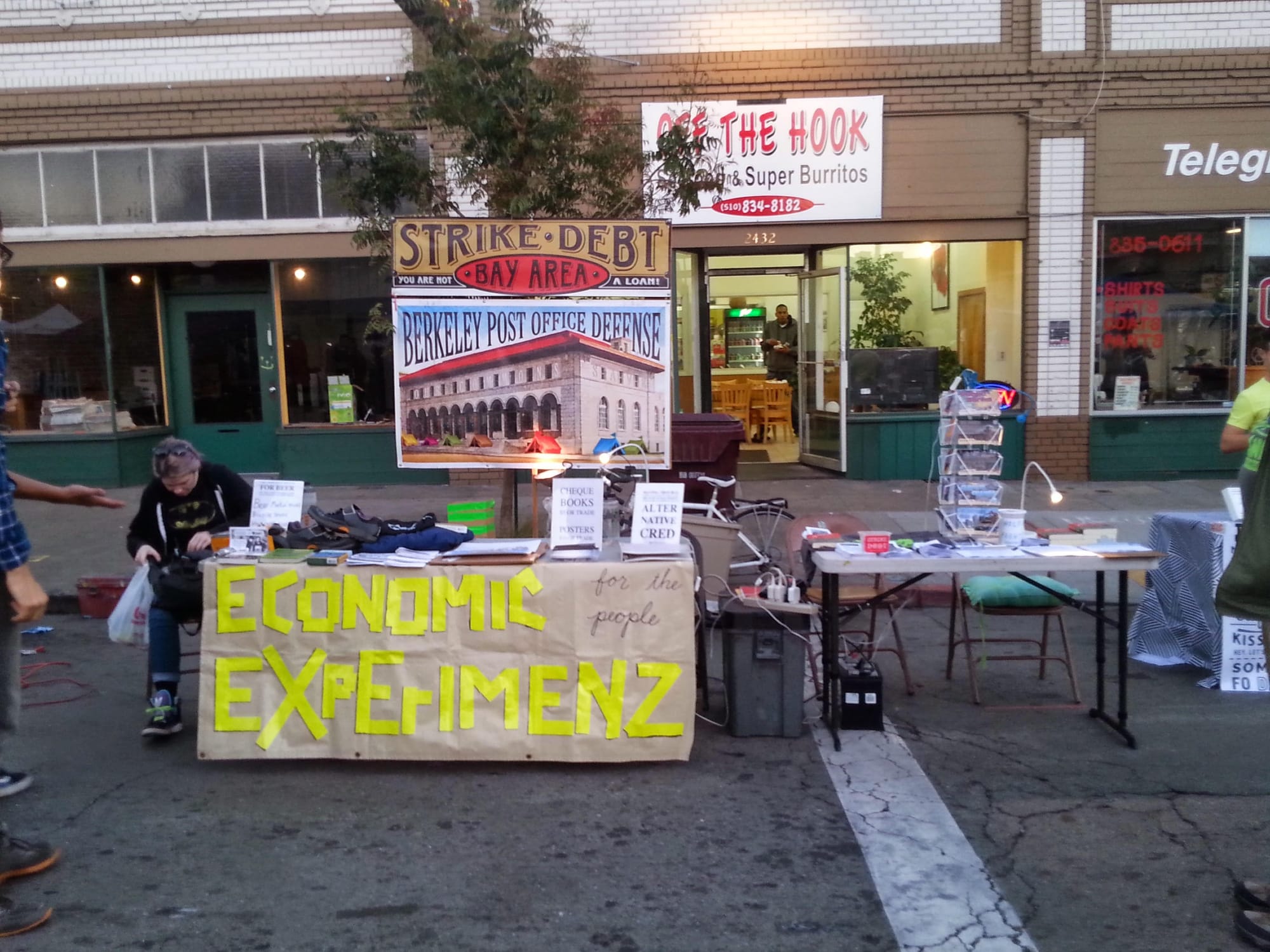
There’s something that runs through all of your economic justice projects, and part of it is the company you keep. The projects are very grounded and functional, and also always strange. Like with the public bank—do you remember that Public Bank of Oakland T-shirt? The one with the very psychedelic aesthetic that we made, maybe in 2016? I think that was my first very simple material experience of parafiction. Like lying about something until it becomes reality. Or living it into reality.
I’ve worn that shirt and had people stop me and ask how they can make a deposit.
And then, in Strike Debt, Mike Wilson and I made the humongous big black meteor or asteroid, just like a chunk of coal, and rolled it through First Friday. And we had Silvia Federici and George Caffentzis hitting a piñata that was supposed to be debt itself, while we recorded people screaming on our Strike Debt Radio Show.
Yeah. Were you there when we pinned all the dollar bills onto the tree outside the Oakland City Council?
No.
That was a Susan project. Because the idea was that money grows on trees, right? We got tons of Monopoly money and literally glued it to a big tree outside the Oakland City Council building. We covered it in money. And there was another time—Susan again—brought a papier-mâché dragon’s head to the city council. She put on this dragon’s head to ask them to do something.
I don’t think capitalism is “like” science fiction. I think capitalism is the kind of thing that science fiction can envision, and also the kind of thing that science fiction can imagine ending.
I see you forever bringing sci-fi into the organizing spaces you are in. As I recently wrote about in the “Public hands” piece, you brought that space-age thinking into a recent public banking meeting, too—by sharing some ideas about how a public bank could perhaps help us defeat fascism by blocking ICE or a data center from buying buildings in its municipality. You thought out loud about how the bank might allow local people to invest in real estate with low interest loans, etc. In some ways, the way we live is so weird that capitalism is very much like science fiction. But we’re so inside it that we don’t see the outside of it. But you do, and it helps us all because it creates a terrain where we can go outside of financialized logic that tells us we are a bunch of losers if we aren’t enjoying the boredom and grinding provided by our economic reality.
I don’t think capitalism is “like” science fiction. I think capitalism is the kind of thing that science fiction can envision, and also the kind of thing that science fiction can imagine ending. When I got dressed this morning, I looked at my Ursula Le Guin T-shirt, the one that says, “We live in capitalism. Its power seems inevitable. So did the divine right of kings.” Capitalism is a fiction because money is a fiction. If we all stop believing in it, it crumbles. The thing I always want to say about science fiction in this work is: If you can’t imagine it, you can’t create it. I believe that you have to imagine it not just in dollars and cents and numbers of housing projects or numbers of new climate projects. You also have to be able to imagine the difference in the world. The subjective difference.
It’s like you just said a little while ago: People don’t understand that you don’t have to live to work. Imagination is a big piece of any activism. I think it’s why people like you are so incredibly valuable.
What is the relationship between sci-fi and economic justice? It sounds like you’ve maybe thought it through before.
My sci-fi work was my political development, or 90 percent of it. Other people were reading Gloria Steinem and Kate Millett and June Jordan, but I was reading Joanna Russ and Ursula Le Guin and Samuel Delany, and, of course, later Octavia Butler. My political conversations were usually with science fiction people.
I worked with all kinds of science fiction, but my heart was always with the feminist SF and SF by people of color, with growing the base of who was writing, who was editing, who was critiquing. Trying to learn the lens of why Anglo science fiction is one thing and Nigerian science fiction is quite different. I spent many years working with the now-renamed James Tiptree Award, which had a goal of “exploring and expanding gender.”
The relationship for me [between science fiction and justice] is that science fiction is the place where I learned to open up possibilities. Those possibilities can be dystopian. They can be awful. But they can also be hopeful and generative, or whatever. I see so many people who, for good and sufficient reasons, don’t really believe that anything can get better. If you’re my age and you demonstrated against the Vietnam War, you really thought that was a revolutionary moment and things were going to get better—and then they got worse. If you’re younger, worse is all you’ve known.
[Science fiction] is the voice that never stops hoping. You always keep imagining. If you read science fiction that’s set 3,000 years in the future, there has to be a way to get from here to there.
It’s really easy, probably the easiest and least-energy choice, to become hopeless and stop being an activist and just sort of give up and tend to your own garden. But for me, science fiction is Rebecca Solnit, right? It’s the voice that never stops hoping. You always keep imagining. If you read science fiction that’s set 3,000 years in the future, there has to be a way to get from here to there. For me, I think it’s the fertilizer that lets me keep doing the work. It lets me keep growing into the work.
As long as I’ve known you, you’ve kept the day job working as an editor.
I retired in 2022, but I kept a day job until then, and I couldn’t have lived without it during the pandemic, when structure and regular contact with humans was my lifeline. What money I have now—a big chunk of it—is from working and having a 401(k) and not really ever thinking about it, and then suddenly stopping work and going, “Oh, look, that’s real money in there.”
Right now you’re getting a lot of interviews about public banking. But you have a whole other life, or a couple of other lives. The two that I know about include the body politics stuff, and then the other is that you started a feminist sci-fi bookstore, right? It was called The Other Change of Hobbit, and you were there for a long time.
That was also an economic experiment. And it was not a feminist store, though I think all three owners identified as feminists.
Oh, man. Talk about not knowing what you’re doing and getting into too much debt and not knowing how to manage your money. There was a successful science fiction bookstore in Los Angeles called A Change of Hobbit, and the owner of that suggested that we open sort of a franchise store. And we did. We did not know what we were doing, and we made an economic hash of it.
You and I were talking earlier, before you turned the recording on, about the pleasure of sharing money out into the world where it can do good work. And I’m realizing, just talking to you, that that’s the way I felt about selling books. It’s like sharing ideas out into the world where they can do good work. I don’t regret the bookstore. I regret how badly we managed it from a financial standpoint. I liked being there, talking to people, recommending books, thinking about ideas, moving through the idea space, the science fictional space, getting to know lots of writers and lots of editors.
It was because of the bookstore that I got an editing job in New York that I did for a couple of years. I was an acquisitions editor for Tor Books, which is a prominent SF publishing house. At the time, it was a division of St. Martin’s Press, and it is now part of Macmillan UK. And that was incredibly exciting: to learn about that piece of the world and bring a couple of books into the world that might not have been there without me, or might not have been at as big a publisher.
It’s almost like science fiction is largely the background, the backdrop, for everything I’ve done. Everything has that flavor. I can see the world the way I think it could be, and that keeps me working toward it.
It sounds like everybody came through there at some point!
Oh, yeah. Kim Stanley Robinson. I don’t remember Octavia ever being there, but Philip K. Dick came through. I wasn’t there the day Whoopi Goldberg came through, but she did, looking for evil baby stories. Whoopi Goldberg, of course, is a Berkeley person originally.
We had some pretty amazing parties. I don’t think we ever did a book signing with Ursula Le Guin, but she came through one day and bought books. Anne McCaffrey was there, Jane Yolen, the fantasy children’s author, came. Marion Zimmer Bradley, who has a very complicated and checkered history, at that point lived nearby and was there a lot. Harlan Ellison came through. Lots of people.
Are you, like, a science fiction doula?
WisCon, the world’s first and most important feminist science fiction convention, I became part of some years after it was going. I got involved at the very beginning of the Tiptree Award.
I had close friends from diverse backgrounds my whole life, but I got my first real political antiracist connections, and class awareness, in the science fiction world. WisCon did a lot of experimenting with ways to bring in people of color, and we made some bad mistakes and learned a lot. I just feel like I grew up there. That was my sandbox.
Do you remember what your entryway was?
Well, there were two entryways. One was that my dad was a science fiction reader, and there were always science fiction books in our house. And then, when I graduated from college, I knew I didn’t want to go to graduate school, and I didn’t know what I wanted to do. I had a little bit of money because I had gone to a state school, and my parents gave me kind of the money they would have spent on a private school.
I bought a little car, and my mother was in absolute horror and panic as I drove alone around the country, meeting people in student unions and places like that. And I came to Berkeley, and I met a man I fell in love with. He was a science fiction fan and a science fiction devotee. He’s still in my life. He really brought me into the whole social world of science fiction.
When I was trying to figure out how to put together something that was a predecessor to the Hologram, you know, and I had this invitation to choreograph something at the Berkeley Art Museum, I had gotten very little money, but I used it to bring all my friends and do kind of a gathering. Everybody was very, very precarious activists and artists. I wanted to make a cooperative of precarious people and share resources, right? And you named it. You were like, “Oh, that’s like you’re making an intentional community in exile.” And I used it, and the acronym was ICE, right?
That was my first impulse to start to have a more distributed life and family structure. And I didn’t know the term family abolition, and I didn’t know all the different forms of polyamory. I just knew that I really needed something to steady me that I had never had before. And I’m curious—the last time I saw you, we talked about family abolition, but you knew the idea before the term ever existed. You’ve been living it.
I don’t know if I knew about family abolition, but I knew chosen family. I knew chosen family for a long time. I didn’t know family abolition until I ran into Sophie Lewis.
You said you didn’t need to read Abolish the Family. It’s like you had already read the book before you read it.
You know, this first partner, the man I met in Berkeley, who was a very big part of my life for a very long time, was absolutely committed to polyamory. And I was a young girl with a lot of insecurities, and I was falling in love with him. It was like, okay, then I guess I’m going to be polyamorous because otherwise he’s not going to stay with me. And you know, that’s the way you go. A lot of women make a lot of decisions based on what they think a man wants. But it turned out, in the long run, that I’m more polyamorous than he is, right? It is more natural to me.
I think that it really goes with both lending money and selling books, right?
It’s just one thing: wanting to live in a web and not a locked room. I want my money to be doing good and making me happy. I want the books I love to be in the hands of people who will love them. And I want my partners, and close friends—and perhaps everyone—to have all the chances they can to lead full and satisfying lives. Polyamory—once I got over the sort of first shock of it, it just came naturally to me. What I used to say—and I don’t have occasion to say it very much anymore—is that I do respect monogamy, and it’s not like I think anybody should do what they don’t want to do. But monogamy privileges sex in a very particular way. Sex becomes different than everything else we do with people, right? Because I can have other friendships, and I can have other professional partnerships, and I can have other artistic pairings. But I can’t have sex with anybody but this one person. And a lot of that always looks to me like insecurity. I just don’t think sex is, in that way, that important. I don’t think it’s important enough to be different from everything else. And I like sex.
But the more that I thought about it and lived it and lived with it, the more I realized that I just like open possibility. I didn’t want to get married. I lived with my second partner for many, many years before we got married. And when we did get married, it was for economic and governmental reasons. I kept saying, “I don’t see why the state should have any interest whatsoever in who I sleep with.” And I certainly don’t want the state to have any interest in who I want to stop living with or sleeping with. I don’t know. Maybe I’m just an open person.
You never know what’s around the next corner. The fewer artificial conditions I put on my choices, the more room I feel like I have to try something that nobody ever told me was possible.
I think the question of monogamy, the sense that everybody might be searching for a one-person solution, feels really familiar to me. Like how many people see the state, or how we see money, as our single solution. It feels like part of a certain acceptance of capitalist acceleration—you just break a bunch of stuff and don’t have time for anything more than an easy solution. And I feel like there’s something about the intricacy of polyamory—or what my friends call “polyester,” which is funny—the practice of keeping all relationships of equal value, whether they are romantic or not.
So my friendships, my mentorships, my lovers—they’re all equally important to me. It really refuses the sort of one-solution logic.
Well, one of the things I’ve said for a long, long time is that I hate the phrase “just friends.” Because I really believe that anybody can find a lover, right? You can lower your standards enough to find a lover, or you can always pay for it. But friendship—that’s work. That’s where you can’t lower your standards and make friends who will give you any pleasure at all.
I’m a little wary of “all of my relationships are of the same importance,” because mine are not. But I think I see what you’re getting at there. It’s a nice thing to hold as a wish. And it is a known part of polyamory that what they call NRE, or New Relationship Energy, will suck you away from everybody else who’s important to you.
One of my best friends in Berlin did this thing that really changed my life. First of all, when I moved to Berlin, she told her partner, “Cassie’s coming. Make room.” Like, it’s going to change our lives because I’m going to spend a lot of time with her.
And then the second part was that she’s polyamorous. She started dating a new person, and she included me, her boyfriend, and her cat on the map of “this is the relationship you’re entering.” That was the first time I ever had somebody really include me in the map of what makes them who they are. So here we are, not a couple, nor a family, but a new form of social structure because we made it so. It can feel really hard to plan, or to make decisions in recent years because so much is changing. What do we trust? How do we plan? How do we make decisions? When we are talking about polyamory and the building of revolutionary projects, I also see us trying to manufacture new ways of organizing belonging in the midst of mayhem.
It’s never made sense to me to make decisions entirely in a vacuum of what I think and what I want, because I know that what I think and what I want is smaller than the universe of things that people think and want and worry about. So if I have to make a big decision, or sometimes even a small one, I will pick a selection of friends and go to them and talk it out with them, not because I want one of them to tell me what to do, but because I want a really big universe of ways to think about the decision before I throw the switch. And the person throwing the switch is me, but I have all this input from all these people that I love and trust.
It’s interesting how this could also go back to public banking in a funny way. Being able to make difficult decisions about how things should be when we don’t have, like, common instructions, institutions, or laws that guide us. Or none that we trust.
I know in my gut that the way most people think about money is wrong. That means when I set out to make a decision about money, I can’t go with common wisdom or “everybody says” or the financial adviser tells you to do this. So I need a universe of thoughtful people who can provide a much richer selection for me than the so-called common wisdom.
It’s so refreshing to talk to you about this, because I get the feeling like the kind of speed with which things are changing and breaking down is so fast. And we’re not always really able to adapt. Most people, in order to survive, are hanging on to doing things the way that they know and doing what’s comfortable. And it’s very clear, that’s not what you’re interested in. And what I have learned from you over the years is that we don’t have to just play by the rules as individuals or collectively. And it doesn’t have to be lonely or hard or scary. What is it that people need to know in order to feel that something else is possible?
The deeper thing is that money is a fiction, right? As I have said I’m a great believer in fiction. But I don’t think it’s wise to let a single calcified fiction control our lives. There are other ways to make choices.