How New York City makes the San Francisco scene
At the end of the first chapter of Jed Perl’s little novel, We Never Called It Frisco, a (fictional) art critic named Marcia Falk is at the opera, amid her longtime friends and art-world associates. It’s 1967, San Francisco’s Summer of Love is in full effect, and she’s in her forties, in her prime. She's a critical force, well-loved (and feared) for her wit and boldness, and generally expected to be “the voice of the decade.”
Then she abruptly dies. If this were a different kind of book, this setup might have kicked off a mystery novel, exploring why she died and who was at fault. It is not really that kind of book. Instead, its unobtrusive conceit is that her lover, Burt, has inherited her house and also the memoir she’d been writing, called We Never Called It Frisco, and Other Stories of My Earlier Years, the account the now-middle-aged critic was giving of her youth. Within that conceit, the book you’re reading turns out to be the “completed” version of her unfinished project, which Burt has supplemented with his own recollections and thoughts. And since her early death renders the “early years” distinction moot, the book within a book presumably has the same title as the one Coffee House Press has published, simply, We Never Called It Frisco.
In a specific sense, you might say—and I shall—Burt's book doesn't need to exist. It's a tribute to a writer whose career ended too soon, but no one was asking for it and Burt admits she would probably have hated it. Even her own editor judges that it’s not enough for “a book that a New York trade publisher could put out.” And the effort to make sense of her contradictions, to pin her down, never quite gets there. Sometimes we see her condemning the entire bohemian scene for being “retrograde, fundamentally conservative”; sometimes she’s more idealistic, “defending the best of Bohemia against the commercialization of Bohemia.” She’s an anti-Romantic with a romantic streak, and while her takedowns are legendary, she cheerfully bears no ill will to her subjects (even regarding them with love). Burt doesn’t really resolve these contradictions, and by the end of the book, you’ve learned more or less what I just told you, with no real revelations, not even what she died of. She’s simply dead.
Within the conceit of the book-within-a-book, her death gives the otherwise unfinished, drifting collection—which hadn’t really come into focus while she was alive—a center of gravity, an occasion, and a set of questions to be answered. And Burt, who owns a small printing press, seem to be simply publishing the thing itself, for himself. But why did Perl write this hundred or so pages of loosely collected (fictional) criticism, reflections, and diaristic accounts of half-forgotten (fictional) art shows and parties, at which artists and critics reflect on and criticize the parties and art shows where they find themselves? Why did (Minnesota-based) Coffee House Press publish it?
I’m not complaining about this book’s existence, exactly, nor am I demanding that it justify its relevance and purpose. It’s a perfectly pleasant novel—at least in part because there’s very little of it and it doesn’t overstay its welcome—and Perl does a good imitation of a good critic (and via Marcia, of a lively scenester), bringing out a diffuse but entertaining crew of painters, poets, critics, and art enthusiasts, who all found themselves, in the fifties and early sixties, somewhere between Berkeley and Marin. It’s the sort of little book you might enjoy, if you enjoy descriptions of the places you know, if you know the Bay Area a little—beaches in Bolinas, City Lights Bookstore, and parts in between—as well as of places you may have heard of even if you don’t. It’s a snapshot of the city’s counterculture that preceded the much more famous counterculture that largely began in the year of her death, 1967.
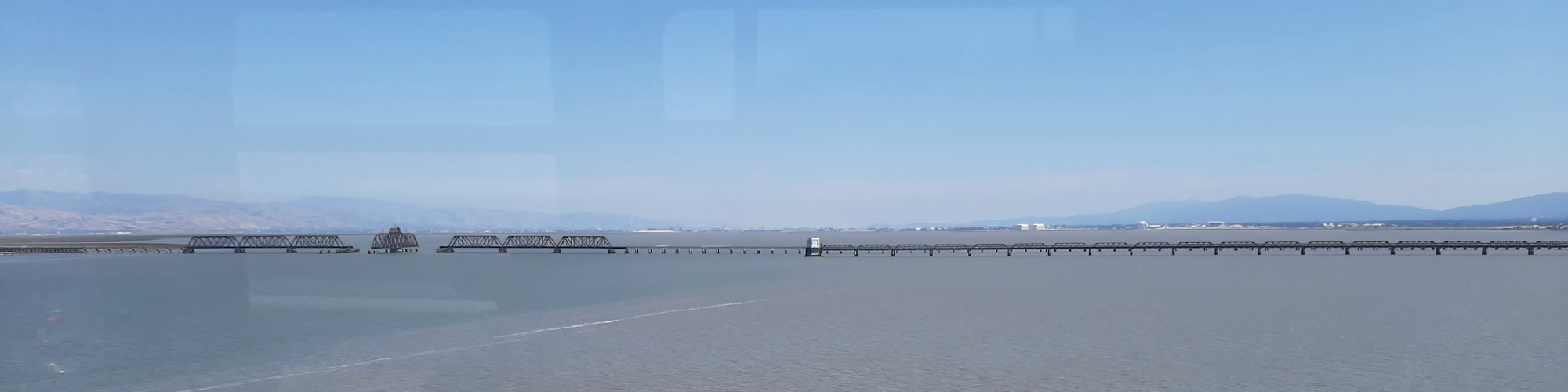
But if it’s a quick and pleasant read, in theory, it also took me a lot longer to finish than its generously spaced length should have warranted. While I was carrying it on several buses and trains on a very long commute to the South Bay from the East, and back, I often found myself putting it down to stare out the window. Reading it was a bit like riding a bus across Dumbarton bridge, in fact. You might know that you’re moving forward, but because nothing changes around you—because it’s all just more vast and empty expanses of the bay, apparently timeless and unchanging—it can be hard to tell where you’re actually going, or if you even are.
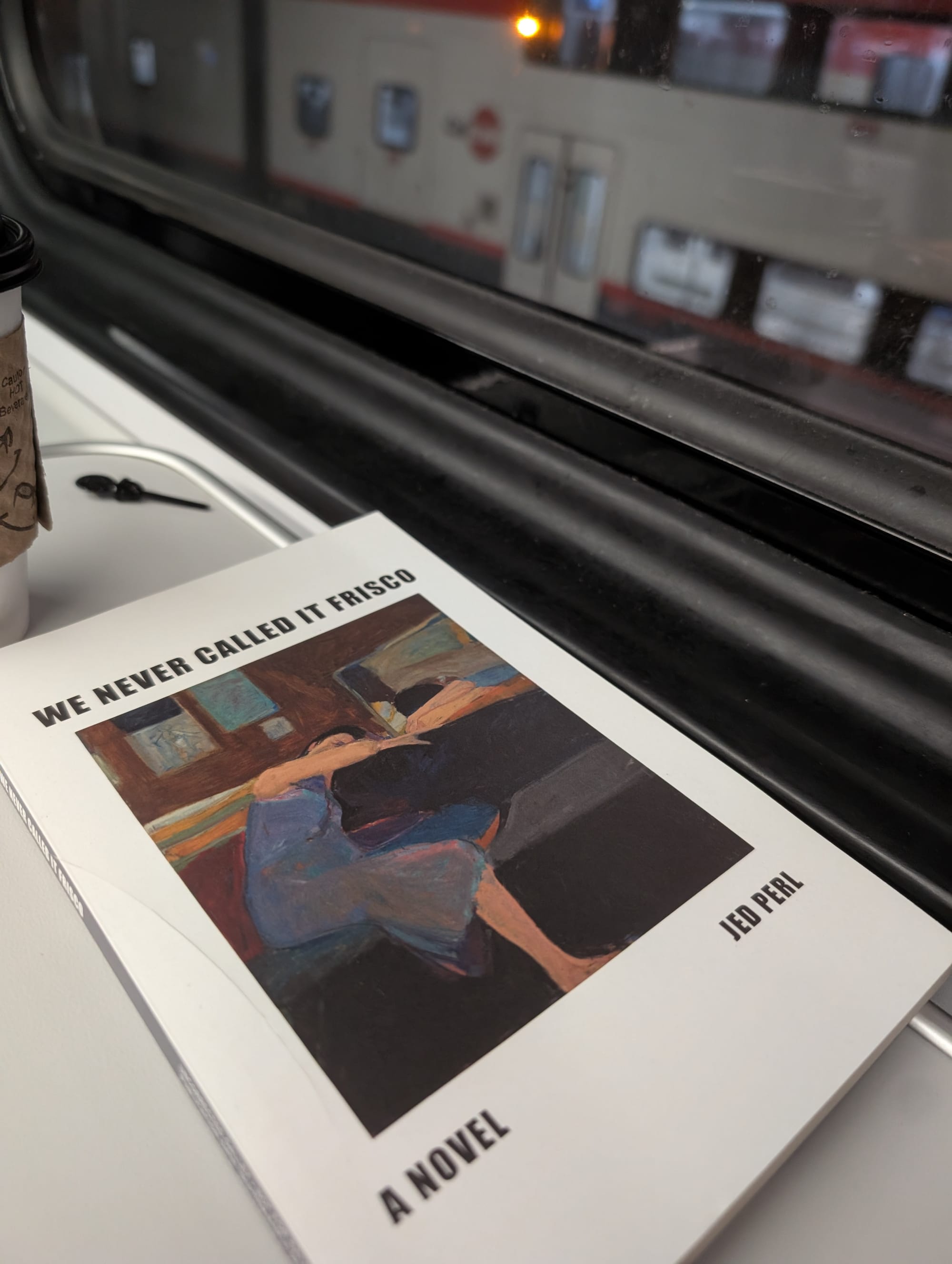
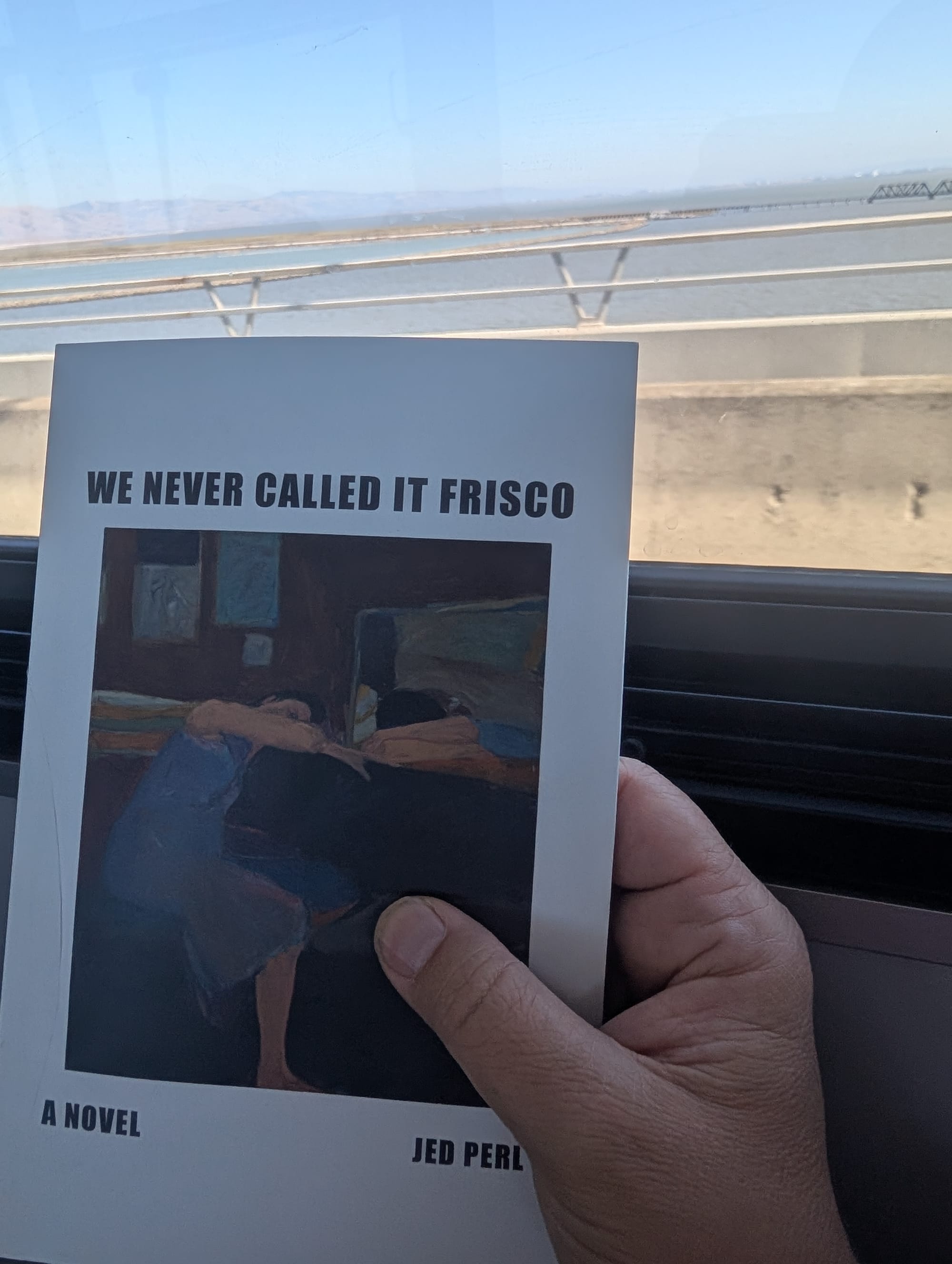
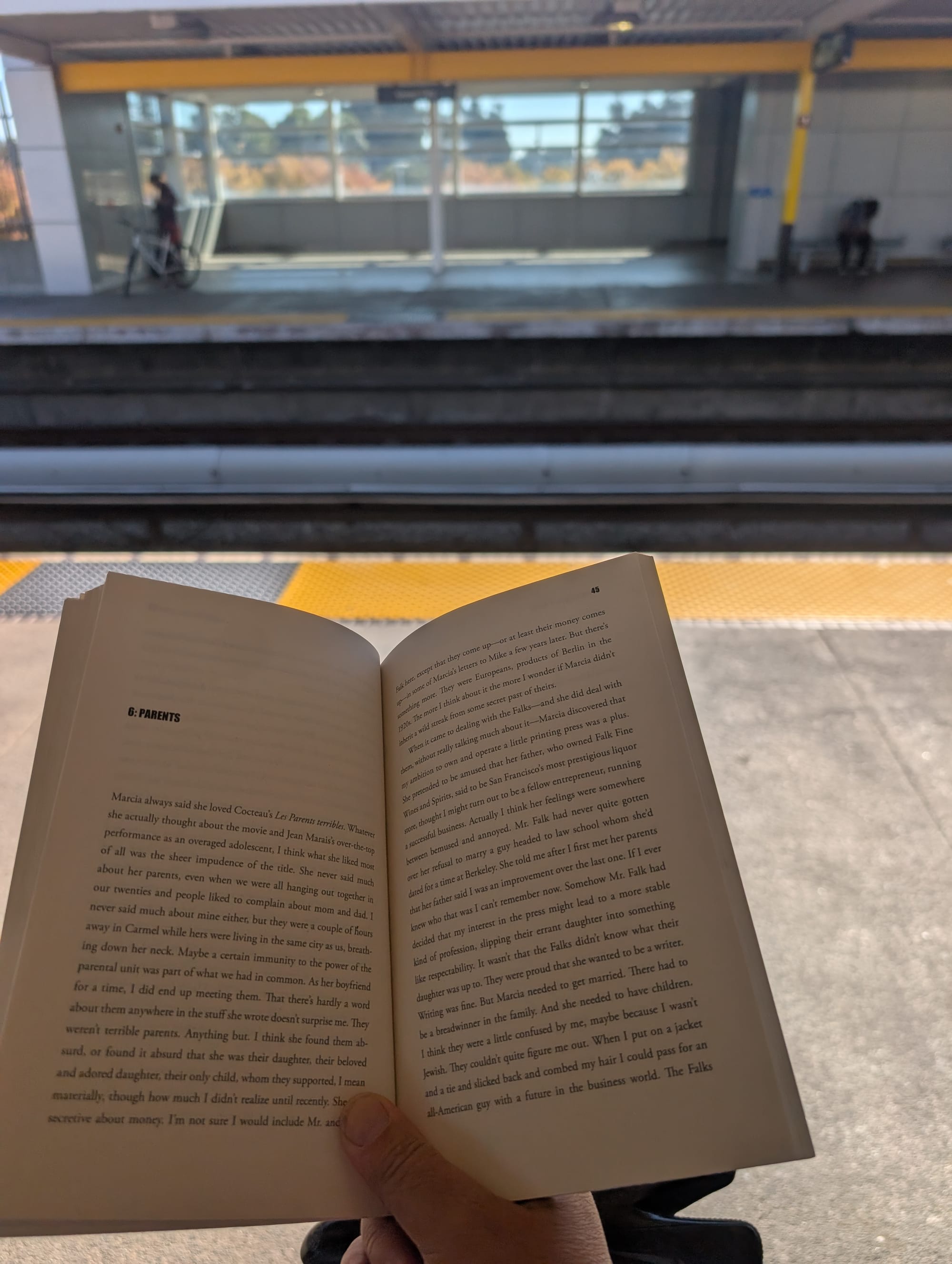
Reading Jed Perl on various forms of East to South Bay (and back) commuting. (AB)
That feels like the point, if I had to guess—and one kind of does have to—what nonfictional art critic Jed Perl was up to in writing this book. When Bolaño invented fictionalized literary scenes, in books like La literatura nazi en América or Los detectives salvajes, he did so to make a point: to assert, for example, that the beating heart of Western literary culture was secretly always fascist and that the real poetry was the fascist friends and soul-destroying compromises we made along the way (respectively). A counterfactual literary past, with some roman à clef references to real people sprinkled in, was Bolaño’s way of exploring some compelling questions. Why did the countercultural literary projects of his youth achieve so much less than they should have? How did a moment full of such possibility and promise fail to fulfill it? If there’s nostalgia in those books, in other words—and there’s some—the goal was far less to recover the counterculture than to understand why it died, how it lost, and what it all added up to.
What is here past the nostalgia? If you knew nothing about Jed Perl and had to deduce him from the text, you might assume this book was written by someone deeply invested in, located in, or identifying with the Bay Area of the fifties and early sixties. You might guess this book to be the same kind of nostalgic memory work, the kind of tribute, that Burt is writing about Marcia (and that Bolaño wrote about his own infrarealist youth). It’s the kind of book that doesn’t just happen to take place in the Bay Area but is about the midcentury Bay Area, as a specific and unreplicable place, and it’s told with a care and attention that implies the kind of scholar who would dig into half-forgotten archives in the Bancroft, or even more obscure collections; Burt finished his lover’s memoir because she was his lover, and cared in a way no one else quite does.
You’d suspect something similar of Perl, and there’s a little to that; he spent a few of his teenage years in Palo Alto, and his parents—an academic family—knew a few artists and writers from that bohemian world. But mostly he is very much from not-San Francisco. Mostly he’s the kind of critic who collects the adjectival “New York” in a variety of places, the kind of critic who would describe his formation in an interview with Brooklyn Rail, by reflecting that his “parents were New Yorkers,” and “[w]e always got the New Yorker and the New Republic, and started getting the New York Review of Books when it first appeared in the ’60s,” and also that “there’s little distance between the world I grew up in and where I am now.” He’s the sort of New York City critic who will publish an essay called “Spirits of San Francisco” in the New York Times Magazine, and the sort of first-time novelist whose novel with “Frisco” in the title would be launched in New York City.
In short, he is a New Yorker, a New Yorker’s New Yorker. And if the Bay Area scene he documents/invents clearly means something to him, it’s in that context. This is worth mentioning because, from beginning to end, the novel construes its “local” and not-called-Frisco scene in reference to the way New York City, specifically, neglects it, condemns it, or ignores it.
These are the novel’s opening lines, which set the tone for the entire endeavor:
They say we’re a town full of losers. They say we’re eccentric, eclectic—marginal. Maybe I’m exaggerating. But when somebody on the East Coast starts talking about a rivalry between New York and San Francisco the truth is they’re trying to shaft us. They’re saying they’re the best. They’re snobs. But I suppose we’re snobs, too. Here in San Francisco we’re proud to be the opposition. We’re glad to be living on what New Yorkers regard as the wrong coast, with the wrong publishers, galleries, reputations. We are what we are. And damn the rest of them. Call me old-fashioned, but I’m still flying the flag for the San Francisco Renaissance, all the poetry readings, mimeographed magazines, improvised galleries, experimental films.
It’s hard to overemphasize how much these characters struggle to, need to, and fail to, kill the New York City in their minds. That NYC is so omnipresent in the minds of the artists and critics he imagines, makes the fact that Perl is a New Yorker writing about the Bay kind of interesting, after all. Burt’s “we” in that sentence never forgets how it’s seen (or not) by New York, they are all always protesting far too much about their autonomy from it. The whole novel is kind of like that, one big cultural wounded attachment, a crew of nomadic artists and writers and critics all collected and stuck together, like scar tissue around the void that is the Bay, with Marcia at the center.
That’s what “the Bay” turns out to be for all of them, especially for Marcia (and through her, ultimately, for Perl): a negative frame, the sense of existing in a space of freedom and isolation from the center, and what that distance positively enables. “Everyone who disappears is said to be seen at San Francisco,” as Marcia quotes Oscar Wilde for what she considers for the epigraph to her book; San Francisco is where you go to not exist. And that nonexistence—in the eyes of New York—allows a unique and precious form of artistic freedom. It’s where a scene springs up, formed by that freedom.
Why? Well, there’s an arresting moment early in the text, when Burt mentions that he manages to make a living off of the old printing press he uses for poetry and his own little magazine that no one reads; it’s a line that will be so foreign to anyone’s experience in the Bay Area, now, that it jumped right out of the book and punched me in the 1040. For Marcia and her set, San Francisco possesses “all the attractions of the next world” (as she quotes Wilde, again) because it’s the midcentury version of Portlandia’s where young people go to retire. But what a counterculture truly requires is rent so low you don’t need to work (or an actual public support system).
This, then, is the tension of the book: If the Bay Area offers them “freedom” to do their own thing, alone together and away from the hubbub of The City—which in this novel, is always New York—it’s NYC's authority that makes that freedom meaningful (and being free of New York City never precludes writing about it for New York Times Magazine or its equivalent). Pastoral retreats are, after all, always a way of relating back to the city, the thing from which the retreat is construed.
Once you see it, you’ll see it everywhere in this book, and in its author. Jed Perl’s last book, “a defense of the arts,” was called Authority and Freedom—the dialectic he construes his artistic philosophy from—and in this novel, he writes about artists in the Bay Area who define themselves by how New York City sees them (or the fact that it mostly doesn’t); “San Francisco” has come to signify to him, in New York City, then, as an idea: the kind of breathing space, critical neglect, and freedom that their West Coast habitus gives them (or, once did).
\O/
I picked this book up for my own provincial reasons. I’m interested in the matter of not-calling-it-Frisco because I recently wrote about how Herb Caen made not-calling-it-Frisco into a whole thing, in his essay and then his 1953 book called Don’t Call It Frisco. Caen wasn’t the first or only person to do that Arguably it was Emperor Norton. But Caen defined the meaning of not saying it, in the particular postwar-but-pre-1967 “midcentury” in which Marcia Falk was (fictionally) an active critic. When a new and booming San Francisco was coming into existence, Caen made not calling it “Frisco” into a way to belong to the future, a form of aspirational (and gentrifying) self-fashioning, in the moment when the city was becoming The City, a center in its own right. For Caen, then, calling it “Frisco” marked you as a rube, lower class, or a tourist; making a point of not calling it Frisco, for him, became a way of erasing (and rendering unspeakable) the entire strata of San Francisco natives who had (and did, and would) call it that, in favor of the more newly arrived, implicitly higher-class people one sought to join and be, who named it as the city it would become.
I don’t know if Jed Perl is hip to all that, to be honest, though Marcia Falk certainly would have been. My essay was published a whole four days before Perl’s novel came out, but it doesn't seem like he was able to update his novel accordingly, as one would have liked. Herb Caen is never mentioned in it, though Marcia Falk briefly works at the San Francisco Chronicle (and thus would have been his colleague). She has nothing but contempt for that period of her working life, and for the Chromicle’s vision of the city’s newly middle-class, bourgeois identity. But she would have known Caen and would have known that she was quoting him. If Perl does, he doesn’t show it.
Another strike against Perl and his novel is that Oakland does not appear a single time in it (beyond an extremely passing reference to Gertrude Stein, which does not count). But despite lamentably few indications of his being an ORB reader, Jed Perl very much gets the way a mimetic term like “Frisco” can be used to index group identity, and how making a point of not saying it calls up an entirely different scene and slice of social experience (measured against those who say it). I don’t have to tell you, for example, what it means to refer to the San Francisco Chronicle as “the Chromicle,” but I also can’t: If you know, you know, and if you don’t, explaining it kills the fun of doing so.
For this reason, Perl’s book never explains why never-calling-it-Frisco sums up Marcia Falk, or the “we” of her book’s title. The book’s single reference to the idea that “only tourists called SF ‘Frisco’” would barely register at all, were it not for the title. And Marcia does use the verboten word once, in the title of an essay on “Forgetting Frisco,” an essay she was tasked by her New York City editors to write as an assault on San Francisco’s overhyped status, as they see it (which she—in that moment—is willing to entertain). But you could be forgiven for reading this novel and having no idea why it’s called that. Appropriately, they don’t really talk about it.
It gets clearer if we think about who was calling it Frisco, in 1967, and whom Marcia and others were distinguishing themselves from. For her and her scene, not-calling-it-Frisco connects to the specific kind of bohemian she was, as a participant in and chronicler of a very distinctly pre-1967 mode of Bay Area counterculture. And I think Perl is largely interested in that scene, and that year, because it’s about to be so comprehensively superseded and overwritten by the Summer of Love, which kills it. The book is not a mystery novel, because there is no mystery: the fact that she dies in 1967 carries explicit symbolic weight (and not only because she is grappling with the feeling, in her forties, that her identity as a “young critic” has abruptly passed her by); Perl makes her represent a form of artistic and critical practice that was being displaced by everything “San Francisco” would come to mean after all those new young people started showing up in the Haight-Ashbury district, congregating in Golden Gate Park, and replacing the older bohemians of the “San Francisco Renaissance” as the local counterculture.
In this sense, Marcia Falk’s is a slightly differently white and bourgeois San Francisco scene than Herb Caen’s, but the closest she comes to directly explaining why her “we” never called it Frisco is a very Caen-ian passage, late in the book: “to us, the old San Francisco—the gold rush saloons, the Barbary Coast brothels—was a big, dumb cliché.” That “Frisco” recalled the old boom-and-bust gold rush–era city of the working class was part of the attraction for all those post-’67 hippies, who very much came as tourists; calling it “Frisco” gestured toward exactly that sense of the American West, as an escape from respectability. This is why Marcia so hates the “stupid bliss” of the Haight-Ashbury scene, why everything about the so-called Summer of Love “infuriates” her, and why her death, in 1967, is so retroactively obvious and symbolically necessary that the book doesn’t bother to explain it.
And all those young people did tend to call it Frisco, exactly like the tourists to the lower class they had no compunctions about being. Otis Redding sang about how he left his home in Georgia and “headed for the Frisco Bay,” because being a pilgrim was precisely the point of the song’s evocation of the place; the Grateful Dead added a “Frisco” to the traditional lyrics of “I Know You Rider” for the same effect. For that broad scene, “Frisco” indexed their sense of the place as a waypoint for the kind of antibourgeois wanderers they wanted to be, who, though not from the place, came to the place because of what it was, and what they wanted to be there, too. Music wasn’t the only thing “San Francisco” came to stand for in the American 1960s, but the “San Francisco Sound” hippies were also inspired by a specifically different set of writers and artists than the people Marcia pals around with; someone like Bob Dylan brought mass attention to people who did call it Frisco—like Kerouac and Ginsberg—because they were freshly arrived, had already departed for the East Coast, or came to “Frisco” specifically for the glamor of that old reputation.
The free thinkers Marcia Falk chronicles—and who Perl chronicles, through her—are, by contrast with the 1967 hippies, a very specifically rooted and sedentary set of artistically bourgeois Bay Area types. They all met at Berkeley—a name which always means the university that brought them all there, in the thirties and forties—but the scene is often rural, and very Marin-oriented; their not-Frisco happens as much in Bolinas as in low-rent apartments in North Beach or the Mission. But their Bay Area is very much not the streets and parks and cafés where the young people were going; it’s the spots, outside the city proper, where you can get your hands on an old weird house with some land and some air—as Marcia did—that you can manage to keep (and pass down).
In 2020, Perl published an essay called the “Spirits of San Francisco,” in which you can see a refraction of this novel; it’s all about Robert Duncan and Jess, about their house, and about the things collected there, and, more expansively, about the “motifs, themes, and even obsessions that link many of the Bay Area figures” of the period:
They valued the intuitive, the quotidian, and the fantastical—and they liked to mix it up. What was it that held them together? Did they all feel the strong impact of the teaching at the California School of Fine Arts? Or did Jess function as a sort of diffident chef d’école and Duncan as the atelier’s exegete, the couple’s interests so captivating that they influenced what their friends were doing? It’s also possible that these artists and writers were under the spell of something more pervasive and elusive—what we might call the spirit of San Francisco.
In naming “the high-minded hedonism of the mid-twentieth-century San Francisco Bay Area avant-garde,” in 2020, Perl was gesturing towards terrain that We Never Called It Frisco would dig into; when he declares that their avant-gardism is “worth contemplating now, when the swagger and free-spiritedness of the old West Coast bohemia have been buried beneath a tech-savvy San Francisco that they would find unrecognizable,” he was offering a kind of “why now?” for the little novel he would publish six years later. And when he declares, in that essay, that amid a flood of their work and archival materials, what “may still be lacking are the analytical tools necessary to describe and define their visual and literary worlds,” I think he was, more or less, describing what he set out to provide with his novel.
What that is, I’m going to suggest, has actually very little to do with “San Francisco,” as a real place and history. It’s about criticism, about what the idea of the place allows Perl to explore. This is, after all, a novel by a critic about a critic, in which much of the actual text is “fictionalized” criticism; it’s a meta-critical take on what criticism should be, written by an author who has said that “Criticism for me has never meant just ‘art criticism’—it’s always been about criticism in general.”
It falls to me, therefore, as critic, to imitate Marcia Falk and declare, pugilistically, that to the extent any critics have noticed this novel—not many have—they are all wrong about it. The Chromicle review calls it a “delightful journey for any San Franciscan or art aficionado as Perl takes us on a tour to City Lights, North Beach restaurants and ‘old San Francisco’ charms,” and all the blurbs one finds on the dust jacket also “Frisco” it in this way: Carol Maso calls it “a poignant attempt to hold a time, a place, a world all but vanished,” Joshua Cohen calls it a “poignant paean to the Bay Area bohemia of the 1940s and ’50s,” Vivian Gornick says that it “evokes wonderfully the middle-class bohemia of San Francisco in the 1950s,” and John Banville declares that “this really must be what it was like to be on the West Coast ‘art scene’ in what we now realise was an age of innocence.”
All of these people are wrong because flattening the novel into “poignant” historical tourism—into “what it was like”—Friscos it, fetishizing a time and place which, after all, Perl himself has only read about, and which he is using far more symbolically than literally. But the novel is obsessed with how people talk about talk about talk (in a novel about a book about an unfinished memoir). Those reviewers and blurbers make you expect that this is a novel that Jed Perl wrote about a place he knows, as the thing itself. But it’s exactly the point that this novel is made up of nothing but conversations among and about critics about criticism of art, always many times removed from The Thing itself, whatever that is (if it even exists). These layers of mediation, in their layered-ness, are what make it all criticism, about the kind of writing about the ever-receding thing that was possible at a different time and place, for which he is, I think, nostalgic. There can be no “what it was like” because, to wax Steinian, there’s never any there there when you go back. It’s all just an imagined recreation of the ways the past was already always imagining recreating itself, just talk on top of talk on top of more talk, all about talk.
It’s more than that I would describe the novel slightly differently from the way these critics have characterized it, though. My version is courageously correct, and theirs is damnably false. But also, being wrong is baked into what critics do, in a way the novel is also using the figure of a dead and fundamentally unfinished critic to explore. Marcia is a very familiar kind of pugilist, brutally unsentimental and unsparing; because she was young in the 1950s, and not the 2010s, she shreds Brecht and popular front leftists, instead of whoever it was that your favorite Patricia Lockwood or Lauren Oyler or Andrea Long Chu takedown review took down. But she’s the kind of polemicist who writes polemics against polemics, who goes to New York to forget San Francisco, and then returns to forget New York City; she’s the swashbuckling critic you hire when you want to see blood on the ceiling, but only as long as she is still young enough to attack the olds. She’s the kind of critic who becomes unthinkable when the new Youngs come along, and usher her from the scene; she’s the kind of critic who, when the time comes to figure out what the meaning of her “early years” was, has a hard time figuring it out, and dies instead.
She might even represent, in that sense, the critical principle that what a work of art is, ultimately, is something that doesn’t last, an event that doesn’t even need to add up. It’s also symbolically potent that Marcia dies at the opera—watching a washed-up chanteuse with whom she identifies—because her most interesting (and “important”) essay, as the book represents it, is a piece she wrote about an event that happened at the opera house in Rome. But that event in Rome is just another prereflection of San Francisco itself (and of the opera house where she will die, watching a singer at the end of her life):
Rome is San Francisco with a history, a hyperbolic San Francisco [which] in its old age has collapsed into a second childhood that’s a little like San Francisco….New Yorkers imagine that San Franciscans envy them their centrality….But there’s also something to be said for decentralization. Instead of the overarching order and standards of New York, London, or Paris, you have neighborhoods, fiefdoms, little rival magazines, alleys, tangents.
So: What is the “something to be said about decentralization” that this novel has to say?
I think Jed Perl, ultimately, created Marcia Falk as a kind of ego ideal and projection of his sense of vocation. They are similar, in some ways; Perl is the kind of art critic that a lot of people call “conservative” but who is more likely to call himself “liberal,” in a context where those words don’t mean what they most colloquially mean. He’s the kind of art critic who loves modern art, but never seems to like anything more modern than the sixties; he’s the kind of art critic who’s been complaining, for decades, that the elite art institutions only promote politicized issue-based art—postmodern and ideologically driven (because he’s the kind of art critic who can find those terms sufficiently synonymous)—and he’s also the kind of art critic who had an expense account at the old New Republic, right up until the great Leon Wieseltier exodus. If he’s a critic who positions himself as a skeptic and a dissident to an art celebrity-oriented mainstream (in which “exhibitions don’t give public expression to private feelings so much as they offer canny responses to market pressures”), he has nevertheless quite successfully managed to make himself a kind of art critic celebrity, with a platform in its most reputable outlets.
On some level, it all makes me wonder if, for Perl, Marcia Falk represents the kind of critic that he should have been, almost exactly because she never lived long enough to be truly successful (or old). And writing a book that doesn’t need to exist, that will be forgotten—about artists and critics that even in their own invented alt history, were largely forgotten—might be a way of suggesting that the art is something whose value is perhaps not best scrutinized in those terms. In Authority and Freedom, Perl wants “to release art from the stranglehold of relevance—from the insistence that works of art, whether classic or contemporary, are validated (or invalidated) by the extent to which they line up with (or fail to line up with) our current social and political concerns.” For “a public inclined to look first for relevance,” I wonder if, perhaps, he wrote a novel based on the idea “that art’s relevance has everything to do with what many regard as its irrelevance.”
\O/
And so, what’s left? At the end?
At one point, Marcia Falk reviews an opera in Rome that I spent some time trying to google and determine whether it actually happened, or was based on anything, or whether it could have happened, and I could not. All the easily available records I found gave me almost nothing to work with, and after that, I gave up. (If you can’t google something, it definitely never existed.)
But in remembering that review, Marcia Falk recalls asking the art critic Giovanni Carandente “Does it all go together?” of a work of art they’re looking at. “Of course not” he responds. “That’s the point.” And then she asks Italo Calvino how the scenario he’s writing, for the opera she’s writing about, is “all supposed to add up”; he responds, with a similar smile and a shrug: “But why should our time add up?”
In the end, the question of this novel is what is there, at the end, of a critic, what is left of her time and what it all added up to. But it’s not clear, for Marcia, that she reached many conclusions, and there’s no clear throughline for her writing, really, just a sense of enthusiasm, searching, and artistic sociality. What’s left, at the end, are the communities and friends and loves that cohered through her words; if her work survives, it turns out, it’s mainly in the hands of her lover and his vanity press, in her letters, and in the spirit of her community. But also, in what is perhaps the most Bay Area touch of all—and here you have to hand it to Perl for absolutely nailing it—the real thing that is left of a person, in the end, is the house where they lived and the question of who gets to inherit it. There you have the real truism for any artist or critic, in New York City or the Bay: Art and life are brief. Only real estate is forever.
We Never Called It Frisco
Jed Perl
Coffee House Press; 136 pp; September 2026