I went to the ‘existential hope’ gala and left hungry
This week we’re publishing a handful of stories about the bad vibes in the tech industry. Sorry!
My friend (let’s call them Elle) scored us tickets to Apollo Innovation Commons’s First Light Gala via an event planner who needed a few seat fillers. As a rule, I always say yes to free tickets for startup incubator summer solstice rituals. This sounded like a throwback to the kind of thing that used to go down in the startup heyday of the 2010s, and I wanted to see how it held up in the Bay of today, where flock cameras are imminent and trillionaires sue billionaires for the public good—and where, for pretty much everyone but its practitioners, tech optimism has curdled into disdain. With a sticker price of $333 a head, I figured at the very least, the food would be decent.
Securing the location had involved some half-baked cloak-and-dagger. Elle sent me my digital passcode the previous day: eudaimonia. This opens a portal, where I’m told the word means human flourishing, the thing “Apollo Innovation Commons exists to build.” I click the “Approach the Oracle” button and navigate a buggy gold-orb cursor through a Greek pantheon personality quiz. After three questions I’m designated Apollo, The Light Bringer, and am bestowed a poem I’m definitely not reading. With that, I arrive at the information that was the whole point of this exercise. The event is at a building called The Hibernia (Latin for Ireland, not hernia). According to the booking site, it holds the limp distinction of being San Francisco’s largest historical rental venue.
We enter the foyer and approach a folding table staffed by someone dressed in white. The invitation was clear on this: We were to wear only white. There’s a Pinterest board, in case any guests forgot what white people in white look like. I’d been able to thrift a pair of eggshell Dickies that afternoon. Those, a Hanes tee, and a bleached ballcap had me looking more house painter than hedonist. Elle and I are handed a trifold run of show, a laurel sprig, and an envelope which we are told not to open until instructed. With that, a sweeping arm gestures toward the elevator.
Apollo Innovation Commons (AIC) is a startup incubator, helping early-stage businesses grow in exchange for equity or something. According to the website, they are “the Evergreen Frontier,” and they are creating “infrastructure for existential hope—education, incubation, research, design, and capital deployment under one roof.” Just the types of glittering tech-industry generalities that, over in Oakland, translate to higher rent and shittier public transit. Sleuthing the fine print, one might learn that AIC is a “fiscally sponsored project” of a 501(c)(3) called the Flourishing Systems Foundation, an organization exploring “AI aligned with human flourishing.” Click a few more partner links and the curtain will open on a maddening vista of interlinked nonprofits and foundations with names like Existential Hope, Future of Life, and Aliveness Ventures—platforms that exist to platform other future-racing platforms. All roads lead to, wait for it, AI research. That, and an EIN for easy tax deductions.
The elevator opens upon a white room. We are greeted by athletic bodies in togas and plastic head wreaths. Over in the corner a small balding man plucks lazily at a harp twice his size. Left of him is a counter-lined hallway, where two catering chefs with worried expressions are bothering a huge pan of meat balanced on a small hot plate. I walk over to the bar and learn that there is no booze, only soda and sparkling water. There is no ice.
I walk back over to Elle holding a warm La Croix I don’t want. She jerks her head in the direction of a tall, charmingly nerdy woman with dusty-brown hair. I learn that this is Curtis Yarvin’s ex-fiancé, Lydia Laurenson. Curtis Yarvin is one of those rare orchids of humanity that only grow in the Bay Area. Originally a software developer, Yarvin began Urbit, a decentralized operating system, in 2010 with funding from Peter Thiel and the other usual suspects. Today, he is better known as the political theorist behind the Dark Enlightenment, a movement advocating for the dismantling of liberal democracy and the installation of a corporate monarchy led by a dictator-CEO. Back in 2007, when Yarvin blogged as Mencius Moldbug, his ideas were on the contrarian fringe. Today, Vice President JD Vance has cited him as an influence, and versions of his proposals for gutting the administrative state have migrated into actual government policy. Remember DOGE?
I try to work the room, but the warm seltzer isn’t loosening any tongues. Everyone has interpreted the all-white dress code differently. There are bedsheet togas, tuxedos, festival shawls, and vipassana PJs. A chill wafts in from the double doors that open on to the veranda where dinner will soon be served. I throw on my jacket. It’s not white, but nobody seems to care. Elle divulges a little more lore on Laurenson. She’d won her engagement to Yarvin by answering a personal ad he published on his blog. Yarvin’s previous wife had died suddenly from a rare form of heart disease. Yarvin was not interested in dating, so he sent out a Substack summons to a woman of “childbearing age.” We all grieve in our own way.
Laurenson, a liberal with a respectable list of feminist publications (under her pen name Clarisse Thorne), answered the call. Her plan was to save Yarvin from the dark side, unite their keen intellects, and fight for good. This didn’t pan out. However, according to an article in the New Yorker, she did get him to stop saying the n-word. They separated in 2022.
A woman in a chic ivory gown begins speaking into a hot mic. There is a quick “invocation,” followed by an “anointing,” and a round of applause for Joe the harpist who almost didn’t make it tonight.
“Joe passed a kidney stone this afternoon,” our MC tells the crowd.
The applause peters out as Joe stares forward with tired, blank eyes. With that, we make our way onto the veranda for dinner.
We may be entering the phase where it feels like Big Tech is abandoning even the end consumer, becoming fully airborne, a production machine that produces only its own furtherance. It is kept aloft on the data of our lives and deaths.
A fog has rolled in. I zip up my jacket as I take my seat. Laurenson, seated across from me, asks after the patch stitched on my jacket’s left front in a tone that is hard to read. The patch is four black letters, CCRU, on a red field. This is an acronym for the Cybernetic and Culture Research Unit, the moniker of a secret society begun by a group of University of Warwick grad students in the mid 1990s. Like Yarvin, the CCRU is another one of those little-known links in the current Bay Area tech’s causal chain. The group offered a dystopian, Lovecraftian alternative to emerging cyberspace, which at the time was tie-dyed by the naive optimism of ex-hippies—folks like Stewart Brand, Steve Jobs, and John Parry Barlow. Though short-lived, the CCRU’s ideas around accelerationism, transhumanism, and artificial intelligence have had a lasting legacy. Its ex-members pepper academia and the arts to this day, including author Hari Kunzru, the late theorist Mark Fisher, and Yarvin’s friend Nick Land. It is likely Land’s affiliation with the CCRU (and her ex) that has Laurenson asking after my patch.
I try to make light of it by complimenting her grasp of cyber-lore and assuring her that I’m more of a fan of the CCRU’s leftist contingent (to which Land is the sole exception). But at an event like this, it’s disconcerting that Laurenson is the only person to make note of this patch. If current blueprint tech accelerationism has a main designer, it’s probably Nick Land. The startup incubator’s model owes a good chunk of its source code to the jam sessions of Land and a bunch of other British grad students—sessions that were far less sober than this gala. The CCRU writings were, at the time, cautionary tales about dark futures, but Silicon Valley has a propensity to mistake apocalyptic warnings for business opportunities. Read now, the CCRU’s writings feel less like dystopian speculation than description. We may be entering the phase where it feels like Big Tech is abandoning even the end consumer, becoming fully airborne, a production machine that produces only its own furtherance. It is kept aloft on the data of our lives and deaths. We are its “commons”—how much longer until we aren’t even that? What happens then?
A late guest slides into the seat beside me dressed in plaid and denim. I feel a pang of annoyance—how quickly I’ve become precious about the rules of our cabal.
“Sorry, I just got back from a popup city,” he says.
“What is a popup city?” I ask.
Bread, brie, and grapes are laid on the table by one of the evening’s volunteer staff. Near the door togas-of-authority discuss issues with the mic in hushed tones.
“It’s when a group of founders take their teams to a small town to do some deep work for a few days.”
My mind fills with the nightmare image of hundreds of device-laden coders rolling into town like a toxic fog, filling every available lodging to capacity, complaining about wifi speed and decimating the lobby coffee station. Was this plague or windfall to their victim’s local economy? I ask about his startup. He works with a company racing to be the first to place shuttle refueling stations in orbit.
“So like a Texaco, but in space?”
“Yeah, pretty much.”
Elle almost chokes on a grape.
“What do you do?”
“I’m a writer,” I say.
“Oh, cool, my wife plays the cello.”
A mic pop diverts all attention to our MC. She says the time has come to open the mystery envelopes we’d been given upon arrival. Inside are five cards, three with monetary sums and two with what I would call both reasonable expectations of and near-impossible goals for our society.
My cards:
- $7,500
- Soil that can grow food.
- $10,000
- A functioning democracy.
- $40,000
The cards are for a game, the rules of which are hard to hear over the conversations of uninterested—who can blame them—guests and an ill-timed dinner service. Near as I can tell, we are to make trade deals with our tablemates, leaving some of us with a stack of the things we would have if Bernie Sanders had won in 2016, and others with a war chest of Apollo dollars. What the game is meant to demonstrate is unclear. Is AIC trying to tell us that nice things take investment? That you can’t have both healthy soil and money? I trade my “functioning democracy” for $5,000 with a man wearing a Tiffany pinky ring. I’ve never seen a democracy function, but I sure as hell know what five grand can do.
The stewards of our “Evergreen Frontier” can’t even steward a hot dish to a table.
Most guests are more preoccupied with trying to attack their dinner—cold lamb chops and about two tablespoons of quinoa salad—with a chintzy plastic knife and fork. After much sawing I see that my chop is rare, with the unsettling purple hue of a week-old bruise. I side-gig as an onsite catering chef. I know the difference between an unfortunate circumstance and a total lack of foresight. This is the latter. The stewards of our “Evergreen Frontier” can’t even steward a hot dish to a table. What did their Slack look like?
Brian: We should serve lambchops at the Gala.
Bryan: I’ll order a hot plate and plastic knives off Amazon!
Brian: Great! 🤗
Our MC, noticing the trouble, encourages us to eat with our hands. The new owner of my functioning democracy is attempting to engage Laurenson in an earnest conversation about the game, lamb juice dripping over his rings. Dessert is distributed by event volunteers, a cream pie with a Kirkland Signature look to it. I politely decline.
“Are you concerned that there is not enough pie for everyone?” the short man holding the plate asks me.
I take a moment to process. Is this another game?
“Is there enough pie for everyone?” I ask.
“Depends on the size of the slice.”
He walks away. Elle and I decide that this evening is, and will continue to be, a beautiful disaster.
In the Rotunda Room, the Gifting Ritual will soon begin. A projection-mapping display and Japanese butoh dance performance are on the docket. Elle and I abandon our table, hoping to get a choice seat. On our way I check on the bar to see if booze has materialized, beseeching Dionysus for anything, a single White Claw to dull my soon-to-be-flogged senses. No dice. No ice.
The Rotunda Room is actually the inside of The Hibernia’s neoclassical rooftop dome. The scant seating is claimed so Elle and I grab a spot on the sharply sloping wall near one of the three human statues spaced equally within the rotunda. They wear ragged white mummy wrappings and expressions of anguish. Same. In the center of the room is a PVC pipe obelisk about the size of a fridge draped in a white sheet. A projection of golden laurel leaves falls infinitely across its western face. When I heard projection-mapping I was expecting more of an Immersive Van Gogh situation. I may leave early and projection-map the 1995 sci-fi classic Hackers on my apartment wall.
It’s getting cramped, and no one knows how much distance is polite to maintain from the three sad mummies. The projector is on an unanchored, flimsy wire bookshelf that keeps getting bumped, shaking the image. Intrusive thought: “please fall.”
LED floodlights begin strobing ROYGBIV across the walls. A sax-heavy cacophony assaults our ears. The statues come to life, contorting through the crowd with the spastic motion of an ungreased seizure. They dance toward the center of the room, spinning little white parasols. Reaching the obelisk, they kneel, offering the parasols balanced across their flat palms—a gesture devoid of context or explanation. The music ends, the lights hold on red, confused applause peppers the room. The dancers proceed out, replaced by our MC and another young host. They flank the cube, which now bears a looping image of a coiling serpent, and begin reading in unison.
“Apollo carried light into the world. The Apollo space mission carried humanity beyond it. On the solstice, the night of the first light, we gather to carry both traditions forward…”
And so forth.
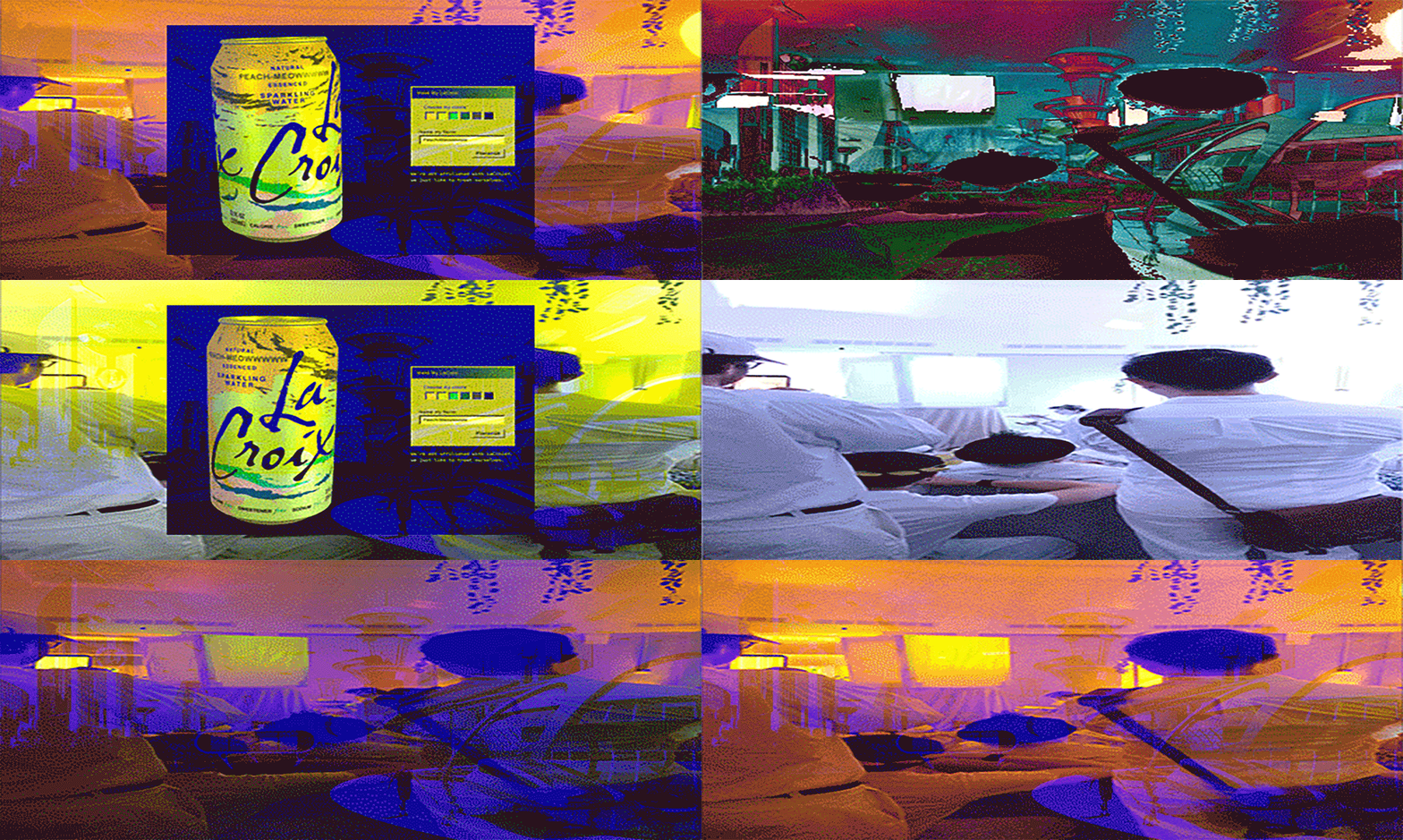
We’re instructed to weave our laurel branches into the plastic vines around the room. The laurels represent the old world we are, on this longest day of the year, leaving behind. The gesture feels less potent as I imagine all this decor, plastic and organic, stuffed into a trash bag before the morrow.
Then we arrive at the whole point of this appropriative, phoned-in, boozeless spectacle: the pitches. Three founders describe their startups. The first is creating a blockchain-based fractional ownership model of paintings to help artists or something. The second is developing networked wands that ravers can use to collectively control the music/lighting (could be cool). The third I’ve forgotten completely. Our MC returns, reminding us of the slip of paper in our pamphlet, the one that says “My Pledge to the Commons” followed by a list of “Giving Levels” starting at 1K and climbing to 25K, then another tax deduction EIN. They tell us to envision a utopia, then pitch blockchain paintings and ask for $25,000.
The new startup kids are looking very tardy to the party. This gambit might have worked in 2012, but we aren’t in VC Kansas anymore (KanSaaS, maybe). It’s the age of Dark Enlightenment. Democracies are things to bet on with Polymarket, and killer apps are not nearly as profitable as killer drone weapons. Almost all of us miss taxis.
Or maybe they’re right on time. Near as I can tell, AIC is just a tiny branch on a fractalizing org-chart of foundations using the nonprofit structure to convert AI research investments into tax deductions. Outfits like AIC probably blink in and out of existence faster than the diodes on a Burner bike. It’s ironic too that AIC, begging us to pay it to build our future, is desperately rummaging through the past for a ritual capable of making that future mean something. They might have the right idea, but they’re searching in the wrong pile. Their ancestors are not in ancient Greece, they’re in the CCRU, Curtis Yarvin, and the sinister corners of early cyberspace. At least back then it was all couched in irony. But as we’ve learned, irony is dark magic. And as Land and Yarvin demonstrated, irony can metastasize into a dangerous earnestness. It can sway the fate of nations.
The pitches end. We transition to a link-and-build hour back in the main room. A table of slumber-party snacks appears (grapes, pretzels, and trail mix), and is rapidly consumed by starved guests. Joe is gone, replaced by a mustachioed white guy playing an African kora wired up to loop pedals. One of the admin togas is panic-ordering Domino’s. Still no booze! I talk to a woman building out an AI platform to accelerate legal contracts. We exchange numbers. I don’t know why.
Sean Jewell is a writer living in Oakland. You can find more of his work on his Substack, eternalreturnpress.substack.com.