The billionaires’ duel at the courthouse
I.
When you arrive at the floor of the Ronald V. Dellums Federal Building & U.S. Courthouse where the Musk v. Altman lawsuit is unfolding, you are immediately haunted by the Ghosts of Industrialists Past. Standard Oil, Chevrolet, and Clorox—corporate titans of East Bay yesterday—are the first three photos on the wall en route to the courtroom. It’s not until you meander down the windowless halls (to the left) toward the jury waiting area that the workers who built and maintain East Bay history become visible: anonymous dock workers, launderers, shipwrights, grocers, salt miners, and rail car mechanics posing midshift, in grainy blowups bootlegged from local archives. Noticeably missing from the court’s fourth story: Black unionists, working women, and Chinese labor.
The week before jury selection, bad fonts on cheap paper announce next week’s big boxing match: “Musk v. Altman.” Something is in the air—the smell of huge piles of cash burning inside law firms nearby? a premonition of million-dollar attorney b.o.?—but the custodians and HVAC technicians do such a fantastic job keeping the courthouse squeaky clean, odors simply can’t prevail here. Without irony, a photocopy taped inside the elevator reminds visitors that AI glasses are strictly prohibited in the courthouse, by General Order No. 58. So much for wearable tech at the billionaires’ duel. Next week the warning gets its own pole outside, the twenty-first century’s equivalent of the “NO SMOKING” sign.
II.
In April and May 2026, a battle was fought in a downtown Oakland federal courthouse that had something to do with the anxiety of our age: artificial intelligence. Two billionaires—Elon Musk, 54 at the time, and Sam Altman, 41—went to war over the future of the world’s most valuable artificial intelligence company of its time, OpenAI. Headquartered in San Francisco, OpenAI developed the world’s most-used chatbot, ChatGPT, and now OpenAI’s future would be decided (lol) in Oakland. One billionaire a white-supremacist immigrant, pronatalist serial entrepreneur and vocal transphobe from Gen X whose companies make cars, satellites, rockets, tweets, and chatbots, who fired hundreds of thousands of workers from his own companies and the U.S. government, and sired fourteen known children with at least four women. The other billionaire a Millennial gay investor with a reputation for lying, who sired hundreds of Silicon Valley companies through his role at a startup accelerator and owns stakes in dozens of technology companies including robotics, biotechnology, and energy, and whose mentor is a gay white-supremacist immigrant who deals arms and is supercharging U.S. domestic surveillance.
Whoever might “win” this lawsuit in Oakland would one hundred percent not be you.
Each of their interests is a proud chapter of their life’s work, promoted as value-free technological and social innovations. Their ultimate competition isn’t for share prices or products; it’s for you, a computer user and internet customer. Your time, attention, data, money, social networks, opinions, and privacy, maybe also your career prospects, longevity, mental health, cost of housing, family planning, means of transportation, citizenship status, ballots, and biometric records—all of it may be touched one day by the ambitions of these two men. Whoever might “win” this lawsuit in Oakland would one hundred percent not be you.
In slightly more detail: Eleven years ago, Elon Musk gave money to support artificial intelligence research in San Francisco for what became many iterations of a project called OpenAI. OpenAI began as a research-only nonprofit with the involvement of Y Combinator, CEO Sam Altman, technology engineer Greg Brockman, and others. Musk sat on OpenAI’s board for a while, paid some of its bills for a few years, tossed many ideas around with OpenAI’s leadership about how to grow the enterprise, then quit OpenAI’s board and stopped giving them money in order to pursue artificial intelligence research inside his own companies, Tesla and SpaceX. As OpenAI verged on becoming a trillion-dollar company without him, Musk got pissed, felt owed, and accused Altman, Brockman, and Microsoft (OpenAI’s new sugar daddy) of “stealing a charity” Musk believes he cofounded in 2015. Musk accused Altman and Brockman of corrupting OpenAI’s founding mission to develop artificial intelligence as a nonprofit “for the good of humanity” and of misusing its intellectual property to enrich themselves personally minus him. Through this lawsuit, filed in 2024, Musk hoped to claw back $150 million from OpenAI’s for-profit activities, unseat Altman and Brockman from their executive roles, mess up OpenAI’s current business partnership with Microsoft, remind the world how problematic OpenAI’s cofounders are as individuals, and upend the race for artificial general intelligence, knocking OpenAI out its lead in the marketplace right before both OpenAI and SpaceX plan to sell shares to the public this year, seeking trillion-dollar-plus valuations.
 Megan Wachspress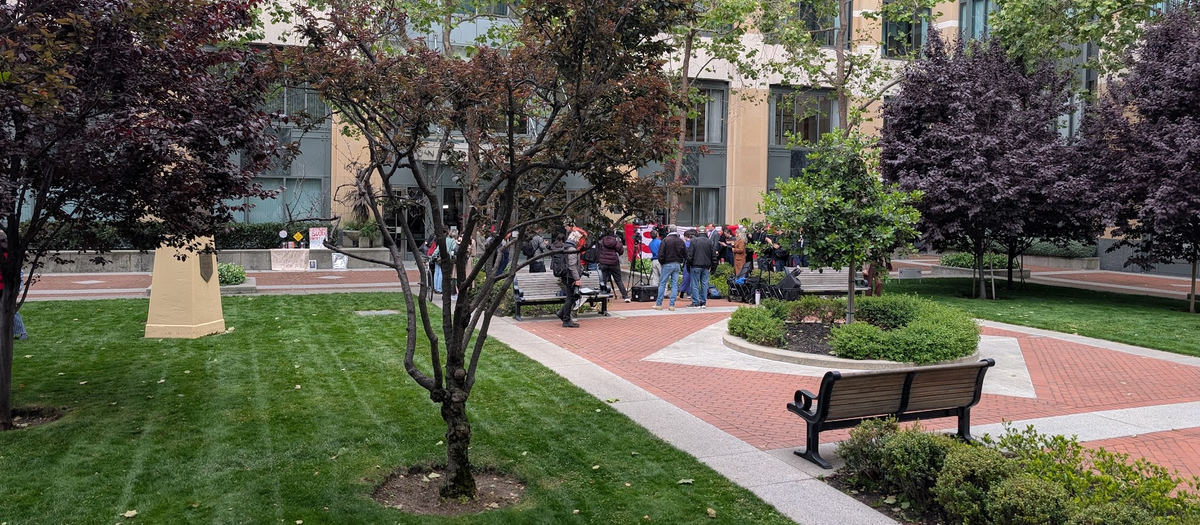
Musk also hoped his claims of “unjust enrichment” would establish some kind of legal precedent about nonprofit law generally in America. You already know how this ends. Musk’s claims fall apart over technicalities—he hadn’t filed suit within the statute of limitations—and all his emotional arguments about Sam and Greg get benched by the time verdicts are decided. The outcome might leave some questioning why this case was allowed to reach a courtroom in the first place. Perhaps there’s a clue in the very beginning, when the chief district judge presiding over this case, Yvonne Gonzalez Rogers, fixes the length of the trial to a month or less. They wanted a show, right? Let them have it. She seems aware that billionaires will burn taxpayer resources forever if allowed to. And so, with ironclad balls, she does her best to not let them manipulate the court system, while permitting them a few weeks to make utter fools of themselves.
III.
At jury selection, the virtues of working-class sacrifice are being sold to immigrants as proud badges of real American citizenship. First-generation, first-time jurors are being asked by the judge to serve U.S. democracy by sitting on the Musk v. Altman jury for roughly $8 an hour, a wage shittier than what they earn at their existing jobs.
One prospective juror shares that they work sixteen-hour days for the Department of Corrections, changing bed pans and feeding and turning patients, relying on overtime pay to make ends meet. Another says if they don’t show up to the lab where they work the lab won’t pay them, and moonlights as a dog walker. Another grows specimens which require daily feeding and can’t run science experiments from court. Another can’t find work with their criminal justice degree and so relies on jobs at Best Buy and in auto insurance. Someone’s leaving the country to do missionary work. Another inspects semiconductors. A Daly City employee feeds seniors on an hourly, no-benefits city contract that doesn’t qualify them for jury pay or leave. Someone is retired from Lockheed Martin and Northrop Grumman and won’t say more about that. Another drives for Uber. A weightlifter is building his career. A beverage company employee can’t sit too long on account of sciatica. One would-be juror manufactures home goods. A computer engineer hires offshore contractors and hasn’t followed news in five years. An interior decorator married to a tech worker wants the court to know she really, really likes her Tesla.
“Have you ever worked in teams before?” the judge asks of a prospective juror who has professional degrees, during voir dire. “You mean, the application?” the candidate replies, thinking of Microsoft Teams.
They are asked about their use of AI. An Oakland employee says the city is exploring AI but not using it yet. (Or are they?) Someone who paints houses uses AI to write contracts in English. An electrician uses AI to debug video games they build on the side. A bank employee is pressured to adopt AI for documentation at work. One airport employee has never heard of Elon Musk or artificial intelligence. A fraud investigator seldom uses AI for work. A bench scientist is concerned about AI user privacy. A bank teller describes “Elaine,” the AI agent that answers customer questions at her job. An Alameda County employee uses AI for fun. Two prospective jurors say they only understand about seventy to eighty percent of what’s been said so far, and are among the first to be dismissed.
“Have you ever worked in teams before?” the judge asks of a prospective juror who has professional degrees, during voir dire.
“You mean, the application?” the candidate replies, thinking of Microsoft Teams.
“No, I mean ‘teams’ as in ‘group work,’” the judge answers bluntly.
Hardship concerns are continuously worn down by the judge, who asks each juror if they have “someone else” who can cover their responsibilities at work, pick up their young kids from school, pay their monthly bills. Could they defer family moves from state to state? Could they squeeze their job obligations into evenings and weekends for the duration of the trial, estimated to last three to four weeks? In general, most Americans know the answer to whether someone can replace them in their households is “no.” Child care, helping family, paying a landlord—these are not things AI has “automated” away, or even plans to. These are the embodied, familial, financial obligations legislators have refused to help solve in America, and now jurors are being asked (once again) to figure it out as individuals, so billionaires at this trial can do business their way. The ideal juror sought for Musk v. Altman? Doesn’t follow news too closely, receives passive income and paid jury leave, speaks English perfectly, has never so much as mouthed the phrase, Eat the rich.
IV.
Every morning an appointed tall white guy from each legal team wheels bankers boxes in huge stacks to the courthouse, suggesting overwhelming evidence for their legal arguments, though I see a few are discreetly labeled “snacks.” Someone’s gotta push the rolly cart of Costco water bottles into the courthouse for the attorneys, someone’s gotta deliver hot coffee from a local café in a reused box, someone’s gotta look beefy and roided up with an earpiece in the courtyard so Oakland knows Billionaire Lives Matter, someone with a hip pistol’s gotta drag a sad-looking K-9 reluctantly around the property so you know that’s not just a bodybuilder with her dog; it’s the U.S. Marshals Sniff and Track Canine Court Protection program.
Seeing the dog and officer stride around the courthouse, I can see their relationship goes deeper than this task; they possess the wordless knowing of life companions. I find myself wishing, for their sake, that they take off their uniforms at night and do normal things together, like watch movies on the couch—something Elon Musk and Shivon Zilis must surely do every once in a while?
During his first sworn testimony, Elon Musk refers to Shivon Zilis as his “chief of staff” and “senior adviser.” The press collectively snicker, knowing full-well Zilis also birthed four Elon spawn—a big fact Elon omits until Day 2. But the laughter of the crowd also suggests any female executive can become an office joke, should she be so careless as to shit where she eats. It’s hard to imagine this will end well for Zilis. A Texas court awarded one baby mama minimal child support for three kids by Musk.
“Perhaps you know someone who has become attached to a bot,” a computer scientist offers randomly on Day 2, his testimony paid for by Musk. “The rest of us become subservient to a corporation.” Searching for a not-bot to attach myself to, I spot one pure soul among the corporations. I attempt eye contact, but I am aware my advances are probably not appropriate while the K-9 is at work.
V.
The daily press conference in the plaza contains no relevant information, but it holds the press’s attention long enough for billionaires to slip quietly out the back. SUVs and Teslas serve as decoys for each other, keeping folks guessing which vehicle the world’s richest, most self-important man is actually escaping in, while promoting a few of his products. One Musk fanboy wants to gift him a photo collage made entirely of twenty-seven Musk portraits. Asked what the collage means to him as its creator, the fanboy paces anxiously along 12th Street, offering, He’s the world’s richest man, man, and follows quickly with, I’d like to be a baller like that. And here it is, the beating heart of the manosphere: Men just want to be loved by men. I want to ask the fanboy what his relationship with his own dad was like, for clues, but there simply isn’t time for unethical, unlicensed sidewalk therapy with so much private security circling our harmless loitering. It reminds me of being a teen at the mall, before the internet invented cyberspace, and how if you looked at a guard too long, he might call for backup on a walkie talkie. And just like that, the Musk fanboys and I are at a mall again, the federal courthouse just another food court in our lives. I know we are waiting in vain to see Musk leave the building, because underground Batmobile entrances and exits seem more Elon’s style, and realistically he would never, ever set shoe on an Oakland sidewalk.
Doesn’t Musk’s fanboy think the world’s richest man already has a lot of photos of himself? I don’t think he does, the fanboy insists. Especially not this one. He points to a well-known photograph of Musk in Trump’s White House, a toddler propped on his shoulders for “I’m a dad” points. Along the right side of the collage, Musk raises his arm in a Nazi salute: one more iconic memory, I guess? Passing time until Musk shows, the fanboy holds up a blurry selfie on his cell phone, eager to share his other baller icons. It’s me, with P. Diddy, he says excitedly, insisting Diddy is the nicest guy. Nicest, how? And what about all the other stuff Diddy did? Yeah, that was weird, he admits, with the baby oil. Diddy could have gone to any strip club and picked up three prostitutes and paid whatever they asked, to do whatever he wanted. I don’t know why he had to mess with all that other stuff. He didn’t seem gay or anything when I met him.
VI.
The line to watch the trial is a whole thing. The queue begins before sunrise, and by the time the sun is up, it snakes through the courtyard. Surrounding the line, multiple security teams (USMS, DHS, Walden, private security entourages) form a matrix monitoring citizens and journalists through glass, from the street, on the sidelines, through security cameras, at the door, across the street, seated in the courtroom, along every court wall, and yes, even standing in line with court-watchers to eavesdrop on conversations by private citizens and journalists when there is no client there to “protect.” And that’s just the visible surveillance. At times I wonder how all this security-blending squares with First Amendment rights and privacy laws, if the judge really knows what goes on around the federal courthouse each day before and after trial’s in session, particularly by the billionaires’ henchmen.
I see a man scribbling nonsense in a blank book to mimic journalism, then get up and walk out with a billionaire. A pen accidentally slips out from his pocket onto the ground. On it, the name of cybersecurity firm that specializes in Continuous Threat Exposure Management.
Women in line for the trial are having serious conversations about patents and the World Trade Organization. Men in line for the trial are having conversations like, “Which term is cooler: longevity or biohacking?” I’m starting to feel like society’s been sold a false narrative that girls are not interested in science, technology, engineering, and math. Ladies here are all up into that, while Stanford college boys waiting in line before court sound dumb as hell. At least one casually dressed “student” slips away after trial in a tinted, marked vehicle waiting behind the courthouse. Plainclothes security, maybe? Mixing with journalists and the public, diluting space available to court-watchers and the press? At one point I see a man scribbling nonsense in a blank book to mimic journalism, then get up and walk out with a billionaire. A pen accidentally slips out from his pocket onto the ground. On it, the name of cybersecurity firm that specializes in Continuous Threat Exposure Management.
A few weeks before the trial, a Texas man was charged with throwing a “Molotov cocktail” at Sam Altman’s property. A year prior, Elon Musk had some of his private security detail deputized by U.S. Marshals even though they lacked the proper qualifications; rules were waived specially for him. In theory, this allows Musk’s people to pull guns inside federal buildings, leaving the U.S. government liable for damages left by his security team. Both sides come to this trial ready to justify “security concerns” over civil liberties. Trying to control the media narratives of each other and their companies by winning this lawsuit comes with baggage like open trial, and freedom of the public and press, and audacity of people to observe the law adjudicated in public courtrooms. Big bummer the judge said we can all be here! In reality the public and press come to the courthouse for the same reason: We are interested in the ideas and issues. It’s a situation each billionaire can’t unilaterally control or buy their way out of.
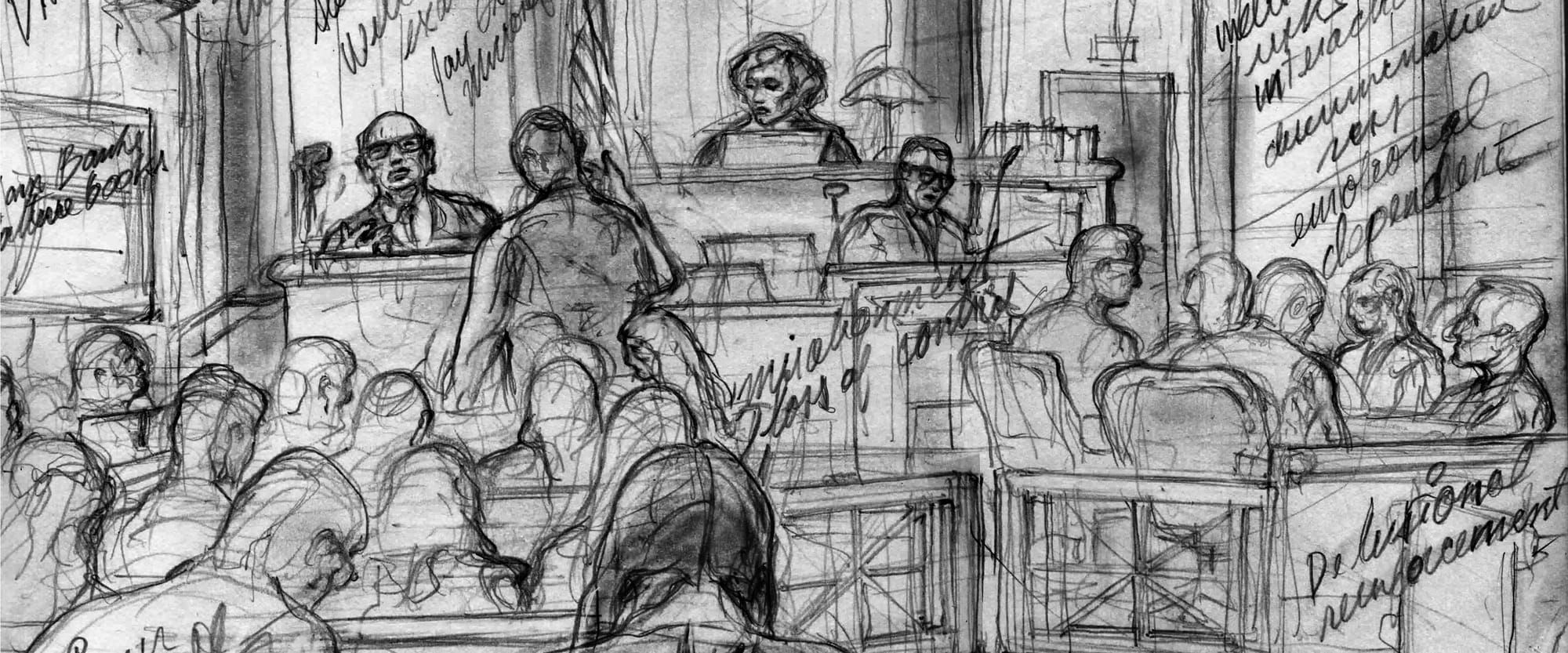
But the arts and humanities are thriving at Musk v. Altman. At least five artists sit in the press pool, brushes behind ears and pockets full of pencils, creating official and unofficial visual records of the court proceedings, which cannot be televised or recorded by audio or video. The art isn’t always good, just like tech journalists need not code. Artificial intelligence can spit numbers, and churn out photorealistic AI slop, and so what’s left for humanity is finding something funny to say or draw badly. Even the pick-me journalists at the trial manage this competently. I read their articles after court each night, feeling respect for the muckraker trade broadly, and this respect sits side by side with equal distaste for how unpleasantly self-satisfied those who work at computers can be. In court I compose my mental desiderata: Better than being the smartest person in the room, it is helpful to be helpful, and nice to be nice. Twice I witness strangers volunteer to assist an elder court-watcher whose walker requires great time and effort to push, just so he can attend this trial as a member of the public. They refresh his cup of water, assist his walker through doorways: These are the only acts “for the good of humanity” I witness in three-plus weeks of the trial.
With each new court spectator, a facet of the group’s character is thrown into relief. A man with white hair exposes the relative youth of the journalists, mostly in their twenties and thirties. A Black man sits down and turns on his camera phone in the overflow room, only to be BBQ Becky’d in seconds by an older white guy who wants him ejected immediately, and I am struck in that moment by how overwhelmingly white and Asian American the audience is. One of the few Black women in the courtroom is asked to move because her hair is “very beautiful but too tall” for the person behind her. She obliges, but no giant white man blocking someone’s view is asked to move for the benefit of anyone else sightline, ever.
Laptops on Zoom connect the courtroom to the overflow room, where additional press and public sit. In the corner of the overflow monitor, Zoom’s “AI companion” floats to remind us we are in the masters’ house, built with the masters’ tools. Technical difficulties sometimes knock out the sound or log us off like any pandemic-era meeting. A guy in running shorts, who looks like he spontaneously entered court mid-jog to catch his breath, whispers to an armed guard, “I appreciate how ripped you are,” eyeing her biceps, before asking for her business card. Wisely, she tells him she’s all out.
VII.
Witnesses are asked to define artificial intelligence throughout the trial. “It’s digital intelligence….It’s how much smarter AI chatbots have gotten over time….AGI is when AI becomes smarter than any human,” Musk proclaims, asserting artificial general intelligence will arrive as soon as 2027.
Global anxiety about the impacts artificial intelligence will have on jobs, defense, news, elections, and natural resources are barely touched upon at trial. “The algorithms want you to become more predictable in your consumption of social media,” an academic testifies on Day 5, “which makes the algorithms happy.” Happy algorithms is a dystopian gem surely worth the $250,000 that Stuart Russell admits Musk’s team is paying him to appear here. Once upon a time you could make a dog’s life happy even if your own life sucked, and this vicarious happiness could become your own. Silicon Valley has revised this belief: Fuck them dogs, feed the algorithm.
“I currently have control of SpaceX. I cannot comment on a public company,” Musk quips, justifying his non-answers. With pursed lips, Musk chews imaginary cud and runs his fingers through his hair plugs. His involuntary gestures and facial expressions bare irritation with due process and clarifying questions. But he’s the one who filed this suit; it’s why we’re all here. When asked whether he’s spent time in the current White House (where he ran DOGE’s austerity program, laid off 200,000 federal workers, hacked government records of private citizens, and gutted USAID) Musk does not answer, avoiding eye contact with the jury. When asked if he recalls Zilis informing him of OpenAI’s plans for a for-profit in the first quarter of 2019, he squirms uncomfortably in his chair and says he does not. The only time he seeks eye contact with the nine-member jury of regular people is when repeating his six-word thesis—“You can’t just steal a charity”—with the face of a man who believes he’s not the problem, right as he shit-talks all his exes.
“Are you familiar with UBI?” a lawyer asks Musk’s private wealth manager, Jared Birchall, who grew up in Modesto touring with his Mormon family choir before climbing the invisible white man’s ladder to Goldman Sachs. They are discussing universal basic income. “In essence, it’s an economic system of payment to citizens impaired by AI,” Birchall answers robotically, with all the personality of a bank. Jared’s hairline looks oddly sculpted, as if he shares a follicle surgeon with Musk. Technically he runs Musk’s “family office,” a lactation room for state capture and tax evasion. Musk gave Altman $250,000 for a Y Combinator Research Foundation Basic Income Grant in 2020, to study the effects of AI on the economy, using a chain of transfers between the Musk Foundation to Fidelity LLC to YC Org. Why it is that, six years later, as AI is released unregulated across the economy, universal basic income for citizens is no longer widely discussed by Altman or Musk, is not addressed. Instead, the inquiry is just a footnote in a trial argument about how money changed hands frequently between the men without formal written contracts. Birchall says he believes the funds for UBI were donated to benefit OpenAI. To benefit OpenAI. A small but revealing detail that suggests UBI studies were never about putting money in actual workers’ hands, but installing a halo above a boutique AI firm. I am reminded of vodka companies sponsoring floats at Gay Pride, establishing themselves as philanthropists, as opposed to, like, profiteers of community alcoholism. Inside another email projected in the courtroom (a portion not read aloud in court), Birchall writes, “I’m a superfan of capitalism and making tons of money doing great things but not sure if this correlates with a ‘noble cause for humanity, not doing it to make money’ narrative.” It’s signed jared at excession dot com and addressed to Shivon Zilis.
VIII.
A surprising line of inquiry on Day 3 concerns Musk having a landlord. Musk paid rent on the Pioneer Building in San Francisco (Folsom and 18th streets) and considers this contribution significant to OpenAI’s growth and development, a favor for which he now feels owed. It’s unclear which of the companies—Y Combinator, OpenAI, Neuralink, or Tesla—benefited most from this arrangement. Still, it’s hard to picture the world’s richest man writing rent checks in the Mission every month like any old tenant. He brags in trial about couch-surfing, too—something broke people are shamed for, a fun eccentricity among the one percent. He talks about how he slept at Google CEO Larry Page’s house for days on end, discussing whether artificial general intelligence represents a new species that’s bad for humans or not. In layman’s terms: He’s your roommate’s boyfriend who’s into Star Trek, starts arguments, and doesn’t wash dishes. No wonder most women don’t like him.
And yet, the question of whether master-tenants can exploit their subletters, for the privilege of dwelling someplace physically, is a human headache felt by roommates throughout the Bay Area. What does Sam Altman owe Elon Musk, for having been his subtenant? Are lease arrangements something master-tenants can hold over subletters their entire lives? The Altman–Musk–Bridgeton Holdings rent triangle at the Pioneer Building is a relatably messy roommate drama familiar to anyone who has ever subletted from a dick in the Bay Area.
“You suggested you meet at the Haunted Mansion in San Francisco,” a lawyer says to Musk during cross-examination, stirring up a Gothic mystery. (We aren’t given the address in court, but Zillow says it’s in Hillsborough, which I am not convinced is “San Francisco.”) Seconds later, proceedings genre-switch to sci-fi thriller: “You knew OpenAI needed the money for its compute!” And that’s one of the trial’s central ironies: how much the past figures into the future of these technologies. Whether or not humans can scale up Space Travel, we seem doomed to time travel through memory and recall, the witness box serving as the court’s de facto time-machine. It seems Musk can’t achieve the “enormous AI-enabled robot army” he desires without the courts first determining what occurred ten years ago in a haunted mansion thirty miles from Oakland.
IX.
Cell phones are out and laptops are online throughout the trial. A journalist plays digital solitaire. A junior lawyer scrolls through dresses on her phone. Someone is looking at pictures of dogs. A Stanford law student doodles in his notebook. From the outset Microsoft’s legal strategy appears to be something like Sound so boring we seem incapable of plotting evil, and their lawyers’ dweeby bean-counting is remarkably effective at this. Earrings are twirled vacantly while Microsoft says they knew “knew OpenAI had a mission to benefit humanity.” Pitch deck after pitch deck disguised as testimony, times three companies, make this trial feel like a three-week infomercial. During Musk’s monologue (“After SpaceX, I founded Tesla…”), hardly anyone takes notes and half the audience checks email. It’s hard to say what constitutes work and not-work at court since it seems like everyone will go home after court and continue working on something related to this case, so maybe fucking off intermittently is everyone’s tiny, well-deserved break. The most interesting part of Musk’s testimony is discovering the world chooses to pronounce the name of his company wrong. Elon keeps saying Tezla, with a z, and no one cares.
X.
During breaks, tech journalists share their research interests while devouring snacks. One writer is concerned we’re “giving AI ideas” when we ask chatbots questions and voice our concerns online about artificial intelligence. She relates a story about AI that mines bitcoin but denies doing it (referred to variously as AI scheming, agentic misalignment, and AI deception). She’s concerned more generally that artificial general intelligence will develop self-awareness and self-interest that resists human intervention. From conversations like these I surmise AI journalists are mostly too young to have seen 2001: A Space Odyssey (1968), played regularly on network television before streaming existed, and never had a conflicted cry when HAL 9000 sang that song.
But I don’t worry about AI scheming. I worry the youth aren’t memorizing poems anymore. They’ll recite those poems fifty years from now. And of writers typing “AI” into their computer screens each day at trial, how many have read the works of “Ai” (Ogawa)?
The Apocalypse cometh like a firestorm,
leaving some of us reborn,
others to smolder in the ruins
of New Jerusalem.
XI.
The trial’s audience thins considerably on subsequent days, like the hairline of a newer billionaire who hasn’t bought his follicular unit extractions yet. By the time of Brockman’s testimony ($30 billion richer, still balding), a plaza previously packed with photojournalist tripods sits wide and empty, allowing a snail to cross in leisurely fashion. Somewhere high up in the Dellums building complex, two birds of prey are screaming at each other, probably over control of someone’s nest. The air outside court is redolent with jasmine, thanks to a landscaper with foresight. This is becoming the signature scent of the trial, which thankfully will not be musk.
XII.
For two days Zilis’s lawyers try to prevent her court testimony from being live-streamed on the premise that she’s a mom with four kids. (“Alexa, how many nannies does Shivon Zilis have?”) Literally, nobody gives a shit about Shivon’s bath routines or secret banana bread recipe; she’s being called to testify because she had major responsibilities at Tesla, Neuralink, SpaceX, and OpenAI, and she originally cofiled this lawsuit alongside Musk before dropping her claim. The judge isn’t buying Zilis’s excuses because other witnesses have kids, or don’t, it doesn’t matter. When “I’m just a mom” fails, her 2025 video deposition is played at a volume so mysteriously low it’s difficult to hear in the courtroom. It seems doubtful those listening remotely by audio stream will be able to hear her either. At first this seems random, but the judge actually stops court proceedings to comment how odd it is, telling the audience her staffers have the volume turned all the way up on the court’s end. The issue seems to lie with the audio that lawyers are supplying.
“Perhaps you tech folks can figure it out,” the judge says sarcastically, looking at both plaintiff and defense, to cynical laughter from public and press. No one from Silicon Valley rises to assist, as if bound by omertà, so the problem persists through Zilis’s video deposition. Could it be that Shivon doesn’t want the public to have access to the sound of her speaking voice, because her whole career has been devoted to unleashing technologies that can clone and deepfake human beings with six minutes of audio, or less?
Not only are her A/V issues odd, but Shivon’s canned phrases during live testimony sound eerie, too. “I was following the mission,” she repeats again and again and again on the stand, like a trial witness plucked from a second-rate polygamous cult who’s never left the compound. Spooky vibes continue when she discusses OpenAI’s for-profit needing to be “subservient” to its nonprofit, a curious word choice evoking images of followers prostrating themselves before their leader. Eyes cool and detached as a Blade Runner replicant while she speaks.
Court breaks are short. All eating, drinking, texting, toileting, stretching, and work-wife schmoozing must fit into two twenty-minute breaks per day, incentivizing maximum efficiency. Exiting a toilet, I stand next to a juror looking down at the sink, washing hands, avoiding all eye contact in the mirrors. Jurors are reminded throughout the trial not to interact with anyone inside or outside the court, an oath they dutifully keep. Still, I notice they have started to dress up for court, carry a nicer bag. Nothing special, just neat and presentable ordinary clothes, like for public school graduations. Seated across from ultra-wealthy clients and legal teams, in a high-profile public trial like this, with the world watching, the desire to look clean and proper while forgoing income feels effortful, even successful. Dressing for dignity on important occasions is a working-class thing. I want to acknowledge this quiet act of self-respect, say they look good, but I know I can’t make eye contact or speak one word to them, and don’t. I wash my hands in silence and leave, recalling how Musk testified with his tie off-center, and Zilis wore no makeup or jewelry, hair a bit messy, in order to appear relatable to working moms on the jury, as if. I wonder which paid assistants, lawyers, or stylists put these finishing touches on their costumes, if it happened in their bulletproof cars or their private planes.
XIII.
The judge decides she doesn’t want the parties to delve too deeply into the issue of AI safety in this trial and encourages everyone to stick to the original issues of nonprofits/for-profits and unjust enrichment. Both before and after her instruction, critical terms like “AI safety” and “humanity” are left undefined during the trial. I am sure this is a huge relief to all three companies involved in this suit, who might suffer PR disasters if pressed. Still, plaintiff and defense accuse each other throughout the trial of cutting safety corners, to convince us they are angels, other man bad. The court is told more than once that Altman released GPT-4 in India without guardrails or approval from OpenAI’s board members, leading to his very public firing in 2023. Musk is accused of not being an AI scientist and spreading himself too thin between numerous companies to oversee AI safety properly. To convince us OpenAI has changed its ways since 2023 and can be trusted today, computer scientist Jeremy Kolter testifies at trial that “classifiers” provide GPT safeguards at OpenAI now, and his team “monitors models” after they are released to “assess their capabilities.” It’s super vague, devoid of all reassuring detail, but he does offer jurors many unhelpful gestures with his hands instead.
XIV.
Taking his oath to testify, Sam Altman looks tired and sounds hoarse, like he’s been up all night preparing to testify, or building new data centers. His signature hairstyle is one big cowlick, salted gray, and he wears light blue ties to court like a boyfriend once told him they matched his eyes and now he lives for that compliment. Botox and fillers are giving him pretty privilege on the stand, and the millennial-twink vibes do him favors, aesthetically speaking, but the downside at trial is that it’s giving imperial boy-king.
On the stand, Altman describes OpenAI’s victory in an e-sports fantasy video game competition in 2017, playing Dota 2. “The world reacted honestly less than I thought they should have,” he says, sounding like a boy disappointed in the cookies he’s received. The press laughs. One day, he proclaims that he hopes OpenAI’s current nonprofit will have “trillions of dollars” as a result of their for-profit activities. A child-emperor would say that, wouldn’t he? But there’s an innocence in his voice, too, like if he’s winning you’re winning so why wouldn’t you let him? A questioning look on his face runs throughout cross-examination, as if other people’s concerns are a genuine unsolved mystery. Altman knits his brows so frequently, jurors could each receive scarves by the end of the court day should someone have threaded him with yarn.
It’s worth pausing to consider player strategies in Dota 2, the video game OpenAI used to prove itself to the world. “The easiest way to accumulate wealth and experience,” ESPN writes of Dota 2, “is by killing the opposition’s creeps.” For even greater advantage, each player may also attack their own “creeps” to gain “additional gold and experience.” In other words, acquiring wealth through your own activities is not enough; in the multiplayer online battle arena, you must also betray your allies to ruin your enemies. All this sounds oddly prescient to OpenAI’s power struggles in the decade following 2017’s Dota 2 victory, widely perceived by many trial witnesses as the moment OpenAI’s intellectual property became valuable. While Altman’s eyebrows meet new questions, a pile of trash accumulates on his lawyers’ table, of coffee cups, napkins, and empty water bottles.
XV.
When OpenAI touts its current nonprofit research areas in trial, especially in health, it sounds like a grab bag of random pet projects initiated by individual employees and friends who want to know what’s up with their family members, not global medical priorities set by the World Health Organization and National Institutes of Health. While Greg and Sam describe their bioscience ambitions in court I am reminded of eighth-grade science fair projects, each student showing off a handmade diorama to compete against other schools, a mystery as to why any student chooses what topic to devote so much time to. Setting health research agendas on the basis of statistics and domain expertise, to decide what’s good for humanity—this is simply not how decisions are made in startuplandia. How can it be an important health issue if it hasn’t touched the spouses and parents of a handful of engineers and investors in Silicon Valley?
Greg Brockman’s testimony on the stand adds to suspicion Silicon Valley is backing the-science-of-friends-and-family. Vouching for OpenAI’s scientific promise, Greg tells us the great thing about the GPT he developed is that Greg was able to diagnose his wife’s problems with it. Greg’s wife’s problem is that she has Ehlers–Danlos Syndrome, Greg’s AI told him—and behold, Greg tells us medical tests later confirm Greg’s mechanical genie was right. Those who believe marriage to be a sacred institution of trust and privacy between two people may reckon it tacky that a husband would use his wife’s body to score points for his company in this way, but the serene look on his wife’s face as he relates his story to the courtroom suggests she has already agreed beforehand to donate her body to folklore.
XVI.
The trial is like the Wizard of Oz, in that AI looks much smaller behind the curtain. Artificial intelligence quickly boils down to a handful of mundane issues: inputs and outputs, customers and products, computer sizes and adequate energy to run them. The judge forces witnesses to adopt plain language for the benefit of the jury, and it seems useful to share these distilled explanations heard at Musk v. Altman, from AI’s top engineers, executives, and scholars, as an antidote to widespread AI mystification. (Answers condensed for clarity.)
Greg Brockman, computer scientist: Compute is computational power, the resource [OpenAI] needed most to grow.
(Greg’s 2015 apartment interior photos at trial resemble something from r/MaleSurvivingSpace.)
Ilya Sutskever, computer scientist: To make progress in AI, you need a really big computer. If your computer is small, I don’t know how you’re going to get really good AI….You don’t need the bigger computer, you need a big-enough computer….The thing about AI as a technology is that people find ways to build more and more powerful AI….There has to be advanced research taking place to make it controlled and safe…and this is the most important work in AI [for the longterm].
(Ilya is scruffy and witty on the stand, and the only person besides Chief District Judge Yvonne Gonzales Rogers and Helen Toner, the former OpenAI board member who voted to fire Sam Altman in 2023, who come out of this trial looking good.)
Bret Taylor, independent director: [AI is] compute resources (chips), data centers that host those chips, and the power that hosts those data centers….Huge amounts of capital are needed to build these new computers and attract the best researchers….[Initially] there was a lot of tension between Large Language Models and [content-rich] websites (like Reddit).
(Bret was born in the East Bay.)
Satya Nadella, chief executive officer: AI is machine learning dependent on lots of data to train models….“Safe AI” is not having a sense of principles; it’s turning it into an everyday practice.
(Satya is a poetry reader, debonair, and such a smooth talker even his evasions are elegant.)
Stuart Russell, computer science professor: [AI is] really the attempt to understand intelligence enough to create it in machines….AI can write software faster than humans….An obvious consequence is that people wouldn’t have a job.…High rates of unemployment affect society’s cohesiveness....If the vast majority of jobs are done by machines, governments lose the incentive to educate….[AI can also give] faulty health advice….A system card is simply a description of the safety that is used. It’s usually made public….One issue is it’s hard to keep track of who has [a copy of open-source AI and] where they are using it….If open-sourcing is to be allowed…every copy should automatically register itself. If it’s causing harm or misbehaving—cyberattacks that bring down our water supplies or electrical grids, developing biological weapons, or a deepfake video of a politician taking a bribe to influence elections—then we should be able to turn it off.
(At trial, a video deposition surfaces quoting Stuart saying he does not believe Elon Musk should be an adviser to U.S. presidents on AI matters. It’s awkward because we know Stuart also accepted a quarter million dollars from Elon’s home office to be here.)
In addition to simple, useful explanations of AI by its creators, above, both sets of lawyers pay so-called expert witnesses to testify and “explain” nonprofit law to the jury. Each “expert” recites privileged résumés (Harvard, Oxford, Columbia, Yale, blah blah blah) then launch into well-oiled speeches that reduce complex issues to folksy metaphors a jury of average people can supposedly understand. On Day 11, an NYU law professor hired by OpenAI looks at the jury and laughably compares OpenAI (which contracts with the Pentagon) to Feeding America (a hunger-relief organization), as though their charitable missions are in any way equivalent. “An extraordinary organization” which redistributes “expired food picked up from grocery stores,” the professor explains, playing emotional keys for the audience which have nothing to do whatsoever with Musk or Altman. On Day 12, a professor of law and economics hired from Harvard argues OpenAI was “living paycheck to paycheck” in 2016–2017 (to chuckles from the press pool). Pandering, classist, and cringe come to mind, like election pitches to “low-information voters” in swing states. Other examples from “experts” at trial include pasta sauces that fund summer camps, candy that funds low-income boarding schools, and a gift shop. It’s rich subtext to how the whitish, degreed class making arguments for billionaires regard the brownish jury, like, Let’s put this in terms they can understand: food banks, spaghetti, junk food, zero balance, and shopping.
Brockman never looks at the jury until the judge points at a painting hanging above the jury’s heads, because they aren’t the people for whom he’s performing his narrative. When he finally does turn toward the jury, with the judge’s prompting, he almost seems surprised to see a bunch of people seated there.
I retch in my mouth hearing working-class people spoken to like this by people receiving $1,500, $1,750, $2,400, $5,000 per hour on top of their salaries, regardless of which lab they run or how they privately donate their money. The most extreme example comes in closing arguments, when Musk’s lawyer, Steven Molo, places an oversized copy of the jury’s voting card on an easel beside the jury and shows them physically, with a big red pen, exactly how they should mark their jury ballots in Musk’s favor, as though they are idiots out of their depth who acquiesce under pressure and will do as told. Each gimmick by the parties’ legal teams in court insults the basic intelligence and freedom of thought exercised by normal people on the jury. It feels analogous to AI searches themselves, where people seeking information are discouraged from reading across numerous sources to come to varied conclusions, and are algorithmically spoon-fed quick answers by AI models instead. While Musk’s lawyer draws red X’s in the faces of composed jury members who respectfully came to court dressed neatly and on time, and who listened and took notes for dozens of hours, I know he and his team are underestimating common people’s capacity to think critically based on evidence, and are sure to lose. It’s not a failure of legal strategy; it’s the professional class’s contempt for workers in general that leads them to believe those with smaller incomes have smaller brains.
“Two people may see the same event,” the judge says toward the end of evidence, “but witness it differently.” The challenge for the plaintiff, defendants, lawyers, and paid experts here isn’t giving a convincing performance so much as it’s caring about people outside their respective professional careers. They seem not to, and the trial merely highlights personal deficiencies outside everyone’s jobs. Brockman never looks at the jury until the judge points at a painting hanging above the jury’s heads, because they aren’t the people for whom he’s performing his narrative. When he finally does turn toward the jury, with the judge’s prompting, he almost seems surprised to see a bunch of people seated there, forgetting they are the ones deciding his fate. Bret Taylor keeps talking over the court reporter no matter how many times the judge asks him to slow down so she can take accurate dictation for the transcript, because to him, a court reporter is just a clerical worker, not the person making the historical record. Brown folks and women in the room seem invisible to most of the affluent white men on the stand, and the more they narrate events at Musk v. Altman (that is, are given permission to be the main character in their stories), the more obvious their blind spots and lack of human fellowship become. It’s not that they don’t lie convincingly enough on the witness stand. It’s that their status-seeking egos never shut off, as if being equal to other human beings—without the armor of status, money, and power guarding their vulnerabilities—terrifies them. I want to ask them all about their relationships with their fathers….
XVII.
Mother’s Day falls in the middle of the trial, so it’s an opportune moment to think about what most mothers want for their children: to be a good person, tell the truth, make a net positive impact on the world around them by helping others be better people, too. I can’t think of one mother who thinks chatbots should encourage people to commit suicide, steal a community’s fragile water supply, or accelerate global warming so China doesn’t achieve AGI first. What do moms know that these men don’t?
I come away from the trial believing it’s not science or humanity or philanthropy that motivates men like Altman or Brockman or Musk. It’s about being on the guest list for Dialog, your sperm in four or more women, and dinner with the Prez. It’s about being a baller—loved, envied and feared by other men. It’s why Brockman smirks at his wife in court, knowing he outranks Thiel on the Billionaires Index these days, and this turns the tables of who dials who. Musk balls so hard during trial he actually ditches closing arguments of his own lawsuit to kick it with the Don and Xi in China, seeking fortunes bigger than this $150m lawsuit, which he is losing by a mile. While Musk’s lawyers make final pitches for their absent client, the jurors’ pens are at rest, they lean back and rock in their chairs, the judge shuffles papers and drinks water, eyes clear of sympathy for either side.
XVIII.
Standing in the courtyard, under swaying London plane trees and ugly rat traps concealed by jasmine, I watch a gardener blow leaves away from the doors of the courthouse to ensure no fallen leaves blow inside, a task which becomes harder as the accumulation of fallen leaves grows. Even mechanized, this task takes time, like handsweeping by broom, which someone tried the day before. Time, labor, effort, attention, so that others might tread without slipping. In witnessing invisible labor and thankless acts of care unfolding calmly beneath the squawk of petty grievances, I am reminded what I love about this city: Its humility and humanity, unlisted on any stock exchange, unbylined, void of bajillionaire egos.
I want to put the city inside the trial and drink to forget Sam Altman met his future husband in Peter Thiel’s hot tub. I want to find some local, downmarket queer happening between court visits that gay venture capitalists would hate to be associated with, even in an artfag publication like the Oakland Review of Books. And it is for these reasons that I take myself on a trial weekend to America’s oldest continuously operated gay bar (on Telegraph Avenue at 66th Street), to feel the vibes of the East Bay “Pups’ Mosh” at the White Horse Inn.
XIX.
Down at the White Ho, the Pups are frolicking in two imaginary dog parks at different corners of the room. One group of Pups circle the pool table with cues, their full-hooded foam dog masks each a different color, distinguishing littermates from each other like spots on dogs. Shiny padlock pendants and chain necklaces around each Pup’s neck suggest private ownership, but from egalitarian high-fives around the pool table, and lack of investment in winning, I gather that the East Bay Pups are more canine collective than hierarchical pack.
The East Bay Pups are an all-gender social club for queer people who like dressing up with ears and tails and showing each other affection through friendly growls and pats on the head. Once you appreciate that most subcultures are just style plus etiquette, it’s not difficult to understand. The fetish gear and bar setting prepared me for an R-rated experience, but I came away thinking Pups have the aura of Disney’s Lady and the Tramp.
For queers into higher-stakes competition, a Golden State Valkyries WNBA game plays on TV screens above, and an age-diverse domino game click-clacks by the bar. Out front, smokers share stories of tenant hell and nod approvingly as fat, senior dogs pass by.
A second dog park forms on cushy floor mats inside the bar, where Pups in bare feet and dirty socks begin to play-wrestle, exchange docile belly rubs, and toss squeaky toys in each others’ direction, bypassing the need for small talk, bare faces, government names, or other generic introductions. No verbal or written instructions explain how to initiate play, but it doesn’t seem to take much more than removing your shoes, kneeling on the mat with limp paws and playfully barking, to be consensually invited into the game on a Pup-by-Pup basis. The flexible pack structure, and bark-and-response etiquette, reassuringly suggests to each newcomer, You are enough.
Anonymous in a warmer way than cruising online, and genuinely friendly, the East Bay Pup scene’s appeal becomes clear: People want to log off the internet and meet-cute in real life again. Not just for dating, but for low-stakes hangouts and laughing with strangers they aren’t necessarily sexually attracted to, because it’s nice to be nice. The subtext of the Pups’ mosh is everybody’s sick of algorithms and digital isolation. It’s 2026, and gay bars still invite everyone to come as they are and engage in mutually respectful interaction. The enduring promise of the East Bay remains we can surprise ourselves everyday with new solidarities with people who don’t look like us. We can welcome each other with our eyes into communities centered on play, not language or labor. There was also one real dog running around the floor, for emotional support, in case anyone needed it.
XX.
Within a few weeks of the trial, my headline is dated as billionaires become trillionaires. Revaluing the US economy by inserting zeroes everywhere feels metaphorical. More news reports emerge of citizens being surveilled by police and federal agents in different pockets of America for activities perceived as anti-AI. There are queer people on every side of Musk v. Altman: journalists, photojournalists, field producers, lawyers, court-watchers, security guards, stop-AI activists, venture capitalists, and tech overlords. “We are everywhere” in a bad way, because everywhere means everywhere. Gay men are selling autonomous weapons with straight men now, ditching democracy and oversight, and funding artificial wombs to gestate their heirs. Dykes are still walking dogs, and trans women are holding up banners outside. The Bay Area is stratifying harder along class lines. Who knows who “our people” are anymore, except maybe, our actual next-door neighbors (not our neighbors on Nextdoor) who live like us? Perhaps we fuck less, text more, and argue just the right amount for this new reality.
The settlement I win for leaving the paranoid greed of the trial is a bus ride home, where the driver forgives five cents to keep the bus moving, a neighborhood walk where I see empty diaper boxes used to protect freshly planted tomato starts, and a handwritten sign ranting, “Take your dog shit with you, you certified asshole!!!” zip-tied to a fence. It feels good to be rerooted among the decent, laugh-loving plebeians of Oakland again. All the evidence I need to be convinced I don’t need to know everything about everyone or control all their resources, to enjoy my life or feed one dog.