How I became the villain of El Cerrito’s Nextdoor
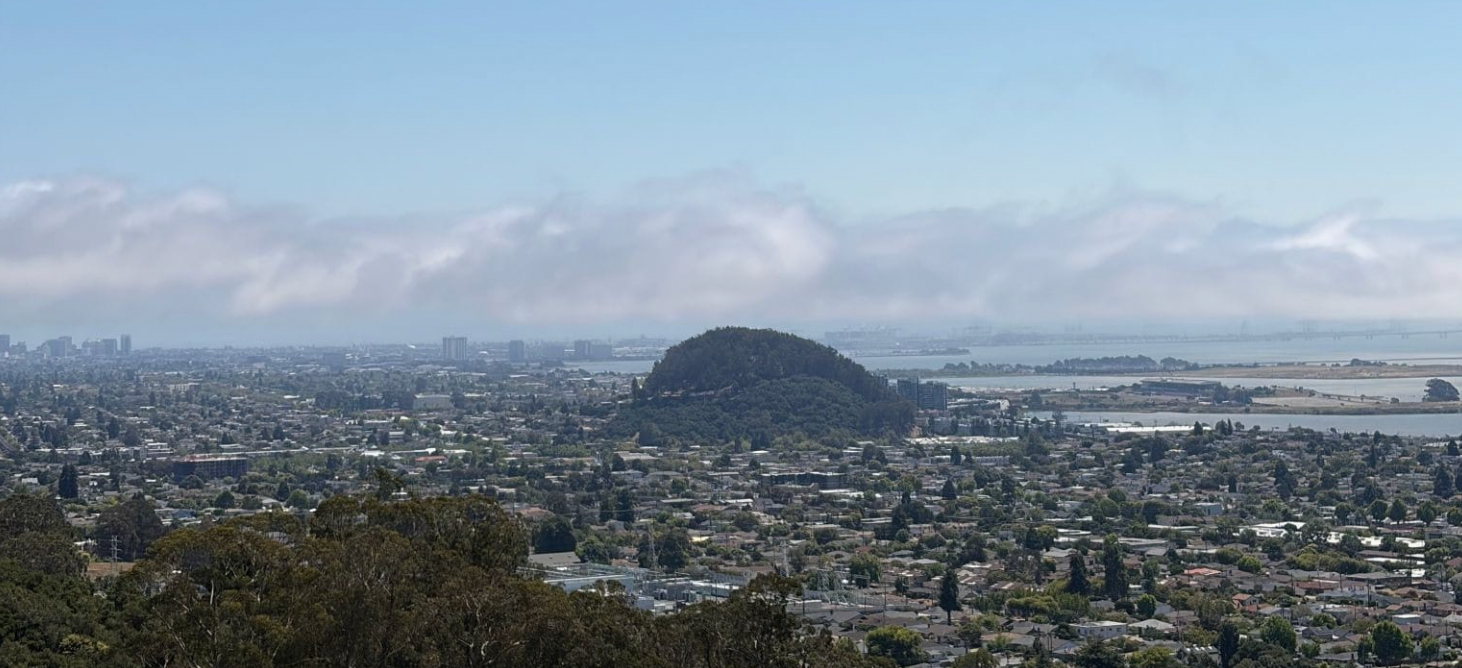
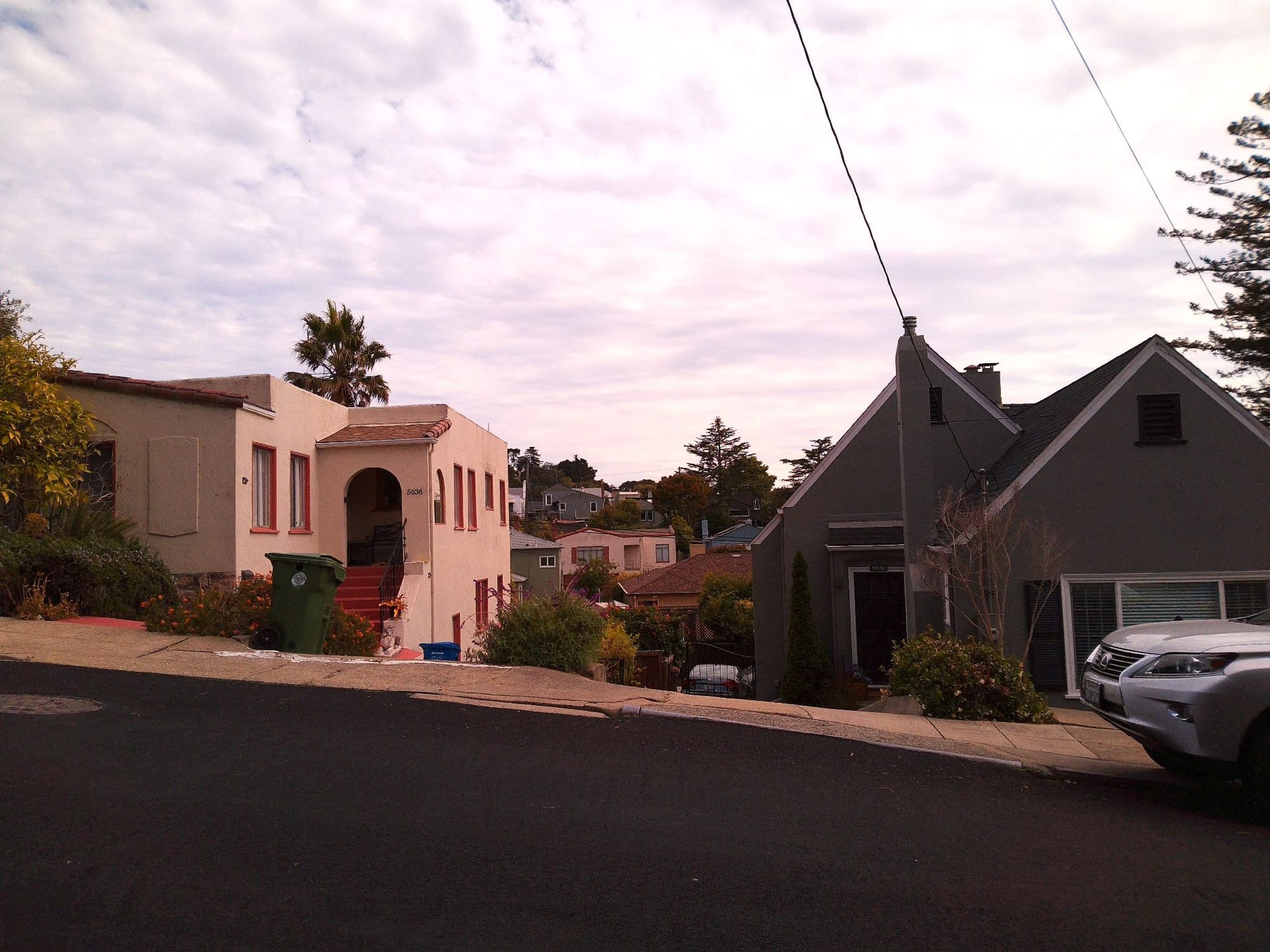
In April 2026, my husband and I bought our first home in El Cerrito, California. By the end of June, I’d become public enemy No. 1 on the local Nextdoor.
This is my story.
First, you have to understand, I’m a compulsive poster. I’ve been screaming into the void since my mom got dial-up internet. The first time someone from online recognized me in public was in 2005, when I ran into one of my Myspace friends at the mall. For a couple years, I ran the Wendy’s Twitter account. I’m not new to this.
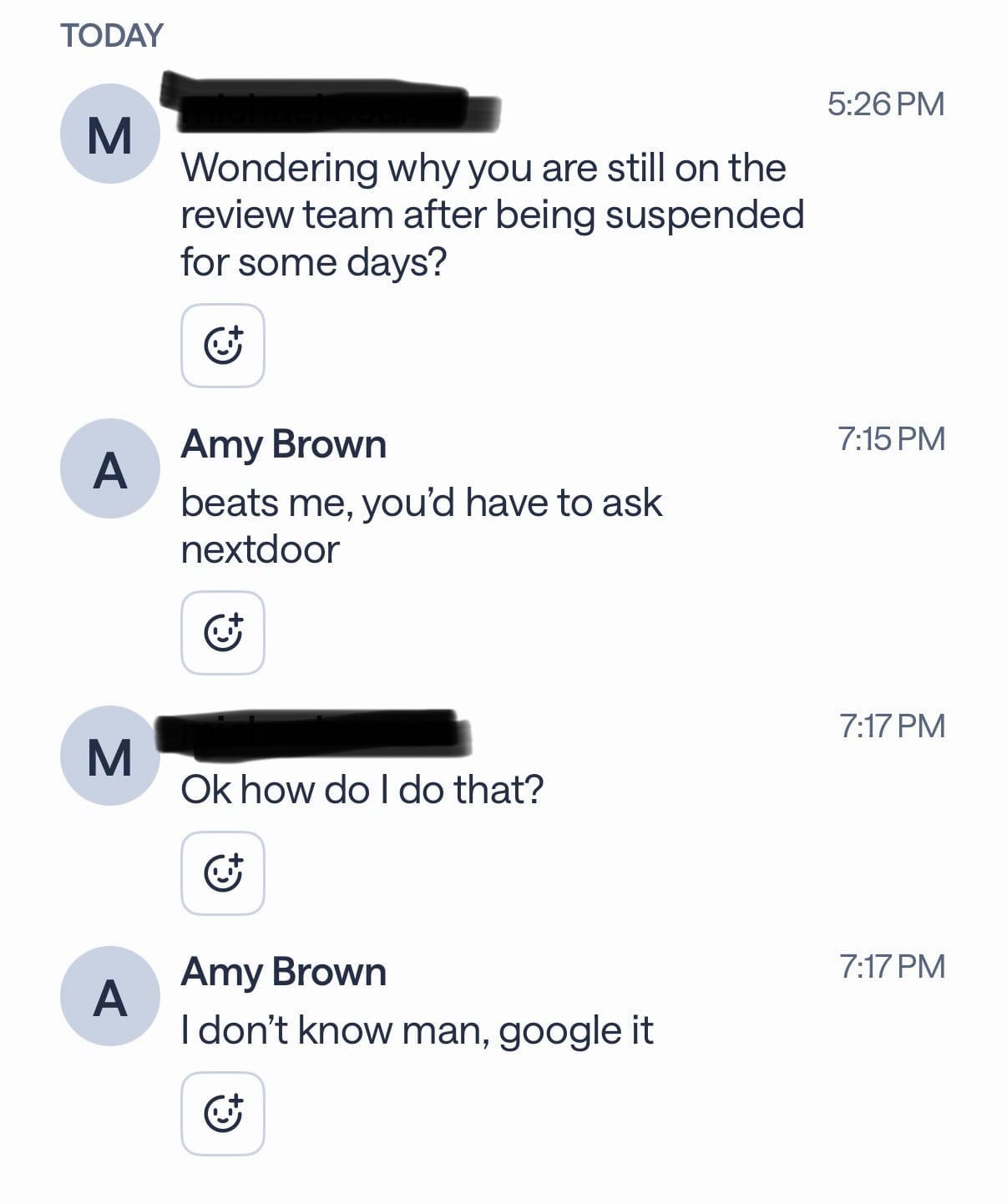
However, until a few months ago, I consumed Nextdoor purely for entertainment. I’m on the “review team,” but that’s a low-level volunteer moderation position, offered at random to Nextdoor users in good standing. All it really means is I get to vote on content from nearby neighborhoods that other users have flagged as disrespectful, discriminatory, or illegal. Essentially, I have a curated feed of the most unhinged things people are saying on Nextdoor within a three-to-five-mile radius.
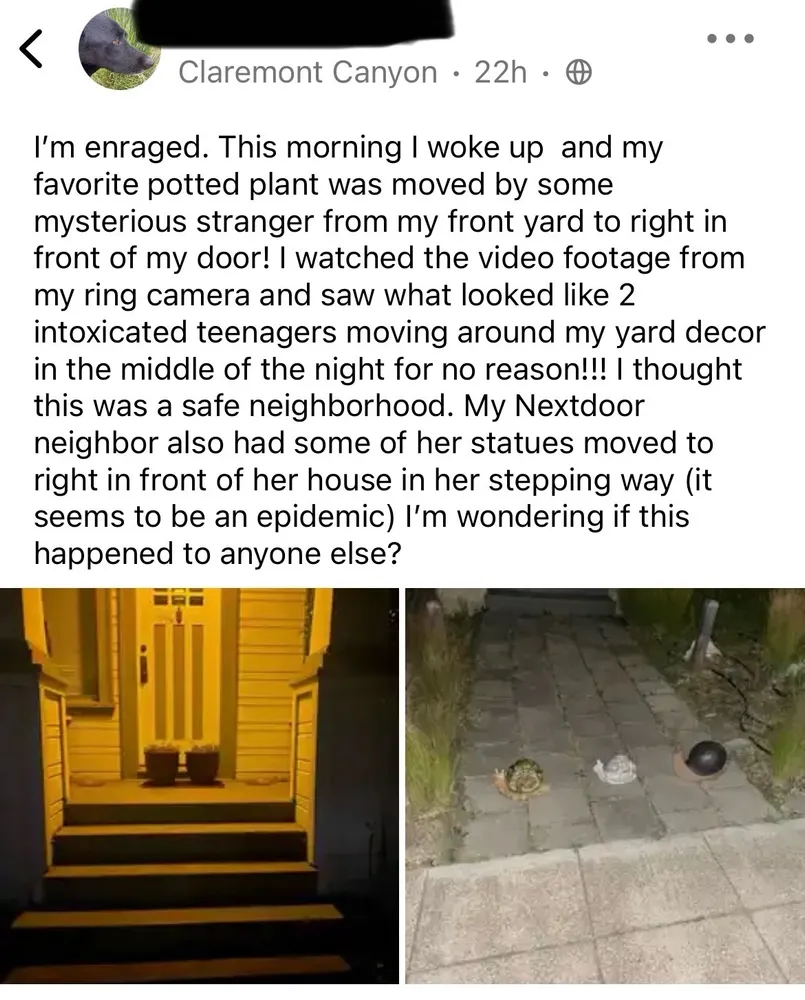
And oh do they say unhinged things on Nextdoor within a three-to-five-mile radius. I have seen things. One time a guy accused me of body shaming my local Cybertruck, apparently outraged at the existence and concept of aesthetic judgment itself (or perhaps just embarrassed because he thinks Cybertrucks look cool). I watched an 83-comment thread unfold about a misspelled YIELD sign, ultimately spiraling into “people don’t actually care about spelling, it’s just thinly veiled racism.” And of course, who could forget this menacing Oakland crime spree from 2024:
For a sicko like me, it’s fascinating. Intoxicating. Impossible not to comment on. But then, naturally, I flew too close to the sun: I developed an earnest opinion on municipal politics.
\O/
When my husband and I moved from the Midwest to Berkeley in 2018, it was the culmination of my lifelong dream to get the fuck out of Ohio. We first rented a one-bedroom cottage in the flats near Berkeley High for a few years. When I had a baby, we found a semi-neglected three-bedroom house to rent in Kensington, at the crest of a hill with an incredible view and questionable electrical wiring. Then I had another baby.
Every day, I’d take the kids down the hill to daycare in El Cerrito, down Moeser Lane, a four-lane road with a 13 percent grade that opens up to a panoramic view of San Francisco and the Golden Gate Bridge. Even driving the posted speed limit of 25 feels like flying. And then at the bottom, you’re in this cute little town.
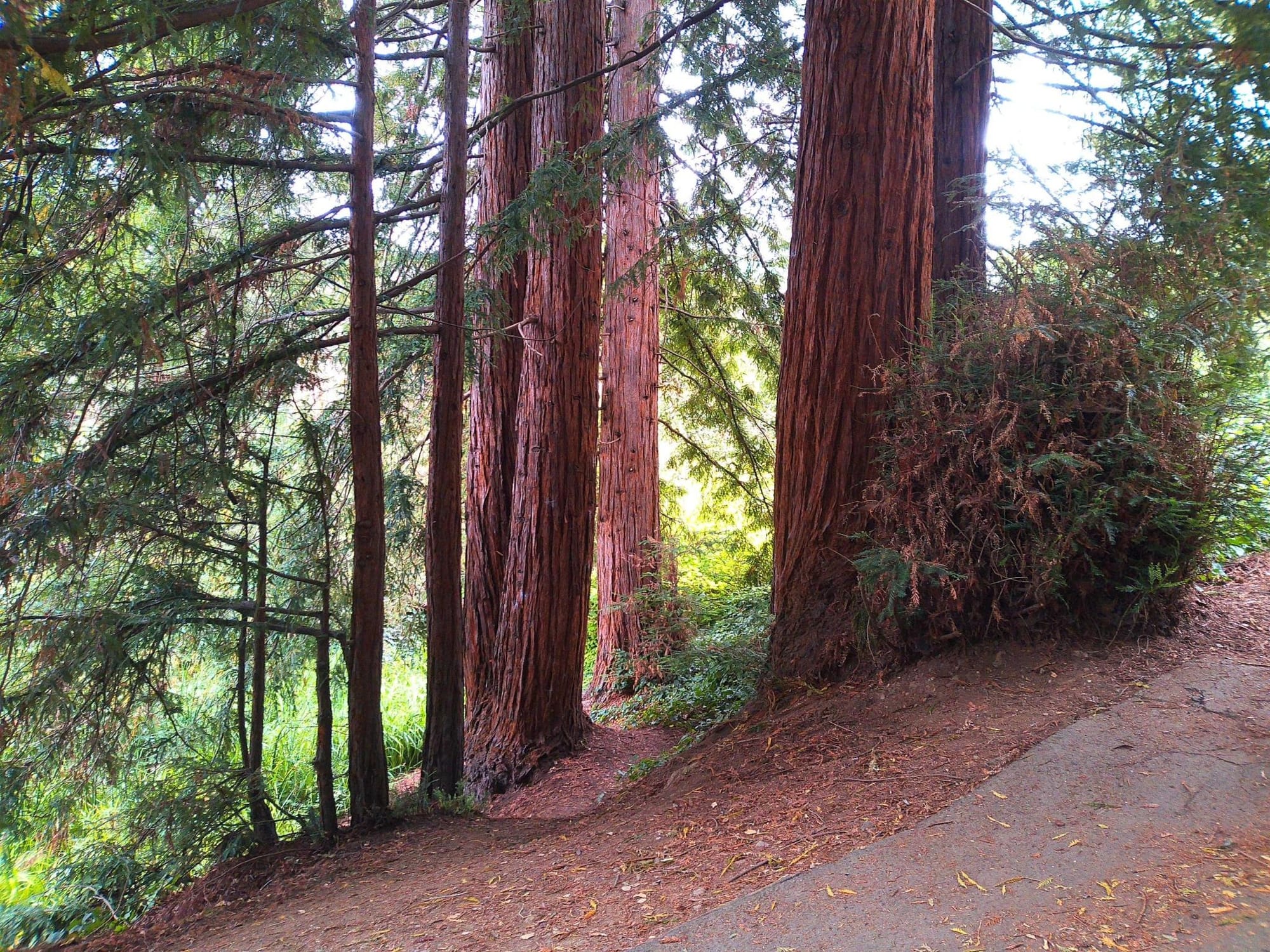
We started exploring. We became regulars at our new favorite donut shop, where they started to throw in a few extra treats with each visit. We hit up the locally owned Japanese grocery store on Tuesdays for snacks. We held a birthday at Arlington Park, up on the hill under the tall trees, by the pond full of ducks and turtles. The more time we spent in El Cerrito, the more I thought: I would raise my kids here if I could afford it.
And then, a Bay Area miracle. I hit the stock lottery. A tech company I’d worked for went public. We weren’t overnight millionaires, but we did suddenly have the down payment for a house. I knew exactly where we should look.
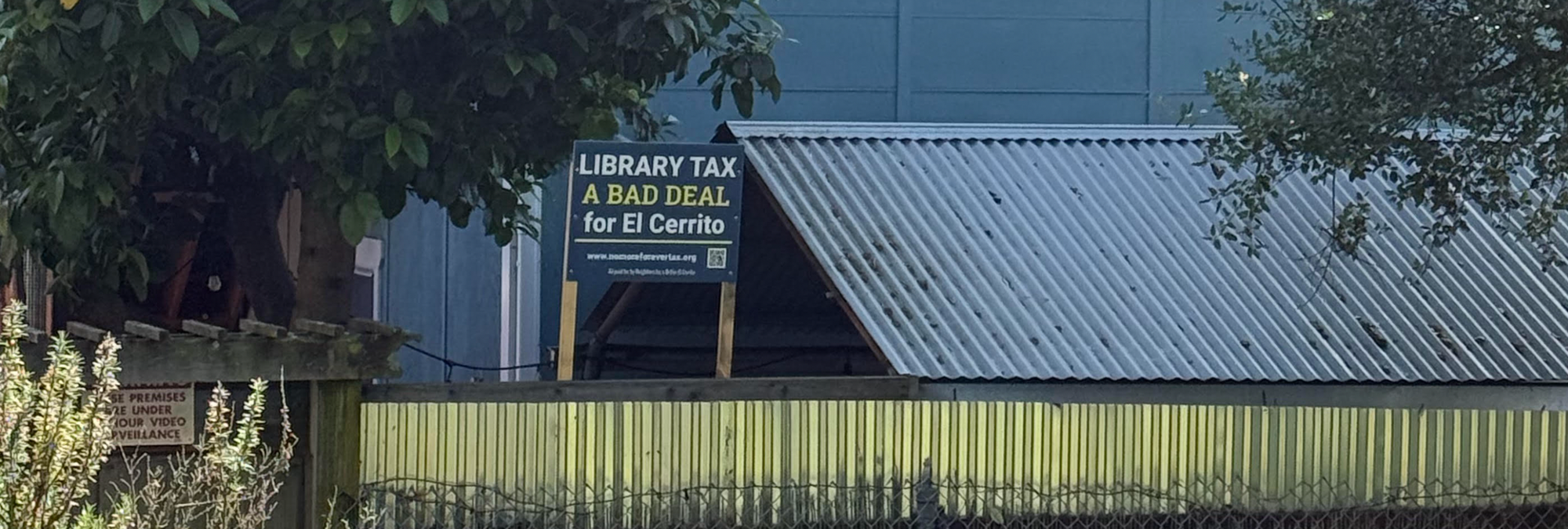
As we started househunting in El Cerrito, I began to notice yard signs popping up: LIBRARY TAX A BAD DEAL FOR EL CERRITO. I looked into it and found out that there would be a measure for library funding on the June primary ballot. The proposed location for the new library was the ground floor of a new mixed-use development currently under construction at the El Cerrito Plaza BART station.
It seemed like a pretty good deal to me. I already pay lots of taxes that go toward things like blowing the limbs off innocent children in Iran and Gaza. You want to use my money for a library? Go right ahead. I figured the opposition to the measure was standard anti-tax griping, the libertarian perspective that you have a right to keep 100 percent of your money and never wear a seatbelt. It didn’t occur to me that anyone could be all that mad at spending a little money to build a library.
 Megan Steffen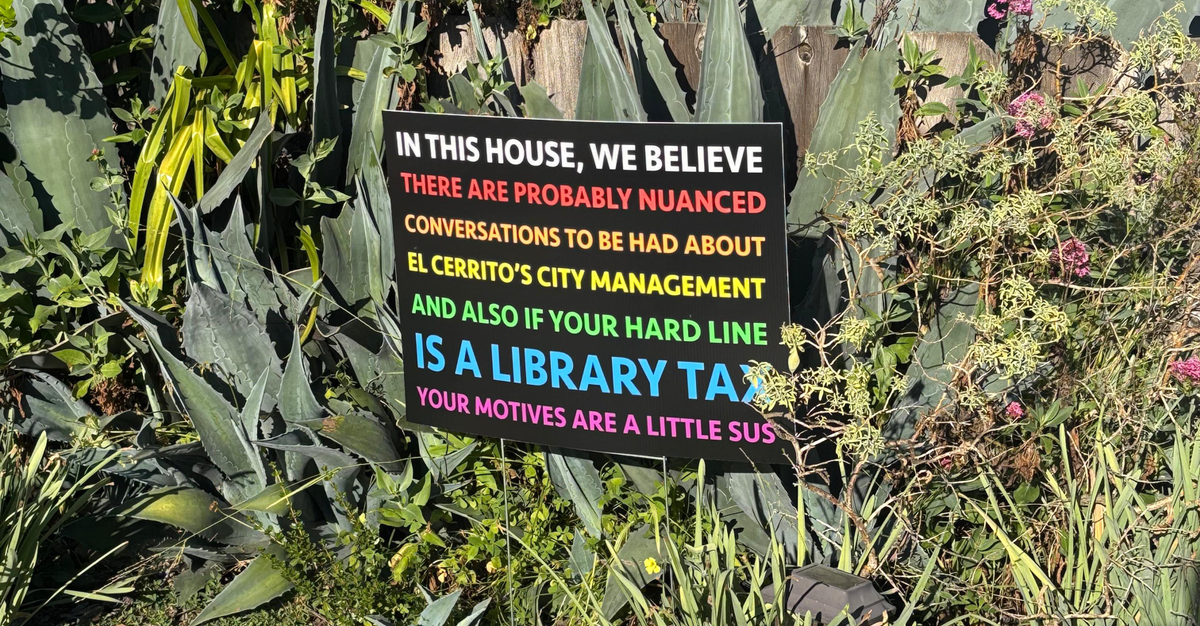
Then I logged onto Nextdoor.
There, I discovered a guy whose profile photo showed him in a three-piece suit and a backwards Kangol hat, telling women who supported the library ballot measure that they’re government lobbyists and he knew where they lived. I saw ALL-CAPS RANTING ABOUT A SENIOR CENTER THAT WAS PROMISED BUT NEVER CAME TO FRUITION. There were people freaking out about parking spaces. People insinuating you can’t take children on BART because it’s not safe. People were opposed to the BART development in its entirety because it’s too tall or because they think affordable housing will drive down their property values.
(An aside here to the residents of El Cerrito who might be reading this: You are right to be angry about the senior center thing. It’s just that a lot of these conversations are impenetrable if you haven’t lived here for 25 years. If you’re not from El Cerrito, you will not understand that at some point there was a senior center located in the library parking lot, but that land belongs to the school district, and they took back the parking lot to put in portable trailers for the nearby elementary school to use as extra classrooms because they’ve outgrown the building. Then the senior center moved to portable trailers in the police department parking lot until COVID hit and they closed, and then those trailers were leased to the Kensington Police Department instead, because they don’t have their own building. The city does senior programming, but even after years of promises to seniors, there’s still no dedicated senior center. So they’re a little pissed.)
As it turns out, the residents of El Cerrito are extremely online. More than 15,000 people in El Cerrito have a Nextdoor account, which is approximately 60 percent of the town’s population.
Anyway, I made a lot of assumptions about where all of this anger was coming from. I made assumptions because a lot of the things that people said were conspiratorial (“the city council has proposed a new library to make themselves rich”) or appeared to be disproportionately angry about what seemed to me like a pretty straightforward tax proposal. I had not done my reading. I didn’t understand the grudges people have with our city government going back decades.
Unfortunately, I made some of those assumptions publicly on my Bluesky account, under my government name. And okay, also, I wasn’t particularly generous in my assessment of their motivations, or of senior citizens as a demographic.
As it turns out, the residents of El Cerrito are extremely online. More than 15,000 people in El Cerrito have a Nextdoor account, which is approximately 60 percent of the town’s population. And while I don’t have stats about how many are on Bluesky, it’s enough that word of my Bluesky activity made it back to Nextdoor.
At this point you’re probably wondering what I said. I’m not even sure. The posts are long deleted (more on that in a minute), but here’s the gist of what I remember saying:
1. I claimed that the opposition to the local library was mostly octogenarians.
2. I suggested maybe it was hard for octogenarians to justify financially contributing to changes they might never see come to fruition, due to being near the end of the natural human lifespan.
3. I believe I might have called these octogenarians rich fucking assholes.
4. I may even have gone so far as to suggest that they wanted to be buried with their money like Pharaohs.
Here is what I wish I had said: “I feel like there is a tension in this town between residents who’ve lived here for decades and are resistant to change, and newer residents who think it’s worth investing in modern amenities, like a library that isn’t 80 years old.”
Here is what the people on Nextdoor heard: “I hope all these awful old people fucking die soon so I can have a library on their graves.”
But here is what I failed to consider: It didn’t always cost a million dollars to buy a house in El Cerrito, and the seniors who live here mostly bought property in a completely different world. Many of my older neighbors live on fixed incomes (like my 76-year-old mother who will probably have to move in with us in the next few years), or are still working. They could sell their houses for a lot of money, but because they want to live in their houses, they do not necessarily, as a result, have a lot of money. In that way, they are not really as similar to ancient Egyptian mummies as, in the heat of the moment, on social media, I may have suggested them to be.
But by the time I considered these things, talked to my mother, and deleted my posts, the damage had been done.
\O/
I grew up in a place called Piqua, Ohio, half an hour outside Dayton, on the wrong side of town, where the “dirty” kids lived. I never aspired to homeownership; it seemed like an impossible amount of money. My version of success as a teenager was being able to someday afford a pair of brand new Abercrombie jeans.
Adjusting from my hometown to the real world was difficult. After college, I found myself moving in circles that seemed to have their own unspoken code, like the time I showed up to an internship in my Walmart shoes and all the other girls were wearing identical $200 Tory Burch flats. Though my economic status has changed over the years, I’ve always felt deep down like that dirty kid from Piqua, paying for my Walmart shoes with a bag of quarters.
What people reading my posts might have failed to consider is how, in my mind, anyone who could afford a home, especially a home in the superheated real-estate market of today’s Bay Area, must be affluent. And yes, that includes myself. I make more than double annually what my parents made combined. I spent years under the assumption I’d never own property, certainly not here, and if I did own property, it would come with some major compromises like moving my family back to Ohio knowing that they’ve slashed reproductive rights and want to check my kids’ genitals before they play high school sports.
I’m very surprised to find myself here, to be honest. For the three years we lived in Kensington, I never fully relaxed, feeling like my affluent neighbors must know just by looking at me that I didn’t belong there.
So that’s where I’m coming from: After desperately clawing my way to the dream of millennial home ownership, when I discovered my neighbors were reluctant to pay a $300-per-year property tax for a library, I got furious.
\O/
I have 43,000 followers on Bluesky, which is not huge by internet standards, but it’s cacophonous when just a fraction of them are talking to me simultaneously. I’m not trying to be an influencer, I don’t do brand deals or anything (due to a combination of my own disinterest and the fact that in corporate social media terms, I have a negligible amount of followers on a niche social platform). I don’t think of myself as a public figure. I just like shooting the shit with my internet friends, and I do it a lot. Though I have simultaneously built a career in corporate social media management, I consider my personal posts pro bono. I do it for the love of the game.
The problem is that when you post online a lot, people start to think they know you. They make assumptions. They stitch your posts together in their mind to paint a blurry outline of a person, and then they fill in the rest with whatever they want it to be. This makes it easier to get into trouble. People have already interpreted your intent based on the parasocial version of you that already exists in their mind.
Now, I’m not new to having strangers get mad at me for my posts. In 2021, for example, I tweeted a joke about a social media monitoring tool called Sprinklr that resulted in their PR person suggesting—to a woman who retweeted me, but whom I’d never met, or even interacted with before—that perhaps fertility treatments were making me cranky. That sort of thing has happened to me more than it has happened to normal people who are not online in the way that I am. I’ve gotten used to that.
But I never worried I’d actually have to sell my house and move until I became locally famous in El Cerrito.
Word about my Bluesky posts moved pretty quickly among the most vocal opponents of the library ballot measure. If I’d comment on Nextdoor, three people would descend in the comments with screenshots to say, “This you? This you saying you wish all your elderly neighbors were dead?” One guy who owns a local junk hauling business we’ve used on multiple occasions called me ageist, which he clarified is “worse than racist” in his eyes. I subsequently left a negative review of his business with a warning that he’ll berate you on Nextdoor over differences of opinion on local politics, which shockingly did not turn down the temperature at all. Now I wasn’t just ageist, but I also wanted to drive a local entrepreneur to bankruptcy. Someone DMed me to call me a bitch and told me to move back to Ohio.
The guy I’d just told to fuck off on Nextdoor lived on my block, and was chatting with my—no, OUR—neighbors.
Nobody asked me to clarify what I meant by the post. But by the time they all started yelling at me, I’d already independently decided that I’d been uncharitable. I thought about the seniors in my own life: my mom constantly fighting with Medicare, my father-in-law still working full-time at 76. I thought about the fact that a $300 annual property tax isn’t that much to me now, but at one point in my life it had been an exorbitant amount of money. It occurred to me that perhaps I was misdirecting my anger, that perhaps I was really angry about how buying a home is inaccessible to most of my generation, and that my senior neighbors aren’t to blame for that.
I made the classic mistake of reducing the people I was talking about to caricatures, and I knew it. So I tried to apologize, but those apologies didn’t seem to travel or get shared in the same way. It seemed like every single senior citizen in El Cerrito wanted an individual apology, along with plenty of people in my own demographic.
It continued. One of the people yelling at me was extremely consistent. He showed up in the comments every time I posted. When I asked what he was hoping to achieve by following me around, posting my own words back at me “a dozen times,” he replied by helpfully defining that a dozen means twelve, which he suggested I must not know because he had not done the action in question twelve times.
I saw his reply the next morning. And I, bleary-eyed, no coffee, with two toddlers crawling all over me, responded in a way I think any woman who’s been condescended to by various neckbeards over a decade and a half online would understand. I messaged him, “I know what a dozen means you fucking asshole,” put my phone down, and went to get my kids ready for school.
When I picked my phone back up, I saw that there were new messages in the Signal chat we’d been invited to for the residents of my block. And I recognized one of the names.
The guy I’d just told to fuck off on Nextdoor lived on my block, and was chatting with my—no, OUR—neighbors about something completely unrelated.
I googled him hoping it was maybe just a case of two guys with the same name (after all, I am not the only Amy Brown in the world). But that didn’t appear to be the case. It was definitely the same guy.
I had a panic attack. Then I wrote an apology letter.
“Hello,” I wrote. “I don’t believe we’ve been properly introduced. My name is Amy Brown, and I am your new neighbor.”
“I do earnestly hope in the long run that we’re able to laugh about this without reservation,” he responded. “This is unavoidably a tough first impression.” Which, to his credit, is far more gracious than I probably would have been.
\O/
After that, things continued. I was suspended from Nextdoor for the initial exchange, because it turns out you’re not supposed to use that website to call your neighbors “fucking assholes” in exactly those words (you have to say it more roundabout ways). When my account was reinstated, I discovered that I had been hotly discussed in my absence. A couple of the most frequent commenters had become obsessed with figuring out how to get me removed from the moderation team, a position that, I must reiterate, comes with no real power. The face of the No on C campaign was talking shit about me on Reddit. And so on.
My husband told me to log off. He said I was spiraling, and he was right. I had become consumed. I spoke to my therapist about it, but she was extremely confused on account of not really using social media at all, and also on account of all of this being baffling and insane in general.
Still, I spent multiple nights lying awake, thinking that everyone in this town must know I’m a bitch now. My son is supposed to start TK at the public school in the fall. What if his classmates’ parents use Nextdoor? What if the nice lady across the street who organizes a monthly dinner for our block uses Nextdoor? What if my neighbor already told everyone that the woman who moved into the house on the corner is an asshole? Does everyone I see on the street think I’m an asshole? Can they tell I don’t belong here? Do I have to go crawling back to my hometown and get a job at the car seat manufacturing plant?
When I tried to apologize, I got suspended again. And then again. Remember how the Nextdoor moderation team is a volunteer effort made of your randomly selected neighbors? Well, every time I’d post, someone would report me for “disrespect” and a council of my pissed-off neighbors would agree, whether I was actually being disrespectful or not. I tried to appeal those decisions and ended up in an argument with a Nextdoor support chatbot.Then I got suspended a fourth time for posting an unredacted screenshot of a Nextdoor message to my Bluesky account and saying, essentially, look at how obsessed these people are with me.
The library tax saga raged on, but eventually the campaign season did reach its climax, on June 2, when we all finally voted. Of the nearly 11,000 votes cast, 69 percent voted no. I was surprised to see it, honestly, and a little sad; I still think a little money for a library was a strange thing to get so incredibly angry about (yes, even now that I know much more of the lore, I still don’t think city council is corrupt). But mostly I was relieved. I thought it was all over.
But is it?
In November, two seats on the El Cerrito city council are up for election. Though Measure C is over, the effects of all the anger still linger. Nextdoor commenters, for example, say that having supported the library funding measure is analogous to being a MAGA voter, in that you should never be trusted again. They want to vote out four of the five members of the city council who supported it.
I still don’t think that that analogy—between a failed library tax and a so-far pretty successful fascist attempt to destroy American democracy—is a very good analogy. But a lot of us are eager to move on. After clashing online for months with the face of the Measure C campaign, we recently got together for coffee, at his suggestion. And you know what? It was nice. I got to destroy the parasocial version of him I’d created in my mind, in favor of a much more realistic picture of a guy who’s more like me than different, a guy who thought the ballot measure was poorly constructed and should have had an exemption for seniors. If we both live here long enough, our kids will be in high school at the same time.
Not a jerk who hates libraries. Just my neighbor.
Unfortunately, not everyone feels the same way. One of our city council candidates recently held an event called “Heal the Hill,” targeted at getting us out from behind our computers and talking face to face. In response, a Nextdoor commenter said El Cerrito doesn’t need healing because we are not divided, because 70 percent of us agree on the library funding. And I want to argue, I do. I want to say that, of course, 100 percent of the town doesn’t show up to vote, so it’s 70 percent of the people who voted, which turns out to be more like 30 percent of the town, but nobody’s listening to me on account of my reputation for being a bitch who hates old people.
\O/
Why do we talk to each other like this online, especially on Nextdoor, where we know the person we’re talking to lives in our community? Is part of it that online isn’t really designed for talking to people you might actually meet in real life? That something about the way we’ve learned to interact on it, over the last few decades, short circuits when we’re on Nextdoor with someone who is, literally, almost “next door”?
To be clear, it’s not a phenomenon restricted to Nextdoor. I’ve been the recipient of plenty of pile-ons, both personally and professionally, across the social media ecosystem. But those pile-ons always felt more contained, like if I just logged off I could forget they were happening. But with Nextdoor, there’s an extreme likelihood I might run into these people at Safeway or the next block party.
At one point, my neighbor told me he was continuing to berate me because he has a justice sensitivity, something I’ve discovered to be a real thing. And please don’t yell at me for misusing a legitimate psychological term, but I think a wide swath of America currently has a justice sensitivity, myself included. We pay taxes to an IRS that barely exists, our money is probably going to another gold-plated West Wing toilet, the president is a rapist and will never go to jail for it, and neither will any of his child-trafficking friends (save the chosen scapegoat). The richest man on Earth is a Nazi.
We all crave the kind of justice it seems unlikely we will see in our lifetimes. So instead, we consider it justice when a woman loses her job for stealing a commemorative trash can, or when two cheaters get caught on the kiss cam, or when someone at Pepsi gets in trouble because everyone on Threads read their post in bad faith. We might even consider it justice when our neighbor gets repeatedly suspended from Nextdoor over a poorly worded post on another platform.
I wish I knew how to fix the internet, but I don’t. So I’m starting with what I can control: my own behavior. Little things, like not jumping into a pile-on in progress just for a cheap hit of dopamine, or not talking shit about my neighbors in a public forum with my full name attached. Being more conscious and intentional about the things I put out there. I am spending less time on Nextdoor overall, and when I find myself there, I try to focus on things I have no emotional stake in, like people in Berkeley going into histrionics over a bike lane.
And I started by inviting my neighbor to coffee.
He has not accepted yet, but we have time. After all, I have a 30-year mortgage. I’m not locked in here with him. He’s locked in here with me.